


What is the Open Source Human Machine Interface (HMI) Software Market Size and Growth Rate?
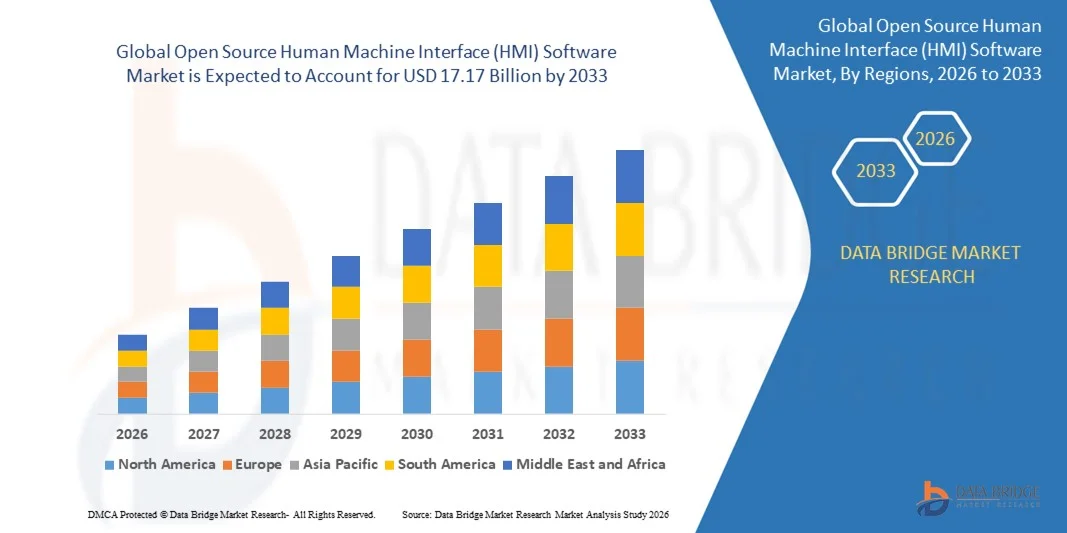
- As per Data Bridge Market Research Analysis the global open source human machine interface (HMI) software market size was valued at USD 8.30 billion in 2025 and is expected to reach USD 17.17 billion by 2033, at a CAGR of 9.50% during the forecast period
- The market growth is largely fuelled by the increasing adoption of automation across industrial sectors, the rising need for real-time monitoring and control systems, and the growing preference for customizable, cost-effective software solutions
- In addition, rapid advancements in IoT, Industry 4.0, and smart manufacturing technologies are driving the demand for open source HMI platforms that enable seamless integration with various industrial devices and protocols
Market Size & Forecast
- Global Market Value (2025): USD 8.30 billion
- Expected Market Value (2033): USD 17.17 billion
- Forecast CAGR (2026–2033): 9.50%
What are the Major Takeaways of Open Source Human Machine Interface (HMI) Software Market?
- The market is witnessing significant adoption across manufacturing, energy and utilities, automotive, and process industries due to the flexibility, scalability, and interoperability offered by open source HMI solutions
- Integration with cloud platforms and industrial IoT systems is becoming a key trend, enabling predictive maintenance, remote monitoring, and improved decision-making capabilities
- North America dominated the open source HMI software market with the largest revenue share of 38.75% in 2025, driven by the growing adoption of industrial automation and increasing awareness of connected manufacturing solutions
- Asia-Pacific region is expected to witness the highest growth rate in the global open source human machine interface (HMI) software market, driven by increasing industrial automation, government-supported digital transformation programs, rising adoption of IoT-enabled manufacturing systems, and expansion of smart factory initiatives in countries such as China, Japan, and India
- The Stand-Alone HMI segment held the largest market revenue share in 2025 driven by its flexibility in integration with multiple industrial devices and advanced visualization capabilities, making it widely adopted across various industrial operations
Report Scope and Open Source Human Machine Interface (HMI) Software Market Segmentation
|
Attributes |
Open Source Human Machine Interface (HMI) Software Key Market Insights |
|
Segments Covered |
|
|
Countries Covered |
North America
Europe
Asia-Pacific
Middle East and Africa
South America
|
|
Key Market Players |
|
|
Market Opportunities |
|
|
Value Added Data Infosets |
In addition to the market insights such as market value, growth rate, market segments, geographical coverage, market players, and market scenario, the market report curated by the Data Bridge Market Research team includes in-depth expert analysis, import/export analysis, pricing analysis, production consumption analysis, and pestle analysis. |
What is the Key Trend in the Open Source Human Machine Interface (HMI) Software Market?
Rising Adoption of Open Source Platforms and Industrial Automation
- The growing focus on automation, IoT integration, and cost-effective software solutions is significantly shaping the open source HMI software market, as manufacturers increasingly prefer platforms that are flexible, scalable, and community-driven. Open source HMI solutions are gaining traction due to their ability to enable real-time monitoring, customization, and seamless integration with industrial devices without heavy licensing costs. This trend strengthens their adoption across manufacturing, energy, and process industries, encouraging vendors to innovate with new interfaces and modules that cater to evolving operational needs
- Increasing awareness around smart manufacturing, predictive maintenance, and operational efficiency has accelerated the demand for open source HMI software in automotive, food & beverage, and chemical industries. Enterprises are actively seeking solutions that improve visibility, reduce downtime, and provide remote monitoring capabilities, prompting collaborations between software developers and industrial operators to enhance functionality and user experience
- Open source, scalability, and interoperability trends are influencing purchasing decisions, with companies emphasizing ease of integration, reduced implementation costs, and strong developer community support. These factors help vendors differentiate their products in a competitive market and build customer trust, while also driving adoption of modular, customizable HMI solutions
- For instance, in 2024, Siemens in Germany and Rockwell Automation in the U.S. expanded their HMI software portfolios by introducing open source modules and cloud-compatible interfaces for smart factories. These launches were introduced in response to increasing demand for flexible, scalable, and cost-efficient control systems, with deployment across industrial plants and automation projects. The products were also marketed as enabling interoperability and real-time analytics, enhancing client efficiency and repeat adoption
- While adoption of open source HMI software is growing, sustained market expansion depends on continuous R&D, cybersecurity, and maintaining performance comparable to proprietary alternatives. Vendors are also focusing on improving integration capabilities, ensuring cross-platform support, and developing innovative interfaces that balance functionality, cost, and scalability for broader industrial use
Open Source Human Machine Interface (HMI) Software Market Dynamics
Driver
Growing Preference for Flexible, Cost-Effective, and Scalable Control Solutions
- Rising demand for open source platforms and flexible interfaces is a major driver for the HMI software market. Manufacturers are increasingly deploying open source HMI solutions to reduce licensing costs, enable customization, and improve operational efficiency. This trend is also encouraging development of modular software components compatible with multiple industrial protocols, supporting system diversification
- Expanding applications across automotive, manufacturing, energy, and process industries are influencing market growth. Open source HMI software helps improve real-time monitoring, control, and analytics capabilities, enabling companies to meet operational efficiency goals and digital transformation objectives
- Software developers are actively promoting open source HMI solutions through product innovation, training, and community support. These efforts are supported by growing awareness of smart manufacturing, industrial IoT, and Industry 4.0 initiatives, and they also encourage partnerships between vendors and industrial operators to enhance functionality and reduce integration costs
- For instance, in 2023, ABB in Switzerland and Mitsubishi Electric in Japan reported increased deployment of open source HMI platforms for manufacturing and process automation projects. This expansion followed higher demand for modular, interoperable, and low-cost solutions, driving repeat adoption and system upgrades. Both companies highlighted cybersecurity, flexibility, and ease of integration in marketing campaigns to strengthen customer confidence
- Although rising automation and cost-conscious trends support growth, wider adoption depends on cybersecurity compliance, compatibility with legacy systems, and skilled personnel to deploy and maintain solutions. Investment in training, integration tools, and advanced interface development will be critical for meeting global demand and maintaining competitive advantage
Restraint/Challenge
Integration Complexity and Cybersecurity Concerns
- Complexity in integrating open source HMI solutions with existing industrial systems remains a key challenge, limiting adoption among manufacturers with legacy infrastructure. Compatibility issues, protocol differences, and system customization requirements contribute to slower deployment
- Cybersecurity concerns are increasingly critical, as open source platforms may be more vulnerable to cyber threats if not properly managed. Industrial operators must implement robust security protocols and regular software updates to mitigate risks, which can increase operational costs
- Limited awareness of functional benefits and technical capabilities restricts adoption across certain industries. Smaller enterprises may be hesitant to deploy open source solutions due to perceived implementation complexity or lack of internal expertise
- For instance, in 2024, manufacturers in India and Brazil reported slower uptake of open source HMI software for energy and process automation projects due to integration challenges and security concerns. Additional training and IT support were necessary to ensure safe and effective implementation, which delayed broader adoption
- Overcoming these challenges will require enhanced cybersecurity measures, simplified integration tools, and educational initiatives for industrial operators. Collaboration with training providers, system integrators, and community developers can help unlock the long-term growth potential of the global open source HMI software market. Moreover, developing user-friendly interfaces and robust support systems will be essential for widespread adoption
How is the Open Source Human Machine Interface (HMI) Software Market Segmented?
The market is segmented on the basis of configuration type, type, deployment, application, end user, and technology
- By Configuration Type
On the basis of configuration type, the open source HMI software market is segmented into Stand-Alone HMI and Embedded HMI. The Stand-Alone HMI segment held the largest market revenue share in 2025 driven by its flexibility in integration with multiple industrial devices and advanced visualization capabilities, making it widely adopted across various industrial operations.
The Embedded HMI segment is expected to witness the fastest growth rate from 2026 to 2033, driven by its seamless integration with machinery and controllers, making it ideal for compact devices and real-time localized control. Embedded HMIs are particularly popular for their space-saving design and reliable performance in automated industrial environments.
- By Type
On the basis of type, the market is segmented into Machine-Level and Supervisory. The Supervisory segment held the largest market revenue share in 2025 driven by its capability to monitor and control multiple processes simultaneously, making it essential for large-scale industrial operations.
The Machine-Level segment is expected to witness the fastest growth rate from 2026 to 2033, driven by its increasing adoption in smart manufacturing for localized control and real-time monitoring of individual machines. Machine-Level HMIs are particularly popular for their simplicity and efficiency in on-site industrial processes.
- By Deployment
On the basis of deployment, the market is segmented into On-Premises and Cloud-Based. The On-Premises segment held the largest market revenue share in 2025 driven by the strong preference for data security and control over critical industrial operations, making it the preferred choice for traditional industries.
The Cloud-Based segment is expected to witness the fastest growth rate from 2026 to 2033, driven by its scalability and remote monitoring capabilities, making it ideal for IoT-connected industrial setups. Cloud-Based HMIs are particularly popular for their flexibility and cost-effectiveness in modern industrial automation.
- By Application
On the basis of application, the market is segmented into Oil and Gas, Energy and Power, Food and Beverages, Metals and Mining, Aerospace and Defence, and Others. The Energy and Power segment held the largest market revenue share in 2025 driven by the critical need for reliable monitoring and process optimization in the sector, making it essential for operational efficiency.
The Food and Beverages segment is expected to witness the fastest growth rate from 2026 to 2033, driven by increasing automation in processing lines and regulatory compliance requirements. Food and Beverage applications are particularly popular for their need for precise control and real-time monitoring.
- By End User
On the basis of end user, the market is segmented into Process Industries and Discrete Industries. The Process Industries segment held the largest market revenue share in 2025 driven by the need for continuous monitoring and control in sectors such as chemicals, oil and gas, and power generation, making it critical for operational safety
The Discrete Industries segment is expected to witness the fastest growth rate from 2026 to 2033, driven by increasing adoption in automotive, electronics, and machinery manufacturing. Discrete Industries applications are particularly popular for their flexibility and integration with smart manufacturing systems.
- By Technology
On the basis of technology, the market is segmented into Optical, Acoustic, Bionic, Tactile, and Motion. The Optical segment held the largest market revenue share in 2025 driven by its high accuracy and reliability in visualization and gesture recognition, making it widely used across industrial applications.
The Motion segment is expected to witness the fastest growth rate from 2026 to 2033, driven by the growing demand for touchless interfaces and automation in smart factories. Motion-based HMIs are particularly popular for their innovative interaction methods and enhanced operational efficiency.
Which Region Holds the Largest Share of the Open Source Human Machine Interface (HMI) Software Market?
- North America dominated the open source HMI software market with the largest revenue share of 38.75% in 2025, driven by the growing adoption of industrial automation and increasing awareness of connected manufacturing solutions
- Companies and end users in the region highly value the flexibility, customization, and real-time monitoring capabilities offered by open source HMI software across multiple industrial applications
- This widespread adoption is further supported by high technological readiness, strong R&D investments, and the rising preference for scalable, cost-effective control solutions, establishing open source HMI software as a preferred choice for both process and discrete industries
U.S. open source HMI software market insight
The U.S. market captured the largest revenue share in 2025 within North America, fueled by rapid adoption of smart manufacturing technologies and the expanding trend of digital factories. End users are increasingly prioritizing real-time monitoring, predictive maintenance, and seamless integration with industrial IoT platforms. The growing use of cloud-enabled and modular HMI solutions, combined with demand for highly customizable interfaces, further drives market growth. Moreover, integration with automation systems such as SCADA and PLCs is significantly contributing to the market expansion.
Europe open source HMI software market insight
The Europe market is expected to witness the fastest growth rate from 2026 to 2033, primarily driven by stringent regulatory standards and the rising need for energy-efficient and secure industrial operations. Increasing urbanization, modernization of industrial facilities, and demand for connected manufacturing solutions are fostering adoption. European end users are also drawn to the flexibility, interoperability, and open architecture provided by open source HMI software, supporting its integration across both new and existing facilities.
U.K. open source HMI software market insight
The U.K. market is expected to witness the fastest growth rate from 2026 to 2033, driven by the expanding trend of smart factories and the growing emphasis on operational efficiency and safety. In addition, the need for easy-to-deploy, customizable HMI solutions is encouraging adoption among industrial and commercial users. The U.K.’s advanced industrial ecosystem, combined with robust digital infrastructure, is expected to continue supporting market growth
Germany open source HMI software market insight
The Germany market is expected to witness the fastest growth rate from 2026 to 2033, fueled by increasing focus on Industry 4.0 initiatives and demand for sustainable, technology-driven manufacturing solutions. Germany’s strong industrial base, innovation-focused ecosystem, and emphasis on automation encourage adoption, particularly in automotive, energy, and manufacturing sectors. Integration with advanced control systems and predictive analytics is also becoming increasingly prevalent, aligning with local requirements for efficiency and security.
Asia-Pacific open source HMI software market insight
The Asia-Pacific market is expected to witness the fastest growth rate from 2026 to 2033, driven by rapid industrialization, rising investment in smart manufacturing, and increasing adoption of automation technologies in countries such as China, Japan, and India. The region’s growing focus on digital transformation, supported by government initiatives and industrial IoT adoption, is propelling market growth. Furthermore, as APAC emerges as a hub for manufacturing HMI solutions, cost-effective and scalable open source software options are expanding across industries.
Japan open source HMI software market insight
The Japan market is expected to witness the fastest growth rate from 2026 to 2033 due to the country’s high-tech industrial culture, strong emphasis on automation, and growing demand for operational efficiency. Japanese end users prioritize reliability, integration with existing manufacturing systems, and ease of use. The adoption of open source HMI software is further supported by smart factory initiatives and integration with IoT-enabled devices, ensuring real-time monitoring and control in both discrete and process industries.
China open source HMI software market insight
The China market accounted for the largest revenue share in Asia-Pacific in 2025, attributed to rapid industrialization, widespread digitalization, and increasing adoption of advanced manufacturing technologies. China is one of the largest markets for industrial automation solutions, and open source HMI software is gaining popularity in manufacturing, energy, and process industries. Government-led smart factory initiatives, availability of cost-effective solutions, and a strong domestic software ecosystem are key factors driving market growth.
Which are the Top Companies in Open Source Human Machine Interface (HMI) Software Market?
The Open Source Human Machine Interface (HMI) Software industry is primarily led by well-established companies, including:
- General Electric (U.S.)
- Rockwell Automation, Inc. (U.S.)
- Schneider Electric (France)
- Siemens (Germany)
- Adroit Technologies (Malaysia)
- Beijer Electronics (Sweden)
- BrainChild Electronic Co., Ltd. (Taiwan)
- Ing. Punzenberger COPA-DATA GmbH (Austria)
- Elipse Software (Brazil)
- Inductive Automation (U.S.)
- NATIONAL INSTRUMENTS CORP. (U.S.)
- ABB (Switzerland)
- Advantech Co., Ltd. (Taiwan)
- Emerson Electric Co. (U.S.)
- Honeywell (U.S.)
- Mitsubishi Electric Corporation (Japan)
- Yokogawa Electric Corporation (Japan)
- VALEO (France)
- Spectris (U.K.)
- Kontron (Germany)

- Interactive Data Analysis Dashboard
- Company Analysis Dashboard for high growth potential opportunities
- Research Analyst Access for customization & queries
- Competitor Analysis with Interactive dashboard
- Latest News, Updates & Trend analysis
- Harness the Power of Benchmark Analysis for Comprehensive Competitor Tracking
Data collection and base year analysis are done using data collection modules with large sample sizes. The stage includes obtaining market information or related data through various sources and strategies. It includes examining and planning all the data acquired from the past in advance. It likewise envelops the examination of information inconsistencies seen across different information sources. The market data is analysed and estimated using market statistical and coherent models. Also, market share analysis and key trend analysis are the major success factors in the market report. To know more, please request an analyst call or drop down your inquiry.
The key research methodology used by DBMR research team is data triangulation which involves data mining, analysis of the impact of data variables on the market and primary (industry expert) validation. Data models include Vendor Positioning Grid, Market Time Line Analysis, Market Overview and Guide, Company Positioning Grid, Patent Analysis, Pricing Analysis, Company Market Share Analysis, Standards of Measurement, Global versus Regional and Vendor Share Analysis. To know more about the research methodology, drop in an inquiry to speak to our industry experts.
Data Bridge Market Research is a leader in advanced formative research. We take pride in servicing our existing and new customers with data and analysis that match and suits their goal. The report can be customized to include price trend analysis of target brands understanding the market for additional countries (ask for the list of countries), clinical trial results data, literature review, refurbished market and product base analysis. Market analysis of target competitors can be analyzed from technology-based analysis to market portfolio strategies. We can add as many competitors that you require data about in the format and data style you are looking for. Our team of analysts can also provide you data in crude raw excel files pivot tables (Fact book) or can assist you in creating presentations from the data sets available in the report.













