


Global Optical Emission Spectroscopy Market
Market Size in USD Million
CAGR :
% 
 USD
779.50 Million
USD
1,320.41 Million
2025
2033
USD
779.50 Million
USD
1,320.41 Million
2025
2033
 Forecast Period Forecast Period |
2026 –2033 |
 Market Size (Base Year) Market Size (Base Year) |
USD 779.50 Million |
 Market Size (Forecast Year) Market Size (Forecast Year) |
USD 1,320.41 Million |
 CAGR CAGR |
% |
| Major Markets Players |
|
Optical Emission Spectroscopy Market Size
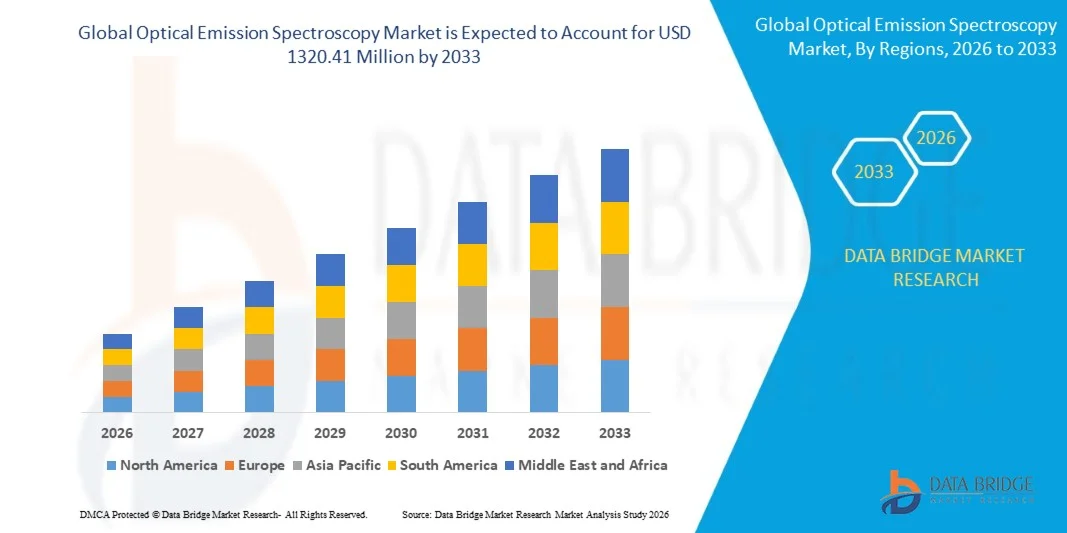
- The global optical emission spectroscopy market size was valued at USD 779.5 million in 2025 and is expected to reach USD 1320.41 million by 2033, at a CAGR of 6.81% during the forecast period
- The market growth is largely fueled by the increasing demand for precise and reliable elemental analysis across industries such as metals, automotive, aerospace, and environmental testing, where quality control and regulatory compliance are critical
- Furthermore, rapid industrialization, advancements in analytical technologies, and the growing need for real-time material verification are establishing optical emission spectroscopy as a preferred solution for accurate and efficient material characterization. These converging factors are accelerating the adoption of OES systems, thereby significantly boosting the market growth
Optical Emission Spectroscopy Market Analysis
- Optical emission spectroscopy is an analytical technique used to determine the elemental composition of materials by measuring the emitted light from excited atoms. It is widely utilized in industrial laboratories and production environments for applications such as alloy identification, quality assurance, and trace element detection
- The escalating demand for OES systems is primarily driven by the need for high-precision testing, increasing regulatory standards, and the expansion of manufacturing activities, along with the growing emphasis on automation and efficiency in material analysis processes
- North America dominated the optical emission spectroscopy market with a share of 43.4% in 2025, due to strong demand from metals, aerospace, and automotive industries for precise elemental analysis and quality control
- Asia-Pacific is expected to be the fastest growing region in the optical emission spectroscopy market during the forecast period due to rapid industrialization, increasing manufacturing activities, and rising investments in quality control infrastructure
- Benchtop segment dominated the market with a market share of 72.43% in 2025, due to their high accuracy, robust performance, and suitability for high-throughput industrial laboratories. These systems are widely used in metals and automotive industries for precise alloy analysis and regulatory compliance testing, cementing their market leadership
Report Scope and Optical Emission Spectroscopy Market Segmentation
|
Attributes |
Optical Emission Spectroscopy Key Market Insights |
|
Segments Covered |
|
|
Countries Covered |
North America
Europe
Asia-Pacific
Middle East and Africa
South America
|
|
Key Market Players |
|
|
Market Opportunities |
|
|
Value Added Data Infosets |
In addition to the insights on market scenarios such as market value, growth rate, segmentation, geographical coverage, and major players, the market reports curated by the Data Bridge Market Research also include in-depth expert analysis, geographically represented company-wise production and capacity, network layouts of distributors and partners, detailed and updated price trend analysis and deficit analysis of supply chain and demand. |
Optical Emission Spectroscopy Market Trends
“Rising Adoption of Portable and On-Site Optical Emission Spectroscopy Solutions”
- A significant trend in the optical emission spectroscopy market is the growing adoption of portable and on-site OES systems, driven by the increasing need for real-time material analysis and rapid decision-making across industries such as metals, scrap recycling, and heavy machinery. This shift is positioning portable OES solutions as essential tools for field-based testing and immediate quality verification
- For instance, Hitachi High-Tech Corporation offers portable OES analyzers that enable on-site alloy identification and elemental analysis in industrial and recycling environments. These solutions enhance operational efficiency by eliminating delays associated with laboratory testing and supporting faster inspection workflows
- Industries are increasingly deploying portable OES systems to improve flexibility in quality control processes, especially in applications where materials must be verified before processing or shipment. This capability reduces the risk of material mismatch and enhances overall production reliability
- The demand for decentralized testing solutions is rising as industries seek to minimize downtime and improve responsiveness in dynamic operational settings. Portable OES instruments support this requirement by delivering accurate results without the need for complex laboratory infrastructure
- Advancements in miniaturization, battery efficiency, and user-friendly interfaces are further strengthening the adoption of portable OES devices across diverse industrial applications. These improvements are making high-performance spectroscopy more accessible to a broader range of users
- The increasing preference for mobility, efficiency, and real-time analysis is reinforcing this trend, positioning portable OES solutions as a key driver of innovation and adoption in the global market
Optical Emission Spectroscopy Market Dynamics
Driver
“Increasing Demand for High-Precision Elemental Analysis”
- The rising need for accurate and reliable elemental composition analysis across industries such as automotive, aerospace, and metals is driving the demand for optical emission spectroscopy systems. These industries rely on precise material characterization to ensure product quality, safety, and compliance with stringent regulatory standards
- For instance, Thermo Fisher Scientific provides advanced OES instruments that are widely used for high-precision elemental analysis in manufacturing and environmental laboratories. These solutions enable industries to achieve consistent quality control and meet regulatory requirements with greater efficiency
- The expansion of advanced manufacturing processes is increasing the requirement for detailed material verification to maintain performance standards and reduce defects. OES systems support this need by delivering rapid and accurate analytical results across a wide range of materials
- Industries are increasingly integrating automated quality control systems where OES plays a critical role in ensuring consistency and reducing human error in testing procedures. This integration enhances productivity and supports scalable manufacturing operations
- The continuous need for reliable, efficient, and precise material analysis is reinforcing this driver, positioning optical emission spectroscopy as a critical technology for modern industrial and laboratory applications
Restraint/Challenge
“High Initial Cost and Operational Complexity of OES Systems”
- The optical emission spectroscopy market faces challenges due to the high initial investment required for acquiring advanced OES instruments, which can limit adoption among small and medium-sized enterprises. These systems involve significant capital expenditure, making cost a critical barrier for market expansion
- For instance, Bruker Corporation develops high-end OES systems that require substantial investment and technical expertise for installation and operation. These requirements can restrict adoption in cost-sensitive industries and emerging markets
- Operating OES systems demands skilled personnel and specialized training to ensure accurate results and proper maintenance, adding to the overall operational complexity. This requirement increases dependency on technical expertise and raises long-term operational costs
- The maintenance and calibration of OES instruments involve recurring expenses and require adherence to strict quality standards, which can further burden end users. These factors contribute to higher total cost of ownership over the lifecycle of the equipment
- The combination of high costs and operational challenges continues to restrain market growth, compelling manufacturers to focus on developing cost-effective and user-friendly solutions to expand accessibility and adoption
Optical Emission Spectroscopy Market Scope
The market is segmented on the basis of offering, form factor, excitation source type, detector type, and end user.
- By Offering
On the basis of offering, the Optical Emission Spectroscopy market is segmented into equipment and services. The equipment segment dominated the largest market revenue share in 2025, driven by the increasing demand for advanced OES instruments across industrial and research applications. Industries such as metals, automotive, and aerospace prefer high-precision OES equipment for accurate elemental analysis and quality control, reinforcing its dominance in the market. Equipment offerings also benefit from technological advancements, enabling faster, more reliable, and automated measurements, which further boosts adoption.
The services segment is anticipated to witness the fastest growth from 2026 to 2033, fueled by the growing need for maintenance, calibration, and analytical services. For instance, companies such as Thermo Fisher Scientific provide on-site OES maintenance and training services, which enhance operational efficiency for end users. Services also allow smaller laboratories and emerging markets to access OES capabilities without heavy upfront investment, driving market expansion.
- By Form Factor
On the basis of form factor, the OES market is segmented into benchtop and portable systems. Benchtop OES systems dominated the largest market revenue share of 72.43% in 2025, owing to their high accuracy, robust performance, and suitability for high-throughput industrial laboratories. These systems are widely used in metals and automotive industries for precise alloy analysis and regulatory compliance testing, cementing their market leadership. Benchtop systems also offer integration with automated sample handling and data management software, which adds operational efficiency for large-scale laboratories.
The portable form factor is expected to witness the fastest growth from 2026 to 2033, driven by the need for on-site elemental analysis and rapid quality checks. For instance, Hitachi High-Tech provides portable OES devices used in scrap yards and field inspections, enabling real-time decision-making. Portability, ease of use, and reduced dependency on laboratory infrastructure make this segment increasingly attractive for decentralized operations.
- By Excitation Source Type
On the basis of excitation source type, the OES market is segmented into Arc/Spark Optical Emission Spectroscopy and Inductively Coupled Plasma (ICP) Optical Emission Spectroscopy. Arc/Spark OES dominated the largest market revenue share in 2025 due to its efficiency in analyzing solid metallic samples and high relevance in metals and heavy machinery industries. These systems provide rapid, reproducible results for alloy composition and trace element detection, which are critical for quality control and regulatory compliance. Arc/Spark OES also benefits from cost-effectiveness compared to ICP systems, further reinforcing its market position.
ICP-OES is anticipated to witness the fastest growth from 2026 to 2033, fueled by its versatility in analyzing a wide range of liquid and trace samples with high sensitivity. For instance, PerkinElmer’s ICP-OES instruments are widely adopted in environmental testing and chemical laboratories for precise multi-element analysis. Its growing adoption in pharmaceuticals, environmental monitoring, and advanced research sectors drives the segment’s rapid expansion.
- By Detector Type
On the basis of detector type, the OES market is segmented into Photomultiplier Tube (PMT), Solid State Detector (SSD), and Hybrid detectors. PMT-based systems dominated the largest market revenue share in 2025 due to their high sensitivity, wide dynamic range, and established reliability in elemental detection for metals and industrial labs. PMTs provide precise measurements even at low concentration levels, which makes them highly suitable for critical quality control applications. Strong OEM support and continued technological improvements maintain PMT’s dominance in the market.
SSD detectors are expected to witness the fastest growth from 2026 to 2033, driven by their compact design, lower maintenance requirements, and enhanced integration with modern analytical instruments. For instance, Bruker’s SSD-equipped OES instruments are increasingly adopted in portable and benchtop devices for faster and robust measurements. SSD technology enables high-speed data acquisition and better energy efficiency, making it attractive for modern laboratories and field applications.
- By End User
On the basis of end user, the OES market serves a wide range of industries, including metals and heavy machinery, oil and gas, automotive, scrap and recycling, aerospace and defence, chemicals, pharmaceuticals and life sciences, power generation, food and beverages, environmental, and others. The metals and heavy machinery segment dominated the largest market revenue share in 2025, driven by the critical need for alloy analysis, quality control, and compliance with industry standards. High-volume production, regulatory scrutiny, and strong integration of OES instruments into metallurgical processes reinforce its leadership in the regional and global market.
The automotive segment is anticipated to witness the fastest growth from 2026 to 2033, fueled by rising demand for lightweight alloys, advanced material testing, and emissions compliance. For instance, Hexagon Manufacturing Intelligence provides OES solutions for automotive manufacturers to analyze steel and aluminum alloys efficiently. The expansion of electric vehicle production and increasing material complexity accelerate the adoption of OES instruments in the automotive sector, driving rapid segment growth.
Optical Emission Spectroscopy Market Regional Analysis
- North America dominated the optical emission spectroscopy market with the largest revenue share of 43.24% in 2025, driven by strong demand from metals, aerospace, and automotive industries for precise elemental analysis and quality control
- Industries in the region emphasize advanced analytical technologies to ensure compliance with stringent regulatory standards and maintain product quality across manufacturing processes
- This widespread adoption is further supported by high R&D investments, presence of leading analytical instrument manufacturers, and strong focus on industrial automation, establishing OES systems as essential tools across laboratories and production facilities
U.S. Optical Emission Spectroscopy Market Insight
The U.S. optical emission spectroscopy market captured the largest revenue share within North America in 2025, fueled by extensive use in aerospace, automotive, and oil and gas industries for material verification and quality assurance. Industries are increasingly adopting advanced OES systems to meet strict regulatory requirements and enhance operational efficiency. The growing integration of automation and digital technologies in manufacturing processes further accelerates demand for high-performance spectroscopy solutions across industrial and research applications.
Europe Optical Emission Spectroscopy Market Insight
The Europe optical emission spectroscopy market is projected to expand at a substantial CAGR throughout the forecast period, primarily driven by stringent environmental and quality regulations across manufacturing sectors. The increasing demand for material testing and compliance verification in automotive and heavy machinery industries is fostering adoption of OES systems. The region is witnessing strong growth across industrial laboratories and research institutions, with increasing focus on precision, sustainability, and technological advancement.
U.K. Optical Emission Spectroscopy Market Insight
The U.K. optical emission spectroscopy market is anticipated to grow at a noteworthy CAGR during the forecast period, driven by rising demand for advanced material testing solutions in aerospace, automotive, and academic research sectors. The growing emphasis on quality assurance and regulatory compliance is encouraging industries to adopt high-precision analytical instruments. The country’s strong research ecosystem and expanding industrial base are expected to continue supporting market growth.
Germany Optical Emission Spectroscopy Market Insight
The Germany optical emission spectroscopy market is expected to expand at a considerable CAGR during the forecast period, fueled by the country’s strong manufacturing base and focus on industrial quality standards. Germany’s leadership in automotive and heavy machinery production drives consistent demand for accurate elemental analysis technologies. The integration of advanced spectroscopy solutions into automated production lines and quality control systems further strengthens market expansion.
Asia-Pacific Optical Emission Spectroscopy Market Insight
The Asia-Pacific optical emission spectroscopy market is poised to grow at the fastest CAGR during the forecast period of 2026 to 2033, driven by rapid industrialization, increasing manufacturing activities, and rising investments in quality control infrastructure. The region's growing focus on metals, automotive, and electronics manufacturing is accelerating the adoption of OES systems. Furthermore, expanding industrial bases and improving technological capabilities are making advanced spectroscopy solutions more accessible across emerging economies.
Japan Optical Emission Spectroscopy Market Insight
The Japan optical emission spectroscopy market is gaining momentum due to the country’s advanced manufacturing sector and strong emphasis on precision engineering. The adoption of OES systems is driven by the need for high-quality material analysis in automotive, electronics, and industrial applications. The integration of advanced analytical technologies into research and production processes is further fueling market growth across the country.
China Optical Emission Spectroscopy Market Insight
The China optical emission spectroscopy market accounted for the largest market revenue share in Asia Pacific in 2025, attributed to rapid industrialization, expanding metals and heavy machinery sectors, and strong manufacturing capabilities. China represents a major hub for industrial production, where OES systems are widely used for quality control and compliance testing. The growing focus on technological advancement and increasing adoption of advanced analytical instruments continue to drive market expansion in the country.
Optical Emission Spectroscopy Market Share
The optical emission spectroscopy industry is primarily led by well-established companies, including:
- Thermo Fisher Scientific Inc. (U.S.)
- Horiba, Ltd. (Japan)
- Hitachi High-Technologies Corporation (Japan)
- Bruker Corporation (U.S.)
- Shimadzu Corporation (Japan)
- AMETEK Inc. (U.S.)
- Skyray Instrument Inc. (China)
- Teledyne Leeman Labs, Inc. (U.S.)
- PerkinElmer, Inc. (U.S.)
- Agilent Technologies (U.S.)
- Analytik Jena (Germany)
- GBC Scientific Equipment Pty Ltd (Australia)
- SGS SA (Switzerland)
- Bureau Veritas SA (France)
- Intertek Group plc (U.K.)
- TÜV SÜD (Germany)
- Element Materials Technology Ltd. (U.K.)
- TÜV Rheinland (Germany)
Latest Developments in Global Optical Emission Spectroscopy Market
- In April 2024, Thermo Fisher Scientific introduced a new semi-quantitative analysis instrument for inductively coupled plasma optical emission spectroscopy, aimed at simplifying the identification of unknown samples and enhancing analytical efficiency. This development strengthens the company’s position in advanced elemental analysis while supporting faster decision-making across environmental, industrial, and research applications, thereby accelerating adoption of ICP-OES technologies in quality control and sustainability-focused operations
- In March 2024, SPECTRO Analytical Instruments launched the latest version of its SPECTROMAXx arc/spark OES analyzer, designed to deliver improved repeatability, reproducibility, and reliability in material control analysis. This advancement enhances operational accuracy across the supply chain, reinforcing demand for high-performance OES systems in metals and manufacturing industries and supporting stricter quality compliance requirements
- In February 2024, Hitachi High-Tech Corporation expanded its portfolio of optical emission spectroscopy solutions with upgraded portable OES systems featuring enhanced detection capabilities and user-friendly interfaces. This development improves on-site material verification and real-time analysis, enabling industries such as scrap recycling and heavy machinery to adopt faster and more flexible testing solutions, thereby boosting market penetration of portable OES devices
- In October 2023, Agilent Technologies enhanced its ICP-OES product line with improved automation features and integrated software capabilities for streamlined workflows. This innovation increases laboratory productivity and reduces operational complexity, encouraging wider adoption of advanced spectroscopy solutions across pharmaceuticals, environmental testing, and research institutions, ultimately driving market growth
- In August 2021, HORIBA Scientific collaborated with Covalent Metrology to establish a North American demonstration lab at Covalent’s Silicon Valley headquarters. This initiative strengthens customer engagement and hands-on evaluation of spectroscopy technologies, accelerating technology adoption and expanding market reach through enhanced accessibility and application-based demonstrations
SKU-
Get online access to the report on the World's First Market Intelligence Cloud

- Interactive Data Analysis Dashboard
- Company Analysis Dashboard for high growth potential opportunities
- Research Analyst Access for customization & queries
- Competitor Analysis with Interactive dashboard
- Latest News, Updates & Trend analysis
- Harness the Power of Benchmark Analysis for Comprehensive Competitor Tracking
Global Optical Emission Spectroscopy Market, Supply Chain Analysis and Ecosystem Framework
To support market growth and help clients navigate the impact of geopolitical shifts, DBMR has integrated in-depth supply chain analysis into its Global Optical Emission Spectroscopy Market research reports. This addition empowers clients to respond effectively to global changes affecting their industries. The supply chain analysis section includes detailed insights such as Global Optical Emission Spectroscopy Market consumption and production by country, price trend analysis, the impact of tariffs and geopolitical developments, and import and export trends by country and HSN code. It also highlights major suppliers with data on production capacity and company profiles, as well as key importers and exporters. In addition to research, DBMR offers specialized supply chain consulting services backed by over a decade of experience, providing solutions like supplier discovery, supplier risk assessment, price trend analysis, impact evaluation of inflation and trade route changes, and comprehensive market trend analysis.
Research Methodology
Data collection and base year analysis are done using data collection modules with large sample sizes. The stage includes obtaining market information or related data through various sources and strategies. It includes examining and planning all the data acquired from the past in advance. It likewise envelops the examination of information inconsistencies seen across different information sources. The market data is analysed and estimated using market statistical and coherent models. Also, market share analysis and key trend analysis are the major success factors in the market report. To know more, please request an analyst call or drop down your inquiry.
The key research methodology used by DBMR research team is data triangulation which involves data mining, analysis of the impact of data variables on the market and primary (industry expert) validation. Data models include Vendor Positioning Grid, Market Time Line Analysis, Market Overview and Guide, Company Positioning Grid, Patent Analysis, Pricing Analysis, Company Market Share Analysis, Standards of Measurement, Global versus Regional and Vendor Share Analysis. To know more about the research methodology, drop in an inquiry to speak to our industry experts.
Customization Available
Data Bridge Market Research is a leader in advanced formative research. We take pride in servicing our existing and new customers with data and analysis that match and suits their goal. The report can be customized to include price trend analysis of target brands understanding the market for additional countries (ask for the list of countries), clinical trial results data, literature review, refurbished market and product base analysis. Market analysis of target competitors can be analyzed from technology-based analysis to market portfolio strategies. We can add as many competitors that you require data about in the format and data style you are looking for. Our team of analysts can also provide you data in crude raw excel files pivot tables (Fact book) or can assist you in creating presentations from the data sets available in the report.












