


Global Optical Preclinical Imaging Market
Market Size in USD Million
CAGR :
% 
 USD
485.16 Million
USD
716.80 Million
2025
2033
USD
485.16 Million
USD
716.80 Million
2025
2033
 Forecast Period Forecast Period |
2026 –2033 |
 Market Size (Base Year) Market Size (Base Year) |
USD 485.16 Million |
 Market Size (Forecast Year) Market Size (Forecast Year) |
USD 716.80 Million |
 CAGR CAGR |
% |
| Major Markets Players |
|
Optical Preclinical Imaging Market Size
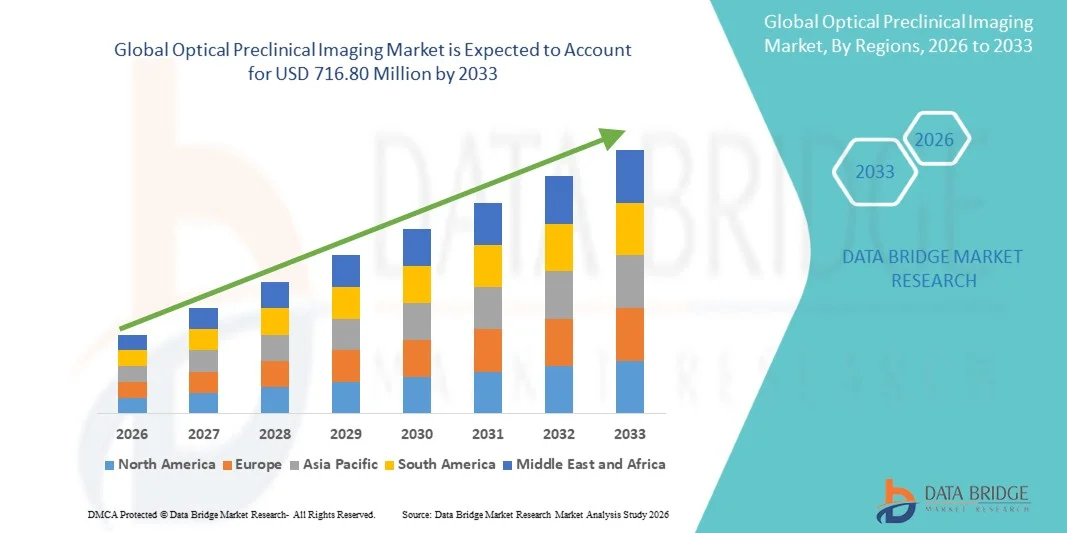
- The global optical preclinical imaging market size was valued at USD 485.16 Million in 2025 and is expected to reach USD 716.80 Million by 2033, at a CAGR of 5.00% during the forecast period
- The market growth is largely fueled by the increasing adoption of advanced imaging technologies in life science research and the continuous technological progress in molecular and optical imaging systems, leading to enhanced efficiency and precision in preclinical studies across pharmaceutical, biotechnology, and academic research settings
- Furthermore, rising demand for non-invasive, high-resolution, and real-time imaging solutions for disease modeling, drug discovery, and translational research is establishing optical preclinical imaging as a preferred tool in modern biomedical research. These converging factors are accelerating the uptake of Optical Preclinical Imaging solutions, thereby significantly boosting the industry's growth
Optical Preclinical Imaging Market Analysis
- Optical Preclinical Imaging systems, offering non-invasive visualization and monitoring of biological processes in small animal models, are increasingly vital components of modern biomedical research and drug development workflows across pharmaceutical, biotechnology, and academic institutions due to their ability to deliver real-time, high-resolution molecular and functional insights
- The escalating demand for Optical Preclinical Imaging is primarily fueled by rising investments in life science research, growing emphasis on early-stage drug discovery, increasing use of personalized medicine approaches, and a strong preference for efficient in vivo imaging methods that reduce study timelines and improve research accuracy
- North America dominated the optical preclinical imaging market with the largest revenue share of approximately 41.3% in 2025, characterized by strong research funding, advanced healthcare and laboratory infrastructure, and the presence of leading industry players, with the U.S. experiencing substantial growth in preclinical imaging installations driven by increasing pharmaceutical R&D and translational medicine initiatives
- Asia-Pacific is expected to be the fastest growing region in the optical preclinical imaging market during the forecast period due to increasing healthcare research expenditure, rapid expansion of biotechnology sectors, growing CRO activities, and rising investments in research infrastructure across China, India, Japan, and South Korea
- The device segment dominated the largest market revenue share of 46.8% in 2025, driven by the growing installation of advanced imaging systems across pharmaceutical companies, biotechnology firms, and academic research centers
Report Scope and Optical Preclinical Imaging Market Segmentation
|
Attributes |
Optical Preclinical Imaging Key Market Insights |
|
Segments Covered |
|
|
Countries Covered |
North America
Europe
Asia-Pacific
Middle East and Africa
South America
|
|
Key Market Players |
|
|
Market Opportunities |
|
|
Value Added Data Infosets |
In addition to the insights on market scenarios such as market value, growth rate, segmentation, geographical coverage, and major players, the market reports curated by the Data Bridge Market Research also include in-depth expert analysis, patient epidemiology, pipeline analysis, pricing analysis, and regulatory framework. |
Optical Preclinical Imaging Market Trends
“Enhanced Research Efficiency Through AI Integration and Multimodal Imaging Platforms”
- A significant and accelerating trend in the global Optical Preclinical Imaging market is the growing integration of artificial intelligence (AI), machine learning analytics, and multimodal imaging systems that combine optical imaging with CT, MRI, PET, or ultrasound technologies. This convergence is significantly improving imaging accuracy, workflow efficiency, and translational research outcomes
- AI-powered image analysis tools are increasingly being used to automate tumor segmentation, quantify fluorescence intensity, and identify subtle biological changes in preclinical studies
- For instance, PerkinElmer’s IVIS imaging platforms incorporate advanced software analytics to support automated bioluminescence signal quantification and longitudinal disease monitoring in small animal models
- The rising adoption of multimodal imaging systems is enabling researchers to combine anatomical and molecular data in a single workflow, improving disease characterization and drug development efficiency
- Another notable trend is the increasing use of real-time in vivo optical imaging in oncology, neurology, and infectious disease studies, allowing researchers to track disease progression and therapeutic response non-invasively. For instance, academic research centers are widely using Bruker’s optical imaging systems for monitoring tumor growth and metastatic spread in mouse models
- In addition, cloud-connected imaging software and digital data management platforms are streamlining collaboration among research institutes, pharmaceutical companies, and CROs by enabling remote access, data sharing, and centralized study analysis
- This shift toward intelligent, automated, and integrated imaging systems is fundamentally reshaping preclinical research, driving demand for faster, more precise, and reproducible imaging solutions
Optical Preclinical Imaging Market Dynamics
Driver
“Growing Demand for Non-Invasive Imaging in Drug Discovery and Disease Research”
- The increasing demand for non-invasive imaging technologies in biomedical research, drug discovery, and disease model studies is a major driver for the Optical Preclinical Imaging market. These systems enable researchers to monitor biological processes in real time without sacrificing laboratory animals
- Rising pharmaceutical and biotechnology R&D investments are further accelerating adoption of optical preclinical imaging systems across global research facilities
- For instance, leading drug developers such as Pfizer, Roche, and Novartis use preclinical imaging technologies during oncology and immunology research to evaluate treatment efficacy in animal models
- Optical imaging systems offer advantages such as high sensitivity, lower operating cost, rapid image acquisition, and the ability to perform repeated longitudinal studies, making them highly attractive in translational research
- Furthermore, the growing prevalence of cancer, neurological disorders, and infectious diseases is increasing the need for advanced imaging tools capable of supporting early-stage therapeutic development
- Government funding for life sciences research, along with expansion of CRO services and academic laboratory infrastructure, is also contributing significantly to market growth
Restraint/Challenge
“High Equipment Costs and Technical Limitations in Deep Tissue Imaging”
- One of the major challenges restraining the growth of the Optical Preclinical Imaging market is the high capital cost associated with advanced imaging instruments, software platforms, and maintenance requirements, particularly for smaller laboratories and universities
- Budget limitations in developing regions often restrict adoption of premium optical imaging systems
- For instance, many academic institutes in parts of Latin America, Africa, and Southeast Asia rely on shared imaging facilities due to the high procurement cost of standalone bioluminescence or fluorescence imaging platforms
- Optical imaging also faces technical limitations related to light scattering and limited tissue penetration depth, which can reduce image clarity when studying deeper internal organs or structures
- In addition, the need for skilled personnel to operate imaging equipment, interpret data, and manage animal study protocols can create operational challenges for new users
- Overcoming these barriers through cost-effective system development, improved imaging probes, enhanced software automation, and broader research funding support will be essential for sustained market growth
Optical Preclinical Imaging Market Scope
The market is segmented on the basis of product type and end-use.
• By Product Type
On the basis of product type, the Optical Preclinical Imaging market is segmented into device, consumables, bioluminescence, and software. The device segment dominated the largest market revenue share of 46.8% in 2025, driven by the growing installation of advanced imaging systems across pharmaceutical companies, biotechnology firms, and academic research centers. Devices such as multimodal imaging platforms, fluorescence imaging systems, PET/SPECT scanners, and CT systems are widely adopted for in vivo small animal imaging studies. Their ability to provide high-resolution anatomical and functional data supports drug discovery and disease model research. Continuous technological advancements, including hybrid imaging platforms and AI-enabled image processing, further strengthen segment demand. The rising need for non-invasive longitudinal imaging methods also encourages replacement of conventional laboratory techniques with advanced devices. Moreover, increasing R&D expenditure and funding for translational research are supporting new installations globally. The presence of major manufacturers offering innovative platforms with enhanced sensitivity and faster imaging workflows also contributes to segment leadership. Demand remains strong in both developed and emerging markets due to expanding biomedical research infrastructure.
The software segment is anticipated to witness the fastest growth rate of 8.9% from 2026 to 2033, fueled by rising demand for advanced image analysis, data quantification, and workflow automation solutions. Imaging software enables researchers to process complex datasets, generate 3D reconstructions, and perform real-time visualization of biological processes. Increasing adoption of cloud-based platforms and AI-powered analytics is improving efficiency and accuracy in preclinical studies. Software solutions also support multimodal data integration from PET, MRI, CT, and optical imaging systems, enhancing decision-making in drug development. Growing emphasis on reducing study timelines and improving reproducibility is driving laboratories toward digital image management tools. Subscription-based software models are making these platforms more accessible to smaller institutions. In addition, regulatory requirements for structured data documentation and traceability are accelerating demand. As imaging datasets continue to grow in complexity and volume, software is becoming an essential component of modern preclinical imaging workflows worldwide.
• By End-Use
On the basis of end-use, the Optical Preclinical Imaging market is segmented into pharma and biotech companies, research institutes, and others. The pharma and biotech companies segment held the largest market revenue share of 52.4% in 2025, driven by increasing use of optical preclinical imaging in drug discovery, oncology studies, toxicology testing, and biomarker development. Pharmaceutical and biotechnology companies heavily invest in imaging technologies to accelerate candidate screening and monitor therapeutic responses in animal models. Optical imaging enables non-invasive and repeated observations, reducing animal usage and improving study efficiency. Growing pipelines for cancer, neurological, and immunology therapies are further increasing imaging demand. These organizations also benefit from faster turnaround times, better translational outcomes, and lower research costs through advanced imaging integration. Strategic collaborations between imaging technology providers and biopharma companies are supporting new product adoption. In addition, rising investments in precision medicine and biologics research are expanding usage across major markets. The presence of strong R&D budgets and continuous innovation keeps this segment dominant globally.
The research institutes segment is expected to witness the fastest CAGR of 9.4% from 2026 to 2033, driven by increasing government grants, academic collaborations, and expansion of life science research infrastructure. Universities and independent research centers are adopting optical preclinical imaging for studies related to cancer biology, infectious diseases, stem cell tracking, and regenerative medicine. Growing emphasis on translational research is encouraging institutes to invest in advanced imaging systems for faster scientific outcomes. Public-private partnerships are also enabling access to sophisticated platforms that were previously limited to commercial laboratories. Rising interest in personalized medicine and genomics research further supports demand for imaging-based validation tools. Many institutes are integrating multimodal imaging capabilities to improve experimental precision and publication quality. Emerging economies are witnessing rapid development of biomedical research hubs, adding to future demand. As funding availability and scientific innovation continue to rise, research institutes are expected to become a key high-growth end-user segment in the coming years.
Optical Preclinical Imaging Market Regional Analysis
- North America dominated the Optical Preclinical Imaging market with the largest revenue share of approximately 41.3% in 2025, driven by strong research funding, advanced healthcare infrastructure, and the presence of major biotechnology and imaging technology companies. The region benefits from well-established pharmaceutical and life sciences industries that continuously invest in drug discovery and translational medicine. Increasing adoption of multimodal imaging systems in preclinical studies is supporting market expansion
- Universities and research institutes across the region are heavily utilizing optical imaging systems for oncology, neurology, and cardiovascular research. Strong collaboration between academia and private companies further accelerates innovation. Favorable regulatory pathways and high R&D expenditure also contribute to market leadershipGrowing demand for non-invasive imaging techniques in animal studies is enhancing product adoption. Rising focus on precision medicine and biomarker discovery is further strengthening growth. Continuous technological advancements in fluorescence and bioluminescence imaging systems are sustaining North America’s dominant position.
U.S. Optical Preclinical Imaging Market Insight
The U.S. optical preclinical imaging market captured the largest revenue share in 2025 within North America, fueled by increasing pharmaceutical R&D spending and strong translational medicine initiatives. The country hosts a large number of pharmaceutical firms, biotechnology companies, and academic medical centers actively engaged in preclinical research. Rising investments in oncology and immunology drug development are boosting demand for advanced imaging systems. Government funding through research grants and innovation programs is supporting laboratory modernization. The growing use of real-time imaging for disease progression studies is accelerating adoption. Presence of leading manufacturers and continuous product launches further strengthen the market. Increasing CRO activities and contract research partnerships are also driving installations. Demand for high-throughput imaging solutions in drug screening remains strong. Expansion of precision medicine programs continues to propel market growth across the U.S.
Europe Optical Preclinical Imaging Market Insight
Europe optical preclinical imaging market held a significant share of the Optical Preclinical Imaging market with around 29.4% in 2025, supported by robust academic research networks and government-funded innovation programs. The region benefits from expanding biotechnology activities across Germany, the U.K., and France. Strong emphasis on early-stage drug development and translational research is increasing demand for optical imaging platforms. Research institutions are adopting advanced fluorescence and bioluminescence systems for disease modeling applications. Favorable funding from the European Union and national healthcare agencies supports continuous technology upgrades. Rising collaboration between universities and life sciences companies is further driving innovation. Increasing focus on personalized medicine and cancer research strengthens market demand. The presence of highly developed healthcare systems supports laboratory investments. Growth in CRO services and biotechnology startups is contributing to wider market penetration. Continuous advancements in imaging software and analytics are supporting regional expansion.
U.K. Optical Preclinical Imaging Market Insight
The U.K. optical preclinical imaging market is anticipated to grow at a noteworthy CAGR during the forecast period, driven by increasing biomedical research activities and strong university-based innovation ecosystems. The country has a well-established pharmaceutical sector investing heavily in preclinical drug development. Rising demand for non-invasive imaging tools in neuroscience and oncology studies is supporting growth. Government grants and public-private partnerships are helping laboratories adopt modern imaging systems. Increasing translational medicine initiatives are further boosting installations. The presence of world-renowned research institutions strengthens market prospects. Growing CRO activity and contract testing demand are also supporting expansion. Adoption of AI-integrated imaging analytics is improving research efficiency. Continuous innovation in life sciences is expected to sustain long-term market growth.
Germany Optical Preclinical Imaging Market Insight
The Germany optical preclinical imaging market is expected to expand at a considerable CAGR during the forecast period, fueled by strong biotechnology capabilities and advanced research infrastructure. Germany’s emphasis on scientific innovation and medical technology development supports high adoption of optical imaging systems. Increasing use of preclinical imaging in oncology, metabolic disease, and neuroscience research is driving demand. Presence of leading universities and pharmaceutical companies enhances market opportunities. Government-backed R&D initiatives are supporting modernization of research laboratories. Rising partnerships between academic institutions and biotech firms are accelerating innovation. Demand for precision research tools and imaging automation is increasing steadily. Germany’s leadership in engineering and instrumentation also strengthens product development. Continuous investment in translational medicine supports sustained market expansion.
Asia Pacific Optical Preclinical Imaging Market Insight
Asia-Pacific optical preclinical imaging market is expected to be the fastest growing region in the Optical Preclinical Imaging market during the forecast period, driven by increasing healthcare research expenditure and rapid biotechnology sector expansion. Rising CRO activities and growing investments in research infrastructure across China, India, Japan, and South Korea are accelerating market growth. Expanding pharmaceutical manufacturing and drug discovery activities are increasing demand for advanced imaging technologies. Governments across the region are promoting life sciences innovation and domestic R&D capabilities. Growing academic collaborations with global pharmaceutical companies are supporting technology adoption. Increasing incidence of chronic diseases is boosting biomedical research activities. Improved affordability of imaging systems and rising local manufacturing are widening accessibility. Expanding medical universities and research institutes further strengthen demand. Continuous technological modernization is expected to sustain the region’s fastest CAGR through 2033.
Japan Optical Preclinical Imaging Market Insight
The Japan optical preclinical imaging market is gaining momentum due to the country’s strong technology ecosystem, aging population, and advanced biomedical research capabilities. Japan places high emphasis on innovation in regenerative medicine, oncology, and neuroscience, creating strong demand for optical imaging systems. Increasing use of non-invasive imaging in translational studies is supporting adoption. Presence of major healthcare technology companies and research institutions strengthens market growth. Government funding for life sciences innovation continues to encourage modernization of laboratories. Integration of AI and robotics into imaging workflows is improving research productivity. Rising pharmaceutical R&D investment is further accelerating installations. Growing collaboration between academia and private companies supports continuous innovation. Japan’s focus on precision healthcare is expected to sustain long-term market expansion.
China Optical Preclinical Imaging Market Insight
The China optical preclinical imaging market accounted for the largest market revenue share in Asia Pacific in 2025, attributed to rapid biotechnology growth, expanding healthcare investments, and strong government support for scientific research. China is one of the fastest-growing pharmaceutical and life sciences markets globally, creating substantial demand for preclinical imaging technologies. Increasing CRO activity and rising domestic drug development programs are supporting adoption. The push toward innovation-led healthcare reforms is encouraging installation of advanced laboratory systems. Growing number of research institutes and universities is expanding the customer base. Presence of domestic imaging manufacturers is improving affordability and accessibility. Rising oncology and immunology research programs are further driving market demand. Increasing collaboration with international biotech companies strengthens technology transfer. Continuous expansion of research infrastructure is expected to maintain China’s leadership in the regional market.
Optical Preclinical Imaging Market Share
The Optical Preclinical Imaging industry is primarily led by well-established companies, including:
- PerkinElmer Inc. (U.S.)
- Bruker Corporation (U.S.)
- Revvity, Inc. (U.S.)
- Miltenyi Biotec (Germany)
- Fujifilm VisualSonics Inc. (Canada)
- Mediso Ltd. (Hungary)
- Aspect Imaging (Israel)
- MR Solutions Ltd. (U.K.)
- LI-COR Biosciences (U.S.)
- Bio-Rad Laboratories, Inc. (U.S.)
- Agilent Technologies, Inc. (U.S.)
- Thermo Fisher Scientific Inc. (U.S.)
- Siemens Healthineers AG (Germany)
- Canon Medical Systems Corporation (Japan)
- Shimadzu Corporation (Japan)
- TriFoil Imaging (U.S.)
- Scanco Medical AG (Switzerland)
- Zeiss Group (Germany)
- Sartorius AG (Germany)
- Promega Corporation (U.S.)
Latest Developments in Global Optical Preclinical Imaging Market
- In February 2023, Fact.MR announced that the global optical preclinical imaging market was valued at approximately USD 612 million in 2023 and forecast to expand at a CAGR of 6.5% through 2033. The study emphasized growing use of optical imaging systems in animal studies for drug development and therapy-response monitoring, reflecting increasing reliance on in-vivo molecular imaging technologies
- In February 2024, Bruker Corporation acquired Spectral Instruments Imaging, a specialist in advanced in-vivo optical imaging systems. The acquisition significantly strengthened Bruker’s preclinical imaging portfolio by adding optical imaging capabilities used in oncology, infectious disease, and drug discovery research, while complementing its existing multimodal imaging solutions
- In October 2024, MBF Bioscience unveiled SLICE, an affordable light sheet microscope developed in collaboration with Columbia University. The new platform was designed to broaden access to advanced imaging tools for laboratories of varying sizes and budgets, supporting high-resolution preclinical research and tissue imaging applications
SKU-
Get online access to the report on the World's First Market Intelligence Cloud

- Interactive Data Analysis Dashboard
- Company Analysis Dashboard for high growth potential opportunities
- Research Analyst Access for customization & queries
- Competitor Analysis with Interactive dashboard
- Latest News, Updates & Trend analysis
- Harness the Power of Benchmark Analysis for Comprehensive Competitor Tracking
Research Methodology
Data collection and base year analysis are done using data collection modules with large sample sizes. The stage includes obtaining market information or related data through various sources and strategies. It includes examining and planning all the data acquired from the past in advance. It likewise envelops the examination of information inconsistencies seen across different information sources. The market data is analysed and estimated using market statistical and coherent models. Also, market share analysis and key trend analysis are the major success factors in the market report. To know more, please request an analyst call or drop down your inquiry.
The key research methodology used by DBMR research team is data triangulation which involves data mining, analysis of the impact of data variables on the market and primary (industry expert) validation. Data models include Vendor Positioning Grid, Market Time Line Analysis, Market Overview and Guide, Company Positioning Grid, Patent Analysis, Pricing Analysis, Company Market Share Analysis, Standards of Measurement, Global versus Regional and Vendor Share Analysis. To know more about the research methodology, drop in an inquiry to speak to our industry experts.
Customization Available
Data Bridge Market Research is a leader in advanced formative research. We take pride in servicing our existing and new customers with data and analysis that match and suits their goal. The report can be customized to include price trend analysis of target brands understanding the market for additional countries (ask for the list of countries), clinical trial results data, literature review, refurbished market and product base analysis. Market analysis of target competitors can be analyzed from technology-based analysis to market portfolio strategies. We can add as many competitors that you require data about in the format and data style you are looking for. Our team of analysts can also provide you data in crude raw excel files pivot tables (Fact book) or can assist you in creating presentations from the data sets available in the report.












