




Global Organ Transplantation Market
Market Size in USD Billion
CAGR :
% 
 USD
23.69 Billion
USD
48.46 Billion
2025
2033
USD
23.69 Billion
USD
48.46 Billion
2025
2033
 Forecast Period Forecast Period |
2026 –2033 |
 Market Size (Base Year) Market Size (Base Year) |
USD 23.69 Billion |
 Market Size (Forecast Year) Market Size (Forecast Year) |
USD 48.46 Billion |
 CAGR CAGR |
% |
| Major Markets Players |
|
Organ Transplantation Market Size
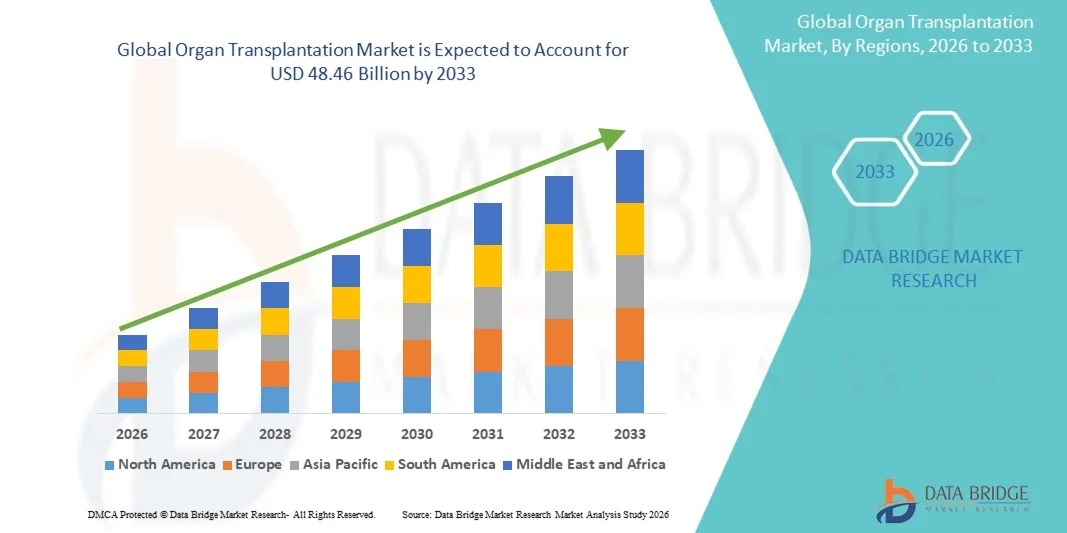
- The global organ transplantation market size was valued at USD 23.69 billion in 2025 and is expected to reach USD 48.46 billion by 2033, at a CAGR of 9.36% during the forecast period
- The market growth is largely fueled by the increasing prevalence of organ failure and chronic diseases, along with advancements in surgical techniques and transplant technologies, leading to improved success rates and greater adoption of organ transplantation procedures across healthcare systems
- Furthermore, rising awareness about organ donation, supportive government initiatives, and the growing demand for effective treatment options for end-stage organ diseases are establishing organ transplantation as a critical component of modern healthcare. These converging factors are accelerating the uptake of Organ Transplantation solutions, thereby significantly boosting the industry's growth
Organ Transplantation Market Analysis
- Organ transplantation, involving the surgical replacement of failing or damaged organs with healthy donor organs, is an increasingly vital component of modern healthcare systems due to its life-saving potential and growing advancements in transplant procedures and post-operative care
- The escalating demand for organ transplantation is primarily fueled by the rising prevalence of chronic diseases such as kidney failure, liver cirrhosis, and heart diseases, along with increasing awareness regarding organ donation and improvements in healthcare infrastructure
- North America dominated the organ transplantation market with the largest revenue share of approximately 37.4% in 2025, characterized by advanced healthcare systems, high adoption of transplant procedures, and strong presence of specialized transplant centers, with the U.S. witnessing substantial growth driven by favorable reimbursement policies and increasing donor registrations
- Asia-Pacific is expected to be the fastest growing region in the organ transplantation market during the forecast period, with a projected CAGR of around 9.8%, due to improving healthcare infrastructure, rising medical tourism, increasing awareness of organ donation, and growing patient population
- The allograft segment accounted for the largest market revenue share of 67.5% in 2025, driven by its widespread use in organ transplantation involving donors and recipients from the same species
Report Scope and Organ Transplantation Market Segmentation
|
Attributes |
Organ Transplantation Key Market Insights |
|
Segments Covered |
|
|
Countries Covered |
North America
Europe
Asia-Pacific
Middle East and Africa
South America
|
|
Key Market Players |
|
|
Market Opportunities |
|
|
Value Added Data Infosets |
In addition to the insights on market scenarios such as market value, growth rate, segmentation, geographical coverage, and major players, the market reports curated by the Data Bridge Market Research also include in-depth expert analysis, patient epidemiology, pipeline analysis, pricing analysis, and regulatory framework. |
Organ Transplantation Market Trends
“Advancements in Transplant Technologies and Growing Adoption of Precision Medicine”
- A significant and accelerating trend in the global organ transplantation market is the advancement of transplant technologies and the increasing integration of precision medicine to improve patient outcomes and graft survival rates
- For instance, organizations such as United Network for Organ Sharing and companies like TransMedics are developing advanced organ preservation and transportation systems, such as ex vivo organ perfusion technologies, to enhance transplant success rates
- Innovations in immunosuppressive therapies and tissue matching techniques are reducing the risk of organ rejection and improving long-term survival outcomes for transplant recipients
- In addition, the use of genomic and immunological profiling is enabling better donor-recipient matching, thereby increasing the efficiency and success of transplantation procedures
- The growing adoption of minimally invasive surgical techniques and robotic-assisted transplant procedures is further improving recovery times and patient outcomes
- This trend toward technologically advanced and patient-centric transplant solutions is reshaping the Organ Transplantation market, driving innovation across surgical procedures, preservation methods, and post-transplant care
Organ Transplantation Market Dynamics
Driver
“Rising Prevalence of Organ Failure and Increasing Demand for Transplant Procedures”
- The increasing incidence of chronic diseases leading to organ failure, such as kidney, liver, and heart diseases, is a major driver fueling the growth of the organ transplantation market globally
- For instance, according to World Health Organization, the growing burden of non-communicable diseases is significantly increasing the demand for organ replacement therapies worldwide
- The rising aging population, which is more susceptible to organ failure and related complications, is further contributing to the increased need for transplant procedures
- In addition, improvements in healthcare infrastructure and surgical techniques have enhanced the success rates of organ transplants, encouraging more patients to opt for these procedures
- Increasing awareness about organ donation and supportive government initiatives are also playing a crucial role in expanding the donor pool and facilitating transplant procedures
- Furthermore, advancements in post-transplant care and immunosuppressive drugs are improving patient survival rates, thereby boosting market growth
Restraint/Challenge
“Shortage of Donor Organs and High Cost of Transplant Procedures”
- One of the major challenges in the Organ Transplantation market is the significant gap between the demand for organs and their availability, leading to long waiting lists and limited access to transplantation
- For instance, organizations such as Global Observatory on Donation and Transplantation highlight the persistent shortage of donor organs despite increasing demand worldwide
- The high cost associated with organ transplantation procedures, including surgery, hospitalization, and long-term post-transplant care, can limit accessibility, especially in low- and middle-income regions
- Ethical and legal complexities related to organ donation, including consent and allocation policies, also pose challenges to market growth
- In addition, the risk of organ rejection and complications after transplantation requires continuous medical monitoring and expensive immunosuppressive therapies
- Addressing these challenges through improved donor awareness programs, policy reforms, technological advancements, and cost optimization strategies will be essential for sustaining growth in the Organ Transplantation market
Organ Transplantation Market Scope
The market is segmented on the basis of product type, application, type of transplant, treatment, and end user.
• By Product Type
On the basis of product type, the Organ Transplantation market is segmented into organ preservation products, transplant diagnostics, immunosuppressant drugs, tissue products, and others. The immunosuppressant drugs segment dominated the largest market revenue share of 41.6% in 2025, driven by their critical role in preventing organ rejection post-transplantation. These drugs are essential for long-term graft survival, making them a cornerstone of transplant procedures. The increasing number of organ transplant surgeries globally significantly fuels demand for immunosuppressants. Advancements in drug formulations with improved efficacy and reduced side effects further support segment growth. In addition, strong clinical adoption and continuous patient dependence on these medications ensure steady revenue generation. Pharmaceutical companies are investing heavily in developing next-generation immunosuppressants. Rising awareness regarding post-transplant care also contributes to higher adoption rates. Favorable reimbursement policies in developed regions further strengthen the segment. The growing aging population and prevalence of chronic diseases increase transplant demand. Continuous innovation and pipeline drugs support future expansion. These factors collectively sustain the dominance of the immunosuppressant drugs segment.
The transplant diagnostics segment is expected to witness the fastest CAGR of 9.8% from 2026 to 2033, driven by the increasing need for accurate donor-recipient matching and early detection of organ rejection. Diagnostic tools such as histocompatibility testing and molecular assays play a crucial role in improving transplant success rates. The rising adoption of precision medicine and genetic testing significantly supports segment growth. Technological advancements in diagnostic platforms enhance accuracy and turnaround time. Increasing awareness among healthcare providers regarding early diagnosis further boosts demand. The segment benefits from growing investments in healthcare infrastructure and laboratory capabilities. Expansion of transplant programs globally also drives diagnostic requirements. In addition, the integration of AI and data analytics improves diagnostic outcomes. The demand for non-invasive monitoring techniques is further accelerating growth. These factors collectively position transplant diagnostics as the fastest-growing segment.
• By Application
On the basis of application, the Organ Transplantation market is segmented into kidney, liver, heart, pancreas, and others. The kidney segment held the largest market revenue share of 48.3% in 2025, driven by the high prevalence of chronic kidney diseases and end-stage renal disorders worldwide. Kidney transplantation is one of the most commonly performed transplant procedures due to the increasing burden of diabetes and hypertension. The availability of both living and deceased donors further supports segment growth. In addition, advancements in surgical techniques and post-operative care improve patient outcomes. Government initiatives promoting organ donation significantly boost transplant rates. The segment also benefits from increasing awareness about kidney health and treatment options. Favorable reimbursement policies in several regions enhance accessibility. Rising investments in transplant infrastructure further support growth. Continuous innovation in immunosuppressive therapies improves graft survival rates. These factors ensure the dominance of the kidney segment.
The liver segment is anticipated to witness the fastest CAGR of 10.2% from 2026 to 2033, fueled by the rising incidence of liver diseases such as cirrhosis and hepatitis. Increasing alcohol consumption and lifestyle-related disorders are major contributing factors. Liver transplantation remains a critical treatment option for end-stage liver disease. Advancements in surgical procedures and donor management enhance success rates. Growing awareness about liver health and early diagnosis supports demand. The segment benefits from expanding transplant programs in emerging economies. Technological innovations in organ preservation further improve outcomes. Increasing availability of skilled surgeons and healthcare facilities drives growth. Government support for organ donation campaigns also contributes to expansion. Rising research in regenerative medicine strengthens future prospects. These combined factors position liver transplantation as the fastest-growing application segment.
• By Type of Transplant
On the basis of type of transplant, the Organ Transplantation market is segmented into autograft, allograft, and others. The allograft segment accounted for the largest market revenue share of 67.5% in 2025, driven by its widespread use in organ transplantation involving donors and recipients from the same species. Allografts are the most common type used in kidney, liver, and heart transplants. The increasing availability of donor organs through organ donation programs significantly supports segment growth. Advances in immunosuppressive therapies reduce rejection risks, enhancing adoption. The segment also benefits from strong clinical success rates and established medical protocols. Growing awareness and acceptance of organ donation further drive demand. Government initiatives promoting organ donation contribute to segment expansion. Improvements in organ preservation and transportation enhance transplant efficiency. Rising prevalence of chronic diseases increases the need for allografts. Continuous advancements in transplantation techniques further support growth. These factors ensure the dominance of the allograft segment.
The autograft segment is projected to witness the fastest CAGR of 8.7% from 2026 to 2033, driven by its lower risk of immune rejection and complications. Autografts involve transplanting tissues within the same individual, making them highly compatible. The increasing use of autografts in reconstructive surgeries and tissue repair supports segment growth. Advancements in surgical techniques and regenerative medicine enhance outcomes. The segment benefits from reduced dependency on donor availability. Growing adoption in orthopedic and cosmetic procedures further boosts demand. In addition, rising awareness about minimally invasive procedures contributes to growth. Technological innovations in tissue engineering support segment expansion. Increasing healthcare expenditure and access to advanced treatments further drive adoption. Research in stem cell therapies also enhances future potential. These factors collectively position autografts as the fastest-growing segment.
• By Treatment
On the basis of treatment, the Organ Transplantation market is segmented into analgesic, immunosuppressant, and others. The immunosuppressant segment dominated the largest market revenue share of 52.4% in 2025, driven by its essential role in preventing transplant rejection and ensuring long-term graft survival. These treatments are mandatory for transplant recipients, resulting in sustained demand. Continuous advancements in drug development improve efficacy and safety profiles. The increasing number of transplant procedures globally significantly boosts segment growth. Pharmaceutical companies are focusing on developing targeted and personalized immunosuppressive therapies. Rising awareness regarding post-transplant care supports higher adoption rates. Favorable reimbursement policies enhance accessibility in developed regions. The segment also benefits from strong clinical guidelines recommending immunosuppressant use. Increasing prevalence of chronic diseases further drives transplant demand. Ongoing research and innovation strengthen the treatment landscape. These factors ensure the continued dominance of the immunosuppressant segment.
The analgesic segment is expected to witness the fastest CAGR of 8.3% from 2026 to 2033, driven by the growing need for effective pain management during and after transplant procedures. Analgesics play a crucial role in improving patient comfort and recovery outcomes. The increasing number of complex surgical procedures supports segment demand. Advancements in pain management therapies enhance treatment effectiveness. The segment benefits from rising awareness regarding patient-centric care. In addition, the development of safer and non-opioid analgesics is driving adoption. Increasing focus on reducing hospital stays further supports demand. Growing healthcare infrastructure and access to advanced treatments boost segment growth. Integration of multimodal pain management approaches enhances outcomes. Continuous innovation in drug formulations further supports expansion. These factors collectively position analgesics as the fastest-growing treatment segment.
• By End User
On the basis of end user, the Organ Transplantation market is segmented into hospitals, transplant centers, and others. The hospitals segment accounted for the largest market revenue share of 44.9% in 2025, driven by the availability of advanced infrastructure and multidisciplinary expertise required for transplant procedures. Hospitals serve as primary centers for organ transplantation surgeries and post-operative care. The presence of skilled surgeons and specialized medical teams supports segment growth. Increasing patient inflow and rising prevalence of chronic diseases further boost demand. Hospitals also benefit from strong reimbursement frameworks and government funding. Integration of advanced technologies enhances surgical precision and outcomes. The segment is supported by expanding healthcare infrastructure globally. Growing collaborations with research institutions further strengthen capabilities. Continuous investments in hospital facilities drive growth. These factors ensure the dominance of hospitals in the market.
The transplant centers segment is projected to witness the fastest CAGR of 9.1% from 2026 to 2033, driven by their specialized focus on organ transplantation procedures. Transplant centers offer dedicated services, improving efficiency and success rates. The increasing establishment of specialized centers globally supports segment growth. Rising demand for high-quality and specialized care contributes to adoption. These centers often provide comprehensive pre- and post-transplant care. Technological advancements and skilled professionals enhance treatment outcomes. Growing awareness about organ donation drives patient inflow. The segment benefits from partnerships with hospitals and research institutions. Increasing investments in specialized healthcare facilities further boost growth. Expansion in emerging markets supports future opportunities. These factors collectively position transplant centers as the fastest-growing end-user segment.
Organ Transplantation Market Regional Analysis
- North America dominated the organ transplantation market with the largest revenue share of approximately 37.4% in 2025, characterized by advanced healthcare systems, high adoption of transplant procedures, and a strong presence of specialized transplant centers
- The region benefits from well-established organ donation frameworks, increasing donor registrations, and advanced surgical and post-transplant care practices
- This widespread adoption is further supported by favorable reimbursement policies, strong regulatory support, and continuous advancements in transplant technologies, establishing organ transplantation as a critical component of modern healthcare
U.S. Organ Transplantation Market Insight
The U.S. organ transplantation market captured the largest revenue share in 2025 within North America, driven by increasing donor registrations and favorable reimbursement policies. The country’s advanced healthcare infrastructure and strong presence of specialized transplant centers are fueling market growth. In addition, rising prevalence of chronic diseases leading to organ failure and increasing awareness about organ donation are significantly contributing to the expansion of the market in the U.S.
Europe Organ Transplantation Market Insight
The Europe organ transplantation market is projected to expand at a substantial CAGR throughout the forecast period, primarily driven by well-established healthcare systems and supportive government policies promoting organ donation. The region is witnessing increasing adoption of advanced transplant procedures and technologies. In addition, rising awareness regarding organ donation and strong regulatory frameworks are supporting steady market growth across Europe.
U.K. Organ Transplantation Market Insight
The U.K. organ transplantation market is anticipated to grow at a noteworthy CAGR during the forecast period, driven by increasing public awareness campaigns and government initiatives encouraging organ donation. The country is experiencing rising demand for transplant procedures due to the growing burden of chronic diseases. Furthermore, advancements in surgical techniques and post-transplant care are contributing to market expansion in the U.K.
Germany Organ Transplantation Market Insight
The Germany organ transplantation market is expected to expand at a considerable CAGR during the forecast period, fueled by a strong healthcare infrastructure and increasing focus on medical innovation. Germany’s emphasis on high-quality healthcare services and advanced medical technologies is promoting the adoption of organ transplantation procedures. In addition, increasing awareness and improvements in donor management systems are supporting market growth.
Asia-Pacific Organ Transplantation Market Insight
The Asia-Pacific Organ Transplantation market is expected to be the fastest-growing region during the forecast period, with a projected CAGR of around 9.8%, driven by improving healthcare infrastructure, rising medical tourism, and increasing awareness of organ donation. The region is witnessing rapid growth due to a large patient population, rising prevalence of chronic diseases, and expanding access to advanced medical treatments. Furthermore, increasing government initiatives and healthcare investments in countries such as China, India, and Japan are accelerating the adoption of organ transplantation procedures
Japan Organ Transplantation Market Insight
The Japan organ transplantation market is gaining momentum due to the country’s aging population and increasing demand for advanced medical treatments. The growing prevalence of chronic diseases and organ failure is driving the need for transplantation procedures. In addition, advancements in medical technologies and increasing awareness about organ donation are contributing to market growth in Japan.
China Organ Transplantation Market Insight
The China organ transplantation market accounted for the largest market revenue share in Asia-Pacific in 2025, attributed to improving healthcare infrastructure, increasing government support, and a growing patient population. The country is witnessing rising awareness regarding organ donation and increasing adoption of advanced transplant technologies. In addition, expanding healthcare investments and the presence of large medical institutions are key factors propelling the growth of the organ transplantation market in China.
Organ Transplantation Market Share
The Organ Transplantation industry is primarily led by well-established companies, including:
- Novartis AG (Switzerland)
- F. Hoffmann-La Roche Ltd. (Switzerland)
- Pfizer Inc. (U.S.)
- Sanofi S.A. (France)
- Bristol-Myers Squibb Company (U.S.)
- AbbVie Inc. (U.S.)
- Thermo Fisher Scientific Inc. (U.S.)
- Medtronic plc (Ireland)
- Stryker Corporation (U.S.)
- Zimmer Biomet Holdings, Inc. (U.S.)
- Veloxis Pharmaceuticals A/S (Denmark)
- Astellas Pharma Inc. (Japan)
- Dr. Franz Köhler Chemie GmbH (Germany)
- XVIVO Perfusion AB (Sweden)
- OrganOx Limited (U.K.)
- CareDx, Inc. (U.S.)
- TransMedics Group, Inc. (U.S.)
- BioLife Solutions, Inc. (U.S.)
- Teva Pharmaceutical Industries Ltd. (Israel)
- CSL Limited (Australia)
Latest Developments in Global Organ Transplantation Market
- In January 2022, surgeons at the University of Maryland successfully performed the world’s first transplant of a genetically modified pig heart into a human patient. This groundbreaking xenotransplantation procedure marked a major milestone in addressing global organ shortages by demonstrating the potential of animal-to-human organ transplants
- In October 2022, researchers at NYU Langone Health conducted a successful transplantation of gene-edited pig kidneys into a brain-dead human recipient, demonstrating normal function without immediate rejection. This development further validated xenotransplantation as a viable future solution for overcoming donor organ scarcity
- In July 2025, researchers reported new techniques to preserve donor hearts after circulatory death, enabling successful transplantation even after the heart has stopped beating. This advancement expands the availability of donor hearts and improves transplant success rates by maintaining organ quality
- In November 2025, researchers at Stanford University developed an artificial intelligence-based tool to improve organ transplant efficiency by predicting donor viability, reducing failed transplant attempts by up to 60%. This innovation enhances decision-making in organ allocation and helps optimize resource utilization in transplant procedures
- In July 2025, the U.S. Department of Health and Human Services initiated major reforms in the organ transplantation system following investigations into donor safety and procedural practices. The reforms aim to improve transparency, safety protocols, and data reporting within the organ procurement and transplantation network
SKU-
Get online access to the report on the World's First Market Intelligence Cloud

- Interactive Data Analysis Dashboard
- Company Analysis Dashboard for high growth potential opportunities
- Research Analyst Access for customization & queries
- Competitor Analysis with Interactive dashboard
- Latest News, Updates & Trend analysis
- Harness the Power of Benchmark Analysis for Comprehensive Competitor Tracking
Research Methodology
Data collection and base year analysis are done using data collection modules with large sample sizes. The stage includes obtaining market information or related data through various sources and strategies. It includes examining and planning all the data acquired from the past in advance. It likewise envelops the examination of information inconsistencies seen across different information sources. The market data is analysed and estimated using market statistical and coherent models. Also, market share analysis and key trend analysis are the major success factors in the market report. To know more, please request an analyst call or drop down your inquiry.
The key research methodology used by DBMR research team is data triangulation which involves data mining, analysis of the impact of data variables on the market and primary (industry expert) validation. Data models include Vendor Positioning Grid, Market Time Line Analysis, Market Overview and Guide, Company Positioning Grid, Patent Analysis, Pricing Analysis, Company Market Share Analysis, Standards of Measurement, Global versus Regional and Vendor Share Analysis. To know more about the research methodology, drop in an inquiry to speak to our industry experts.
Customization Available
Data Bridge Market Research is a leader in advanced formative research. We take pride in servicing our existing and new customers with data and analysis that match and suits their goal. The report can be customized to include price trend analysis of target brands understanding the market for additional countries (ask for the list of countries), clinical trial results data, literature review, refurbished market and product base analysis. Market analysis of target competitors can be analyzed from technology-based analysis to market portfolio strategies. We can add as many competitors that you require data about in the format and data style you are looking for. Our team of analysts can also provide you data in crude raw excel files pivot tables (Fact book) or can assist you in creating presentations from the data sets available in the report.












