


What is the Organic Seed Market Size and Growth Rate?
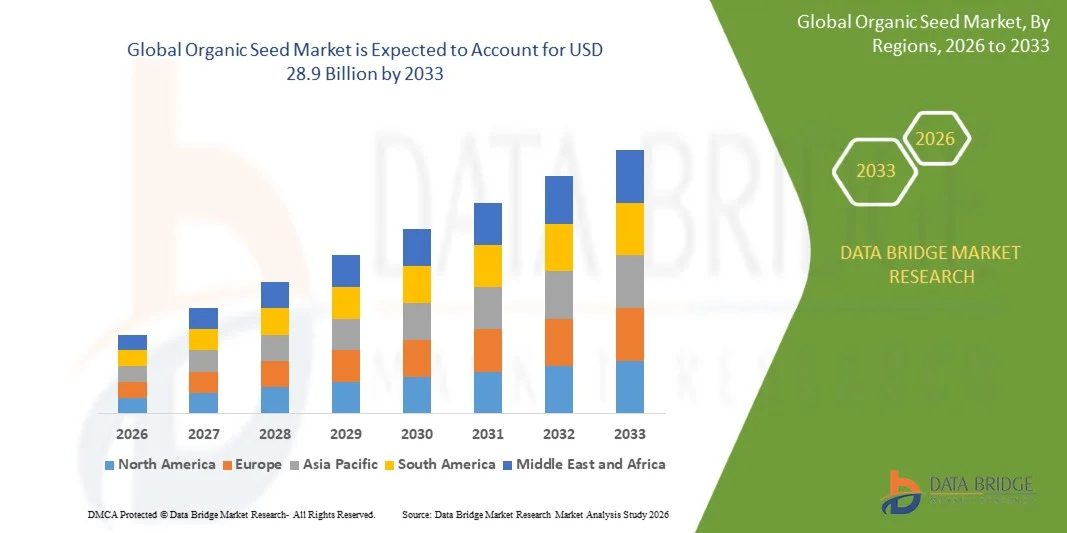
- As per Data Bridge Market Research analysis, the Global Organic Seed Market was valued at USD 18.6 billion in 2025 and is projected to reach USD 28.9 billion by 2033, growing at a CAGR of 5.8% from 2026 to 2033. The market is witnessing steady growth driven by increasing consumer preference for organically produced food, rising awareness of the health and environmental benefits of organic farming, expanding organic agricultural land, and growing demand for chemical-free and sustainable agricultural practices.
- Increasing adoption of organic farming, supportive government initiatives, rising demand for organic fruits and vegetables, growing concerns regarding synthetic agrochemicals, and advancements in organic seed development and breeding technologies are encouraging farmers and agricultural producers to invest in high-quality organic seeds.
Market Size & Forecast
- Market Value (2025): USD 18.6 billion
- Expected Market Value (2033): USD 28.9 billion
- Forecast CAGR (2026–2033): 5.8%
- Leading Region in 2025: North America
- Fastest Growing Region: Asia-Pacific
What are the Major Takeaways of the Organic Seed Market?
- North America dominated the Organic Seed Market with the largest revenue share of 40.5% in 2025, supported by well-established organic farming practices, strong consumer preference for organic food products, developed organic certification systems, and the presence of leading organic seed producers.
- Asia-Pacific Organic Seed Market is expected to witness the fastest growth at a CAGR of 8.5% from 2026 to 2033, supported by increasing adoption of organic farming, rising awareness of chemical-free agricultural products, expanding organic farmland, growing food demand, and supportive government initiatives across China, India, Japan, and other emerging economies.
- Vegetable seeds held the largest market revenue share of 40.0% in 2025, driven by increasing cultivation of organic vegetables, rising consumer demand for fresh and chemical-free produce, and growing adoption of organic farming practices among commercial and small-scale farmers.
- Organic fruit seeds are projected to register the fastest growth at a CAGR of 8.2% from 2026 to 2033, driven by increasing consumption of organically grown fruits, rising health consciousness, expansion of organic horticulture, and growing demand for sustainable agricultural production.
- Commercial farmers accounted for the largest market revenue share of 55.32% in 2025, driven by the expansion of certified organic agriculture, increasing demand for organic food products, and the need for high-quality seeds that support reliable yields under organic cultivation systems.
- Online and e-commerce distribution is expected to witness the fastest CAGR of 9.1% from 2026 to 2033, driven by increasing digitalization of agricultural supply chains, convenient access to specialized organic seed varieties, expanding online agricultural marketplaces, and growing adoption of digital purchasing channels among farmers and home growers.
Report Scope and Organic Seed Market Segmentation
|
Attributes |
Organic Seed Key Market Insights |
|
Segments Covered |
|
|
Countries Covered |
North America
Europe
Asia-Pacific
Middle East and Africa
South America
|
|
Key Market Players |
|
|
Market Opportunities |
|
|
Value Added Data Infosets |
In addition to the insights on market scenarios such as market value, growth rate, segmentation, geographical coverage, and major players, the market reports curated by the Data Bridge Market Research also include in-depth expert analysis, pricing analysis, brand share analysis, consumer survey, demography analysis, supply chain analysis, value chain analysis, raw material/consumables overview, vendor selection criteria, PESTLE Analysis, Porter Analysis, and regulatory framework. |
What is the Key Trend in the Organic Seed Market?
- The growing adoption of high-quality, climate-resilient, and disease-resistant organic seed varieties is emerging as a key trend, enabling farmers to improve crop productivity, adapt to changing climatic conditions, reduce dependence on synthetic agricultural inputs, and meet the increasing demand for organically produced food.
- Seed companies are increasingly focusing on organic breeding, varietal improvement, and non-GMO seed development to provide varieties suited to organic farming conditions while maintaining yield, quality, and resistance to pests and diseases.
- Growing demand for locally adapted and climate-resilient organic seeds is encouraging the development of varieties capable of performing under drought, temperature fluctuations, water scarcity, and other environmental stresses.
- Organic seed producers are also expanding digital distribution and direct-to-farmer channels, making specialized seed varieties more accessible to commercial growers, small-scale farmers, and home gardeners.
- As organic agriculture continues to expand and consumers increasingly prioritize chemical-free, sustainable, and environmentally responsible food production, demand for high-performance organic seeds with improved resilience and productivity is expected to strengthen across major agricultural markets.
What are the Key Drivers of the Organic Seed Market?
- The increasing adoption of sustainable and chemical-free agricultural practices is emerging as a key trend in the organic seed market, driven by growing consumer preference for organic food, environmental concerns, and the expansion of certified organic farming.
- Organic seed companies are increasingly developing improved seed varieties with better disease resistance, climate adaptability, yield potential, and suitability for organic cultivation systems.
- For instance, seed producers are expanding their portfolios of certified organic vegetable, fruit, herb, and field-crop varieties to address the growing requirements of organic farmers and commercial growers.
- The growing emphasis on biodiversity and non-GMO seed varieties is further supporting demand for organic seeds, particularly among farmers seeking to maintain soil health, preserve genetic diversity, and comply with organic farming standards.
- For instance, organic seed suppliers are increasingly offering open-pollinated and heirloom varieties alongside certified organic seeds, providing growers with greater choice and supporting sustainable agricultural practices.
- As farmers and consumers increasingly prioritize chemical-free food production, environmental sustainability, biodiversity, and resilient agricultural systems, the adoption of certified organic seeds is expected to increase across commercial farming, horticulture, and home gardening applications.
Which Factors are Challenging the Growth of the Organic Seed Market?
- The increasing adoption of organic farming and sustainable agricultural practices is emerging as a key trend in the Organic Seed Market, encouraging farmers to shift toward certified organic seeds and reduce dependence on synthetic fertilizers, pesticides, and genetically modified inputs.
- Growing consumer preference for organic and chemical-free food products is encouraging farmers and agricultural producers to increase organic cultivation, creating greater demand for certified organic seeds.
- Seed companies are increasingly investing in organic seed breeding and varietal development to improve yield potential, disease resistance, climate adaptability, and crop quality while complying with organic production standards.
- For instance, the development and commercialization of new organic vegetable, cereal, pulse, and specialty crop varieties are enabling growers to access seeds specifically suited to organic cultivation conditions.
- Government initiatives supporting organic agriculture, including certification programs, financial incentives, and sustainable farming policies, are encouraging the expansion of organic farmland and increasing the use of organic seeds.
- As farmers increasingly prioritize soil health, biodiversity, sustainable crop production, and chemical-free cultivation, demand for certified organic seeds is expected to increase across commercial agriculture, horticulture, and home gardening applications.
How is the Organic Seed Market Segmented?
The market is segmented on the basis of type, crop type, seed form, distribution channel, and end user.
- By Type
On the basis of type, the Organic Seed Market is segmented into vegetable seeds, field crop seeds, fruit seeds, herb and spice seeds, and others. The vegetable seeds segment held the largest estimated market revenue share of approximately 40.0% in 2025, driven by increasing demand for organically grown vegetables, rising consumer preference for chemical-free food products, and expanding cultivation of organic horticultural crops. The segment is expected to grow at an estimated CAGR of 6.4% from 2026 to 2033, supported by increasing organic farming practices and growing demand for fresh organic produce.
The fruit seeds segment is expected to witness significant growth during the forecast period, with an estimated CAGR of 7.2% from 2026 to 2033, supported by rising consumption of organic fruits, increasing awareness of sustainable agriculture, and expansion of organic fruit cultivation.
- By Crop Type
On the basis of crop type, the market is segmented into cereals & grains, fruits & vegetables, oilseeds & pulses, herbs & spices, and others. The fruits & vegetables segment accounted for an estimated market share of 45.0% in 2025, supported by increasing consumer demand for fresh organic produce, expanding organic farmland, and growing adoption of sustainable cultivation practices. The segment is projected to expand at an estimated CAGR of 6.7% from 2026 to 2033.
The oilseeds & pulses segment is expected to register notable growth, with an estimated CAGR of 7.0% during 2026–2033, driven by increasing demand for plant-based protein, organic pulses, and sustainably produced agricultural commodities.
- By Seed Form
On the basis of seed form, the market is segmented into open-pollinated seeds and hybrid seeds. The open-pollinated seeds segment held the largest estimated revenue share of approximately 62.0% in 2025, owing to their compatibility with organic farming systems, seed-saving potential, genetic diversity, and growing preference among organic farmers and home gardeners. The segment is estimated to grow at a CAGR of 5.6% from 2026 to 2033.
The hybrid seeds segment is expected to witness faster growth, registering an estimated CAGR of 6.5%, as seed developers increasingly focus on improving yield, disease resistance, climate adaptability, and crop quality while meeting organic production requirements.
- By Distribution Channel
On the basis of distribution channel, the market is segmented into direct sales, retail stores, specialty stores, agricultural cooperatives, and online/e-commerce. Retail stores accounted for an estimated 38.0% market share in 2025, supported by established agricultural supply networks and convenient access to certified seed varieties. The segment is estimated to grow at a CAGR of 5.5% from 2026 to 2033.
The online/e-commerce segment is expected to register the fastest growth at an estimated CAGR of 9.1%, driven by increasing digitalization of agricultural supply chains, wider availability of specialized organic seed varieties, and growing preference for convenient online purchasing.
- By End User
On the basis of end user, the market is segmented into commercial farmers, small and medium-sized farmers, home gardeners, and research & seed breeding institutions. Commercial farmers held the largest estimated market revenue share of approximately 55.0% in 2025, driven by the expansion of certified organic agriculture, increasing demand for organic food, and rising adoption of organic cultivation practices. The segment is projected to grow at an estimated CAGR of 5.9% from 2026 to 2033.
The small and medium-sized farmers segment is expected to witness significant growth, with an estimated CAGR of 7.0%, supported by government initiatives, increasing awareness of organic farming, and growing access to certified organic seeds.
Which Region Holds the Largest Share of the Organic Seed Market?
- North America dominated the Organic Seed Market with the largest estimated revenue share of approximately 46.5% in 2025, supported by well-established organic farming practices, strong consumer demand for organic food products, developed certification systems, and increasing adoption of sustainable agricultural practices across the region.
- Organic farmers and agricultural producers across North America are increasingly investing in certified organic seeds to meet growing demand for chemical-free and sustainably produced crops. The expansion of organic farmland, supportive government initiatives, established seed distribution networks, and rising consumer awareness are further strengthening demand for high-quality organic seeds across the region.
U.S. Organic Seed Market Insight
The U.S. Organic Seed Market is supported by strong consumer demand for organic food, expanding organic farming practices, and increasing interest in sustainable agricultural production. The development of certified organic farmland and growing participation of farmers in organic agriculture are strengthening demand for high-quality organic seeds. In addition, established certification standards, research initiatives, and expanding access to organic products through conventional retailers and online channels are supporting market development.
Europe Organic Seed Market Insight
The Europe Organic Seed Market is supported by increasing consumer preference for organic and sustainably produced food, expanding organic farming practices, and strong environmental awareness. Favorable agricultural policies, established organic certification frameworks, and growing investments in sustainable crop production are encouraging farmers to adopt certified organic seeds. The region’s developed agricultural sector and increasing demand for chemical-free fruits, vegetables, cereals, and specialty crops are further supporting market growth.
U.K. Organic Seed Market Insight
The U.K. Organic Seed Market is supported by expanding organic agriculture, increasing consumer preference for organically produced food, and growing emphasis on sustainable farming practices. The country’s organic farmland base is also expanding, creating opportunities for certified organic seed suppliers. Increasing demand for organic vegetables, cereals, fruits, and specialty crops, along with efforts to improve the availability of organic planting materials, is expected to strengthen market development.
Germany Organic Seed Market Insight
Germany represents a well-established and steadily developing market for organic seeds, supported by strong consumer preference for organic products, growing adoption of sustainable farming practices, and supportive government policies. The expansion of organic agriculture is encouraging demand for locally adapted and certified seed varieties across farming, horticulture, and gardening applications. Increasing emphasis on biodiversity, seed quality, and sustainable crop production is also creating opportunities for organic seed producers and suppliers.
Asia-Pacific Organic Seed Market Insight
The Asia-Pacific Organic Seed Market is experiencing strong growth, supported by increasing adoption of organic farming practices, rising consumer preference for chemical-free food, expanding agricultural activities, and growing awareness of sustainable cultivation. Improving agricultural infrastructure, supportive government initiatives, and increasing investments in organic food production are encouraging farmers to adopt certified organic seeds. The region’s expanding food industry and growing focus on sustainable agriculture are further creating opportunities for market participants.
Japan Organic Seed Market Insight
The Japan Organic Seed Market is experiencing steady growth, supported by increasing consumer awareness of health, food safety, and environmental sustainability. Rising adoption of organic farming and growing demand for locally produced, chemical-free fruits and vegetables are encouraging farmers and home gardeners to use organic seed varieties. Government support for sustainable agriculture, improved seed technologies, and greater availability of locally adapted varieties are further supporting market development across Japan.
China Organic Seed Market Insight
The China Organic Seed Market is gaining momentum as rising consumer awareness of health, food safety, and environmental sustainability encourages greater adoption of organic farming practices. Demand is supported by expanding organic cultivation, increasing interest in non-GMO and locally adapted seed varieties, and government efforts to promote sustainable agriculture. The market is also benefiting from growing investment in seed research, biodiversity conservation, and digital distribution channels, creating opportunities for domestic and international organic seed producers.
Which are the Top Companies in Organic Seed Market?
The Organic Seed industry is primarily led by well-established companies, including:
- Rijk Zwaan Zaadteelt en Zaadhandel B.V. (Netherlands)
- Vitalis Organic Seeds (Netherlands)
- De Bolster B.V. (Netherlands)
- Enza Zaden Beheer B.V. (Netherlands)
- Johnny’s Selected Seeds (U.S.)
- High Mowing Organic Seeds (U.S.)
- Seed Savers Exchange (U.S.)
- Fedco Seeds Inc. (U.S.)
- Baker Creek Heirloom Seed Company (U.S.)
- Southern Exposure Seed Exchange (U.S.)
- Wild Garden Seed (U.S.)
- Territorial Seed Company (U.S.)
- Sakata Seed Corporation (Japan)
- Takii & Co., Ltd. (Japan)
- HILD Samen GmbH (Germany)
What are Latest Developments in Organic Seed Market?
- In August 2025, Government-backed quality and natural seed initiative: India’s Ministry of Cooperation announced that Bharatiya Beej Sahakari Samiti Limited (BBSSL) would support the production, procurement, preservation, breeding, and distribution of quality and natural seeds. The initiative also includes incentives for farmers cultivating natural seeds and the establishment of a seed bank.
- In August 2025, Strategic partnership for indigenous seeds: The Sri Sri Institute of Agricultural Sciences and Technology Trust signed MoUs with Bharatiya Beej Sahakari Samiti Limited (BBSSL) and National Cooperative Organics Limited (NCOL) to strengthen indigenous seed preservation, natural farming, and market linkages for farmers.
- In June 2025, Seed research partnership: ICRISAT, IFFCO, and BBSSL entered into a tripartite agreement to establish the Beej Anusandhan Kendra in Gujarat, aimed at advancing seed innovation, sustainable agriculture, and farmer empowerment.
- In January 2025, Industry collaboration: HM.CLAUSE, Enza Zaden, and SeedWorks joined Syngenta and BASF in the WISH project, a multi-stakeholder initiative focused on improving labor standards, minimum-wage compliance, and addressing child-labor issues in India's vegetable seed sector.
- In August 2025, Organic seed research expansion: The Organic Seed Alliance's OSPREY project continued multi-location organic seed production trials involving more than 35 participating locations, focusing on improving seed yields, production practices, economic decision-making, and availability of high-quality organic seed.

- Interactive Data Analysis Dashboard
- Company Analysis Dashboard for high growth potential opportunities
- Research Analyst Access for customization & queries
- Competitor Analysis with Interactive dashboard
- Latest News, Updates & Trend analysis
- Harness the Power of Benchmark Analysis for Comprehensive Competitor Tracking
Global Organic Seed Market, Supply Chain Analysis and Ecosystem Framework
To support market growth and help clients navigate the impact of geopolitical shifts, DBMR has integrated in-depth supply chain analysis into its Global Organic Seed Market research reports. This addition empowers clients to respond effectively to global changes affecting their industries. The supply chain analysis section includes detailed insights such as Global Organic Seed Market consumption and production by country, price trend analysis, the impact of tariffs and geopolitical developments, and import and export trends by country and HSN code. It also highlights major suppliers with data on production capacity and company profiles, as well as key importers and exporters. In addition to research, DBMR offers specialized supply chain consulting services backed by over a decade of experience, providing solutions like supplier discovery, supplier risk assessment, price trend analysis, impact evaluation of inflation and trade route changes, and comprehensive market trend analysis.
Data collection and base year analysis are done using data collection modules with large sample sizes. The stage includes obtaining market information or related data through various sources and strategies. It includes examining and planning all the data acquired from the past in advance. It likewise envelops the examination of information inconsistencies seen across different information sources. The market data is analysed and estimated using market statistical and coherent models. Also, market share analysis and key trend analysis are the major success factors in the market report. To know more, please request an analyst call or drop down your inquiry.
The key research methodology used by DBMR research team is data triangulation which involves data mining, analysis of the impact of data variables on the market and primary (industry expert) validation. Data models include Vendor Positioning Grid, Market Time Line Analysis, Market Overview and Guide, Company Positioning Grid, Patent Analysis, Pricing Analysis, Company Market Share Analysis, Standards of Measurement, Global versus Regional and Vendor Share Analysis. To know more about the research methodology, drop in an inquiry to speak to our industry experts.
Data Bridge Market Research is a leader in advanced formative research. We take pride in servicing our existing and new customers with data and analysis that match and suits their goal. The report can be customized to include price trend analysis of target brands understanding the market for additional countries (ask for the list of countries), clinical trial results data, literature review, refurbished market and product base analysis. Market analysis of target competitors can be analyzed from technology-based analysis to market portfolio strategies. We can add as many competitors that you require data about in the format and data style you are looking for. Our team of analysts can also provide you data in crude raw excel files pivot tables (Fact book) or can assist you in creating presentations from the data sets available in the report.













