

Global Orthopedic Biomaterial Market
Market Size in USD Billion
CAGR :
% 
 USD
10.31 Billion
USD
16.27 Billion
2025
2033
USD
10.31 Billion
USD
16.27 Billion
2025
2033
 Forecast Period Forecast Period |
2026 –2033 |
 Market Size (Base Year) Market Size (Base Year) |
USD 10.31 Billion |
 Market Size (Forecast Year) Market Size (Forecast Year) |
USD 16.27 Billion |
 CAGR CAGR |
% |
| Major Markets Players |
|
Orthopedic Biomaterial Market Size
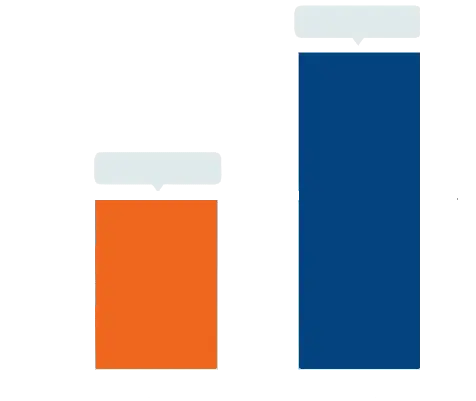
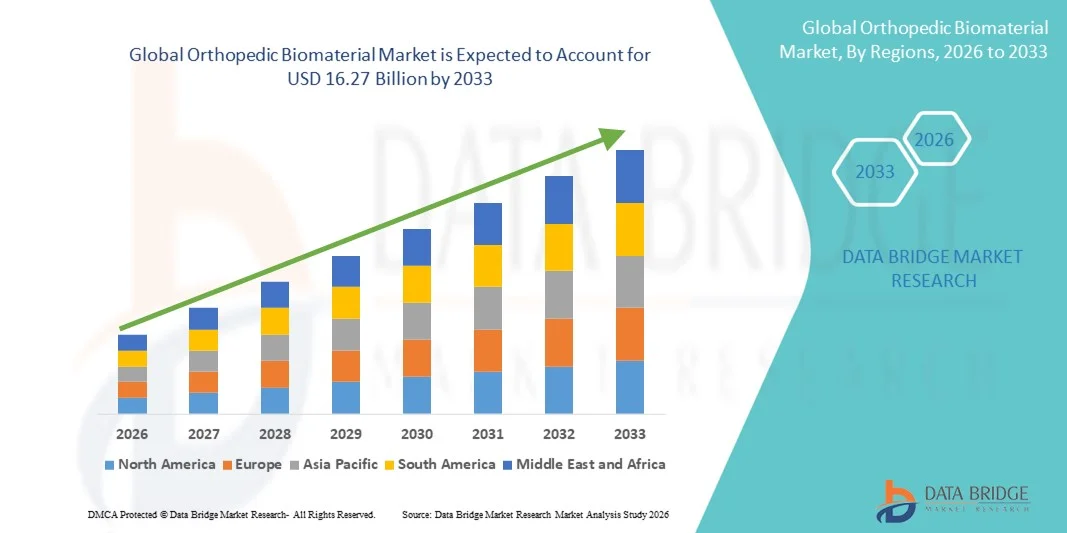
- The global orthopedic biomaterial market size was valued at USD 10.31 billion in 2025 and is expected to reach USD 16.27 billion by 2033, at a CAGR of 5.87% during the forecast period
- The market growth is largely fueled by increasing adoption of advanced orthopedic implant technologies and continuous innovations in biomaterials, leading to improved biocompatibility, strength, and long-term performance in orthopedic applications such as joint replacement, spinal fusion, and trauma fixation
- Furthermore, rising demand for minimally invasive surgeries, growing prevalence of musculoskeletal disorders, and expanding elderly population are establishing orthopedic biomaterials as essential components of modern orthopedic treatments. These converging factors are accelerating the uptake of orthopedic biomaterial solutions, thereby significantly boosting overall market growth
Orthopedic Biomaterial Market Analysis
- Orthopedic biomaterials, which are used in implants and devices for bone and joint repair, are increasingly vital components of modern orthopedic care due to their ability to improve implant durability, biocompatibility, and patient outcomes in joint replacement, spinal fusion, and trauma applications
- The escalating demand for orthopedic biomaterials is primarily fueled by the rising prevalence of musculoskeletal disorders, growing geriatric population, and increasing volume of orthopedic surgeries, along with continuous advancements in biomaterial technologies such as bioresorbable polymers and 3D-printed implants
- North America dominated the orthopedic biomaterial market with the largest revenue share of approximately 43.5% in 2025, supported by advanced healthcare infrastructure, high adoption of innovative orthopedic implants, strong reimbursement frameworks, and the presence of leading device manufacturers, with the U.S. accounting for a major portion of regional demand
- Asia-Pacific is expected to be the fastest-growing region in the orthopedic biomaterial market during the forecast period, registering a CAGR ,driven by increasing healthcare spending, growing medical tourism, rising orthopedic surgery volumes, and expanding access to advanced orthopedic care across emerging economies
- The metal segment dominated the largest market revenue share of 46.2% in 2025, driven by its strong use in load-bearing implants such as hip and knee prostheses
Report Scope and Orthopedic Biomaterial Market Segmentation
|
Attributes |
Orthopedic Biomaterial Key Market Insights |
|
Segments Covered |
|
|
Countries Covered |
North America
Europe
Asia-Pacific
Middle East and Africa
South America
|
|
Key Market Players |
|
|
Market Opportunities |
|
|
Value Added Data Infosets |
In addition to the insights on market scenarios such as market value, growth rate, segmentation, geographical coverage, and major players, the market reports curated by the Data Bridge Market Research also include in-depth expert analysis, patient epidemiology, pipeline analysis, pricing analysis, and regulatory framework. |
Orthopedic Biomaterial Market Trends
Advanced 3D Printing and Customized Implants
- A significant and accelerating trend in the global orthopedic biomaterial market is the increasing adoption of 3D-printed and patient-specific implants, enabling personalized treatment and improved anatomical fit
- For instance, several companies are developing customized titanium and PEEK implants for spinal and orthopedic applications, allowing better bone integration and reduced risk of implant failure
- Additive manufacturing enables complex porous structures that mimic natural bone and enhance osseointegration, supporting faster recovery and long-term stability
- The trend is driven by advancements in imaging technologies and design software, which allow precise implant modeling and manufacturing based on individual patient anatomy
- This shift towards personalized implants is reshaping surgeon preferences and increasing demand for advanced biomaterials in orthopedic surgeries
- As a result, leading manufacturers are investing heavily in 3D printing capabilities and collaborations with hospitals to expand the use of patient-specific orthopedic biomaterials
Orthopedic Biomaterial Market Dynamics
Driver
Growing Surgical Volume and Rising Demand for Minimally Invasive Procedures
- The increasing prevalence of orthopedic disorders such as osteoarthritis, osteoporosis, and sports injuries is driving a higher volume of orthopedic surgeries globally, thereby boosting demand for orthopedic biomaterials
- For instance, the rise in joint replacement procedures and spinal fusion surgeries is pushing manufacturers to develop high-performance biomaterials like titanium alloys, bio-ceramics, and polymer composites
- Improved healthcare infrastructure and higher healthcare spending in emerging markets are expanding access to advanced orthopedic treatments, supporting market growth
- The growing preference for minimally invasive procedures is also fueling demand for advanced biomaterials that provide better strength, biocompatibility, and reduced complications
- Moreover, increasing medical tourism and investments in orthopedic research are further supporting the adoption of innovative biomaterial solutions
- These factors collectively are expected to drive sustained growth in the orthopedic biomaterial market over the forecast period
Restraint/Challenge
High Costs and Regulatory Barriers
- High costs associated with advanced orthopedic biomaterials and implant procedures pose a significant challenge for market growth, especially in price-sensitive regions
- For instance, bioresorbable implants and custom 3D-printed implants remain expensive, limiting their adoption among low-income patient segments
- In addition, stringent regulatory requirements and lengthy approval processes for new biomaterials delay market entry and increase R&D expenses for manufacturers
- Concerns regarding long-term safety, implant failure, and compatibility issues also restrain market growth, as healthcare providers seek proven and reliable solutions
- Lack of awareness and limited availability of advanced biomaterial technologies in developing regions further restrict market penetration
- Overcoming these challenges through cost reduction, enhanced clinical evidence, and streamlined regulatory pathways will be crucial for sustained market expansion
Orthopedic Biomaterial Market Scope
The market is segmented on the basis of type, material, application, and end user.
- By Type
On the basis of type, the Orthopedic Biomaterial market is segmented into metal and non-metal. The metal segment dominated the largest market revenue share of 46.2% in 2025, driven by its strong use in load-bearing implants such as hip and knee prostheses. Metals such as titanium alloys and stainless steel are preferred for their superior strength, fatigue resistance, and long-term stability. The high demand for joint replacement surgeries globally supports this dominance. Metal biomaterials also show strong compatibility with coating technologies for better osseointegration. Rising orthopedic trauma cases and spinal implants further contribute to market share. Developed regions continue to rely heavily on metal-based implants due to advanced healthcare infrastructure. Metal implants also support high-volume production and established surgical protocols. The growing elderly population and sports injuries add to the demand. Strong adoption in both public and private hospitals strengthens the segment. The metal segment is expected to remain dominant during the forecast period.
The non-metal segment is expected to witness the fastest CAGR of 19.3% from 2026 to 2033, driven by increasing use of polymers, ceramics, and composites in minimally invasive and bioresorbable implants. Non-metal biomaterials offer advantages like lightweight structure, flexibility, and reduced risk of metal-related allergies. Advancements in bioresorbable materials and 3D printing technologies support rapid adoption. Non-metal implants are increasingly used in tissue engineering and soft tissue repair. Growing demand for customized implants in orthopedic surgeries fuels the segment. In addition, the rising preference for biodegradable implants in pediatric orthopedics supports growth. Research on polymeric scaffolds and composite materials enhances innovation. As a result, non-metal biomaterials are expected to grow fastest in the forecast period.
- By Material
On the basis of material, the Orthopedic Biomaterial market is segmented into ceramics and bioactive glasses, polymers, calcium phosphate cements, and composites. The polymers segment dominated the largest market revenue share of 38.7% in 2025, driven by their extensive use in bone cements, spacers, and scaffolds. Polymers like polyethylene and PMMA are widely used in joint replacement and bone fixation. Their lightweight properties and flexibility make them suitable for diverse orthopedic applications. Polymer-based implants also support drug delivery and bioactive coatings. Growing demand for minimally invasive procedures increases polymer adoption. Polymers are also favored in pediatric orthopedics due to reduced long-term risks. Advancements in biodegradable polymers further support growth. The expanding tissue engineering market also contributes to polymer dominance. Strong R&D and improved manufacturing processes strengthen this segment. As a result, polymers remain the leading material in 2025.
The ceramics and bioactive glasses segment is expected to witness the fastest CAGR of 20.6% from 2026 to 2033, driven by growing demand for bone graft substitutes and improved osseointegration. Ceramic materials like alumina and zirconia are widely used in joint implants due to high wear resistance and biocompatibility. Bioactive glasses support bone regeneration and are increasingly used in bone defect repair. Rising cases of bone diseases and fractures drive demand. Ceramic coatings are also used to enhance implant surface properties. Increasing research in bioactive glass composites further accelerates growth. The segment benefits from rising investments in regenerative medicine and bone graft substitutes. Therefore, ceramics and bioactive glasses are expected to grow fastest.
- By Application
On the basis of application, the Orthopedic Biomaterial market is segmented into orthobiologics, orthopedic implants, joint replacement/reconstruction, viscosupplementation, and bio-resorbable tissue fixation. The orthopedic implants segment dominated the largest market revenue share of 41.9% in 2025, driven by high demand for fracture fixation devices, spinal implants, and trauma reconstruction. Orthopedic implants require high-strength materials to support load-bearing functions. The rising incidence of bone fractures and spinal disorders contributes to growth. Improved surgical techniques and implant designs increase adoption. Strong healthcare infrastructure in developed countries supports high procedure volumes. The growth of trauma cases and sports injuries further drives the segment. High demand for internal fixation devices such as plates and screws increases biomaterial use. Increased adoption of advanced implant technologies boosts market share. Orthopedic implants remain the largest application segment due to continuous procedural demand.
The joint replacement/reconstruction segment is expected to witness the fastest CAGR of 18.9% from 2026 to 2033, driven by rising prevalence of osteoarthritis and aging population. Joint replacement surgeries are growing globally, especially hip and knee arthroplasty. Demand for advanced biomaterials that provide longer implant life supports growth. Improved implant designs and robotic-assisted surgery enhance outcomes. The increasing number of sports injuries also contributes to joint reconstruction demand. Rising patient awareness and healthcare expenditure support growth. The segment is supported by strong adoption in developed and emerging markets. Therefore, joint replacement/reconstruction is expected to grow fastest during the forecast period.
- By End User
On the basis of end user, the Orthopedic Biomaterial market is segmented into hospitals, clinics, and others. The hospitals segment accounted for the largest market revenue share of 45.4% in 2025, driven by the high number of orthopedic surgeries performed in hospitals. Hospitals have advanced infrastructure and specialist surgeons, making them primary centers for complex orthopedic procedures. The presence of trauma centers and dedicated orthopedic departments increases implant use. Hospitals also participate in clinical trials and adopt new biomaterial technologies faster. Higher purchasing power and bulk procurement agreements support revenue dominance. Rising healthcare spending and increasing surgical volumes in hospitals strengthen this segment. Hospitals are also preferred for post-operative care and rehabilitation services. As a result, the hospitals segment remains the largest end user.
The clinics segment is expected to witness the fastest CAGR of 16.8% from 2026 to 2033, driven by increasing outpatient orthopedic procedures and minimally invasive treatments. Clinics provide cost-effective care and quick patient turnaround, attracting more patients. Rising demand for outpatient fracture management and joint care boosts the segment. Clinics are also expanding their service offerings with advanced biomaterial implants. Growing patient preference for private clinics in emerging markets supports growth. Increased accessibility and convenience drive adoption. Therefore, clinics are expected to grow fastest in the forecast period.
Orthopedic Biomaterial Market Regional Analysis
- North America dominated the Orthopedic Biomaterial market with the largest revenue share of 43.5% in 2025, supported by advanced healthcare infrastructure, high adoption of innovative orthopedic implants, strong reimbursement frameworks, and the presence of leading device manufacturers
- The region is driven by a growing number of orthopedic surgeries such as joint replacement, spinal fusion, and trauma fixation, which increase the demand for advanced biomaterials. The U.S. accounts for the major portion of regional demand due to high healthcare expenditure and strong R&D investment. Increasing geriatric population and rising incidence of osteoporosis also boost implant demand
- North America has high adoption of bioresorbable and bioactive ceramic biomaterials, supported by advanced hospitals and specialty orthopedic centers that contribute to higher implant usage. Strong clinical trial activities and faster adoption of new biomaterial technologies are key drivers in the region. In addition, well-established healthcare reimbursement policies, high disposable income, and strong patient awareness support premium biomaterial adoption. Increasing use of 3D-printed implants and regenerative orthobiologics further expands the market, ensuring North America maintains dominance during the forecast period due to continuous innovation and investment
U.S. Orthopedic Biomaterial Market Insight
The U.S. orthopedic biomaterial market captured the largest revenue share in 2025 within North America, fueled by the swift uptake of advanced orthopedic implants and increasing orthopedic surgery volumes. Strong healthcare infrastructure and high healthcare spending support market growth, while the country leads in R&D and innovation, especially in titanium alloys, polymers, and bioactive ceramics. The rising number of joint replacement and trauma surgeries increases demand, while the growing incidence of sports injuries and osteoporosis drives implant use. Strong reimbursement policies make advanced implants more accessible, and high adoption of 3D-printed implants and bioresorbable materials supports growth. Hospitals and specialty orthopedic centers are major end users, with the market benefiting from leading manufacturers and advanced clinical research. The growing demand for orthobiologics and regenerative solutions also fuels expansion, while integration of digital surgical planning and robotics enhances outcomes. Overall, the U.S. remains the largest and most advanced orthopedic biomaterial market globally.
Europe Orthopedic Biomaterial Market Insight
The Europe orthopedic biomaterial market is projected to expand at a substantial CAGR throughout the forecast period, primarily driven by increasing orthopedic surgery rates and rising healthcare investments. The growing geriatric population and rising musculoskeletal disorders boost demand, while the strong presence of orthopedic device manufacturers supports market growth. Increasing adoption of bioresorbable and bioactive materials in implants is also rising across the region. Europe has strict regulatory standards ensuring high-quality implants, while high reimbursement and insurance coverage support orthopedic procedures. Increasing joint replacement surgeries in Germany, France, and Italy drive demand, and growing adoption of minimally invasive procedures increases biomaterial use. Research collaborations and clinical trials support product innovation, and high awareness of advanced orthopedic care supports market expansion. Digital and robotic-assisted surgeries contribute to higher implant adoption, and Europe continues to be a major market due to mature healthcare systems and high patient awareness.
U.K. Orthopedic Biomaterial Market Insight
The U.K. orthopedic biomaterial market is anticipated to grow at a noteworthy CAGR during the forecast period, driven by increasing orthopedic surgery volumes and healthcare modernization. Increasing demand for joint replacement and trauma fixation surgeries fuels growth, while NHS support and high healthcare spending enhance adoption of advanced implants. Rising osteoarthritis and sports injuries contribute to market demand, while growing use of bioresorbable implants and polymer-based biomaterials supports expansion. Patients prefer minimally invasive procedures and faster recovery, and increasing investments in orthopedic research and clinical trials further strengthen growth. Hospitals and specialty orthopedic centers remain key end users, while rising adoption of 3D-printed implants supports market expansion. High adoption of digital surgical planning and robotics improves outcomes, and government initiatives for elderly care increase treatment rates. Overall, the U.K. market is expected to grow steadily due to high healthcare standards.
Germany Orthopedic Biomaterial Market Insight
The Germany orthopedic biomaterial market is expected to expand at a considerable CAGR during the forecast period, fueled by strong healthcare infrastructure and high adoption of advanced implants. Germany is one of the leading markets for orthopedic surgeries in Europe, with rising incidence of musculoskeletal disorders and trauma cases increasing implant demand. Strong presence of leading biomaterial manufacturers supports growth, while increasing awareness about advanced biomaterials such as ceramics and bioactive glasses boosts adoption. The country’s focus on innovation and sustainability supports advanced biomaterial use, and increasing integration of implants with digital surgical systems improves outcomes. High adoption of joint replacement surgeries drives market growth, supported by strong reimbursement and insurance policies. The growing elderly population contributes to higher orthopedic treatment rates, and Germany invests heavily in research and development for orthopedic biomaterials. Overall, Germany remains a key growth market due to its advanced healthcare ecosystem.
Asia-Pacific Orthopedic Biomaterial Market Insight
The Asia-Pacific orthopedic biomaterial market is poised to grow at the fastest CAGR during 2026–2033, driven by increasing healthcare spending, growing medical tourism, rising orthopedic surgery volumes, and expanding access to advanced orthopedic care across emerging economies. Rapid urbanization and rising disposable incomes in India, China, and Southeast Asia boost demand, while increasing prevalence of osteoarthritis, trauma, and sports injuries drives implant adoption. The growing number of orthopedic hospitals and specialty clinics supports market growth, while expansion of healthcare infrastructure and access to advanced treatments enhances adoption. Government initiatives promoting healthcare modernization increase demand for biomaterials, and rising medical tourism boosts orthopedic surgery volumes. Increasing adoption of minimally invasive surgery and 3D-printed implants supports growth, while local manufacturers and affordable implants improve accessibility. Rising awareness about orthobiologics and regenerative medicine supports expansion, and APAC becomes a major manufacturing hub for biomaterials. The region is expected to lead global growth due to large patient base and improving healthcare access.
Japan Orthopedic Biomaterial Market Insight
The Japan orthopedic biomaterial market is gaining momentum due to high-tech medical infrastructure and aging population. Increasing orthopedic surgeries for osteoarthritis and spinal disorders support growth, while high adoption of advanced implant technologies drives market expansion. Japan has strong research in biomaterials and regenerative medicine, and growing demand for minimally invasive procedures increases implant use. The aging population increases need for joint replacement and trauma treatment, while high healthcare spending supports adoption of advanced biomaterials. Hospitals and specialized orthopedic clinics are major end users, with increasing use of robotic-assisted surgeries enhancing demand. Government initiatives for elderly healthcare increase treatment rates, and Japan continues to invest in biomaterial research and manufacturing. The market is expected to grow steadily due to strong healthcare infrastructure.
China Orthopedic Biomaterial Market Insight
The China orthopedic biomaterial market accounted for the largest market revenue share in Asia Pacific in 2025, attributed to the country's expanding middle class, rapid urbanization, and high rates of technological adoption. China is one of the largest markets for orthopedic implants and biomaterials, with increasing incidence of fractures and sports injuries increasing implant demand. Rapid growth in healthcare infrastructure and hospitals supports market expansion, while rising medical tourism and cost-effective surgeries boost orthopedic treatment volumes. Domestic manufacturers offer affordable biomaterial solutions, increasing adoption, and government initiatives promoting smart healthcare and digital hospitals support growth. Growing use of 3D-printed implants and bioresorbable materials accelerates demand, while high patient awareness and improved access to advanced care increase market growth. Increasing joint replacement surgeries drive biomaterial consumption, and China remains a key growth market due to large patient base. The market continues to expand with rising healthcare investments and technological advancement.
Orthopedic Biomaterial Market Share
The Orthopedic Biomaterial industry is primarily led by well-established companies, including:
- Stryker Corporation (U.S.)
- Zimmer Biomet (U.S.)
- Johnson & Johnson (U.S.)
- Medtronic (Ireland)
- Smith & Nephew (U.K.)
- DePuy Synthes (U.S.)
- Boston Scientific (U.S.)
- B. Braun Melsungen AG (Germany)
- Baxter International (U.S.)
- Terumo Corporation (Japan)
- 3M Company (U.S.)
- Gore Medical (U.S.)
- Corbion (Netherlands)
- DSM Biomedical (Netherlands)
- Cook Medical (U.S.)
- Integra LifeSciences (U.S.)
- Teleflex (U.S.)
- Evonik Industries (Germany)
- Heraeus Medical (Germany)
- Mitsubishi Chemical Group (Japan)
Latest Developments in Global Orthopedic Biomaterial Market
- In March 2022, Synergy Biomedical, LLC announced the launch of Biosphere® Flex SP Extremities, a synthetic bioactive bone graft designed to improve bone regeneration and structural support in orthopedic procedures, expanding the availability of advanced biomaterials for extremity reconstruction
- In July 2023, Himed and Lithoz entered into a long-term strategic collaboration to develop novel bioceramic feedstocks integrating calcium phosphate biomaterials with advanced ceramic 3D printing technologies, aimed at improving additive manufacturing of bone repair implants
- In June 2024, Smith & Nephew introduced the REGENETEN Bioinductive Implant for rotator cuff repair, an FDA-approved biologic scaffold that promotes natural tendon healing with minimal invasion, marking a significant expansion in biomaterial-based orthopedic repair options
SKU-
Get online access to the report on the World's First Market Intelligence Cloud

- Interactive Data Analysis Dashboard
- Company Analysis Dashboard for high growth potential opportunities
- Research Analyst Access for customization & queries
- Competitor Analysis with Interactive dashboard
- Latest News, Updates & Trend analysis
- Harness the Power of Benchmark Analysis for Comprehensive Competitor Tracking
Research Methodology
Data collection and base year analysis are done using data collection modules with large sample sizes. The stage includes obtaining market information or related data through various sources and strategies. It includes examining and planning all the data acquired from the past in advance. It likewise envelops the examination of information inconsistencies seen across different information sources. The market data is analysed and estimated using market statistical and coherent models. Also, market share analysis and key trend analysis are the major success factors in the market report. To know more, please request an analyst call or drop down your inquiry.
The key research methodology used by DBMR research team is data triangulation which involves data mining, analysis of the impact of data variables on the market and primary (industry expert) validation. Data models include Vendor Positioning Grid, Market Time Line Analysis, Market Overview and Guide, Company Positioning Grid, Patent Analysis, Pricing Analysis, Company Market Share Analysis, Standards of Measurement, Global versus Regional and Vendor Share Analysis. To know more about the research methodology, drop in an inquiry to speak to our industry experts.
Customization Available
Data Bridge Market Research is a leader in advanced formative research. We take pride in servicing our existing and new customers with data and analysis that match and suits their goal. The report can be customized to include price trend analysis of target brands understanding the market for additional countries (ask for the list of countries), clinical trial results data, literature review, refurbished market and product base analysis. Market analysis of target competitors can be analyzed from technology-based analysis to market portfolio strategies. We can add as many competitors that you require data about in the format and data style you are looking for. Our team of analysts can also provide you data in crude raw excel files pivot tables (Fact book) or can assist you in creating presentations from the data sets available in the report.