




Global Pack Conveyors Market
Market Size in USD Billion
CAGR :
% 
 USD
10.81 Billion
USD
17.89 Billion
2025
2033
USD
10.81 Billion
USD
17.89 Billion
2025
2033
 Forecast Period Forecast Period |
2026 - 2033 |
 Market Size (Base Year) Market Size (Base Year) |
USD 10.81 Billion |
 Market Size (Forecast Year) Market Size (Forecast Year) |
USD 17.89 Billion |
 CAGR CAGR |
% |
| Major Markets Players |
|
Pack Conveyors Market Overview
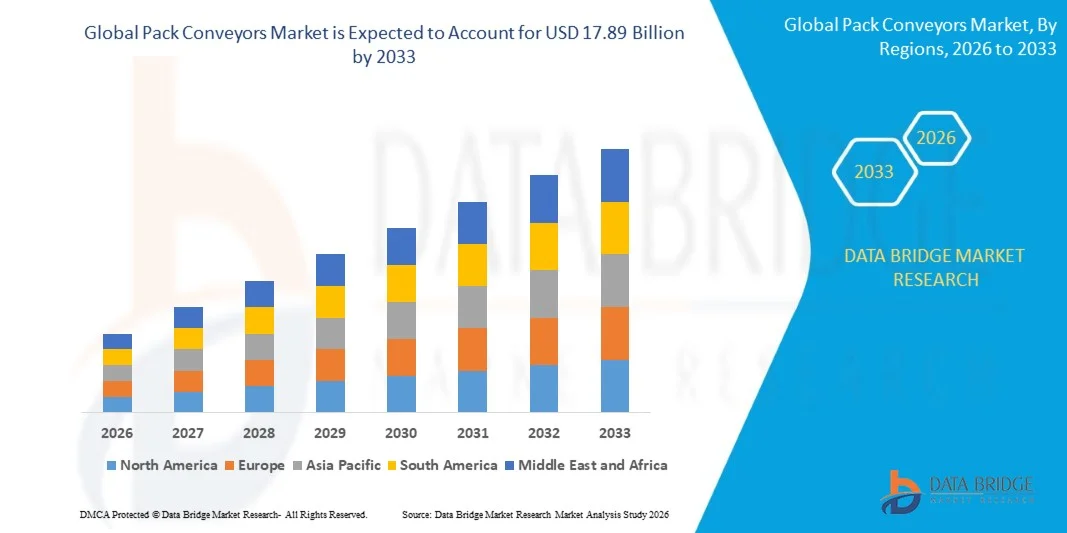
The Pack Conveyors Market was valued at USD 10.81 billion in 2025 and is projected to reach USD 17.89 billion by 2033, growing at a CAGR of 6.50% from 2026 to 2033. The market is experiencing steady growth driven by increasing automation across manufacturing and packaging facilities, rising demand for efficient material handling systems, and expanding investments in warehouse modernization and industrial productivity enhancement. Technological advancements in conveyor control systems, smart sensors, and automated sorting solutions are further supporting market expansion across food and beverage, pharmaceuticals, e-commerce, logistics, and consumer goods industries.
The rapid growth of e-commerce activities globally, combined with increasing pressure on manufacturers and distribution centers to improve operational efficiency and reduce labor dependency, is accelerating the adoption of advanced pack conveyor systems. Automated conveyor solutions are increasingly replacing manual handling processes in packaging and fulfillment operations, offering higher throughput, reduced product damage, and improved inventory management capabilities. Belt conveyors, roller conveyors, and modular conveyor systems are witnessing widespread deployment across production facilities and distribution hubs due to their ability to streamline material flow and optimize space utilization. In addition, growing emphasis on Industry 4.0 initiatives, real-time monitoring capabilities, and integrated warehouse automation systems is encouraging organizations to invest in intelligent conveyor technologies that enhance productivity, operational accuracy, and supply chain performance.
Key Market Trends & Insights
- North America dominated the pack conveyors market with the largest revenue share of 36.8% in 2025, supported by widespread deployment of automated warehousing solutions, strong logistics infrastructure, and significant investments in industrial automation across manufacturing and distribution sectors.
- Asia-Pacific is expected to be the fastest-growing region, recording a CAGR of 8.1% from 2026 to 2033. Growth is driven by rapid industrialization, expanding e-commerce networks, increasing warehouse construction activities, and rising adoption of automation technologies across manufacturing and logistics industries.
- The Belt Conveyors segment held the largest market revenue share of approximately 38.7% in 2025 driven by its extensive adoption across packaging facilities, warehouses, distribution centers, and manufacturing plants. Belt conveyors are preferred due to their versatility, continuous material flow capability, low maintenance requirements, and ability to handle a wide variety of packaged goods efficiently.
- The Accumulation Conveyors segment is projected to register the fastest growth at a CAGR of 7.8% from 2026 to 2033, driven by increasing demand for automated product buffering, intelligent sorting operations, and high-speed packaging lines. Rising investments in warehouse automation and e-commerce fulfillment centers are accelerating segment expansion.
- The Modular segment accounted for the largest market revenue share of approximately 35.9% in 2025 owing to its flexibility, durability, ease of maintenance, and suitability for complex conveyor layouts. Modular chains are widely utilized across food processing, packaging, and logistics applications where operational efficiency and system adaptability are critical.
- The Thermoplastic Resin segment is anticipated to witness the fastest growth at a CAGR of 7.4% from 2026 to 2033, supported by growing demand for lightweight, corrosion-resistant, and hygienic conveyor components. Increasing adoption across food and beverage and pharmaceutical industries is contributing significantly to segment growth.
- The Food and Beverages segment dominated the market with a revenue share of approximately 34.6% in 2025 driven by rising automation in food processing facilities, increasing packaged food consumption, and stringent requirements for efficient product handling and hygiene compliance. Conveyor systems play a critical role in packaging, sorting, and transportation processes across food manufacturing operations.
- The Healthcare segment is projected to grow at the fastest CAGR of 8.1% from 2026 to 2033, driven by expanding pharmaceutical manufacturing capacity, increasing demand for automated packaging systems, and growing investments in medical product distribution infrastructure. The need for precise, contamination-free material handling is further supporting segment expansion.
Market Size & Forecast
- Global Market Value (2025): USD 10.81 Billion
- Expected Market Value (2033): USD 17.89 Billion
- Forecast CAGR (2026–2033): 6.50%
- Leading Region in 2025: North America
- Fastest Growing Region: Asia-Pacific
Report Scope and Pack Conveyors Market Segmentation
|
Attributes |
Pack Conveyors Key Market Insights |
|
Segments Covered |
|
|
Countries Covered |
North America
Europe
Asia-Pacific
Middle East and Africa
South America
|
|
Key Market Players |
• ContiTech AG (Germany) |
|
Market Opportunities |
• Expansion Of Automated Warehousing And Smart Distribution Centers • Increasing Adoption Of Industry 4.0 Enabled Material Handling Solutions |
|
Value Added Data Infosets |
In addition to the insights on market scenarios such as market value, growth rate, segmentation, geographical coverage, and major players, the market reports curated by the Data Bridge Market Research also include in-depth expert analysis, geographically represented company-wise production and capacity, network layouts of distributors and partners, detailed and updated price trend analysis and deficit analysis of supply chain and demand. |
Pack Conveyors Market Trends
Trend: Increasing Adoption Of Smart Conveyor Automation And Warehouse Digitalization
Growing demand for highly efficient, automated, and intelligent material handling systems across manufacturing, logistics, e-commerce, and packaging industries is accelerating the adoption of advanced pack conveyor solutions. Traditional manual handling processes often result in higher labor costs, operational inefficiencies, and increased product handling errors, encouraging businesses to deploy automated conveyor technologies capable of improving throughput and workflow optimization.
In modern distribution centers, operators are integrating smart conveyor systems, For instance with automated sorting, barcode scanning, and real-time tracking capabilities, to improve order fulfillment speed and inventory accuracy. In e-commerce facilities, conveyor systems are being utilized to manage rising parcel volumes while reducing processing time and labor dependency. Major logistics providers are increasingly deploying AI-enabled conveyor networks to optimize package routing and improve warehouse productivity.
The rapid expansion of online retailing and same-day delivery services is also increasing demand for scalable conveyor infrastructure capable of handling high package volumes. In addition, Industry 4.0 initiatives continue to promote the adoption of connected conveyor systems integrated with IoT sensors and predictive maintenance platforms. Growing industry validation through warehouse modernization projects in 2025 demonstrated productivity improvements of approximately 15–25% and order processing time reductions of nearly 20% after implementation of automated conveyor and sorting systems.
Pack Conveyors Market Dynamics
Key Market Driver: Rising Investments In Warehouse Automation And E-Commerce Infrastructure
Businesses worldwide are facing increasing pressure to improve operational efficiency, reduce fulfillment costs, and accelerate order processing capabilities. The substantial growth of e-commerce transactions and omnichannel retail operations is creating strong demand for automated material handling technologies capable of supporting high-volume package movement and inventory management.
Industries such as e-commerce, food and beverage, logistics, and consumer goods are increasingly deploying pack conveyors to streamline packaging operations, warehouse workflows, and distribution activities. Large retailers and third-party logistics providers are actively expanding automated fulfillment centers, For instance utilizing conveyor-integrated sorting systems to improve delivery performance and warehouse productivity. These investments support faster order processing and reduced dependence on manual labor.
Similarly, manufacturing facilities are integrating conveyor systems with robotic packaging and palletizing solutions to enhance production efficiency while minimizing operational bottlenecks. Real-world warehouse automation deployments across North America and Europe during 2024 demonstrated improvements of approximately 20–30% in package handling capacity and significant reductions in order processing errors.
Key Restraint/Challenge: High Initial Installation Costs And Complex System Integration
Advanced pack conveyor systems often require substantial capital investment for equipment procurement, installation, facility redesign, and integration with existing warehouse management infrastructure. Small and medium-sized enterprises may face financial constraints when adopting large-scale conveyor automation projects, limiting market penetration in certain regions.
In addition, integrating conveyor systems with robotics, automated storage solutions, enterprise resource planning platforms, and warehouse management software can be technically complex and time-consuming. Downtime during installation and system upgrades may also disrupt ongoing operations, creating implementation challenges for end users.
Commercial assessments indicate that comprehensive conveyor automation projects may require significant upfront investment and extended deployment timelines, particularly in large distribution centers with complex operational workflows. These factors continue to influence purchasing decisions among cost-sensitive organizations.
Key Market Opportunity: Expansion Of Smart Fulfillment Centers And AI-Driven Logistics Networks
Modern supply chains increasingly require intelligent, scalable, and highly responsive material handling solutions capable of supporting rising package volumes and evolving customer expectations. Conventional manual handling systems often struggle to meet the speed, accuracy, and efficiency requirements of modern logistics operations, creating opportunities for advanced pack conveyor technologies.
Logistics providers and warehouse operators are increasingly deploying smart conveyor systems, For instance integrated with artificial intelligence, machine vision, and automated sorting technologies, to improve operational performance and package tracking capabilities. In e-commerce fulfillment centers, rising order volumes are accelerating investments in automated conveyor infrastructure capable of supporting rapid order processing and inventory movement.
In addition, advancements in IoT connectivity, predictive maintenance software, and digital twin technologies are enhancing conveyor performance and operational visibility, opening opportunities across logistics, manufacturing, pharmaceuticals, and food processing industries in North America, Europe, and Asia-Pacific. Large-scale fulfillment center projects commissioned during 2025 reported order accuracy improvements exceeding 99% and conveyor system utilization gains of approximately 15–20% following implementation of AI-assisted material handling solutions.
Pack Conveyors Market Scope
The market is segmented on the basis of conveyor types, chain types, and end-use industry.
• By Conveyor Types
On the basis of conveyor types, the pack conveyors market is segmented into Slat Conveyors, Belt Conveyors, Roller Conveyors, Accumulation Conveyors, and LBP Conveyors. The Belt Conveyors segment held the largest market revenue share of approximately 38.7% in 2025 driven by its extensive adoption across packaging facilities, warehouses, distribution centers, and manufacturing plants. Belt conveyors are preferred due to their versatility, continuous material flow capability, low maintenance requirements, and ability to handle a wide variety of packaged goods efficiently.
The Accumulation Conveyors segment is projected to register the fastest growth at a CAGR of 7.8% from 2026 to 2033, driven by increasing demand for automated product buffering, intelligent sorting operations, and high-speed packaging lines. Rising investments in warehouse automation and e-commerce fulfillment centers are accelerating segment expansion.
• By Chain Types
On the basis of chain types, the pack conveyors market is segmented into Thermoplastic Resin, Rubber, Roller, and Modular. The Modular segment accounted for the largest market revenue share of approximately 35.9% in 2025 owing to its flexibility, durability, ease of maintenance, and suitability for complex conveyor layouts. Modular chains are widely utilized across food processing, packaging, and logistics applications where operational efficiency and system adaptability are critical.
The Thermoplastic Resin segment is anticipated to witness the fastest growth at a CAGR of 7.4% from 2026 to 2033, supported by growing demand for lightweight, corrosion-resistant, and hygienic conveyor components. Increasing adoption across food and beverage and pharmaceutical industries is contributing significantly to segment growth.
• By End-Use Industry
On the basis of end-use industry, the pack conveyors market is segmented into Food and Beverages, Healthcare, Automotive, Aerospace, and Others. The Food and Beverages segment dominated the market with a revenue share of approximately 34.6% in 2025 driven by rising automation in food processing facilities, increasing packaged food consumption, and stringent requirements for efficient product handling and hygiene compliance. Conveyor systems play a critical role in packaging, sorting, and transportation processes across food manufacturing operations.
The Healthcare segment is projected to grow at the fastest CAGR of 8.1% from 2026 to 2033, driven by expanding pharmaceutical manufacturing capacity, increasing demand for automated packaging systems, and growing investments in medical product distribution infrastructure. The need for precise, contamination-free material handling is further supporting segment expansion.
Pack Conveyors Market Regional Analysis
North America Pack Conveyors Market Insight
North America dominated the pack conveyors market with the largest revenue share of 36.8% in 2025, supported by extensive adoption of warehouse automation technologies, strong investments in logistics infrastructure, and the presence of large-scale e-commerce and manufacturing operations. Businesses across the region increasingly rely on advanced conveyor systems to improve operational efficiency, reduce labor dependency, and accelerate order fulfillment processes. The growing deployment of automated distribution centers and smart manufacturing facilities continues to strengthen demand for pack conveyor solutions across multiple industries.
U.S. Pack Conveyors Market Insight
The U.S. pack conveyors market captured the largest revenue share in 2025 within North America, fueled by rapid expansion of e-commerce fulfillment networks and increasing investments in warehouse modernization. Companies are actively implementing conveyor-integrated sorting, packaging, and material handling systems to support rising consumer demand for faster deliveries. The growing adoption of robotics, artificial intelligence, and Industry 4.0 technologies across logistics and manufacturing facilities is further contributing to market growth.
Europe Pack Conveyors Market Insight
The Europe pack conveyors market is expected to witness significant growth from 2026 to 2033, primarily driven by increasing automation across manufacturing and packaging industries. Stringent workplace safety standards, rising labor costs, and growing emphasis on operational efficiency are encouraging businesses to deploy advanced conveyor solutions. The region is experiencing growing demand across food processing, pharmaceuticals, automotive manufacturing, and logistics sectors, where automated material handling systems are becoming essential for productivity enhancement.
U.K. Pack Conveyors Market Insight
The U.K. pack conveyors market is expected to witness strong growth from 2026 to 2033, driven by expanding e-commerce activities and increasing investments in automated warehousing infrastructure. Businesses are increasingly adopting conveyor-based material handling systems to improve package processing speed, inventory accuracy, and supply chain efficiency. The country's advanced logistics sector and growing focus on digital transformation continue to support market expansion.
Germany Pack Conveyors Market Insight
The Germany pack conveyors market is expected to witness substantial growth from 2026 to 2033, fueled by the country's strong industrial base and leadership in manufacturing automation. German manufacturers are increasingly integrating conveyor systems with robotics and smart factory technologies to optimize production workflows and material movement. Growing investments in automotive, food processing, and industrial manufacturing facilities are further supporting demand for advanced conveyor solutions.
Asia-Pacific Pack Conveyors Market Insight
The Asia-Pacific pack conveyors market is expected to witness the fastest growth rate from 2026 to 2033, supported by rapid industrialization, expanding manufacturing activities, and growing investments in logistics infrastructure. Rising e-commerce penetration, increasing warehouse construction, and government initiatives supporting industrial automation are accelerating conveyor system adoption across the region. In addition, Asia-Pacific's role as a global manufacturing hub is creating significant demand for efficient material handling and packaging solutions.
Japan Pack Conveyors Market Insight
The Japan pack conveyors market is expected to witness notable growth from 2026 to 2033 due to the country's advanced manufacturing ecosystem and strong emphasis on automation technologies. Japanese companies are increasingly implementing intelligent conveyor systems to improve production efficiency, address labor shortages, and enhance operational accuracy. The growing adoption of smart factories and automated logistics facilities is further driving market expansion across various industrial sectors.
China Pack Conveyors Market Insight
The China pack conveyors market accounted for the largest market revenue share in Asia-Pacific in 2025, attributed to the country's massive manufacturing sector, rapidly expanding e-commerce industry, and significant investments in logistics infrastructure. China remains one of the world's largest markets for warehouse automation and material handling equipment, with conveyor systems playing a critical role in manufacturing, packaging, and distribution operations. The continued development of smart factories and automated fulfillment centers is expected to further strengthen market growth in the country.
Pack Conveyors Market Share
The Pack Conveyors industry is primarily led by well-established companies, including:
• ContiTech AG (Germany)
• Vetromeccanica S.r.l. (Italy)
• Microline S.r.l. (Italy)
• Siemens (Germany)
• Emerson Electric Co. (U.S.)
• Vanderlande Industries B.V. (Netherlands)
• Fives (France)
• Daifuku Co., Ltd. (Japan)
• Schaefer Systems International Pvt. Ltd. (Germany)
• Swisslog Holding AG (Switzerland)
• Taikisha Ltd. (Japan)
• Dematic (U.S.)
• Interroll Group (Switzerland)
• Shuttleworth LLC. (U.S.)
• Dorner Mfg. Corp. (U.S.)
• Eaglestone (U.K.)
• Kleenline (U.S.)
• Lake Air Metals (U.S.)
• Bando Chemical Industries, Ltd. (Japan)
• S.V. Modular Conveyors Private Limited (India)
• Power-Pack Conveyor Co. (India)
• Integrated Conveyors (Australia)
• Pacline Automation Technologies (Canada)
SKU-
Get online access to the report on the World's First Market Intelligence Cloud

- Interactive Data Analysis Dashboard
- Company Analysis Dashboard for high growth potential opportunities
- Research Analyst Access for customization & queries
- Competitor Analysis with Interactive dashboard
- Latest News, Updates & Trend analysis
- Harness the Power of Benchmark Analysis for Comprehensive Competitor Tracking
Global Pack Conveyors Market, Supply Chain Analysis and Ecosystem Framework
To support market growth and help clients navigate the impact of geopolitical shifts, DBMR has integrated in-depth supply chain analysis into its Global Pack Conveyors Market research reports. This addition empowers clients to respond effectively to global changes affecting their industries. The supply chain analysis section includes detailed insights such as Global Pack Conveyors Market consumption and production by country, price trend analysis, the impact of tariffs and geopolitical developments, and import and export trends by country and HSN code. It also highlights major suppliers with data on production capacity and company profiles, as well as key importers and exporters. In addition to research, DBMR offers specialized supply chain consulting services backed by over a decade of experience, providing solutions like supplier discovery, supplier risk assessment, price trend analysis, impact evaluation of inflation and trade route changes, and comprehensive market trend analysis.
Research Methodology
Data collection and base year analysis are done using data collection modules with large sample sizes. The stage includes obtaining market information or related data through various sources and strategies. It includes examining and planning all the data acquired from the past in advance. It likewise envelops the examination of information inconsistencies seen across different information sources. The market data is analysed and estimated using market statistical and coherent models. Also, market share analysis and key trend analysis are the major success factors in the market report. To know more, please request an analyst call or drop down your inquiry.
The key research methodology used by DBMR research team is data triangulation which involves data mining, analysis of the impact of data variables on the market and primary (industry expert) validation. Data models include Vendor Positioning Grid, Market Time Line Analysis, Market Overview and Guide, Company Positioning Grid, Patent Analysis, Pricing Analysis, Company Market Share Analysis, Standards of Measurement, Global versus Regional and Vendor Share Analysis. To know more about the research methodology, drop in an inquiry to speak to our industry experts.
Customization Available
Data Bridge Market Research is a leader in advanced formative research. We take pride in servicing our existing and new customers with data and analysis that match and suits their goal. The report can be customized to include price trend analysis of target brands understanding the market for additional countries (ask for the list of countries), clinical trial results data, literature review, refurbished market and product base analysis. Market analysis of target competitors can be analyzed from technology-based analysis to market portfolio strategies. We can add as many competitors that you require data about in the format and data style you are looking for. Our team of analysts can also provide you data in crude raw excel files pivot tables (Fact book) or can assist you in creating presentations from the data sets available in the report.












