Global Pagod Syndrome Market
Market Size in USD Million
CAGR :
% 
 USD
123.66 Million
USD
167.42 Million
2025
2033
USD
123.66 Million
USD
167.42 Million
2025
2033
 Forecast Period Forecast Period |
2026 - 2033 |
 Market Size (Base Year) Market Size (Base Year) |
USD 123.66 Million |
 Market Size (Forecast Year) Market Size (Forecast Year) |
USD 167.42 Million |
 CAGR CAGR |
% |
| Major Markets Players |
|
PAGOD Syndrome Market Overview
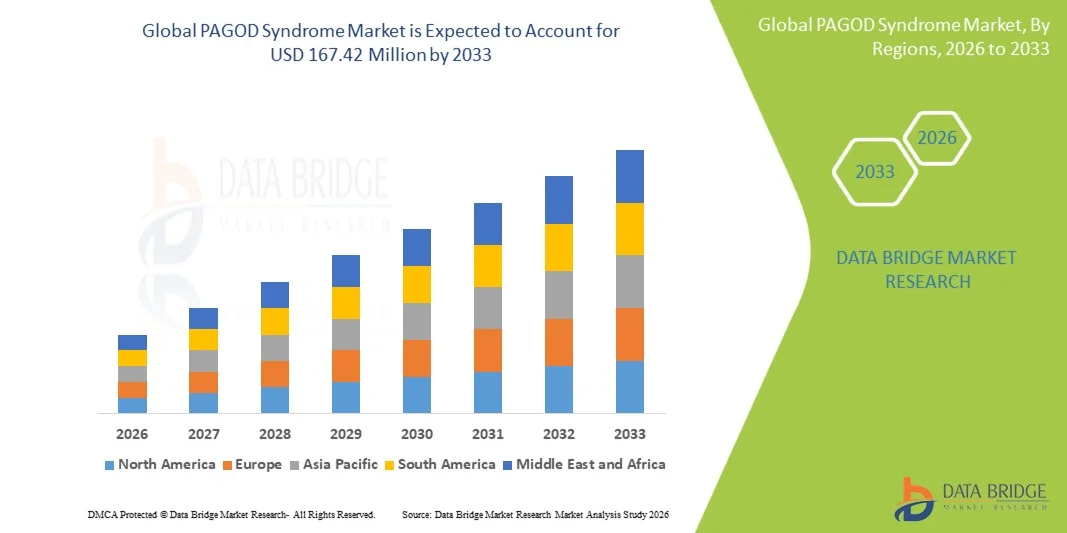
The PAGOD Syndrome Market was valued at USD 123.66 million in 2025 and is projected to reach USD 167.42 million by 2033, growing at a CAGR of 3.86% from 2026 to 2033. The market is witnessing steady growth driven by increasing awareness of rare genetic disorders, advancements in molecular diagnostics, and expanding adoption of orphan drug development programs across key healthcare systems.
The rising focus on early and accurate diagnosis of rare syndromes, coupled with growing availability of next-generation sequencing and precision medicine approaches, is supporting improved detection rates and clinical characterization of PAGOD Syndrome cases. Government incentives for orphan drug development and expanding research collaborations between academic institutes and biotechnology firms are further accelerating therapeutic innovation and supportive care solutions for affected patients.
Key Market Trends & Insights
- North America dominated the PAGOD Syndrome Market with the largest revenue share of 38.42% in 2025, supported by strong rare disease research funding, advanced genetic testing infrastructure, and high adoption of orphan drug programs.
- The Non-biologics segment led the market with a 56.28% share in 2025, driven by wider availability, lower cost, and extensive use in symptomatic management of rare genetic disorders.
- Asia-Pacific is expected to be the fastest-growing region at a CAGR of 5.4% from 2026 to 2033, fueled by expanding healthcare infrastructure, rising genetic disorder screening programs, and growing investments in precision medicine in China and India.
- Biologics are the fastest-growing drug type, projected to register a CAGR of 6.3%, reflecting the surge in focus on targeted and disease-modifying therapies for rare genetic disorders.
- The Genetic Testing segment dominated the diagnosis type category with a 48.92% revenue share in 2025, led by increasing adoption of next-generation sequencing and whole exome analysis for rare disease identification.
- Oral accounted for 61.34% of the market, preferred by ease of administration, better patient compliance, and widespread use in long-term symptomatic management.
- The Injectable segment is the fastest-growing route of administration category, with a CAGR of 6.2%, driven by the rising adoption of biologics and advanced targeted therapies requiring parenteral delivery.
Market Size & Forecast
- Global Market Value (2025): USD 123.66 Million
- Expected Market Value (2033): USD 167.42 Million
- Forecast CAGR (2026–2033): 3.86%
- Leading Region in 2025: North America
- Fastest Growing Region: Asia Pacific
Report Scope and PAGOD Syndrome Market Segmentation
|
Attributes |
PAGOD Syndrome Key Market Insights |
|
Segments Covered |
|
|
Countries Covered |
North America · U.S. · Canada · Mexico Europe · Germany · France · U.K. · Netherlands · Switzerland · Belgium · Russia · Italy · Spain · Turkey · Rest of Europe Asia-Pacific · China · Japan · India · South Korea · Singapore · Malaysia · Australia · Thailand · Indonesia · Philippines · Rest of Asia-Pacific Middle East and Africa · Saudi Arabia · U.A.E. · South Africa · Egypt · Israel · Rest of Middle East and Africa South America · Brazil · Argentina · Rest of South America |
|
Key Market Players |
· Amgen Inc. (U.S.) · Novartis AG (Switzerland) · Roche Holding AG (Switzerland) · Pfizer Inc. (U.S.) · Sanofi (France) · Bristol-Myers Squibb Company (U.S.) · AstraZeneca (U.K.) · Johnson & Johnson Services, Inc. (U.S.) · GSK plc (U.K.) · Takeda Pharmaceutical Company Limited (Japan) · Biogen Inc. (U.S.) · Vertex Pharmaceuticals Incorporated (U.S.) · Regeneron Pharmaceuticals, Inc. (U.S.) · Moderna, Inc. (U.S.) · Illumina, Inc. (U.S.) · Thermo Fisher Scientific Inc. (U.S.) · CRISPR Therapeutics AG (Switzerland) · Editas Medicine, Inc. (U.S.) · Ionis Pharmaceuticals, Inc. (U.S.) · Ultragenyx Pharmaceutical Inc. (U.S.) |
|
Market Opportunities |
· Expansion of next-generation sequencing-based newborn screening programs · Increasing orphan drug designation incentives and regulatory fast-track approvals · Growth in AI-driven genomic interpretation platforms |
|
Value Added Data Infosets |
In addition to the insights on market scenarios such as market value, growth rate, segmentation, geographical coverage, and major players, the market reports curated by the Data Bridge Market Research also include in-depth expert analysis, patient epidemiology, pipeline analysis, pricing analysis, and regulatory framework. |
PAGOD Syndrome Market Trends
Trend: Expansion of Genomic Sequencing in Rare Disease Diagnosis
Healthcare systems are increasingly adopting next-generation sequencing and multi-omics platforms to identify ultra-rare genetic conditions such as PAGOD syndrome at earlier stages. The integration of AI-assisted variant interpretation is improving diagnostic accuracy, while national rare disease programs are promoting standardized screening pathways. Academic medical centers are also building centralized genomic databases to improve phenotype–genotype correlation and support long-term research into syndromic disorders. For instance, large hospital networks are expanding whole-exome sequencing panels to include broader rare disease coverage.
PAGOD Syndrome Market Dynamics
Key Market Driver: Rising Adoption of Precision Medicine in Rare Disorders
The growing shift toward precision medicine is driving demand for targeted diagnostic and therapeutic approaches in PAGOD syndrome, particularly through advanced genetic testing and individualized treatment planning. Increasing government funding for orphan diseases and expanding collaboration between biotech firms and research institutes are accelerating clinical pipeline development. The use of biomarker-based stratification is also improving patient identification and treatment outcomes in highly heterogeneous rare disease populations. For instance, national rare disease initiatives are funding genome-wide screening programs for pediatric patients with unexplained neurological symptoms
Key Restraint/Challenge: Limited Patient Pool and Diagnostic Complexity
A major restraint in the PAGOD syndrome market is the extremely low prevalence of confirmed cases, which limits large-scale clinical trials and slows therapeutic development. Diagnostic complexity due to overlapping symptoms with other genetic disorders further delays accurate identification and treatment initiation. High costs associated with genetic testing and limited awareness among primary healthcare providers also restrict early diagnosis in emerging regions. For instance, many patients remain undiagnosed for years due to lack of access to specialized rare disease diagnostic centers.
Key Market Opportunity: Expansion of AI-Driven Rare Disease Analytics Platforms
The integration of artificial intelligence with genomic and clinical data presents a significant opportunity for improving PAGOD syndrome detection and management. AI-based platforms can analyze complex genetic datasets, identify hidden mutation patterns, and support faster clinical decision-making in rare disease cases. Cloud-based rare disease registries are also enabling global data sharing and accelerating research collaboration across institutions. For instance, AI-enabled diagnostic tools are being deployed in tertiary hospitals to flag potential rare genetic syndromes from sequencing reports.
PAGOD Syndrome Market Scope
The PAGOD Syndrome market is segmented on the basis of drug type, diagnosis type, route of administration, and distribution channel.
- By Drug Type
On the basis of drug type, the PAGOD Syndrome Market is segmented into biologics and non-biologics. The Non-biologics segment dominated the market with a 56.28% share in 2025, owing to wider availability, lower cost, and extensive use in symptomatic management of rare genetic disorders. These therapies are commonly used for managing neurological, metabolic, and systemic complications associated with PAGOD syndrome where curative options are limited. They are easily accessible across hospital settings and require less complex storage and administration compared to biologics. Increasing reliance on supportive pharmacological care in rare diseases further strengthens this segment’s dominance. Their use is also supported by established regulatory approvals and long-standing clinical adoption. However, limited disease-modifying potential restricts long-term efficacy compared to advanced therapies.
The Biologics segment is expected to witness the fastest growth at a CAGR of 6.3% from 2026 to 2033, driven by increasing focus on targeted and disease-modifying therapies for rare genetic disorders. Biologics offer higher specificity by targeting molecular pathways involved in PAGOD syndrome progression. Rising investment in orphan drug development and biotech innovation is accelerating pipeline activity in this segment. Improved manufacturing technologies and better delivery systems are enhancing feasibility and scalability. Expanding clinical trials in gene-based and protein-based therapies are further supporting growth. Growing regulatory incentives for biologics in rare diseases are also encouraging pharmaceutical participation.
- By Diagnosis Type
On the basis of diagnosis type, the market is segmented into genetic testing, imaging diagnostics, biochemical testing, and prenatal screening & carrier testing. The Genetic Testing segment dominated the market with a 48.92% share in 2025, driven by increasing adoption of next-generation sequencing and whole exome analysis for rare disease identification. Genetic testing provides the highest diagnostic accuracy for PAGOD syndrome compared to other methods. It enables early detection, precise mutation mapping, and improved clinical decision-making. Expanding newborn screening programs and hospital-based genomic labs are further strengthening demand. Continuous reduction in sequencing costs is improving accessibility across healthcare systems. Integration of AI-based variant interpretation tools is also enhancing diagnostic efficiency.
The Prenatal Screening & Carrier Testing segment is expected to register the fastest growth at a CAGR of 6.7% from 2026 to 2033, due to increasing awareness of hereditary risk detection and rising adoption of preventive healthcare. These tests help identify genetic abnormalities before birth, enabling early counseling and intervention decisions. Expanding maternal healthcare programs and improved access to prenatal diagnostics are supporting adoption. Technological advancements in non-invasive prenatal testing (NIPT) are further accelerating growth. Growing demand for family planning and genetic counseling services is also contributing to expansion. Increasing government focus on reducing congenital disorder burden is strengthening this segment globally.
- By Route of Administration
On the basis of route of administration, the market is segmented into oral and injectable. The Oral segment dominated the market with a 61.34% share in 2025, owing to ease of administration, better patient compliance, and widespread use in long-term symptomatic management. Oral therapies are preferred for chronic management of neurological and metabolic complications associated with PAGOD syndrome. They are widely prescribed in outpatient and homecare settings due to convenience and lower administration costs. Established oral drug formulations ensure steady availability across hospital and retail pharmacies. Increasing preference for non-invasive treatment options further supports this segment’s dominance. However, limited efficacy in disease modification remains a key limitation.
The Injectable segment is expected to witness the fastest growth at a CAGR of 6.2% from 2026 to 2033, driven by rising adoption of biologics and advanced targeted therapies requiring parenteral delivery. Injectable formulations offer higher bioavailability and faster therapeutic action compared to oral drugs. Increasing use of monoclonal antibodies and gene-based therapies is supporting segment expansion. Hospital-based administration infrastructure is improving accessibility for complex treatments. Growing clinical pipeline of rare disease injectables is further accelerating demand. Regulatory approvals for advanced injectable orphan drugs are also strengthening market growth.
- By Distribution Channel
On the basis of distribution channel, the market is segmented into hospital pharmacy, retail pharmacy, online pharmacies, and others. The Hospital Pharmacy segment dominated the market with a 58.77% share in 2025, due to centralized treatment of rare diseases and high dependency on specialist care settings. Hospital pharmacies ensure controlled dispensing of high-cost orphan drugs and biologics. They are closely integrated with diagnostic and treatment pathways for PAGOD syndrome patients. Increasing hospitalization rates for rare disease management further supports this dominance. Availability of multidisciplinary care teams enhances treatment efficiency within hospital systems. Strong procurement networks and insurance coverage also reinforce this segment’s leadership.
The Online Pharmacies segment is expected to witness the fastest growth at a CAGR of 6.8% from 2026 to 2033, driven by increasing digitalization of healthcare and rising demand for convenient drug access. Online platforms improve accessibility to specialty medications for patients in remote and underserved regions. Expansion of e-pharmacy regulations and secure prescription verification systems is supporting adoption. Growing preference for home delivery of chronic disease medications is also boosting demand. Integration of telemedicine with digital pharmacies is further accelerating growth. Increasing awareness of online rare disease drug procurement is strengthening this segment globally.
PAGOD Syndrome Market Regional Analysis
North America dominated the PAGOD Syndrome Market with the largest revenue share of 38.42% in 2025, supported by strong rare disease research funding, advanced genetic testing infrastructure, and high adoption of orphan drug programs. The region also benefits from well-established genetic screening networks, high clinical awareness of ultra-rare disorders, and strong collaboration between biotech firms and academic research institutes. Increasing use of next-generation sequencing, precision medicine initiatives, and expanding patient registries continues to strengthen North America’s leadership position in the global market.
U.S. PAGOD Syndrome Market Insight
The U.S. PAGOD Syndrome market is witnessing steady growth due to strong rare disease research funding, advanced genomic testing infrastructure, and early adoption of precision medicine approaches. The country’s well-established biotechnology ecosystem, along with increasing use of next-generation sequencing and AI-driven diagnostics, is driving demand across hospitals, research institutes, and specialty clinics. In addition, growing emphasis on orphan drug development and expansion of patient registries for ultra-rare genetic disorders is accelerating diagnosis and treatment adoption across healthcare systems.
Europe PAGOD Syndrome Market Insight
The Europe PAGOD Syndrome market remains a significant contributor to global revenue, driven by strong government support for rare disease programs, advanced healthcare systems, and increasing focus on genomic medicine. The widespread use of centralized diagnostic networks and national rare disease registries is supporting earlier identification of ultra-rare conditions. Increasing investments in precision medicine, coupled with strong collaboration between academic institutions and pharmaceutical companies, continue to enhance diagnostic and therapeutic development across the region.
U.K. PAGOD Syndrome Market Insight
The U.K. PAGOD Syndrome market is experiencing gradual growth, supported by rising adoption of genomic screening programs, expanding rare disease research initiatives, and strong integration of NHS-based genetic services. Increasing investments in next-generation sequencing infrastructure and growing demand for early diagnostic solutions are contributing to market expansion. Furthermore, collaboration between research universities, biotech firms, and public health agencies is improving clinical understanding and accelerating rare disease identification.
Germany PAGOD Syndrome Market Insight
The Germany PAGOD Syndrome market is expanding steadily due to strong healthcare infrastructure, advanced biomedical research capabilities, and increasing adoption of molecular diagnostics. Hospitals, genetic research centers, and specialty clinics are increasingly utilizing genomic sequencing for early detection of rare disorders. Continuous advancements in biotechnology, along with government support for orphan disease research and precision medicine initiatives, are further driving market growth in Germany.
Asia-Pacific PAGOD Syndrome Market Insight
The Asia-Pacific PAGOD Syndrome market is expected to witness rapid growth, driven by improving healthcare infrastructure, rising awareness of rare genetic disorders, and increasing investments in genomic medicine across countries such as China, India, and Japan. Growing adoption of advanced diagnostic technologies and expanding access to specialized healthcare services are supporting regional market expansion. Additionally, increasing government initiatives for rare disease screening and rising participation in global clinical research are accelerating market development across the region.
Japan PAGOD Syndrome Market Insight
The Japan PAGOD Syndrome market is witnessing consistent growth due to strong focus on advanced medical research, increasing use of genetic testing, and well-developed healthcare infrastructure. Hospitals and research institutes are increasingly adopting high-throughput sequencing and precision diagnostics for rare disease identification. Moreover, government support for regenerative medicine and personalized healthcare is further contributing to improved diagnosis and management of ultra-rare genetic conditions.
China PAGOD Syndrome Market Insight
The China PAGOD Syndrome market is growing rapidly, driven by expanding healthcare infrastructure, increasing adoption of genomic sequencing technologies, and rising government focus on rare disease diagnosis and treatment. Growing investments in biotechnology and precision medicine are significantly boosting diagnostic capabilities across major hospitals and research centers. In addition, increasing awareness of genetic disorders and expanding newborn screening programs are positioning China as one of the fastest-growing markets for PAGOD Syndrome globally.
PAGOD Syndrome Market Share
The PAGOD Syndrome industry is primarily led by well-established companies, including:
- Amgen Inc. (U.S.)
- Novartis AG (Switzerland)
- Roche Holding AG (Switzerland)
- Pfizer Inc. (U.S.)
- Sanofi (France)
- Bristol-Myers Squibb Company (U.S.)
- AstraZeneca (U.K.)
- Johnson & Johnson Services, Inc. (U.S.)
- GSK plc (U.K.)
- Takeda Pharmaceutical Company Limited (Japan)
- Biogen Inc. (U.S.)
- Vertex Pharmaceuticals Incorporated (U.S.)
- Regeneron Pharmaceuticals, Inc. (U.S.)
- Moderna, Inc. (U.S.)
- Illumina, Inc. (U.S.)
- Thermo Fisher Scientific Inc. (U.S.)
- CRISPR Therapeutics AG (Switzerland)
- Editas Medicine, Inc. (U.S.)
- Ionis Pharmaceuticals, Inc. (U.S.)
- Ultragenyx Pharmaceutical Inc. (U.S.)
Latest Developments in PAGOD Syndrome Market
- In March 2026, U.S. FDA expanded rare disease drug approvals under CDER Accelerating Rare Disease Cures (ARC) program, supporting multiple new therapies for ultra-rare genetic conditions through expedited review pathways. The initiative strengthened regulatory acceleration for orphan drugs and improved access to novel treatments for previously untreatable disorders, reinforcing global rare disease drug development momentum
- In September 2024, EMA launched a pilot programme to support orphan medical devices, providing scientific advice and regulatory guidance for diagnostics and treatments targeting rare diseases across the European Union. The initiative aims to accelerate clinical development and approval of innovative technologies for conditions affecting small patient populations, strengthening rare disease infrastructure across Europe
- In April 2024, FDA approval trends showed continued dominance of orphan-designated therapies, with over half of novel biologic approvals linked to rare diseases, including gene therapies and protein-based treatments. This reflects increasing reliance on advanced biologics to address unmet needs in ultra-rare genetic disorders, supporting faster innovation in conditions with limited treatment options
- In November 2023, FDA granted orphan drug designation to multiple gene-based and RNA-targeted therapies, including programs using advanced delivery systems and exon-skipping technologies for rare pediatric and neurological disorders. These designations highlight growing investment in precision medicine platforms aimed at addressing single-gene and ultra-rare conditions similar to PAGOD syndrome
- In August 2021, FDA approved Nexviazyme (avalglucosidase alfa) for Pompe disease, marking continued progress in enzyme replacement therapies for rare genetic disorders. The approval demonstrated the growing regulatory support for targeted biologics in rare disease treatment and strengthened the pipeline for advanced metabolic and syndromic disorder therapies
SKU-
Get online access to the report on the World's First Market Intelligence Cloud

- Interactive Data Analysis Dashboard
- Company Analysis Dashboard for high growth potential opportunities
- Research Analyst Access for customization & queries
- Competitor Analysis with Interactive dashboard
- Latest News, Updates & Trend analysis
- Harness the Power of Benchmark Analysis for Comprehensive Competitor Tracking
Research Methodology
Data collection and base year analysis are done using data collection modules with large sample sizes. The stage includes obtaining market information or related data through various sources and strategies. It includes examining and planning all the data acquired from the past in advance. It likewise envelops the examination of information inconsistencies seen across different information sources. The market data is analysed and estimated using market statistical and coherent models. Also, market share analysis and key trend analysis are the major success factors in the market report. To know more, please request an analyst call or drop down your inquiry.
The key research methodology used by DBMR research team is data triangulation which involves data mining, analysis of the impact of data variables on the market and primary (industry expert) validation. Data models include Vendor Positioning Grid, Market Time Line Analysis, Market Overview and Guide, Company Positioning Grid, Patent Analysis, Pricing Analysis, Company Market Share Analysis, Standards of Measurement, Global versus Regional and Vendor Share Analysis. To know more about the research methodology, drop in an inquiry to speak to our industry experts.
Customization Available
Data Bridge Market Research is a leader in advanced formative research. We take pride in servicing our existing and new customers with data and analysis that match and suits their goal. The report can be customized to include price trend analysis of target brands understanding the market for additional countries (ask for the list of countries), clinical trial results data, literature review, refurbished market and product base analysis. Market analysis of target competitors can be analyzed from technology-based analysis to market portfolio strategies. We can add as many competitors that you require data about in the format and data style you are looking for. Our team of analysts can also provide you data in crude raw excel files pivot tables (Fact book) or can assist you in creating presentations from the data sets available in the report.