


Global Pallet Pooling Market
Market Size in USD Billion
CAGR :
% 
 USD
2.22 Billion
USD
4.20 Billion
2025
2033
USD
2.22 Billion
USD
4.20 Billion
2025
2033
 Forecast Period Forecast Period |
2026 –2033 |
 Market Size (Base Year) Market Size (Base Year) |
USD 2.22 Billion |
 Market Size (Forecast Year) Market Size (Forecast Year) |
USD 4.20 Billion |
 CAGR CAGR |
% |
| Major Markets Players |
|
Pallet Pooling Market Size
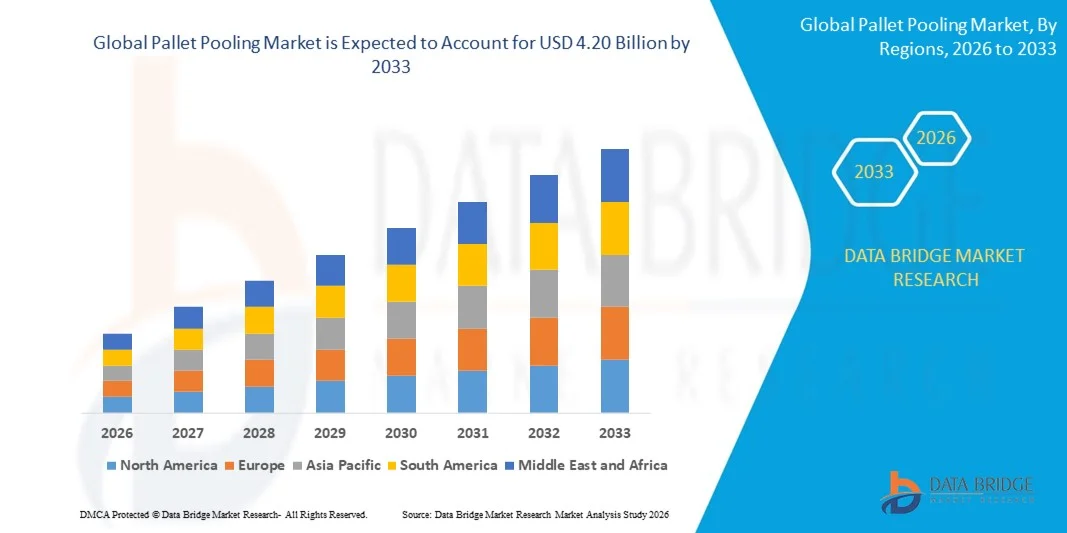
- The global pallet pooling market size was valued at USD 2.22 billion in 2025 and is expected to reach USD 4.20 billion by 2033, at a CAGR of 8.30% during the forecast period
- The market growth is largely fueled by the increasing need for cost-efficient and sustainable logistics solutions across retail, FMCG, pharmaceuticals, and manufacturing sectors, leading to higher adoption of shared and reusable pallet systems in global supply chains
- Furthermore, rising emphasis on reducing capital expenditure, optimizing asset utilization, and improving reverse logistics efficiency is positioning pallet pooling as a strategic solution for companies aiming to enhance operational performance and meet sustainability targets. These converging factors are accelerating the transition from pallet ownership models to organized pooling networks, thereby significantly boosting the industry’s growth
Pallet Pooling Market Analysis
- Pallet pooling systems, which provide standardized reusable pallets on a rental or shared basis, are becoming essential components of modern supply chain and distribution networks due to their ability to streamline transportation, reduce handling inefficiencies, and ensure consistent quality across multiple shipment cycles
- The escalating demand for pallet pooling is primarily driven by rapid expansion of organized retail and e-commerce, increasing cross-border trade activities, and growing corporate focus on circular economy practices aimed at minimizing waste and improving resource efficiency
- North America dominated the pallet pooling market with a share of 38.45% in 2025, due to the presence of well-established retail, FMCG, and manufacturing sectors along with highly organized supply chain networks
- Asia-Pacific is expected to be the fastest growing region in the pallet pooling market during the forecast period due to rapid industrialization, expanding retail networks, and increasing cross-border trade activities
- Wood segment dominated the market with a market share of 68.05% in 2025, due to its cost-effectiveness, widespread availability, and established use in global logistics networks. Wooden pallets are easy to repair and refurbish within pooling systems, extending their lifecycle and reducing overall asset replacement costs. Their high strength-to-weight ratio and adaptability across various industries such as FMCG and food distribution contribute to sustained demand
Report Scope and Pallet Pooling Market Segmentation
|
Attributes |
Pallet Pooling Key Market Insights |
|
Segments Covered |
|
|
Countries Covered |
North America
Europe
Asia-Pacific
Middle East and Africa
South America
|
|
Key Market Players |
|
|
Market Opportunities |
|
|
Value Added Data Infosets |
In addition to the insights on market scenarios such as market value, growth rate, segmentation, geographical coverage, and major players, the market reports curated by the Data Bridge Market Research also include in-depth expert analysis, geographically represented company-wise production and capacity, network layouts of distributors and partners, detailed and updated price trend analysis and deficit analysis of supply chain and demand. |
Pallet Pooling Market Trends
Increasing Adoption of Sustainable and Reusable Logistics Solutions
- A significant trend in the pallet pooling market is the growing adoption of sustainable and reusable pallet systems, driven by increasing environmental regulations and corporate sustainability commitments across supply chains. Businesses are transitioning from single-use wooden pallets to pooled and returnable solutions that reduce waste generation and optimize resource utilization across transportation networks
- For instance, CHEP operates large-scale pallet pooling networks that enable manufacturers and retailers to share and reuse standardized pallets, reducing overall material consumption and carbon emissions. Such structured pooling systems enhance supply chain efficiency while supporting corporate sustainability targets and regulatory compliance initiatives
- The expansion of organized retail and e-commerce sectors is strengthening the demand for standardized and trackable pallet assets that ensure smooth inter-facility product movement. Pooled pallets provide consistent quality and compatibility across warehouses, distribution centers, and cross-docking hubs, improving handling efficiency and minimizing product damage
- Industries such as food and beverages, pharmaceuticals, and fast-moving consumer goods are increasingly preferring hygienic and durable pallet solutions that comply with safety standards. Reusable plastic pallets within pooling networks offer improved sanitation control and long operational lifespans, aligning with strict industry requirements
- The integration of digital tracking technologies into pallet pooling systems is gaining momentum as companies aim to improve asset visibility and reduce losses. RFID and IoT-enabled pallets are enabling real-time monitoring, better inventory planning, and enhanced reverse logistics coordination across complex supply chains
- The market is witnessing stronger collaboration between logistics providers, manufacturers, and retailers to develop circular supply chain ecosystems based on shared pallet assets. This rising focus on sustainability, operational transparency, and long-term cost optimization is reinforcing pallet pooling as a strategic logistics model across global trade networks
Pallet Pooling Market Dynamics
Driver
Rising Demand for Cost-Effective and Efficient Supply Chain Operations
- The rising pressure on companies to optimize logistics expenses and improve operational efficiency is a major driver for the pallet pooling market. Shared pallet systems eliminate the need for large capital expenditure on pallet procurement and maintenance, allowing businesses to convert fixed costs into variable service-based expenses
- For instance, Brambles Limited, through its pooling operations, provides standardized pallet solutions that reduce handling inefficiencies and lower transportation costs for large retailers and manufacturers. These managed services enhance supply chain coordination and allow companies to focus on core production and distribution activities
- The increasing complexity of global supply chains is encouraging organizations to adopt standardized pallet formats that ensure compatibility across different transport modes and international markets. Pooling providers maintain pallet quality and repair cycles, minimizing disruptions and improving turnaround time across distribution networks
- Growing demand for just-in-time delivery models in sectors such as automotive and consumer goods is strengthening the need for reliable and ready-to-use pallet inventories. Pooling systems support continuous pallet availability, which reduces delays and enhances overall logistics responsiveness
- The consistent requirement to enhance supply chain productivity while controlling logistics expenditure continues to reinforce this driver. The shift toward outsourced pallet management solutions is positioning pooling networks as essential tools for achieving scalable, cost-efficient, and performance-oriented distribution systems
Restraint/Challenge
High Initial Investment and Complex Pallet Tracking Management
- The pallet pooling market faces challenges due to the substantial initial investment required to establish large pallet inventories, repair facilities, and distribution infrastructure. Providers must deploy significant capital to build extensive networks capable of supporting high-volume customer operations
- For instance, PECO Pallet invests heavily in pallet manufacturing, recovery depots, and tracking technologies to maintain service reliability across North America. Such infrastructure development demands strong financial resources and long-term operational planning, which may limit entry for smaller players
- Implementing advanced tracking systems such as RFID and barcode technologies adds complexity to pallet management processes. Integrating these systems across multiple stakeholders requires coordination, data synchronization, and cybersecurity safeguards to ensure seamless asset monitoring
- Managing reverse logistics and ensuring timely pallet returns from various supply chain nodes remains operationally demanding. Delays or mismanagement in retrieval processes can increase asset loss rates and disrupt circulation efficiency within pooling networks
- The ongoing need to balance infrastructure investment, technology integration, and service scalability presents a structural challenge for market participants. These factors collectively influence profitability margins and require continuous optimization to sustain competitive positioning in the pallet pooling industry
Pallet Pooling Market Scope
The market is segmented on the basis of structural design, material, and end user.
- By Structural Design
On the basis of structural design, the pallet pooling market is segmented into blocks, stringers, and customized pallets. The blocks segment dominated the market with the largest revenue share in 2025, driven by its superior durability, four-way entry design, and high load-bearing capacity suitable for automated handling systems. Block pallets are widely preferred in large-scale distribution centers and export-oriented supply chains due to their compatibility with forklifts and pallet jacks from all sides, improving operational efficiency. Their longer service life and ability to withstand multiple rotation cycles within pooling networks further enhance cost optimization for logistics providers and manufacturers. In addition, standardized block pallet designs support seamless integration across international transportation and warehouse systems, strengthening their dominance in organized pallet pooling operations.
The customized segment is anticipated to witness the fastest growth rate from 2026 to 2033, fueled by increasing demand for tailored pallet solutions across diverse industries with specific load and handling requirements. Companies operating in pharmaceuticals, electronics, and high-value goods are increasingly opting for customized pallets designed to meet precise dimensional, hygiene, and safety standards. Customized structural designs enable better space utilization in warehouses and vehicles, reducing transportation costs and product damage risks. The rising complexity of supply chains and the expansion of automated storage and retrieval systems are further accelerating the adoption of structurally customized pallets within pooling models.
- By Material
On the basis of material, the pallet pooling market is segmented into wood, composite, plastic, steel, and other metals. The wood segment dominated the market with the largest revenue share of 68.05% in 2025, driven by its cost-effectiveness, widespread availability, and established use in global logistics networks. Wooden pallets are easy to repair and refurbish within pooling systems, extending their lifecycle and reducing overall asset replacement costs. Their high strength-to-weight ratio and adaptability across various industries such as FMCG and food distribution contribute to sustained demand. In addition, the familiarity of wooden pallets with regulatory frameworks and export compliance standards supports their continued dominance in pooled pallet operations.
The plastic segment is expected to witness the fastest CAGR from 2026 to 2033, driven by increasing emphasis on hygiene, durability, and sustainability in closed-loop supply chains. Plastic pallets offer resistance to moisture, chemicals, and pests, making them highly suitable for pharmaceuticals and food applications. Their consistent dimensions and lighter weight improve automation compatibility and transportation efficiency. Growing environmental concerns and the rising adoption of recyclable and reusable plastic materials within circular economy initiatives are further propelling the growth of plastic pallets in pooling networks.
- By End User
On the basis of end user, the pallet pooling market is segmented into FMCG, food & beverages, pharmaceuticals, electronics, chemicals, and others. The FMCG segment dominated the market with the largest revenue share in 2025, driven by high-volume product movement, rapid inventory turnover, and the need for standardized logistics solutions. Pallet pooling enables FMCG companies to optimize distribution efficiency, reduce capital expenditure on pallet ownership, and streamline reverse logistics processes. The frequent replenishment cycles and expansive retail networks within the FMCG sector significantly increase demand for reliable and reusable pallet systems. In addition, the growing expansion of organized retail and e-commerce channels further strengthens pallet pooling adoption in this segment.
The pharmaceuticals segment is projected to witness the fastest growth rate from 2026 to 2033, fueled by stringent regulatory requirements, rising demand for temperature-controlled logistics, and increasing global drug distribution. Pallet pooling provides pharmaceutical companies with traceable, hygienic, and standardized load carriers that support compliance and product safety. The expansion of biologics, vaccines, and specialty medicines requiring secure and contamination-free transportation further accelerates demand. Growing investments in healthcare infrastructure and cross-border pharmaceutical trade are also contributing to the rapid adoption of pallet pooling solutions in this segment.
Pallet Pooling Market Regional Analysis
- North America dominated the pallet pooling market with the largest revenue share of 38.45% in 2025, driven by the presence of well-established retail, FMCG, and manufacturing sectors along with highly organized supply chain networks
- Companies in the region emphasize efficient logistics, asset optimization, and cost reduction, leading to widespread adoption of pooled pallets across distribution centers and cross-border trade routes
- This strong market position is further supported by advanced warehouse automation, high trade volumes, and the presence of major pooling service providers, establishing pallet pooling as a preferred logistics solution across industries
U.S. Pallet Pooling Market Insight
The U.S. pallet pooling market captured the largest revenue share within North America in 2025, fueled by extensive retail networks, large-scale manufacturing output, and growing e-commerce penetration. Businesses are increasingly focusing on reducing capital expenditure and improving supply chain sustainability through shared pallet systems. The strong presence of national distribution hubs and third-party logistics providers accelerates pallet circulation and recovery rates. Moreover, increasing emphasis on circular economy practices and standardized freight handling systems continues to propel market expansion across the country.
Europe Pallet Pooling Market Insight
The Europe pallet pooling market is projected to expand at a substantial CAGR throughout the forecast period, primarily driven by strict environmental regulations and strong focus on sustainable logistics practices. The widespread adoption of reusable transport packaging solutions across food & beverages and pharmaceuticals supports market growth. European companies prioritize standardized load carriers to streamline cross-border trade within the region. Growth in organized retail chains and expansion of automated warehousing infrastructure further encourage pallet pooling adoption across multiple industries.
U.K. Pallet Pooling Market Insight
The U.K. pallet pooling market is anticipated to grow at a noteworthy CAGR during the forecast period, driven by increasing demand for efficient distribution systems and expansion of online retail channels. Businesses are focusing on minimizing logistics costs and enhancing asset utilization through rental-based pallet solutions. The country’s advanced retail supply chains and strong import-export activities create consistent demand for pooled pallets. Rising sustainability commitments among corporations are also supporting the transition toward reusable pallet systems.
Germany Pallet Pooling Market Insight
The Germany pallet pooling market is expected to expand at a considerable CAGR during the forecast period, fueled by its strong manufacturing base and export-oriented economy. The country’s automotive, chemicals, and industrial sectors require durable and standardized pallet systems for efficient goods movement. High adoption of automated storage and retrieval systems promotes the use of uniform pooled pallets. Germany’s focus on operational efficiency and environmentally responsible logistics further strengthens market growth.
Asia-Pacific Pallet Pooling Market Insight
The Asia-Pacific pallet pooling market is poised to grow at the fastest CAGR during the forecast period of 2026 to 2033, driven by rapid industrialization, expanding retail networks, and increasing cross-border trade activities. Growing investments in logistics infrastructure and warehousing facilities are encouraging the shift from traditional pallet ownership to pooling models. Rising awareness regarding cost optimization and sustainable supply chain practices is accelerating adoption across emerging economies. The expansion of manufacturing hubs and organized distribution channels further supports strong regional growth momentum.
Japan Pallet Pooling Market Insight
The Japan pallet pooling market is gaining momentum due to the country’s advanced logistics systems and strong emphasis on operational precision. Businesses increasingly adopt standardized and reusable pallets to improve efficiency within automated warehouses and just-in-time delivery models. The growing need for hygienic transport solutions in food and pharmaceutical industries supports pallet pooling expansion. In addition, Japan’s focus on waste reduction and resource efficiency aligns with the adoption of returnable pallet systems.
China Pallet Pooling Market Insight
The China pallet pooling market accounted for the largest market revenue share in Asia Pacific in 2025, attributed to rapid industrial growth, expanding e-commerce platforms, and increasing domestic consumption. The country’s large manufacturing output and export activities generate substantial demand for standardized pallet circulation systems. Government initiatives promoting modern logistics infrastructure and smart warehousing solutions further accelerate market penetration. The presence of large distribution networks and rising investment in supply chain optimization continue to propel pallet pooling adoption across China.
Pallet Pooling Market Share
The pallet pooling industry is primarily led by well-established companies, including:
- Brambles Limited (Australia)
- LOSCAM (Hong Kong)
- Euro Pool System Benelux (Netherlands)
- Faber Halbertsma Group (Netherlands)
- Schoeller Allibert (Netherlands)
- LPR - La Palette Rouge (France)
- Zentek Pool System GmbH (Germany)
- Contraload NV (Belgium)
- PPS Midlands Limited (U.K.)
- DS Smith Plastics Ltd. (U.K.)
- Buckhorn Inc. (U.S.)
- CABKA Group (Germany)
- iGPS Logistics LLC (U.S.)
- Litco International, Inc. (U.S.)
- Noto GmbH (Germany)
- Falkenhahn AG (Germany)
- The Corrugated Pallets Company (U.K.)
- PGS GROUP (France)
Latest Developments in Global Pallet Pooling Market
- In February 2025, IFCO Systems reported avoiding 674,333 tonnes of CO₂e across 2.4 billion shipments in 2024 and introduced lightweight Dora and Nestor plastic pallets while expanding automated service centers in the U.K., significantly strengthening its sustainability credentials within the pallet pooling market. The launch of lighter pallets is expected to reduce transportation fuel consumption and improve handling efficiency, while automation investments enhance turnaround speed, asset tracking accuracy, and overall service reliability for retailers and fresh food supply chains
- In February 2025, Ercros achieved 8,580 tonnes of CO₂ savings by increasing the use of recycled and second-hand pallets to 50% of its annual volumes, reinforcing circular economy integration within industrial logistics operations. This transition lowers procurement costs and reduces dependency on virgin raw materials, encouraging other chemical and manufacturing companies to adopt reusable and pooled pallet systems to meet sustainability targets and regulatory expectations
- In January 2025, Hyne Group acquired Express Pallets to expand its timber processing and pallet manufacturing capacity in Australia, enhancing domestic production capabilities and vertical integration. The acquisition strengthens supply security for pallet pooling providers and large-scale distributors, reduces lead times, and supports rising regional demand for standardized wooden pallets across retail and export-driven industries
- In December 2024, BC Wood Products acquired American Pallet Corporation, broadening its manufacturing and distribution footprint across North America. This strategic move increases production capacity, improves regional service coverage, and enhances competitive positioning in the pallet pooling market by enabling faster pallet recovery, refurbishment, and redeployment across high-volume logistics corridors
- In November 2024, Brambles Limited expanded its pallet pooling operations across Southeast Asia through greater investment in digital tracking and asset management technologies. The deployment of advanced visibility systems improves pallet utilization rates, minimizes loss and damage, and enhances data-driven decision-making, thereby accelerating the transition from traditional pallet ownership models to technology-enabled shared pooling systems in emerging markets
SKU-
Get online access to the report on the World's First Market Intelligence Cloud

- Interactive Data Analysis Dashboard
- Company Analysis Dashboard for high growth potential opportunities
- Research Analyst Access for customization & queries
- Competitor Analysis with Interactive dashboard
- Latest News, Updates & Trend analysis
- Harness the Power of Benchmark Analysis for Comprehensive Competitor Tracking
Global Pallet Pooling Market, Supply Chain Analysis and Ecosystem Framework
To support market growth and help clients navigate the impact of geopolitical shifts, DBMR has integrated in-depth supply chain analysis into its Global Pallet Pooling Market research reports. This addition empowers clients to respond effectively to global changes affecting their industries. The supply chain analysis section includes detailed insights such as Global Pallet Pooling Market consumption and production by country, price trend analysis, the impact of tariffs and geopolitical developments, and import and export trends by country and HSN code. It also highlights major suppliers with data on production capacity and company profiles, as well as key importers and exporters. In addition to research, DBMR offers specialized supply chain consulting services backed by over a decade of experience, providing solutions like supplier discovery, supplier risk assessment, price trend analysis, impact evaluation of inflation and trade route changes, and comprehensive market trend analysis.
Research Methodology
Data collection and base year analysis are done using data collection modules with large sample sizes. The stage includes obtaining market information or related data through various sources and strategies. It includes examining and planning all the data acquired from the past in advance. It likewise envelops the examination of information inconsistencies seen across different information sources. The market data is analysed and estimated using market statistical and coherent models. Also, market share analysis and key trend analysis are the major success factors in the market report. To know more, please request an analyst call or drop down your inquiry.
The key research methodology used by DBMR research team is data triangulation which involves data mining, analysis of the impact of data variables on the market and primary (industry expert) validation. Data models include Vendor Positioning Grid, Market Time Line Analysis, Market Overview and Guide, Company Positioning Grid, Patent Analysis, Pricing Analysis, Company Market Share Analysis, Standards of Measurement, Global versus Regional and Vendor Share Analysis. To know more about the research methodology, drop in an inquiry to speak to our industry experts.
Customization Available
Data Bridge Market Research is a leader in advanced formative research. We take pride in servicing our existing and new customers with data and analysis that match and suits their goal. The report can be customized to include price trend analysis of target brands understanding the market for additional countries (ask for the list of countries), clinical trial results data, literature review, refurbished market and product base analysis. Market analysis of target competitors can be analyzed from technology-based analysis to market portfolio strategies. We can add as many competitors that you require data about in the format and data style you are looking for. Our team of analysts can also provide you data in crude raw excel files pivot tables (Fact book) or can assist you in creating presentations from the data sets available in the report.












