




Global Paperboard Jar Market
Market Size in USD Million
CAGR :
% 
 USD
354.47 Million
USD
477.71 Million
2025
2033
USD
354.47 Million
USD
477.71 Million
2025
2033
 Forecast Period Forecast Period |
2026 - 2033 |
 Market Size (Base Year) Market Size (Base Year) |
USD 354.47 Million |
 Market Size (Forecast Year) Market Size (Forecast Year) |
USD 477.71 Million |
 CAGR CAGR |
% |
| Major Markets Players |
|
Paperboard Jar Market Overview
The Paperboard Jar Market was valued at USD 354.47 Million in 2025 and is projected to reach USD 477.71 Million by 2033, growing at a CAGR of 3.8% from 2026 to 2033. The market is experiencing consistent growth driven by rising demand for sustainable and recyclable packaging solutions, increasing substitution of plastic containers with fiber-based alternatives, and growing adoption across food, personal care, and consumer goods industries. Expanding e-commerce packaging requirements, coupled with advancements in barrier-coated paperboard technologies, are further strengthening market growth across developed and emerging regions.
The increasing global shift toward circular economy practices and stringent regulations on single-use plastics is significantly accelerating the adoption of paperboard jars as brands focus on reducing environmental impact. Growing consumer preference for eco-friendly, lightweight, and premium packaging formats is further encouraging manufacturers to invest in fiber-based rigid packaging solutions that offer both sustainability and branding advantages.
Key Market Trends & Insights
- Asia-Pacific dominated the Paperboard Jar Market with the largest revenue share of 40% in 2025, supported by strong manufacturing capabilities, expanding packaging industry infrastructure, and rising demand for sustainable alternatives across food, personal care, and consumer goods applications
- The up to 50 mm segment led the market with a 46% share in 2025, driven by strong usage in personal care, cosmetics, and premium sample packaging applications where compact and precise dispensing is required
- North America is expected to be the fastest-growing region at a CAGR of 14.77% from 2026 to 2033, fueled by increasing demand for sustainable packaging solutions, strong regulatory focus on plastic reduction, and rising adoption of circular packaging systems
- Paperboard ends are the fastest-growing closure type, projected to register a CAGR of 16% from 2026 to 2033, supported by rising sustainability mandates and increasing substitution of plastic-based closures with recyclable paperboard alternatives
- The caps segment dominated the closure type category with a 38% revenue share in 2025, led by its widespread use across food, cosmetics, and personal care packaging due to its strong sealing efficiency and user-friendly design
- Food & beverages accounted for 37.6% of the market in 2025, preferred by strong demand for sustainable packaging solutions in dry food, powdered beverages, and specialty food products
- The 51 mm – 100 mm segment is the fastest-growing neck diameter category, with a CAGR of 14% from 2026 to 2033, driven by increasing adoption in food, beverage, and ready-to-use consumer products requiring moderate to high-volume dispensing
Market Size & Forecast
- Global Market Value (2025): USD 47 Million
- Expected Market Value (2033): USD 477.71 Million
- Forecast CAGR (2026–2033): 3.8%
- Leading Region in 2025: Asia-Pacific
- Fastest Growing Region: North America
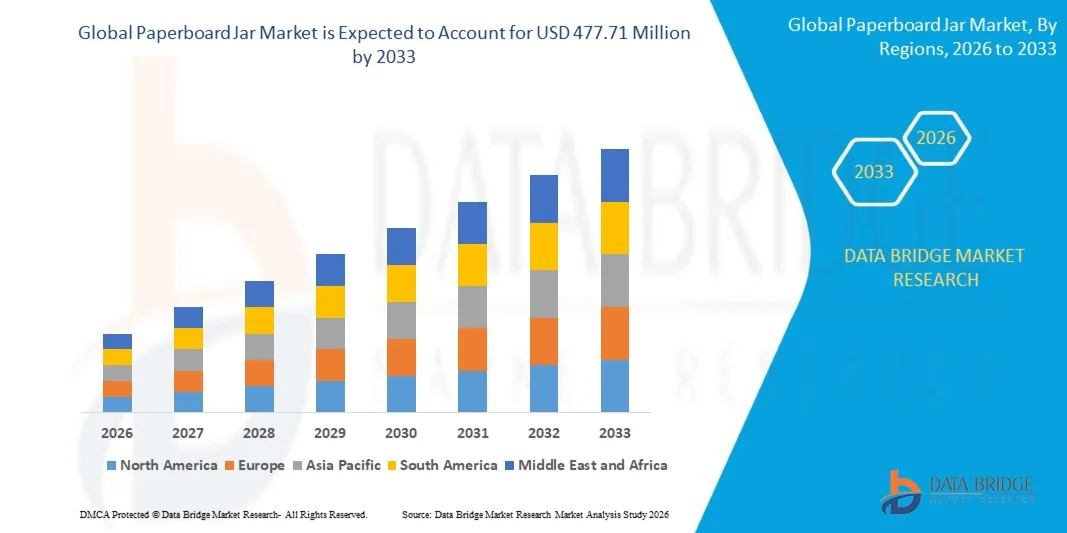
Report Scope and Paperboard Jar Market Segmentation
|
Attributes |
Paperboard Jar Key Market Insights |
|
Segments Covered |
|
|
Countries Covered |
North America · U.S. · Canada · Mexico Europe · Germany · France · U.K. · Netherlands · Switzerland · Belgium · Russia · Italy · Spain · Turkey · Rest of Europe Asia-Pacific · China · Japan · India · South Korea · Singapore · Malaysia · Australia · Thailand · Indonesia · Philippines · Rest of Asia-Pacific Middle East and Africa · Saudi Arabia · U.A.E. · South Africa · Egypt · Israel · Rest of Middle East and Africa South America · Brazil · Argentina · Rest of South America |
|
Key Market Players |
· Paper Tube Co. (U.S.) · Chicago Paper Tube & Can Company (U.S.) · Sonoco Products Company (U.S.) · WestRock Company (U.S.) · Nagel Paper (Germany) · Halaspack Bt (Hungary) · Irwin Packaging Pty Ltd. (Australia) · Ace Paper Tube (U.S.) · International Paper (U.S.) · Mondi (U.K.) · DS Smith (U.K.) · BRØDRENE HARTMANN A/S (Denmark) · Smurfit WestRock (U.S.) · Graphic Packaging International (U.S.) · Stora Enso Oyj (Finland) · Elopak ASA (Norway) · Greif, Inc. (U.S.) |
|
Market Opportunities |
· Expansion in Premium Cosmetics and Personal Care Packaging · Adoption in Food Packaging for Dry and Organic Products · Innovation in Coated and Barrier-Enhanced Paperboard Materials |
|
Value Added Data Infosets |
In addition to the insights on market scenarios such as market value, growth rate, segmentation, geographical coverage, and major players, the market reports curated by the Data Bridge Market Research also include import export analysis, production capacity overview, production consumption analysis, price trend analysis, climate change scenario, supply chain analysis, value chain analysis, raw material/consumables overview, vendor selection criteria, PESTLE Analysis, Porter Analysis, and regulatory framework. |
Paperboard Jar Market Trends
Trend: Rising Shift Toward Sustainable and Plastic-Free Packaging Alternatives
The paperboard jar market is witnessing a strong transition toward sustainable and plastic-free packaging formats, driven by increasing demand for recyclable and biodegradable container solutions. Brands are replacing conventional plastic jars with fiber-based paperboard alternatives to reduce environmental footprint and align with circular economy goals. Adoption is particularly strong in cosmetics, personal care, and dry food packaging, where lightweight and renewable materials are gaining preference.
Companies such as Sonoco Products Company are advancing fiber-based container solutions, including rigid paperboard jars used in food and consumer goods packaging, supporting large-scale plastic substitution initiatives across global retail supply chains.
Paperboard Jar Market Dynamics
Key Market Driver: Growing Demand from Eco-Conscious Consumer Brands and Retailers
The growing emphasis on sustainability targets and stricter packaging regulations is significantly driving demand for paperboard jars across multiple end-use industries. Consumer brands are increasingly shifting toward recyclable and renewable packaging formats to meet ESG commitments and comply with regulations such as extended producer responsibility frameworks. Major FMCG companies are redesigning packaging portfolios to reduce plastic usage and improve recyclability performance across global markets.
Companies such as Unilever and Procter & Gamble are actively introducing paper-based and fiber-reinforced packaging solutions in personal care and household product segments, accelerating adoption of paperboard jar formats in mainstream retail channels.
Key Restraint/Challenge: Limited Moisture Resistance and Structural Durability
A major challenge in the paperboard jar market is the limited moisture resistance and structural integrity compared to plastic and metal packaging formats. Paperboard jars often require barrier coatings or liners to prevent deformation and product contamination, particularly in humid environments or liquid-sensitive applications. The use of advanced coatings improves performance but can increase production complexity and raise sustainability concerns in certain cases.
Packaging manufacturers such as Mondi Group and Smurfit Kappa are investing in fiber-based barrier technologies and recyclable coating innovations to enhance durability while maintaining environmental compliance across food and personal care applications.
Key Market Opportunity: Adoption in Food Packaging for Dry and Organic Products
The growing demand for premium, organic, and dry food products is creating significant opportunities for paperboard jar adoption in retail packaging applications. Consumers are increasingly favoring eco-friendly packaging formats for products such as powdered foods, supplements, skincare, and cosmetics, where product stability aligns well with fiber-based containers. The rise of e-commerce and premium branding strategies is further supporting adoption of lightweight and visually customizable paperboard jars.
Companies such as Huhtamaki are expanding fiber-based packaging portfolios, enabling brands to adopt sustainable jar formats across organic food and personal care product lines, strengthening long-term market growth potential.
Paperboard Jar Market Scope
The paperboard jar market is segmented on the basis of neck diameter, closure type, and end use.
- By Neck Diameter
On the basis of neck diameter, the Paperboard Jar Market is segmented into up to 50 mm, 51 mm – 100 mm, and 101 mm and above. The Up to 50 mm segment dominated the market with the largest share of 46% in 2025, driven by strong usage in personal care, cosmetics, and premium sample packaging applications where compact and precise dispensing is required. Manufacturers prefer smaller neck diameters as they support controlled product flow and reduce material wastage during usage. The segment also benefits from high compatibility with lightweight paperboard structures used in sustainable packaging formats. Rising demand for travel-size and single-use packaging formats further strengthens its leading position across developed and emerging markets.
The 51 mm – 100 mm segment is projected to register the fastest growth at a CAGR of 14% from 2026 to 2033, driven by increasing adoption in food, beverage, and ready-to-use consumer products requiring moderate to high-volume dispensing. This range supports better product accessibility and ease of filling, making it suitable for expanding packaged food applications. Growing shift toward sustainable alternatives in mid-size packaging formats is accelerating replacement of plastic containers with paperboard jars. Expanding retail penetration of bulk snack and dry food packaging is further supporting segment expansion across urban consumption markets.
- By Closure Type
On the basis of closure type, the Paperboard Jar Market is segmented into caps, snap-on, plug, lids, metal, plastic, and paperboard ends. The Caps segment dominated the market with a share of 38% in 2025, supported by its widespread use across food, cosmetics, and personal care packaging due to its strong sealing efficiency and user-friendly design. Caps offer reliable protection against moisture and contamination, making them highly suitable for sensitive and dry product categories. Their cost-effectiveness and ease of integration with paperboard jar structures further enhance adoption among manufacturers. Strong compatibility with automated filling and sealing lines reinforces their dominant position in large-scale production environments.
The Paperboard Ends segment is projected to register the fastest growth at a CAGR of 16% from 2026 to 2033, driven by rising sustainability mandates and increasing substitution of plastic-based closures with recyclable paperboard alternatives. Brands are rapidly adopting fiber-based closure systems to improve circular packaging performance and reduce carbon footprint. Advancements in barrier coating technologies are improving durability and moisture resistance of paperboard ends, expanding their usability across food and beverage applications. Increasing regulatory pressure on single-use plastics is further accelerating adoption across global packaging supply chains.
- By End Use
On the basis of end use, the Paperboard Jar Market is segmented into personal care & cosmetics, coffee and tea, food & beverages, snacks & confectionery, industrial goods, consumer goods, and others. The Food & Beverages segment dominated the market with the largest share of 37.6% in 2025, driven by strong demand for sustainable packaging solutions in dry food, powdered beverages, and specialty food products. Paperboard jars offer lightweight structure, recyclability, and strong branding surfaces, making them highly preferred by food manufacturers. Increasing consumer shift toward eco-friendly packaging alternatives is further strengthening adoption in mainstream retail channels. Expansion of organized food retail and private label brands continues to reinforce segment leadership across global markets.
The Personal Care & Cosmetics segment is projected to register the fastest growth at a CAGR of 15% from 2026 to 2033, driven by rising demand for premium, sustainable, and aesthetic packaging formats in skincare, haircare, and beauty products. Brands are increasingly adopting paperboard jars to align with clean-label positioning and environmental commitments. Growing consumer preference for recyclable and plastic-free packaging is accelerating innovation in moisture-resistant and durable paperboard solutions. Expanding premium cosmetics distribution through e-commerce and boutique retail channels is further supporting rapid segment expansion.
Paperboard Jar Market Regional Analysis
Asia-Pacific dominated the paperboard jar market and accounted for the largest revenue share of 40% in 2025, supported by strong manufacturing capabilities, expanding packaging industry infrastructure, and rising demand for sustainable alternatives across food, personal care, and consumer goods applications. The region benefits from large-scale paperboard production capacity, cost-efficient raw material availability, and rapid adoption of eco-friendly packaging formats. Increasing consumption of packaged food products, growth of e-commerce retail channels, and shifting consumer preference toward recyclable packaging are further strengthening regional market expansion. Strong export activity from key manufacturing hubs and continuous innovation in fiber-based packaging solutions continue to reinforce Asia-Pacific’s leading position.
China Paperboard Jar Market Insight
China held the largest share in the Asia-Pacific Paperboard Jar market in 2025, supported by its extensive packaging manufacturing ecosystem and high-volume production of sustainable packaging materials. The country benefits from strong integration between paperboard producers, packaging converters, and end-use industries such as food, cosmetics, and household goods. Rising domestic demand for eco-friendly packaging driven by environmental regulations is further accelerating adoption. In addition, rapid expansion of e-commerce platforms and branded consumer goods packaging is strengthening large-scale utilization of paperboard jars across industrial and retail supply chains.
India Paperboard Jar Market Insight
India is witnessing the fastest growth in the Asia-Pacific region, driven by increasing demand for sustainable packaging solutions, rapid expansion of the food processing sector, and growing adoption of premium packaging formats in personal care and consumer goods. Rising environmental awareness and regulatory push toward plastic reduction are significantly accelerating substitution with paperboard-based containers. Expanding organized retail, growing penetration of packaged food brands, and increasing use of eco-friendly packaging in cosmetics and wellness products are further supporting market growth. Continuous investments in packaging innovation and cost-efficient manufacturing are reinforcing long-term expansion.
Europe Paperboard Jar Market Insight
The Europe Paperboard Jar market is expanding steadily, supported by strong sustainability regulations, high consumer preference for recyclable packaging, and increasing adoption of circular economy practices across industries. Demand is particularly strong in food & beverages, cosmetics, and premium consumer goods segments where brands are prioritizing low-impact packaging materials. Rising imports of advanced fiber-based packaging solutions and continuous innovation in barrier coatings are improving performance and durability of paperboard jars. In addition, growing emphasis on reducing single-use plastics is further supporting regional market development.
Germany Paperboard Jar Market Insight
Germany accounted for the largest share in the Europe Paperboard Jar market in 2025, driven by its advanced packaging industry, strong presence of food processing manufacturers, and high adoption of sustainable packaging technologies. The country’s well-developed retail and industrial ecosystem supports large-scale integration of paperboard jars across multiple end-use sectors. Increasing demand for organic food products and premium cosmetics is further strengthening adoption of recyclable packaging formats. In addition, strong regulatory frameworks promoting environmental sustainability continue to reinforce Germany’s leadership position in the regional market.
U.K. Paperboard Jar Market Insight
The U.K. market is driven by rising consumer preference for sustainable and plastic-free packaging solutions across food, beverage, and personal care applications. Growing demand for premium packaged goods and organic products is accelerating adoption of paperboard jars among manufacturers and retailers. The country is also experiencing increasing use of eco-friendly packaging in cosmetics and wellness products due to evolving consumer lifestyle trends. In addition, expansion of online grocery platforms and direct-to-consumer brands is further supporting market penetration.
North America Paperboard Jar Market Insight
North America is projected to register the fastest CAGR of 14.77% from 2026 to 2033, driven by increasing demand for sustainable packaging solutions, strong regulatory focus on plastic reduction, and rising adoption of circular packaging systems. Growing consumer awareness regarding environmental impact is accelerating the shift toward fiber-based containers across food, cosmetics, and household product categories. Expansion of premium and organic product lines, coupled with advancements in paperboard barrier technologies, is further supporting market growth. Increasing investments in sustainable packaging innovation and large-scale retail adoption continue to strengthen regional expansion.
U.S. Paperboard Jar Market Insight
The U.S. accounted for the largest share in the North America Paperboard Jar market in 2025, supported by strong demand from food & beverage, personal care, and consumer goods industries. The country benefits from a highly developed packaging ecosystem and widespread adoption of sustainable packaging initiatives across major brands. Rising consumer preference for eco-friendly, recyclable, and premium packaging formats is further driving market expansion. In addition, growing penetration of e-commerce platforms and private-label product lines is reinforcing the dominance of the U.S. in the regional market.
Paperboard Jar Market Share
The paperboard jar industry is primarily led by well-established companies, including:
- Paper Tube Co. (U.S.)
- Chicago Paper Tube & Can Company (U.S.)
- Sonoco Products Company (U.S.)
- WestRock Company (U.S.)
- Nagel Paper (Germany)
- Halaspack Bt (Hungary)
- Irwin Packaging Pty Ltd. (Australia)
- Ace Paper Tube (U.S.)
- International Paper (U.S.)
- Mondi (U.K.)
- DS Smith (U.K.)
- BRØDRENE HARTMANN A/S (Denmark)
- Smurfit WestRock (U.S.)
- Graphic Packaging International (U.S.)
- Stora Enso Oyj (Finland)
- Elopak ASA (Norway)
- Greif, Inc. (U.S.)
Latest Developments in Paperboard Jar Market
- In July 2024, the completion of the merger between Smurfit Kappa and WestRock to form Smurfit WestRock significantly strengthened global fiber-based packaging capacity, directly benefiting the paperboard jar market by expanding large-scale production of recyclable rigid paper containers and improving supply chain efficiency for FMCG and industrial packaging demand. The integration enhances innovation in molded fiber and paperboard jar formats, enabling faster commercialization of sustainable cylindrical packaging solutions across food, cosmetics, and consumer goods sectors
- In March 2024, Mondi expanded its paper-based packaging portfolio through increased investment in recyclable fiber packaging systems, strengthening its ability to supply high-barrier paperboard alternatives used in jar-like formats. This development positively impacts the market by accelerating substitution of plastic jars with sustainable fiber containers across food and personal care industries. It also enhances material performance, enabling better moisture resistance and durability required for premium packaging applications
- In June 2023, Sonoco Products Company expanded its paper can and rigid fiber container capabilities, reinforcing its role in providing sustainable alternatives to plastic jars in food, snacks, and cosmetic packaging applications. This development supports market growth by increasing availability of scalable, recyclable cylindrical packaging solutions that align with brand sustainability goals. It also strengthens adoption across retail and e-commerce channels where lightweight and eco-friendly packaging demand is rising
- In September 2023, Paper Bottle Company (Paboco) advanced its commercialization efforts for fiber-based bottle and jar-like packaging through strategic collaborations with global beverage and consumer brands, improving the feasibility of paper-based primary packaging. This development impacts the market by accelerating innovation in fully recyclable packaging systems that replace conventional plastic jars. It also enhances material engineering, particularly in barrier coating technologies needed for liquid and semi-solid product applications
- In April 2023, Huhtamaki completed the acquisition of Elif Plastics, strengthening its sustainable packaging capabilities and supporting expansion into advanced fiber-based and recyclable packaging solutions. This development positively influences the paperboard jar market by improving material innovation and enabling hybrid packaging structures that support circular economy goals. It also enhances production scalability, helping meet growing global demand for eco-friendly jar and container formats across food and personal care sectors
SKU-
Get online access to the report on the World's First Market Intelligence Cloud

- Interactive Data Analysis Dashboard
- Company Analysis Dashboard for high growth potential opportunities
- Research Analyst Access for customization & queries
- Competitor Analysis with Interactive dashboard
- Latest News, Updates & Trend analysis
- Harness the Power of Benchmark Analysis for Comprehensive Competitor Tracking
Global Paperboard Jar Market, Supply Chain Analysis and Ecosystem Framework
To support market growth and help clients navigate the impact of geopolitical shifts, DBMR has integrated in-depth supply chain analysis into its Global Paperboard Jar Market research reports. This addition empowers clients to respond effectively to global changes affecting their industries. The supply chain analysis section includes detailed insights such as Global Paperboard Jar Market consumption and production by country, price trend analysis, the impact of tariffs and geopolitical developments, and import and export trends by country and HSN code. It also highlights major suppliers with data on production capacity and company profiles, as well as key importers and exporters. In addition to research, DBMR offers specialized supply chain consulting services backed by over a decade of experience, providing solutions like supplier discovery, supplier risk assessment, price trend analysis, impact evaluation of inflation and trade route changes, and comprehensive market trend analysis.
Research Methodology
Data collection and base year analysis are done using data collection modules with large sample sizes. The stage includes obtaining market information or related data through various sources and strategies. It includes examining and planning all the data acquired from the past in advance. It likewise envelops the examination of information inconsistencies seen across different information sources. The market data is analysed and estimated using market statistical and coherent models. Also, market share analysis and key trend analysis are the major success factors in the market report. To know more, please request an analyst call or drop down your inquiry.
The key research methodology used by DBMR research team is data triangulation which involves data mining, analysis of the impact of data variables on the market and primary (industry expert) validation. Data models include Vendor Positioning Grid, Market Time Line Analysis, Market Overview and Guide, Company Positioning Grid, Patent Analysis, Pricing Analysis, Company Market Share Analysis, Standards of Measurement, Global versus Regional and Vendor Share Analysis. To know more about the research methodology, drop in an inquiry to speak to our industry experts.
Customization Available
Data Bridge Market Research is a leader in advanced formative research. We take pride in servicing our existing and new customers with data and analysis that match and suits their goal. The report can be customized to include price trend analysis of target brands understanding the market for additional countries (ask for the list of countries), clinical trial results data, literature review, refurbished market and product base analysis. Market analysis of target competitors can be analyzed from technology-based analysis to market portfolio strategies. We can add as many competitors that you require data about in the format and data style you are looking for. Our team of analysts can also provide you data in crude raw excel files pivot tables (Fact book) or can assist you in creating presentations from the data sets available in the report.












