


Global Parcel Sortation Systems Market
Market Size in USD Billion
CAGR :
% 
 USD
3.47 Billion
USD
9.62 Billion
2025
2033
USD
3.47 Billion
USD
9.62 Billion
2025
2033
 Forecast Period Forecast Period |
2026 –2033 |
 Market Size (Base Year) Market Size (Base Year) |
USD 3.47 Billion |
 Market Size (Forecast Year) Market Size (Forecast Year) |
USD 9.62 Billion |
 CAGR CAGR |
% |
| Major Markets Players |
|
Parcel Sortation Systems Market Size
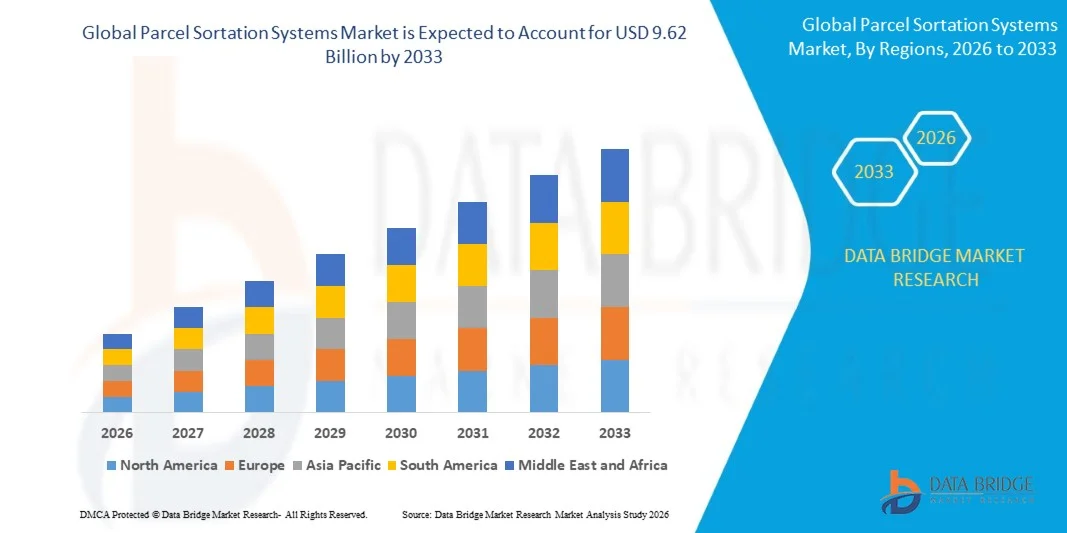
- The global parcel sortation systems market size was valued at USD 3.47 billion in 2025 and is expected to reach USD 9.62 billion by 2033, at a CAGR of 13.6% during the forecast period
- The market growth is largely fueled by the rapid expansion of e-commerce platforms and increasing parcel volumes across global supply chains, leading to strong demand for high-speed automated sortation systems in warehouses and distribution centers
- Furthermore, continuous advancements in robotics, artificial intelligence, and conveyor-based automation technologies are enabling higher sorting accuracy, faster processing speeds, and reduced operational costs, significantly strengthening system adoption across logistics networks
Parcel Sortation Systems Market Analysis
- Parcel sortation systems, designed to automatically identify, classify, and route packages within logistics and warehouse environments, are becoming essential components of modern supply chain automation due to their ability to enhance operational efficiency, reduce manual handling, and support large-scale order fulfillment
- The increasing need for faster delivery times, rising labor cost pressures, and growing demand for scalable logistics infrastructure are driving widespread deployment of advanced sortation solutions across e-commerce, retail, postal, and third-party logistics sectors
- Asia-Pacific dominated the parcel sortation systems market with a share of70% in 2025, due to rapid expansion of e-commerce fulfillment centers, express logistics networks, and high-volume retail distribution operations
- North America is expected to be the fastest growing region in the parcel sortation systems market during the forecast period due to rapid automation in e-commerce fulfillment, retail distribution, and third-party logistics operations
- Hardware segment dominated the market with a market share of 54.5% in 2025, due to the extensive requirement of physical infrastructure such as conveyors, scanners, and diverters in parcel sortation systems. High initial deployment of automated sorting machinery across large warehouses supports strong revenue contribution
Report Scope and Parcel Sortation Systems Market Segmentation
|
Attributes |
Parcel Sortation Systems Key Market Insights |
|
Segments Covered |
|
|
Countries Covered |
North America · U.S. · Canada · Mexico Europe · Germany · France · U.K. · Netherlands · Switzerland · Belgium · Russia · Italy · Spain · Turkey · Rest of Europe Asia-Pacific · China · Japan · India · South Korea · Singapore · Malaysia · Australia · Thailand · Indonesia · Philippines · Rest of Asia-Pacific Middle East and Africa · Saudi Arabia · U.A.E. · South Africa · Egypt · Israel · Rest of Middle East and Africa South America · Brazil · Argentina · Rest of South America |
|
Key Market Players |
· Siemens Logistics GmbH (Germany) · Vanderlande Industries B.V. (Netherlands) · BEUMER GROUP (Germany) · Bastian Solutions, LLC (U.S.) · FIVES (France) · Dematic (U.S.) · Murata Machinery, Ltd. (Japan) · Interroll Group (Switzerland) · Invata Intralogistics (U.S.) · viastore (Germany) · Okura Yusoki Co., Ltd. (Japan) · GBI Intralogistics, Inc. (U.S.) · Daifuku Co., Ltd. (Japan) · Equinox (India) · Pitney Bowes Inc. (U.S.) · MHS Global (U.S.) · SOLYSTIC SAS (France) · BOWE SYSTEC GMBH (Germany) · Honeywell International Inc. (U.S.) · Intralox (U.S.) |
|
Market Opportunities |
· Expansion of Smart Warehouses in Emerging Markets · Growth in Last-Mile and Micro-Fulfillment Automation |
|
Value Added Data Infosets |
In addition to the insights on market scenarios such as market value, growth rate, segmentation, geographical coverage, and major players, the market reports curated by the Data Bridge Market Research also include in-depth expert analysis, geographically represented company-wise production and capacity, network layouts of distributors and partners, detailed and updated price trend analysis and deficit analysis of supply chain and demand. |
Parcel Sortation Systems Market Trends
“Rising Adoption of AI and Robotic Sortation Systems”
- A significant trend in the parcel sortation systems market is the increasing deployment of AI-enabled and robotic sorting technologies across high-volume logistics and e-commerce fulfillment centers, driven by the need for faster, more accurate, and scalable parcel handling operations. This shift is transforming traditional warehouse operations into highly automated environments where intelligent systems manage sorting, routing, and distribution with minimal manual intervention
- For instance, Amazon has integrated AI-powered robotics and automated sortation systems across its fulfillment centers, significantly improving package processing speed and delivery efficiency during peak order volumes
- The adoption of machine learning-based vision systems and robotic arms is expanding across logistics hubs to enhance parcel identification, classification, and real-time decision-making. This is enabling logistics providers to reduce sorting errors and improve operational consistency in complex distribution networks
- Companies are increasingly investing in modular and scalable sortation systems that can be rapidly deployed and adjusted based on fluctuating parcel volumes, especially in e-commerce-driven markets. This flexibility is supporting the growing demand for efficient warehouse automation infrastructure
- The integration of smart sensors and data-driven automation platforms is improving system coordination and predictive maintenance capabilities within sortation facilities. This is enhancing system uptime and reducing operational disruptions in high-throughput environments
- The market is witnessing strong momentum toward fully automated, end-to-end logistics ecosystems where AI and robotics play a central role in parcel flow management. This evolution is reinforcing the shift toward intelligent, high-speed distribution networks across global supply chains
Parcel Sortation Systems Market Dynamics
Driver
“Growing E-Commerce Parcel Volumes Driving Automation Demand”
- The rapid expansion of global e-commerce activity is significantly increasing parcel volumes, creating strong demand for automated sortation systems that can efficiently handle large-scale order fulfillment and reduce dependency on manual labor. This is driving logistics providers to adopt high-speed sorting technologies to meet rising consumer expectations for faster deliveries
- For instance, Alibaba’s Cainiao Network has implemented large-scale automated sorting hubs in China to manage massive daily parcel flows generated by online retail platforms
- The surge in cross-border trade and online shopping platforms is further intensifying pressure on logistics infrastructure, requiring advanced sorting systems capable of processing diverse parcel types with high accuracy. This is supporting the expansion of automated distribution centers globally
- Rising demand for same-day and next-day delivery services is accelerating the need for faster and more efficient sortation processes within warehouses and fulfillment centers. This is pushing companies to invest in high-throughput automation systems
- The continuous increase in consumer expectations for speed, reliability, and transparency in deliveries is reinforcing long-term investment in automated sortation infrastructure. This sustained demand is a key factor driving market expansion globally
Restraint/Challenge
“High Installation Cost and System Integration Complexity”
- The parcel sortation systems market faces significant challenges due to the high initial investment required for installing advanced automation systems, including robotics, conveyor networks, and AI-enabled control platforms. These costs often limit adoption among small and mid-sized logistics operators
- For instance, companies implementing large-scale solutions such as Dematic’s automated sortation systems require substantial capital investment for infrastructure upgrades and system integration
- Integration of modern sortation systems with existing warehouse infrastructure is complex, often requiring customization and operational downtime during installation. This increases deployment timelines and disrupts ongoing logistics operations
- The need for skilled technical expertise to manage, operate, and maintain advanced automation systems further adds to operational complexity and cost burden for logistics providers. This creates barriers to rapid adoption in cost-sensitive markets
- The overall financial and technical barriers associated with deployment continue to restrain market penetration, particularly in developing regions where logistics infrastructure modernization is still in early stages of adoption
Parcel Sortation Systems Market Scope
The market is segmented on the basis of type, offering, tray size, parcel handling capacity, and end user.
- By Type
On the basis of type, the parcel sortation systems market is segmented into linear parcel sortation systems and loop parcel sortation systems. The loop parcel sortation systems segment dominated the market due to its high throughput capability and continuous operation design, making it suitable for large-scale distribution centers. These systems support high-speed sorting with minimal downtime, improving operational efficiency in high-volume logistics environments. Growing adoption in e-commerce fulfillment hubs further strengthens its market position. Integration with automated conveyor networks enhances accuracy and reduces manual intervention, supporting large order volumes.
The linear parcel sortation systems segment is expected to witness the fastest growth rate, driven by increasing demand for modular and flexible warehouse automation solutions. Linear systems are easier to install and scale, making them suitable for mid-sized facilities and expanding regional distribution centers. Their cost-effectiveness compared to loop systems supports adoption among small and medium logistics operators. Rising preference for adaptable infrastructure in dynamic supply chain environments further accelerates growth. These systems also allow incremental expansion without major structural redesign.
- By Offering
On the basis of offering, the market is segmented into hardware, software, and services. The hardware segment dominated the market with the largest share of 54.5% due to the extensive requirement of physical infrastructure such as conveyors, scanners, and diverters in parcel sortation systems. High initial deployment of automated sorting machinery across large warehouses supports strong revenue contribution. Continuous upgrades in mechanical components enhance sorting speed and accuracy. Expansion of fulfillment centers globally further drives hardware installations in high-capacity logistics networks.
The software segment is anticipated to witness the fastest growth rate, driven by increasing adoption of AI-based routing, warehouse management integration, and real-time tracking systems. Software solutions optimize parcel flow, reduce sorting errors, and improve operational visibility across facilities. Growing demand for predictive analytics and automation control systems strengthens software penetration. Integration with cloud-based logistics platforms further enhances scalability and remote management capabilities.
- By Tray Size
On the basis of tray size, the market is segmented into medium, small, and large. The medium tray size segment dominated the market due to its versatility in handling a wide range of parcel dimensions commonly processed in e-commerce and retail logistics. These systems balance speed and flexibility, making them suitable for mixed parcel environments. High compatibility with standard conveyor configurations supports widespread adoption. Medium trays also optimize space utilization in existing warehouse layouts.
The large tray size segment is expected to witness the fastest growth rate, driven by increasing demand for bulk parcel handling in mega fulfillment centers and high-volume logistics hubs. Large trays improve efficiency in transporting oversized and consolidated shipments, reducing handling cycles. Rising expansion of large-scale distribution infrastructure supports adoption. These systems enhance throughput capacity while minimizing congestion in high-density sorting environments.
- By Parcel Handling Capacity
On the basis of parcel handling capacity, the market is segmented into less than 20000 parcels per hour, 20000 to 30000 parcels per hour, and more than 30000 parcels per hour. The more than 30000 parcels per hour segment dominated the market due to strong deployment in large e-commerce fulfillment centers and global logistics hubs. High-speed automation systems in this category enable continuous high-volume sorting with minimal bottlenecks. Advanced robotics and conveyor integration support operational efficiency at scale. Growing demand for rapid order fulfillment further strengthens this segment.
The 20000 to 30000 parcels per hour segment is expected to witness the fastest growth rate, driven by expansion of mid-tier logistics hubs and regional distribution centers. These systems offer balanced performance and cost efficiency, making them suitable for scaling operations. Increasing investments in automated sorting infrastructure by third-party logistics providers supports growth. Flexibility in handling medium-to-high parcel volumes enhances adoption across emerging logistics networks.
- By End User
On the basis of end user, the market is segmented into e-commerce, logistics, pharmaceuticals and medical supply, food and beverages, and others. The e-commerce segment dominated the market due to the rapid rise in online shopping and increasing demand for fast order fulfillment systems. Parcel sortation systems enable high-speed processing of large order volumes generated by digital retail platforms. Continuous expansion of fulfillment warehouses strengthens adoption across global e-commerce players. Automation helps reduce delivery time and improve customer satisfaction levels.
The logistics segment is expected to witness the fastest growth rate, driven by increasing reliance on third-party logistics providers and supply chain outsourcing. Logistics companies are rapidly adopting advanced sortation systems to improve efficiency and reduce operational delays. Rising cross-border trade and growing parcel volumes further support adoption. Integration of smart tracking and automated routing enhances scalability and service quality across logistics networks.
Parcel Sortation Systems Market Regional Analysis
- Asia-Pacific dominated the parcel sortation systems market with the largest revenue share of 41.70% in 2025, driven by rapid expansion of e-commerce fulfillment centers, express logistics networks, and high-volume retail distribution operations
- The region benefits from strong adoption of automated conveyor-based and robotic sortation systems across warehouses and logistics hubs supported by large-scale manufacturing capability and cost-efficient deployment
- Rapid industrialization, growing digital commerce penetration, and increasing investments in smart logistics infrastructure are accelerating market expansion across major economies in the region
China Parcel Sortation Systems Market Insight
China held the largest share in the Asia-Pacific parcel sortation systems market in 2025, supported by its massive e-commerce ecosystem and highly automated logistics infrastructure led by platforms such as Alibaba’s Cainiao Network and JD Logistics. The country has a well-established manufacturing base for logistics automation equipment enabling large-scale deployment of high-speed sorting centers across urban and intercity distribution hubs. In addition, strong integration of AI-based logistics optimization and continuous investment in smart warehousing technologies are reinforcing China’s leadership in parcel handling systems.
India Parcel Sortation Systems Market Insight
India is witnessing the fastest growth in the Asia-Pacific region, driven by rapid expansion of e-commerce platforms, courier services, and last-mile delivery networks. Companies such as Amazon India and Flipkart are increasingly deploying automated sortation systems supplied by global players such as Daifuku and Vanderlande to manage rising order volumes efficiently. Growing investments in logistics parks, digital supply chain infrastructure, and warehouse automation are significantly boosting long-term market expansion across the country.
Europe Parcel Sortation Systems Market Insight
The Europe parcel sortation systems market is expanding steadily, supported by strong demand from e-commerce logistics, postal services, and retail supply chain modernization initiatives. The region emphasizes highly efficient and energy-optimized automation systems integrated with advanced warehouse management and sustainable logistics operations. In addition, increasing cross-border parcel traffic within the European Union is driving demand for advanced multi-node sorting infrastructure across major logistics hubs.
Germany Parcel Sortation Systems Market Insight
Germany accounted for the largest share in the Europe parcel sortation systems market in 2025, driven by its strong industrial automation ecosystem and advanced logistics infrastructure. The country benefits from extensive use of high-speed sortation systems in e-commerce fulfillment centers, automotive supply chains, and industrial distribution networks. In addition, strong presence of automation leaders such as Siemens Logistics and Dematic is supporting continuous innovation in intelligent material handling technologies.
U.K. Parcel Sortation Systems Market Insight
The U.K. market is supported by strong growth in e-commerce demand, courier services, and modernization of postal and logistics infrastructure. Increasing adoption of automated sorting solutions across warehousing and distribution centers is improving operational speed, accuracy, and delivery efficiency. In addition, rising investment in digital logistics technologies and AI-driven warehouse systems is strengthening supply chain performance across the country.
North America Parcel Sortation Systems Market Insight
North America is projected to grow at the fastest CAGR from 2026 to 2033, driven by rapid automation in e-commerce fulfillment, retail distribution, and third-party logistics operations. The region is witnessing strong adoption of robotics-based and AI-enabled sortation systems that enhance throughput and operational accuracy in large-scale warehouses. In addition, reshoring of manufacturing activities and increasing investment in smart logistics infrastructure are accelerating regional market growth.
U.S. Parcel Sortation Systems Market Insight
The U.S. accounted for the largest share in the North America parcel sortation systems market in 2025, supported by strong e-commerce expansion and highly advanced logistics automation infrastructure. The country benefits from widespread deployment of high-capacity sortation systems across leading logistics providers and retail giants such as Amazon and UPS. In addition, continuous innovation by companies such as Honeywell Intelligrated and Dematic is enhancing efficiency, scalability, and speed in parcel processing operations.
Parcel Sortation Systems Market Share
The parcel sortation systems industry is primarily led by well-established companies, including:
- Siemens Logistics GmbH (Germany)
- Vanderlande Industries B.V. (Netherlands)
- BEUMER GROUP (Germany)
- Bastian Solutions, LLC (U.S.)
- FIVES (France)
- Dematic (U.S.)
- Murata Machinery, Ltd. (Japan)
- Interroll Group (Switzerland)
- Invata Intralogistics (U.S.)
- viastore (Germany)
- Okura Yusoki Co., Ltd. (Japan)
- GBI Intralogistics, Inc. (U.S.)
- Daifuku Co., Ltd. (Japan)
- Equinox (India)
- Pitney Bowes Inc. (U.S.)
- MHS Global (U.S.)
- SOLYSTIC SAS (France)
- BOWE SYSTEC GMBH (Germany)
- Honeywell International Inc. (U.S.)
- Intralox (U.S.)
Latest Developments in Global Parcel Sortation Systems Market
- In April 2025, Vanderlande Industries introduced the CROSSORTER 1500 equipped with AI-driven predictive maintenance capabilities and energy consumption reduced by nearly 30%. This innovation significantly improves operational reliability in parcel sortation systems by enabling real-time equipment monitoring and early fault detection, which minimizes unplanned downtime in high-volume logistics centers. The reduction in energy usage also supports cost optimization for large e-commerce and express logistics operators, while aligning with sustainability goals in warehouse automation. In addition, the system enhances throughput stability, making it suitable for continuous 24/7 parcel processing environments where efficiency and uptime are critical performance factors
- In January 2024, Viettel Post, a major Vietnamese logistics provider, deployed a fully automated robot-based parcel sorting system developed by LiBiao Robotics. The system is capable of processing around 6,000 parcels per hour, significantly improving sorting speed while reducing manual intervention and operational errors. This automation has enhanced throughput capacity across Viettel Post’s logistics network, allowing faster order fulfillment and improved delivery accuracy for growing e-commerce demand in Vietnam. In addition, the deployment reflects a broader shift toward robotics-led automation in Southeast Asia’s logistics sector, where rising parcel volumes are pushing companies to modernize their distribution infrastructure
- In December 2023, BeeVision implemented its AI-powered BeeSort parcel sorting system across nine logistics hubs operated by Aramex, a global logistics company. The system uses artificial intelligence to optimize parcel classification and routing, improving both speed and accuracy in high-volume sorting environments. This deployment enhances operational consistency across Aramex’s international network, enabling better handling of peak shipment periods and reducing bottlenecks in warehouse operations. In addition, the integration of BeeSort supports data-driven logistics decision-making, helping Aramex improve efficiency and maintain service quality across multiple geographies
- In October 2023, Pitney Bowes partnered with Ambi Robotics, a U.S.-based robotics startup, to advance automation in parcel sorting operations through the deployment of robotic systems such as AmbiSort A-Series and B-Series. These systems are designed to improve sorting precision, operational speed, and worker safety by reducing manual handling in logistics facilities. The deployment across U.S. coastal hubs enhances both middle-mile and last-mile efficiency, particularly during high-demand periods such as holiday seasons. In addition, this collaboration strengthens the role of AI-powered robotics in scaling logistics operations while addressing labor challenges in the parcel delivery ecosystem
- In December 2021, Beumer Group launched an advanced parcel sorting system in Germany specifically designed for small and medium-sized e-commerce shipments. The system enables efficient separation of smaller parcels from bulk cargo, allowing optimized routing and delivery using smaller urban transport vehicles. With a processing capacity exceeding 40,000 parcels per hour, it significantly boosts sorting efficiency and supports high-volume distribution demands in dense urban markets. In addition, the system improves logistics flexibility and scalability, enabling e-commerce companies and logistics providers to manage growing shipment volumes more effectively while reducing operational congestion in sorting facilities
SKU-
Get online access to the report on the World's First Market Intelligence Cloud

- Interactive Data Analysis Dashboard
- Company Analysis Dashboard for high growth potential opportunities
- Research Analyst Access for customization & queries
- Competitor Analysis with Interactive dashboard
- Latest News, Updates & Trend analysis
- Harness the Power of Benchmark Analysis for Comprehensive Competitor Tracking
Global Parcel Sortation Systems Market, Supply Chain Analysis and Ecosystem Framework
To support market growth and help clients navigate the impact of geopolitical shifts, DBMR has integrated in-depth supply chain analysis into its Global Parcel Sortation Systems Market research reports. This addition empowers clients to respond effectively to global changes affecting their industries. The supply chain analysis section includes detailed insights such as Global Parcel Sortation Systems Market consumption and production by country, price trend analysis, the impact of tariffs and geopolitical developments, and import and export trends by country and HSN code. It also highlights major suppliers with data on production capacity and company profiles, as well as key importers and exporters. In addition to research, DBMR offers specialized supply chain consulting services backed by over a decade of experience, providing solutions like supplier discovery, supplier risk assessment, price trend analysis, impact evaluation of inflation and trade route changes, and comprehensive market trend analysis.
Research Methodology
Data collection and base year analysis are done using data collection modules with large sample sizes. The stage includes obtaining market information or related data through various sources and strategies. It includes examining and planning all the data acquired from the past in advance. It likewise envelops the examination of information inconsistencies seen across different information sources. The market data is analysed and estimated using market statistical and coherent models. Also, market share analysis and key trend analysis are the major success factors in the market report. To know more, please request an analyst call or drop down your inquiry.
The key research methodology used by DBMR research team is data triangulation which involves data mining, analysis of the impact of data variables on the market and primary (industry expert) validation. Data models include Vendor Positioning Grid, Market Time Line Analysis, Market Overview and Guide, Company Positioning Grid, Patent Analysis, Pricing Analysis, Company Market Share Analysis, Standards of Measurement, Global versus Regional and Vendor Share Analysis. To know more about the research methodology, drop in an inquiry to speak to our industry experts.
Customization Available
Data Bridge Market Research is a leader in advanced formative research. We take pride in servicing our existing and new customers with data and analysis that match and suits their goal. The report can be customized to include price trend analysis of target brands understanding the market for additional countries (ask for the list of countries), clinical trial results data, literature review, refurbished market and product base analysis. Market analysis of target competitors can be analyzed from technology-based analysis to market portfolio strategies. We can add as many competitors that you require data about in the format and data style you are looking for. Our team of analysts can also provide you data in crude raw excel files pivot tables (Fact book) or can assist you in creating presentations from the data sets available in the report.












