




Global Patient Access Solutions Market
Market Size in USD Billion
CAGR :
% 
 USD
2.48 Billion
USD
4.75 Billion
2025
2033
USD
2.48 Billion
USD
4.75 Billion
2025
2033
 Forecast Period Forecast Period |
2026 –2033 |
 Market Size (Base Year) Market Size (Base Year) |
USD 2.48 Billion |
 Market Size (Forecast Year) Market Size (Forecast Year) |
USD 4.75 Billion |
 CAGR CAGR |
% |
| Major Markets Players |
|
Patient Access Solutions Market Size
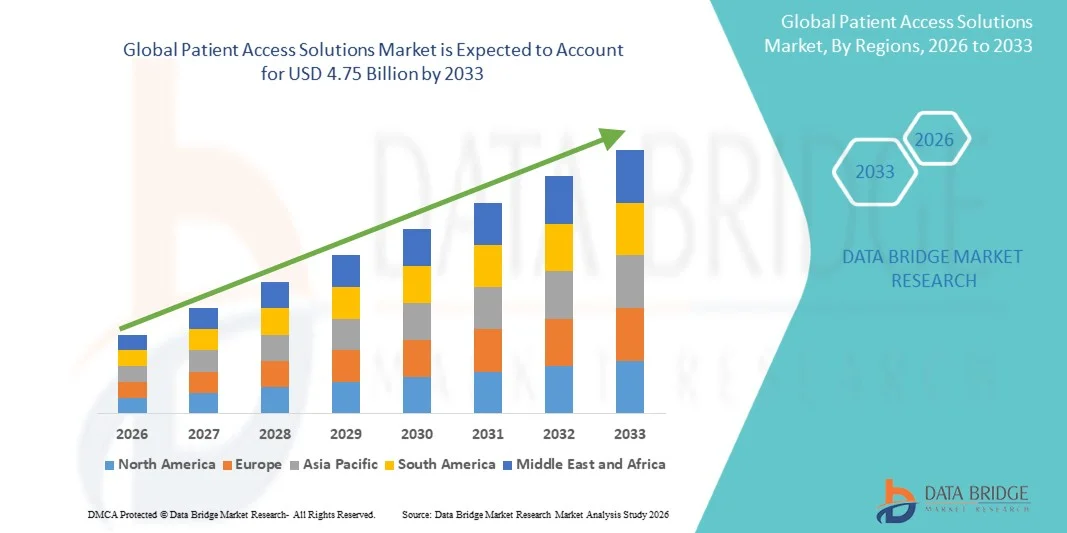
- The global patient access solutions market size was valued at USD 2.48 billion in 2025 and is expected to reach USD 4.75 billion by 2033, at a CAGR of 8.47% during the forecast period
- The market growth is largely fueled by the increasing adoption of digital healthcare infrastructure and the rapid integration of advanced technologies within patient management systems, leading to enhanced efficiency across both healthcare providers and administrative operations. The growing emphasis on streamlining patient onboarding, scheduling, and billing processes is driving the digital transformation of healthcare facilities
- Furthermore, rising demand for seamless, user-friendly, and integrated solutions among healthcare providers and patients is positioning patient access solutions as a critical component of modern healthcare delivery. These solutions help reduce administrative burdens, improve patient experience, and ensure better coordination of care. These converging factors are accelerating the adoption of patient access solutions, thereby significantly boosting the growth of the Patient Access Solutions market
Patient Access Solutions Market Analysis
- Patient access solutions, offering digital platforms for managing patient intake, scheduling, registration, insurance verification, and billing, are increasingly vital components of modern healthcare systems in both hospitals and outpatient settings due to their ability to enhance operational efficiency, reduce administrative burdens, and improve overall patient experience
- The escalating demand for patient access solutions is primarily fueled by the widespread adoption of healthcare IT systems, growing need for streamlined administrative workflows, increasing patient volumes, and a rising preference for convenient, transparent, and digitally enabled healthcare services
- North America dominated the patient access solutions market with the largest revenue share of 40.51% in 2025, characterized by advanced healthcare infrastructure, high adoption of digital health technologies, and a strong presence of key industry players, with the U.S. experiencing substantial growth in patient access solution deployments, particularly across large hospital networks and integrated healthcare systems driven by continuous innovations in automation, AI, and cloud-based platforms
- Asia-Pacific is expected to be the fastest growing region in the patient access solutions market during the forecast period due to increasing healthcare investments, rapid urbanization, expanding healthcare infrastructure, and rising awareness regarding digital healthcare solutions, along with growing demand for efficient patient management systems
- The web and cloud-based solutions segment accounted for the largest market revenue share of 64.3% in 2025, driven by its scalability, flexibility, and cost-effectiveness
Report Scope and Patient Access Solutions Market Segmentation
|
Attributes |
Patient Access Solutions Key Market Insights |
|
Segments Covered |
|
|
Countries Covered |
North America
Europe
Asia-Pacific
Middle East and Africa
South America
|
|
Key Market Players |
•Epic Systems Corporation (U.S.) |
|
Market Opportunities |
|
|
Value Added Data Infosets |
In addition to the insights on market scenarios such as market value, growth rate, segmentation, geographical coverage, and major players, the market reports curated by the Data Bridge Market Research also include in-depth expert analysis, patient epidemiology, pipeline analysis, pricing analysis, and regulatory framework. |
Patient Access Solutions Market Trends
“Digital Transformation and Interoperability Enhancing Patient Access Solutions”
- A significant and accelerating trend in the global patient access solutions market is the increasing digital transformation of healthcare systems and the growing emphasis on interoperability across platforms. This shift is enhancing the efficiency, accuracy, and accessibility of patient access processes across healthcare providers
- For instance, advanced patient access platforms are now seamlessly integrating with electronic health records (EHRs), revenue cycle management systems, and scheduling tools, enabling streamlined workflows and reducing administrative burdens. Solutions offered by leading providers allow real-time eligibility verification, automated appointment scheduling, and improved patient data management
- The incorporation of intelligent automation is enabling features such as predictive scheduling, automated insurance verification, and personalized patient communication. These capabilities help healthcare providers optimize operational efficiency while minimizing errors and delays in patient onboarding and service delivery
- Furthermore, the integration of patient access solutions with digital health ecosystems facilitates centralized management of patient interactions, billing, and documentation through unified platforms. This ensures a smoother and more coordinated patient journey across multiple touchpoints within the healthcare system
- This trend towards more connected, efficient, and patient-centric access systems is reshaping expectations for healthcare service delivery. Consequently, companies are focusing on developing advanced platforms that offer seamless integration, real-time data access, and enhanced user experiences for both patients and providers
- The demand for comprehensive and interoperable patient access solutions is growing rapidly across hospitals, clinics, and ambulatory care centers, as healthcare organizations increasingly prioritize efficiency, accuracy, and patient satisfaction
Patient Access Solutions Market Dynamics
Driver
“Growing Need Due to Increasing Healthcare Demand and Administrative Efficiency”
- The rising demand for healthcare services, coupled with the need to streamline administrative processes, is a major driver for the growth of the Patient Access Solutions market, as healthcare systems globally face increasing patient volumes and operational complexities
- For instance, in 2024, several large hospital networks across the U.S. and Europe implemented integrated patient access platforms to automate eligibility verification and prior authorization processes, significantly reducing patient wait times and administrative bottlenecks while improving revenue cycle performance
- As patient inflow continues to rise, healthcare providers are under constant pressure to improve operational efficiency, reduce delays in care delivery, and enhance overall patient satisfaction, thereby accelerating the adoption of advanced access solutions
- These solutions support critical functions such as automated patient registration, insurance verification, real-time appointment scheduling, and billing transparency, helping minimize manual errors and optimize staff productivity
- In addition, the ongoing shift toward value-based care models is encouraging healthcare organizations to adopt systems that improve care coordination, patient engagement, and financial outcomes
- The increasing penetration of digital health technologies, including telehealth and mobile health applications, is further strengthening the need for robust patient access infrastructure that can support seamless virtual and in-person care experiences
- Moreover, healthcare providers are increasingly focusing on reducing claim denials and improving reimbursement rates, which is driving the demand for accurate and efficient front-end access solutions
- The growing emphasis on enhancing patient experience through faster service delivery, transparent communication, and simplified administrative procedures is further contributing to market expansion
Restraint/Challenge
“Concerns Regarding Data Security and High Implementation Costs”
- Concerns related to data security and patient privacy continue to pose a significant challenge to the widespread adoption of patient access solutions, as these systems handle large volumes of sensitive healthcare and financial information
- For instance, in recent years, several healthcare organizations globally have reported data breaches targeting patient management and access systems, leading to increased scrutiny on cybersecurity frameworks and hesitancy among smaller providers to adopt fully digital solutions
- The need to comply with stringent regulatory requirements and data protection laws increases the complexity of implementation and requires continuous investment in system upgrades and monitoring
- In addition, the high upfront costs associated with deploying advanced patient access solutions—including software acquisition, system integration, infrastructure upgrades, and employee training—can be prohibitive for small and mid-sized healthcare facilities
- Ongoing maintenance costs, subscription fees, and the need for periodic software updates further add to the financial burden, particularly for organizations operating on tight budgets
- Resistance to transitioning from traditional, manual administrative workflows to digital systems can also slow down adoption, especially in regions with limited technological readiness
- Furthermore, interoperability challenges between legacy systems and modern patient access platforms can create integration issues, leading to inefficiencies and delayed implementation timelines
- Limited technical expertise among healthcare staff and the need for continuous training to effectively use these systems can further hinder smooth adoption
- Addressing these challenges through enhanced cybersecurity measures, cost-effective deployment models, improved interoperability, and comprehensive training programs will be critical to ensuring sustained growth in the patient access solutions market
Patient Access Solutions Market Scope
The market is segmented on the basis of services, software, delivery mode, and end user.
• By Services
On the basis of services, the Patient Access Solutions market is segmented into support and maintenance, implementation, and training and education. The support and maintenance segment dominated the largest market revenue share of 46.8% in 2025, driven by the continuous requirement for system monitoring, troubleshooting, updates, and performance optimization across healthcare IT infrastructures. Healthcare providers increasingly depend on uninterrupted functioning of patient access platforms to ensure smooth administrative workflows such as patient registration, insurance verification, and billing processes. The rising integration of advanced technologies such as AI and automation has further increased the complexity of systems, thereby boosting the demand for ongoing maintenance services. In addition, regulatory compliance requirements in healthcare necessitate frequent updates and security patches, which further supports segment growth. The expansion of cloud-based solutions also requires continuous backend support and monitoring. Hospitals and clinics are investing heavily in long-term service contracts to avoid system downtime. Moreover, increasing patient volumes are putting pressure on healthcare systems, making reliable maintenance services critical. The segment also benefits from the need for cybersecurity and data protection services. Overall, the reliability and continuity offered by support and maintenance services make it the leading segment in the market.
The training and education segment is expected to witness the fastest CAGR of 22.4% from 2026 to 2033, driven by the increasing need for skilled professionals capable of effectively utilizing advanced patient access solutions. As healthcare systems become more digitized, proper training is essential to ensure efficient use of software platforms and minimize operational errors. Training programs help staff adapt to new technologies, improve workflow efficiency, and enhance patient experience. The growing adoption of AI-driven and analytics-based solutions is also creating demand for specialized training modules. Furthermore, frequent software upgrades and evolving compliance standards require continuous education for healthcare personnel. Organizations are increasingly investing in structured training programs to maximize return on investment in digital solutions. The rise of remote and e-learning platforms is further supporting segment growth. Training services also play a key role in reducing claim errors and improving revenue cycle management. In addition, increasing awareness regarding the importance of staff competency is driving demand. Overall, this segment is gaining traction as healthcare providers focus on improving operational efficiency and service quality.
• By Software
On the basis of software, the Patient Access Solutions market is segmented into eligibility verification software, medical necessity management software, pre-certification and authorization software, claims denial and appeal management software, payment estimation software, medical claims payment processing software, and others. The eligibility verification software segment held the largest market revenue share of 28.6% in 2025, owing to its critical role in verifying patient insurance coverage and minimizing claim denials. This software enables healthcare providers to validate insurance details in real time, thereby reducing administrative errors and improving operational efficiency. Increasing patient inflow and the growing complexity of insurance policies are major factors driving adoption. In addition, the need to enhance revenue cycle management and reduce financial losses is boosting demand for eligibility verification tools. Integration with electronic health records (EHR) systems further enhances its utility. Healthcare organizations are prioritizing front-end process optimization, which is contributing to segment growth. Moreover, automation in eligibility checks reduces manual workload and improves accuracy. The rising focus on patient satisfaction also supports adoption. Overall, this segment remains dominant due to its direct impact on operational and financial performance.
The claims denial and appeal management software segment is anticipated to witness the fastest CAGR of 24.1% from 2026 to 2033, driven by the increasing frequency of claim denials and the growing need for efficient resolution mechanisms. Healthcare providers are facing significant revenue losses due to denied claims, prompting the adoption of advanced software solutions to manage and appeal such cases effectively. These solutions help identify denial patterns, automate workflows, and improve claim approval rates. In addition, financial pressures on healthcare organizations are pushing investments in revenue optimization tools. Integration with AI and data analytics is further enhancing the efficiency of denial management systems. The rising complexity of reimbursement policies also contributes to segment growth. Moreover, these tools help reduce administrative burden and improve cash flow. Increasing awareness regarding revenue cycle management is another key factor. The demand for automation and error reduction is further accelerating adoption. Overall, this segment is expected to grow rapidly as healthcare providers seek to minimize financial losses and improve operational efficiency.
• By Delivery Mode
On the basis of delivery mode, the Patient Access Solutions market is segmented into web and cloud-based solutions and on-premise solutions. The web and cloud-based solutions segment accounted for the largest market revenue share of 64.3% in 2025, driven by its scalability, flexibility, and cost-effectiveness. Cloud-based platforms allow healthcare providers to access patient data remotely, enabling better coordination and faster decision-making. The reduced need for physical infrastructure and IT maintenance significantly lowers operational costs. In addition, cloud solutions offer automatic updates, enhanced data security, and seamless integration with other healthcare systems. The increasing adoption of telehealth and digital health services is further boosting demand. Healthcare organizations are also leveraging cloud platforms for data analytics and real-time insights. Moreover, the ability to handle large volumes of data efficiently supports segment growth. The shift toward value-based care models is also contributing to adoption. Overall, the advantages of accessibility and efficiency make cloud-based solutions the dominant segment.
The on-premise segment is expected to witness a CAGR of 18.2% from 2026 to 2033, driven by the need for greater control over data security and system customization. Large healthcare organizations often prefer on-premise solutions to comply with strict regulatory requirements and ensure data privacy. These systems provide enhanced control over sensitive patient information and allow for tailored configurations. Despite higher initial costs, they offer long-term reliability and security. In addition, organizations with established IT infrastructure continue to rely on on-premise deployment. The segment also benefits from demand in regions with limited cloud adoption. Hybrid deployment models are further supporting growth. Moreover, on-premise solutions reduce dependency on internet connectivity. Increasing concerns regarding cybersecurity are also driving demand. Overall, while cloud dominates, on-premise remains relevant for specific use cases requiring high security and control.
• By End User
On the basis of end user, the Patient Access Solutions market is segmented into healthcare providers, healthcare information technology outsourcing companies, and others. The healthcare providers segment dominated the largest market revenue share of 57.9% in 2025, driven by the increasing need to streamline administrative processes such as patient registration, scheduling, and billing. Hospitals and clinics are rapidly adopting patient access solutions to enhance operational efficiency and improve patient experience. The growing burden of administrative tasks and the need for accurate data management are major factors supporting segment growth. In addition, rising patient volumes and the demand for improved healthcare services are driving adoption. Integration with electronic health records and other healthcare systems further enhances efficiency. Healthcare providers are also focusing on reducing claim denials and improving revenue cycle management. Moreover, digital transformation initiatives in healthcare are accelerating adoption. The need for real-time data access and analytics is another contributing factor. Overall, healthcare providers remain the primary users of these solutions.
The healthcare IT outsourcing companies segment is expected to witness the fastest CAGR of 23.5% from 2026 to 2033, fueled by the growing trend of outsourcing non-core operations to specialized service providers. These companies offer cost-effective and scalable solutions, enabling healthcare organizations to focus on core clinical functions. Increasing demand for revenue cycle management and administrative support is driving segment growth. In addition, outsourcing helps reduce operational costs and improve efficiency. The adoption of advanced technologies such as AI and automation is further enhancing service offerings. Moreover, outsourcing providers bring expertise and standardized processes, improving service quality. The expansion of global healthcare infrastructure is also contributing to demand. Organizations are increasingly seeking flexible and efficient solutions, which outsourcing companies provide. Furthermore, the need for compliance and risk management is supporting adoption. Overall, this segment is expected to grow rapidly as healthcare systems continue to evolve and digitize.
Patient Access Solutions Market Regional Analysis
- North America dominated the patient access solutions market with the largest revenue share of 40.51% in 2025, characterized by advanced healthcare infrastructure, high adoption of digital health technologies, and a strong presence of key industry players. The region benefits from widespread implementation of integrated healthcare IT systems, enabling efficient patient registration, eligibility verification, and revenue cycle management across hospitals and healthcare networks
- Healthcare providers in the region highly prioritize operational efficiency, patient experience, and accuracy in administrative processes, leading to increased adoption of automated patient access platforms that seamlessly integrate with electronic health records and billing systems
- This widespread adoption is further supported by high healthcare spending, favorable reimbursement frameworks, and continuous technological advancements, establishing patient access solutions as essential tools for both large healthcare systems and outpatient facilities
U.S. Patient Access Solutions Market Insight
The U.S. patient access solutions market captured the largest revenue share in 2025 within North America, driven by the rapid deployment of digital health technologies across large hospital networks and integrated delivery systems. Healthcare providers are increasingly investing in automation, AI-enabled tools, and cloud-based platforms to streamline patient intake, scheduling, and insurance verification processes. The growing focus on reducing administrative burdens, minimizing claim denials, and enhancing patient engagement is significantly propelling market growth. In addition, strong regulatory support, continuous innovation, and the presence of major industry players further contribute to the expansion of patient access solutions across the country.
Europe Patient Access Solutions Market Insight
The Europe patient access solutions market is projected to expand at a substantial CAGR throughout the forecast period, primarily driven by the increasing emphasis on healthcare digitalization and the need for efficient patient management systems. Governments and healthcare organizations across the region are investing in modernizing healthcare IT infrastructure to improve patient access and streamline administrative workflows. The rising demand for accurate patient data management, coupled with regulatory requirements for data transparency and interoperability, is further accelerating adoption. The market is witnessing significant growth across public healthcare systems, private hospitals, and outpatient care centers.
U.K. Patient Access Solutions Market Insight
The U.K. patient access solutions market is anticipated to grow at a noteworthy CAGR during the forecast period, driven by ongoing efforts to digitize healthcare services and improve patient access within the National Health Service (NHS). Increasing patient volumes and the need to reduce waiting times are encouraging healthcare providers to adopt advanced access solutions. In addition, the focus on enhancing patient experience, improving care coordination, and optimizing administrative efficiency is supporting market growth. The integration of digital tools for appointment scheduling, patient registration, and communication is becoming increasingly prevalent across the country.
Germany Patient Access Solutions Market Insight
The Germany patient access solutions market is expected to expand at a considerable CAGR during the forecast period, fueled by strong government initiatives promoting healthcare digitalization and the adoption of advanced IT solutions. Germany’s well-established healthcare infrastructure and emphasis on data security and efficiency are driving the demand for reliable patient access systems. Healthcare providers are increasingly implementing digital platforms to streamline administrative workflows, improve patient data accuracy, and enhance overall service delivery. The growing focus on interoperability and secure data exchange is also contributing to market expansion.
Asia-Pacific Patient Access Solutions Market Insight
The Asia-Pacific patient access solutions market is poised to grow at the fastest CAGR during the forecast period of 2026 to 2033, driven by increasing healthcare investments, rapid urbanization, expanding healthcare infrastructure, and rising awareness regarding digital healthcare solutions. Governments across countries such as China, Japan, and India are actively promoting the adoption of healthcare IT systems to improve accessibility and efficiency. The growing demand for streamlined patient management processes, coupled with the rising burden on healthcare facilities, is significantly boosting the adoption of patient access solutions across the region.
Japan Patient Access Solutions Market Insight
The Japan patient access solutions market is gaining momentum due to the country’s advanced healthcare system, aging population, and strong focus on technological innovation. The increasing need to manage a growing elderly population efficiently is driving the adoption of digital patient access systems in hospitals and clinics. Healthcare providers are leveraging these solutions to improve appointment scheduling, reduce administrative workload, and enhance patient experience. In addition, Japan’s emphasis on precision, efficiency, and high-quality healthcare services supports continued market growth.
China Patient Access Solutions Market Insight
The China patient access solutions market accounted for the largest market revenue share in Asia-Pacific in 2025, attributed to rapid healthcare infrastructure development, a large patient population, and increasing government initiatives toward healthcare digitalization. The expansion of hospitals and healthcare facilities, along with the growing adoption of digital health platforms, is driving demand for efficient patient access systems. Furthermore, the rising focus on improving healthcare accessibility, reducing patient wait times, and enhancing operational efficiency is propelling the market. The presence of domestic technology providers and increasing investments in healthcare IT are further strengthening market growth in China.
Patient Access Solutions Market Share
The Patient Access Solutions industry is primarily led by well-established companies, including:
•Epic Systems Corporation (U.S.)
• McKesson Corporation (U.S.)
• Optum Inc. (U.S.)
• Conifer Health Solutions (U.S.)
• R1 RCM Inc. (U.S.)
• Experian Health (U.K.)
• Change Healthcare (U.S.)
• Allscripts Healthcare Solutions (U.S.)
• NextGen Healthcare (U.S.)
• Athenahealth (U.S.)
• eClinicalWorks (U.S.)
• Waystar (U.S.)
• GE HealthCare (U.S.)
• Siemens Healthineers (Germany)
• Oracle Health (U.S.)
• Infor (U.S.)
• Cognizant (U.S.)
• Wipro (India)
• Tata Consultancy Services (India
Latest Developments in Global Patient Access Solutions Market
- In January 2023, Annexus Health, a U.S.-based healthcare technology company, announced the expansion and demonstrated success of its patient access solutions portfolio, including AssistPoint®, AP Connect, and Adparo. These platforms are designed to streamline patient access to financial assistance programs, integrate life sciences support services into provider workflows, and reduce administrative burden across the patient access journey. The development highlights the growing focus on improving affordability, efficiency, and patient-centric care through integrated digital solutions
- In May 2023, the global Patient Access Solutions market report published via Yahoo Finance highlighted significant expansion in the U.S. and China markets, driven by increasing adoption of digital healthcare infrastructure and revenue cycle management solutions. The report emphasized the growing demand for automation in eligibility verification, prior authorization, and patient engagement processes, reflecting a broader industry shift toward digital transformation and operational efficiency in healthcare systems
- In January 2024, Medicare (U.S.) expanded coverage to include patient advocacy services, significantly boosting companies offering patient access and navigation solutions such as Solace. This policy change enabled broader insurance reimbursement for services that help patients manage appointments, paperwork, and care coordination. The development marks a major step toward institutionalizing patient access services within mainstream healthcare reimbursement frameworks and expanding access to support services
- In April 2025, Solace, a healthcare navigation startup, raised USD 60 million in Series B funding, following the expansion of Medicare coverage for patient advocacy services. The funding round aims to scale its platform that connects patients with healthcare professionals who assist in navigating complex healthcare systems, including scheduling and administrative processes. This reflects increasing investor confidence in patient access and navigation solutions as a critical component of modern healthcare delivery
- In September 2025, the global healthtech sector, including patient access solution providers, witnessed a surge in mergers and acquisitions activity, with over 100 deals recorded in the first half of the year. Companies are increasingly consolidating to enhance capabilities in AI, data analytics, and integrated patient access platforms. This trend indicates strong market maturation and a shift toward comprehensive, end-to-end healthcare access and revenue cycle management solutions
SKU-
Get online access to the report on the World's First Market Intelligence Cloud

- Interactive Data Analysis Dashboard
- Company Analysis Dashboard for high growth potential opportunities
- Research Analyst Access for customization & queries
- Competitor Analysis with Interactive dashboard
- Latest News, Updates & Trend analysis
- Harness the Power of Benchmark Analysis for Comprehensive Competitor Tracking
Research Methodology
Data collection and base year analysis are done using data collection modules with large sample sizes. The stage includes obtaining market information or related data through various sources and strategies. It includes examining and planning all the data acquired from the past in advance. It likewise envelops the examination of information inconsistencies seen across different information sources. The market data is analysed and estimated using market statistical and coherent models. Also, market share analysis and key trend analysis are the major success factors in the market report. To know more, please request an analyst call or drop down your inquiry.
The key research methodology used by DBMR research team is data triangulation which involves data mining, analysis of the impact of data variables on the market and primary (industry expert) validation. Data models include Vendor Positioning Grid, Market Time Line Analysis, Market Overview and Guide, Company Positioning Grid, Patent Analysis, Pricing Analysis, Company Market Share Analysis, Standards of Measurement, Global versus Regional and Vendor Share Analysis. To know more about the research methodology, drop in an inquiry to speak to our industry experts.
Customization Available
Data Bridge Market Research is a leader in advanced formative research. We take pride in servicing our existing and new customers with data and analysis that match and suits their goal. The report can be customized to include price trend analysis of target brands understanding the market for additional countries (ask for the list of countries), clinical trial results data, literature review, refurbished market and product base analysis. Market analysis of target competitors can be analyzed from technology-based analysis to market portfolio strategies. We can add as many competitors that you require data about in the format and data style you are looking for. Our team of analysts can also provide you data in crude raw excel files pivot tables (Fact book) or can assist you in creating presentations from the data sets available in the report.












