


Global Patient Positioning System Market
Market Size in USD Billion
CAGR :
% 
 USD
1.25 Billion
USD
1.81 Billion
2025
2033
USD
1.25 Billion
USD
1.81 Billion
2025
2033
 Forecast Period Forecast Period |
2026 –2033 |
 Market Size (Base Year) Market Size (Base Year) |
USD 1.25 Billion |
 Market Size (Forecast Year) Market Size (Forecast Year) |
USD 1.81 Billion |
 CAGR CAGR |
% |
| Major Markets Players |
|
Patient Positioning System Market Size
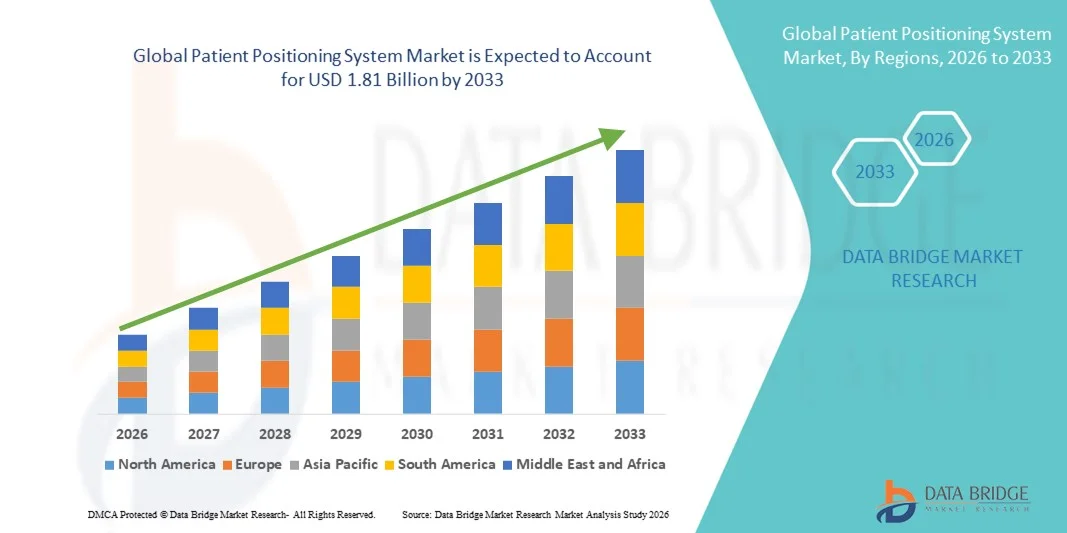
- The global Patient Positioning System market size was valued at USD 1.25 billion in 2025 and is expected to reach USD 1.81 billion by 2033, at a CAGR of 4.80% during the forecast period
- The market growth is largely fueled by the increasing adoption of advanced imaging modalities such as CT, MRI, and radiotherapy systems, along with technological advancements in patient positioning devices that enhance precision, reproducibility, and safety during diagnostic and therapeutic procedures in hospitals, clinics, and specialty care centers
- Furthermore, rising demand for improved treatment accuracy, growing prevalence of chronic diseases such as cancer, increasing investments in healthcare infrastructure, and the need to reduce human error in medical procedures are establishing patient positioning systems as essential tools in modern healthcare workflows. These converging factors are accelerating the uptake of Patient Positioning System solutions, thereby significantly boosting the industry’s growth
Patient Positioning System Market Analysis
- Patient positioning systems, including radiotherapy couches, immobilization devices, and surgical positioning tables, are increasingly vital in modern healthcare settings due to their ability to enhance procedural accuracy, improve patient safety, and enable reproducible outcomes across diagnostic imaging, radiotherapy, and surgical applications
- The escalating demand for patient positioning systems is primarily fueled by rising prevalence of cancer and chronic diseases, growing adoption of advanced imaging and radiotherapy equipment, increasing investments in hospital infrastructure, and the need for precise, automated patient alignment to reduce human error and improve treatment efficacy
- North America dominated the patient positioning system market with the largest revenue share of 38.9% in 2025, driven by high adoption of advanced medical imaging and radiotherapy technologies, robust healthcare infrastructure, strong presence of key industry players, and increasing utilization of automated and robotic positioning solutions, with the U.S. leading regional growth
- Asia-Pacific is expected to be the fastest-growing region in the patient positioning system market during the forecast period, expanding at a CAGR of 9.7% from 2026 to 2033, supported by rising healthcare expenditure, increasing hospital infrastructure development, rapid urbanization, and growing adoption of advanced patient care technologies in countries such as China, India, and Japan
- The Surgical Tables segment dominated the largest market revenue share of 46.3% in 2025, driven by the increasing number of surgical procedures worldwide and the critical role of patient positioning in ensuring operative accuracy and safety
Report Scope and Patient Positioning System Market Segmentation
|
Attributes |
Patient Positioning System Key Market Insights |
|
Segments Covered |
|
|
Countries Covered |
North America
Europe
Asia-Pacific
Middle East and Africa
South America
|
|
Key Market Players |
|
|
Market Opportunities |
|
|
Value Added Data Infosets |
In addition to the insights on market scenarios such as market value, growth rate, segmentation, geographical coverage, and major players, the market reports curated by the Data Bridge Market Research also include in-depth expert analysis, patient epidemiology, pipeline analysis, pricing analysis, and regulatory framework. |
Patient Positioning System Market Trends
Growing Adoption of Advanced Imaging and Robotic Integration
- A key trend in the global Patient Positioning System market is the increasing integration of these systems with advanced imaging modalities, such as CT, MRI, and fluoroscopy, which enable precise patient alignment and optimal imaging outcomes. This integration improves diagnostic accuracy, reduces procedure time, and enhances overall patient safety
- Robotic-assisted surgical systems are increasingly being paired with patient positioning platforms to improve surgical precision, particularly in orthopedic, neurosurgical, and cardiovascular procedures. Hospitals are adopting fully motorized tables capable of automated tilting and positioning during complex surgeries
- For instance, in 2024, Stryker Corporation launched its next-generation surgical patient positioning platform compatible with robotic-assisted operating rooms, offering improved alignment accuracy and customizable positioning for various procedures
- Furthermore, modular and multi-functional patient positioning systems are trending, allowing hospitals to use a single platform for multiple procedures, reducing equipment redundancy and capital expenditure
Patient Positioning System Market Dynamics
Driver
Rising Demand for Improved Patient Safety and Workflow Efficiency
- Patient safety and procedure outcomes are a primary driver for market growth. Improper positioning during surgeries or diagnostic procedures can lead to complications such as nerve injuries, pressure ulcers, and misalignment of implants. Advanced positioning systems mitigate these risks by offering automated adjustments, memory settings, and real-time monitoring
- The need for efficiency in high-volume hospitals and surgical centers is driving adoption. Modern systems reduce time required for repositioning, enabling faster patient turnover and enhancing operational productivity
- For instance, in 2023, Hillrom (now Baxter International) introduced an ICU bed positioning system with automated tilt and lateral rotation features that reduce the risk of pressure ulcers, improve patient comfort, and reduce caregiver fatigue
- Growing hospital investments in minimally invasive and robotic-assisted procedures are further pushing demand. Integration with navigation systems allows precise alignment during surgeries, supporting better surgical outcomes and reduced recovery times
- The aging population and increasing prevalence of chronic conditions such as cardiovascular, orthopedic, and neurological disorders are also fueling demand for patient positioning systems, as these patients often require complex procedures where accurate positioning is critical
Restraint/Challenge
High Costs and Need for Specialized Training
- The high upfront cost of advanced motorized or robotic-compatible patient positioning systems is a significant barrier, particularly for smaller hospitals, clinics, and emerging markets. These systems can range from tens to hundreds of thousands of dollars, depending on features and integrations
- In addition, effective utilization requires trained personnel. Staff must understand the proper operation, safety protocols, and maintenance procedures, which adds to training costs and can delay adoption
- For instance, mid-sized hospitals in Southeast Asia have reported slower uptake of motorized surgical tables due to budget constraints and the need for intensive staff training
- Maintenance and service requirements for sophisticated systems, especially those integrated with imaging and robotic platforms, can be costly and complex, creating additional operational challenges for healthcare providers
- Moreover, compatibility with existing hospital infrastructure or legacy imaging systems can sometimes pose integration challenges, requiring additional investment in software or hardware upgrades
- Manufacturers are addressing these challenges by developing modular, cost-efficient, and user-friendly solutions, alongside offering training programs and remote support, as seen with companies like Maquet Getinge Group, which provide both in-person and digital training modules for operating room staff
Patient Positioning System Market Scope
The market is segmented on the basis of product, application, and end user.
- By Product
On the basis of product, the Patient Positioning System market is segmented into Tables, Surgical Tables, Radiolucent Imaging Tables, Examination Tables, Accessories, and Other Patient Positioning Systems. The Surgical Tables segment dominated the largest market revenue share of 46.3% in 2025, driven by the increasing number of surgical procedures worldwide and the critical role of patient positioning in ensuring operative accuracy and safety. Surgical tables are preferred in hospitals and ambulatory surgical centers due to their advanced adjustability, ergonomic design, and compatibility with imaging modalities. Integration with robotic-assisted surgery and intraoperative imaging systems further boosts adoption. The segment benefits from rising investments in hospital infrastructure, increasing healthcare expenditures, and government initiatives promoting advanced surgical care. Continuous innovation in motorized tables, weight capacity, and radiolucency enhances usability. In addition, training programs for surgeons and staff promote consistent adoption in clinical settings. Overall, surgical tables dominate due to their essential role in operating rooms and high utilization across hospitals.
The Radiolucent Imaging Tables segment is expected to witness the fastest CAGR of 11.8% from 2026 to 2033, fueled by the growing demand for accurate imaging during diagnostics and interventional procedures. Radiolucent tables allow high-quality X-ray, CT, and MRI imaging without repositioning patients, improving workflow efficiency and diagnostic precision. Adoption is increasing in diagnostic laboratories, specialty clinics, and hospitals performing interventional radiology. Technological advancements such as lightweight materials, adjustable heights, and integrated accessories drive growth. Rising incidence of chronic and acute diseases requiring imaging, along with expansion of diagnostic centers in emerging markets, supports market expansion. Overall, radiolucent imaging tables represent the fastest-growing product segment due to enhanced imaging capabilities and workflow optimization.
- By Application
On the basis of application, the market is segmented into Surgeries, Disease Diagnosis, and Cancer Therapy. The Surgeries segment accounted for the largest market revenue share of 49.2% in 2025, driven by the increasing volume of surgical procedures globally and the need for precision patient positioning to reduce operative complications. Surgical applications require highly adjustable, stable, and ergonomically designed tables to support diverse procedures ranging from general surgery to minimally invasive operations. Hospitals and ambulatory surgical centers prioritize these systems for operational efficiency. Integration with imaging systems and intraoperative navigation technologies enhances adoption. Government support for surgical infrastructure development and growing awareness among surgeons about patient safety further strengthen market dominance.
The Cancer Therapy segment is expected to witness the fastest CAGR of 12.5% from 2026 to 2033, fueled by the rising prevalence of cancer and increased adoption of radiotherapy and proton therapy treatments. Patient positioning systems are critical in radiation oncology for accurate targeting, minimizing exposure to surrounding healthy tissue, and improving treatment outcomes. Technological advancements such as robotic arms, motion tracking, and multi-angle adjustment enhance precision. Expansion of cancer treatment centers and increased investment in oncology infrastructure further drive segment growth. Overall, cancer therapy applications are the fastest-growing segment due to rising global cancer incidence and demand for advanced positioning solutions.
- By End User
On the basis of end user, the market is segmented into Hospitals, Ambulatory Surgery Centers, Diagnostic Laboratories, and Other End Users. The Hospitals segment held the largest market revenue share of 52.7% in 2025, attributed to high patient throughput, requirement for diverse surgical and diagnostic procedures, and integration with advanced imaging and surgical systems. Hospitals invest heavily in patient positioning systems to improve procedural accuracy, patient safety, and operational efficiency. Government funding, healthcare infrastructure expansion, and increasing surgical volumes further support dominance.
The Ambulatory Surgery Centers segment is expected to witness the fastest CAGR of 11.9% from 2026 to 2033, driven by the shift toward outpatient procedures, cost-effective surgeries, and preference for minimally invasive interventions. Patient positioning systems in ambulatory centers enhance workflow efficiency, improve patient comfort, and support imaging-guided procedures. Rising adoption of outpatient care and investments in modern surgical facilities fuel growth. Overall, ambulatory surgery centers are the fastest-growing end-user segment due to rising outpatient procedures and demand for efficient, compact positioning solutions.
Patient Positioning System Market Regional Analysis
- North America dominated the patient positioning system market with the largest revenue share of 38.9% in 2025, driven by the high adoption of advanced medical imaging and radiotherapy technologies, robust healthcare infrastructure, and the increasing utilization of automated and robotic positioning solutions
- Hospitals and specialty clinics are increasingly integrating patient positioning systems with radiotherapy, imaging, and surgical platforms to enhance precision, reduce procedural time, and improve patient outcomes
- Continuous innovations by major players, such as Medtronic plc and Siemens Healthineers, are driving adoption of motorized and robotic-compatible patient positioning tables that improve workflow efficiency in operating rooms and imaging suites
U.S. Patient Positioning System Market Insight
The U.S. patient positioning system market captured the largest share of the North American market in 2025, accounting for over 80% of regional revenue. Growth is driven by high prevalence of cancer, orthopedic disorders, and neurological conditions requiring precise imaging and surgical interventions. Advanced hospitals are increasingly adopting robotic-assisted positioning systems integrated with CT, MRI, and radiotherapy equipment to enhance surgical accuracy and patient safety. Innovations such as automated lateral tilting, motorized table movement, and real-time alignment monitoring are facilitating faster procedures and minimizing human error, supporting better patient outcomes. Strong government funding, reimbursements for high-end imaging procedures, and widespread adoption of advanced hospital infrastructure are further supporting market expansion.
Europe Patient Positioning System Market Insight
The Europe patient positioning system market is projected to grow at a substantial CAGR over the forecast period, fueled by the increasing demand for technologically advanced patient care solutions and stringent healthcare regulations. Hospitals in countries such as Germany, France, and Italy are investing in advanced imaging and robotic-assisted surgical setups, driving the adoption of motorized patient positioning systems. The trend toward minimally invasive surgeries and improved imaging accuracy is encouraging healthcare providers to adopt automated positioning solutions for both diagnostic and therapeutic procedures. Furthermore, integration with multi-modality imaging equipment, such as PET-CT and MRI, enhances diagnostic precision and operational efficiency.
U.K. Patient Positioning System Market Insight
The U.K. patient positioning system market is anticipated to witness notable growth due to increasing hospital investments in modern operating rooms, imaging facilities, and cancer treatment centers. Rising awareness of patient safety, combined with adoption of robotic-assisted surgical systems and advanced radiotherapy equipment, is fueling demand for precise positioning platforms. Healthcare providers are also seeking flexible, multi-purpose patient positioning tables that can support a variety of diagnostic and surgical applications, reducing equipment redundancy.
Germany Patient Positioning System Market Insight
Germany’s patient positioning system market is expected to expand at a considerable CAGR due to the country’s advanced healthcare infrastructure and strong emphasis on precision medicine. High adoption of digital and automated technologies in hospitals, along with increased demand for radiation therapy, neurosurgery, and orthopedic procedures, is driving growth. Patient positioning systems integrated with imaging and robotic technologies help reduce procedure time, enhance surgical accuracy, and improve overall workflow efficiency in German hospitals.
Asia-Pacific Patient Positioning System Market Insight
The Asia-Pacific patient positioning system market is projected to be the fastest-growing region, expanding at a CAGR of 9.7% from 2026 to 2033. Growth is supported by rising healthcare expenditure, rapid urbanization, expansion of hospital infrastructure, and increasing adoption of advanced patient care technologies in countries such as China, India, and Japan. The expanding geriatric population, higher prevalence of chronic diseases, and growing demand for advanced diagnostic and surgical procedures are driving market demand. Countries like China and India are witnessing rapid adoption of automated and robotic-compatible positioning systems in high-volume hospitals to improve procedural efficiency and patient outcomes. Furthermore, government initiatives to modernize healthcare infrastructure, along with increasing private investment in hospital modernization, are key factors accelerating regional growth.
Japan Patient Positioning System Market Insight
Japan’s patient positioning system market is gaining momentum due to the country’s high-tech healthcare environment, rapid urbanization, and increasing demand for precise and efficient patient care. Integration of patient positioning systems with imaging and radiotherapy equipment is becoming widespread, enhancing surgical accuracy and minimizing procedural risks. An aging population and rising demand for complex surgical procedures are driving adoption of automated, ergonomic, and multi-functional positioning platforms.
China Patient Positioning System Market Insight
China patient positioning system market accounted for the largest revenue share in Asia-Pacific in 2025, driven by rapid hospital infrastructure development, increasing investments in high-end diagnostic equipment, and rising healthcare awareness. Advanced hospitals are adopting motorized and robotic-compatible patient positioning systems to improve diagnostic and surgical precision. The push toward smart hospitals, combined with strong domestic manufacturing capabilities for medical devices, is making advanced patient positioning platforms more accessible and affordable.
Patient Positioning System Market Share
The Patient Positioning System industry is primarily led by well-established companies, including:
- Civco Medical Solutions, Inc. (U.S.)
- Elekta AB (Sweden)
- Varian Medical Systems, Inc. (U.S.)
- Accuray Incorporated (U.S.)
- Siemens Healthineers AG (Germany)
- Medical Intelligence GmbH (Germany)
- Orfit Industries NV (Belgium)
- Mizuho OSI, Inc. (U.S.)
- Protura, Inc. (U.S.)
- Shimadzu Corporation (Japan)
- Medtronic plc (Ireland/U.S.)
- Hill-Rom Holdings, Inc. (U.S.)
- Fischer Imaging Technologies GmbH (Germany)
- Biodex Medical Systems, Inc. (U.S.)
- Isono Medical, Inc. (U.S.)
- Esaote S.p.A. (Italy)
- SurgiSystems GmbH (Germany)
- AccuTec Instruments, Inc. (U.S.)
- ATOM Medical Corporation (Japan)
- Orthopedic Systems, Inc. (U.S.)
Latest Developments in Global Patient Positioning System Market
- In June 2021, Philips rolled out its AI‑based Precise Suite solution for its Incisive CT platform, aimed at enhancing workflow from image acquisition through reporting with AI‑based image reconstruction, motion‑free cardiac image capture, and automated patient positioning. This launch sought to improve imaging precision and patient alignment during scanning procedures
- In March 2023, Hill‑Rom completed the acquisition of Voalte, a provider of real‑time communication and workflow solutions for healthcare environments, to enhance patient safety and clinical workflow efficiency, which indirectly supports improved patient positioning outcomes in care settings
- In September 2023, Elekta announced the development of an integrated positioning system for use in its radiotherapy solutions, which improves patient alignment precision through real‑time imaging guidance, enhancing accuracy in complex cancer treatments
- In October 2023, Siemens Healthineers unveiled a next‑generation robotic‑assisted positioning system that enhances patient alignment in radiotherapy therapy, resulting in improved treatment accuracy and reduced exposure to healthy tissues, underscoring innovation in precision positioning solutions
- In August 2023, Getinge introduced a new line of patient positioning accessories designed for hybrid operating rooms with improved surgical efficiency and enhanced patient safety features, expanding options for multi‑procedure OR environments
- In January 2025, Medtronic announced a strategic partnership with Intuitive Surgical to co‑develop advanced robotic‑assisted surgical systems that integrate patient positioning technologies to enhance surgical accuracy and outcomes, reflecting growing collaboration between major med‑tech firms
SKU-
Get online access to the report on the World's First Market Intelligence Cloud

- Interactive Data Analysis Dashboard
- Company Analysis Dashboard for high growth potential opportunities
- Research Analyst Access for customization & queries
- Competitor Analysis with Interactive dashboard
- Latest News, Updates & Trend analysis
- Harness the Power of Benchmark Analysis for Comprehensive Competitor Tracking
Research Methodology
Data collection and base year analysis are done using data collection modules with large sample sizes. The stage includes obtaining market information or related data through various sources and strategies. It includes examining and planning all the data acquired from the past in advance. It likewise envelops the examination of information inconsistencies seen across different information sources. The market data is analysed and estimated using market statistical and coherent models. Also, market share analysis and key trend analysis are the major success factors in the market report. To know more, please request an analyst call or drop down your inquiry.
The key research methodology used by DBMR research team is data triangulation which involves data mining, analysis of the impact of data variables on the market and primary (industry expert) validation. Data models include Vendor Positioning Grid, Market Time Line Analysis, Market Overview and Guide, Company Positioning Grid, Patent Analysis, Pricing Analysis, Company Market Share Analysis, Standards of Measurement, Global versus Regional and Vendor Share Analysis. To know more about the research methodology, drop in an inquiry to speak to our industry experts.
Customization Available
Data Bridge Market Research is a leader in advanced formative research. We take pride in servicing our existing and new customers with data and analysis that match and suits their goal. The report can be customized to include price trend analysis of target brands understanding the market for additional countries (ask for the list of countries), clinical trial results data, literature review, refurbished market and product base analysis. Market analysis of target competitors can be analyzed from technology-based analysis to market portfolio strategies. We can add as many competitors that you require data about in the format and data style you are looking for. Our team of analysts can also provide you data in crude raw excel files pivot tables (Fact book) or can assist you in creating presentations from the data sets available in the report.












