




Global Patient Scheduling Software Market
Market Size in USD Million
CAGR :
% 
 USD
319.30 Million
USD
457.91 Million
2025
2033
USD
319.30 Million
USD
457.91 Million
2025
2033
 Forecast Period Forecast Period |
2026 - 2033 |
 Market Size (Base Year) Market Size (Base Year) |
USD 319.30 Million |
 Market Size (Forecast Year) Market Size (Forecast Year) |
USD 457.91 Million |
 CAGR CAGR |
% |
| Major Markets Players |
|
Patient Scheduling Software Market Overview
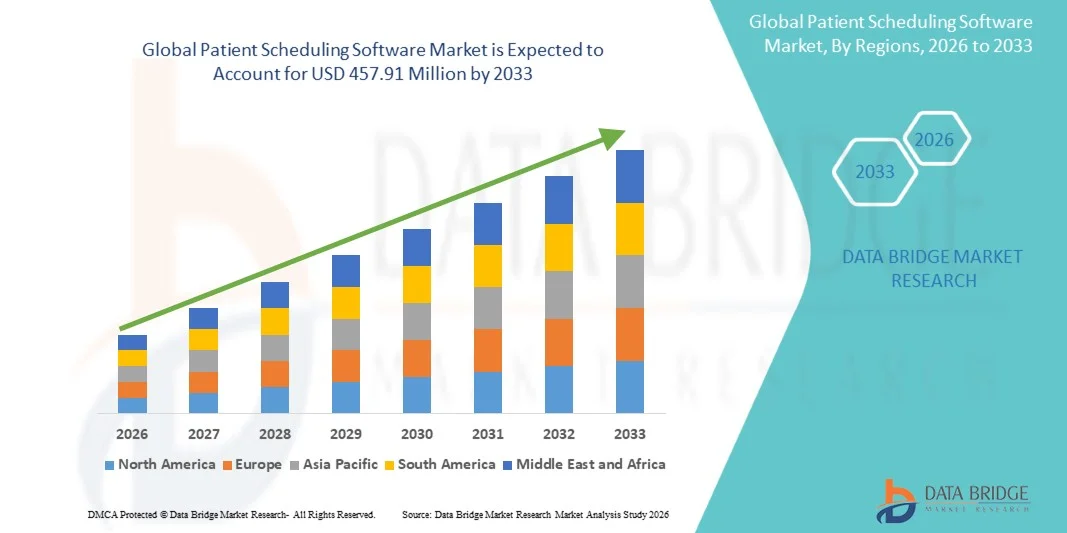
The Patient Scheduling Software Market was valued at USD 319.30 Million in 2025 and is projected to reach USD 457.91 Million by 2033, growing at a CAGR of 4.61% from 2026 to 2033. The market is experiencing steady growth driven by the increasing digitalization of healthcare systems, rising demand for efficient appointment management solutions, and growing adoption of cloud-based healthcare IT platforms across hospitals, clinics, and diagnostic centers. The expansion of telehealth services, increasing patient volume, and the need to reduce administrative burden are encouraging healthcare providers to implement advanced patient scheduling software solutions that improve workflow efficiency, patient engagement, and care coordination.
The growing prevalence of chronic diseases and rising demand for seamless healthcare access are compelling healthcare organizations to adopt AI-enabled and automated scheduling platforms capable of managing appointments, reminders, virtual consultations, and patient flow optimization. Cloud-based and mobile-integrated patient scheduling systems are increasingly replacing conventional manual scheduling methods by offering real-time appointment booking, automated notifications, reduced no-show rates, and enhanced operational efficiency. In addition, increasing integration with electronic health records (EHR), telemedicine platforms, and revenue cycle management systems is further accelerating adoption across healthcare networks, ambulatory care centers, and specialty clinics globally.
Key Market Trends & Insights
- North America dominated the Patient Scheduling Software Market with the largest revenue share of 38.64% in 2025, supported by advanced healthcare IT infrastructure, widespread adoption of electronic health records (EHRs), growing telehealth penetration, and increasing investments in digital patient engagement solutions across hospitals and clinics.
- The cloud segment dominated the market with a share of 62.47% in 2025 due to increasing demand for scalable, remote-accessible, and cost-efficient healthcare software solutions.
- Asia-Pacific is expected to be the fastest-growing region at a CAGR of 8.1% from 2026 to 2033, fueled by rapid healthcare digitalization, increasing smartphone penetration, expanding private healthcare infrastructure, and rising adoption of cloud-based scheduling platforms across China, India, and Japan.
- The Waitlist Management segment is projected to register the fastest growth at a CAGR of 8.4% from 2026 to 2033, reflecting the growing need for optimized patient flow management, reduced scheduling gaps, and improved healthcare resource utilization.
- The Hospitals segment dominates the application category with a 36.92% revenue share in 2025, supported by high patient volumes, increasing demand for workflow automation, and strong adoption of integrated scheduling systems across multi-specialty healthcare networks.
- Cloud deployment accounts for 62.47% of the market in 2025, preferred by healthcare providers due to lower infrastructure costs, remote accessibility, real-time data synchronization, and seamless integration with telehealth and EHR platforms.
- The Large Enterprises segment dominated the company size category with a 58.35% share in 2025, driven by strong IT budgets, large-scale patient management requirements, and growing investments in enterprise-wide healthcare workflow automation solutions.
- The Windows platform segment accounted for the largest market share of 46.18% in 2025, supported by widespread adoption across hospitals, clinics, and healthcare administration systems due to compatibility, scalability, and ease of software integration.
- The 50+ Doctors segment dominated the number of doctor category with a 31.74% revenue share in 2025, owing to increasing demand for centralized scheduling systems capable of managing complex multi-physician workflows and large patient databases.
- The 4 Star and Up segment held the leading position in the rating category with a 42.26% share in 2025, driven by growing preference among healthcare providers for highly rated scheduling solutions offering advanced automation, user-friendly interfaces, and strong technical support.
- The Cardiology segment dominated the specialty category with a 18.91% revenue share in 2025, supported by rising cardiovascular disease burden, increasing patient appointment volumes, and growing need for efficient scheduling and follow-up management systems in specialty cardiac care clinics.
Market Size & Forecast
- Global Market Value (2025): USD 319.30 Million
- Expected Market Value (2033): USD 457.91 Million
- Forecast CAGR (2026–2033): 4.61%
- Leading Region in 2025: North America
- Fastest Growing Region: Asia-Pacific
Report Scope and Patient Scheduling Software Market Segmentation
|
Attributes |
Patient Scheduling Software Key Market Insights |
|
Segments Covered |
|
|
Countries Covered |
North America · U.S. · Canada · Mexico Europe · Germany · France · U.K. · Netherlands · Switzerland · Belgium · Russia · Italy · Spain · Turkey · Rest of Europe Asia-Pacific · China · Japan · India · South Korea · Singapore · Malaysia · Australia · Thailand · Indonesia · Philippines · Rest of Asia-Pacific Middle East and Africa · Saudi Arabia · U.A.E. · South Africa · Egypt · Israel · Rest of Middle East and Africa South America · Brazil · Argentina · Rest of South America |
|
Key Market Players |
• Oracle Corporation (U.S.) |
|
Market Opportunities |
· Expansion of AI-Powered Predictive Scheduling & Workflow Automation · Rising Adoption of Telehealth and Remote Healthcare Services · Growing Healthcare Digitalization in Emerging Markets |
|
Value Added Data Infosets |
In addition to the insights on market scenarios such as market value, growth rate, segmentation, geographical coverage, and major players, the market reports curated by the Data Bridge Market Research also include in-depth expert analysis, geographically represented company-wise production and capacity, network layouts of distributors and partners, detailed and updated price trend analysis and deficit analysis of supply chain and demand. |
Patient Scheduling Software Market Trends
Trend: Growing Adoption of AI-Driven Patient Engagement & Digital Healthcare Scheduling Platforms
Healthcare providers are increasingly adopting advanced patient scheduling software to improve patient engagement, streamline appointment management, and reduce administrative burden across hospitals, clinics, and specialty care centers. The integration of artificial intelligence, automated reminders, telehealth connectivity, and real-time scheduling dashboards is enabling healthcare organizations to optimize patient flow and improve operational efficiency. For instance, industry studies indicate that automated appointment reminder systems can reduce patient no-show rates by nearly 25–35%, significantly improving healthcare resource utilization and revenue management. In addition, hospitals are increasingly deploying self-service scheduling platforms and mobile healthcare applications that allow patients to book, reschedule, and manage appointments remotely. The growing use of cloud-based healthcare IT systems and digital front-door strategies is further accelerating adoption of intelligent patient scheduling solutions across both developed and emerging healthcare markets.
Patient Scheduling Software Market Dynamics
Key Market Driver: Rising Adoption of Digital Healthcare Infrastructure & Workflow Automation
The rapid expansion of digital healthcare ecosystems, telemedicine services, and electronic health record (EHR) integration is significantly driving demand for patient scheduling software globally. Healthcare organizations are increasingly investing in automated scheduling systems to reduce administrative workload, optimize physician utilization, and improve patient satisfaction. According to healthcare IT estimates, healthcare providers can reduce appointment scheduling time by nearly 30–40% through AI-enabled automation and digital workflow management platforms. Hospitals and multispecialty clinics are integrating scheduling software with EHR systems, billing platforms, and telehealth applications to create unified patient management ecosystems. In addition, growing patient preference for online booking, automated reminders, and mobile healthcare access is accelerating software deployment across hospitals, diagnostic laboratories, ambulatory care centers, and specialty clinics worldwide.
Key Restraint/Challenge: Data Privacy Concerns and High Integration Complexity
A significant challenge in the Patient Scheduling Software Market is the growing concern regarding healthcare data privacy, cybersecurity risks, and integration complexity with legacy healthcare IT infrastructure. Modern scheduling platforms require seamless interoperability with EHR systems, telehealth applications, billing software, and patient databases, creating technical and operational challenges for healthcare organizations. In addition, compliance with healthcare regulations such as HIPAA, GDPR, and regional patient data protection frameworks increases implementation complexity and operational costs. Smaller healthcare providers and independent clinics often face budget constraints and limited IT expertise, restricting adoption of advanced scheduling systems. For instance, healthcare cybersecurity reports indicate that the healthcare industry continues to experience increasing ransomware and data breach incidents, prompting providers to invest heavily in secure cloud infrastructure and encrypted patient communication systems.
Key Market Opportunity: Integration of AI, Predictive Analytics, and Telehealth Scheduling Platforms
The integration of artificial intelligence, predictive analytics, and telehealth-enabled scheduling platforms presents a major growth opportunity for the Patient Scheduling Software Market. AI-powered scheduling systems can analyze patient behavior, appointment history, physician availability, and treatment workflows to optimize scheduling efficiency and minimize no-show rates. Advanced predictive scheduling tools are increasingly being used to forecast patient demand, automate waitlist management, and improve staff allocation across healthcare facilities. In addition, cloud-based scheduling platforms integrated with telemedicine services are enabling seamless virtual appointment booking, remote patient management, and automated follow-up care coordination. Emerging healthcare markets across Asia-Pacific, Latin America, and the Middle East are also witnessing strong growth opportunities due to expanding healthcare digitalization initiatives, rising smartphone penetration, and increasing investments in healthcare IT modernization programs.
Patient Scheduling Software Market Scope
The Patient Scheduling Software market is segmented on the basis of services, application, company size, price range, deployment, platform, number of doctor, rating, and speciality.
- By Services
On the basis of services, the Patient Scheduling Software Market is segmented into insurance eligibility verification, appointment reminders, schedule snapshot, quick-look summaries, quick-add functions, recurring appointments, waitlist management, and patient room tracking. The appointment reminders segment dominated the market with a share of 24.83% in 2025 due to the increasing demand for automated patient communication systems that help reduce appointment no-show rates, improve patient engagement, and optimize healthcare workflow efficiency. Healthcare providers are increasingly deploying SMS, email, and AI-enabled reminder systems to improve scheduling accuracy and enhance operational productivity across hospitals and clinics. In addition, growing adoption of mobile health applications, cloud-based scheduling platforms, and integrated telehealth systems is accelerating segment growth. Hospitals and multispecialty clinics are leveraging automated reminder systems to reduce administrative burden and improve patient adherence to follow-up consultations and chronic disease management programs. Rising patient preference for digital healthcare interactions and self-service scheduling options is further supporting market expansion. Furthermore, increasing healthcare digitalization initiatives and integration with EHR platforms are reinforcing the dominance of the appointment reminders segment across developed healthcare markets globally.
The waitlist management segment is expected to witness the fastest CAGR of 8.4% from 2026 to 2033, driven by the increasing need for optimized patient flow management and efficient appointment slot utilization across healthcare organizations. Advanced waitlist management solutions enable providers to automatically fill cancelled appointments, minimize scheduling gaps, and improve physician utilization rates. Growing patient volumes, rising demand for specialty consultations, and increasing pressure on healthcare facilities to reduce waiting times are accelerating adoption of AI-enabled waitlist optimization tools. In addition, integration of predictive analytics and automated scheduling algorithms is helping providers improve resource allocation and operational efficiency. Healthcare providers are increasingly adopting cloud-based waitlist systems to support real-time patient notifications, virtual queue management, and dynamic scheduling capabilities. Expanding telehealth services and increasing investments in digital patient engagement platforms are further contributing to the rapid growth of this segment globally.
- By Application
On the basis of application, the Patient Scheduling Software Market is segmented into manage patient appointments, automate administrative workflows, allocate medical staff, hospitals, health systems, clinics, and others. The manage patient appointments segment dominated the market with a share of 34.76% in 2025 due to the growing need for streamlined appointment booking, patient tracking, and automated scheduling management across healthcare facilities. Hospitals, clinics, and ambulatory care centers are increasingly adopting advanced scheduling platforms to reduce patient waiting time, improve appointment accuracy, and enhance operational productivity. The integration of mobile applications, telehealth services, and AI-powered scheduling tools is further improving patient convenience and healthcare accessibility. In addition, increasing adoption of cloud-based healthcare IT systems and growing emphasis on patient-centric healthcare delivery are accelerating segment growth. Healthcare organizations are also utilizing automated scheduling systems to improve physician availability management and optimize healthcare resource utilization. Rising demand for digital healthcare services and online appointment booking platforms continues to strengthen the dominance of this segment globally.
The automate administrative workflows segment is projected to register the fastest CAGR of 8.2% from 2026 to 2033, driven by increasing healthcare provider focus on reducing manual administrative tasks and improving workflow efficiency. Automated workflow platforms enable healthcare organizations to streamline billing, appointment coordination, insurance verification, patient communication, and reporting functions through integrated digital systems. Rising labor shortages, increasing operational costs, and growing pressure to improve healthcare productivity are encouraging providers to adopt AI-driven workflow automation tools. In addition, integration with EHR systems, revenue cycle management software, and patient engagement platforms is significantly improving administrative efficiency and reducing operational errors. Healthcare organizations are increasingly leveraging automation technologies to improve patient satisfaction and reduce administrative burden across multi-specialty care networks and hospitals globally.
- By Company Size
On the basis of company size, the Patient Scheduling Software Market is segmented into small and medium enterprises and large enterprises. The large enterprises segment dominated the market with a share of 58.35% in 2025 due to strong IT budgets, high patient volumes, and increasing adoption of enterprise-wide healthcare workflow management systems. Large hospital networks and healthcare systems are increasingly investing in integrated scheduling platforms to improve patient coordination, physician allocation, and operational efficiency across multiple facilities. In addition, growing deployment of cloud-based healthcare infrastructure and AI-enabled patient management systems is accelerating adoption among large healthcare organizations. These enterprises also require scalable scheduling platforms capable of supporting telehealth integration, centralized data management, and multi-location operations. Furthermore, rising focus on improving patient experience, reducing no-show rates, and enhancing digital healthcare delivery continues to strengthen the dominance of the large enterprises segment globally.
The small and medium enterprises segment is expected to witness the fastest CAGR of 7.9% from 2026 to 2033, driven by increasing affordability of cloud-based scheduling solutions and growing healthcare digitalization among independent clinics and small healthcare providers. SMEs are increasingly adopting subscription-based scheduling platforms that offer low implementation costs, remote accessibility, and simplified appointment management capabilities. In addition, rising awareness regarding operational efficiency, patient retention, and workflow automation is encouraging smaller healthcare facilities to invest in digital scheduling technologies. Growing availability of SaaS-based healthcare software solutions and mobile-integrated scheduling applications is further accelerating adoption across emerging healthcare markets.
- By Price Range
On the basis of price range, the Patient Scheduling Software Market is segmented into low, medium, and high. The medium price range segment dominated the market with a share of 46.18% in 2025 due to its balance between affordability and advanced functionality. Medium-priced scheduling solutions offer healthcare providers integrated appointment management, automated reminders, telehealth support, and reporting features at competitive pricing structures. These platforms are widely adopted across hospitals, clinics, and multispecialty healthcare networks due to scalability and ease of implementation. Increasing demand for cost-effective healthcare IT solutions and growing preference for subscription-based cloud deployment models are further supporting segment growth. In addition, healthcare organizations are increasingly selecting mid-tier platforms that support EHR integration, patient communication tools, and workflow automation without requiring large capital investments.
The low price range segment is projected to register the fastest CAGR of 7.8% from 2026 to 2033, driven by rising adoption among small clinics, solo practitioners, and emerging healthcare providers. Affordable cloud-based scheduling systems with flexible monthly subscription plans are enabling smaller healthcare facilities to digitize appointment management and improve patient engagement. Growing healthcare digitalization in emerging economies and increasing penetration of SaaS healthcare platforms are further accelerating adoption of low-cost scheduling software solutions globally.
- By Deployment
On the basis of deployment, the Patient Scheduling Software Market is segmented into cloud and on-premises. The cloud segment dominated the market with a share of 62.47% in 2025 due to increasing demand for scalable, remote-accessible, and cost-efficient healthcare software solutions. Cloud-based patient scheduling systems enable healthcare providers to manage appointments, patient communication, telehealth integration, and workflow coordination through centralized digital platforms. In addition, lower infrastructure costs, automatic software updates, and simplified deployment processes are driving adoption across hospitals, clinics, and specialty healthcare centers. Healthcare organizations are increasingly preferring cloud deployment due to improved interoperability, real-time data access, and support for remote healthcare services. Rising investments in healthcare digital transformation and expansion of telemedicine services are further reinforcing the leading position of the cloud segment globally.
The cloud segment is also expected to witness the fastest CAGR of 8.3% from 2026 to 2033, driven by increasing adoption of SaaS healthcare applications and growing demand for connected healthcare ecosystems. Expanding use of AI-powered scheduling platforms, mobile health applications, and remote patient engagement systems is significantly contributing to segment growth. Furthermore, rising investments in healthcare cybersecurity and secure cloud infrastructure are enhancing provider confidence in cloud-based patient scheduling platforms.
- By Platform
On the basis of platform, the Patient Scheduling Software Market is segmented into MacOS, Windows, and Linux. The Windows segment dominated the market with a share of 46.18% in 2025 due to its widespread adoption across hospitals, healthcare administration systems, and clinical management platforms. Windows-based scheduling systems offer broad compatibility with healthcare IT infrastructure, EHR platforms, and enterprise software applications, making them highly preferred among healthcare providers globally. In addition, ease of software integration, user familiarity, and availability of technical support services are supporting strong adoption across healthcare organizations. Healthcare facilities are increasingly deploying Windows-compatible scheduling platforms to streamline appointment coordination, administrative workflows, and telehealth operations.
The MacOS segment is anticipated to witness the fastest CAGR of 7.5% from 2026 to 2033, driven by increasing adoption among private clinics, specialty healthcare providers, and premium healthcare facilities seeking secure and user-friendly scheduling solutions. Growing use of Apple-based healthcare ecosystems, mobile device integration, and cloud-enabled healthcare applications is accelerating segment growth across developed healthcare markets.
- By Number of Doctor
On the basis of number of doctor, the Patient Scheduling Software Market is segmented into solo practice, 2-5 doctors, 6-10 doctors, 11-25 doctors, 25-50 doctors, and 50+ doctors. The 50+ doctors segment dominated the market with a share of 31.74% in 2025 due to increasing adoption of centralized scheduling systems across large hospitals and multispecialty healthcare networks. These healthcare organizations require advanced scheduling platforms capable of managing high patient volumes, physician coordination, and complex appointment workflows across multiple departments. In addition, growing focus on workflow optimization, patient engagement, and healthcare resource allocation is accelerating adoption of enterprise-grade scheduling solutions among large physician networks.
The 11-25 doctors segment is expected to witness the fastest CAGR of 7.7% from 2026 to 2033, driven by rising digital transformation among mid-sized clinics and specialty healthcare providers. Increasing demand for integrated scheduling, billing, and telehealth management solutions is encouraging medium-sized healthcare facilities to adopt cloud-based patient scheduling platforms. Growing emphasis on improving operational efficiency and patient satisfaction is further supporting segment expansion globally.
- By Rating
On the basis of rating, the Patient Scheduling Software Market is segmented into 1 star and up, 2 star and up, 3 star and up, and 4 star and up. The 4 star and up segment dominated the market with a share of 42.26% in 2025 due to growing preference among healthcare providers for highly rated scheduling solutions offering advanced automation, reliability, and technical support capabilities. Healthcare organizations increasingly prioritize software platforms with strong customer satisfaction ratings, intuitive interfaces, and comprehensive workflow management features. In addition, increasing reliance on peer reviews, software comparison platforms, and healthcare IT recommendations is influencing purchasing decisions across hospitals and clinics.
The 3 star and up segment is projected to witness the fastest CAGR of 7.4% from 2026 to 2033, driven by rising demand for cost-effective scheduling platforms among small healthcare providers and independent practices. These solutions provide essential scheduling, reminder, and patient management features at affordable pricing structures, supporting broader adoption across emerging healthcare markets.
- By Speciality
On the basis of speciality, the Patient Scheduling Software Market is segmented into allergy and immunology, cardiology, dentistry, fertility clinics, oncology, urology, and other speciality. The cardiology segment dominated the market with a share of 18.91% in 2025 due to rising cardiovascular disease prevalence and increasing patient appointment volumes across specialty cardiac care centers. Cardiology practices require advanced scheduling platforms to manage recurring consultations, diagnostic procedures, follow-up appointments, and telecardiology services efficiently. In addition, increasing adoption of digital patient engagement tools and remote cardiac monitoring platforms is accelerating demand for integrated scheduling systems across cardiology departments globally.
The oncology segment is expected to witness the fastest CAGR of 8.1% from 2026 to 2033, driven by increasing global cancer burden and rising demand for coordinated patient care workflows across oncology treatment centers. Oncology clinics are increasingly adopting scheduling platforms capable of managing chemotherapy sessions, follow-up visits, multidisciplinary consultations, and long-term treatment planning. Growing investments in cancer care infrastructure and digital oncology management systems are further contributing to segment growth globally.
Patient Scheduling Software Market Regional Analysis
North America dominated the Patient Scheduling Software Market and accounted for the largest revenue share of 38.64% in 2025, supported by advanced healthcare IT infrastructure, widespread adoption of electronic health records (EHRs), growing telehealth penetration, and increasing investments in digital patient engagement solutions across hospitals and clinics. The region also benefits from strong presence of leading healthcare technology providers, increasing focus on workflow optimization, and rising demand for automated appointment management systems to improve operational efficiency and patient experience. Continuous advancements in AI-powered scheduling platforms, cloud-based healthcare solutions, and interoperability technologies are further strengthening North America’s leadership position in the global market.
U.S. Patient Scheduling Software Market Insight
The U.S. Patient Scheduling Software market is witnessing strong growth due to increasing adoption of digital healthcare technologies, rising demand for streamlined appointment management, and growing emphasis on enhancing patient engagement and operational efficiency. The country’s advanced healthcare infrastructure, widespread EHR integration, and rapid expansion of telehealth services are driving software adoption across hospitals, clinics, and ambulatory care centers. In addition, increasing investments in AI-enabled scheduling systems, automated reminders, and cloud-based healthcare platforms are supporting market expansion in the United States.
Europe Patient Scheduling Software Market Insight
The Europe Patient Scheduling Software market remains a major contributor to global revenue, driven by increasing healthcare digitalization, strong government support for e-health initiatives, and rising demand for efficient patient management solutions. Healthcare providers across the region are increasingly adopting cloud-based and AI-integrated scheduling platforms to reduce administrative burden, minimize appointment no-shows, and improve patient care coordination. Furthermore, growing focus on interoperability, data security, and digital transformation in healthcare systems continues to accelerate adoption of Patient Scheduling Software across Europe.
U.K. Patient Scheduling Software Market Insight
The U.K. Patient Scheduling Software market is experiencing steady growth, supported by increasing adoption of digital healthcare systems, rising focus on reducing patient wait times, and growing demand for efficient appointment scheduling solutions within the National Health Service (NHS) and private healthcare facilities. Increasing investments in healthcare automation, telemedicine platforms, and AI-powered patient communication technologies are contributing to market growth. In addition, rising emphasis on improving healthcare accessibility and patient satisfaction is further driving software adoption across the U.K. healthcare sector.
Germany Patient Scheduling Software Market Insight
The Germany Patient Scheduling Software market is expanding steadily due to the country’s advanced healthcare infrastructure, strong focus on healthcare digitization, and increasing adoption of integrated hospital management systems. Hospitals, specialty clinics, and healthcare providers are increasingly utilizing automated scheduling software to enhance operational efficiency, optimize patient flow, and improve care coordination. Continuous advancements in cloud computing, AI-driven healthcare analytics, and secure digital health platforms are further supporting market growth in Germany.
Asia-Pacific Patient Scheduling Software Market Insight
The Asia-Pacific Patient Scheduling Software market is expected to witness rapid growth, driven by increasing healthcare digitalization, expanding private healthcare infrastructure, and rising smartphone and internet penetration across countries such as China, India, and Japan. Growing awareness regarding digital health solutions, increasing adoption of cloud-based scheduling platforms, and rising demand for cost-effective healthcare management systems are supporting regional market expansion. In addition, government initiatives promoting e-health services and rapid growth in telemedicine adoption are accelerating the implementation of Patient Scheduling Software across the Asia-Pacific region.
Japan Patient Scheduling Software Market Insight
The Japan Patient Scheduling Software market is witnessing consistent growth due to rising investments in healthcare IT infrastructure, increasing adoption of digital patient management systems, and growing demand for efficient healthcare service delivery. Hospitals and healthcare providers are increasingly adopting AI-enabled scheduling tools, telehealth integration, and automated patient communication systems to improve operational efficiency and patient satisfaction. Moreover, the country’s focus on advanced healthcare technologies and aging population management is further contributing to market growth.
China Patient Scheduling Software Market Insight
The China Patient Scheduling Software market is growing rapidly, driven by expanding healthcare infrastructure, rising healthcare digitalization, and increasing government support for smart healthcare initiatives. Growing adoption of cloud-based healthcare platforms, AI-powered appointment management systems, and mobile health applications across hospitals and clinics is significantly boosting market demand. In addition, increasing patient volumes, rising smartphone penetration, and strong investments in healthcare technology innovation are positioning China as one of the fastest-growing markets for Patient Scheduling Software globally.
Patient Scheduling Software Market Share
The Patient Scheduling Software industry is primarily led by well-established companies, including:
- Oracle Corporation (U.S.)
- Epic Systems Corporation (U.S.)
- Athenahealth, Inc. (U.S.)
- NextGen Healthcare, Inc. (U.S.)
- eClinicalWorks LLC (U.S.)
- Cerner Corporation (U.S.)
- QGenda, LLC (U.S.)
- Zocdoc, Inc. (U.S.)
- SimplePractice, LLC (U.S.)
- AdvancedMD, Inc. (U.S.)
- NexHealth, Inc. (U.S.)
- Careo AI (U.S.)
- DrChrono Inc. (U.S.)
- PatientPop, Inc. (U.S.)
- Doctolib SAS (France)
- Practo Technologies Pvt. Ltd. (India)
- Booksy International Sp. z o.o. (Poland)
- MEDIKEEPER, Inc. (U.S.)
- Phreesia, Inc. (U.S.)
- Microsoft Corporation (U.S.)
- Salesforce, Inc. (U.S.)
- McKesson Corporation (U.S.)
- Experian Health (U.S.)
- WellSky Corporation (U.S.)
- CureMD Healthcare (U.S.)
- 10to8 Ltd. (United Kingdom)
- Setmore Appointments (U.S.)
- SimplyBook.me Ltd. (Cyprus)
- Fresha.com SV Ltd. (United Kingdom)
- Zoho Corporation Pvt. Ltd. (India)
- Docpulse Technologies Pvt. Ltd. (India)
- Vagaro, Inc. (U.S.)
- Reservio s.r.o. (Czech Republic)
- ClinicSense, LLC (Canada)
Latest Developments in Patient Scheduling Software Market
- In December 2021, Oracle Corporation announced its agreement to acquire Cerner Corporation for approximately USD 28.3 billion. The acquisition aimed to strengthen Oracle’s position in healthcare IT and accelerate the development of cloud-based healthcare management, electronic health records (EHR), and patient scheduling solutions. This development marked one of the largest healthcare technology acquisitions globally and highlighted the growing importance of integrated digital patient management platforms
- In June 2022, Oracle Corporation officially completed the acquisition of Cerner Corporation, further expanding Oracle’s healthcare technology ecosystem. The acquisition strengthened Oracle’s capabilities in hospital workflow automation, patient scheduling, cloud healthcare infrastructure, and connected digital care solutions, supporting the modernization of healthcare administration systems worldwide
- In June 2023, Zocdoc partnered with Elation Health to integrate online patient scheduling directly with Elation’s EHR platform. The collaboration enabled healthcare providers to synchronize real-time appointment availability and improve patient booking efficiency, reducing administrative workload while enhancing patient access to care
- In September 2023, Zocdoc launched “Zocdoc Practice Solutions,” a new suite of patient engagement and scheduling tools that included online appointment scheduling, digital intake forms, and telehealth services. The launch reflected the increasing industry shift toward integrated patient scheduling ecosystems designed to improve healthcare accessibility and streamline front-office operations
- In February 2025, Zocdoc announced a partnership with Epic Systems Corporation to integrate Zocdoc’s online appointment scheduling capabilities with Epic’s MyChart platform. The integration enabled patients to book appointments more seamlessly within healthcare provider systems, enhancing digital patient engagement and scheduling efficiency
- In April 2025, eClinicalWorks launched “Scheduling Pro 2.0,” an upgraded patient scheduling platform featuring AI-assisted appointment optimization, enhanced self-scheduling functions, and improved availability management tools. The launch highlighted the growing adoption of AI-driven automation within patient scheduling software to reduce no-shows and improve operational efficiency in healthcare facilities
- In May 2025, Epic Systems Corporation introduced a conversational AI scheduling tool that enabled patients to schedule healthcare appointments via SMS without requiring portal login access. The AI-powered assistant streamlined appointment booking, confirmations, and patient communication, demonstrating the increasing integration of conversational AI technologies in modern patient scheduling software platforms
SKU-
Get online access to the report on the World's First Market Intelligence Cloud

- Interactive Data Analysis Dashboard
- Company Analysis Dashboard for high growth potential opportunities
- Research Analyst Access for customization & queries
- Competitor Analysis with Interactive dashboard
- Latest News, Updates & Trend analysis
- Harness the Power of Benchmark Analysis for Comprehensive Competitor Tracking
Research Methodology
Data collection and base year analysis are done using data collection modules with large sample sizes. The stage includes obtaining market information or related data through various sources and strategies. It includes examining and planning all the data acquired from the past in advance. It likewise envelops the examination of information inconsistencies seen across different information sources. The market data is analysed and estimated using market statistical and coherent models. Also, market share analysis and key trend analysis are the major success factors in the market report. To know more, please request an analyst call or drop down your inquiry.
The key research methodology used by DBMR research team is data triangulation which involves data mining, analysis of the impact of data variables on the market and primary (industry expert) validation. Data models include Vendor Positioning Grid, Market Time Line Analysis, Market Overview and Guide, Company Positioning Grid, Patent Analysis, Pricing Analysis, Company Market Share Analysis, Standards of Measurement, Global versus Regional and Vendor Share Analysis. To know more about the research methodology, drop in an inquiry to speak to our industry experts.
Customization Available
Data Bridge Market Research is a leader in advanced formative research. We take pride in servicing our existing and new customers with data and analysis that match and suits their goal. The report can be customized to include price trend analysis of target brands understanding the market for additional countries (ask for the list of countries), clinical trial results data, literature review, refurbished market and product base analysis. Market analysis of target competitors can be analyzed from technology-based analysis to market portfolio strategies. We can add as many competitors that you require data about in the format and data style you are looking for. Our team of analysts can also provide you data in crude raw excel files pivot tables (Fact book) or can assist you in creating presentations from the data sets available in the report.












