




Global Perfusion Radiology Market
Market Size in USD Billion
CAGR :
% 
 USD
2.88 Billion
USD
5.66 Billion
2025
2033
USD
2.88 Billion
USD
5.66 Billion
2025
2033
 Forecast Period Forecast Period |
2026 –2033 |
 Market Size (Base Year) Market Size (Base Year) |
USD 2.88 Billion |
 Market Size (Forecast Year) Market Size (Forecast Year) |
USD 5.66 Billion |
 CAGR CAGR |
% |
| Major Markets Players |
|
Perfusion Radiology Market Size
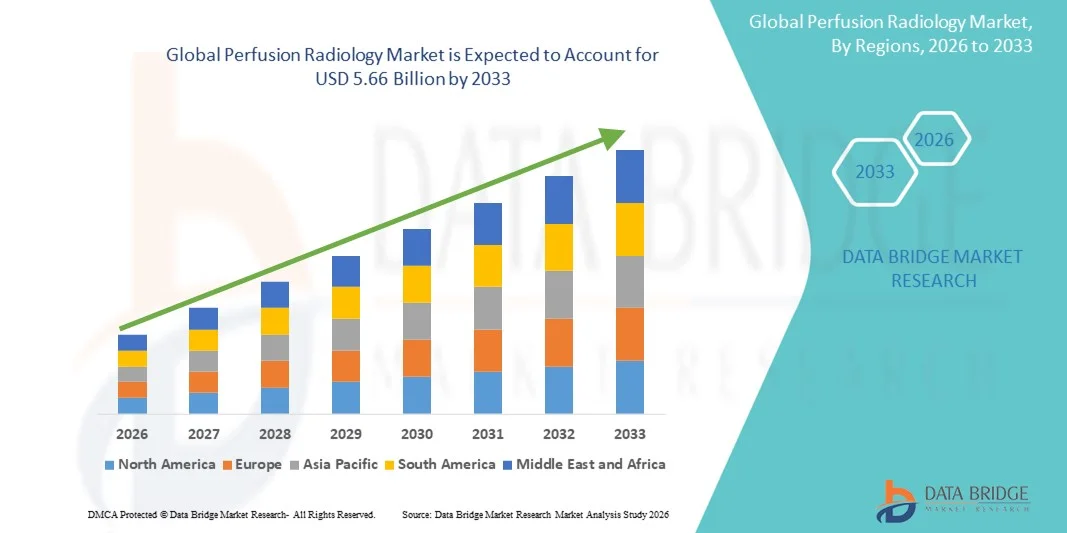
- The global perfusion radiology market size was valued at USD 2.88 billion in 2025 and is expected to reach USD 5.66 billion by 2033, at a CAGR of 8.81% during the forecast period
- The market growth is largely driven by the rising prevalence of neurological and cardiovascular disorders, along with the increasing clinical adoption of advanced imaging techniques for early diagnosis, treatment planning, and outcome monitoring across hospitals and diagnostic centers
- Furthermore, continuous technological advancements in CT and MRI perfusion imaging, combined with growing demand for precise, non-invasive, and time-efficient diagnostic solutions, are positioning perfusion radiology as a critical component of modern medical imaging. These converging factors are accelerating adoption, thereby significantly boosting overall market growth
Perfusion Radiology Market Analysis
- Perfusion radiology, encompassing advanced CT and MRI imaging techniques that assess tissue blood flow and perfusion dynamics, is an increasingly critical component of modern diagnostic imaging, particularly in neurology, oncology, and cardiology, due to its ability to enable rapid, accurate, and non-invasive clinical decision-making
- The rising demand for perfusion radiology is primarily driven by the increasing global burden of stroke, cancer, and cardiovascular diseases, along with greater clinical emphasis on early diagnosis, precision medicine, and data-driven treatment planning across hospitals and diagnostic imaging centers
- North America dominated the perfusion radiology market with a revenue share of 38.6% in 2025, supported by advanced healthcare infrastructure, high penetration of CT and MRI systems, and strong adoption of perfusion imaging in acute stroke and oncology workflows, particularly across the U.S.
- Asia-Pacific is expected to be the fastest-growing region, accounting for a market share of in 2025, driven by rapid healthcare infrastructure development, increasing diagnostic imaging volumes, and rising investments in advanced radiology technologies across China, India, and Southeast Asia
- Computed Tomography (CT Scan) segment dominated the global perfusion radiology market with a share of 44.1% in 2025, owing to its fast acquisition time, widespread availability in emergency care settings, and its critical role in time-sensitive applications such as acute stroke diagnosis and treatment planning
Report Scope and Perfusion Radiology Market Segmentation
|
Attributes |
Perfusion Radiology Key Market Insights |
|
Segments Covered |
|
|
Countries Covered |
North America
Europe
Asia-Pacific
Middle East and Africa
South America
|
|
Key Market Players |
|
|
Market Opportunities |
|
|
Value Added Data Infosets |
In addition to the insights on market scenarios such as market value, growth rate, segmentation, geographical coverage, and major players, the market reports curated by the Data Bridge Market Research also include in-depth expert analysis, patient epidemiology, pipeline analysis, pricing analysis, and regulatory framework |
Perfusion Radiology Market Trends
Rising Adoption of AI-Enabled and Automated Perfusion Imaging
- A significant and accelerating trend in the global perfusion radiology market is the integration of artificial intelligence (AI) and advanced automation into CT and MRI perfusion workflows, enhancing diagnostic accuracy, speed, and clinical decision support across neurology, oncology, and cardiology
- For instance, AI-powered perfusion software is increasingly being deployed in stroke imaging to automatically quantify cerebral blood flow and generate rapid maps that assist clinicians in identifying salvageable brain tissue within critical time windows
- AI integration in perfusion radiology enables features such as automated lesion detection, standardized perfusion parameter analysis, and reduction of inter-reader variability, thereby improving consistency and confidence in diagnostic outcomes. In addition, machine learning algorithms support faster post-processing, which is essential in emergency and acute care settings
- The seamless integration of perfusion imaging software with hospital PACS, RIS, and clinical decision systems facilitates centralized imaging workflows, allowing radiologists and clinicians to access perfusion insights alongside other diagnostic data through a unified interface
- This trend toward intelligent, workflow-optimized, and data-driven perfusion imaging solutions is reshaping expectations for advanced diagnostic radiology. Consequently, imaging vendors are increasingly focusing on AI-enabled perfusion platforms that support automated analysis, real-time reporting, and scalable deployment
- The demand for AI-enhanced perfusion radiology solutions is growing across hospitals and diagnostic centers, as healthcare providers prioritize faster diagnosis, improved outcomes, and operational efficiency in time-sensitive clinical environments
Perfusion Radiology Market Dynamics
Driver
Increasing Burden of Neurological and Cardiovascular Disorders
- The rising global prevalence of stroke, cancer, and cardiovascular diseases, combined with the growing need for precise functional imaging, is a major driver fueling demand for perfusion radiology solutions
- For instance, the expanding use of CT perfusion imaging in acute ischemic stroke pathways has become critical for guiding thrombolysis and thrombectomy decisions, significantly improving patient outcomes
- As healthcare systems emphasize early diagnosis and personalized treatment planning, perfusion imaging provides valuable physiological insights that go beyond conventional anatomical imaging, supporting evidence-based clinical decisions
- Furthermore, the increasing availability of advanced CT and MRI scanners in hospitals and diagnostic centers is enabling broader adoption of perfusion imaging across both developed and emerging healthcare markets
- The growing focus on outcome-based care and precision medicine is further accelerating the integration of perfusion radiology into routine clinical workflows, particularly in oncology treatment response assessment and cardiac perfusion evaluation
- Rising investments in healthcare infrastructure, coupled with improved reimbursement frameworks for advanced imaging procedures, continue to support sustained market growth across multiple clinical applications
Restraint/Challenge
High System Costs and Technical Complexity
- The high cost associated with advanced CT and MRI perfusion systems, along with specialized software and maintenance requirements, poses a significant challenge to widespread adoption, particularly in resource-constrained healthcare settings
- For instance, smaller hospitals and diagnostic centers often face budgetary limitations that restrict access to high-end perfusion imaging technologies, slowing market penetration in developing regions
- Addressing these challenges requires simplified software solutions, improved scanner utilization, and enhanced clinician training, as perfusion imaging demands technical expertise for accurate acquisition and interpretation of results
- While technological advancements are gradually reducing scan times and operational complexity, the perceived cost-to-benefit ratio can still deter adoption among facilities with lower patient volumes
- In addition, variability in reimbursement policies for advanced perfusion imaging procedures across regions can limit adoption, as inconsistent coverage creates financial uncertainty for healthcare providers
- The lack of standardized clinical protocols and interpretation guidelines for perfusion imaging in certain applications further challenges adoption, leading to cautious uptake among clinicians and imaging centers
- Overcoming these barriers through cost-effective imaging solutions, cloud-based post-processing, and expanded training initiatives will be essential for unlocking the full growth potential of the global perfusion radiology market
Perfusion Radiology Market Scope
The market is segmented on the basis of modality, application, end-user, and organ type.
- By Modality
On the basis of modality, the perfusion radiology market is segmented into Computed Tomography (CT Scan), Magnetic Resonance Imaging (MRI), and Nuclear Medicine. The CT scan segment dominated the market with the largest market revenue share of 44.1% in 2025, driven by its rapid acquisition time, widespread availability in hospitals and emergency care settings, and critical role in acute stroke diagnosis and cardiovascular assessments. CT perfusion provides high-resolution images and rapid perfusion mapping, making it essential for time-sensitive clinical decisions, particularly in neurology and cardiology. The segment also benefits from continuous technological upgrades, such as iterative reconstruction algorithms and AI-based post-processing, enhancing accuracy and efficiency. Furthermore, the relatively lower cost and broad clinical familiarity of CT systems support their dominance in both developed and emerging markets. Hospitals increasingly prefer CT perfusion for its operational efficiency and ability to integrate with existing imaging workflows.
The MRI segment is expected to witness the fastest growth rate of CAGR 9% from 2026 to 2033, fueled by its superior soft tissue contrast, multiparametric imaging capabilities, and non-ionizing nature, making it ideal for neurological, oncological, and cardiac perfusion studies. Advanced MRI perfusion techniques, including dynamic susceptibility contrast (DSC) and arterial spin labeling (ASL), are gaining popularity due to their ability to provide quantitative perfusion metrics without radiation exposure. The growing adoption of high-field MRI scanners and AI-assisted perfusion mapping further drives the segment’s expansion. Increasing awareness among clinicians about MRI’s diagnostic benefits and rising investments in healthcare infrastructure in emerging economies are expected to contribute to the accelerated growth of this segment.
- By Application
On the basis of application, the perfusion radiology market is segmented into cardiovascular imaging, ventilation imaging, brain imaging, and others. The brain imaging segment dominated the market with the largest share of 41.5% in 2025, owing to the increasing incidence of stroke and neurodegenerative disorders. Perfusion imaging plays a critical role in early stroke detection, identification of ischemic penumbra, and monitoring of brain tumor perfusion during treatment. Hospitals and diagnostic centers widely adopt brain perfusion protocols due to the clinical significance in acute care and treatment planning. Furthermore, advancements in AI-based automated perfusion analysis enhance diagnostic accuracy and workflow efficiency, further supporting the segment’s dominance. Brain imaging remains central to research and clinical trials, driving continuous investment and adoption.
The cardiovascular imaging segment is anticipated to witness the fastest growth rate of CAGR 7% from 2026 to 2033, driven by the rising prevalence of heart diseases and increasing use of perfusion imaging for myocardial ischemia assessment and treatment planning. Advanced cardiac perfusion techniques, including stress perfusion MRI and CT perfusion angiography, enable early detection of coronary artery disease and functional evaluation of myocardial blood flow. Hospitals and cardiac centers are increasingly integrating perfusion imaging into routine cardiovascular diagnostics. The growing awareness of non-invasive and precise diagnostic alternatives to traditional invasive angiography supports the segment’s rapid adoption.
- By End-User
On the basis of end-user, the perfusion radiology market is segmented into hospitals, diagnostic centers, and others. The hospital segment dominated the market with a share of 62% in 2025, due to the availability of advanced imaging equipment, trained radiologists, and high patient throughput. Hospitals often require rapid and accurate perfusion assessments for emergency care, oncology, and cardiovascular interventions, making them the primary consumers of perfusion radiology solutions. The integration of perfusion imaging into hospital workflows and electronic health records further enhances its utilization. In addition, hospitals invest heavily in upgrading their imaging infrastructure, which reinforces their dominance in the market. Large academic medical centers also drive research and clinical adoption of perfusion imaging, contributing to the segment’s market share.
The diagnostic centers segment is expected to witness the fastest growth rate of CAGR 9% from 2026 to 2033, driven by increasing outpatient imaging demand, lower operational costs, and growing healthcare access in emerging regions. Diagnostic centers are expanding their service offerings to include perfusion imaging for neurological, cardiac, and oncological applications, leveraging portable and cost-effective CT/MRI systems. Collaborations with hospitals and tele-radiology platforms enable rapid reporting and workflow optimization. Rising awareness among patients and referring physicians about the advantages of perfusion imaging in non-hospital settings further supports this segment’s growth trajectory.
- By Organ Type
On the basis of organ type, the perfusion radiology market is segmented into heart, lung, kidney, liver, and others. The heart segment dominated the market with a share of 50.2% in 2025, driven by the increasing prevalence of cardiovascular diseases and the critical role of myocardial perfusion imaging in diagnosing ischemia and assessing treatment efficacy. Perfusion imaging enables non-invasive evaluation of coronary artery disease and guides intervention strategies. Hospitals and cardiac centers are investing in advanced perfusion protocols for both CT and MRI, strengthening segment dominance. In addition, the integration of AI-driven perfusion mapping facilitates accurate quantification of myocardial blood flow, improving clinical outcomes and decision-making. Research and clinical trials focusing on cardiac perfusion further enhance awareness and adoption.
The lung segment is expected to witness the fastest growth rate of CAGR 8% from 2026 to 2033, fueled by rising cases of chronic obstructive pulmonary disease (COPD), pulmonary embolism, and other respiratory conditions. Pulmonary perfusion imaging, particularly using CT and nuclear medicine techniques, is increasingly used for non-invasive assessment of ventilation-perfusion mismatch and functional lung evaluation. Growing awareness among pulmonologists and healthcare providers about advanced diagnostic options supports adoption. Emerging markets are witnessing increased investment in imaging centers offering lung perfusion diagnostics, contributing to rapid growth. Continuous development of low-dose imaging protocols and AI-assisted lung perfusion quantification further accelerates this segment.
Perfusion Radiology Market Regional Analysis
- North America dominated the perfusion radiology market with a revenue share of 38.6% in 2025, supported by advanced healthcare infrastructure, high penetration of CT and MRI systems, and strong adoption of perfusion imaging in acute stroke and oncology workflows, particularly across the U.S.
- Hospitals and diagnostic centers in the region increasingly implement CT, MRI, and nuclear medicine perfusion imaging for early disease detection, treatment planning, and research purposes, reflecting high clinical awareness and technological readiness
- The widespread adoption is further supported by favorable reimbursement policies, high healthcare expenditure, and the presence of major market players investing in R&D and innovative perfusion imaging solutions
U.S. Perfusion Radiology Market Insight
The U.S. perfusion radiology market captured the largest revenue share of 42% in North America in 2025, driven by high adoption of advanced imaging modalities including CT, MRI, and nuclear medicine for cardiovascular, neuro, and oncological applications. Hospitals and diagnostic centers are increasingly investing in perfusion imaging for early disease detection, treatment planning, and post-therapy monitoring. The growing prevalence of stroke, coronary artery disease, and cancer fuels demand for accurate, non-invasive perfusion assessment. Integration of AI-assisted analysis, automated post-processing software, and tele-radiology solutions is enhancing workflow efficiency and diagnostic accuracy. Moreover, favorable reimbursement policies, high healthcare expenditure, and skilled radiologists continue to propel market growth. The U.S. remains the largest revenue contributor due to its advanced healthcare infrastructure and strong R&D focus.
Europe Perfusion Radiology Market Insight
The Europe perfusion radiology market is projected to expand at a substantial CAGR through the forecast period, driven by increasing healthcare investments, rising incidence of cardiovascular and neurological disorders, and strong government initiatives promoting early disease detection. Hospitals and imaging centers across Germany, France, and Italy are adopting advanced perfusion imaging systems, while reimbursement frameworks support wider clinical utilization. Urbanization and increasing awareness of non-invasive diagnostic techniques are fostering adoption. The demand spans cardiovascular, brain, and oncology imaging applications, particularly in multi-specialty and teaching hospitals. Furthermore, continuous technological advancements and integration of AI-based perfusion analysis contribute to market expansion.
U.K. Perfusion Radiology Market Insight
The U.K. perfusion radiology market is anticipated to grow at a noteworthy CAGR during the forecast period, driven by rising healthcare expenditure, expanding hospital infrastructure, and increasing prevalence of stroke and cardiovascular diseases. The adoption of CT, MRI, and nuclear medicine perfusion imaging is supported by public health initiatives and private sector investment in imaging technologies. The integration of AI for automated perfusion analysis, improved workflow, and enhanced diagnostic accuracy is accelerating uptake. Hospitals, diagnostic centers, and specialty clinics are incorporating perfusion imaging into clinical workflows for early detection and treatment monitoring. Increasing awareness among clinicians and patients regarding non-invasive imaging benefits further drives growth. Evolving clinical guidelines and adoption of hybrid imaging systems reinforce market momentum.
Germany Perfusion Radiology Market Insight
The Germany perfusion radiology market is expected to expand at a considerable CAGR during the forecast period, fueled by strong healthcare infrastructure, technological advancements, and high adoption of precision imaging techniques. Hospitals and diagnostic centers are investing in perfusion imaging for cardiovascular, neurovascular, and oncological applications. Growing awareness of early disease detection, coupled with government funding and private investments in imaging technologies, supports market expansion. Integration of AI-assisted software and hybrid imaging modalities enhances diagnostic accuracy and efficiency. Germany’s emphasis on innovation, sustainability, and quality healthcare promotes the adoption of advanced perfusion imaging solutions. Demand spans both new hospital installations and upgrades in existing radiology departments.
Asia-Pacific Perfusion Radiology Market Insight
The Asia-Pacific perfusion radiology market is poised to grow at the fastest CAGR of 12% from 2026 to 2033, driven by rising incidence of cardiovascular, neurovascular, and pulmonary diseases, increasing healthcare expenditure, and technological advancements in countries such as China, Japan, and India. Rapid urbanization, growing awareness of non-invasive diagnostics, and government initiatives promoting smart hospitals and advanced imaging infrastructure support market adoption. Hospitals and diagnostic centers are expanding imaging services, and hybrid CT/MRI systems are increasingly deployed. Rising investment in healthcare infrastructure and accessibility to affordable perfusion imaging solutions further boost market growth. The region is also emerging as a hub for manufacturing and innovation in imaging equipment.
Japan Perfusion Radiology Market Insight
The Japan perfusion radiology market is gaining momentum due to the country’s advanced healthcare system, aging population, and high adoption of technologically sophisticated imaging modalities. Hospitals and specialty clinics are increasingly using perfusion imaging for stroke, cardiovascular, and oncology applications. Integration of AI-assisted perfusion analysis, automated post-processing, and tele-radiology supports faster and more accurate diagnosis. The increasing number of smart hospitals and connected healthcare infrastructure promotes widespread adoption. Demand for non-invasive, precise imaging for early detection and treatment monitoring is driving market expansion. Japan’s focus on innovation, patient safety, and advanced medical care reinforces sustained market growth.
India Perfusion Radiology Market Insight
The India perfusion radiology market accounted for the largest market revenue share in Asia-Pacific in 2025, attributed to the country’s expanding healthcare infrastructure, rising prevalence of cardiovascular and neurological diseases, and rapid adoption of advanced imaging technologies. Hospitals, diagnostic centers, and specialty clinics are increasingly incorporating CT, MRI, and nuclear medicine perfusion imaging into routine clinical practice. Government initiatives for digital healthcare and smart hospitals, combined with the availability of cost-effective imaging solutions, are boosting adoption. Rising awareness among clinicians and patients about non-invasive diagnostic benefits further accelerates market growth. India’s large patient population and growing middle class contribute to increasing demand for perfusion imaging services.
Perfusion Radiology Market Share
The Perfusion Radiology industry is primarily led by well-established companies, including:
- GE HealthCare (U.S.)
- CANON MEDICAL SYSTEMS CORPORATION (Japan)
- Koninklijke Philips N.V. (Netherlands)
- Siemens Healthineers AG (Germany)
- Viz.ai, Inc. (U.S.)
- Bracco S.p.A. (Italy)
- FUJIFILM Holdings Corporation (Japan)
- Shimadzu Corporation (Japan)
- Lantheus Medical Imaging, Inc. (U.S.)
- Perimed AB (Sweden)
- Neusoft Medical Systems Co., Ltd. (China)
- Medtronic (Ireland)
- Positron Corporation (U.S.)
- iSchemaView, Inc. (U.S.)
- Olea Medical (France)
- RapidAI (U.S.)
- United Imaging Healthcare (China)
- RamSoft Inc. (Canada)
- RadNet, Inc. (U.S.)
- Spectrum Health (U.S.)
What are the Recent Developments in Global Perfusion Radiology Market?
- In July 2025, 4DMedical’s CT:VQ software received FDA 510(k) clearance for its non‑contrast CT‑based ventilation‑perfusion imaging solution, enabling quantitative lung ventilation and perfusion maps using routine CT data without specialized hardware. This innovation broadens access to functional lung perfusion imaging and integrates with standard workflows
- In April 2025, Brainomix announced that its Brainomix 360 stroke imaging platform received FDA clearance for a novel ischemic core volume feature, enabling clinicians to estimate core volume from non‑contrast CT scans with performance similar to CT perfusion and MRI perfusion. This advance expands access to perfusion‑level insights even in settings without dedicated perfusion imaging, improving stroke triage and treatment decisions
- In December 2024, Cercare Medical announced that it secured FDA clearance for its CT perfusion imaging software, complementing its earlier MRI perfusion solution. This milestone expands advanced cerebral perfusion analysis capabilities for clinicians, offering precise perfusion maps to support faster diagnoses in acute stroke and other neurological conditions
- In May 2024, RapidAI announced that the U.S. FDA granted 510(k) clearance for its AI‑enabled AngioFlow™ perfusion imaging module, designed to deliver perfusion maps directly within the interventional suite to help clinicians assess cerebral blood flow changes during stroke care. This clearance supports faster, more efficient workflow and potentially better patient outcomes at critical time points
- In March 2023, Brainomix received FDA clearance for its Brainomix 360 e‑ASPECTS AI software, part of a broader imaging platform that supports stroke care including perfusion analysis modules (e‑CTP and e‑MRI). This clearance enabled rapid adoption of AI‑based perfusion decision support across U.S. stroke networks
SKU-
Get online access to the report on the World's First Market Intelligence Cloud

- Interactive Data Analysis Dashboard
- Company Analysis Dashboard for high growth potential opportunities
- Research Analyst Access for customization & queries
- Competitor Analysis with Interactive dashboard
- Latest News, Updates & Trend analysis
- Harness the Power of Benchmark Analysis for Comprehensive Competitor Tracking
Research Methodology
Data collection and base year analysis are done using data collection modules with large sample sizes. The stage includes obtaining market information or related data through various sources and strategies. It includes examining and planning all the data acquired from the past in advance. It likewise envelops the examination of information inconsistencies seen across different information sources. The market data is analysed and estimated using market statistical and coherent models. Also, market share analysis and key trend analysis are the major success factors in the market report. To know more, please request an analyst call or drop down your inquiry.
The key research methodology used by DBMR research team is data triangulation which involves data mining, analysis of the impact of data variables on the market and primary (industry expert) validation. Data models include Vendor Positioning Grid, Market Time Line Analysis, Market Overview and Guide, Company Positioning Grid, Patent Analysis, Pricing Analysis, Company Market Share Analysis, Standards of Measurement, Global versus Regional and Vendor Share Analysis. To know more about the research methodology, drop in an inquiry to speak to our industry experts.
Customization Available
Data Bridge Market Research is a leader in advanced formative research. We take pride in servicing our existing and new customers with data and analysis that match and suits their goal. The report can be customized to include price trend analysis of target brands understanding the market for additional countries (ask for the list of countries), clinical trial results data, literature review, refurbished market and product base analysis. Market analysis of target competitors can be analyzed from technology-based analysis to market portfolio strategies. We can add as many competitors that you require data about in the format and data style you are looking for. Our team of analysts can also provide you data in crude raw excel files pivot tables (Fact book) or can assist you in creating presentations from the data sets available in the report.












