
Global Poland Syndrome Market
Market Size in USD Million
CAGR :
% 
 USD
72.20 Million
USD
100.11 Million
2025
2033
USD
72.20 Million
USD
100.11 Million
2025
2033
 Forecast Period Forecast Period |
2026 - 2033 |
 Market Size (Base Year) Market Size (Base Year) |
USD 72.20 Million |
 Market Size (Forecast Year) Market Size (Forecast Year) |
USD 100.11 Million |
 CAGR CAGR |
% |
| Major Markets Players |
|
Poland Syndrome Market Overview
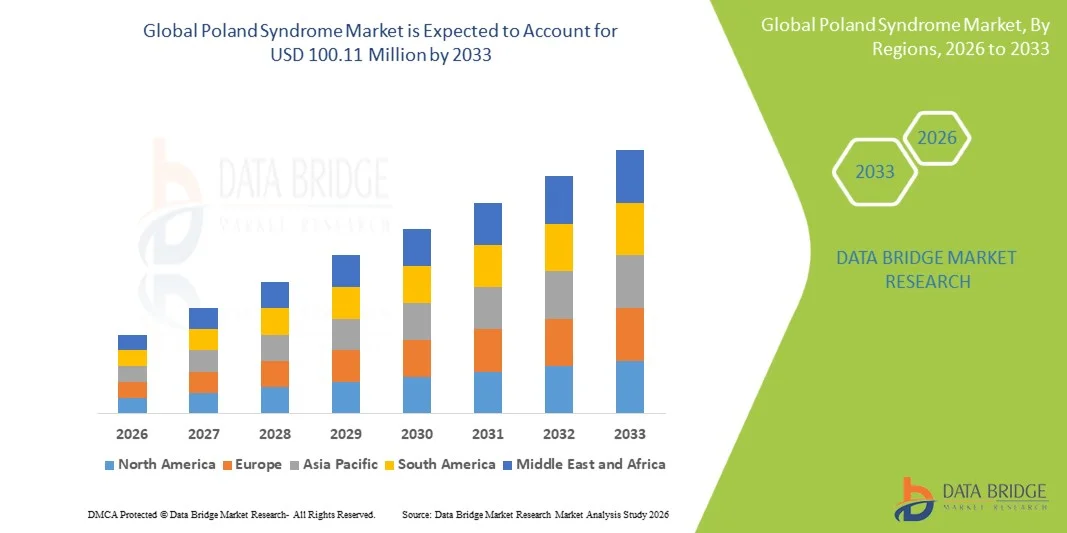
The Poland Syndrome Market was valued at USD 72.20 million in 2025 and is projected to reach USD 100.11 million by 2033, growing at a CAGR of 4.17% from 2026 to 2033. The market is witnessing steady growth driven by increasing awareness of rare congenital chest wall deformities, advancements in reconstructive plastic surgery techniques, and improved access to early diagnosis and specialized surgical care.
The rising demand for aesthetic and functional reconstruction procedures, along with growing adoption of implant-based and autologous tissue reconstruction methods, is supporting market expansion. Increasing clinical focus on pediatric congenital anomaly correction and improved surgical outcomes through microsurgical innovations are further strengthening treatment uptake across healthcare systems. In addition, expanding capabilities of specialty plastic surgery centers and hospitals, along with gradual improvements in insurance coverage for reconstructive procedures, are contributing to the steady growth of the Poland Syndrome treatment landscape globally.
Key Market Trends & Insights
- North America dominated the Poland Syndrome Market with the largest share of 38.6% in 2025, supported by advanced healthcare infrastructure, high awareness of rare congenital disorders, and strong adoption of reconstructive plastic surgery procedures.
- The Unilateral Poland Syndrome segment led the market with a 62.4% share in 2025, driven by its significantly higher prevalence and more frequent clinical diagnosis compared to bilateral and complex variants.
- Asia-Pacific is expected to be the fastest-growing region at a CAGR of 5.1% from 2026 to 2033, fueled by improving healthcare access, rising awareness of congenital anomalies, increasing medical tourism, and expanding availability of advanced plastic and reconstructive surgery in countries such as India, China, and Japan.
- Severe Form are the fastest-growing type, projected to register a CAGR of 5.4%, reflecting the surge in identification of complex congenital presentations involving chest wall deformities and associated limb abnormalities such as syndactyly.
- The Plastic Surgery segment dominated the treatment category with a 78.9% revenue share in 2025, led by the primary and most effective treatment approach for chest wall reconstruction and aesthetic correction.
- MRI Scans accounted for 49.6% of the market, preferred by its superior ability to evaluate soft tissue structures, muscle absence, and chest wall asymmetry with high precision.
- The CT Scans segment is the fastest-growing diagnosis category, with a CAGR of 5.1%, driven by the increasing demand for high-resolution 3D visualization of bone structures for surgical reconstruction planning.
Market Size & Forecast
- Global Market Value (2025): USD 72.20 Million
- Expected Market Value (2033): USD 100.11 Million
- Forecast CAGR (2026–2033): 4.17%
- Leading Region in 2025: North America
- Fastest Growing Region: Asia Pacific
Report Scope and Poland Syndrome Market Segmentation
|
Attributes |
Poland Syndrome Key Market Insights |
|
Segments Covered |
|
|
Countries Covered |
North America · U.S. · Canada · Mexico Europe · Germany · France · U.K. · Netherlands · Switzerland · Belgium · Russia · Italy · Spain · Turkey · Rest of Europe Asia-Pacific · China · Japan · India · South Korea · Singapore · Malaysia · Australia · Thailand · Indonesia · Philippines · Rest of Asia-Pacific Middle East and Africa · Saudi Arabia · U.A.E. · South Africa · Egypt · Israel · Rest of Middle East and Africa South America · Brazil · Argentina · Rest of South America |
|
Key Market Players |
· Johnson & Johnson Services, Inc. (U.S.) · Stryker (U.S.) · Zimmer Biomet (U.S.) · Medtronic (Ireland) · Smith+Nephew (U.K.) · B. Braun SE (Germany) · GE HealthCare (U.S.) · Siemens Healthineers AG (Germany) · Koninklijke Philips N.V. (Netherlands) · AbbVie Inc. (U.S.) · Merz Pharma GmbH & Co. KGaA (Germany) · POLYTECH Health & Aesthetics GmbH (Germany) · GC Aesthetics plc (Ireland) · Mentor Worldwide LLC (U.S.) · Establishment Labs Holdings Inc. (Costa Rica) · HansBiomed Co., Ltd. (South Korea) · Cynosure, LLC (U.S.) · Cutera, Inc. (U.S.) · Integra LifeSciences Holdings Corporation (U.S.) · KLS Martin Group (Germany) |
|
Market Opportunities |
· Rising adoption of 3D-printed custom implants for precise chest wall reconstruction · Expanding use of regenerative medicine and fat stem-cell–enriched grafting techniques · Growing medical tourism for rare reconstructive plastic surgery |
|
Value Added Data Infosets |
In addition to the insights on market scenarios such as market value, growth rate, segmentation, geographical coverage, and major players, the market reports curated by the Data Bridge Market Research also include in-depth expert analysis, patient epidemiology, pipeline analysis, pricing analysis, and regulatory framework. |
Poland Syndrome Market Trends
Trend: Growth in Advanced Reconstructive and Minimally Invasive Surgical Techniques
The increasing adoption of advanced reconstructive procedures such as implant-based chest reconstruction, autologous fat grafting, and microsurgical flap techniques is significantly improving aesthetic and functional outcomes for Poland Syndrome patients. Surgeons are increasingly integrating 3D imaging and surgical planning tools to enhance precision in chest wall symmetry correction, while regenerative approaches such as fat-enriched grafting are gaining traction for less invasive correction. Growing specialization in pediatric and adult congenital deformity correction, along with improved post-operative recovery protocols, is further enhancing procedural success rates in tertiary care centers and specialized plastic surgery hospitals. For instance, high-volume reconstructive centers in Europe and North America are increasingly using 3D-assisted pre-surgical modeling for chest wall reconstruction cases.
Poland Syndrome Market Dynamics
Key Market Driver: Rising Demand for Specialized Reconstructive Surgery in Congenital Chest Deformities
The growing recognition and diagnosis of Poland Syndrome, combined with increasing awareness of cosmetic and functional correction options, is driving demand for specialized reconstructive surgeries globally. Improvements in surgical techniques, availability of advanced implants, and expansion of trained plastic surgeons are enabling more patients to undergo corrective procedures at earlier stages of life. In addition, rising healthcare access and gradual improvements in insurance coverage for congenital reconstructive procedures are supporting market growth across developed and emerging economies. For instance, specialized plastic surgery units in tertiary hospitals across the United States and Europe are reporting increasing volumes of congenital chest wall reconstruction cases.
Key Restraint/Challenge: High Cost and Limited Accessibility of Advanced Reconstructive Procedures
A major restraint in the Poland Syndrome market is the high cost associated with advanced reconstructive surgeries, including implant-based reconstruction, fat grafting procedures, and multi-stage surgical corrections. Limited reimbursement coverage in many regions further restricts patient access, particularly in low- and middle-income countries where specialized plastic surgery infrastructure is underdeveloped. In addition, the scarcity of highly trained reconstructive microsurgeons and uneven distribution of specialized treatment centers creates significant access barriers for patients requiring complex chest wall correction. For instance, patients in several developing regions often face long waiting times or must travel internationally to access advanced congenital reconstruction procedures.
Key Market Opportunity: Expansion of Regenerative Medicine and Personalized Reconstruction Technologies
The increasing integration of regenerative medicine approaches, including stem-cell–enhanced fat grafting and bioengineered tissue scaffolds, presents a major growth opportunity in the Poland Syndrome market by improving long-term volume retention and aesthetic outcomes in chest reconstruction procedures. Advancements in 3D printing and patient-specific implant design are enabling highly customized reconstruction solutions that better match individual anatomical variations, reducing revision surgery rates and improving patient satisfaction. In addition, the growing use of digital surgical planning and AI-assisted reconstruction modeling is enhancing procedural precision and expanding the adoption of advanced corrective surgeries across specialized healthcare centers. For instance, leading plastic surgery institutes in North America and Europe are increasingly utilizing patient-specific 3D-printed chest implants for complex congenital deformity correction cases.
Poland Syndrome Market Scope
The Poland Syndrome market is segmented on the basis of type, treatment, diagnosis, and distribution channel.
- By Type
On the basis of type, the Poland Syndrome Market is segmented into Unilateral Poland Syndrome, Bilateral Poland Syndrome, Mild Form, and Severe Form. The Unilateral Poland Syndrome segment dominated the market with a 62.4% share in 2025, owing to its significantly higher prevalence and more frequent clinical diagnosis compared to bilateral and complex variants. This form typically presents as one-sided chest wall asymmetry with underdeveloped or absent pectoralis muscle, making it the most commonly treated category in reconstructive practice. High adoption of implant-based reconstruction and fat grafting procedures further reinforces its dominance. Standardized surgical approaches and relatively predictable anatomical correction outcomes contribute to higher procedural success rates. Increasing awareness and improved diagnostic imaging are also driving higher detection rates in developed healthcare systems. The segment continues to benefit from strong demand for both cosmetic and functional correction procedures.
The Severe Form segment is expected to register the fastest growth at a CAGR of 5.4% from 2026 to 2033, driven by increasing identification of complex congenital presentations involving chest wall deformities and associated limb abnormalities such as syndactyly. These cases require advanced multi-stage reconstructive procedures, significantly increasing clinical intervention rates. Improvements in microsurgical techniques, 3D surgical planning, and regenerative reconstruction approaches are making treatment more feasible and successful. Expanding availability of specialized congenital deformity and tertiary care centers is improving access to advanced care. Rising pediatric screening and early diagnosis are also contributing to higher treatment uptake. Increasing willingness among patients to undergo corrective surgery for functional improvement is further accelerating segment growth.
- By Treatment
On the basis of treatment, the Poland Syndrome Market is segmented into Plastic Surgery, Therapeutic Tattooing, and Physical Therapy. The Plastic Surgery segment dominated the market with a 78.9% share in 2025, as it represents the primary and most effective treatment approach for chest wall reconstruction and aesthetic correction. Procedures such as implant-based reconstruction, muscle flap surgery, and autologous fat grafting are widely performed across hospitals and specialty clinics. Continuous advancements in surgical techniques have significantly improved symmetry outcomes and reduced recovery times. High procedural success rates and strong clinical preference make it the standard treatment option globally. Increasing availability of skilled reconstructive surgeons further strengthens its position. The segment benefits from growing demand for both functional restoration and cosmetic enhancement.
The Plastic Surgery segment is expected to register the fastest growth at a CAGR of 5.3% from 2026 to 2033, driven by rising adoption of minimally invasive and regenerative reconstruction techniques. Innovations such as stem-cell–enhanced fat grafting and 3D-printed patient-specific implants are improving aesthetic precision and long-term results. Increasing patient awareness and preference for natural-looking outcomes are boosting demand for advanced surgical solutions. Expansion of medical tourism for complex reconstructive procedures is further supporting growth. Improvements in insurance coverage for congenital deformity correction in select regions are enhancing affordability. Continuous technological advancements in surgical tools and digital planning systems are accelerating adoption across specialized centers.
- By Diagnosis
On the basis of diagnosis, the Poland Syndrome Market is segmented into CT scans, MRI scans, and X-ray. The MRI Scans segment led the market with a 49.6% share in 2025, due to its superior ability to evaluate soft tissue structures, muscle absence, and chest wall asymmetry with high precision. MRI is widely preferred for pre-surgical assessment because it provides detailed imaging without radiation exposure, making it especially suitable for pediatric and adolescent patients. It plays a critical role in planning reconstructive procedures and evaluating severity of deformity. Increasing availability of advanced imaging infrastructure in hospitals is supporting its widespread use. Clinicians rely heavily on MRI for accurate diagnosis and treatment planning. Its non-invasive nature further enhances its dominance in clinical practice.
The CT Scans segment is expected to register the fastest growth at a CAGR of 5.1% from 2026 to 2033, driven by increasing demand for high-resolution 3D visualization of bone structures for surgical reconstruction planning. CT imaging enables precise assessment of rib and chest wall deformities, which is critical in complex surgical cases. Integration of AI-based imaging reconstruction is improving diagnostic accuracy and efficiency. Expanding use in preoperative planning for customized implants is further supporting adoption. Growing availability of low-dose CT systems is improving safety, especially in younger patients. Increasing reliance on advanced imaging in tertiary care centers is accelerating segment growth.
- By Distribution Channel
On the basis of distribution channel, the Poland Syndrome Market is segmented into Hospital Pharmacy, Retail Pharmacy, Online Pharmacies, and Others. The Hospital Pharmacy segment dominated the market with a 67.8% share in 2025, as most Poland Syndrome treatments are surgical in nature and performed in hospital or specialty clinical settings. Hospital pharmacies ensure the availability of post-operative medications, anesthesia drugs, and supportive care products required for reconstructive procedures. Strong integration with surgical departments ensures efficient treatment delivery and patient management. Centralized procurement systems in hospitals support consistent drug availability. Increasing volume of reconstructive surgeries further reinforces this segment’s dominance. Hospitals remain the primary care setting for congenital deformity treatment globally.
The Online Pharmacies segment is expected to register the fastest growth at a CAGR of 5.6% from 2026 to 2033, driven by increasing adoption of digital healthcare platforms and rising demand for post-operative medication convenience. Patients undergoing reconstructive surgery often require long-term pain management and wound care medicines, which are increasingly being delivered through online channels. Growing penetration of e-prescriptions and telemedicine services is supporting this shift. Improved regulatory frameworks for e-pharmacy operations are enhancing trust and accessibility. Rising consumer preference for home delivery and discounted pricing is further accelerating adoption. Expansion of digital health ecosystems is expected to continue driving strong segment growth.
Poland Syndrome Market Regional Analysis
North America dominated the Poland Syndrome Market with the largest share of 38.6% in 2025, supported by advanced healthcare infrastructure, high awareness of rare congenital disorders, and strong adoption of reconstructive plastic surgery procedures. The region benefits from early diagnosis through advanced imaging technologies and widespread access to complex reconstructive procedures such as implant-based chest reconstruction and fat grafting. Strong insurance coverage for congenital deformity correction in several cases and the presence of leading tertiary care hospitals further support market leadership. Increasing adoption of minimally invasive reconstructive techniques and regenerative medicine approaches continues to strengthen North America’s dominance in the global market.
U.S. Poland Syndrome Market Insight
The U.S. Poland Syndrome market is witnessing steady growth due to advanced healthcare infrastructure, high awareness of rare congenital disorders, and strong availability of specialized reconstructive plastic surgeons. Increasing adoption of implant-based reconstruction, fat grafting, and microsurgical techniques is driving demand across hospitals and specialty clinics. The presence of well-established insurance coverage for congenital deformity correction further supports patient access to advanced surgical procedures. In addition, continuous improvements in 3D surgical planning, regenerative medicine, and personalized reconstruction approaches are enhancing treatment outcomes and expanding procedural uptake across the country.
Europe Poland Syndrome Market Insight
The Europe Poland Syndrome market remains a major contributor to global revenue, driven by strong healthcare systems, early diagnostic capabilities, and increasing adoption of advanced reconstructive surgery techniques. High awareness of congenital chest wall deformities and growing use of minimally invasive procedures are supporting market expansion across the region. The presence of specialized plastic surgery centers and tertiary care hospitals is improving access to complex reconstructive treatments. In addition, rising investments in medical technologies and regenerative surgical approaches continue to enhance treatment precision and outcomes in Europe.
U.K. Poland Syndrome Market Insight
The U.K. Poland Syndrome market is experiencing steady growth, supported by increasing utilization of reconstructive surgery in NHS and private healthcare settings. Growing awareness of congenital chest deformities and availability of skilled plastic surgeons are contributing to higher diagnosis and treatment rates. The adoption of fat grafting, implant-based reconstruction, and minimally invasive techniques is further improving patient outcomes. In addition, integration of advanced imaging technologies and surgical planning tools is strengthening clinical efficiency and supporting market growth in the country.
Germany Poland Syndrome Market Insight
The Germany Poland Syndrome market is expanding steadily due to its strong medical infrastructure, advanced surgical capabilities, and high focus on precision-based healthcare. Increasing use of innovative reconstructive techniques, including microsurgery and 3D-assisted implant planning, is driving procedural advancements. Germany’s emphasis on medical research and adoption of regenerative medicine is further supporting market development. In addition, well-established specialty clinics and hospital networks are improving access to complex congenital deformity correction procedures.
Asia-Pacific Poland Syndrome Market Insight
The Asia-Pacific Poland Syndrome market is expected to witness rapid growth, driven by improving healthcare access, rising awareness of congenital disorders, and increasing availability of advanced reconstructive surgery options. Expanding medical infrastructure in countries such as China, India, and Japan is supporting greater diagnosis and treatment rates. Growing adoption of minimally invasive procedures and rising medical tourism for plastic and reconstructive surgery are further accelerating regional market expansion. In addition, increasing investments in specialty healthcare centers are strengthening long-term market growth potential.
Japan Poland Syndrome Market Insight
The Japan Poland Syndrome market is witnessing consistent growth due to advanced healthcare systems, strong surgical expertise, and increasing adoption of high-precision reconstructive techniques. Rising use of microsurgery, implant-based reconstruction, and fat grafting procedures is improving treatment outcomes for congenital chest deformities. Japan’s focus on innovation in medical technology and regenerative medicine is further enhancing surgical precision. In addition, integration of advanced imaging and digital surgical planning is supporting better diagnosis and treatment planning in clinical practice.
China Poland Syndrome Market Insight
The China Poland Syndrome market is growing rapidly, driven by expanding healthcare infrastructure, increasing awareness of congenital disorders, and rising adoption of advanced reconstructive surgical techniques. Growing availability of specialized plastic surgery centers and improving access to diagnostic imaging are supporting higher treatment rates. The adoption of minimally invasive reconstruction methods and regenerative therapies is further strengthening market growth. In addition, increasing medical investments and rising demand for aesthetic and functional correction procedures are positioning China as one of the fastest-growing markets globally.
Poland Syndrome Market Share
The Poland Syndrome industry is primarily led by well-established companies, including:
- Johnson & Johnson Services, Inc. (U.S.)
- Stryker (U.S.)
- Zimmer Biomet (U.S.)
- Medtronic (Ireland)
- Smith+Nephew (U.K.)
- Braun SE (Germany)
- GE HealthCare (U.S.)
- Siemens Healthineers AG (Germany)
- Koninklijke Philips N.V. (Netherlands)
- AbbVie Inc. (U.S.)
- Merz Pharma GmbH & Co. KGaA (Germany)
- POLYTECH Health & Aesthetics GmbH (Germany)
- GC Aesthetics plc (Ireland)
- Mentor Worldwide LLC (U.S.)
- Establishment Labs Holdings Inc. (Costa Rica)
- HansBiomed Co., Ltd. (South Korea)
- Cynosure, LLC (U.S.)
- Cutera, Inc. (U.S.)
- Integra LifeSciences Holdings Corporation (U.S.)
- KLS Martin Group (Germany)
Latest Developments in Poland Syndrome Market
- In November 2025, clinical studies reported increasing use of customized 3D-printed implants for Poland Syndrome chest wall reconstruction, demonstrating improved symmetry correction, reduced surgical complexity, and faster recovery compared to traditional flap-based techniques. The adoption of CT-based digital planning is enabling patient-specific implant design, improving aesthetic outcomes and lowering revision surgery rates. This reflects a strong shift toward precision-based reconstructive surgery in congenital chest deformities
- In November 2025, clinical case reports highlighted successful outcomes of customized silicone and titanium implants in Poland Syndrome patients, demonstrating long-term stability and high patient satisfaction in chest wall symmetry restoration. The study emphasized the role of computer-assisted surgical planning in improving implant positioning accuracy and reducing operative time. This reflects the growing integration of digital manufacturing technologies in reconstructive plastic surgery
- In April 2025, advancements in endoscopic-assisted latissimus dorsi flap reconstruction were reported for Poland Syndrome treatment, demonstrating reduced incision size, lower tissue trauma, and faster post-operative recovery. The minimally invasive approach improved cosmetic outcomes while maintaining functional chest wall reconstruction effectiveness. This highlights a shift toward less invasive muscle flap techniques in reconstructive surgery
- In August 2024, clinical reviews documented increasing adoption of autologous fat grafting (lipofilling) for Poland Syndrome correction, particularly in mild and moderate cases requiring soft tissue volume restoration. The technique showed improved aesthetic contouring and high patient satisfaction due to its minimally invasive nature and repeatability. This reflects a broader trend toward regenerative and non-implant-based reconstruction methods
- In July 2023, clinical case studies reported successful hybrid reconstruction approaches combining implants, muscle flaps, and fat grafting in Poland Syndrome patients, improving both functional stability and aesthetic symmetry. The multi-layered reconstruction strategy allowed better correction of complex chest wall deformities. This highlights the growing preference for combined surgical techniques in moderate-to-severe cases
SKU-
Get online access to the report on the World's First Market Intelligence Cloud

- Interactive Data Analysis Dashboard
- Company Analysis Dashboard for high growth potential opportunities
- Research Analyst Access for customization & queries
- Competitor Analysis with Interactive dashboard
- Latest News, Updates & Trend analysis
- Harness the Power of Benchmark Analysis for Comprehensive Competitor Tracking
Research Methodology
Data collection and base year analysis are done using data collection modules with large sample sizes. The stage includes obtaining market information or related data through various sources and strategies. It includes examining and planning all the data acquired from the past in advance. It likewise envelops the examination of information inconsistencies seen across different information sources. The market data is analysed and estimated using market statistical and coherent models. Also, market share analysis and key trend analysis are the major success factors in the market report. To know more, please request an analyst call or drop down your inquiry.
The key research methodology used by DBMR research team is data triangulation which involves data mining, analysis of the impact of data variables on the market and primary (industry expert) validation. Data models include Vendor Positioning Grid, Market Time Line Analysis, Market Overview and Guide, Company Positioning Grid, Patent Analysis, Pricing Analysis, Company Market Share Analysis, Standards of Measurement, Global versus Regional and Vendor Share Analysis. To know more about the research methodology, drop in an inquiry to speak to our industry experts.
Customization Available
Data Bridge Market Research is a leader in advanced formative research. We take pride in servicing our existing and new customers with data and analysis that match and suits their goal. The report can be customized to include price trend analysis of target brands understanding the market for additional countries (ask for the list of countries), clinical trial results data, literature review, refurbished market and product base analysis. Market analysis of target competitors can be analyzed from technology-based analysis to market portfolio strategies. We can add as many competitors that you require data about in the format and data style you are looking for. Our team of analysts can also provide you data in crude raw excel files pivot tables (Fact book) or can assist you in creating presentations from the data sets available in the report.