




Global Polyphenylene Market
Market Size in USD Billion
CAGR :
% 
 USD
5.83 Billion
USD
10.87 Billion
2025
2033
USD
5.83 Billion
USD
10.87 Billion
2025
2033
 Forecast Period Forecast Period |
2026 –2033 |
 Market Size (Base Year) Market Size (Base Year) |
USD 5.83 Billion |
 Market Size (Forecast Year) Market Size (Forecast Year) |
USD 10.87 Billion |
 CAGR CAGR |
% |
| Major Markets Players |
|
What is the Global Polyphenylene Market Size and Growth Rate?
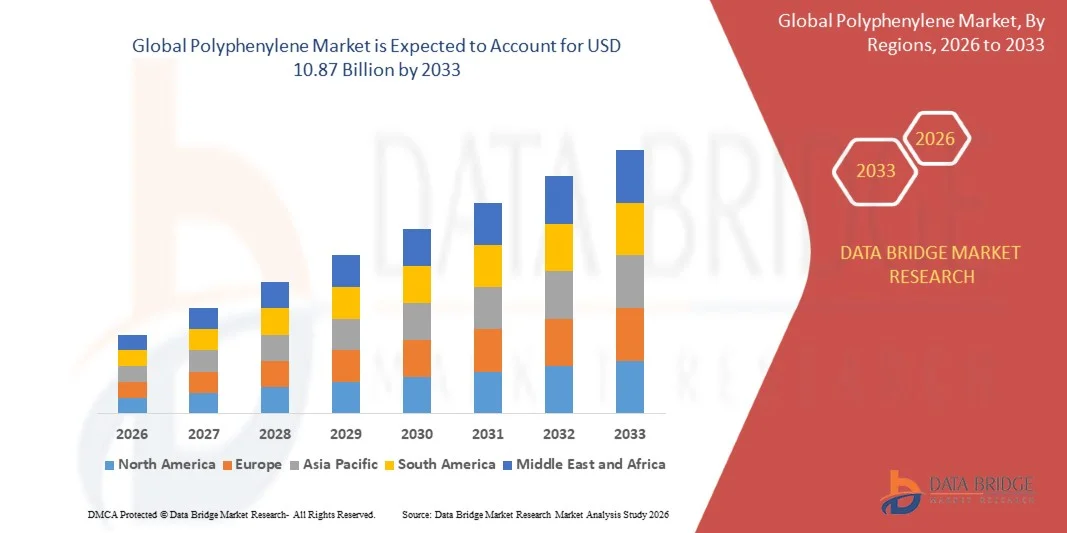
- The global polyphenylene market size was valued at USD 5.83 billion in 2025 and is expected to reach USD 10.87 billion by 2033, at a CAGR of 8.1% during the forecast period
- The rising use of polyphenylene resin in automotive and aerospace sector will influence the growth rate of the polyphenylene market. The growing consumption in filter bag applications is the key elements driving market expansion. Along with this, increasing preference in various applications because of special features will increase the demand for the polyphenylene market
What are the Major Takeaways of Polyphenylene Market?
- The polyphenylene market is also being driven by significant factors such as the upsurge in the level of disposable income and increasing urbanization. Furthermore, upsurge in the demand from hybrid electric vehicles will enhance the growth rate of polyphenylene market
- Also, rising use of the product in electrical and electronics industry will act as major factors influencing the growth of polyphenylene market. The advancement in technologies and surging demand from developing nations will have positive impact on the growth rate of polyphenylene market
- Asia-Pacific dominated the Polyphenylene market with a 43.2% revenue share in 2025, driven by strong growth in automotive manufacturing, electronics production, industrial machinery, and high-performance polymer processing across China, Japan, South Korea, and India
- North America is projected to register the fastest CAGR of 7.12% from 2026 to 2033, driven by rapid expansion in EV production, aerospace engineering, industrial automation, and high-performance electronics manufacturing across the U.S. and Canada
- The Polyphenylene Sulfide (PPS) segment dominated the market with a 52.6% share in 2025, as it remains the most widely adopted high-performance engineering polymer across automotive, electrical, and industrial applications
Report Scope and Polyphenylene Market Segmentation
|
Attributes |
Polyphenylene Key Market Insights |
|
Segments Covered |
|
|
Countries Covered |
North America
Europe
Asia-Pacific
Middle East and Africa
South America
|
|
Key Market Players |
|
|
Market Opportunities |
|
|
Value Added Data Infosets |
In addition to the insights on market scenarios such as market value, growth rate, segmentation, geographical coverage, and major players, the market reports curated by the Data Bridge Market Research also include in-depth expert analysis, pricing analysis, brand share analysis, consumer survey, demography analysis, supply chain analysis, value chain analysis, raw material/consumables overview, vendor selection criteria, PESTLE Analysis, Porter Analysis, and regulatory framework. |
What is the Key Trend in the Polyphenylene Market?
“Increasing Shift Toward High-Performance, Lightweight, and Heat-Resistant Engineering Polymers”
- The polyphenylene market is witnessing strong adoption of high-performance thermoplastic resins and composites designed to support demanding applications across automotive, aerospace, electronics, and industrial manufacturing sectors
- Manufacturers are introducing glass-fiber reinforced, flame-retardant, and chemically resistant polyphenylene grades that offer superior thermal stability, dimensional strength, and long-term durability for high-temperature applications
- Growing demand for lightweight, cost-efficient, and metal-replacement materials is driving usage across EV battery housings, connectors, pump components, filtration systems, and aerospace structural parts
- For instance, companies such as Toray, Solvay, SABIC, Asahi Kasei, and LG Chem are expanding advanced PPS and PPE product portfolios with enhanced mechanical and insulation properties
- Increasing need for heat resistance, chemical stability, and electrical insulation is accelerating the shift toward advanced polyphenylene-based engineering materials
- As industries increasingly prioritize miniaturization, energy efficiency, and material durability, polyphenylenes will remain vital for next-generation industrial and automotive applications
What are the Key Drivers of Polyphenylene Market?
- Rising demand for lightweight, thermally stable, and chemically resistant materials to support automotive, aerospace, electrical, and industrial applications is a major growth driver
- For instance, in 2025, leading companies such as SABIC, Toray, and Asahi Kasei expanded their advanced polyphenylene resin portfolios to support EVs, electronics, and high-temperature applications
- Growing adoption of electric vehicles, consumer electronics, aerospace components, and industrial filtration systems is boosting demand across the U.S., Europe, and Asia-Pacific
- Advancements in polymer blending, glass-fiber reinforcement, and flame-retardant formulations have strengthened material performance, processability, and lifecycle efficiency
- Rising use in battery modules, under-the-hood automotive components, connectors, switches, and insulation systems is creating demand for high-performance polyphenylene materials
- Supported by steady investments in EV manufacturing, aerospace innovation, and advanced electronics infrastructure, the Polyphenylene market is expected to witness strong long-term growth
Which Factor is Challenging the Growth of the Polyphenylene Market?
- High costs associated with premium engineering-grade polyphenylene resins and reinforced compounds restrict adoption among cost-sensitive manufacturers and SMEs
- For instance, during 2024–2025, fluctuations in petrochemical feedstock prices, supply chain disruptions, and specialty additive shortages increased production costs for several global vendors
- Complexity in processing high-temperature thermoplastics and composite grades increases the need for specialized machinery and skilled operators
- Limited awareness in emerging markets regarding the performance advantages of polyphenylene over conventional polymers slows adoption
- Competition from alternative high-performance materials such as PEEK, polyamide, and polycarbonate blends creates pricing pressure and reduces product differentiation
- To address these issues, companies are focusing on cost-optimized formulations, recyclable compounds, and sustainable resin development to increase global adoption of polyphenylenes
How is the Polyphenylene Market Segmented?
The market is segmented on the basis of type, application, and end-use industry.
• By Type
On the basis of type, the polyphenylene market is segmented into Polyphenylene Sulfide (PPS), Polyphenylene Oxide/Polyphenylene Ether (PPO/PPE), and Others. The Polyphenylene Sulfide (PPS) segment dominated the market with a 52.6% share in 2025, as it remains the most widely adopted high-performance engineering polymer across automotive, electrical, and industrial applications. PPS offers excellent thermal stability, flame resistance, chemical resistance, and dimensional strength, making it highly suitable for high-temperature components such as connectors, pump housings, filters, and under-the-hood automotive parts. Its growing use in EV battery modules and lightweight structural components continues to support market dominance.
The Polyphenylene Oxide/Polyphenylene Ether segment is expected to grow at the fastest CAGR from 2026 to 2033, driven by rising demand for electrical insulation materials, consumer electronics housings, and advanced engineering plastics. Increasing use in precision-molded components and electronics applications is accelerating segment expansion globally.
• By Application
On the basis of application, the market is segmented into Engineering Plastics, Filter Bag, Composites, and High Performance Lubricants. The Engineering Plastics segment dominated the market with a 46.9% share in 2025, supported by strong demand across automotive, aerospace, electronics, and industrial manufacturing sectors. Polyphenylene-based engineering plastics are extensively used in electrical connectors, switches, automotive components, pump parts, and structural housings due to their superior heat resistance, mechanical durability, and chemical stability. Growing adoption in EV systems and miniaturized electronics continues to strengthen segment leadership.
The Composites segment is projected to grow at the fastest CAGR from 2026 to 2033, driven by increasing use in lightweight automotive structures, aerospace interiors, industrial machinery, and reinforced plastic components. Rising demand for metal replacement materials with enhanced strength-to-weight ratio is significantly boosting growth across advanced manufacturing industries.
• By End-Use Industry
On the basis of end-use industry, the polyphenylene market is segmented into Automotive, Electronics and Electrical, Industrial, and Coatings. The Automotive segment dominated the market with a 38.7% share in 2025, driven by extensive use in under-the-hood components, EV battery systems, connectors, sensors, fuel system parts, and lightweight structural assemblies. Automakers increasingly rely on polyphenylene materials to reduce vehicle weight, improve thermal resistance, and enhance fuel efficiency and EV performance.
The Electronics and Electrical segment is expected to grow at the fastest CAGR from 2026 to 2033, propelled by increasing demand for miniaturized circuit components, connectors, switches, insulation systems, and consumer electronic devices. Rising complexity in smart electronics, IoT devices, and high-voltage electrical systems is driving strong demand for advanced polyphenylene materials across global electronics manufacturing facilities.
Which Region Holds the Largest Share of the Polyphenylene Market?
- Asia-Pacific dominated the Polyphenylene market with a 43.2% revenue share in 2025, driven by strong growth in automotive manufacturing, electronics production, industrial machinery, and high-performance polymer processing across China, Japan, South Korea, and India. High adoption of polyphenylene materials in electrical connectors, EV battery components, industrial filters, and lightweight automotive parts continues to fuel demand across manufacturing hubs, industrial plants, and research centres.
- Leading companies in Asia-Pacific are expanding advanced PPS and PPO/PPE polymer portfolios with improved heat resistance, flame retardancy, and dimensional stability, strengthening the region’s technological advantage. Continuous investment in electric vehicles, consumer electronics, aerospace components, and industrial automation drives long-term market expansion
- Strong manufacturing ecosystems, advanced material processing capabilities, and sustained investment in specialty engineering plastics further reinforce regional market leadership
China Polyphenylene Market Insight
China is the largest contributor to Asia-Pacific due to massive investments in electronics manufacturing, EV production, industrial machinery, and polymer compounding facilities. Rising development of high-performance connectors, battery modules, automotive sensors, and industrial filtration systems drives strong demand for polyphenylene materials. Local manufacturing capabilities and competitive pricing further expand domestic and export market adoption.
Japan Polyphenylene Market Insight
Japan shows steady growth supported by advanced automotive engineering, consumer electronics, robotics, and industrial control system manufacturing. Strong focus on high-quality engineering materials and precision molded components drives adoption of premium polyphenylene grades. Increasing need for thermal stability, miniaturized electronics, and lightweight automotive systems reinforces long-term market expansion.
India Polyphenylene Market Insight
India is emerging as a major growth hub, driven by expanding electronics assembly, automotive production, industrial equipment manufacturing, and government-backed Make in India initiatives. Growing demand for EV electronics, electrical insulation materials, and high-performance molded parts fuels adoption of polyphenylene materials in production and prototyping environments. Increasing industrial investments and manufacturing expansion further accelerate market penetration.
South Korea Polyphenylene Market Insight
South Korea contributes significantly due to strong demand for advanced semiconductors, consumer electronics, EV battery systems, and industrial automation equipment. Rapid development of AI hardware, display technologies, and automotive electronics drives adoption of polyphenylene materials with superior thermal and mechanical properties. Technological innovation, strong manufacturing capacity, and growing digital ecosystems support sustained market growth.
North America Polyphenylene Market
North America is projected to register the fastest CAGR of 7.12% from 2026 to 2033, driven by rapid expansion in EV production, aerospace engineering, industrial automation, and high-performance electronics manufacturing across the U.S. and Canada. Rising demand for lightweight, chemically resistant, and heat-stable polymers across automotive, defence, and electrical industries continues to accelerate regional growth. Growth in AI hardware, smart manufacturing, and sustainable material innovation further increases demand for advanced polyphenylene compounds across engineering and industrial applications.
U.S. Polyphenylene Market Insight
The U.S. is the largest contributor in North America, supported by strong automotive R&D, aerospace innovation, electrical systems manufacturing, and industrial automation sectors. Increasing development of EV battery systems, advanced sensors, lightweight structural components, and high-speed communication modules intensifies demand for polyphenylene materials. Presence of major material science companies, advanced R&D labs, and strong startup ecosystems further drives market growth.
Canada Polyphenylene Market Insight
Canada contributes significantly to regional growth, driven by expanding industrial manufacturing clusters, automotive supply chains, electronics production, and aerospace R&D. Engineering facilities increasingly utilize polyphenylene materials for insulation components, industrial filters, and molded engineering parts. Government-supported innovation programs, skilled workforce availability, and rising interest in advanced materials strengthen market adoption across the country.
Which are the Top Companies in Polyphenylene Market?
The polyphenylene industry is primarily led by well-established companies, including:
- TORAY INDUSTRIES, INC. (Japan)
- DIC CORPORATION (Japan)
- Solvay (Belgium)
- Tosoh Corporation (Japan)
- KUREHA CORPORATION (Japan)
- Celanese Corporation (U.S.)
- SABIC (Saudi Arabia)
- China Lumena New Materials Corp. (China)
- Ensinger (Germany)
- Idemitsu Kosan Co., Ltd. (Japan)
- INITZ TECHNOLOGIES (South Korea)
- NHU Materials Co. (China)
- Asahi Kasei Corporation (Japan)
- Chevron Phillips Chemical Company LLC. (U.S.)
- RYAN PLASTICS LIMITED (India)
- RTP Company (U.S.)
- TEIJIN LIMITED (Japan)
- Daicel Corporation (Japan)
- Polyplastics Co., Ltd. (Japan)
- LyondellBasell Industries Holdings B.V. (Netherlands)
- Biesterfeld AG (Germany)
- LG Chem (South Korea)
- Saint-Gobain Performance Plastics (France)
What are the Recent Developments in Global Polyphenylene Market?
- In December 2025, Toray Industries secured ISCC PLUS certification for its Korean subsidiary, Toray Advanced Materials Korea Inc., covering PPS resin production at its Gunsan plant. This certification supports the company’s efforts to strengthen sustainable, deforestation-free, and climate-friendly supply chains while enhancing transparency in material sourcing and manufacturing practices. This development is expected to reinforce Toray’s sustainability positioning and improve customer confidence in environmentally responsible engineering plastics
- In September 2025, Solvay obtained ISCC PLUS certification for its polyphenylene sulfide (PPS) manufacturing facilities in Texas and Belgium, enabling full traceability of circular and bio-based content across its value chain. This certification highlights the company’s focus on sustainable materials and circular economy initiatives in specialty polymers. This milestone is expected to strengthen Solvay’s competitive advantage in eco-friendly high-performance polymer solutions
- In September 2025, Asahi Kasei showcased a range of advanced material solutions at Fakuma, aimed at enabling safer and more compact EV batteries, improved connectivity systems, lightweight product designs, and circular economy applications. The presentation underlined the company’s focus on innovation in automotive and sustainable material technologies. This initiative is expected to accelerate adoption of advanced polymer solutions in next-generation electric vehicle applications
- In January 2024, Asahi Kasei and its affiliated company received the internationally recognized ISCC PLUS sustainability certification for multiple product categories, including thermoplastic elastomers, rubbers, and engineering plastics. This certification emphasizes the company’s commitment to responsible sourcing and efficient management of biomass and recycled materials throughout the supply chain. This development is expected to support long-term sustainable growth and strengthen the company’s ESG-driven material portfolio
SKU-
Get online access to the report on the World's First Market Intelligence Cloud

- Interactive Data Analysis Dashboard
- Company Analysis Dashboard for high growth potential opportunities
- Research Analyst Access for customization & queries
- Competitor Analysis with Interactive dashboard
- Latest News, Updates & Trend analysis
- Harness the Power of Benchmark Analysis for Comprehensive Competitor Tracking
Global Polyphenylene Market, Supply Chain Analysis and Ecosystem Framework
To support market growth and help clients navigate the impact of geopolitical shifts, DBMR has integrated in-depth supply chain analysis into its Global Polyphenylene Market research reports. This addition empowers clients to respond effectively to global changes affecting their industries. The supply chain analysis section includes detailed insights such as Global Polyphenylene Market consumption and production by country, price trend analysis, the impact of tariffs and geopolitical developments, and import and export trends by country and HSN code. It also highlights major suppliers with data on production capacity and company profiles, as well as key importers and exporters. In addition to research, DBMR offers specialized supply chain consulting services backed by over a decade of experience, providing solutions like supplier discovery, supplier risk assessment, price trend analysis, impact evaluation of inflation and trade route changes, and comprehensive market trend analysis.
Research Methodology
Data collection and base year analysis are done using data collection modules with large sample sizes. The stage includes obtaining market information or related data through various sources and strategies. It includes examining and planning all the data acquired from the past in advance. It likewise envelops the examination of information inconsistencies seen across different information sources. The market data is analysed and estimated using market statistical and coherent models. Also, market share analysis and key trend analysis are the major success factors in the market report. To know more, please request an analyst call or drop down your inquiry.
The key research methodology used by DBMR research team is data triangulation which involves data mining, analysis of the impact of data variables on the market and primary (industry expert) validation. Data models include Vendor Positioning Grid, Market Time Line Analysis, Market Overview and Guide, Company Positioning Grid, Patent Analysis, Pricing Analysis, Company Market Share Analysis, Standards of Measurement, Global versus Regional and Vendor Share Analysis. To know more about the research methodology, drop in an inquiry to speak to our industry experts.
Customization Available
Data Bridge Market Research is a leader in advanced formative research. We take pride in servicing our existing and new customers with data and analysis that match and suits their goal. The report can be customized to include price trend analysis of target brands understanding the market for additional countries (ask for the list of countries), clinical trial results data, literature review, refurbished market and product base analysis. Market analysis of target competitors can be analyzed from technology-based analysis to market portfolio strategies. We can add as many competitors that you require data about in the format and data style you are looking for. Our team of analysts can also provide you data in crude raw excel files pivot tables (Fact book) or can assist you in creating presentations from the data sets available in the report.












