




Global Polyvinyl Alcohol Pva Market
Market Size in USD Billion
CAGR :
% 
 USD
1.17 Billion
USD
1.80 Billion
2025
2033
USD
1.17 Billion
USD
1.80 Billion
2025
2033
 Forecast Period Forecast Period |
2026 –2033 |
 Market Size (Base Year) Market Size (Base Year) |
USD 1.17 Billion |
 Market Size (Forecast Year) Market Size (Forecast Year) |
USD 1.80 Billion |
 CAGR CAGR |
% |
| Major Markets Players |
|
Polyvinyl Alcohol (PVA) Market Size
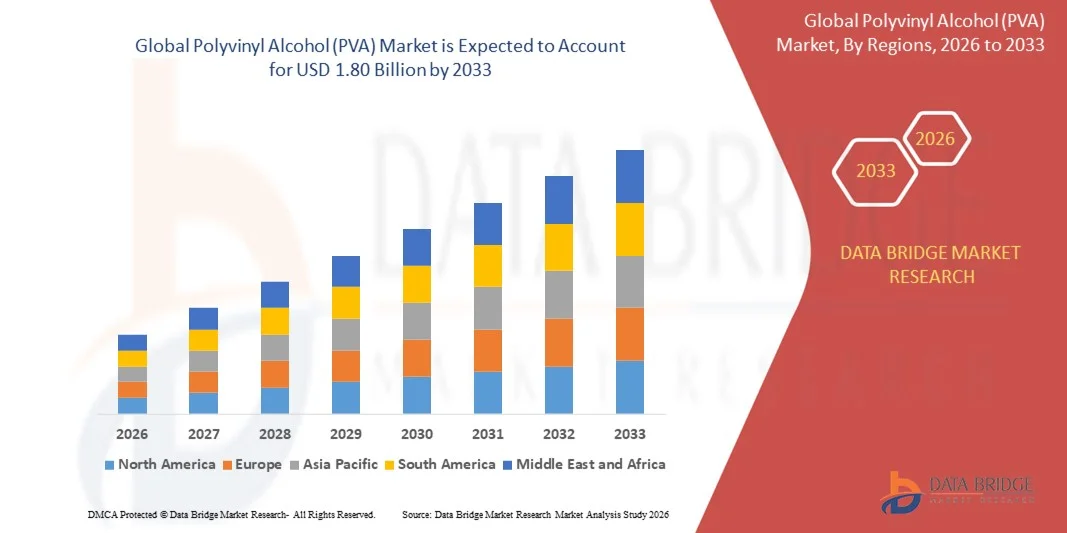
- The global Polyvinyl Alcohol (PVA) market size was valued at USD 1.17 billion in 2025 and is expected to reach USD 1.80 billion by 2033, at a CAGR of 5.54% during the forecast period
- The market growth is largely fueled by the increasing demand for water-soluble, biodegradable, and environmentally friendly polymers across industries such as packaging, textiles, construction, and paper processing, supporting the shift toward sustainable material solutions
- Furthermore, rising adoption of Polyvinyl Alcohol (PVA) in high-performance applications including adhesives, coatings, films, and construction additives, combined with expanding industrialization and manufacturing activities, is accelerating market penetration and significantly boosting overall PVA market growth
Polyvinyl Alcohol (PVA) Market Analysis
- Polyvinyl Alcohol (PVA), known for its excellent film-forming ability, chemical resistance, and water solubility, plays a critical role in a wide range of industrial and consumer applications, including papermaking, textiles, medical products, and packaging solutions
- The escalating demand for Polyvinyl Alcohol (PVA) is primarily driven by growing emphasis on sustainable materials, increasing use in biodegradable packaging and medical applications, and rising demand from emerging economies with expanding industrial and infrastructure development
- Asia-Pacific dominated the Polyvinyl Alcohol (PVA) market with a share of 54.1% in 2025, due to strong demand from papermaking, textile, and construction industries, along with large-scale manufacturing capacity across the region
- North America is expected to be the fastest growing region in the Polyvinyl Alcohol (PVA) market during the forecast period due to rising demand for biodegradable polymers in packaging, medical products, and construction applications
- Fully hydrolyzed segment dominated the market with a market share of 45.5% in 2025, due to its superior tensile strength, chemical resistance, and excellent film-forming properties. Fully hydrolyzed PVA is widely used in papermaking, construction additives, and textile sizing due to its high durability and strong adhesion characteristics. Its ability to perform under demanding industrial conditions further supports consistent demand across large-scale manufacturing applications. The segment also benefits from established production processes and broad acceptance in traditional end-use industries. As a result, fully hydrolyzed grades continue to serve as the backbone of overall PVA consumption
Report Scope and Polyvinyl Alcohol (PVA) Market Segmentation
|
Attributes |
Polyvinyl Alcohol (PVA) Key Market Insights |
|
Segments Covered |
|
|
Countries Covered |
North America
Europe
Asia-Pacific
Middle East and Africa
South America
|
|
Key Market Players |
|
|
Market Opportunities |
|
|
Value Added Data Infosets |
In addition to the insights on market scenarios such as market value, growth rate, segmentation, geographical coverage, and major players, the market reports curated by the Data Bridge Market Research also include import export analysis, production capacity overview, production consumption analysis, price trend analysis, climate change scenario, supply chain analysis, value chain analysis, raw material/consumables overview, vendor selection criteria, PESTLE Analysis, Porter Analysis, and regulatory framework. |
Polyvinyl Alcohol (PVA) Market Trends
Growing Adoption of Biodegradable and Water-Soluble Polymer Solutions
- A major trend in the Polyvinyl Alcohol (PVA) market is the increasing adoption of biodegradable and water-soluble polymer solutions, driven by rising environmental concerns and stricter regulations on plastic usage across multiple industries. PVA’s ability to dissolve in water and degrade more easily compared to conventional polymers is strengthening its position in sustainable material development for packaging, textiles, and industrial applications
- For instance, Kuraray Co., Ltd. has been actively supplying water-soluble PVA grades for packaging films and detergent pods, supporting the shift toward environmentally responsible material solutions. These products help reduce plastic waste while maintaining functional performance in end-use applications
- The packaging industry is increasingly incorporating PVA-based films for single-use and soluble packaging formats, particularly in agrochemicals and household products. This trend is enhancing demand for specialty PVA grades that balance strength, solubility, and environmental compliance
- Textile manufacturers are expanding the use of PVA in sizing agents due to its easy removability and reduced wastewater impact compared to traditional materials. This supports cleaner production processes and aligns with sustainability goals in textile processing
- Medical and pharmaceutical applications are also contributing to this trend, as PVA is used in drug delivery systems, ophthalmic solutions, and biodegradable medical films. Its biocompatibility and non-toxic properties make it suitable for sensitive applications requiring safe dissolution
- Overall, the growing preference for sustainable and water-soluble materials is positioning PVA as a key polymer in the global transition toward environmentally conscious manufacturing practices, reinforcing long-term demand across diverse industries
Polyvinyl Alcohol (PVA) Market Dynamics
Driver
Rising Demand from Papermaking, Textile, and Packaging Industries
- The increasing demand for Polyvinyl Alcohol from papermaking, textile, and packaging industries is a primary driver supporting market growth. PVA is widely used as a binder, coating, and sizing agent due to its excellent film-forming ability, adhesion properties, and chemical resistance, which enhance product quality and process efficiency
- For instance, Sekisui Chemical Co., Ltd. supplies PVA grades extensively used in paper coating and surface sizing applications, helping improve paper strength, printability, and resistance to ink absorption. This consistent demand from large-scale paper manufacturers strengthens market stability
- The textile industry relies heavily on PVA-based sizing agents to improve yarn strength during weaving while enabling easy removal during finishing processes. This functional advantage supports widespread adoption across cotton and synthetic textile production
- In packaging applications, PVA is gaining traction in water-soluble films and coatings that meet sustainability and performance requirements. This is particularly relevant in agrochemical and detergent packaging, where controlled dissolution is essential
- The sustained reliance of these core industries on PVA is reinforcing its role as a critical polymer, directly contributing to consistent market expansion and long-term growth prospects
Restraint/Challenge
Fluctuating Raw Material Prices and Production Cost Pressures
- The Polyvinyl Alcohol market faces challenges related to fluctuating raw material prices and rising production costs, primarily linked to the volatility of vinyl acetate monomer prices. These fluctuations directly impact manufacturing expenses and reduce cost predictability for PVA producers
- For instance, Kuraray Europe GmbH announced price increases for PVOH resins in response to rising raw material and energy costs, highlighting the pressure faced by manufacturers in maintaining margins. Such cost adjustments often affect downstream industries and procurement planning
- Energy-intensive production processes further contribute to cost pressures, especially in regions experiencing higher utility and compliance expenses. This limits flexibility in pricing strategies and affects competitiveness in cost-sensitive markets
- Logistics and transportation costs also influence overall production economics, particularly for manufacturers serving global markets. Supply chain disruptions can amplify cost volatility and affect timely delivery
- Overall, ongoing raw material and cost pressures remain a key restraint for the PVA market, requiring manufacturers to focus on process optimization, efficiency improvements, and strategic pricing to sustain profitability
Polyvinyl Alcohol (PVA) Market Scope
The market is segmented on the basis of grade and application.
- By Grade
On the basis of grade, the Polyvinyl Alcohol (PVA) market is segmented into fully hydrolyzed, partially hydrolyzed, sub-partially hydrolyzed, low foaming grades, and others. The fully hydrolyzed segment dominated the market with the largest revenue share of 45.5% in 2025, driven by its superior tensile strength, chemical resistance, and excellent film-forming properties. Fully hydrolyzed PVA is widely used in papermaking, construction additives, and textile sizing due to its high durability and strong adhesion characteristics. Its ability to perform under demanding industrial conditions further supports consistent demand across large-scale manufacturing applications. The segment also benefits from established production processes and broad acceptance in traditional end-use industries. As a result, fully hydrolyzed grades continue to serve as the backbone of overall PVA consumption.
The partially hydrolyzed segment is anticipated to witness the fastest growth from 2026 to 2033, supported by its higher solubility in cold water and improved flexibility compared to fully hydrolyzed grades. These properties make partially hydrolyzed PVA highly suitable for applications requiring quick dissolution, such as adhesives, packaging films, and personal care formulations. Growing demand for water-soluble and biodegradable materials further accelerates adoption across consumer-focused industries. The segment’s versatility in processing and compatibility with modern formulations also contribute to its rapid expansion. Increasing innovation in specialty coatings and films strengthens its growth outlook over the forecast period.
- By Application
On the basis of application, the Polyvinyl Alcohol (PVA) market is segmented into papermaking and processing, building and construction, electronics, textile, medical, personal care, and others. The papermaking and processing segment accounted for the largest market revenue share in 2025, driven by extensive use of PVA as a surface sizing agent and binder to improve paper strength and printability. Its ability to enhance fiber bonding and reduce ink absorption makes it essential in high-quality paper production. Rising demand for packaging paper and specialty paper products continues to reinforce consumption in this segment. In addition, the material’s compatibility with large-scale paper manufacturing processes supports steady and repeat demand. These factors collectively position papermaking as the leading application area for PVA.
The medical segment is expected to register the fastest growth rate from 2026 to 2033, fueled by increasing use of PVA in drug delivery systems, ophthalmic solutions, and biodegradable medical films. The polymer’s non-toxic nature, biocompatibility, and excellent water solubility make it suitable for sensitive healthcare applications. Growth in pharmaceutical manufacturing and medical device development further supports rising demand. Increasing focus on patient safety and controlled-release formulations enhances adoption across medical uses. As healthcare innovation advances, the medical segment is projected to emerge as a key growth driver for the PVA market.
Polyvinyl Alcohol (PVA) Market Regional Analysis
- Asia-Pacific dominated the Polyvinyl Alcohol (PVA) market with the largest revenue share of 54.1% in 2025, driven by strong demand from papermaking, textile, and construction industries, along with large-scale manufacturing capacity across the region
- The region’s cost-efficient production structure, easy availability of raw materials, and growing investments in water-soluble and biodegradable polymers are accelerating overall market expansion
- Rapid industrialization, expanding packaging demand, and supportive government initiatives across developing economies are increasing PVA consumption in both industrial and consumer-oriented applications
China Polyvinyl Alcohol (PVA) Market Insight
China held the largest share in the Asia-Pacific Polyvinyl Alcohol (PVA) market in 2025, supported by its extensive chemical manufacturing base and large domestic demand from textiles, paper processing, and construction sectors. The country benefits from vertically integrated production, strong export capabilities, and continuous capacity expansion by domestic manufacturers. Rising adoption of eco-friendly materials and water-soluble films further strengthens PVA demand across multiple end-use industries.
India Polyvinyl Alcohol (PVA) Market Insight
India is witnessing the fastest growth in the Asia-Pacific region, driven by expanding textile manufacturing, growing paper and packaging demand, and increasing use of PVA in construction additives. Government initiatives supporting domestic chemical production and infrastructure development are improving market penetration. In addition, rising awareness of biodegradable and sustainable materials is accelerating PVA adoption across industrial and consumer applications.
Europe Polyvinyl Alcohol (PVA) Market Insight
The Europe Polyvinyl Alcohol (PVA) market is growing steadily, supported by strong demand for sustainable polymers, stringent environmental regulations, and high usage in specialty applications. The region emphasizes high-quality, compliant materials for use in medical, electronics, and advanced construction products. Increasing focus on biodegradable packaging and water-soluble formulations is further supporting market growth.
Germany Polyvinyl Alcohol (PVA) Market Insight
Germany’s Polyvinyl Alcohol (PVA) market is driven by its advanced chemical manufacturing ecosystem, strong R&D capabilities, and high demand from automotive, construction, and electronics industries. The country’s focus on precision manufacturing and sustainable material innovation supports consistent demand for high-performance PVA grades. Strong collaboration between chemical producers and end-use industries enhances product development and application diversity.
U.K. Polyvinyl Alcohol (PVA) Market Insight
The U.K. market benefits from growing demand in medical, personal care, and specialty packaging applications. Increasing focus on sustainable materials, coupled with investments in advanced polymer research, is supporting PVA adoption. The presence of a well-developed healthcare sector and rising demand for water-soluble films contribute to steady market expansion.
North America Polyvinyl Alcohol (PVA) Market Insight
North America is projected to grow at the fastest CAGR from 2026 to 2033, driven by rising demand for biodegradable polymers in packaging, medical products, and construction applications. Strong focus on sustainability, regulatory compliance, and advanced material development is boosting PVA usage. Increased adoption of water-soluble films and specialty formulations further supports regional growth.
U.S. Polyvinyl Alcohol (PVA) Market Insight
The U.S. accounted for the largest share in the North America Polyvinyl Alcohol (PVA) market in 2025, supported by strong demand from packaging, medical, and construction sectors. The country’s emphasis on innovation, sustainable materials, and high-performance polymers encourages wider adoption of PVA across industries. Presence of established chemical manufacturers and a robust distribution network further reinforces the U.S.’s leading position in the region.
Polyvinyl Alcohol (PVA) Market Share
The Polyvinyl Alcohol (PVA) industry is primarily led by well-established companies, including:
- Merck KGaA (Germany)
- OCI COMPANY Ltd. (South Korea)
- SEKISUI CHEMICAL CO., LTD. (Japan)
- Kuraray Europe GmbH (Germany)
- Chang Chun Group (Taiwan)
- JAPAN VAM & POVAL CO., LTD. (Japan)
- DuPont (U.S.)
- China Petrochemical Corporation (China)
- Mitsubishi Chemical Corporation (Japan)
- Solvay (Belgium)
- Eastman Chemical Company (U.S.)
- AICELLO CORPORATION (Japan)
- Cortec Corporation (U.S.)
- ECOMAVI S.r.l. (Italy)
- BASF SE (Germany)
Latest Developments in Global Polyvinyl Alcohol (PVA) Market
- In April 2025, KURARAY CO., LTD. implemented a global price increase for PVOH resins across Japan, Asia-Pacific, the Americas, the Middle East, Africa, and Europe, reflecting higher raw material, logistics, and energy costs. This pricing action is influencing overall market dynamics by increasing procurement costs for downstream users, encouraging optimization of formulations, and reinforcing the premium positioning of high-performance PVA grades in industrial, packaging, and specialty applications
- In May 2024, WANWEI CHEMICAL SUPPLY CHAIN CO., LTD. launched a new Polyvinyl Alcohol product in China to broaden its materials portfolio and strengthen domestic market presence. This development is enhancing supply availability and product diversity for key end-use sectors such as papermaking, construction additives, and textiles, while supporting market expansion through improved performance characteristics and localized production
- In November 2023, SEKISUI CHEMICAL CO., LTD. expanded production capacity for specialty PVA grades to meet rising demand for water-soluble and biodegradable materials. This capacity enhancement is improving supply reliability and enabling wider adoption of PVA in packaging, medical, and environmental applications, aligning the market with increasing sustainability and regulatory requirements
- In July 2023, NIPPON GOHSEI advanced its high-purity PVA product offerings through process optimization and quality enhancement initiatives. This strategic focus is supporting greater penetration of PVA in electronics, medical, and high-precision industrial applications, contributing to the shift toward higher-value and technologically advanced PVA products
- In February 2023, KURARAY CO., LTD. announced increased investment in research and development for environmentally friendly and biodegradable PVA solutions. This initiative is accelerating innovation in water-soluble films and sustainable materials, strengthening long-term market growth by addressing evolving environmental standards and expanding application potential across packaging and consumer-oriented industries
SKU-
Get online access to the report on the World's First Market Intelligence Cloud

- Interactive Data Analysis Dashboard
- Company Analysis Dashboard for high growth potential opportunities
- Research Analyst Access for customization & queries
- Competitor Analysis with Interactive dashboard
- Latest News, Updates & Trend analysis
- Harness the Power of Benchmark Analysis for Comprehensive Competitor Tracking
Global Polyvinyl Alcohol Pva Market, Supply Chain Analysis and Ecosystem Framework
To support market growth and help clients navigate the impact of geopolitical shifts, DBMR has integrated in-depth supply chain analysis into its Global Polyvinyl Alcohol Pva Market research reports. This addition empowers clients to respond effectively to global changes affecting their industries. The supply chain analysis section includes detailed insights such as Global Polyvinyl Alcohol Pva Market consumption and production by country, price trend analysis, the impact of tariffs and geopolitical developments, and import and export trends by country and HSN code. It also highlights major suppliers with data on production capacity and company profiles, as well as key importers and exporters. In addition to research, DBMR offers specialized supply chain consulting services backed by over a decade of experience, providing solutions like supplier discovery, supplier risk assessment, price trend analysis, impact evaluation of inflation and trade route changes, and comprehensive market trend analysis.
Research Methodology
Data collection and base year analysis are done using data collection modules with large sample sizes. The stage includes obtaining market information or related data through various sources and strategies. It includes examining and planning all the data acquired from the past in advance. It likewise envelops the examination of information inconsistencies seen across different information sources. The market data is analysed and estimated using market statistical and coherent models. Also, market share analysis and key trend analysis are the major success factors in the market report. To know more, please request an analyst call or drop down your inquiry.
The key research methodology used by DBMR research team is data triangulation which involves data mining, analysis of the impact of data variables on the market and primary (industry expert) validation. Data models include Vendor Positioning Grid, Market Time Line Analysis, Market Overview and Guide, Company Positioning Grid, Patent Analysis, Pricing Analysis, Company Market Share Analysis, Standards of Measurement, Global versus Regional and Vendor Share Analysis. To know more about the research methodology, drop in an inquiry to speak to our industry experts.
Customization Available
Data Bridge Market Research is a leader in advanced formative research. We take pride in servicing our existing and new customers with data and analysis that match and suits their goal. The report can be customized to include price trend analysis of target brands understanding the market for additional countries (ask for the list of countries), clinical trial results data, literature review, refurbished market and product base analysis. Market analysis of target competitors can be analyzed from technology-based analysis to market portfolio strategies. We can add as many competitors that you require data about in the format and data style you are looking for. Our team of analysts can also provide you data in crude raw excel files pivot tables (Fact book) or can assist you in creating presentations from the data sets available in the report.












