




Global Potato Starch Market
Market Size in USD Billion
CAGR :
% 
 USD
4.55 Billion
USD
7.83 Billion
2025
2033
USD
4.55 Billion
USD
7.83 Billion
2025
2033
 Forecast Period Forecast Period |
2026 –2033 |
 Market Size (Base Year) Market Size (Base Year) |
USD 4.55 Billion |
 Market Size (Forecast Year) Market Size (Forecast Year) |
USD 7.83 Billion |
 CAGR CAGR |
% |
| Major Markets Players |
|
Potato Starch Market Size
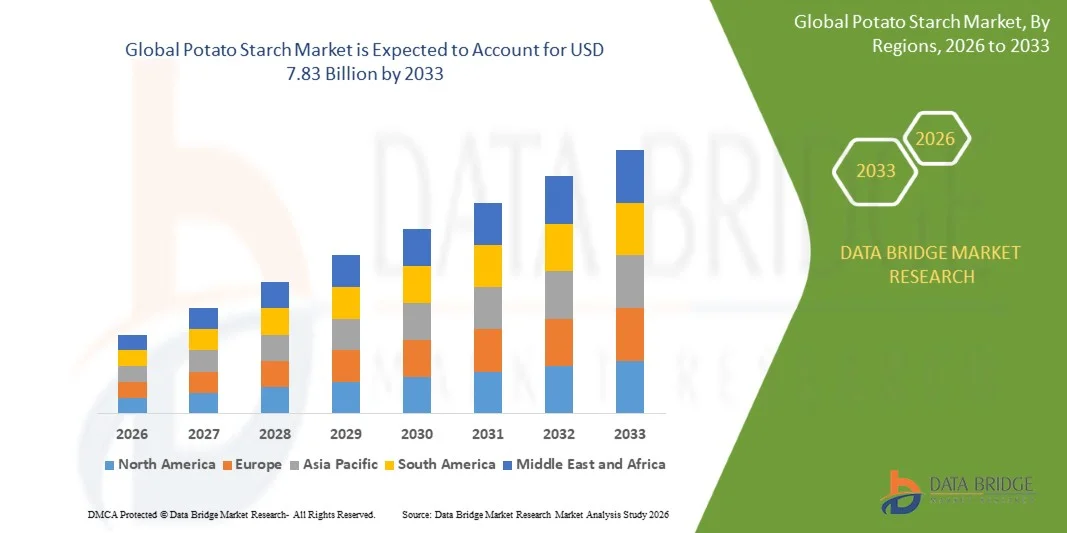
- The global potato starch market size was valued at USD 4.55 billion in 2025 and is expected to reach USD 7.83 billion by 2033, at a CAGR of 7.00% during the forecast period
- The market growth is largely fueled by the rising demand for clean label, gluten-free, and plant-based food ingredients, which has significantly increased the adoption of potato starch across food processing industries
- In addition, its strong functional properties such as thickening, binding, and stabilizing food formulations are driving its use in bakery, snacks, and convenience food products. Expanding processed food consumption and growing preference for natural additives are further accelerating market expansion across global regions
Potato Starch Market Analysis
- Potato starch is a fine, white powder extracted from potatoes and widely used as a functional ingredient in food and industrial applications due to its high purity and neutral taste. It is extensively utilized in processed foods, pharmaceuticals, textiles, and biodegradable packaging because of its excellent thickening, moisture retention, and texture-enhancing properties
- The escalating demand for potato starch is primarily driven by increasing consumption of convenience foods, rising health awareness supporting clean label ingredient adoption, and growing industrial applications such as paper manufacturing and eco-friendly packaging solutions
- North America dominated the potato starch market with a share of 43.1% in 2025, due to strong demand from processed food manufacturing, bakery applications, and clean label ingredient adoption
- Asia-Pacific is expected to be the fastest growing region in the potato starch market during the forecast period due to rapid urbanization, rising disposable incomes, and expanding processed food industries
- Modified segment dominated the market with a market share of 72.8% in 2025, due to its superior functional performance, including enhanced stability, viscosity control, and improved resistance to heat, acid, and shear conditions. It is widely preferred in processed and convenience food applications where consistent texture, longer shelf life, and processing flexibility are critical requirements for manufacturers
Report Scope and Potato Starch Market Segmentation
|
Attributes |
Potato Starch Key Market Insights |
|
Segments Covered |
|
|
Countries Covered |
North America
Europe
Asia-Pacific
Middle East and Africa
South America
|
|
Key Market Players |
|
|
Market Opportunities |
|
|
Value Added Data Infosets |
In addition to the insights on market scenarios such as market value, growth rate, segmentation, geographical coverage, and major players, the market reports curated by the Data Bridge Market Research also include in-depth expert analysis, pricing analysis, brand share analysis, consumer survey, demography analysis, supply chain analysis, value chain analysis, raw material/consumables overview, vendor selection criteria, PESTLE Analysis, Porter Analysis, and regulatory framework. |
Potato Starch Market Trends
“Growing Shift Toward Clean Label and Plant-Based Food Ingredients”
- A key trend in the potato starch market is the rising preference for clean label formulations and plant-based food ingredients, driven by increasing consumer awareness regarding ingredient transparency and natural sourcing in food products. This shift is encouraging food manufacturers to replace synthetic additives with starch-based functional ingredients derived from potatoes, enhancing product appeal across processed and convenience food categories
- For instance, AVEBE and Emsland Group are actively supplying potato starch solutions to food manufacturers for use in soups, sauces, and bakery products where clean label positioning is prioritized. These companies are strengthening the adoption of natural starch ingredients by offering non-GMO and sustainably sourced potato-based functional starches for food processing applications
- The demand for plant-based and allergen-free food formulations is expanding the use of potato starch as a key binding, thickening, and stabilizing agent across multiple product categories. This is supporting its increased penetration in dairy alternatives, meat substitutes, and ready-to-eat meals where texture and consistency are critical performance factors
- Food ingredient companies such as Cargill and Ingredion are expanding their potato starch portfolios to support manufacturers targeting clean label reformulations. These suppliers are focusing on starch modification technologies that maintain functional performance while meeting consumer demand for simple ingredient declarations
- The bakery and confectionery sectors are increasingly integrating potato starch to improve moisture retention and product softness without artificial additives. This trend is reinforcing its role as a versatile ingredient in reformulated food systems designed for health-conscious consumers
- The market is witnessing stronger alignment between sustainability-driven sourcing practices and food industry demand for plant-based ingredients, positioning potato starch as a key component in modern food innovation strategies. This continued transition is supporting long-term adoption across global processed food supply chains
Potato Starch Market Dynamics
Driver
“Rising Demand for Gluten-Free and Processed Food Applications”
- The increasing prevalence of gluten intolerance and growing consumer shift toward gluten-free diets are significantly driving the demand for potato starch in processed food applications. Its functional properties, including high viscosity and neutral taste, make it a preferred alternative to wheat-based thickeners in gluten-free formulations
- For instance, Roquette Frères supplies potato-based starch ingredients widely used in gluten-free bakery products and processed foods, supporting manufacturers in achieving desired texture and stability. These applications are particularly important in bread, noodles, and snack products where gluten replacement requires strong binding performance
- The expansion of processed and convenience food consumption is further accelerating the use of potato starch as a stabilizer and thickening agent in ready meals and packaged food products. This supports food manufacturers in maintaining product consistency during storage and distribution
- Ingredion Incorporated is actively supplying functional starch solutions derived from potatoes to support large-scale food processing operations requiring clean label and gluten-free compliance. This is strengthening the integration of potato starch across global food production systems
- Overall, the growing dependence on gluten-free and processed food categories continues to reinforce potato starch as a critical ingredient in food manufacturing, supporting both functional performance and dietary requirement trends
Restraint/Challenge
“Volatility in Raw Potato Supply and Price Fluctuations”
- The potato starch market faces significant challenges due to fluctuations in raw potato availability, which directly impacts production stability and cost structures. Seasonal variations, weather conditions, and agricultural yield inconsistencies create supply uncertainties for starch manufacturers
- For instance, AVEBE experiences periodic raw material supply variations linked to European potato harvest cycles, which influence production planning and pricing strategies. Such dependencies on agricultural output make the starch supply chain vulnerable to external environmental conditions
- Price volatility in raw potatoes also affects the profitability of starch processors as procurement costs fluctuate based on crop yield and market demand. This creates difficulties in maintaining consistent pricing for end-use industries such as food processing and paper manufacturing
- Emsland Group faces similar challenges in managing raw material sourcing from contracted farmers, where climatic changes can impact potato quality and starch extraction efficiency. These variations directly influence production efficiency and operational cost stability
- Overall, raw potato supply uncertainty and associated price fluctuations remain a persistent challenge for the potato starch industry, affecting production planning, cost management, and supply chain reliability across global markets
Potato Starch Market Scope
The market is segmented on the basis of nature, type, applications, end use, and distribution channel.
• By Nature
On the basis of nature, the potato starch market is segmented into organic and conventional. The conventional segment dominated the largest market revenue share in 2025 due to its wide availability, lower production cost, and strong integration into large-scale food processing industries. Manufacturers prefer conventional potato starch as it ensures consistent functional properties such as thickening, binding, and stabilizing across multiple food applications. Its established supply chain and cost efficiency make it the primary choice for mass production requirements in bakery, dairy, and processed food sectors. The segment continues to maintain strong demand due to its scalability and compatibility with industrial formulations.
The organic segment is anticipated to witness the fastest growth rate from 2026 to 2033, driven by rising consumer preference for clean-label and chemical-free food ingredients. Increasing health awareness and demand for non-GMO and sustainably sourced ingredients are encouraging food manufacturers to incorporate organic potato starch. Premium food brands are adopting organic variants to meet evolving dietary expectations and regulatory compliance in developed markets. The segment is also supported by expansion in organic-certified food processing facilities and retail offerings. Growing focus on natural ingredient sourcing continues to accelerate its adoption across global markets.
• By Type
On the basis of type, the potato starch market is segmented into native and modified. The modified starch segment held the largest market revenue share of 72.8% in 2025 due to its superior functional performance, including enhanced stability, viscosity control, and improved resistance to heat, acid, and shear conditions. It is widely preferred in processed and convenience food applications where consistent texture, longer shelf life, and processing flexibility are critical requirements for manufacturers. Food producers rely on modified starch to maintain product quality during high-temperature processing, freezing, and extended storage. Its ability to deliver reliable performance across diverse industrial formulations strengthens its dominance in bakery, dairy, sauces, and ready-to-eat products.
The native starch segment is expected to witness the fastest growth rate from 2026 to 2033, driven by increasing demand for clean-label and minimally processed ingredients in food formulations. Consumers are shifting toward natural and transparent ingredient lists, encouraging manufacturers to replace chemically modified additives with native starch alternatives. Its natural composition, cost effectiveness, and suitability for basic thickening and binding applications are supporting wider adoption across bakery, dairy, and packaged food products. Growing health awareness and preference for non-modified food ingredients are further accelerating its demand.
• By Applications
On the basis of applications, the potato starch market is segmented into bakery, dairy desserts, fruit fillings, pourable dressings, and others. The bakery segment dominated the largest market revenue share in 2025 due to the extensive use of potato starch in improving texture, moisture retention, and softness in baked goods. It is widely incorporated in bread, cakes, and pastries to enhance product quality and extend shelf life. The segment benefits from strong global consumption of bakery products and continuous product innovation by manufacturers. Its functional versatility makes it a key ingredient in large-scale bakery production.
The fruit fillings segment is anticipated to witness the fastest growth rate from 2026 to 2033, driven by rising demand for processed and convenience foods. Potato starch is increasingly used in fruit fillings to improve gel formation, stability, and resistance to heat during baking and storage. The growth of bakery chains and packaged dessert products is further supporting this demand. Manufacturers are focusing on enhancing product consistency and texture in fruit-based applications. Expanding consumer preference for ready-to-use dessert components continues to accelerate this segment’s growth.
• By End Use
On the basis of end use, the potato starch market is segmented into food industry, paper industry, and others. The food industry segment held the largest market revenue share in 2025 due to the widespread application of potato starch as a thickener, stabilizer, and binder in multiple food products. It is extensively used in processed foods, bakery items, sauces, and dairy formulations. Strong demand for convenience foods and packaged products continues to reinforce its dominance. The segment benefits from large-scale consumption and continuous innovation in food processing applications.
The paper industry segment is expected to witness the fastest growth rate from 2026 to 2033, driven by increasing demand for sustainable and biodegradable raw materials in paper production. Potato starch is used in paper coating and surface sizing to improve strength, smoothness, and printability. Rising emphasis on eco-friendly packaging solutions is encouraging its adoption in the paper manufacturing sector. Growth in e-commerce and packaging industries is further supporting demand for starch-based additives. The shift toward renewable materials continues to drive this segment’s expansion.
• By Distribution Channel
On the basis of distribution channel, the potato starch market is segmented into indirect and direct channels. The indirect segment dominated the largest market revenue share in 2025 due to the strong presence of distributors, wholesalers, and retail networks that ensure wide product availability. This channel enables manufacturers to reach a broader customer base across food processing and industrial sectors. It also supports efficient supply chain management and bulk distribution to small and medium enterprises. The segment benefits from established trade networks and consistent demand flow across regions.
The direct segment is anticipated to witness the fastest growth rate from 2026 to 2033, driven by increasing adoption of direct procurement by large food manufacturers and industrial users. Direct purchasing enables cost efficiency, better price negotiation, and improved supply chain transparency. Manufacturers are strengthening direct sales channels through digital platforms and contract-based supply agreements. This approach also ensures product customization and consistent quality control for end users. Growing preference for streamlined procurement processes continues to support the expansion of this segment.
Potato Starch Market Regional Analysis
- North America dominated the potato starch market with the largest revenue share of 43.1% in 2025, driven by strong demand from processed food manufacturing, bakery applications, and clean label ingredient adoption
- Consumers in the region increasingly value functional benefits such as thickening, stabilizing, and fat-replacement properties, which enhance texture and shelf stability in packaged foods
- This widespread usage is further supported by high demand for gluten-free products, strong food processing infrastructure, and growing preference for natural and plant-based ingredients, making potato starch a key functional ingredient across food and industrial applications
U.S. Potato Starch Market Insight
The U.S. potato starch market captured the largest revenue share in North America in 2025, driven by rapid expansion of processed and convenience food consumption and strong adoption of clean label formulations. The market benefits from rising demand for texture enhancement and fat reduction in packaged foods, along with increasing usage in bakery, snacks, and dairy alternative products. Strong innovation in plant-based ingredients and functional food formulations continues to support growth. Rising preference for non-GMO, allergen-free, and natural ingredients is further strengthening market penetration across retail and foodservice sectors.
Europe Potato Starch Market Insight
The Europe potato starch market is projected to expand at a substantial CAGR throughout the forecast period, driven by stringent food labeling regulations and increasing demand for natural food additives. The market is witnessing strong adoption in clean label reformulation across bakery, confectionery, and processed food applications. Growing consumption of convenience foods, along with rising preference for plant-based and sustainable ingredients, is supporting expansion. Well-established potato cultivation and advanced starch processing infrastructure further ensure stable supply and continuous product innovation across the region.
U.K. Potato Starch Market Insight
The U.K. potato starch market is anticipated to grow at a notable CAGR during the forecast period, driven by increasing demand for clean label bakery and ready-to-eat products. Manufacturers are shifting toward natural thickeners and stabilizers to meet consumer demand for minimally processed food ingredients. Growth is further supported by rising vegan and gluten-free dietary trends across retail and foodservice channels. The market also benefits from increasing focus on food texture improvement, shelf-life extension, and product formulation efficiency.
Germany Potato Starch Market Insight
The Germany potato starch market is expected to expand at a considerable CAGR during the forecast period, driven by strong demand from food processing, pharmaceutical, and biodegradable packaging industries. The market is witnessing growing adoption of plant-based starch ingredients aligned with sustainability and environmental goals. Strong regulatory emphasis on food quality and safety is further supporting usage in processed food applications. Advanced processing technologies and integration of starch in industrial applications are contributing to continued market expansion.
Asia-Pacific Potato Starch Market Insight
The Asia-Pacific potato starch market is poised to grow at the fastest CAGR during the forecast period of 2026 to 2033, driven by rapid urbanization, rising disposable incomes, and expanding processed food industries. Increasing consumption of convenience foods, bakery products, and packaged snacks is significantly boosting demand. Growing industrial food production and expanding manufacturing capabilities are improving availability and affordability of potato starch. Rising adoption of modern food processing technologies is further strengthening regional market growth.
Japan Potato Starch Market Insight
The Japan potato starch market is gaining momentum due to strong demand from convenience foods, traditional cuisine applications, and functional food development. Consumers value potato starch for its neutral taste, smooth texture, and suitability in ready-to-eat and processed food products. The aging population is driving demand for easily digestible food formulations where starch plays an important role in texture modification. Integration of starch in advanced food processing systems continues to support stable and consistent market growth.
China Potato Starch Market Insight
The China potato starch market accounted for the largest revenue share in Asia-Pacific in 2025, driven by rapid expansion of the food processing industry and strong domestic production capacity. High consumption of noodles, sauces, snacks, and frozen foods is significantly increasing demand for potato starch as a functional ingredient. Growing urbanization, expansion of modern retail channels, and strong manufacturing infrastructure are further supporting market dominance. Continued development of supply chains and large-scale production capabilities is reinforcing China’s leading position in the region.
Potato Starch Market Share
The potato starch industry is primarily led by well-established companies, including:
- AGRANA Beteiligungs-AG (Austria)
- AKV Langholt AmbA (Denmark)
- ALOJA-STARKELSEN (Latvia)
- Avebe (Netherlands)
- Cargill, Incorporated (U.S.)
- Emsland Group (Germany)
- Bangkok Starch Industrial Co., Ltd. (Thailand)
- Roquette Frères (France)
- Sahyadri Starch & Industries Pvt. Ltd. (India)
- Sanstar Bio-Polymers Ltd (India)
- Finnamyl Ltd (Finland)
- Ingredion Incorporated (U.S.)
- Manitoba Starch Products (Canada)
- Novidon B.V. (Netherlands)
- PEPEES Group (Poland)
- PPZ Trzemeszno Sp. z o.o. (Poland)
- Roquette (France)
- Siddharth Starch Pvt. Ltd. (India)
- Tereos (France)
Latest Developments in Global Potato Starch Market
- In January 2026, Emsland Group introduced Emjel LC 15, a next-generation functional potato starch designed specifically for vegan and vegetarian confectionery applications, significantly improving gelatin replacement capabilities. The innovation enables manufacturers to achieve desired texture, stability, and mouthfeel using simpler atmospheric cooking processes, reducing reliance on complex high-energy or vacuum systems. This development strengthens the shift toward clean label and plant-based formulations, supporting food producers in meeting rising consumer demand for allergen-free, sustainable, and ethically sourced ingredients. It also enhances production efficiency and expands application scope for potato starch in premium confectionery and dessert categories, reinforcing its role as a key functional ingredient in modern food innovation
- In May 2025, KMC, a leading Danish potato ingredient specialist, partnered with Daymer Ingredients to expand the distribution of clean label and functional potato starches across the UK food industry, initially focusing on native potato starch with plans to introduce modified starch variants. This collaboration improves supply accessibility for food manufacturers seeking plant-based, allergen-free alternatives to traditional gelling agents such as gelatin, eggs, and dairy proteins. It supports the growing demand for sustainable and transparent ingredient sourcing in bakery, confectionery, and processed food applications. The partnership also enhances market penetration of potato starch solutions by strengthening distribution networks and enabling wider adoption of functional starches in product reformulation strategies across the U.K.
- In March 2024, Ingredion Incorporated expanded its production capacity for clean label and modified potato starch solutions to meet rising global demand from food processing and industrial applications. This expansion supports the growing requirement for scalable and reliable supply chains as consumption of plant-based, gluten-free, and convenience foods continues to increase across multiple regions. It enhances the availability of functional starch ingredients used for thickening, stabilizing, and texture improvement in packaged food products, improving formulation flexibility for manufacturers. In addition, the capacity increase strengthens supply security for non-food applications such as biodegradable packaging and paper processing, reinforcing Ingredion’s competitive position in the global potato starch market
- In June 2023, Brenntag Specialties entered a strategic partnership with Royal Avebe, combining strong distribution capabilities with advanced potato starch production expertise to enhance global supply chain efficiency in the nutrition sector. The collaboration improves access to high-quality potato starch ingredients for food, beverage, and industrial manufacturers by leveraging Brenntag’s extensive market reach and Royal Avebe’s specialization in potato-based solutions. It supports rising global demand for functional and clean label ingredients used in texture modification, stabilization, and fat replacement applications. This partnership strengthens market connectivity, accelerates product availability, and reinforces the role of potato starch in expanding applications across both developed and emerging markets
- In October 2022, AKV Langholt AmbA completed the acquisition of Cargill’s 50% stake in their joint venture Cargill-AKV I/S, consolidating full ownership of a production unit initially established for cationic potato starch used in the paper industry. This strategic move enhanced operational control and streamlined decision-making within the organization, improving efficiency in production and product development. It also strengthened AKV Langholt’s position in industrial starch markets by enabling greater focus on specialized applications such as paper coating, surface treatment, and binding solutions. The acquisition supports long-term scalability and reinforces competitiveness in the global functional starch industry, particularly in non-food industrial applications
SKU-
Get online access to the report on the World's First Market Intelligence Cloud

- Interactive Data Analysis Dashboard
- Company Analysis Dashboard for high growth potential opportunities
- Research Analyst Access for customization & queries
- Competitor Analysis with Interactive dashboard
- Latest News, Updates & Trend analysis
- Harness the Power of Benchmark Analysis for Comprehensive Competitor Tracking
Global Potato Starch Market, Supply Chain Analysis and Ecosystem Framework
To support market growth and help clients navigate the impact of geopolitical shifts, DBMR has integrated in-depth supply chain analysis into its Global Potato Starch Market research reports. This addition empowers clients to respond effectively to global changes affecting their industries. The supply chain analysis section includes detailed insights such as Global Potato Starch Market consumption and production by country, price trend analysis, the impact of tariffs and geopolitical developments, and import and export trends by country and HSN code. It also highlights major suppliers with data on production capacity and company profiles, as well as key importers and exporters. In addition to research, DBMR offers specialized supply chain consulting services backed by over a decade of experience, providing solutions like supplier discovery, supplier risk assessment, price trend analysis, impact evaluation of inflation and trade route changes, and comprehensive market trend analysis.
Research Methodology
Data collection and base year analysis are done using data collection modules with large sample sizes. The stage includes obtaining market information or related data through various sources and strategies. It includes examining and planning all the data acquired from the past in advance. It likewise envelops the examination of information inconsistencies seen across different information sources. The market data is analysed and estimated using market statistical and coherent models. Also, market share analysis and key trend analysis are the major success factors in the market report. To know more, please request an analyst call or drop down your inquiry.
The key research methodology used by DBMR research team is data triangulation which involves data mining, analysis of the impact of data variables on the market and primary (industry expert) validation. Data models include Vendor Positioning Grid, Market Time Line Analysis, Market Overview and Guide, Company Positioning Grid, Patent Analysis, Pricing Analysis, Company Market Share Analysis, Standards of Measurement, Global versus Regional and Vendor Share Analysis. To know more about the research methodology, drop in an inquiry to speak to our industry experts.
Customization Available
Data Bridge Market Research is a leader in advanced formative research. We take pride in servicing our existing and new customers with data and analysis that match and suits their goal. The report can be customized to include price trend analysis of target brands understanding the market for additional countries (ask for the list of countries), clinical trial results data, literature review, refurbished market and product base analysis. Market analysis of target competitors can be analyzed from technology-based analysis to market portfolio strategies. We can add as many competitors that you require data about in the format and data style you are looking for. Our team of analysts can also provide you data in crude raw excel files pivot tables (Fact book) or can assist you in creating presentations from the data sets available in the report.












