




Global Precision Gearbox Market
Market Size in USD Billion
CAGR :
% 
 USD
3.70 Billion
USD
7.42 Billion
2025
2033
USD
3.70 Billion
USD
7.42 Billion
2025
2033
 Forecast Period Forecast Period |
2026 - 2033 |
 Market Size (Base Year) Market Size (Base Year) |
USD 3.70 Billion |
 Market Size (Forecast Year) Market Size (Forecast Year) |
USD 7.42 Billion |
 CAGR CAGR |
% |
| Major Markets Players |
|
Precision Gearbox Market Overview
The Precision Gearbox Market was valued at USD 3.70 billion in 2025 and is projected to reach USD 7.42 billion by 2033, growing at a CAGR of 9.06 % from 2026 to 2033. The market is experiencing strong growth driven by increasing adoption of industrial automation, rapid expansion of robotics applications across manufacturing sectors, and rising demand for high-precision motion control systems in advanced production environments.
The growing emphasis on operational efficiency, product quality, and manufacturing accuracy is encouraging industries to deploy precision gearboxes in robotics, machine tools, packaging equipment, semiconductor manufacturing systems, and material handling applications. Planetary, harmonic, and cycloidal precision gearboxes are increasingly being integrated into automated production lines to deliver superior torque transmission, positioning accuracy, and motion control performance. In addition, the expansion of Industry 4.0 initiatives, increasing investments in smart factories, and growing adoption of collaborative robots and autonomous systems are supporting market growth, while manufacturers continue to develop compact, lightweight, and high-efficiency gearbox solutions to meet the evolving requirements of industrial automation and precision engineering applications.
Key Market Trends & Insights
- North America dominated the precision gearbox market with the largest revenue share of 36.4% in 2025, supported by strong investments in advanced manufacturing technologies, industrial automation, robotics integration, and semiconductor production facilities.
- Asia-Pacific is expected to be the fastest-growing region, recording a CAGR of 10.8% from 2026 to 2033. Growth is driven by rapid industrialization, expanding smart manufacturing initiatives, rising robotics adoption, and increasing investments in electronics and semiconductor manufacturing across China, Japan, South Korea, and India.
- The Planetary Gearboxes segment held the largest market revenue share of approximately 31.7% in 2025 driven by its high torque density, compact design, superior efficiency, and extensive deployment across industrial robotics, machine tools, and automation systems. Planetary gearboxes are widely preferred for precision motion control applications requiring high positioning accuracy and operational reliability. Their ability to distribute loads across multiple gears improves durability and operational lifespan. Increasing investments in factory automation and robotic manufacturing lines continue to support segment dominance across developed and emerging industrial economies.
- The Harmonic Gearboxes segment is projected to register the fastest growth at a CAGR of 11.8% from 2026 to 2033, driven by increasing adoption in collaborative robots, semiconductor manufacturing equipment, and advanced automation systems. Rising demand for ultra-high precision and lightweight motion control solutions is accelerating segment expansion. Harmonic gearboxes provide near-zero backlash and exceptional positioning accuracy, making them highly suitable for sophisticated robotic applications. Growing investments in semiconductor fabrication facilities and next-generation automation technologies are expected to further boost demand.
- The In-Line segment held the largest market revenue share of approximately 48.6% in 2025 driven by its compact structure, simplified installation, and extensive utilization across industrial automation and robotic applications. In-line configurations are preferred where space efficiency and high transmission accuracy are critical. The design offers efficient power transfer while minimizing energy losses during operation. Its widespread compatibility with servo motors and automation equipment further contributes to strong market adoption.
- The Right Angle segment is projected to register the fastest growth at a CAGR of 10.2% from 2026 to 2033, driven by increasing demand for flexible equipment layouts and compact automation systems in manufacturing facilities and warehouses. These gearboxes allow designers to optimize machine architecture where installation space is limited. Rising deployment of automated guided vehicles, packaging machinery, and material handling systems is supporting segment growth. Continued industrial modernization initiatives are expected to increase adoption across multiple industries.
- The Deep Groove Ball Bearings segment held the largest market revenue share of approximately 35.9% in 2025 driven by its cost efficiency, versatility, low friction characteristics, and widespread use in precision gearbox assemblies across industrial equipment. These bearings support smooth rotational movement while maintaining operational reliability. Their suitability for both radial and axial loads enhances their utilization across various industrial automation applications.
- The Cross Roller Bearings segment is projected to register the fastest growth at a CAGR of 11.1% from 2026 to 2033, driven by rising adoption in robotic joints, semiconductor equipment, and precision positioning systems requiring superior rotational accuracy and rigidity. Cross roller bearings provide high load-bearing capabilities while maintaining compact dimensions. Growing demand for precision engineering solutions in robotics and medical devices is supporting segment expansion. Technological advancements in bearing materials and manufacturing techniques are also improving product performance.
- The Flange Output segment held the largest market revenue share of approximately 38.4% in 2025 driven by its robust load-handling capabilities, ease of integration, and extensive use in robotics and industrial automation systems. Flange-mounted designs provide stable mechanical connections and simplified installation procedures. Their ability to support high-performance applications across machine tools and manufacturing equipment contributes significantly to market demand.
- The Hollow Shaft segment is projected to register the fastest growth at a CAGR of 10.9% from 2026 to 2033, driven by increasing demand for compact machine architectures, simplified cabling arrangements, and advanced robotic applications. Hollow shaft designs improve equipment flexibility while reducing assembly complexity. They are increasingly utilized in collaborative robots, semiconductor equipment, and automated manufacturing systems. The growing focus on space-efficient industrial equipment continues to support adoption.
- The 50–500 Nm segment held the largest market revenue share of approximately 36.8% in 2025 driven by its extensive deployment across industrial robots, packaging equipment, machine tools, and material handling systems. This torque range offers an optimal balance between power output and operational efficiency for most industrial automation applications. Its broad applicability across manufacturing sectors supports continued segment leadership.
- The Up to 50 Nm segment is projected to register the fastest growth at a CAGR of 11.5% from 2026 to 2033, driven by increasing adoption of collaborative robots, medical devices, and compact automation equipment requiring lightweight precision motion systems. Miniaturization trends across electronics and automation industries are further supporting demand. The growing use of lightweight robotic systems in laboratories and healthcare facilities is expected to contribute significantly to future growth.
- The Steel segment held the largest market revenue share of approximately 62.3% in 2025 driven by its superior mechanical strength, durability, wear resistance, and suitability for high-load industrial applications. Steel gearboxes offer excellent reliability under continuous operation and demanding environmental conditions. Their widespread use across robotics, manufacturing, and aerospace applications continues to drive market dominance.
- The Aluminum segment is projected to register the fastest growth at a CAGR of 10.7% from 2026 to 2033, driven by growing demand for lightweight automation components, energy-efficient machinery, and high-performance robotic systems. Aluminum-based gearboxes help reduce overall equipment weight while maintaining operational performance. Increasing adoption in mobile robotics and automated transportation systems is expected to support segment expansion.
- The 800–1500 N segment held the largest market revenue share of approximately 44.2% in 2025 driven by its widespread utilization in industrial robotics, machine tools, and automated manufacturing systems requiring balanced load-bearing performance. The segment offers versatility across a broad range of industrial applications. Strong demand from manufacturing and logistics industries continues to support segment growth.
- The More Than 1500 N segment is projected to register the fastest growth at a CAGR of 10.4% from 2026 to 2033, driven by increasing deployment in heavy-duty automation equipment, aerospace systems, and advanced material handling applications. These systems are designed to withstand demanding operational environments and high-performance requirements. Rising industrial investments in large-scale automation projects are expected to create additional growth opportunities.
- The Multi Stage segment held the largest market revenue share of approximately 46.7% in 2025 driven by its ability to deliver higher gear reduction ratios, superior torque output, and enhanced positioning precision for demanding industrial applications. Multi-stage systems are extensively used where high accuracy and operational stability are essential. Their capability to support advanced robotic and machine tool applications contributes significantly to market leadership.
- The Double segment is projected to register the fastest growth at a CAGR of 10.6% from 2026 to 2033, driven by rising demand for optimized performance, compact design configurations, and improved motion control capabilities. Double-stage gearboxes provide an effective balance between efficiency and precision. Growing automation adoption across manufacturing and electronics sectors is expected to accelerate segment growth.
- The Robotics segment held the largest market revenue share of approximately 29.4% in 2025 driven by rapid industrial robot deployment, increasing automation investments, and growing adoption of collaborative robots across manufacturing industries. Precision gearboxes play a critical role in enabling accurate robotic movement and positioning. Expanding smart factory initiatives worldwide continue to strengthen demand for robotic automation solutions.
- The Semiconductor Equipment segment is projected to register the fastest growth at a CAGR of 12.4% from 2026 to 2033, driven by expanding semiconductor fabrication capacity, rising investments in advanced chip manufacturing facilities, and increasing demand for ultra-precise motion control systems. Semiconductor equipment requires extremely high positioning accuracy and reliability. Growing global investments in artificial intelligence, high-performance computing, and advanced electronics manufacturing are expected to drive segment expansion.
- The Direct (OEM) segment held the largest market revenue share of approximately 73.6% in 2025 driven by strong partnerships between gearbox manufacturers and automation equipment producers, along with increasing integration of precision gearboxes into newly manufactured robotic and industrial systems. OEM channels ensure product customization, quality assurance, and long-term technical support. Growing demand for factory automation solutions continues to support segment dominance.
- The Aftermarket segment is projected to register the fastest growth at a CAGR of 9.8% from 2026 to 2033, driven by increasing maintenance requirements, replacement demand for aging industrial equipment, and growing emphasis on operational reliability and equipment upgrades. Industries are increasingly investing in preventive maintenance programs to minimize downtime. The expansion of installed automation equipment globally is expected to generate sustained aftermarket opportunities.
Market Size & Forecast
- Global Market Value (2025): USD 3.70 Billion
- Expected Market Value (2033): USD 7.42 Billion
- Forecast CAGR (2026–2033): 9.06 %
- Leading Region in 2025: North America
- Fastest Growing Region: Asia-Pacific
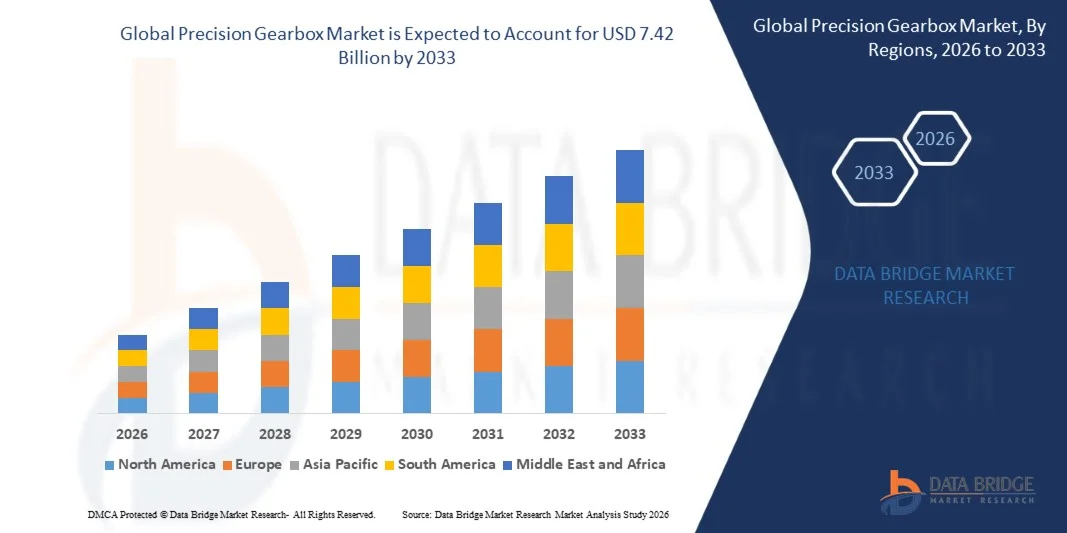
Report Scope and Precision Gearbox Market Segmentation
|
Attributes |
Precision Gearbox Key Market Insights |
|
Segments Covered |
· By Type: Planetary Gearboxes, Helical Gearboxes, Harmonic Gearboxes, Cycloidal Gearboxes, Bevel Gearboxes, Spur Gearboxes, Worm Gearboxes, Cylindrical Gearboxes, Others · By Axis Orientation: In‑Line, Right Angle, Parallel · By Bearing Type: Deep Groove Ball Bearings, Tapered Roller Bearings, Cylindrical Roller Bearings, Needle Roller Bearings, Cross Roller Bearings, Others · By Mounting Style: Flange Output, Hollow Shaft, Tapped Holes, Through Holes, Others · By Torque: UP TO 50 NM, 50-500 NM, 500-1000 NM, 1000-3000 NM, ABOVE 3000 NM · By Material: Steel, Aluminum, Plastics, Titanium, Others · By Axle LoadCapacity: Up To 800 N, 800-1500 N, More Than 1500 N · By Gearbox Stage: Multi Stage, Single, Double · By Application: Robotics, Machine Tools, Material Handling, Construction Equipment, Automotive, Semiconductor Equipment, Aerospace and Defense, Agricultural, Packaging, Medical, Food and Beverages, Others) · By Sales Channel: Direct (OEM), Aftermarket |
|
Countries Covered |
North America · U.S. · Canada · Mexico Europe · Germany · France · U.K. · Netherlands · Switzerland · Belgium · Russia · Italy · Spain · Turkey · Rest of Europe Asia-Pacific · China · Japan · India · South Korea · Singapore · Malaysia · Australia · Thailand · Indonesia · Philippines · Rest of Asia-Pacific Middle East and Africa · Saudi Arabia · U.A.E. · South Africa · Egypt · Israel · Rest of Middle East and Africa South America · Brazil · Argentina · Rest of South America |
|
Key Market Players |
• Siemens AG (Germany) |
|
Market Opportunities |
• Increasing Adoption Of Collaborative Robots Across Manufacturing Industries • Expansion Of Semiconductor Manufacturing And Advanced Automation Infrastructure |
|
Value Added Data Infosets |
In addition to the market insights such as market value, growth rate, market segments, geographical coverage, market players, and market scenario, the market report curated by the Data Bridge Market Research team includes in-depth expert analysis, import/export analysis, pricing analysis, production consumption analysis, and pestle analysis. |
Precision Gearbox Market Trends
Trend: Rapid Adoption Of Robotics And High-Precision Automation Systems
Increasing demand for highly accurate motion control, positioning, and torque transmission solutions across industrial automation, robotics, semiconductor manufacturing, and machine tool applications. Conventional mechanical transmission systems often struggle to deliver the precision, repeatability, and compactness required in modern automated production environments, encouraging manufacturers to adopt advanced precision gearbox technologies for enhanced operational efficiency and performance.
In modern industrial robots, manufacturers are integrating precision planetary, harmonic, and cycloidal gearboxes, For instance in robotic arms and collaborative robots, to improve positioning accuracy, torque density, and operational reliability. In semiconductor manufacturing facilities, these gearboxes are being utilized in wafer handling and lithography equipment where micron-level motion precision is essential. The rapid expansion of automated warehouses and smart factories is also increasing demand for compact and high-performance motion control systems capable of continuous operation under demanding conditions.
In addition, aerospace and defense sectors continue to utilize precision gearbox technology in radar systems, unmanned platforms, and guidance equipment because of their reliability and precision under critical operating conditions. Growing industry validation through advanced robotics deployments in 2025 showed that harmonic drive-based robotic joints achieved positioning repeatability of less than ±0.02 mm in high-precision assembly applications, supporting wider adoption across manufacturing industries.
Precision Gearbox Market Dynamics
Key Market Driver: Rising Adoption Of Industrial Automation And Robotics
Industries worldwide are increasingly investing in automation technologies to improve productivity, reduce operational costs, and enhance manufacturing precision. The growing deployment of industrial robots, collaborative robots, automated guided vehicles, and smart manufacturing systems is creating strong demand for precision gearboxes capable of delivering accurate motion control and high torque transmission.
Industries such as automotive, electronics, logistics, and semiconductor manufacturing are increasingly deploying precision gearboxes to support robotic operations, automated assembly lines, and advanced production equipment. Automotive manufacturers are actively expanding robotic installations, For instance in welding, painting, and material handling applications, to improve production efficiency and product quality. According to international robotics industry statistics, more than 540,000 industrial robots were installed globally in recent years, with Asia accounting for the largest share of new deployments.
Similarly, semiconductor fabrication facilities and advanced electronics manufacturers are utilizing precision gearboxes to support ultra-precise manufacturing processes while maintaining high operational reliability. Real-world smart factory implementations across Germany, Japan, and South Korea during 2024 demonstrated productivity improvements exceeding 15–20% through increased automation and robotic integration, strengthening demand for precision motion control components.
Key Restraint/Challenge: High Manufacturing Costs And Complex Engineering Requirements
Precision gearboxes require advanced engineering, specialized materials, and highly accurate manufacturing processes to achieve the performance standards demanded by industrial automation and robotics applications. The need for tight tolerances, precision machining, and rigorous quality control significantly increases production costs compared to conventional gearbox systems.
In addition, complex product design, specialized assembly procedures, and stringent performance requirements contribute to higher acquisition and maintenance costs, creating affordability concerns for small and medium-sized manufacturers. Limited availability of highly skilled manufacturing capabilities further increases barriers to entry within the industry. Precision gearbox systems used in advanced robotics can cost several times more than conventional industrial gear units due to their superior accuracy, durability, and torque performance.
Commercial benchmarking studies indicate that high-precision harmonic and cycloidal gearboxes often operate with positioning accuracy levels exceeding 90–95%, substantially higher than standard industrial transmission systems, but at significantly elevated production and procurement costs.
Key Market Opportunity: Expansion Of Semiconductor Manufacturing And Collaborative Robotics
Modern semiconductor fabrication facilities, collaborative robots, autonomous mobile robots, and advanced manufacturing systems increasingly require compact, lightweight, and highly precise motion control technologies. Conventional transmission systems are often unable to provide the positioning accuracy and torque density required for next-generation automation equipment, creating demand for advanced precision gearbox solutions.
Manufacturers are increasingly integrating precision gearboxes, For instance in semiconductor wafer handling equipment, collaborative robotic arms, and automated inspection systems, to improve operational accuracy, system reliability, and productivity. In electronics manufacturing, increasing miniaturization and complexity of components are accelerating demand for precision motion systems capable of micron-level positioning performance.
In addition, advancements in gearbox materials, digital monitoring technologies, and lightweight design architectures are improving product efficiency and operational lifespan, opening opportunities across semiconductor, aerospace, medical device, and logistics automation markets in Asia-Pacific and North America. Semiconductor capacity expansion projects announced during 2025 across Taiwan, the U.S., and South Korea are expected to generate substantial demand for precision robotics and motion control equipment, supporting long-term growth opportunities for precision gearbox manufacturers.
Precision Gearbox Market Scope
The market is segmented on the basis of type, axis orientation, bearing type, mounting style, torque, material, axle load capacity, gearbox stage, application, and sales channel.
- By Type
On the basis of type, the precision gearbox market is segmented into Planetary Gearboxes, Helical Gearboxes, Harmonic Gearboxes, Cycloidal Gearboxes, Bevel Gearboxes, Spur Gearboxes, Worm Gearboxes, Cylindrical Gearboxes, and Others. The Planetary Gearboxes segment held the largest market revenue share of approximately 31.7% in 2025 driven by its high torque density, compact design, superior efficiency, and extensive deployment across industrial robotics, machine tools, and automation systems. Planetary gearboxes are widely preferred for precision motion control applications requiring high positioning accuracy and operational reliability. Their ability to distribute loads across multiple gears improves durability and operational lifespan. Increasing investments in factory automation and robotic manufacturing lines continue to support segment dominance across developed and emerging industrial economies.
The Harmonic Gearboxes segment is projected to register the fastest growth at a CAGR of 11.8% from 2026 to 2033, driven by increasing adoption in collaborative robots, semiconductor manufacturing equipment, and advanced automation systems. Rising demand for ultra-high precision and lightweight motion control solutions is accelerating segment expansion. Harmonic gearboxes provide near-zero backlash and exceptional positioning accuracy, making them highly suitable for sophisticated robotic applications. Growing investments in semiconductor fabrication facilities and next-generation automation technologies are expected to further boost demand.
- By Axis Orientation
On the basis of axis orientation, the precision gearbox market is segmented into In-Line, Right Angle, and Parallel. The In-Line segment held the largest market revenue share of approximately 48.6% in 2025 driven by its compact structure, simplified installation, and extensive utilization across industrial automation and robotic applications. In-line configurations are preferred where space efficiency and high transmission accuracy are critical. The design offers efficient power transfer while minimizing energy losses during operation. Its widespread compatibility with servo motors and automation equipment further contributes to strong market adoption.
The Right Angle segment is projected to register the fastest growth at a CAGR of 10.2% from 2026 to 2033, driven by increasing demand for flexible equipment layouts and compact automation systems in manufacturing facilities and warehouses. These gearboxes allow designers to optimize machine architecture where installation space is limited. Rising deployment of automated guided vehicles, packaging machinery, and material handling systems is supporting segment growth. Continued industrial modernization initiatives are expected to increase adoption across multiple industries.
- By Bearing Type
On the basis of bearing type, the precision gearbox market is segmented into Deep Groove Ball Bearings, Tapered Roller Bearings, Cylindrical Roller Bearings, Needle Roller Bearings, Cross Roller Bearings, and Others. The Deep Groove Ball Bearings segment held the largest market revenue share of approximately 35.9% in 2025 driven by its cost efficiency, versatility, low friction characteristics, and widespread use in precision gearbox assemblies across industrial equipment. These bearings support smooth rotational movement while maintaining operational reliability. Their suitability for both radial and axial loads enhances their utilization across various industrial automation applications.
The Cross Roller Bearings segment is projected to register the fastest growth at a CAGR of 11.1% from 2026 to 2033, driven by rising adoption in robotic joints, semiconductor equipment, and precision positioning systems requiring superior rotational accuracy and rigidity. Cross roller bearings provide high load-bearing capabilities while maintaining compact dimensions. Growing demand for precision engineering solutions in robotics and medical devices is supporting segment expansion. Technological advancements in bearing materials and manufacturing techniques are also improving product performance.
- By Mounting Style
On the basis of mounting style, the precision gearbox market is segmented into Flange Output, Hollow Shaft, Tapped Holes, Through Holes, and Others. The Flange Output segment held the largest market revenue share of approximately 38.4% in 2025 driven by its robust load-handling capabilities, ease of integration, and extensive use in robotics and industrial automation systems. Flange-mounted designs provide stable mechanical connections and simplified installation procedures. Their ability to support high-performance applications across machine tools and manufacturing equipment contributes significantly to market demand.
The Hollow Shaft segment is projected to register the fastest growth at a CAGR of 10.9% from 2026 to 2033, driven by increasing demand for compact machine architectures, simplified cabling arrangements, and advanced robotic applications. Hollow shaft designs improve equipment flexibility while reducing assembly complexity. They are increasingly utilized in collaborative robots, semiconductor equipment, and automated manufacturing systems. The growing focus on space-efficient industrial equipment continues to support adoption.
- By Torque
On the basis of torque, the precision gearbox market is segmented into Up to 50 Nm, 50–500 Nm, 500–1000 Nm, 1000–3000 Nm, and Above 3000 Nm. The 50–500 Nm segment held the largest market revenue share of approximately 36.8% in 2025 driven by its extensive deployment across industrial robots, packaging equipment, machine tools, and material handling systems. This torque range offers an optimal balance between power output and operational efficiency for most industrial automation applications. Its broad applicability across manufacturing sectors supports continued segment leadership.
The Up to 50 Nm segment is projected to register the fastest growth at a CAGR of 11.5% from 2026 to 2033, driven by increasing adoption of collaborative robots, medical devices, and compact automation equipment requiring lightweight precision motion systems. Miniaturization trends across electronics and automation industries are further supporting demand. The growing use of lightweight robotic systems in laboratories and healthcare facilities is expected to contribute significantly to future growth.
- By Material
On the basis of material, the precision gearbox market is segmented into Steel, Aluminum, Plastics, Titanium, and Others. The Steel segment held the largest market revenue share of approximately 62.3% in 2025 driven by its superior mechanical strength, durability, wear resistance, and suitability for high-load industrial applications. Steel gearboxes offer excellent reliability under continuous operation and demanding environmental conditions. Their widespread use across robotics, manufacturing, and aerospace applications continues to drive market dominance.
The Aluminum segment is projected to register the fastest growth at a CAGR of 10.7% from 2026 to 2033, driven by growing demand for lightweight automation components, energy-efficient machinery, and high-performance robotic systems. Aluminum-based gearboxes help reduce overall equipment weight while maintaining operational performance. Increasing adoption in mobile robotics and automated transportation systems is expected to support segment expansion.
- By Axle Load Capacity
On the basis of axle load capacity, the precision gearbox market is segmented into Up to 800 N, 800–1500 N, and More Than 1500 N. The 800–1500 N segment held the largest market revenue share of approximately 44.2% in 2025 driven by its widespread utilization in industrial robotics, machine tools, and automated manufacturing systems requiring balanced load-bearing performance. The segment offers versatility across a broad range of industrial applications. Strong demand from manufacturing and logistics industries continues to support segment growth.
The More Than 1500 N segment is projected to register the fastest growth at a CAGR of 10.4% from 2026 to 2033, driven by increasing deployment in heavy-duty automation equipment, aerospace systems, and advanced material handling applications. These systems are designed to withstand demanding operational environments and high-performance requirements. Rising industrial investments in large-scale automation projects are expected to create additional growth opportunities.
- By Gearbox Stage
On the basis of gearbox stage, the precision gearbox market is segmented into Multi Stage, Single, and Double. The Multi Stage segment held the largest market revenue share of approximately 46.7% in 2025 driven by its ability to deliver higher gear reduction ratios, superior torque output, and enhanced positioning precision for demanding industrial applications. Multi-stage systems are extensively used where high accuracy and operational stability are essential. Their capability to support advanced robotic and machine tool applications contributes significantly to market leadership.
The Double segment is projected to register the fastest growth at a CAGR of 10.6% from 2026 to 2033, driven by rising demand for optimized performance, compact design configurations, and improved motion control capabilities. Double-stage gearboxes provide an effective balance between efficiency and precision. Growing automation adoption across manufacturing and electronics sectors is expected to accelerate segment growth.
- By Application
On the basis of application, the precision gearbox market is segmented into Robotics, Machine Tools, Material Handling, Construction Equipment, Automotive, Semiconductor Equipment, Aerospace and Defense, Agricultural, Packaging, Medical, Food and Beverages, and Others. The Robotics segment held the largest market revenue share of approximately 29.4% in 2025 driven by rapid industrial robot deployment, increasing automation investments, and growing adoption of collaborative robots across manufacturing industries. Precision gearboxes play a critical role in enabling accurate robotic movement and positioning. Expanding smart factory initiatives worldwide continue to strengthen demand for robotic automation solutions.
The Semiconductor Equipment segment is projected to register the fastest growth at a CAGR of 12.4% from 2026 to 2033, driven by expanding semiconductor fabrication capacity, rising investments in advanced chip manufacturing facilities, and increasing demand for ultra-precise motion control systems. Semiconductor equipment requires extremely high positioning accuracy and reliability. Growing global investments in artificial intelligence, high-performance computing, and advanced electronics manufacturing are expected to drive segment expansion.
- By Sales Channel
On the basis of sales channel, the precision gearbox market is segmented into Direct (OEM) and Aftermarket. The Direct (OEM) segment held the largest market revenue share of approximately 73.6% in 2025 driven by strong partnerships between gearbox manufacturers and automation equipment producers, along with increasing integration of precision gearboxes into newly manufactured robotic and industrial systems. OEM channels ensure product customization, quality assurance, and long-term technical support. Growing demand for factory automation solutions continues to support segment dominance.
The Aftermarket segment is projected to register the fastest growth at a CAGR of 9.8% from 2026 to 2033, driven by increasing maintenance requirements, replacement demand for aging industrial equipment, and growing emphasis on operational reliability and equipment upgrades. Industries are increasingly investing in preventive maintenance programs to minimize downtime. The expansion of installed automation equipment globally is expected to generate sustained aftermarket opportunities.
Precision Gearbox Market Regional Analysis
North America Precision Gearbox Market Insight
North America dominated the precision gearbox market with the largest revenue share of 36.4% in 2025, supported by strong investments in industrial automation, advanced manufacturing technologies, and robotics deployment across key industries. Companies in the region highly value high-precision motion control systems that improve productivity, operational efficiency, and manufacturing accuracy. This widespread adoption is further supported by increasing investments in smart factories, semiconductor production facilities, and aerospace technologies, establishing precision gearboxes as critical components across industrial automation and high-performance engineering applications.
U.S. Precision Gearbox Market Insight
The U.S. precision gearbox market captured the largest revenue share in 2025 within North America, fueled by the rapid adoption of industrial robotics, growing investments in advanced manufacturing infrastructure, and expansion of semiconductor fabrication facilities. Manufacturers are increasingly prioritizing automation solutions that deliver superior positioning accuracy and operational reliability. The growing deployment of collaborative robots, automated material handling systems, and precision machine tools further propels the precision gearbox industry. Moreover, increasing investments in aerospace, defense, and next-generation manufacturing technologies are significantly contributing to market expansion.
Europe Precision Gearbox Market Insight
The Europe precision gearbox market is expected to witness the fastest growth rate from 2026 to 2033, primarily driven by expanding Industry 4.0 initiatives, rising adoption of industrial automation, and growing demand for energy-efficient manufacturing solutions. The increase in smart factory investments, coupled with rising deployment of robotics across automotive and industrial sectors, is fostering the adoption of precision gearboxes. European manufacturers are also focused on improving operational efficiency, production quality, and sustainability. The region is experiencing significant growth across robotics, machine tools, semiconductor equipment, and material handling applications.
U.K. Precision Gearbox Market Insight
The U.K. precision gearbox market is expected to witness the fastest growth rate from 2026 to 2033, driven by increasing investments in advanced manufacturing, robotics integration, and automated production systems. In addition, growing demand for precision engineering solutions across aerospace, defense, and electronics industries is encouraging businesses to adopt high-performance motion control technologies. The U.K.’s strong focus on industrial modernization, digital manufacturing, and innovation is expected to continue stimulating market growth.
Germany Precision Gearbox Market Insight
The Germany precision gearbox market is expected to witness the fastest growth rate from 2026 to 2033, fueled by increasing automation across automotive manufacturing, machine tool production, and industrial robotics applications. Germany’s well-developed manufacturing infrastructure, combined with its leadership in engineering excellence and industrial innovation, promotes the adoption of precision gearboxes throughout production facilities. The integration of advanced robotics and smart factory technologies is also becoming increasingly prevalent, with manufacturers prioritizing precision, efficiency, and operational reliability.
Asia-Pacific Precision Gearbox Market Insight
The Asia-Pacific precision gearbox market is expected to witness the fastest growth rate from 2026 to 2033, supported by increasing industrialization, rising automation investments, and expanding manufacturing activities in countries such as China, Japan, South Korea, and India. The region's growing focus on smart manufacturing and robotics deployment is driving the adoption of precision gearboxes. Furthermore, as Asia-Pacific continues to emerge as a global manufacturing hub for electronics, semiconductors, and industrial equipment, demand for advanced motion control systems is expanding rapidly across multiple industries.
Japan Precision Gearbox Market Insight
The Japan precision gearbox market is expected to witness the fastest growth rate from 2026 to 2033 due to the country’s strong robotics industry, advanced manufacturing capabilities, and leadership in automation technologies. The Japanese market places significant emphasis on precision engineering, and the adoption of precision gearboxes is driven by increasing deployment of industrial robots, semiconductor equipment, and machine tools. The integration of precision motion systems into collaborative robots and intelligent manufacturing platforms is fueling growth. Moreover, Japan’s continuous investments in robotics innovation and smart production technologies are expected to strengthen market demand.
China Precision Gearbox Market Insigh
The China precision gearbox market accounted for the largest market revenue share in Asia-Pacific in 2025, attributed to the country's rapid industrialization, large-scale manufacturing base, and high adoption of automation technologies. China stands as one of the largest markets for industrial robots and factory automation equipment, and precision gearboxes are becoming increasingly essential in robotics, semiconductor equipment, machine tools, and automated production systems. The push toward smart manufacturing, growing semiconductor investments, and strong domestic production capabilities are key factors propelling the market in China.
Precision Gearbox Market Share
The Precision Gearbox industry is primarily led by well-established companies, including:
- Siemens AG (Germany)
- Nabtesco Corporation (Japan)
- Sumitomo Electric Industries (Japan)
- ABB Ltd (Switzerland)
- Bonfiglioli (Italy)
- Emerson Electric Co. (U.S.)
- Parker Hannifin Corporation (U.S.)
- Regal Rexnord Corporation (U.S.)
- Hiwin Corporation (Taiwan)
- STOBER Drives Inc. (U.S.)
- David Brown Santasalo (United Kingdom)
- Neugart GmbH (Germany)
- Dana Incorporated (U.S.)
- Apex Dynamics, Inc. (Taiwan)
- SEW-EURODRIVE GmbH & Co KG (Germany)
- Cone Drive (U.S.)
- Spinea s.r.o. (Slovakia)
- WITTENSTEIN SE (Germany)
- Horsburgh & Scott (U.S.)
- GAM Enterprises, Inc. (U.S.)
- Nidec Drive Technology America Corporation (U.S.)
- Curtis Machine Company (U.S.)
- Newstart Planetary Gear Boxes Co., Ltd (China)
- Onvio LLC (U.S.)
- Harmonic Drive LLC (U.S.)
- Riley Gear Corp (U.S.)
- Prime Transmission (India)
- ATLANTA Drive Systems, Inc. (U.S.)
- SMD Gearbox (India)
Latest Developments in Precision Gearbox Market
- In September 2022, Gabriel-Chemie introduced a new series of halogen-free flame retardant masterbatches for the electrical conduits and tubes market, emphasizing the company's commitment to sustainability. These masterbatches comply with flame retardant standard EN 61386, halogen-free standard EN 50642, and low smoke standard IEC 61304-2. Benefits include reduced toxic gas emissions during fires, enhanced recyclability, and minimized corrosion of electronic equipment and machinery.
- In October 2023, Clariant inaugurated a new CHF 60 million Exolit™ OP flame retardant plant in Daya Bay, China. Aimed at meeting Asia’s demand for sustainable fire protection, the facility enhances local supply capabilities. A second production line is under construction, set to launch in 2024
- In May, BASF expanded its Polyphthalamide (PPA) portfolio with various flame-retardant grades offering high thermal stability, excellent electrical insulation, and low water uptake. These halogen-free materials featured RTI values above 140°C, improved color stability, and enabled safer, more reliable applications across e-mobility, electronics, appliances, and power connectors.
- In July, BASF and THOR GmbH combined their expertise in non-halogenated flame retardant additives to offer a comprehensive solution that improved sustainability and performance in select plastic compounds while meeting strict fire safety standards.
- In January, BASF's advanced flame-retardant grade of Ultramid T6000 polyphthalamide (PPA) was adopted for terminal block applications, replacing non-FR materials to improve safety in inverter and motor systems of Electric Vehicles (EVs). It supports electrical safety enhancement in electric vehicles, making it a functional upgrade with direct implications for thermal protection, reliability, and compliance in automotive electrical systems
SKU-
Get online access to the report on the World's First Market Intelligence Cloud

- Interactive Data Analysis Dashboard
- Company Analysis Dashboard for high growth potential opportunities
- Research Analyst Access for customization & queries
- Competitor Analysis with Interactive dashboard
- Latest News, Updates & Trend analysis
- Harness the Power of Benchmark Analysis for Comprehensive Competitor Tracking
Research Methodology
Data collection and base year analysis are done using data collection modules with large sample sizes. The stage includes obtaining market information or related data through various sources and strategies. It includes examining and planning all the data acquired from the past in advance. It likewise envelops the examination of information inconsistencies seen across different information sources. The market data is analysed and estimated using market statistical and coherent models. Also, market share analysis and key trend analysis are the major success factors in the market report. To know more, please request an analyst call or drop down your inquiry.
The key research methodology used by DBMR research team is data triangulation which involves data mining, analysis of the impact of data variables on the market and primary (industry expert) validation. Data models include Vendor Positioning Grid, Market Time Line Analysis, Market Overview and Guide, Company Positioning Grid, Patent Analysis, Pricing Analysis, Company Market Share Analysis, Standards of Measurement, Global versus Regional and Vendor Share Analysis. To know more about the research methodology, drop in an inquiry to speak to our industry experts.
Customization Available
Data Bridge Market Research is a leader in advanced formative research. We take pride in servicing our existing and new customers with data and analysis that match and suits their goal. The report can be customized to include price trend analysis of target brands understanding the market for additional countries (ask for the list of countries), clinical trial results data, literature review, refurbished market and product base analysis. Market analysis of target competitors can be analyzed from technology-based analysis to market portfolio strategies. We can add as many competitors that you require data about in the format and data style you are looking for. Our team of analysts can also provide you data in crude raw excel files pivot tables (Fact book) or can assist you in creating presentations from the data sets available in the report.












