


Global Probe Card Market
Market Size in USD Billion
CAGR :
% 
 USD
3.57 Billion
USD
8.10 Billion
2025
2033
USD
3.57 Billion
USD
8.10 Billion
2025
2033
 Forecast Period Forecast Period |
2026 –2033 |
 Market Size (Base Year) Market Size (Base Year) |
USD 3.57 Billion |
 Market Size (Forecast Year) Market Size (Forecast Year) |
USD 8.10 Billion |
 CAGR CAGR |
% |
| Major Markets Players |
|
Probe Card Market Size
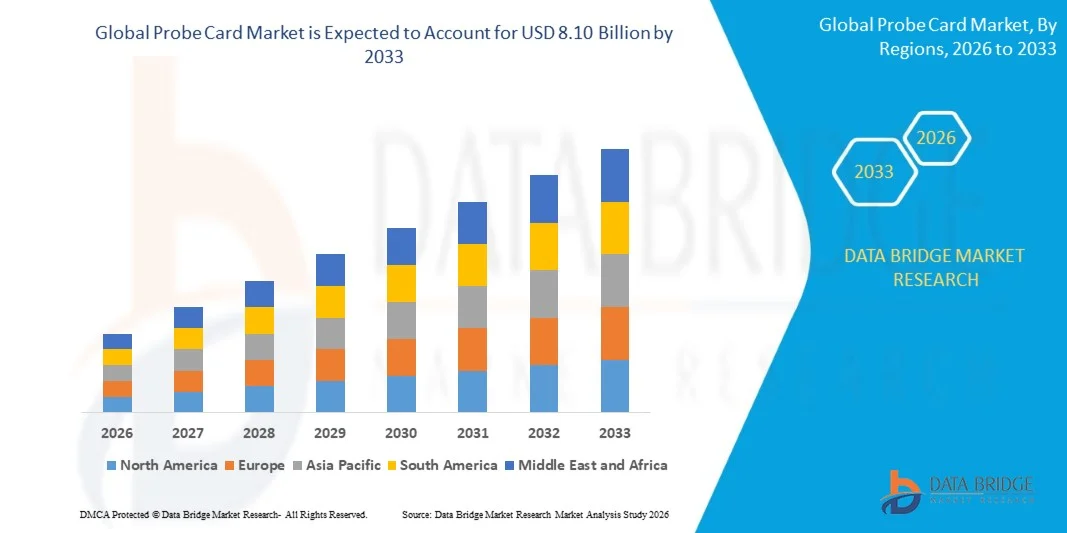
- The global probe card market size was valued at USD 3.57 billion in 2025 and is expected to reach USD 8.10 billion by 2033, at a CAGR of 10.8% during the forecast period
- The market growth is largely fueled by the rapid expansion of semiconductor manufacturing and increasing complexity of integrated circuits, leading to higher demand for advanced wafer-level testing solutions across logic, memory, and mixed-signal devices
- Furthermore, rising adoption of technologies such as AI, 5G, automotive electronics, and high-performance computing is increasing the need for precise, high-density probe cards capable of ensuring accuracy and reliability in testing processes. These converging factors are accelerating the adoption of advanced probe card solutions, thereby significantly boosting the market growth
Probe Card Market Analysis
- Probe cards are critical interfaces used in semiconductor wafer testing to establish electrical contact between test equipment and integrated circuits, enabling validation of performance, functionality, and reliability before packaging. These components play a vital role in ensuring yield optimization and quality control across semiconductor manufacturing processes
- The escalating demand for probe cards is primarily driven by continuous advancements in semiconductor technologies, increasing transition toward smaller nodes, and growing need for high-speed and high-frequency testing. Rising investments in wafer fabrication facilities and the expansion of advanced packaging technologies are further supporting the market growth
- Asia-Pacific dominated the probe card market with a share of 84.62% in 2025, due to the strong presence of semiconductor manufacturing hubs across countries such as China, Taiwan, South Korea, and Japan
- North America is expected to be the fastest growing region in the probe card market during the forecast period due to increasing investments in semiconductor manufacturing and testing infrastructure
- Advanced probe card segment dominated the market with a market share of 63% in 2025, due to increasing demand for high-performance semiconductor testing across complex integrated circuits and advanced nodes. These probe cards support fine pitch, high pin count, and enhanced accuracy, making them essential for testing modern chips used in AI, automotive, and high-speed computing applications
Report Scope and Probe Card Market Segmentation
|
Attributes |
Probe Card Key Market Insights |
|
Segments Covered |
|
|
Countries Covered |
North America
Europe
Asia-Pacific
Middle East and Africa
South America
|
|
Key Market Players |
|
|
Market Opportunities |
|
|
Value Added Data Infosets |
In addition to the insights on market scenarios such as market value, growth rate, segmentation, geographical coverage, and major players, the market reports curated by the Data Bridge Market Research also include in-depth expert analysis, geographically represented company-wise production and capacity, network layouts of distributors and partners, detailed and updated price trend analysis and deficit analysis of supply chain and demand. |
Probe Card Market Trends
“Increasing Demand for Advanced Semiconductor Testing Solutions”
- A significant trend in the probe card market is the rising demand for advanced semiconductor testing solutions driven by the increasing complexity of integrated circuits and the need for higher accuracy in wafer-level testing. This demand is strengthening the role of probe cards as essential tools for ensuring performance validation and defect detection in modern semiconductor manufacturing processes
- For instance, FormFactor Inc. provides advanced probe card solutions that support high-frequency and high-density testing for logic and memory devices. These solutions enhance test precision and enable semiconductor manufacturers to maintain product quality across complex chip architectures
- The transition toward smaller nodes and advanced packaging technologies is increasing the need for probe cards capable of handling fine pitch and high pin-count testing environments. This is encouraging continuous innovation in probe card design to support evolving semiconductor requirements
- The growing adoption of 5G, artificial intelligence, and high-performance computing is driving the need for reliable testing solutions that can handle higher data speeds and complex chip functionalities. This is positioning advanced probe cards as critical components in next-generation semiconductor validation
- Semiconductor manufacturers are focusing on improving yield rates and reducing defects during wafer testing which is increasing reliance on high-performance probe cards. This trend is contributing to improved production efficiency and reduced cost of faulty chip output
- The expansion of advanced semiconductor applications across industries is reinforcing the importance of precise and scalable testing solutions. This ongoing demand is shaping the probe card market toward higher innovation, improved reliability, and enhanced testing capabilities across global semiconductor production
Probe Card Market Dynamics
Driver
“Growing Semiconductor Industry and Rising Chip Production Volumes”
- The rapid growth of the global semiconductor industry combined with increasing chip production volumes is driving demand for probe cards used in wafer testing and quality assurance processes. As semiconductor fabrication scales up to meet demand from various industries the need for efficient and reliable testing solutions continues to rise
- For instance, Taiwan Semiconductor Manufacturing Company has expanded its wafer fabrication capacity to support rising demand for advanced chips across consumer electronics and automotive sectors. This expansion directly increases the requirement for high-performance probe cards to ensure consistent testing and yield optimization
- The rising demand for consumer electronics including smartphones, laptops, and wearable devices is contributing to higher semiconductor production which in turn drives probe card adoption. Increased device complexity is further intensifying the need for accurate testing solutions
- The automotive sector is witnessing strong growth in semiconductor usage due to electrification and advanced driver assistance systems which is boosting wafer testing requirements. This is creating sustained demand for probe cards capable of handling automotive-grade chips
- The continuous scaling of semiconductor production to meet global technology demand is reinforcing this driver. The need for efficient testing systems to support large-scale chip output is positioning probe cards as indispensable components in semiconductor fabrication processes
Restraint/Challenge
“High Cost and Maintenance Complexity of Probe Card Systems”
- The probe card market faces challenges due to the high cost associated with designing, manufacturing, and maintaining advanced probe card systems required for precise semiconductor testing. These systems require sophisticated materials and engineering which significantly increases their overall cost
- For instance, Micronics Japan Co. Ltd. develops highly specialized probe cards designed for advanced node testing which involve complex microfabrication and alignment processes. These advanced systems demand regular maintenance and calibration increasing operational expenses for semiconductor manufacturers
- The need for frequent replacement and repair of probe needles due to wear and tear adds to maintenance complexity and cost burden. This affects the overall efficiency and cost-effectiveness of testing operations in high-volume production environments
- Advanced probe cards used for fine pitch and high-density applications require precise alignment and handling which increases operational difficulty. This complexity demands skilled technicians and specialized infrastructure for effective utilization
- The challenge of managing high costs and maintenance requirements continues to impact market growth. These constraints are influencing manufacturers to focus on cost optimization and durable probe card designs while maintaining high testing accuracy and performance
Probe Card Market Scope
The market is segmented on the basis of probe type, manufacturing technology type, wafer size, head size, test, material, application, beam size, and end-use.
- By Probe Type
On the basis of probe type, the probe card market is segmented into advanced probe card and standard probe card. The advanced probe card segment dominated the largest market revenue share of 63% in 2025, driven by increasing demand for high-performance semiconductor testing across complex integrated circuits and advanced nodes. These probe cards support fine pitch, high pin count, and enhanced accuracy, making them essential for testing modern chips used in AI, automotive, and high-speed computing applications. The rising complexity of semiconductor architectures has further accelerated the adoption of advanced probe cards due to their ability to ensure precision and reliability during wafer testing processes.
The standard probe card segment is anticipated to witness the fastest growth rate from 2026 to 2033, fueled by its cost-effectiveness and suitability for testing less complex and mature node devices. Many manufacturers continue to rely on standard probe cards for legacy semiconductor production where high-end testing capabilities are not required. Their simplicity, lower maintenance costs, and widespread usage in analog and discrete device testing contribute to their steady growth across diverse semiconductor applications.
- By Manufacturing Technology Type
On the basis of manufacturing technology type, the probe card market is segmented into MEMS, vertical, cantilever, epoxy, blade, and others. The MEMS segment dominated the largest market revenue share in 2025, driven by its superior precision, scalability, and capability to handle high-density wafer testing. MEMS probe cards are widely used in advanced semiconductor nodes due to their excellent planarity and consistent contact performance, making them highly suitable for logic and memory device testing. Their integration with cutting-edge fabrication technologies further strengthens their position in high-performance semiconductor manufacturing environments.
The vertical segment is expected to witness the fastest growth rate from 2026 to 2033, driven by increasing demand for testing high pin-count devices and improved electrical performance. Vertical probe cards offer better signal integrity and durability, making them ideal for applications requiring repeated testing cycles and higher current carrying capacity. Their enhanced mechanical stability and compatibility with evolving semiconductor packaging technologies are contributing to their growing adoption.
- By Wafer Size
On the basis of wafer size, the probe card market is segmented into more than 12 inches and less than 12 inches. The more than 12 inches segment dominated the largest market revenue share in 2025, driven by the widespread transition toward larger wafer sizes in semiconductor manufacturing to improve productivity and reduce cost per chip. Larger wafers enable higher output and efficiency, increasing the need for advanced probe cards capable of testing a greater number of dies simultaneously. The growing demand for high-volume production of memory and logic devices further strengthens this segment’s dominance.
The less than 12 inches segment is anticipated to witness the fastest growth rate from 2026 to 2033, fueled by continued demand for specialty semiconductors and legacy devices that still rely on smaller wafer sizes. Industries such as automotive, industrial electronics, and IoT continue to utilize these wafers due to cost efficiency and established manufacturing processes. This sustained demand ensures consistent growth of probe cards designed for smaller wafer applications.
- By Head Size
On the basis of head size, the probe card market is segmented into more than 40mm x 40mm and less than 40mm x 40mm. The more than 40mm x 40mm segment dominated the largest market revenue share in 2025, driven by the need to accommodate larger wafer sizes and higher pin-count testing requirements. Larger head sizes enable more comprehensive testing coverage and improved efficiency in handling complex semiconductor devices. Their ability to support advanced testing environments makes them a preferred choice in high-end semiconductor fabrication facilities.
The less than 40mm x 40mm segment is expected to witness the fastest growth rate from 2026 to 2033, driven by increasing demand for compact and cost-effective testing solutions in niche semiconductor applications. Smaller head sizes are suitable for testing smaller dies and less complex circuits, making them ideal for specialized use cases. Their lower operational cost and flexibility support their adoption in emerging and mid-scale semiconductor manufacturing setups.
- By Test
On the basis of test, the probe card market is segmented into DC test, functional test, and AC test. The DC test segment dominated the largest market revenue share in 2025, driven by its fundamental role in verifying electrical continuity and identifying defects at the wafer level. DC testing ensures that basic electrical parameters are met before devices proceed to advanced testing stages, making it an essential step in semiconductor quality control. Its widespread application across all types of semiconductor devices contributes to its leading position in the market.
The functional test segment is anticipated to witness the fastest growth rate from 2026 to 2033, fueled by increasing complexity in semiconductor devices that require comprehensive validation of performance and operational behavior. Functional testing enables manufacturers to simulate real-world conditions, ensuring device reliability and efficiency. The rising demand for high-performance computing and automotive electronics further accelerates the adoption of functional testing solutions.
- By Material
On the basis of material, the probe card market is segmented into tungsten, copper clad laminated (CCL), aluminum, and others. The tungsten segment dominated the largest market revenue share in 2025, driven by its excellent mechanical strength, durability, and stable electrical conductivity. Tungsten probe needles are widely used due to their resistance to wear and ability to maintain consistent performance during repeated testing cycles. Their reliability in high-volume semiconductor testing environments reinforces their dominant position.
The copper clad laminated segment is expected to witness the fastest growth rate from 2026 to 2033, driven by its superior electrical performance and increasing use in advanced probe card designs. CCL materials offer improved signal transmission and thermal management, making them suitable for high-frequency and high-speed testing applications. Their growing relevance in next-generation semiconductor technologies supports their rapid market expansion.
- By Application
On the basis of application, the probe card market is segmented into WLCSP, SIP, mixed signal flip chip, and analog. The mixed signal flip chip segment dominated the largest market revenue share in 2025, driven by the increasing integration of digital and analog functions in modern semiconductor devices. These applications require precise and reliable testing solutions, making probe cards essential for ensuring performance and functionality. The rising demand for advanced consumer electronics and automotive systems further boosts the adoption of mixed signal flip chip testing.
The WLCSP segment is anticipated to witness the fastest growth rate from 2026 to 2033, fueled by the growing trend toward miniaturization and compact packaging in semiconductor devices. Wafer-level chip scale packaging requires highly accurate testing at the wafer level, increasing the demand for advanced probe cards. The expanding use of WLCSP in smartphones and wearable devices supports its rapid growth.
- By Beam Size
On the basis of beam size, the probe card market is segmented into more than 1.5 mil and less than 1.5 mil. The more than 1.5 mil segment dominated the largest market revenue share in 2025, driven by its suitability for testing larger pitch devices and its robustness in handling high current applications. These probe cards provide stability and durability, making them ideal for conventional semiconductor testing processes. Their widespread usage in legacy and mid-range devices contributes to their leading market share.
The less than 1.5 mil segment is expected to witness the fastest growth rate from 2026 to 2033, driven by the increasing need for fine pitch testing in advanced semiconductor nodes. Smaller beam sizes enable precise stability with densely packed circuits, supporting high-performance device testing. The shift toward miniaturized and high-density chips accelerates the demand for this segment.
- By End-Use
On the basis of end-use, the probe card market is segmented into foundry, parametric, logic and memory device, DRAM, CMOS image sensor (CIS), flash, and others. The foundry segment dominated the largest market revenue share in 2025, driven by the rising outsourcing of semiconductor manufacturing and increasing wafer fabrication activities globally. Foundries require high-volume and precise testing solutions, leading to strong demand for advanced probe cards. The growth of fabless semiconductor companies further strengthens this segment’s dominance.
The CMOS image sensor (CIS) segment is anticipated to witness the fastest growth rate from 2026 to 2033, fueled by the growing adoption of imaging technologies in smartphones, automotive systems, and security applications. CIS devices require highly accurate and sensitive testing to ensure image quality and performance. The increasing demand for high-resolution cameras and advanced sensing solutions accelerates the growth of probe cards in this segment.
Probe Card Market Regional Analysis
- Asia-Pacific dominated the probe card market with the largest revenue share of 84.62% in 2025, driven by the strong presence of semiconductor manufacturing hubs across countries such as China, Taiwan, South Korea, and Japan
- The region benefits from high wafer fabrication capacity, cost-efficient production environments, and increasing demand for advanced semiconductor testing solutions across consumer electronics and automotive industries
- Rapid expansion of foundries, rising investments in advanced nodes, and growing adoption of AI and high-performance computing chips are accelerating market growth across the region
China Probe Card Market Insight
China held the largest share in the Asia-Pacific probe card market in 2025, supported by its rapidly expanding semiconductor manufacturing ecosystem and strong government support for domestic chip production. The country is investing heavily in wafer fabrication facilities and testing infrastructure to reduce dependence on imports. Increasing demand from consumer electronics, automotive electronics, and industrial automation is further strengthening market growth. In addition, integrated supply chains and advancements in semiconductor technologies are reinforcing China’s position in probe card demand and production.
India Probe Card Market Insight
India is witnessing the fastest growth in the Asia-Pacific region, driven by increasing investments in semiconductor manufacturing, electronics production, and government-backed initiatives promoting domestic fabrication. The rising demand for smartphones, automotive electronics, and IoT devices is supporting the need for advanced testing solutions. Growing focus on building semiconductor ecosystems and attracting global chip manufacturers is accelerating probe card adoption. In addition, infrastructure development and policy support for electronics manufacturing are contributing to long-term market expansion.
Europe Probe Card Market Insight
The Europe probe card market is expanding steadily, supported by strong demand from automotive electronics, industrial automation, and advanced manufacturing sectors. The region emphasizes high-quality semiconductor testing solutions to support precision-driven applications in automotive safety and industrial systems. Increasing focus on electric vehicles and smart manufacturing technologies is driving demand for reliable testing equipment. In addition, continuous advancements in semiconductor design and packaging are enhancing the adoption of advanced probe cards across the region.
Germany Probe Card Market Insight
Germany accounted for the largest share in the Europe probe card market in 2025, driven by its strong automotive electronics and industrial manufacturing base. The country has significant demand for semiconductor testing in applications such as electric vehicles, industrial automation, and smart mobility systems. Advanced engineering capabilities and strong R&D infrastructure support innovation in testing technologies. In addition, collaboration between semiconductor companies and industrial manufacturers is strengthening Germany’s leadership in the regional market.
U.K. Probe Card Market Insight
The U.K. market is supported by growing demand from electronics, automotive, and research-driven semiconductor applications. The country focuses on advanced semiconductor design and testing solutions, particularly in high-performance and specialty applications. Strong academic and research institutions contribute to innovation in semiconductor technologies. In addition, increasing investments in domestic semiconductor capabilities are supporting gradual market growth.
North America Probe Card Market Insight
North America is projected to grow at the fastest CAGR from 2026 to 2033, driven by increasing investments in semiconductor manufacturing and testing infrastructure. Rising demand for advanced chips used in AI, data centers, and automotive applications is supporting market expansion. Strong presence of leading semiconductor companies and continuous innovation in testing technologies are further boosting growth. In addition, government initiatives supporting domestic chip production are accelerating adoption of advanced probe card solutions.
U.S. Probe Card Market Insight
The U.S. accounted for the largest share in the North America probe card market in 2025, supported by its advanced semiconductor industry and strong presence of major chip manufacturers. The country has high demand for probe cards in testing cutting-edge technologies such as AI processors and high-performance computing devices. Robust R&D capabilities and continuous innovation in semiconductor testing are driving market growth. In addition, increasing investments in fabrication facilities and supply chain resilience are reinforcing the U.S. leadership position in the regional market.
Probe Card Market Share
The probe card industry is primarily led by well-established companies, including:
- FormFactor, Inc. (U.S.)
- Chunghwa Precision Test Tech. Co., Ltd. (Taiwan)
- FEINMETALL GmbH (Germany)
- RIKA DENSHI CO., LTD. (Japan)
- TSE Co., Ltd. (South Korea)
- Dynamic-Test Co., Ltd. (South Korea)
- STAr Technologies Inc. (Taiwan)
- MICRONICS JAPAN CO., LTD. (Japan)
- Microfriend, Inc. (Japan)
- Translarity, Inc. (U.S.)
- Korea Instrument Co., Ltd. (South Korea)
- MPI Corporation (Taiwan)
- Onto Innovation Inc. (U.S.)
- JAPAN ELECTRONIC MATERIALS CORPORATION (Japan)
- WinWay Technology Co., Ltd. (Taiwan)
- Technoprobe S.p.A. (Italy)
- WILL Technology Co., Ltd. (Japan)
- Wentworth Laboratories, Inc. (U.S.)
- htt high tech trade GmbH (Germany)
- SV Probe Pte. Ltd. (Singapore)
Latest Developments in Global Probe Card Market
- In November 2025, Korea Instrument strengthened its position in the probe card market by advancing its technological capabilities and expanding its presence in semiconductor testing solutions, which is expected to enhance competitive intensity and support innovation across high-performance chip testing applications. This development reflects the company’s focus on aligning with next-generation semiconductor requirements, enabling more precise wafer-level testing and improving overall yield efficiency for advanced nodes
- In October 2025, FormFactor acquired a California-based MEMS firm for USD 120 million, adding 50 patents focused on vertical spring optimization, which significantly strengthens its intellectual property portfolio and enhances its capability to deliver advanced probe cards for next-generation semiconductor nodes. This acquisition is expected to accelerate product innovation, improve probe durability and accuracy, and strengthen the company’s competitive advantage in high-density and fine-pitch testing environments
- In September 2025, Technoprobe opened an EUR 80 million (USD 88 million) facility in Dresden targeting European fabs, which is expected to improve regional supply chain efficiency and support the growing demand for localized semiconductor testing solutions. This expansion enables faster delivery timelines, closer collaboration with European chip manufacturers, and strengthens the company’s strategic positioning in a region increasingly focused on semiconductor self-sufficiency and advanced manufacturing capabilities
- In August 2025, TSMC qualified Micronics Japan as a primary 2 nm supplier after an 18-month co-development effort, which highlights the increasing importance of advanced probe card technologies in next-generation semiconductor manufacturing. This qualification enhances supplier credibility and demonstrates the ability to meet stringent requirements for cutting-edge node testing, thereby reinforcing the role of collaborative innovation in supporting ultra-advanced chip production
- In April 2025, MPI Corporation partnered with ASE Technology to co-develop chiplet-ready probe cards with initial products expected in Q2 2026, which is expected to accelerate innovation in advanced packaging and chiplet architectures. This collaboration supports the growing adoption of heterogeneous integration, enabling more efficient and reliable testing of complex multi-die systems, and strengthening the market’s readiness for evolving semiconductor design trends
SKU-
Get online access to the report on the World's First Market Intelligence Cloud

- Interactive Data Analysis Dashboard
- Company Analysis Dashboard for high growth potential opportunities
- Research Analyst Access for customization & queries
- Competitor Analysis with Interactive dashboard
- Latest News, Updates & Trend analysis
- Harness the Power of Benchmark Analysis for Comprehensive Competitor Tracking
Global Probe Card Market, Supply Chain Analysis and Ecosystem Framework
To support market growth and help clients navigate the impact of geopolitical shifts, DBMR has integrated in-depth supply chain analysis into its Global Probe Card Market research reports. This addition empowers clients to respond effectively to global changes affecting their industries. The supply chain analysis section includes detailed insights such as Global Probe Card Market consumption and production by country, price trend analysis, the impact of tariffs and geopolitical developments, and import and export trends by country and HSN code. It also highlights major suppliers with data on production capacity and company profiles, as well as key importers and exporters. In addition to research, DBMR offers specialized supply chain consulting services backed by over a decade of experience, providing solutions like supplier discovery, supplier risk assessment, price trend analysis, impact evaluation of inflation and trade route changes, and comprehensive market trend analysis.
Research Methodology
Data collection and base year analysis are done using data collection modules with large sample sizes. The stage includes obtaining market information or related data through various sources and strategies. It includes examining and planning all the data acquired from the past in advance. It likewise envelops the examination of information inconsistencies seen across different information sources. The market data is analysed and estimated using market statistical and coherent models. Also, market share analysis and key trend analysis are the major success factors in the market report. To know more, please request an analyst call or drop down your inquiry.
The key research methodology used by DBMR research team is data triangulation which involves data mining, analysis of the impact of data variables on the market and primary (industry expert) validation. Data models include Vendor Positioning Grid, Market Time Line Analysis, Market Overview and Guide, Company Positioning Grid, Patent Analysis, Pricing Analysis, Company Market Share Analysis, Standards of Measurement, Global versus Regional and Vendor Share Analysis. To know more about the research methodology, drop in an inquiry to speak to our industry experts.
Customization Available
Data Bridge Market Research is a leader in advanced formative research. We take pride in servicing our existing and new customers with data and analysis that match and suits their goal. The report can be customized to include price trend analysis of target brands understanding the market for additional countries (ask for the list of countries), clinical trial results data, literature review, refurbished market and product base analysis. Market analysis of target competitors can be analyzed from technology-based analysis to market portfolio strategies. We can add as many competitors that you require data about in the format and data style you are looking for. Our team of analysts can also provide you data in crude raw excel files pivot tables (Fact book) or can assist you in creating presentations from the data sets available in the report.












