




Global Process Orchestration Market
Market Size in USD Billion
CAGR :
% 
 USD
9.27 Billion
USD
34.16 Billion
2025
2033
USD
9.27 Billion
USD
34.16 Billion
2025
2033
 Forecast Period Forecast Period |
2026 –2033 |
 Market Size (Base Year) Market Size (Base Year) |
USD 9.27 Billion |
 Market Size (Forecast Year) Market Size (Forecast Year) |
USD 34.16 Billion |
 CAGR CAGR |
% |
| Major Markets Players |
|
Process Orchestration Market Size
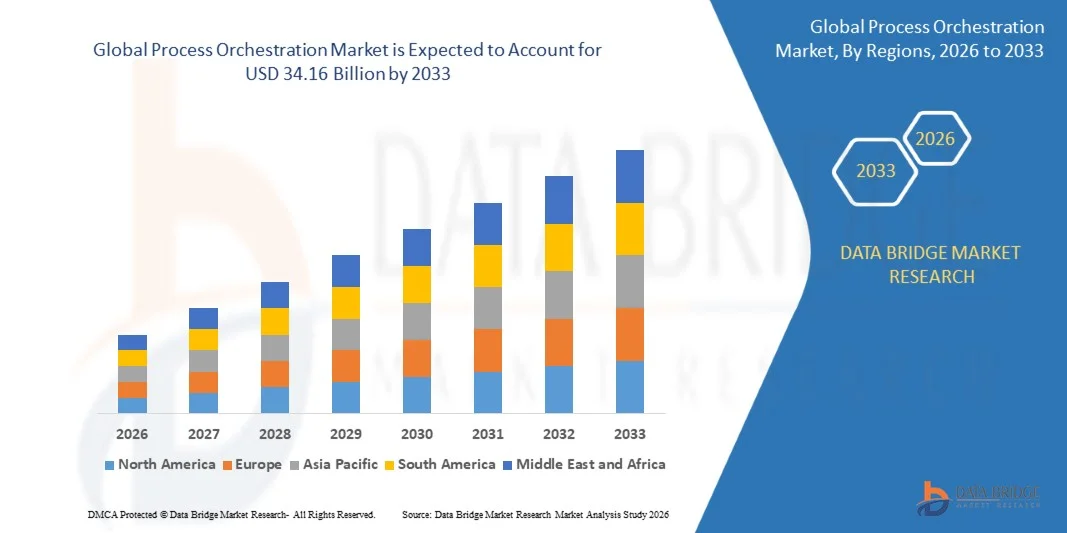
- The global process orchestration market size was valued at USD 9.27 billion in 2025 and is expected to reach USD 34.16 billion by 2033, at a CAGR of 17.71% during the forecast period
- The market growth is largely fueled by the increasing adoption of digital transformation initiatives and the rising need for end-to-end workflow automation across enterprises, enabling organizations to streamline complex processes and enhance operational efficiency
- Furthermore, growing demand for real-time process visibility, improved decision-making, and seamless integration across multiple enterprise systems is establishing process orchestration as a critical solution for modern business operations. These converging factors are accelerating the adoption of orchestration platforms, thereby significantly boosting market growth
Process Orchestration Market Analysis
- Process orchestration refers to the coordination and automation of multiple interconnected workflows, systems, and tasks across an organization to ensure efficient and streamlined operations. These platforms integrate various applications, data sources, and services, enabling businesses to achieve end-to-end process automation and improved operational control
- The escalating demand for process orchestration is primarily driven by the increasing complexity of enterprise IT environments, rising adoption of cloud and AI technologies, and the need to enhance productivity through automation while ensuring scalability and agility across business functions
- North America dominated the process orchestration market with a share of 34.3% in 2025, due to the rapid adoption of digital transformation strategies and increasing demand for workflow automation across enterprises
- Asia-Pacific is expected to be the fastest growing region in the process orchestration market during the forecast period due to rapid digitalization, increasing adoption of cloud technologies, and expanding IT infrastructure across emerging economies
- Solution segment dominated the market with a market share of 71% in 2025, due to the increasing need for centralized platforms that enable end-to-end workflow automation, process visibility, and integration across enterprise systems. Organizations are prioritizing orchestration solutions to streamline complex multi-system processes, reduce manual intervention, and enhance operational efficiency across departments
Report Scope and Process Orchestration Market Segmentation
|
Attributes |
Process Orchestration Key Market Insights |
|
Segments Covered |
|
|
Countries Covered |
North America
Europe
Asia-Pacific
Middle East and Africa
South America
|
|
Key Market Players |
|
|
Market Opportunities |
|
|
Value Added Data Infosets |
In addition to the market insights such as market value, growth rate, market segments, geographical coverage, market players, and market scenario, the market report curated by the Data Bridge Market Research team includes in-depth expert analysis, import/export analysis, pricing analysis, production consumption analysis, and pestle analysis. |
Process Orchestration Market Trends
“Rising Integration of AI-Driven Intelligent Process Automation”
- A significant trend in the process orchestration market is the increasing integration of AI-driven automation into enterprise workflows, driven by the need for intelligent decision-making and real-time process optimization across complex business environments. This integration is transforming orchestration platforms into adaptive systems capable of dynamically managing tasks, improving efficiency, and reducing manual intervention across industries
- For instance, Celonis has introduced AI-powered process orchestration solutions that leverage real-time process intelligence to optimize workflows and enhance operational agility across enterprises. Such solutions enable organizations to identify inefficiencies, automate corrective actions, and continuously improve process performance at scale
- The adoption of AI-enabled orchestration is expanding across industries as enterprises seek to automate multi-step processes involving multiple systems and data sources. This is enabling faster execution of workflows and enhancing responsiveness to changing business conditions
- Organizations are increasingly integrating orchestration platforms with machine learning and analytics tools to enable predictive insights and proactive decision-making. This trend is improving process accuracy, reducing errors, and enhancing overall business outcomes
- The growing demand for hyperautomation is further accelerating the integration of AI into orchestration platforms, enabling end-to-end automation of complex enterprise processes. This is supporting organizations in achieving higher productivity and operational resilience
- The market is witnessing a shift toward intelligent and self-optimizing workflows where AI continuously monitors and refines processes. This rising integration is reinforcing the transition toward smarter, data-driven operations and strengthening the role of process orchestration in enterprise digital transformation
Process Orchestration Market Dynamics
Driver
“Increasing Demand for End-to-End Workflow Automation Across Enterprises”
- The increasing need to automate complex, multi-system workflows across enterprises is driving the demand for process orchestration solutions that enable seamless coordination of tasks and systems. Organizations are focusing on improving efficiency, reducing operational costs, and enhancing process visibility through automation
- For instance, ServiceNow provides workflow orchestration platforms that enable enterprises to automate processes across IT, customer service, and HR functions, improving productivity and operational efficiency. These solutions help organizations streamline operations, reduce manual errors, and ensure consistent process execution across departments
- The growing complexity of enterprise IT environments is further fueling the adoption of orchestration platforms that can integrate disparate systems and applications. This integration capability supports unified operations and enhances data flow across organizational processes
- The increasing adoption of cloud computing and digital transformation initiatives is boosting the demand for orchestration solutions that can manage workflows across hybrid and multi-cloud environments. This is enabling organizations to achieve scalability and flexibility in their operations
- The continued emphasis on efficiency, agility, and cost optimization across industries is reinforcing this driver. The need for comprehensive workflow automation is significantly contributing to the growth of the process orchestration market
Restraint/Challenge
“Complexity in Integration with Legacy Systems”
- The process orchestration market faces challenges due to the complexity involved in integrating modern orchestration platforms with existing legacy systems that lack standardization and compatibility. These integration issues increase deployment time and require significant technical expertise, limiting adoption in some organizations
- For instance, IBM has highlighted challenges in integrating orchestration solutions with legacy enterprise systems, where outdated infrastructure and fragmented architectures require extensive customization and transformation efforts. These complexities increase implementation costs and create barriers to seamless orchestration adoption
- Many enterprises operate on legacy IT environments that were not designed for modern automation, making it difficult to achieve seamless workflow integration. This results in inefficiencies and delays in implementing orchestration solutions
- The need for data consistency and synchronization across multiple legacy and modern systems further complicates integration efforts. Organizations must invest in additional tools and resources to ensure accurate data flow and process alignment
- The ongoing challenge of modernizing legacy infrastructure while adopting advanced orchestration solutions continues to impact market growth. These integration complexities place pressure on organizations to balance innovation with system compatibility and cost considerations
Process Orchestration Market Scope
The market is segmented on the basis of component, business function, deployment type, organization size, and industry vertical.
• By Component
On the basis of component, the process orchestration market is segmented into solution and services. The solution segment dominated the largest market revenue share of 71% in 2025, driven by the increasing need for centralized platforms that enable end-to-end workflow automation, process visibility, and integration across enterprise systems. Organizations are prioritizing orchestration solutions to streamline complex multi-system processes, reduce manual intervention, and enhance operational efficiency across departments. The rising adoption of AI-powered orchestration platforms further strengthens this segment, as enterprises seek intelligent decision-making capabilities and real-time analytics. In addition, the scalability and customization offered by orchestration solutions make them suitable for diverse industry requirements, supporting their widespread adoption. The ability to unify disparate IT environments and improve process governance continues to reinforce the dominance of the solution segment.
The services segment is anticipated to witness the fastest growth rate from 2026 to 2033, fueled by the increasing demand for consulting, implementation, and support services to ensure seamless deployment of orchestration platforms. Enterprises often require specialized expertise to integrate orchestration tools with legacy systems and optimize workflows according to business needs. The growing complexity of digital transformation initiatives has further accelerated the demand for managed and professional services. Service providers also play a critical role in training, maintenance, and continuous improvement of orchestration systems, ensuring long-term value realization. As organizations increasingly rely on external expertise for successful orchestration adoption, the services segment is expected to grow rapidly.
• By Business Function
On the basis of business function, the process orchestration market is segmented into supply chain management and order fulfilment, marketing, human resource management, finance and accounting, and customer service and support. The supply chain management and order fulfilment segment dominated the largest market revenue share in 2025, driven by the need for real-time coordination across procurement, inventory, logistics, and delivery processes. Organizations are leveraging orchestration platforms to improve supply chain visibility, reduce delays, and enhance demand forecasting accuracy. The increasing complexity of global supply chains and the need for resilient operations have further accelerated adoption in this segment. Automation of order processing and fulfilment workflows also helps reduce operational costs and improve customer satisfaction. The growing emphasis on agility and efficiency in supply chain operations continues to drive dominance of this segment.
The customer service and support segment is anticipated to witness the fastest growth rate from 2026 to 2033, fueled by the rising demand for enhanced customer experiences and faster query resolution. Process orchestration enables seamless integration of customer interaction channels, backend systems, and support workflows, improving response times and service quality. Organizations are increasingly adopting orchestration to automate ticket management, personalize customer interactions, and enable omnichannel support. The integration of AI-driven chatbots and analytics further enhances service efficiency and customer engagement. As businesses prioritize customer-centric strategies, the adoption of orchestration in customer service functions is expected to grow significantly.
• By Deployment Type
On the basis of deployment type, the process orchestration market is segmented into cloud and on-premises. The cloud segment dominated the largest market revenue share in 2025, driven by its scalability, flexibility, and cost-effectiveness compared to traditional deployment models. Cloud-based orchestration platforms enable organizations to rapidly deploy and manage workflows without significant upfront infrastructure investments. The increasing adoption of remote work and digital transformation initiatives has further accelerated the demand for cloud solutions. Cloud deployment also facilitates seamless integration with other cloud-based applications and services, enhancing operational efficiency. Continuous advancements in cloud security and compliance capabilities further support the dominance of this segment.
The on-premises segment is anticipated to witness the fastest growth rate from 2026 to 2033, fueled by the growing need for enhanced data control, security, and regulatory compliance in sensitive industries. Organizations operating in sectors such as BFSI and government prefer on-premises deployment to maintain full control over their data and IT infrastructure. The ability to customize orchestration platforms according to specific enterprise requirements further drives adoption. In addition, concerns regarding data privacy and latency continue to support demand for on-premises solutions. As enterprises balance security and performance requirements, the on-premises segment is expected to grow steadily.
• By Organization Size
On the basis of organization size, the process orchestration market is segmented into small and medium-sized enterprises and large enterprises. The large enterprises segment dominated the largest market revenue share in 2025, driven by their complex operational structures and the need for advanced workflow automation across multiple departments and geographies. Large organizations often deal with high volumes of data and processes, making orchestration essential for ensuring efficiency and consistency. The availability of substantial IT budgets also enables these enterprises to invest in advanced orchestration platforms and integration capabilities. In addition, the need for compliance, governance, and real-time decision-making further accelerates adoption in this segment. The continuous focus on digital transformation initiatives reinforces the dominance of large enterprises.
The small and medium-sized enterprises segment is anticipated to witness the fastest growth rate from 2026 to 2033, fueled by the increasing accessibility of cost-effective and cloud-based orchestration solutions. SMEs are adopting process orchestration to streamline operations, reduce manual workloads, and improve productivity. The growing awareness of automation benefits and the need to remain competitive in dynamic markets further support adoption. Vendors are also offering tailored solutions specifically designed for SMEs, lowering entry barriers. As digitalization expands across smaller organizations, the demand for orchestration solutions in this segment is expected to grow rapidly.
• By Industry Vertical
On the basis of industry vertical, the process orchestration market is segmented into banking, financial services and insurance, telecom and IT, consumer goods and retail, media and entertainment, manufacturing, transportation and logistics, energy and utilities, and others. The banking, financial services and insurance segment dominated the largest market revenue share in 2025, driven by the need for efficient management of complex financial processes, regulatory compliance, and risk management. Process orchestration enables automation of critical workflows such as loan processing, claims management, and fraud detection, improving operational efficiency and accuracy. The increasing adoption of digital banking services and the need for seamless customer experiences further support demand in this sector. Integration of legacy systems with modern digital platforms also drives the adoption of orchestration solutions. The growing emphasis on compliance and security continues to strengthen the dominance of the BFSI segment.
The telecom and IT segment is anticipated to witness the fastest growth rate from 2026 to 2033, fueled by the rapid expansion of digital services, network management complexity, and increasing demand for automation in service delivery. Process orchestration helps telecom and IT companies streamline operations, manage network workflows, and improve service provisioning efficiency. The growing adoption of technologies such as 5G, cloud computing, and IoT further accelerates the need for orchestration platforms. Automation of incident management and service requests enhances operational agility and customer satisfaction. As the telecom and IT sector continues to evolve rapidly, the demand for process orchestration solutions is expected to grow significantly.
Process Orchestration Market Regional Analysis
- North America dominated the process orchestration market with the largest revenue share of 34.3% in 2025, driven by the rapid adoption of digital transformation strategies and increasing demand for workflow automation across enterprises
- Organizations in the region emphasize operational efficiency, real-time decision-making, and seamless integration of enterprise applications, which accelerates the adoption of orchestration platforms across industries
- This growth is further supported by strong IT infrastructure, high technology investments, and the presence of major solution providers, establishing process orchestration as a critical component for enterprise automation and optimization
U.S. Process Orchestration Market Insight
The U.S. process orchestration market captured the largest revenue share in 2025 within North America, fueled by the increasing adoption of advanced technologies such as AI, cloud computing, and robotic process automation. Enterprises are focusing on automating complex workflows to enhance productivity and reduce operational costs. The strong presence of leading technology companies and continuous innovation in orchestration platforms further drive market expansion. In addition, the growing need for regulatory compliance and efficient data management supports the widespread adoption of orchestration solutions across multiple industries.
Europe Process Orchestration Market Insight
The Europe process orchestration market is projected to expand at a substantial CAGR throughout the forecast period, primarily driven by increasing emphasis on operational efficiency and stringent regulatory requirements. Organizations across the region are adopting orchestration solutions to streamline business processes and ensure compliance with data protection standards. The rising focus on digital transformation and automation across industries is fostering market growth. In addition, the demand for integrated and scalable solutions is supporting the adoption of process orchestration in both large enterprises and SMEs.
U.K. Process Orchestration Market Insight
The U.K. process orchestration market is anticipated to grow at a noteworthy CAGR during the forecast period, driven by the increasing demand for automation and efficient business process management. Organizations are focusing on enhancing customer experience and operational agility through the adoption of orchestration platforms. The strong presence of financial institutions and growing digital initiatives further support market growth. The integration of orchestration tools with cloud and analytics platforms is also contributing to the expansion of the market in the U.K.
Germany Process Orchestration Market Insight
The Germany process orchestration market is expected to expand at a considerable CAGR during the forecast period, fueled by the country’s strong industrial base and focus on Industry 4.0 initiatives. Enterprises are increasingly adopting orchestration solutions to optimize manufacturing processes and improve operational efficiency. The emphasis on automation, innovation, and data-driven decision-making further accelerates market adoption. In addition, the need for secure and compliant workflow management solutions aligns with Germany’s regulatory standards, supporting market growth.
Asia-Pacific Process Orchestration Market Insight
The Asia-Pacific process orchestration market is poised to grow at the fastest CAGR during the forecast period of 2026 to 2033, driven by rapid digitalization, increasing adoption of cloud technologies, and expanding IT infrastructure across emerging economies. China is the fastest growing country in this region, fueled by large-scale digital transformation initiatives and strong investments in automation technologies. The growing number of enterprises adopting automation to enhance efficiency and reduce operational costs is accelerating market expansion. Government initiatives promoting digital economy development and smart infrastructure further support the adoption of orchestration solutions. In addition, the presence of a large SME base and increasing technology awareness contribute to the rapid growth of the market in the region.
Japan Process Orchestration Market Insight
The Japan process orchestration market is gaining momentum due to the country’s advanced technological ecosystem and increasing focus on automation. Enterprises are adopting orchestration platforms to streamline complex workflows and improve operational efficiency. The integration of AI and IoT technologies with orchestration solutions is further enhancing capabilities. In addition, the need for efficient resource management and productivity improvement supports the growing demand for process orchestration in Japan.
China Process Orchestration Market Insight
The China process orchestration market accounted for the largest market revenue share in Asia Pacific in 2025, attributed to rapid industrialization, strong government support for digital transformation, and increasing adoption of automation technologies. Enterprises are leveraging orchestration platforms to manage complex business processes and improve efficiency. The expansion of cloud infrastructure and rising investments in AI-driven solutions further drive market growth. In addition, the presence of a large number of technology providers and growing enterprise digitization contribute to the dominance of China in the region.
Process Orchestration Market Share
The process orchestration industry is primarily led by well-established companies, including:
- IBM Corporation (U.S.)
- Cisco Systems, Inc. (U.S.)
- SAP SE (Germany)
- Oracle Corporation (U.S.)
- CA Technologies (U.S.)
- Atlassian Corporation Plc (Australia)
- BMC Software, Inc. (U.S.)
- Software AG (Germany)
- Intel Corporation (U.S.)
- Huawei Technologies Co., Ltd. (China)
- Ayehu Software Technologies Ltd. (Israel)
- IBM Corporation (U.S.)
- Bradford Networks, Inc. (U.S.)
- OpenText Corporation (Canada)
- TIBCO Software Inc. (U.S.)
- Wipro Limited (India)
- Nipendo Ltd. (Israel)
- Dealflo Ltd. (U.K.)
- Data Ductus AB (Sweden)
- HCL Technologies Limited (India)
Latest Developments in Global Process Orchestration Market
- In February 2025, ServiceNow integrated Microsoft 365 Copilot into Now Assist, strengthening its process orchestration capabilities by enabling unified front-office operations and accelerating productivity across enterprise workflows. This development enhances real-time collaboration, streamlines task execution, and improves decision-making efficiency, positioning ServiceNow to expand its influence in AI-driven orchestration and enterprise automation markets
- In January 2025, ServiceNow unveiled AI Agent Orchestrator to manage multi-agent environments, significantly advancing orchestration capabilities by simplifying governance and enabling scalable automation across business functions. This launch supports enterprises in coordinating multiple AI agents efficiently, reducing operational complexity and enhancing cross-functional workflow automation, thereby driving broader adoption of intelligent orchestration platforms
- In July 2024, Celonis launched an AI-driven process orchestration solution in partnership with Emporix, aimed at delivering end-to-end process optimization through real-time process intelligence. This innovation enables organizations to achieve large-scale process transformation, improve agility, and reduce operational complexity, strengthening Celonis’ position in the process mining and orchestration market while accelerating enterprise adoption of AI-powered workflow optimization
- In January 2024, Kyndryl Holdings, Inc. introduced AI-enabled workflow orchestration services designed to automate complex business processes and enhance operational efficiency. The solution improves productivity through real-time visibility, secure workflow management, and intelligent automation, supporting enterprises in modernizing digital workplaces and reinforcing Kyndryl’s role in managed services and orchestration solutions
- In January 2023, Dell Technologies, Inc. acquired Cloudify to enhance its cloud orchestration capabilities and expand its multi-cloud automation offerings. This strategic move enables Dell to deliver more integrated and scalable cloud solutions, particularly in edge computing environments, strengthening its competitive positioning and accelerating innovation in cloud-based process orchestration systems
SKU-
Get online access to the report on the World's First Market Intelligence Cloud

- Interactive Data Analysis Dashboard
- Company Analysis Dashboard for high growth potential opportunities
- Research Analyst Access for customization & queries
- Competitor Analysis with Interactive dashboard
- Latest News, Updates & Trend analysis
- Harness the Power of Benchmark Analysis for Comprehensive Competitor Tracking
Research Methodology
Data collection and base year analysis are done using data collection modules with large sample sizes. The stage includes obtaining market information or related data through various sources and strategies. It includes examining and planning all the data acquired from the past in advance. It likewise envelops the examination of information inconsistencies seen across different information sources. The market data is analysed and estimated using market statistical and coherent models. Also, market share analysis and key trend analysis are the major success factors in the market report. To know more, please request an analyst call or drop down your inquiry.
The key research methodology used by DBMR research team is data triangulation which involves data mining, analysis of the impact of data variables on the market and primary (industry expert) validation. Data models include Vendor Positioning Grid, Market Time Line Analysis, Market Overview and Guide, Company Positioning Grid, Patent Analysis, Pricing Analysis, Company Market Share Analysis, Standards of Measurement, Global versus Regional and Vendor Share Analysis. To know more about the research methodology, drop in an inquiry to speak to our industry experts.
Customization Available
Data Bridge Market Research is a leader in advanced formative research. We take pride in servicing our existing and new customers with data and analysis that match and suits their goal. The report can be customized to include price trend analysis of target brands understanding the market for additional countries (ask for the list of countries), clinical trial results data, literature review, refurbished market and product base analysis. Market analysis of target competitors can be analyzed from technology-based analysis to market portfolio strategies. We can add as many competitors that you require data about in the format and data style you are looking for. Our team of analysts can also provide you data in crude raw excel files pivot tables (Fact book) or can assist you in creating presentations from the data sets available in the report.












