

Global Product Information Management Market
Market Size in USD Billion
CAGR :
% 
 USD
15.25 Billion
USD
36.44 Billion
2025
2033
USD
15.25 Billion
USD
36.44 Billion
2025
2033
 Forecast Period Forecast Period |
2026 –2033 |
 Market Size (Base Year) Market Size (Base Year) |
USD 15.25 Billion |
 Market Size (Forecast Year) Market Size (Forecast Year) |
USD 36.44 Billion |
 CAGR CAGR |
% |
| Major Markets Players |
|
Product Information Management Market Size
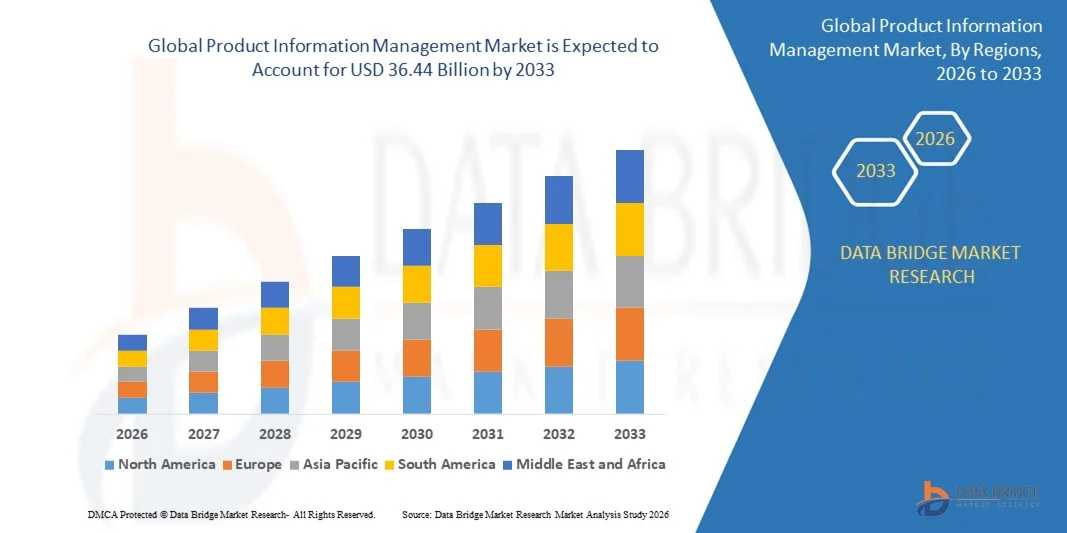
- The global product information management market size was valued at USD 15.25 billion in 2025 and is expected to reach USD 36.44 billion by 2033, at a CAGR of 11.50% during the forecast period
- The market growth is largely fuelled by the rising need for centralized product data management, increasing adoption of e-commerce and omnichannel retail strategies, and growing emphasis on improving customer experience
- Rapid digital transformation across industries and the demand for real-time, accurate product information for decision-making and marketing campaigns are further driving market expansion
Product Information Management Market Analysis
- The market is witnessing strong growth due to the need for accurate, consistent, and easily accessible product data across multiple sales channels, helping organizations improve operational efficiency and reduce errors
- Increasing demand for personalized customer experiences, data governance, and regulatory compliance is encouraging enterprises to adopt PIM solutions, driving market adoption across retail, manufacturing, and distribution sectors
- North America dominated the global product information management market with the largest revenue share of 39.7% in 2025, driven by the increasing adoption of e-commerce platforms, the need for accurate product data management, and the rising demand for omnichannel customer experiences
- Asia-Pacific region is expected to witness the highest growth rate in the global product information management market, driven by rising digital transformation initiatives, increasing urbanization, and growing investments in cloud-based PIM solutions across key countries such as China, Japan, and India
- The solutions segment held the largest market revenue share in 2025 driven by the increasing adoption of PIM platforms to centralize, manage, and distribute product data efficiently across multiple channels. Solutions often offer integrated features such as data enrichment, workflow management, and analytics, making them a preferred choice for enterprises aiming to improve product data quality and consistency
Report Scope and Product Information Management Market Segmentation
|
Attributes |
Product Information Management Key Market Insights |
|
Segments Covered |
|
|
Countries Covered |
North America
Europe
Asia-Pacific
Middle East and Africa
South America
|
|
Key Market Players |
|
|
Market Opportunities |
|
|
Value Added Data Infosets |
In addition to the market insights such as market value, growth rate, market segments, geographical coverage, market players, and market scenario, the market report curated by the Data Bridge Market Research team includes in-depth expert analysis, import/export analysis, pricing analysis, production consumption analysis, and pestle analysis. |
Product Information Management Market Trends
Rising Demand For Centralized Product Data And Omnichannel Strategies
- The increasing need for accurate, consistent, and centralized product information is significantly shaping the product information management market, as businesses aim to improve operational efficiency and reduce errors across multiple channels. PIM solutions are gaining traction due to their ability to streamline product data, enhance customer experience, and support omnichannel retail strategies. This trend strengthens their adoption across e-commerce, retail, and manufacturing sectors, encouraging companies to innovate with advanced PIM platforms
- Growing awareness around the importance of high-quality product data, regulatory compliance, and personalized customer experiences has accelerated the demand for PIM systems in retail, distribution, and manufacturing. Companies are actively seeking solutions that consolidate data from multiple sources, enabling better decision-making and consistent product presentation across all sales channels
- Digital transformation trends and the integration of AI, machine learning, and cloud-based solutions are influencing purchasing decisions, with organizations emphasizing automated data management, analytics capabilities, and scalability. These factors help businesses differentiate in competitive markets and improve operational efficiency while driving adoption of advanced PIM platforms
- For instance, in 2024, Shopify in Canada and SAP in Germany expanded their PIM offerings by incorporating AI-driven data enrichment and analytics features. These launches were introduced in response to increasing enterprise demand for centralized, real-time product information across e-commerce and retail channels. The products were marketed as solutions for operational efficiency, enhanced data accuracy, and improved customer experience
- While demand for PIM solutions is growing, sustained market expansion depends on continuous R&D, integration capabilities, and providing seamless scalability for enterprises of all sizes. Vendors are also focusing on enhancing security, data governance, and advanced analytics to support broader adoption
Product Information Management Market Dynamics
Driver
Growing Need For Centralized Product Data And Omnichannel Retail
- Rising demand for accurate, consistent, and real-time product information is a major driver for the PIM market. Companies are increasingly adopting PIM solutions to improve operational efficiency, reduce errors, and support omnichannel retail strategies. This trend also encourages investment in AI-enabled and cloud-based PIM platforms, supporting digital transformation across industries
- Expanding applications across e-commerce, retail, manufacturing, and distribution sectors are influencing market growth. PIM solutions help enhance data accuracy, enrich product content, and provide seamless integration across sales channels, enabling organizations to meet customer expectations for consistent, high-quality product information
- Vendors are actively promoting PIM-based solutions through product innovation, marketing campaigns, and partnerships with e-commerce and retail platforms. These efforts are supported by growing enterprise demand for automated data management, personalized customer experiences, and regulatory compliance, while also encouraging collaborations between PIM providers and businesses to optimize workflows
- For instance, in 2023, Akeneo in France and InRiver in Sweden reported increased adoption of their PIM solutions among retail and manufacturing clients. This expansion followed growing enterprise demand for centralized, real-time product data, driving operational efficiency and omnichannel consistency. Both companies emphasized integration with ERP and e-commerce systems to strengthen client value propositions
- Although rising demand for centralized data and omnichannel capabilities supports growth, wider adoption depends on cost optimization, data integration, and scalable cloud-based deployment. Investment in AI, machine learning, and analytics-driven PIM platforms will be critical for meeting global demand and maintaining competitive advantage
Restraint/Challenge
High Implementation Costs And Integration Complexity
- The relatively high cost of PIM solutions, along with complex integration requirements with existing ERP, CRM, and e-commerce systems, remains a key challenge, limiting adoption among small and medium-sized enterprises. Implementation costs, software licensing fees, and customization requirements contribute to elevated pricing
- Awareness and understanding of PIM benefits remain uneven across regions, particularly in emerging markets where digital transformation is still nascent. Limited knowledge of functional advantages restricts adoption across certain industries
- Integration, data migration, and change management challenges also impact market growth, as enterprises require robust IT infrastructure, skilled personnel, and adherence to security and compliance standards. Complexity in consolidating heterogeneous product data can increase implementation timelines and operational costs
- For instance, in 2024, SMEs in Southeast Asia and Latin America reported slower uptake of PIM solutions due to high costs, complex integration with existing systems, and limited awareness of functional benefits. These factors also led to reduced vendor selection options and delayed project timelines
- Overcoming these challenges will require cost-efficient solutions, cloud-based deployment models, and educational initiatives for enterprises. Collaboration with system integrators, technology consultants, and PIM vendors can help unlock the long-term growth potential of the global product information management market. Furthermore, developing scalable, AI-enabled, and integration-friendly platforms will be essential for widespread adoption
Product Information Management Market Scope
The market is segmented on the basis of component, deployment type, organization size, and vertical
- By Component
On the basis of component, the global product information management market is segmented into solutions and services. The solutions segment held the largest market revenue share in 2025 driven by the increasing adoption of PIM platforms to centralize, manage, and distribute product data efficiently across multiple channels. Solutions often offer integrated features such as data enrichment, workflow management, and analytics, making them a preferred choice for enterprises aiming to improve product data quality and consistency.
The services segment is expected to witness the fastest growth rate from 2026 to 2033, driven by the rising demand for consulting, implementation, and managed services that support the deployment and optimization of PIM systems. Services are particularly popular among organizations seeking expert guidance to streamline product information workflows and accelerate time-to-market.
- By Deployment Type
On the basis of deployment type, the market is segmented into on-premises and cloud. The cloud segment held the largest revenue share in 2025, attributed to the increasing adoption of cloud-based PIM solutions that provide scalability, remote accessibility, and lower upfront costs. Cloud deployments enable seamless integration with e-commerce platforms and ERP systems, enhancing operational efficiency.
The on-premises segment is expected to register significant growth from 2026 to 2033 due to the preference of large organizations for enhanced data control, customization, and compliance with internal IT policies. On-premises solutions offer robust security features and allow enterprises to maintain complete ownership of their product data.
- By Organization Size
On the basis of organization size, the market is categorized into large enterprises and small and medium-sized enterprises (SMEs). The large enterprises segment held the largest market share in 2025 owing to its extensive product portfolios and the need for centralized management of complex product information across global operations.
The SMEs segment is expected to witness the fastest growth rate from 2026 to 2033, driven by the growing awareness among smaller businesses about the benefits of PIM solutions in enhancing product data accuracy, supporting omnichannel strategies, and improving customer experience.
- By Vertical
On the basis of vertical, the market is segmented into BFSI, consumer goods and retail, manufacturing, IT and telecom, transportation and logistics, media and entertainment, and others. The consumer goods and retail segment held the largest market revenue share in 2025 due to the high demand for accurate and enriched product information to support e-commerce growth and omnichannel strategies.
The manufacturing segment is expected to witness the fastest growth rate from 2026 to 2033, driven by the increasing adoption of PIM solutions to manage complex product catalogs, regulatory compliance data, and supply chain information across multiple markets.
Product Information Management Market Regional Analysis
- North America dominated the global product information management market with the largest revenue share of 39.7% in 2025, driven by the increasing adoption of e-commerce platforms, the need for accurate product data management, and the rising demand for omnichannel customer experiences
- Enterprises in the region prioritize the centralization of product information to enhance data accuracy, streamline operations, and support faster time-to-market for products
- This widespread adoption is further supported by high digital maturity, advanced IT infrastructure, and the growing focus on data governance, positioning PIM solutions as a critical tool for both large enterprises and SMEs
U.S. Product Information Management Market Insight
The U.S. product information management market captured the largest revenue share in 2025 within North America, fueled by the rapid adoption of digital commerce and increasing complexity of product catalogs. Companies are increasingly leveraging PIM solutions to improve product content quality, ensure consistency across multiple sales channels, and enhance customer experiences. The growing focus on AI-powered enrichment, integration with ERP and e-commerce platforms, and cloud-based PIM solutions is further driving market expansion.
Europe Product Information Management Market Insight
The Europe product information management market is expected to witness the fastest growth rate from 2026 to 2033, primarily driven by stringent regulatory requirements, the rise of digital retail, and the demand for accurate product information in manufacturing and retail sectors. European businesses are adopting PIM solutions to optimize workflows, support omnichannel strategies, and enhance operational efficiency. The market is witnessing strong growth across BFSI, consumer goods, and manufacturing verticals.
U.K. Product Information Management Market Insight
The U.K. product information management market is expected to witness the fastest growth rate from 2026 to 2033, driven by the increasing need for streamlined product data management and enhanced customer experiences. The rising adoption of e-commerce platforms, digital marketing, and omnichannel retail strategies is encouraging businesses to invest in PIM solutions. The U.K.’s strong IT infrastructure and advanced retail ecosystem are expected to continue supporting market growth.
Germany Product Information Management Market Insight
The Germany product information management market is expected to witness the fastest growth rate from 2026 to 2033, fueled by growing awareness of data quality, digitalization initiatives, and the need for compliance with industry regulations. Germany’s emphasis on technological innovation and operational efficiency is promoting the adoption of PIM solutions in manufacturing, retail, and logistics. Integration with ERP, CRM, and e-commerce systems is becoming increasingly important to meet local business demands.
Asia-Pacific Product Information Management Market Insight
The Asia-Pacific product information management market is expected to witness the fastest growth rate from 2026 to 2033, driven by increasing digitalization, rapid urbanization, and growing e-commerce adoption in countries such as China, Japan, and India. Businesses in the region are leveraging PIM solutions to manage complex product catalogs, enhance omnichannel experiences, and improve operational efficiency. Government initiatives supporting digital transformation and the rise of SMEs are also contributing to market growth.
Japan Product Information Management Market Insight
The Japan product information management market is expected to witness the fastest growth rate from 2026 to 2033, due to the country’s advanced digital infrastructure, high e-commerce penetration, and focus on operational efficiency. Japanese companies are increasingly using PIM solutions to centralize product data, enhance accuracy, and integrate with IoT and connected systems. The growing demand for automation and AI-powered content enrichment is driving adoption across manufacturing and retail sectors.
China Product Information Management Market Insight
The China product information management market accounted for the largest market revenue share in Asia-Pacific in 2025, attributed to the rapid expansion of e-commerce, the growing middle class, and the increasing complexity of product information across industries. Companies are investing in PIM solutions to support omnichannel strategies, ensure accurate product content, and improve customer experiences. The rise of domestic PIM solution providers and government initiatives promoting digitalization are key factors propelling the market in China.
Product Information Management Market Share
The Product Information Management industry is primarily led by well-established companies, including:
IBM Corporation (U.S.)
• Informatica (U.S.)
• .inriver (Sweden)
• Oracle (U.S.)
• Riversand (U.S.)
• SAP (Germany)
• Stibo Systems (Denmark)
• Contentserv (Switzerland)
• Mobius (U.K.)
• Perfion (Denmark)
• Profisee (U.S.)
• Censhare (Germany)
• Vinculum (India)
Latest Developments in Global Product Information Management Market
- In November 2022, Propel Software launched a product information management (PIM) solution aimed at providing accurate and customized product information across all sales channels. The solution connects manufacturing and marketing teams through a centralized and reliable product database, enabling faster new product launches and helping businesses capitalize on emerging market opportunities. This development enhances operational efficiency, ensures data consistency, and strengthens the market presence of companies adopting the solution
- In April 2023, Image Relay introduced Marketing Delivery, a cloud-based solution combining digital asset management (DAM) and product information management (PIM) capabilities. The platform allows organizations to organize, link, manage, and distribute all product information and digital assets seamlessly and accurately. By improving workflow efficiency, reducing time-to-market, and enhancing data accuracy, this solution is expected to boost adoption of integrated PIM-DAM systems and drive growth in the global product information management market
SKU-
Get online access to the report on the World's First Market Intelligence Cloud

- Interactive Data Analysis Dashboard
- Company Analysis Dashboard for high growth potential opportunities
- Research Analyst Access for customization & queries
- Competitor Analysis with Interactive dashboard
- Latest News, Updates & Trend analysis
- Harness the Power of Benchmark Analysis for Comprehensive Competitor Tracking
Research Methodology
Data collection and base year analysis are done using data collection modules with large sample sizes. The stage includes obtaining market information or related data through various sources and strategies. It includes examining and planning all the data acquired from the past in advance. It likewise envelops the examination of information inconsistencies seen across different information sources. The market data is analysed and estimated using market statistical and coherent models. Also, market share analysis and key trend analysis are the major success factors in the market report. To know more, please request an analyst call or drop down your inquiry.
The key research methodology used by DBMR research team is data triangulation which involves data mining, analysis of the impact of data variables on the market and primary (industry expert) validation. Data models include Vendor Positioning Grid, Market Time Line Analysis, Market Overview and Guide, Company Positioning Grid, Patent Analysis, Pricing Analysis, Company Market Share Analysis, Standards of Measurement, Global versus Regional and Vendor Share Analysis. To know more about the research methodology, drop in an inquiry to speak to our industry experts.
Customization Available
Data Bridge Market Research is a leader in advanced formative research. We take pride in servicing our existing and new customers with data and analysis that match and suits their goal. The report can be customized to include price trend analysis of target brands understanding the market for additional countries (ask for the list of countries), clinical trial results data, literature review, refurbished market and product base analysis. Market analysis of target competitors can be analyzed from technology-based analysis to market portfolio strategies. We can add as many competitors that you require data about in the format and data style you are looking for. Our team of analysts can also provide you data in crude raw excel files pivot tables (Fact book) or can assist you in creating presentations from the data sets available in the report.