


Global Proximity And Displacement Sensor Market
Market Size in USD Billion
CAGR :
% 
 USD
6.38 Billion
USD
12.81 Billion
2025
2033
USD
6.38 Billion
USD
12.81 Billion
2025
2033
 Forecast Period Forecast Period |
2026 –2033 |
 Market Size (Base Year) Market Size (Base Year) |
USD 6.38 Billion |
 Market Size (Forecast Year) Market Size (Forecast Year) |
USD 12.81 Billion |
 CAGR CAGR |
% |
| Major Markets Players |
|
Proximity and Displacement Sensor Market Size
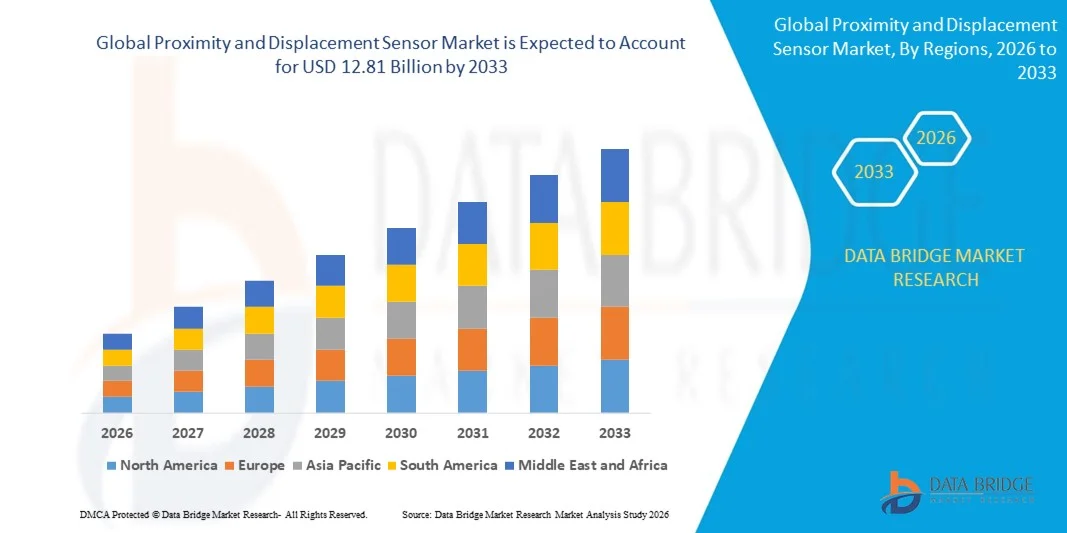
- The global proximity and displacement sensor market size was valued at USD 6.38 billion in 2025 and is expected to reach USD 12.81 billion by 2033, at a CAGR of 9.10% during the forecast period
- The market growth is largely fuelled by the increasing adoption of automation across industrial sectors, rising demand for precise position and motion detection, and the growing integration of sensors in consumer electronics and automotive applications
- In addition, advancements in sensor technologies, such as miniaturization, higher sensitivity, and IoT compatibility, are supporting wider deployment across robotics, manufacturing, and smart devices
Proximity and Displacement Sensor Market Analysis
- The market is witnessing strong growth due to the rising use of automation in manufacturing, automotive, aerospace, and consumer electronics industries
- Increasing demand for contactless measurement, accurate position detection, and enhanced operational safety is propelling the adoption of advanced proximity and displacement sensors
- North America dominated the proximity and displacement sensor market with the largest revenue share in 2025, driven by the widespread adoption of automation, robotics, and advanced industrial monitoring systems.
- Asia-Pacific region is expected to witness the highest growth rate in the global proximity and displacement sensor market, driven by rising demand for automotive safety systems, smart devices, and increasing industrial automation across emerging economies
- Inductive sensors held the largest market revenue share in 2025, driven by their robust performance, reliability in harsh industrial environments, and widespread use in automation and manufacturing processes. These sensors are preferred for position detection, object sensing, and speed monitoring, making them a popular choice across diverse industrial applications
Report Scope and Proximity and Displacement Sensor Market Segmentation
|
Attributes |
Proximity and Displacement Sensor Key Market Insights |
|
Segments Covered |
|
|
Countries Covered |
North America
Europe
Asia-Pacific
Middle East and Africa
South America
|
|
Key Market Players |
|
|
Market Opportunities |
|
|
Value Added Data Infosets |
In addition to the insights on market scenarios such as market value, growth rate, segmentation, geographical coverage, and major players, the market reports curated by the Data Bridge Market Research also include in-depth expert analysis, geographically represented company-wise production and capacity, network layouts of distributors and partners, detailed and updated price trend analysis and deficit analysis of supply chain and demand. |
Proximity and Displacement Sensor Market Trends
Rising Demand for High-Precision and Smart Sensing Solutions
- Growing industrial automation and the adoption of smart manufacturing processes are significantly shaping the proximity and displacement sensor market. End users increasingly prefer sensors that deliver high accuracy, fast response times, and reliable performance for automation, robotics, and precision machinery applications. This trend is driving sensor manufacturers to innovate and offer solutions that cater to evolving industrial and consumer electronics needs
- Increasing use of proximity and displacement sensors in automotive, consumer electronics, and healthcare sectors is accelerating market growth. Sensors are widely deployed for position detection, object monitoring, and safety applications, enhancing operational efficiency and product functionality. Collaborations between sensor manufacturers and OEMs are supporting advanced applications and improving integration across multiple platforms
- Rising emphasis on smart factories and Industry 4.0 is influencing purchasing decisions, with companies prioritizing sensors that enable predictive maintenance, process optimization, and energy efficiency. The integration of IoT-enabled sensors with data analytics platforms is further encouraging adoption, providing real-time insights for operational improvements
- For instance, in 2024, key sensor manufacturers in Germany and the U.S. introduced enhanced proximity and displacement sensor solutions for industrial automation and automotive applications. These products were marketed for their high-precision performance, compact form factor, and IoT compatibility, driving adoption across manufacturing plants and automotive assembly lines
- Sustained market growth depends on continuous R&D, miniaturization, and the development of cost-effective, energy-efficient sensors. Companies are also focusing on improving integration capabilities, ruggedness, and adaptability for diverse industrial and consumer applications, supporting broader adoption across regions
Proximity and Displacement Sensor Market Dynamics
Driver
Rising Demand for Smart, High-Precision Sensing Solutions
- Increasing industrial automation and robotics adoption is a major driver for the proximity and displacement sensor market. Manufacturers are seeking high-accuracy sensors for position monitoring, object detection, and process control, which enhance operational efficiency and safety
- Expanding applications in automotive systems, consumer electronics, and healthcare devices are positively influencing market growth. Sensors provide reliable measurements for motion control, collision avoidance, and medical equipment, supporting innovation and product differentiation
- Companies are actively promoting sensor-based solutions through partnerships, product innovation, and integration with IoT and AI platforms. These efforts align with growing industrial digitalization trends, enabling predictive maintenance and optimized operations
- For instance, in 2023, sensor suppliers in Japan and the U.S. reported increased adoption of proximity and displacement sensors in automated manufacturing lines and advanced automotive systems. The deployment followed rising demand for precision, real-time monitoring, and intelligent sensing solutions, contributing to operational efficiency and competitive advantage
- Wider adoption depends on cost optimization, scalability, and ensuring reliable performance under challenging conditions. Investment in R&D, miniaturization, and smart connectivity will be critical to meet the growing global demand for high-precision sensors
Restraint/Challenge
High Cost And Integration Complexity Compared To Conventional Sensors
- The relatively higher cost of proximity and displacement sensors compared to conventional mechanical or basic electronic sensors limits adoption among price-sensitive manufacturers. Advanced sensor technologies often require specialized materials and production processes, contributing to elevated pricing
- Limited awareness of sensor capabilities and integration requirements in emerging markets restricts adoption. Manufacturers may face challenges in selecting appropriate sensors for specific industrial applications, leading to slower uptake
- Integration complexities with existing systems and the need for calibration and maintenance impact market growth. Sensors must be compatible with control systems and industrial protocols, which may increase installation and operational costs
- For instance, in 2024, distributors in India and Southeast Asia supplying industrial automation and automotive clients reported slower adoption due to high costs, limited technical expertise, and integration challenges. These barriers affected market penetration and delayed implementation in some projects
- Overcoming these challenges will require cost-effective production, simplified integration solutions, and targeted training programs for end users. Collaborations with system integrators, OEMs, and industrial technology providers can unlock long-term growth potential. In addition, developing compact, energy-efficient, and versatile sensors will support broader adoption across multiple industries
Proximity and Displacement Sensor Market Scope
The proximity and displacement sensor market is segmented on the basis of type, application, and end-users.
- By Type
On the basis of type, the market is segmented into inductive sensors, photoelectric sensors, capacitive sensors, ultrasonic sensors, magnetic sensors, and LVDT sensors. Inductive sensors held the largest market revenue share in 2025, driven by their robust performance, reliability in harsh industrial environments, and widespread use in automation and manufacturing processes. These sensors are preferred for position detection, object sensing, and speed monitoring, making them a popular choice across diverse industrial applications.
The ultrasonic sensor segment is expected to witness the fastest growth rate from 2026 to 2033, driven by its high accuracy, non-contact sensing capability, and suitability for applications requiring long-range detection. Ultrasonic sensors are increasingly deployed in automotive parking systems, conveyor systems, and industrial automation, where precision and safety are critical, supporting rapid adoption across multiple sectors.
- By Application
On the basis of application, the market is segmented into parking sensor systems, ground proximity warning systems, vibration monitoring systems, anti-aircraft warfare, roller coasters, conveyor systems, mobile devices, and line testing. Parking sensor systems held a significant market share in 2025 due to the growing demand for vehicle safety features and smart automotive technologies.
Vibration monitoring systems is expected to witness the fastest growth rate from 2026 to 2033, driven by the rising need for predictive maintenance in manufacturing, energy, and aerospace sectors. These systems help reduce downtime, optimize equipment performance, and ensure operational efficiency, making them increasingly valuable for industrial applications.
- By End-Users
On the basis of end-users, the market is segmented into automotive, pharmaceuticals, food and beverage, pulp and paper, elevators and escalators, manufacturing, and metals and mining. The automotive sector held the largest share in 2025, fueled by growing adoption of parking sensors, collision avoidance systems, and advanced driver-assistance systems (ADAS) that rely on proximity and displacement sensing technologies.
The manufacturing sector is expected to witness the fastest growth rate from 2026 to 2033, driven by increasing automation, robotics deployment, and Industry 4.0 initiatives. Proximity and displacement sensors are critical for precision control, quality assurance, and operational safety in manufacturing lines, boosting demand for advanced sensor solutions.
Proximity and Displacement Sensor Market Regional Analysis
- North America dominated the proximity and displacement sensor market with the largest revenue share in 2025, driven by the widespread adoption of automation, robotics, and advanced industrial monitoring systems.
- Consumers and industries in the region highly value high-precision sensing, reliability in harsh environments, and integration with industrial IoT and predictive maintenance platforms.
- This adoption is further supported by advanced manufacturing infrastructure, high industrial spending, and a focus on operational efficiency, establishing proximity and displacement sensors as essential components across automotive, manufacturing, and aerospace sectors.
U.S. Proximity and Displacement Sensor Market Insight
The U.S. proximity and displacement sensor market captured the largest revenue share in 2025 within North America, fueled by increased deployment in automotive safety systems, industrial automation, and consumer electronics. Growing investment in smart manufacturing, robotics, and Industry 4.0 initiatives is driving demand for high-precision sensors. The integration of these sensors with connected devices and predictive maintenance platforms is further boosting operational efficiency and reducing downtime, enhancing market growth.
Europe Proximity and Displacement Sensor Market Insight
The Europe proximity and displacement sensor market is expected to witness the fastest growth rate from 2026 to 2033, driven by rising adoption of smart factory solutions, stringent industrial safety regulations, and advancements in automation technologies. The demand for accurate and reliable sensors in automotive, manufacturing, and aerospace sectors is increasing, supporting growth across industrial and commercial applications.
U.K. Proximity and Displacement Sensor Market Insight
The U.K. proximity and displacement sensor market is expected to witness significant growth from 2026 to 2033, fueled by the increasing adoption of Industry 4.0 practices, automotive safety systems, and advanced manufacturing technologies. The integration of these sensors in robotics and automated production lines is enhancing efficiency and productivity, encouraging wider implementation across industries.
Germany Proximity and Displacement Sensor Market Insight
The Germany proximity and displacement sensor market is expected to witness the fastest growth rate from 2026 to 2033, driven by the country’s advanced automotive industry, industrial automation adoption, and increasing focus on predictive maintenance. High demand for precision, reliability, and integration with industrial IoT systems is further supporting market expansion.
Asia-Pacific Proximity and Displacement Sensor Market Insight
The Asia-Pacific proximity and displacement sensor market is expected to witness the highest growth rate from 2026 to 2033, driven by rapid industrialization, urbanization, and rising demand for automation in countries such as China, Japan, and India. Growth in automotive production, consumer electronics, and industrial manufacturing, combined with government initiatives promoting smart factories, is expanding the adoption of advanced sensing solutions.
Japan Proximity and Displacement Sensor Market Insight
The Japan proximity and displacement sensor market is expected to witness the fastest growth rate from 2026 to 2033 due to the country’s high focus on automotive safety, robotics, and precision manufacturing. The integration of sensors into smart devices, automated production lines, and predictive maintenance systems is fueling growth in both industrial and consumer applications.
China Proximity and Displacement Sensor Market Insight
The China proximity and displacement sensor market accounted for the largest market revenue share in Asia-Pacific in 2025, attributed to rapid industrialization, growing automotive production, and adoption of smart manufacturing technologies. The country’s push toward Industry 4.0 and rising demand for precision sensing in industrial, automotive, and consumer electronics sectors are key factors propelling market growth.
Proximity and Displacement Sensor Market Share
The Proximity and Displacement Sensor industry is primarily led by well-established companies, including:
- Delta Electronics, Inc. (U.S.)
- Datalogic S.p.A. (Italy)
- STMicroelectronics (Switzerland)
- OMRON Corporation (Japan)
- Rockwell Automation, Inc. (U.S.)
- Schneider Electric (France)
- Pepperl+Fuchs SE (Germany)
- Honeywell International Inc. (U.S.)
- Panasonic Corporation (Japan)
- SICK AG (Germany)
- Baumer Holding AG (Switzerland)
- Contrinex AG (Switzerland)
- Autonics Corporation (South Korea)
- Broadcom (U.S.)
- Semtech Corporation (U.S.)
- Infineon Technologies AG (Germany)
- Balluff Automation India Pvt. Ltd. (India)
- Hans Turck GmbH & Co. KG (Germany)
- Fargo Controls Inc. (U.S.)
- Eaton (U.S.)
Latest Developments in Global Proximity and Displacement Sensor Market
- In March 2024, Honeywell International Inc. (U.S.) executed a strategic acquisition by launching a voluntary tender offer for all outstanding Civitanavi Systems shares. This move is aimed at expanding Honeywell’s capabilities in advanced sensing and automation solutions, enhancing its product portfolio, and strengthening its presence in the industrial and aerospace sensor market. The acquisition is expected to drive synergies, improve technological integration, and support long-term growth by offering more comprehensive solutions to global customers
- In January 2024, Panasonic Corporation (Japan) launched the LUMIX S-E100, a medium-telephoto macro lens featuring a Dual Phase linear motor, advanced optical design, and an ultra-high-precision manual focus sensor. This development enables high-resolution imaging and precise autofocus, benefiting professional photographers and industrial imaging applications. The introduction of this lens strengthens Panasonic’s competitive position in the imaging and sensor market and supports growth in precision optical technologies
SKU-
Get online access to the report on the World's First Market Intelligence Cloud

- Interactive Data Analysis Dashboard
- Company Analysis Dashboard for high growth potential opportunities
- Research Analyst Access for customization & queries
- Competitor Analysis with Interactive dashboard
- Latest News, Updates & Trend analysis
- Harness the Power of Benchmark Analysis for Comprehensive Competitor Tracking
Global Proximity And Displacement Sensor Market, Supply Chain Analysis and Ecosystem Framework
To support market growth and help clients navigate the impact of geopolitical shifts, DBMR has integrated in-depth supply chain analysis into its Global Proximity And Displacement Sensor Market research reports. This addition empowers clients to respond effectively to global changes affecting their industries. The supply chain analysis section includes detailed insights such as Global Proximity And Displacement Sensor Market consumption and production by country, price trend analysis, the impact of tariffs and geopolitical developments, and import and export trends by country and HSN code. It also highlights major suppliers with data on production capacity and company profiles, as well as key importers and exporters. In addition to research, DBMR offers specialized supply chain consulting services backed by over a decade of experience, providing solutions like supplier discovery, supplier risk assessment, price trend analysis, impact evaluation of inflation and trade route changes, and comprehensive market trend analysis.
Research Methodology
Data collection and base year analysis are done using data collection modules with large sample sizes. The stage includes obtaining market information or related data through various sources and strategies. It includes examining and planning all the data acquired from the past in advance. It likewise envelops the examination of information inconsistencies seen across different information sources. The market data is analysed and estimated using market statistical and coherent models. Also, market share analysis and key trend analysis are the major success factors in the market report. To know more, please request an analyst call or drop down your inquiry.
The key research methodology used by DBMR research team is data triangulation which involves data mining, analysis of the impact of data variables on the market and primary (industry expert) validation. Data models include Vendor Positioning Grid, Market Time Line Analysis, Market Overview and Guide, Company Positioning Grid, Patent Analysis, Pricing Analysis, Company Market Share Analysis, Standards of Measurement, Global versus Regional and Vendor Share Analysis. To know more about the research methodology, drop in an inquiry to speak to our industry experts.
Customization Available
Data Bridge Market Research is a leader in advanced formative research. We take pride in servicing our existing and new customers with data and analysis that match and suits their goal. The report can be customized to include price trend analysis of target brands understanding the market for additional countries (ask for the list of countries), clinical trial results data, literature review, refurbished market and product base analysis. Market analysis of target competitors can be analyzed from technology-based analysis to market portfolio strategies. We can add as many competitors that you require data about in the format and data style you are looking for. Our team of analysts can also provide you data in crude raw excel files pivot tables (Fact book) or can assist you in creating presentations from the data sets available in the report.












