




Global Queue Management System Market
Market Size in USD Million
CAGR :
% 
 USD
670.99 Million
USD
1,069.45 Million
2025
2033
USD
670.99 Million
USD
1,069.45 Million
2025
2033
 Forecast Period Forecast Period |
2026 –2033 |
 Market Size (Base Year) Market Size (Base Year) |
USD 670.99 Million |
 Market Size (Forecast Year) Market Size (Forecast Year) |
USD 1,069.45 Million |
 CAGR CAGR |
% |
| Major Markets Players |
|
Queue Management System Market Size
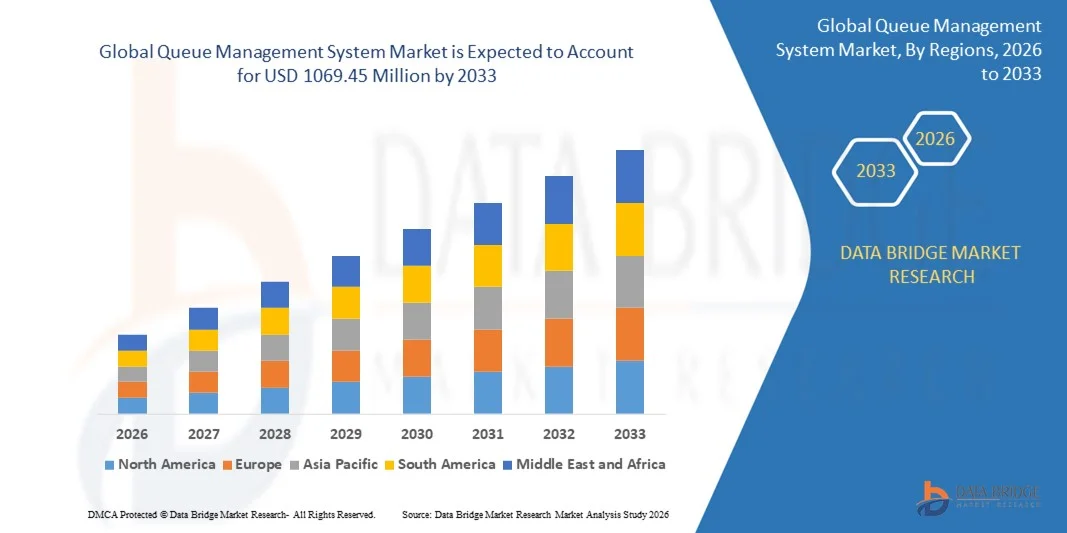
- The global queue management system market size was valued at USD 670.99 million in 2025 and is expected to reach USD 1069.45 million by 2033, at a CAGR of 6.00% during the forecast period
- The market growth is largely fueled by the increasing adoption of digital customer service solutions and technological advancements in queue management platforms, enabling organizations to optimize customer flow and operational efficiency across sectors such as healthcare, BFSI, retail, and government services
- Furthermore, rising consumer and business demand for seamless, user-friendly, and data-driven queue management solutions is establishing QMS as an essential tool for enhancing service delivery, reducing wait times, and improving overall customer experience. These converging factors are accelerating the adoption of queue management systems, thereby significantly boosting the industry’s growth
Queue Management System Market Analysis
- Queue management systems, providing structured and virtual queuing solutions for customers in high-traffic environments, are increasingly vital for modern businesses due to their ability to streamline operations, monitor service performance, and integrate with mobile and cloud platforms
- The escalating demand for QMS is primarily driven by the need to enhance customer satisfaction, reduce physical congestion, and enable data-driven insights for better resource allocation, with organizations across healthcare, banking, retail, and public services seeking efficient and scalable solutions
- North America dominated the queue management system market with a share of 36.45% in 2025, due to the growing adoption of digital customer service solutions and increasing focus on enhancing customer experience across sectors such as healthcare, BFSI, and retail
- Asia-Pacific is expected to be the fastest growing region in the queue management system market during the forecast period due to rapid urbanization, rising digital adoption, and increased focus on enhancing customer experiences in countries such as China, Japan, and India
- Solutions segment dominated the market with a market share of 63% in 2025, due to the widespread adoption of comprehensive queue management platforms that include software, hardware, and analytics modules. Organizations prefer end-to-end solutions as they provide real-time insights into customer flow, reduce waiting times, and enable informed decision-making for resource allocation
Report Scope and Queue Management System Market Segmentation
|
Attributes |
Queue Management System Key Market Insights |
|
Segments Covered |
|
|
Countries Covered |
North America
Europe
Asia-Pacific
Middle East and Africa
South America
|
|
Key Market Players |
|
|
Market Opportunities |
|
|
Value Added Data Infosets |
In addition to the market insights such as market value, growth rate, market segments, geographical coverage, market players, and market scenario, the market report curated by the Data Bridge Market Research team includes in-depth expert analysis, import/export analysis, pricing analysis, production consumption analysis, and pestle analysis. |
Queue Management System Market Trends
Rising Adoption of Virtual and Mobile Queuing Solutions
- A significant trend in the queue management system market is the increasing adoption of virtual and mobile queuing solutions, driven by businesses’ focus on minimizing physical crowding and enhancing operational efficiency. This trend is transforming customer interaction by enabling digital appointment booking, real-time queue updates, and contactless service management across sectors such as banking, healthcare, and retail
- For instance, Qmatic and QLess provide mobile queuing and virtual queue management platforms that are widely deployed in hospitals and government service centers to streamline customer flow and reduce waiting times. Such solutions are improving customer satisfaction and enabling staff to allocate resources more effectively
- Retail chains are integrating virtual queuing applications to allow customers to join queues via smartphones, monitor wait times, and receive notifications when their service is ready. This adoption is driving operational optimization and helping retailers manage peak-hour traffic efficiently
- Healthcare providers are increasingly deploying mobile queuing systems to manage patient appointments, reduce overcrowding in waiting areas, and enhance service delivery. This trend is supporting safer and more organized patient experiences while maintaining social distancing norms
- Government and public service institutions are leveraging digital queue management to improve citizen experience and operational transparency. Applications in DMV offices and municipal service centers demonstrate enhanced throughput and reduced in-person congestion
- The hospitality sector is adopting virtual queue solutions for restaurants, hotels, and event venues to enable reservations, digital check-ins, and wait-time monitoring. This integration is creating seamless customer journeys and reinforcing the value of queue management systems in enhancing service quality
Queue Management System Market Dynamics
Driver
Increasing Focus on Enhancing Customer Experience and Operational Efficiency
- The rising demand for improved customer experience and streamlined operations is driving investments in queue management systems that enable efficient service delivery, reduced wait times, and better resource allocation. These systems provide analytics for performance monitoring and operational decision-making
- For instance, Cisco’s queue management solutions help banks and retail outlets optimize service counters and improve customer satisfaction by tracking traffic patterns and queue behavior. The actionable insights offered by these platforms allow businesses to enhance operational efficiency and reduce bottlenecks
- The growing emphasis on personalized customer service is fueling adoption of intelligent queue management platforms capable of analyzing preferences and predicting demand surges. Such platforms are helping organizations deliver tailored experiences and improve service responsiveness
- Enterprises are adopting automated and digital queue solutions to reduce manual intervention, increase staff productivity, and maintain consistent service standards. This focus is aligning with broader organizational goals of efficiency and quality assurance
- The integration of mobile applications and self-service kiosks into queue management processes is expanding the market as businesses seek to reduce human dependency while enhancing convenience. These solutions support smoother operations and provide data-driven insights for continuous improvement
Restraint/Challenge
High Implementation and Integration Costs
- The queue management system market faces challenges due to the high costs associated with implementing advanced digital and virtual queuing solutions, including hardware, software, and staff training requirements. These investments can be substantial, especially for small and medium-sized enterprises
- For instance, companies such as Qmatic and QLess report significant upfront costs for deploying end-to-end queue management solutions that include cloud-based software, kiosks, and mobile integration. Such expenses may slow adoption among budget-conscious organizations and require careful ROI analysis
- Integrating queue management platforms with existing enterprise resource planning and customer relationship management systems can be complex and resource-intensive. This integration challenge increases project timelines and operational disruption during deployment
- Maintenance, software updates, and cybersecurity measures further contribute to ongoing costs, creating budgetary pressures for organizations seeking to modernize their queue systems
- The market continues to encounter obstacles related to balancing technological advancement with cost-effectiveness, which can limit adoption among sectors with constrained budgets and affect overall market growth
Queue Management System Market Scope
The market is segmented on the basis of type, component, deployment mode, and application.
- By Type
On the basis of type, the Queue Management System market is segmented into virtual queuing and linear queuing. The virtual queuing segment dominated the market with the largest market revenue share in 2025, driven by its ability to reduce physical crowding and enhance customer experience in high-traffic environments. Organizations increasingly adopt virtual queuing systems for their flexibility, allowing customers to join queues remotely via mobile apps or kiosks, thereby optimizing service efficiency. The rising focus on contactless interactions, particularly in healthcare and banking sectors, further boosts the demand for virtual queuing systems, making them a preferred choice for enterprises aiming to improve operational efficiency and customer satisfaction.
The linear queuing segment is expected to witness the fastest growth rate from 2026 to 2033, fueled by continued demand in retail and government offices where structured, in-person queues remain necessary. Linear systems provide clear visibility of waiting lines, help manage peak-hour traffic, and are increasingly integrated with digital display boards and token management solutions to enhance user experience. Businesses adopting linear queuing systems benefit from straightforward implementation and scalable deployment, making them suitable for both small and large-scale service environments.
- By Component
On the basis of component, the Queue Management System market is segmented into solutions and services. The solutions segment held the largest market revenue share of 63% in 2025, driven by the widespread adoption of comprehensive queue management platforms that include software, hardware, and analytics modules. Organizations prefer end-to-end solutions as they provide real-time insights into customer flow, reduce waiting times, and enable informed decision-making for resource allocation.
The services segment is expected to witness the fastest growth from 2026 to 2033, fueled by increasing demand for managed services, technical support, and system maintenance contracts. Service offerings ensure smooth operation of QMS platforms, reduce downtime, and help organizations optimize their existing infrastructure without significant upfront investment. Businesses increasingly rely on subscription-based service models for upgrades and integration with other digital solutions, driving the rapid growth of the services segment.
- By Deployment Mode
On the basis of deployment mode, the Queue Management System market is segmented into cloud-based and on-premises solutions. The cloud-based segment dominated the market in 2025 due to its scalability, cost-efficiency, and remote accessibility, enabling organizations to manage queues across multiple locations with centralized control. Cloud-based systems allow real-time monitoring, reporting, and integration with mobile apps, making them particularly attractive for enterprises with geographically dispersed operations.
The on-premises segment is anticipated to witness the fastest growth from 2026 to 2033, driven by organizations requiring enhanced data security and control over sensitive customer information. On-premises deployments appeal to banks, hospitals, and government offices that prioritize compliance with data protection regulations. Businesses adopting on-premises systems benefit from customized configurations, reliable performance, and integration with existing enterprise infrastructure, contributing to the growing adoption of this segment.
- By Application
On the basis of application, the Queue Management System market is segmented into hospitals and clinics, banks and financial institutions, retail outlets, private utility service providers/airline check-in counters, self-service restaurants, government offices, telecom service centers, and others. The hospitals and clinics segment dominated the market in 2025 due to the high volume of patient visits and the critical need to streamline patient flow while minimizing wait times. Healthcare providers increasingly rely on QMS to manage appointment scheduling, reduce overcrowding, and enhance patient satisfaction.
The retail outlets segment is expected to witness the fastest growth from 2026 to 2033, driven by the rising emphasis on improving in-store customer experiences and reducing checkout wait times. Retailers are adopting digital queue management solutions integrated with loyalty programs and mobile apps to enhance engagement and operational efficiency. The growing demand for omnichannel experiences, where physical and digital touchpoints converge, further fuels the rapid expansion of QMS adoption in retail environments.
Queue Management System Market Regional Analysis
- North America dominated the queue management system market with the largest revenue share of 36.45% in 2025, driven by the growing adoption of digital customer service solutions and increasing focus on enhancing customer experience across sectors such as healthcare, BFSI, and retail
- Organizations in the region highly value QMS for reducing wait times, improving service efficiency, and providing data-driven insights for resource allocation
- The widespread adoption is further supported by high technological readiness, strong IT infrastructure, and increasing preference for cloud-based and mobile-accessible solutions, establishing queue management systems as a critical tool for operational excellence
U.S. Queue Management System Market Insight
The U.S. queue management system market captured the largest revenue share within North America in 2025, fueled by rapid digital transformation initiatives and the rising trend of customer-centric service models. Businesses are increasingly prioritizing queue optimization to enhance customer satisfaction and streamline operations. The growing adoption of cloud-based QMS, mobile queue access, and real-time analytics platforms further propels the market. Moreover, integration with digital signage, CRM systems, and mobile notifications is significantly driving market expansion, particularly in healthcare facilities, banks, and large retail outlets.
Europe Queue Management System Market Insight
The Europe queue management system market is projected to grow at a substantial CAGR during the forecast period, primarily driven by increasing investments in smart infrastructure and the need to improve service efficiency across hospitals, government offices, and financial institutions. Urbanization and the proliferation of digital services are fostering the adoption of queue management solutions. European organizations are also drawn to the operational efficiency, enhanced customer experience, and analytics capabilities offered by QMS. Growth is observed across both new infrastructure projects and modernization initiatives in commercial and public service sectors.
U.K. Queue Management System Market Insight
The U.K. queue management system market is expected to grow at a noteworthy CAGR during the forecast period, driven by the rising demand for streamlined service delivery and customer-centric solutions. Businesses and government agencies are increasingly adopting QMS to manage high customer traffic efficiently and reduce wait times. The country’s robust IT ecosystem, increasing preference for mobile-based queue access, and strong retail and healthcare sectors are expected to continue supporting market growth.
Germany Queue Management System Market Insight
The Germany queue management system market is anticipated to expand at a considerable CAGR during the forecast period, fueled by the adoption of digital workflow solutions and the emphasis on operational efficiency in healthcare, banking, and government sectors. Germany’s focus on technological innovation, process optimization, and smart infrastructure is promoting the implementation of queue management systems. Integration of QMS with enterprise software, analytics tools, and mobile applications is also gaining traction, aligning with local preferences for efficiency and precision.
Asia-Pacific Queue Management System Market Insight
The Asia-Pacific queue management system market is poised to grow at the fastest CAGR during the forecast period, driven by rapid urbanization, rising digital adoption, and increased focus on enhancing customer experiences in countries such as China, Japan, and India. Government initiatives promoting smart cities and digital services are supporting the adoption of queue management solutions. Furthermore, the increasing presence of global and regional QMS providers is improving accessibility and affordability, expanding the market to various sectors, including healthcare, BFSI, retail, and transportation.
Japan Queue Management System Market Insight
The Japan queue management system market is gaining momentum due to the country’s advanced technological landscape, high urban population density, and focus on service efficiency. Healthcare, banks, and retail sectors are increasingly adopting QMS to streamline operations and reduce customer wait times. Integration with mobile apps, cloud platforms, and real-time analytics systems is driving adoption. Moreover, Japan’s aging population is likely to increase demand for easy-to-use and accessible queue management solutions in both public and private service environments.
China Queue Management System Market Insight
The China queue management system market accounted for the largest revenue share in Asia-Pacific in 2025, attributed to rapid urbanization, high technological adoption, and increasing emphasis on digital customer service solutions. Hospitals, retail outlets, banks, and transportation hubs are increasingly implementing QMS to enhance operational efficiency and customer experience. The push for smart city initiatives, coupled with the availability of cost-effective solutions from domestic and international providers, is significantly propelling market growth in China.
Queue Management System Market Share
The queue management system industry is primarily led by well-established companies, including:
- Aurionpro Solutions Limited (India)
- Qminder Ltd. (U.K.)
- Seehash Softwares Pvt. Ltd. (India)
- Qmatic (Sweden)
- XIPHIAS Software Technologies (India)
- Lavi Industries (U.S.)
- ATT Systems (S’pore) Pte Ltd. (Singapore)
- E. Oppermann GmbH (Germany)
- AKIS Technologies (Germany)
- Advantech Co., Ltd. (Taiwan)
- Infrared Integrated Systems Limited (U.K.)
- MULTIMEX LTD. (U.K.)
- Skiplino (Bahrain)
- Wavetec (U.A.E.)
- SEDCO (U.A.E.)
- Qnomy Inc. (U.S.)
- Qudini (U.K.)
- QLess, Inc. (U.S.)
- Tensator (U.K.)
Latest Developments in Global Queue Management System Market
- In April 2025, Akamai Technologies partnered with Queue-it under the Akamai Qualified Compute Partner Program to deliver scalable virtual waiting rooms for high-traffic events. This collaboration strengthens the virtual queuing segment by offering enterprises the ability to manage massive online traffic surges efficiently, enhancing user experience and reducing website downtime. The partnership also reinforces the adoption of cloud-based queue management solutions for digital events, positioning both companies as key players in high-demand, real-time queue management
- In October 2024, QLess launched Service Intelligence, an advanced analytics add-on for its Tempo suite designed to deepen insights into employee performance and operational bottlenecks. This development enhances the solutions segment of the QMS market by providing organizations with actionable data to optimize service efficiency and customer flow. By integrating analytics-driven insights, QLess helps businesses make informed decisions to reduce wait times and improve overall operational performance, thereby increasing market reliance on intelligent queue management tools
- In July 2023, Alizz Islamic Bank announced a collaboration with Dubai-based queue management provider SEDCO to implement its Advanced Queue Management Solution. This initiative aims to optimize customer flow and operational efficiency within the bank, highlighting the growing importance of virtual and automated queue solutions in the BFSI sector. The deployment reflects a broader trend in the QMS market toward improving customer experience through technology-driven solutions, especially in high-traffic service environments
- In March 2023, Qmatic Group launched a mobile ticketing feature that allows customers to join a queue via text message. This innovation drives adoption in the mobile-accessible segment of the QMS market by offering convenient, flexible, and contactless queuing options. It demonstrates the market shift toward enhancing customer convenience and operational efficiency while reducing physical waiting line congestion, particularly in retail and service sectors
- In February 2023, Orabank Gabon collaborated with GBM to implement SEDCO’s virtual queue management solutions to reduce customer waiting times and support the opening of new branches. This initiative underscores the critical role of virtual queuing in emerging markets and highlights the expansion of QMS adoption in the banking sector. By streamlining customer flow and enhancing service efficiency, the deployment positions virtual queue solutions as an essential tool for improving operational performance in high-demand environments
SKU-
Get online access to the report on the World's First Market Intelligence Cloud

- Interactive Data Analysis Dashboard
- Company Analysis Dashboard for high growth potential opportunities
- Research Analyst Access for customization & queries
- Competitor Analysis with Interactive dashboard
- Latest News, Updates & Trend analysis
- Harness the Power of Benchmark Analysis for Comprehensive Competitor Tracking
Research Methodology
Data collection and base year analysis are done using data collection modules with large sample sizes. The stage includes obtaining market information or related data through various sources and strategies. It includes examining and planning all the data acquired from the past in advance. It likewise envelops the examination of information inconsistencies seen across different information sources. The market data is analysed and estimated using market statistical and coherent models. Also, market share analysis and key trend analysis are the major success factors in the market report. To know more, please request an analyst call or drop down your inquiry.
The key research methodology used by DBMR research team is data triangulation which involves data mining, analysis of the impact of data variables on the market and primary (industry expert) validation. Data models include Vendor Positioning Grid, Market Time Line Analysis, Market Overview and Guide, Company Positioning Grid, Patent Analysis, Pricing Analysis, Company Market Share Analysis, Standards of Measurement, Global versus Regional and Vendor Share Analysis. To know more about the research methodology, drop in an inquiry to speak to our industry experts.
Customization Available
Data Bridge Market Research is a leader in advanced formative research. We take pride in servicing our existing and new customers with data and analysis that match and suits their goal. The report can be customized to include price trend analysis of target brands understanding the market for additional countries (ask for the list of countries), clinical trial results data, literature review, refurbished market and product base analysis. Market analysis of target competitors can be analyzed from technology-based analysis to market portfolio strategies. We can add as many competitors that you require data about in the format and data style you are looking for. Our team of analysts can also provide you data in crude raw excel files pivot tables (Fact book) or can assist you in creating presentations from the data sets available in the report.












