Global Radio Access Network Market
Market Size in USD Million
CAGR :
% 
 USD
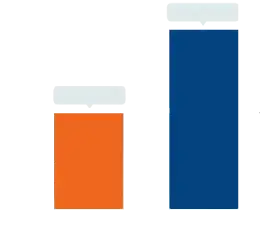
40.20 Million
USD
94.68 Million
2025
2033
USD
40.20 Million
USD
94.68 Million
2025
2033
 Forecast Period Forecast Period |
2026 –2033 |
 Market Size (Base Year) Market Size (Base Year) |
USD 40.20 Million |
 Market Size (Forecast Year) Market Size (Forecast Year) |
USD 94.68 Million |
 CAGR CAGR |
% |
| Major Markets Players |
|
What is the Global Radio Access Network Market Size and Growth Rate?
- The global radio access network market size was valued at USD 40.20 million in 2025and is expected to reach USD 94.68 million by 2033, at a CAGR of 11.30% during the forecast period
- The rising demand of mobile data tariff, increasing acceptance of latest technologies like smart phones, rising mobile data traffic and rising demand for network infrastructure will emerge as the major factor driving market growth
- Furthermore, the rising demand for improved network coverage, rise in the demand for network infrastructure due to internet of things (IoT) and rising development of 5G network will further aggravate the market value
What are the Major Takeaways of Radio Access Network Market?
- The increasing demand for mobile broadband technology, high-speed data transfer rate, and data and information processing to boost the overall growth of the market. However, spectrum crunch and delay in the standardization are projected to act as a restraint for the market
- In addition to this, rising concerns related to fiber backhaul are delay in spectrum allocation are estimated to create new opportunities for growing the market within the forecast period. The rising privacy and security concerns along with common problem with the radio access network issues result as a challenge for the market
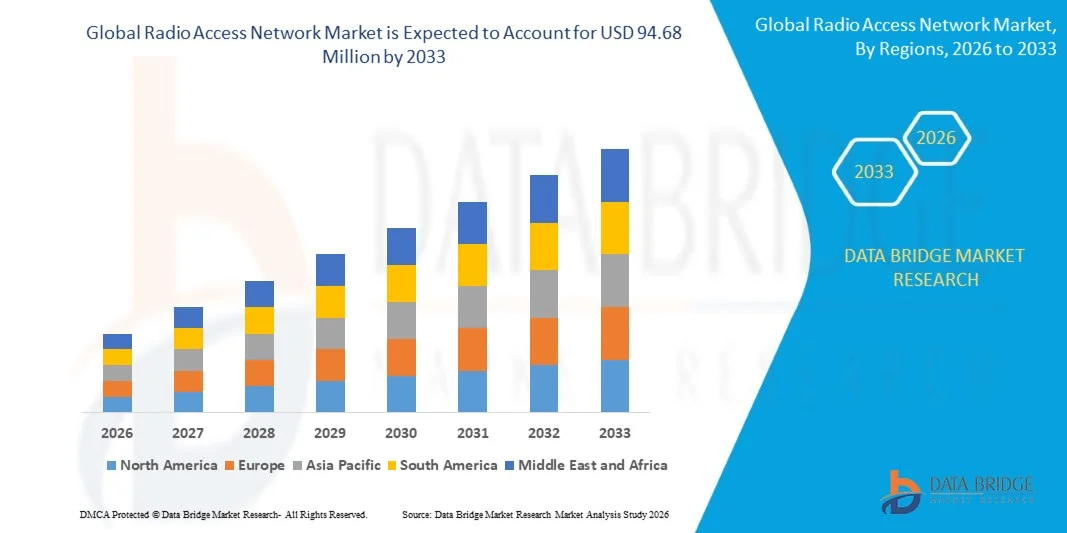
- Asia-Pacific dominated the radio access network market with a 42.23% revenue share in 2025, driven by rapid 5G infrastructure deployment, strong telecom manufacturing ecosystems, increasing mobile data consumption, and large-scale investments in digital connectivity across China, Japan, India, South Korea, and Southeast Asia
- North America is projected to register the fastest CAGR of 9.13% from 2026 to 2033, driven by rapid expansion of Open RAN deployment, private enterprise 5G networks, AI-powered network automation, and cloud-native telecom transformation across the U.S. and Canada
- The Macro Cell segment dominated the market with a 41.8% share in 2025, as it remains the preferred infrastructure for wide-area mobile coverage, high-capacity network deployment, and seamless voice and data connectivity across urban and suburban regions
Report Scope and Radio Access Network Market Segmentation
|
Attributes |
Radio Access Network Key Market Insights |
|
Segments Covered |
|
|
Countries Covered |
North America · U.S. · Canada · Mexico Europe · Germany · France · U.K. · Netherlands · Switzerland · Belgium · Russia · Italy · Spain · Turkey · Rest of Europe Asia-Pacific · China · Japan · India · South Korea · Singapore · Malaysia · Australia · Thailand · Indonesia · Philippines · Rest of Asia-Pacific Middle East and Africa · Saudi Arabia · U.A.E. · South Africa · Egypt · Israel · Rest of Middle East and Africa South America · Brazil · Argentina · Rest of South America |
|
Key Market Players |
· SAMSUNG (South Korea) · Sony Corporation (Japan) · Huawei Technologies Co., Ltd. (China) · Telefonaktiebolaget LM Ericsson (Sweden) · Nokia (Finland) · ZTE Corporation (China) · NEC Technologies India Private Limited (Japan) · Qualcomm Technologies, Inc. (U.S.) · Intel Corporation (U.S.) · FUJITSU (Japan) · Juniper Networks, Inc. (U.S.) · Hewlett Packard Enterprise Development LP (U.S.) · Corning Incorporated (U.S.) · Verizon (U.S.) · Airspan Networks (U.S.) · Qorvo Inc. (U.S.) · LG Electronics (South Korea) · HUBER+SUHNER (Switzerland) |
|
Market Opportunities |
· Rising Demand of Mobile Data Tariff · Increasing Acceptance of Latest Technologies |
|
Value Added Data Infosets |
In addition to the insights on market scenarios such as market value, growth rate, segmentation, geographical coverage, and major players, the market reports curated by the Data Bridge Market Research also include in-depth expert analysis, pricing analysis, brand share analysis, consumer survey, demography analysis, supply chain analysis, value chain analysis, raw material/consumables overview, vendor selection criteria, PESTLE Analysis, Porter Analysis, and regulatory framework. |
What is the Key Trend in the Radio Access Network Market?
“Increasing Shift Toward Open, Virtualized, and Cloud-Native Radio Access Network”
- The radio access network market is witnessing strong adoption of Open RAN, virtualized RAN (vRAN), and cloud-native network architectures designed to support 5G deployments, private wireless networks, edge computing, and ultra-low latency applications
- Network vendors and telecom operators are introducing software-defined, multi-vendor, and AI-enabled RAN solutions that offer advanced network slicing, intelligent traffic management, and interoperability with modern telecom infrastructure
- Growing demand for cost-efficient, scalable, and flexible network infrastructure is driving usage across telecom operators, enterprise private networks, smart cities, and industrial IoT environments
- For instance, companies such as Ericsson, Nokia, Huawei, Samsung, and Qualcomm are expanding advanced RAN solutions with enhanced spectrum efficiency, Massive MIMO support, and cloud-enabled orchestration
- Increasing need for high-speed mobile broadband, low-latency edge connectivity, and massive IoT support is accelerating the shift toward virtualized and software-centric RAN deployments
- As mobile networks become more complex and data-intensive, Radio Access Networks will remain vital for 5G expansion, private wireless ecosystems, and future 6G readiness
What are the Key Drivers of Radio Access Network Market?
- Rising demand for high-speed internet connectivity, low-latency communication, and seamless mobile broadband services is a major growth driver for the market
- For instance, in 2025–2026, leading companies such as Ericsson, Nokia, and Samsung expanded their 5G RAN portfolios to support Open RAN, network slicing, and AI-based optimization
- Growing adoption of 5G smartphones, connected vehicles, industrial automation, smart factories, and IoT ecosystems is boosting demand across the U.S., Europe, and Asia-Pacific
- Advancements in Massive MIMO, beamforming, cloud-native deployment, and AI-driven network management have strengthened performance, scalability, and operational efficiency
- Rising use of edge computing, private 5G networks, and mission-critical enterprise connectivity is creating demand for flexible and high-capacity RAN solutions
- Supported by steady investments in telecom infrastructure, spectrum deployment, and smart city initiatives, the Radio Access Network market is expected to witness strong long-term growth
Which Factor is Challenging the Growth of the Radio Access Network Market?
- High costs associated with 5G infrastructure deployment, spectrum acquisition, and advanced base station equipment restrict adoption among smaller telecom operators and emerging economies
- For instance, during 2024–2026, fluctuations in semiconductor prices, radio component shortages, and fiber backhaul investments increased deployment costs for several global vendors
- Complexity in integrating multi-vendor Open RAN ecosystems, legacy LTE networks, and cloud-native orchestration layers increases the need for skilled telecom engineers and specialized software expertise
- Limited awareness and slower 5G monetization in developing regions continue to slow adoption and large-scale rollout
- Competition from Wi-Fi 6/7, fixed wireless access solutions, and satellite connectivity platforms creates pricing pressure and reduces infrastructure differentiation
- To address these issues, companies are focusing on cost-optimized Open RAN frameworks, AI-led network automation, and cloud-based analytics to increase global adoption of radio access networks
How is the Radio Access Network Market Segmented?
The market is segmented on the basis of communication infrastructure, connectivity technology, and deployment location.
- By Communication Infrastructure
On the basis of communication infrastructure, the radio access network market is segmented into Small Cell, Macro Cell, RAN Equipment, and DAS. The Macro Cell segment dominated the market with a 41.8% share in 2025, as it remains the preferred infrastructure for wide-area mobile coverage, high-capacity network deployment, and seamless voice and data connectivity across urban and suburban regions. Macro cells are extensively deployed by telecom operators to support high subscriber density, broad signal coverage, and 4G/5G backbone expansion. Their ability to provide strong outdoor coverage and support high network traffic continues to drive large-scale adoption across developed and emerging telecom markets.
The Small Cell segment is expected to grow at the fastest CAGR from 2026 to 2033, driven by rising demand for high-speed 5G connectivity, indoor coverage enhancement, dense urban network deployment, and smart city infrastructure. Increasing use in enterprise campuses, stadiums, malls, and transport hubs is significantly accelerating segment growth.
- By Connectivity Technology
On the basis of connectivity technology, the market is segmented into 2G, 3G, 4G/LTE, and 5G. The 4G/LTE segment dominated the market with a 38.6% share in 2025, supported by its extensive installed base, widespread smartphone penetration, and ongoing network modernization initiatives across global telecom operators. 4G/LTE continues to serve as the primary communication layer for mobile broadband, enterprise connectivity, IoT devices, and legacy telecom infrastructure, particularly in developing economies where 5G deployment is still scaling.
The 5G segment is projected to grow at the fastest CAGR from 2026 to 2033, driven by increasing deployment of Massive MIMO, low-latency edge connectivity, network slicing, and ultra-high-speed broadband services. Rising adoption of smart factories, autonomous vehicles, industrial IoT, and AI-powered telecom networks is significantly boosting demand for next-generation 5G RAN infrastructure.
- By Deployment Location
On the basis of deployment location, the radio access network market is segmented into Urban, Rural, Residential, and Retail Stores. The Urban segment dominated the market with a 45.2% share in 2025, driven by extensive demand for high-capacity mobile networks, dense user traffic management, smart city connectivity, and enterprise telecom services. Urban areas require continuous network densification through macro cells, small cells, and distributed antenna systems to support growing smartphone and IoT device penetration.
The Rural segment is expected to grow at the fastest CAGR from 2026 to 2033, propelled by increasing investments in digital inclusion, rural broadband expansion, government connectivity programs, and fixed wireless access deployment. Growing telecom infrastructure expansion in underserved regions is driving strong demand for scalable and cost-efficient RAN solutions.
Which Region Holds the Largest Share of the Radio Access Network Market?
- Asia-Pacific dominated the radio access network market with a 42.23% revenue share in 2025, driven by rapid 5G infrastructure deployment, strong telecom manufacturing ecosystems, increasing mobile data consumption, and large-scale investments in digital connectivity across China, Japan, India, South Korea, and Southeast Asia. The region benefits from the presence of major telecom equipment manufacturers, widespread rollout of small cells, macro cells, Open RAN, and cloud-native network solutions, which continue to accelerate demand for advanced radio access infrastructure. Strong government initiatives supporting smart cities, Industry 4.0, and nationwide 5G coverage expansion further strengthen regional leadership
- Leading telecom companies across Asia-Pacific are actively investing in 5G standalone networks, Open RAN architecture, edge computing integration, and massive MIMO deployments, reinforcing the region’s competitive advantage in next-generation wireless connectivity. Continuous expansion of enterprise networks, IoT ecosystems, and ultra-low-latency communication applications continues to support long-term market growth
- Strong telecom infrastructure investment, rising smartphone penetration, and rapid urban digitalization continue to reinforce the region’s market leadership
China Radio Access Network Market Insight
China is the largest contributor in Asia-Pacific, supported by large-scale 5G base station deployment, strong domestic telecom manufacturing capabilities, and aggressive digital infrastructure investments. Rising demand for 5G macro cells, distributed antenna systems, Open RAN solutions, and AI-driven network optimization is significantly driving market growth. The country’s extensive smart city development, industrial automation initiatives, and connected mobility projects continue to fuel adoption of advanced RAN technologies.
Japan Radio Access Network Market Insight
Japan contributes significantly to regional growth, driven by advanced telecom infrastructure, high mobile data traffic, and continuous modernization of enterprise and public communication networks. Increasing deployment of private 5G networks, industrial IoT, and mission-critical wireless systems is accelerating demand for robust radio access solutions. Strong technological innovation and early adoption of next-generation telecom standards continue to support sustained market expansion.
India Radio Access Network Market Insight
India is emerging as a major growth hub, driven by rapid 5G rollout, expanding telecom subscriber base, rural broadband expansion, and government-backed digital connectivity initiatives. Increasing demand for urban small-cell deployment, enterprise connectivity, and fixed wireless access solutions is boosting the adoption of RAN infrastructure across the country.
South Korea Radio Access Network Market Insight
South Korea contributes significantly due to strong demand for advanced 5G services, smart manufacturing, autonomous mobility networks, and high-speed consumer connectivity solutions. Rapid deployment of dense urban 5G infrastructure and innovation in telecom technologies continue to support strong regional growth.
North America Radio Access Network Market
North America is projected to register the fastest CAGR of 9.13% from 2026 to 2033, driven by rapid expansion of Open RAN deployment, private enterprise 5G networks, AI-powered network automation, and cloud-native telecom transformation across the U.S. and Canada. Increasing investments in telecom modernization, spectrum optimization, and edge-based communication architecture are accelerating demand for advanced radio access infrastructure solutions. The region is also witnessing strong adoption across defence communications, smart transportation, healthcare networks, and industrial automation ecosystems.
U.S. Radio Access Network Market Insight
The U.S. is the largest contributor in North America, supported by strong investment in 5G standalone deployment, enterprise wireless networks, and telecom cloud infrastructure. Growing demand for private 5G campuses, low-latency industrial applications, and nationwide carrier upgrades continues to drive market growth.
Canada Radio Access Network Market Insight
Canada contributes steadily to regional growth through expanding smart city connectivity, telecom infrastructure upgrades, and rural broadband expansion initiatives. Growing deployment of 5G towers, small cells, and enterprise wireless solutions further strengthens market adoption.
Which are the Top Companies in Radio Access Network Market?
The radio access network industry is primarily led by well-established companies, including:
- SAMSUNG (South Korea)
- Sony Corporation (Japan)
- Huawei Technologies Co., Ltd. (China)
- Telefonaktiebolaget LM Ericsson (Sweden)
- Nokia (Finland)
- ZTE Corporation (China)
- NEC Technologies India Private Limited (Japan)
- Qualcomm Technologies, Inc. (U.S.)
- Intel Corporation (U.S.)
- FUJITSU (Japan)
- Juniper Networks, Inc. (U.S.)
- Hewlett Packard Enterprise Development LP (U.S.)
- Corning Incorporated (U.S.)
- Verizon (U.S.)
- Airspan Networks (U.S.)
- Qorvo Inc. (U.S.)
- LG Electronics (South Korea)
- HUBER+SUHNER (Switzerland)
What are the Recent Developments in Global Radio Access Network Market?
- In February 2025, Ericsson announced a major expansion of its Radio Access Network product portfolio by launching new energy-efficient radios, advanced antennas, and RAN Connect solutions. The company stated its plan to introduce nearly 130 radio products supporting open and programmable networks throughout 2025, aimed at improving network efficiency, scalability, and sustainability for next-generation 5G deployments. This development is expected to strengthen Ericsson’s market position and accelerate innovation in energy-efficient RAN infrastructure globally
- In May 2024, Ericsson and Dell Technologies expanded their strategic partnership to further advance Cloud RAN solutions and open network architecture development. Building on their collaboration initiated in mid-2023, both companies are focusing on programmable and flexible network infrastructure to support the evolving demands of 5G ecosystems. This partnership is expected to drive faster adoption of cloud-native RAN solutions and support large-scale telecom transformation
- In February 2024, Corning Incorporated introduced its new RAN Compute Platform, developed in collaboration with Dell Technologies and Intel. The platform serves as the core component of Corning’s Everon 5G Extended Radio Access Network (ERAN) solution, specifically designed to enhance 5G deployments across high-density indoor environments such as airports, hospitals, and corporate buildings. This launch is expected to improve indoor connectivity performance and strengthen next-generation enterprise network infrastructure
- In December 2023, AT&T announced a multi-year collaboration with Ericsson to accelerate the deployment of open and interoperable RAN technologies across the U.S. The initiative targets 70% of AT&T’s wireless network traffic to operate on open RAN platforms by late 2026, enhancing network flexibility, interoperability, and vendor diversity. This collaboration is expected to significantly advance Open RAN adoption and improve long-term telecom network resilience
SKU-
Get online access to the report on the World's First Market Intelligence Cloud

- Interactive Data Analysis Dashboard
- Company Analysis Dashboard for high growth potential opportunities
- Research Analyst Access for customization & queries
- Competitor Analysis with Interactive dashboard
- Latest News, Updates & Trend analysis
- Harness the Power of Benchmark Analysis for Comprehensive Competitor Tracking
Global Radio Access Network Market, Supply Chain Analysis and Ecosystem Framework
To support market growth and help clients navigate the impact of geopolitical shifts, DBMR has integrated in-depth supply chain analysis into its Global Radio Access Network Market research reports. This addition empowers clients to respond effectively to global changes affecting their industries. The supply chain analysis section includes detailed insights such as Global Radio Access Network Market consumption and production by country, price trend analysis, the impact of tariffs and geopolitical developments, and import and export trends by country and HSN code. It also highlights major suppliers with data on production capacity and company profiles, as well as key importers and exporters. In addition to research, DBMR offers specialized supply chain consulting services backed by over a decade of experience, providing solutions like supplier discovery, supplier risk assessment, price trend analysis, impact evaluation of inflation and trade route changes, and comprehensive market trend analysis.
Research Methodology
Data collection and base year analysis are done using data collection modules with large sample sizes. The stage includes obtaining market information or related data through various sources and strategies. It includes examining and planning all the data acquired from the past in advance. It likewise envelops the examination of information inconsistencies seen across different information sources. The market data is analysed and estimated using market statistical and coherent models. Also, market share analysis and key trend analysis are the major success factors in the market report. To know more, please request an analyst call or drop down your inquiry.
The key research methodology used by DBMR research team is data triangulation which involves data mining, analysis of the impact of data variables on the market and primary (industry expert) validation. Data models include Vendor Positioning Grid, Market Time Line Analysis, Market Overview and Guide, Company Positioning Grid, Patent Analysis, Pricing Analysis, Company Market Share Analysis, Standards of Measurement, Global versus Regional and Vendor Share Analysis. To know more about the research methodology, drop in an inquiry to speak to our industry experts.
Customization Available
Data Bridge Market Research is a leader in advanced formative research. We take pride in servicing our existing and new customers with data and analysis that match and suits their goal. The report can be customized to include price trend analysis of target brands understanding the market for additional countries (ask for the list of countries), clinical trial results data, literature review, refurbished market and product base analysis. Market analysis of target competitors can be analyzed from technology-based analysis to market portfolio strategies. We can add as many competitors that you require data about in the format and data style you are looking for. Our team of analysts can also provide you data in crude raw excel files pivot tables (Fact book) or can assist you in creating presentations from the data sets available in the report.