


Global Rangefinder Market
Market Size in USD Billion
CAGR :
% 
 USD
4.38 Billion
USD
19.08 Billion
2025
2033
USD
4.38 Billion
USD
19.08 Billion
2025
2033
 Forecast Period Forecast Period |
2026 –2033 |
 Market Size (Base Year) Market Size (Base Year) |
USD 4.38 Billion |
 Market Size (Forecast Year) Market Size (Forecast Year) |
USD 19.08 Billion |
 CAGR CAGR |
% |
| Major Markets Players |
|
What is the Global Rangefinder Market Size and Growth Rate?
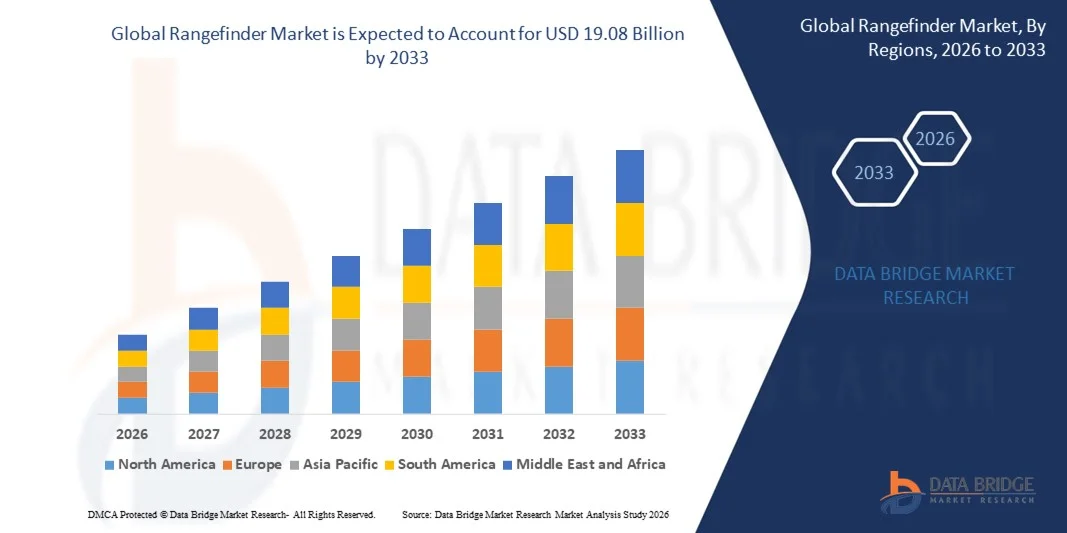
- The global rangefinder market size was valued at USD 4.38 billion in 2025 and is expected to reach USD 19.08 billion by 2033, at a CAGR of 20.20% during the forecast period
- The rise in the focus on the modernization of the defence equipment across the globe acts as one of the major factors driving the growth of rangefinder market
- The increase in the need for advanced and high-precision equipment in various industrial processes and high deployment of the equipment in surveying, navigation, and photography applications accelerate the market growth
What are the Major Takeaways of Rangefinder Market?
- The surge in the need for improving accuracy in sports activities with the use of rangefinders and the rise in the number of advancements in defence systems with the utilization of rangefinders further influence the market
- In addition, growth of the defence sector, increase in inclination towards outdoor sports activities, and urbanization positively affect the rangefinder market. Furthermore, use of rangefinders in autonomous cars extend profitable opportunities to the market players
- North America dominated the rangefinder market with a 37.71% revenue share in 2025, driven by strong participation in golf, hunting, and outdoor recreational activities across the U.S. and Canada
- Asia-Pacific is projected to register the fastest CAGR of 8.24% from 2026 to 2033, driven by rising defense budgets, expanding sports participation, and rapid industrial development across China, Japan, India, South Korea, and Southeast Asia
- The Laser segment dominated the market with a 71.6% share in 2025, driven by its superior accuracy, longer measurement range, faster response time, and compact design. Laser rangefinders are widely used in golf, hunting, defense targeting, construction measurement, and industrial surveying applications due to their precision and reliability
Report Scope and Rangefinder Market Segmentation
|
Attributes |
Rangefinder Key Market Insights |
|
Segments Covered |
|
|
Countries Covered |
North America
Europe
Asia-Pacific
Middle East and Africa
South America
|
|
Key Market Players |
|
|
Market Opportunities |
|
|
Value Added Data Infosets |
In addition to the insights on market scenarios such as market value, growth rate, segmentation, geographical coverage, and major players, the market reports curated by the Data Bridge Market Research also include in-depth expert analysis, pricing analysis, brand share analysis, consumer survey, demography analysis, supply chain analysis, value chain analysis, raw material/consumables overview, vendor selection criteria, PESTLE Analysis, Porter Analysis, and regulatory framework. |
What is the Key Trend in the Rangefinder Market?
Increasing Shift Toward Compact, High-Precision, and Smart Laser-Integrated Rangefinders
- The Rangefinder market is witnessing strong adoption of compact, lightweight, and high-accuracy laser-based rangefinders designed for hunting, golfing, military targeting, surveying, and industrial measurement applications
- Manufacturers are introducing advanced laser distance measurement technologies, improved optical clarity, digital displays, and ballistic compensation features to enhance accuracy and real-time performance
- Growing demand for portable, rugged, and weather-resistant devices is driving adoption across outdoor sports, defense operations, and construction environments
- For instance, leading companies are upgrading products with longer measurement ranges, slope-adjusted distance calculation, target-lock vibration alerts, and Bluetooth-enabled connectivity for smart integration
- Increasing need for precision targeting, enhanced safety, and quick distance calculation is accelerating innovation in laser-based and hybrid optical rangefinding technologies
- As outdoor recreation, tactical operations, and smart surveying expand globally, Rangefinders remain essential for accurate distance measurement and situational awareness
What are the Key Drivers of Rangefinder Market?
- Rising participation in golf, hunting, and outdoor recreational activities is significantly increasing demand for portable and user-friendly rangefinders
- For instance, in 2025, major manufacturers introduced upgraded models featuring extended range capabilities, faster laser response times, and improved battery efficiency to strengthen market competitiveness
- Growing adoption of rangefinding systems in military and defense applications for surveillance, target acquisition, and tactical planning is driving high-value demand
- Advancements in laser diode technology, digital signal processing, and compact optics engineering have improved measurement precision and device durability
- Increasing use of rangefinders in construction, forestry, industrial measurement, and real estate surveying further broadens application scope
- Supported by technological innovation and expanding outdoor equipment markets, the Rangefinder market is expected to witness steady long-term growth
Which Factor is Challenging the Growth of the Rangefinder Market?
- High costs associated with premium long-range and military-grade laser rangefinders limit adoption among price-sensitive consumer segments
- For instance, during 2024–2025, fluctuations in optical component prices, semiconductor supply constraints, and precision lens manufacturing costs increased overall device pricing
- Performance limitations in extreme weather conditions, reflective surface interference, and long-distance accuracy constraints create operational challenges
- Limited awareness in emerging markets regarding advanced features such as ballistic calculators and slope compensation slows adoption
- Competition from smartphone-based measurement apps and low-cost generic optical devices creates pricing pressure in entry-level segments
- To address these challenges, companies are focusing on cost-optimized production, improved laser efficiency, enhanced durability, and smart connectivity features to increase global adoption of Rangefinders
How is the Rangefinder Market Segmented?
The market is segmented on the basis of type, range, and end-use.
- By Type
On the basis of type, the rangefinder market is segmented into Laser and Ultrasonic rangefinders. The Laser segment dominated the market with a 71.6% share in 2025, driven by its superior accuracy, longer measurement range, faster response time, and compact design. Laser rangefinders are widely used in golf, hunting, defense targeting, construction measurement, and industrial surveying applications due to their precision and reliability. Technological advancements in laser diode efficiency, optical clarity, and digital signal processing further strengthen segment leadership.
The Ultrasonic segment is expected to grow at the fastest CAGR from 2026 to 2033, supported by increasing adoption in short-range industrial automation, robotics, parking assistance systems, and indoor measurement applications. Lower cost, safe operation, and suitability for non-reflective surfaces are accelerating ultrasonic rangefinder demand in smart manufacturing and consumer electronics environments.
- By Range
On the basis of range, the market is segmented into Very Low (<50 m), Low (50 m to 500 m), Medium (500 m to 2.5 km), and High (>2.5 km). The Low (50 m to 500 m) segment dominated the market with a 38.9% share in 2025, as it remains the preferred range category for golf, hunting, construction measurement, and recreational applications. These rangefinders offer an optimal balance between affordability, portability, and accuracy, making them highly popular among consumers and professionals.
The High (>2.5 km) segment is projected to grow at the fastest CAGR from 2026 to 2033, driven by rising defense modernization programs, long-range surveillance needs, and advanced tactical targeting systems. Increasing deployment in military reconnaissance, border security, and aerospace applications is accelerating demand for high-precision, extended-range laser rangefinders globally.
- By End-Use
On the basis of end-use, the rangefinder market is segmented into Defence, Commercial, and Sports. The Sports segment dominated the market with a 41.8% share in 2025, supported by rising participation in golf, hunting, and outdoor recreational activities worldwide. Increasing demand for slope-adjusted measurement, target-lock vibration alerts, and compact handheld devices is strengthening adoption among individual consumers and sports professionals.
The Defence segment is expected to grow at the fastest CAGR from 2026 to 2033, propelled by increasing military expenditure, modernization of targeting systems, and integration of laser rangefinders into weapon systems, armored vehicles, and unmanned aerial platforms. Growing geopolitical tensions and investments in advanced battlefield situational awareness technologies are further driving long-term demand in the defense sector.
Which Region Holds the Largest Share of the Rangefinder Market?
- North America dominated the rangefinder market with a 37.71% revenue share in 2025, driven by strong participation in golf, hunting, and outdoor recreational activities across the U.S. and Canada. High defense expenditure and widespread adoption of advanced laser targeting systems further support regional demand. Growing use of rangefinders in construction, surveying, and industrial measurement applications also contributes to market expansion
- Leading companies in North America are introducing technologically advanced laser rangefinders featuring longer measurement distances, slope-adjusted calculations, ballistic compensation, vibration target-lock systems, and Bluetooth-enabled connectivity. Continuous product innovation and premium consumer preference strengthen the region’s competitive advantage
- Strong purchasing power, established outdoor sports culture, advanced defense modernization programs, and a well-developed distribution network further reinforce North America’s leadership in the global Rangefinder market
U.S. Rangefinder Market Insight
The U.S. represents the largest contributor within North America, supported by high adoption across golf courses, hunting communities, defense forces, and industrial sectors. Increasing integration of laser rangefinders into weapon systems, tactical surveillance equipment, and unmanned platforms drives defense-sector growth. Rising popularity of smart golf devices and precision outdoor gear further accelerates consumer demand. Presence of major optics manufacturers and strong retail penetration supports sustained market expansion.
Canada Rangefinder Market Insight
Canada contributes significantly to regional growth, driven by expanding outdoor recreation, hunting culture, and defense modernization initiatives. Growing adoption in forestry management, construction measurement, and wildlife monitoring applications further strengthens demand. Government investments in border security and surveillance systems also support rangefinder procurement across defense agencies.
Asia-Pacific Rangefinder Market
Asia-Pacific is projected to register the fastest CAGR of 8.24% from 2026 to 2033, driven by rising defense budgets, expanding sports participation, and rapid industrial development across China, Japan, India, South Korea, and Southeast Asia. Increasing consumer spending on golf and outdoor equipment, coupled with infrastructure development projects, is accelerating adoption of laser measurement devices. Growth in smart manufacturing and surveying activities further fuels regional demand.
China Rangefinder Market Insight
China is the largest contributor in Asia-Pacific due to expanding defense investments, strong manufacturing capacity, and growing domestic demand for golf and outdoor sports equipment. Increasing development of advanced optical technologies and competitive local production strengthens both domestic consumption and export growth.
Japan Rangefinder Market Insight
Japan shows steady growth supported by advanced optics manufacturing expertise and rising adoption in golf and industrial measurement sectors. Strong emphasis on precision engineering and high-quality optical devices drives demand for premium rangefinders.
India Rangefinder Market Insight
India is emerging as a high-growth market driven by expanding defense procurement, infrastructure development, and increasing interest in golf and shooting sports. Rising urbanization and smart city projects further support industrial rangefinder adoption.
South Korea Rangefinder Market Insight
South Korea contributes significantly due to increasing defense modernization, growing sports participation, and strong electronics manufacturing capabilities. Technological innovation and rising consumer demand for advanced optical devices support sustained market growth.
Which are the Top Companies in Rangefinder Market?
The rangefinder industry is primarily led by well-established companies, including:
- Lockheed Martin Corporation (U.S.)
- Northrop Grumman (U.S.)
- Thales Group (France)
- Elbit Systems Ltd. (Israel)
- Saab AB (Sweden)
- Robert Bosch GmbH (Germany)
- Teledyne FLIR LLC (U.S.)
- Rheinmetall AG (Germany)
- KONGSBERG (Norway)
- ZEISS International (Germany)
- Bushnell (U.S.)
- Callaway Golf Company (U.S.)
- Garmin Ltd. (Switzerland)
- GOGOGO SPORT (China)
- Leica Camera AG (Germany)
- LEUPOLD & STEVENS, INC. (U.S.)
- Macwheel (China)
- Nikon Corporation (Japan)
- SkyHawke Technologies, LLC (U.S.)
- Wosports (China)
- Trueyard Outdoor Optics Ltd (China)
What are the Recent Developments in Global Rangefinder Market?
- In June 2023, Mileseey introduced the TNV30, recognized as the world’s first Mg-Al 384×256 thermal monocular, marking a significant technological advancement in compact thermal imaging devices. This launch positioned the company among the leaders in high-performance portable thermal optics innovation
- In August 2023, Optilogic unveiled the Frogger Pond Supply Chain Design Community, creating a collaborative platform aimed at enhancing supply chain optimization and digital design capabilities. This initiative strengthened ecosystem-driven innovation and advanced analytics adoption within logistics networks
- In September 2022, Bushnell launched its first GPS-enabled golf watch featuring slope-adjusted distance measurement, expanding its smart golf product portfolio. This development enhanced precision and convenience for golfers while reinforcing Bushnell’s position in connected sports technology
- In August 2022, Golf Zondeka Co., Ltd. announced the release of the ultra-compact premium laser rangefinder “GOLFBUDDY aim QUANTUM,” designed to transform the golf rangefinder segment with enhanced portability and performance. This launch intensified competition and innovation within the high-end golf optics market
- In June 2022, Voice Caddie partnered with Daol Private Equity to jointly acquire SuperStroke, a U.S.-based manufacturer of putter and club grips, expanding its global footprint in the golf equipment industry. This strategic acquisition strengthened product diversification and international market presence
SKU-
Get online access to the report on the World's First Market Intelligence Cloud

- Interactive Data Analysis Dashboard
- Company Analysis Dashboard for high growth potential opportunities
- Research Analyst Access for customization & queries
- Competitor Analysis with Interactive dashboard
- Latest News, Updates & Trend analysis
- Harness the Power of Benchmark Analysis for Comprehensive Competitor Tracking
Research Methodology
Data collection and base year analysis are done using data collection modules with large sample sizes. The stage includes obtaining market information or related data through various sources and strategies. It includes examining and planning all the data acquired from the past in advance. It likewise envelops the examination of information inconsistencies seen across different information sources. The market data is analysed and estimated using market statistical and coherent models. Also, market share analysis and key trend analysis are the major success factors in the market report. To know more, please request an analyst call or drop down your inquiry.
The key research methodology used by DBMR research team is data triangulation which involves data mining, analysis of the impact of data variables on the market and primary (industry expert) validation. Data models include Vendor Positioning Grid, Market Time Line Analysis, Market Overview and Guide, Company Positioning Grid, Patent Analysis, Pricing Analysis, Company Market Share Analysis, Standards of Measurement, Global versus Regional and Vendor Share Analysis. To know more about the research methodology, drop in an inquiry to speak to our industry experts.
Customization Available
Data Bridge Market Research is a leader in advanced formative research. We take pride in servicing our existing and new customers with data and analysis that match and suits their goal. The report can be customized to include price trend analysis of target brands understanding the market for additional countries (ask for the list of countries), clinical trial results data, literature review, refurbished market and product base analysis. Market analysis of target competitors can be analyzed from technology-based analysis to market portfolio strategies. We can add as many competitors that you require data about in the format and data style you are looking for. Our team of analysts can also provide you data in crude raw excel files pivot tables (Fact book) or can assist you in creating presentations from the data sets available in the report.












