

Global Razors Market
Market Size in USD Billion
CAGR :
% 
 USD
13.68 Billion
USD
22.72 Billion
2025
2033
USD
13.68 Billion
USD
22.72 Billion
2025
2033
 Forecast Period Forecast Period |
2026 - 2033 |
 Market Size (Base Year) Market Size (Base Year) |
USD 13.68 Billion |
 Market Size (Forecast Year) Market Size (Forecast Year) |
USD 22.72 Billion |
 CAGR CAGR |
% |
| Major Markets Players |
|
Razor Market Overview
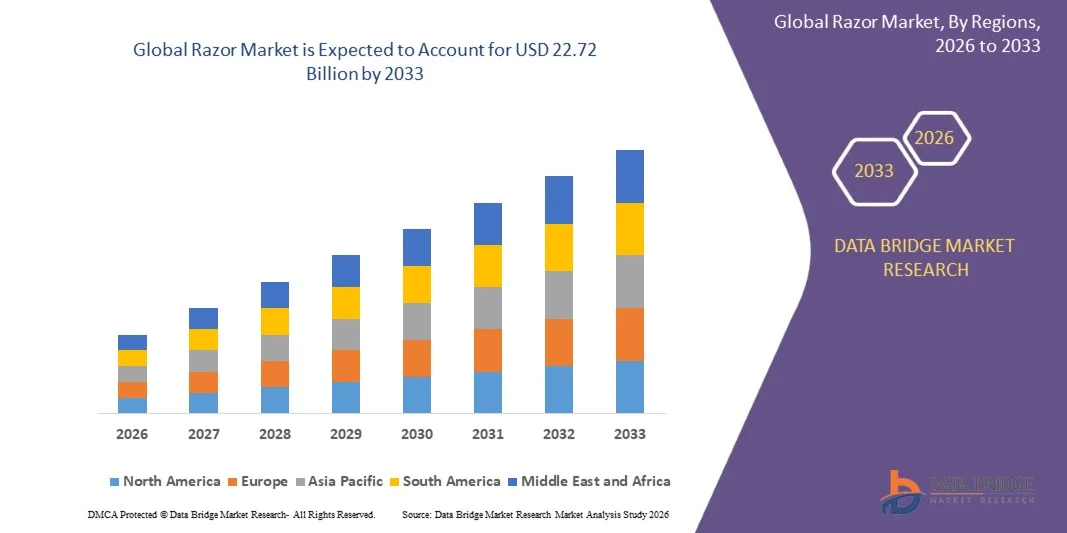
The Razor Market was valued at USD 13.68 billion in 2025 and is projected to reach USD 22.72 billion by 2033, growing at a CAGR of 6.55% from 2026 to 2033. The market is experiencing steady growth driven by rising demand for personal grooming products, increasing focus on hygiene and appearance, and rapid product innovation in both manual and electric shaving technologies. Growing urbanization, expanding middle-class populations, and changing lifestyle preferences are further supporting adoption of advanced grooming tools across developed and emerging markets.
The increasing emphasis on personal care and grooming standards globally, combined with rising disposable income and the influence of social media-driven beauty trends, is encouraging consumers to adopt premium and multifunctional razors. The shift toward sustainable grooming products, including recyclable and reusable razor systems, is also gaining traction as environmental awareness increases. In addition, e-commerce expansion and subscription-based grooming services are making razors more accessible and affordable, while brands continue to innovate with skin-sensitive blades, ergonomic designs, and electric grooming technologies.
Key Market Trends & Insights
- North America dominated the Razor Market with the largest revenue share of 34.26% in 2025, supported by high grooming awareness, strong penetration of premium personal care brands, and widespread adoption of advanced shaving systems. The region benefits from established retail networks, strong consumer preference for personal hygiene products, and high demand for both disposable and electric razors. Increasing focus on skin-sensitive grooming solutions and sustainable razor systems is further strengthening regional dominance.
- The Cartridge Razors segment led the market with a 38.74% share in 2025, driven by their superior shaving comfort, multi-blade technology, and longer durability compared to disposable alternatives. Growing consumer preference for premium grooming experiences and reduced skin irritation is accelerating adoption. Leading brands continue to innovate with lubrication strips, flexible heads, and ergonomic designs, further reinforcing segment leadership.
- Asia-Pacific is expected to be the fastest-growing region at a CAGR of 7.8% from 2026 to 2033, fueled by rising urbanization, increasing disposable income, expanding male grooming awareness, and rapid penetration of e-commerce platforms across China, India, and Southeast Asia. Growing demand for affordable grooming products and expanding retail distribution networks are further supporting market growth.
- Electric Razors are the fastest-growing product type, projected to register a CAGR of 7.3%, driven by increasing demand for convenient, reusable, and skin-friendly grooming solutions. Rising adoption of battery-powered and rechargeable grooming devices, along with technological advancements such as waterproof designs and precision trimming systems, is accelerating segment expansion.
- The Stainless Steel segment dominated the market with a 78.63% share in 2025, driven by superior durability, corrosion resistance, and longer sharpness retention.
Market Size & Forecast
- Global Market Value (2025): USD 13.68 Billion
- Expected Market Value (2033): USD 22.72 Billion
- Forecast CAGR (2026–2033): 6.55%
- Leading Region in 2025: North America
- Fastest Growing Region: Asia-Pacific
Report Scope and Razor Market Segmentation
|
Attributes |
Razor Key Market Insights |
|
Segments Covered |
· By Product Type: Cartridge Razors, Disposable Razors, Straight Razors, Safety Razors, Electric Razors · By Consumer: Men and Women · By Segment: Mass, Standard, and Premium · By Distribution Channel: Supermarkets & Hypermarkets, Convenience Stores, and Online Retail · By Razor Blade Type: Stainless Steel and Carbon Steel |
|
Countries Covered |
North America · U.S. · Canada · Mexico Europe · Germany · France · U.K. · Netherlands · Switzerland · Belgium · Russia · Italy · Spain · Turkey · Rest of Europe Asia-Pacific · China · Japan · India · South Korea · Singapore · Malaysia · Australia · Thailand · Indonesia · Philippines · Rest of Asia-Pacific Middle East and Africa · Saudi Arabia · U.A.E. · South Africa · Egypt · Israel · Rest of Middle East and Africa South America · Brazil · Argentina · Rest of South America |
|
Key Market Players |
· Procter & Gamble (Gillette) (U.S.) · Edgewell Personal Care Company (U.S.) · Bic Group (France) · Energizer Holdings Inc. (Schick / Wilkinson Sword) (U.S.) · Dorco Co., Ltd. (South Korea) · Super-Max Group (United Arab Emirates) · Harry’s Inc. (U.S.) · Dollar Shave Club (U.S.) · Beiersdorf AG (Germany) · Philips N.V. (Netherlands) · Panasonic Corporation (Japan) · Conair Corporation (U.S.) · Feather Safety Razor Co. Ltd. (Japan) · Kai Corporation (Japan) · BIC Shave Club (France) · Bombay Shaving Company (India) · Syska Group (India) · LetsShave (India) · Vega Industries (India) · Lord International Co. (Egypt) · Personna (Edgewell) (U.S.) · Harry’s Lab GmbH (Germany operations) · Supply (The Art of Shaving) (U.S.) · Gillette India Ltd. (India) · Supermax India Pvt. Ltd. (India) · Shenzhen KAI Razor Industrial Co., Ltd. (China) · Ningbo Jiali Plastics Co., Ltd. (China) · Sweeney Todd Shaving Co. (UK niche brand) · Bombay Shaving Company Pvt. Ltd. (India) |
|
Market Opportunities |
· Rising demand for premium and skin-sensitive grooming products · Rapid expansion of e-commerce and subscription-based grooming services · Growing shift toward sustainable and eco-friendly shaving solutions |
|
Value Added Data Infosets |
In addition to the insights on market scenarios such as market value, growth rate, segmentation, geographical coverage, and major players, the market reports curated by the Data Bridge Market Research also include in-depth expert analysis, geographically represented company-wise production and capacity, network layouts of distributors and partners, detailed and updated price trend analysis and deficit analysis of supply chain and demand. |
Razor Market Trends
Trend: Growth in Premium Grooming, Skin-Sensitive and Sustainable Shaving Solutions
The Razor Market is witnessing strong growth driven by rising consumer demand for premium grooming products, skin-sensitive shaving systems, and sustainable personal care solutions. Increasing awareness regarding skin health and irritation-free shaving is pushing consumers toward advanced cartridge and electric razors with multi-blade technology, lubricating strips, and precision trimming features. Studies indicate that over 55–60% of male consumers in developed markets prefer skin-protection-focused shaving systems, boosting demand for premium razors. At the same time, sustainability trends are reshaping product design, with leading brands introducing recyclable handles, refillable blade cartridges, and reduced-plastic packaging. Companies such as Gillette and Bic are investing in eco-friendly product lines aligned with global plastic reduction initiatives. E-commerce growth and subscription-based grooming models are further accelerating personalized razor consumption worldwide. Overall, product innovation and sustainability are becoming key competitive differentiators in the razor industry.
Razor Market Dynamics
Key Market Driver: Rising Consumer Focus on Personal Grooming and Hygiene Awareness
The increasing emphasis on personal grooming, hygiene awareness, and lifestyle aesthetics is a major driver of the Razor Market. According to consumer behavior studies, more than 65% of urban male consumers in North America and Europe engage in regular shaving or grooming routines using advanced razors or trimmers. Rising disposable incomes, urbanization, and the influence of social media grooming trends are significantly boosting product demand. The expansion of the male grooming industry, valued at over USD 80 billion globally, is further strengthening razor adoption. In addition, increasing penetration of electric razors and smart grooming devices is enhancing convenience and product performance. The growth of retail chains and online grooming platforms is improving accessibility in emerging economies. Overall, lifestyle changes and hygiene consciousness continue to strongly support market expansion.
Key Restraint/Challenge: High Competition and Price Sensitivity in Mass Market Segments
A major challenge in the Razor Market is intense competition and high price sensitivity, especially in disposable and mass-market segments. The market is highly consolidated, with dominant players such as Procter & Gamble (Gillette), Bic, and Edgewell controlling a large share, creating pricing pressure for smaller brands. In emerging markets, consumers often prefer low-cost disposable razors, limiting the adoption of premium products. Additionally, private-label brands and local manufacturers in Asia and Latin America intensify pricing competition. Raw material price fluctuations, particularly stainless steel and polymer-based components, also impact profit margins. Counterfeit and low-quality razor products in some developing regions further affect brand trust and market stability. Overall, strong competition and affordability constraints remain key barriers to high-margin growth.
Key Market Opportunity: Expansion of E-Commerce, Subscription Models, and Men’s Grooming Ecosystem
The rapid expansion of e-commerce platforms and subscription-based grooming services presents a major growth opportunity for the razor market. Direct-to-consumer models such as Dollar Shave Club and Harry’s have demonstrated strong adoption, with subscription services improving customer retention and reducing distribution costs. Online grooming sales have grown significantly, accounting for an estimated 25–35% of premium razor sales in developed markets. In addition, the rising men’s grooming ecosystem—including beard care, trimmers, and skincare products—is creating cross-selling opportunities for razor manufacturers. Increasing penetration of smartphones and digital payment systems in Asia-Pacific and Latin America is further accelerating online razor adoption. Integration of AI-driven personalization and targeted marketing is also enhancing consumer engagement. Overall, digital transformation and subscription models are reshaping the global razor industry landscape.
Razor Market Scope
The Razor market is segmented on the basis of product type, consumer, segment, distribution channel, and razor blade type.
- By Product Type
On the basis of product type, the Razor Market is segmented into cartridge razors, disposable razors, straight razors, safety razors, and electric razors. The Cartridge Razors segment dominated the market with a 38.74% share in 2025, driven by superior shaving precision, multi-blade technology, lubricating strips, and strong brand penetration by leading players such as Gillette and Schick. These razors provide enhanced comfort, reduced skin irritation, and longer usability due to replaceable cartridge heads. High adoption across developed regions such as North America and Europe is further supported by premium grooming habits and frequent product innovation. Strong retail availability across supermarkets and e-commerce platforms is reinforcing dominance. Rising male grooming awareness and preference for convenience-based shaving solutions are accelerating consumption. Marketing investments by FMCG giants are strengthening product visibility. Subscription-based razor refill models are also boosting repeat purchases.
The Electric Razors segment is projected to register the fastest growth at a CAGR of 6.9% from 2026 to 2033, driven by increasing demand for advanced grooming technology, cordless convenience, and skin-friendly shaving systems. Rising adoption of rechargeable, waterproof, and multi-functional grooming devices is significantly boosting market expansion. Integration of smart sensors, adjustable trimming settings, and ergonomic designs is enhancing user experience. Growing preference for painless and time-saving grooming solutions is supporting adoption among urban consumers. Expanding premium grooming electronics market in Asia-Pacific is further accelerating growth. Increasing disposable income and lifestyle modernization are contributing to higher adoption. E-commerce penetration is improving accessibility of electric grooming devices globally. Rising influence of tech-enabled personal care products is strengthening segment growth. Continuous innovation in battery efficiency and blade technology is improving performance. Subscription-based grooming kits are also driving demand.
- By Consumer
On the basis of consumer, the Razor Market is segmented into men and women. The Men’s segment dominated the market with a 72.85% share in 2025, driven by high shaving frequency, strong beard grooming culture, and daily grooming routines among working-age male populations. Men’s grooming habits are heavily influenced by professional appearance standards and lifestyle trends. Strong presence of premium shaving brands and continuous product innovation is reinforcing demand. Subscription-based grooming services and refill systems are widely adopted among male consumers. High penetration of cartridge and electric razors is supporting segment dominance. Increasing awareness of personal grooming and hygiene is further boosting consumption. Urbanization and rising disposable income are strengthening premium product adoption. Social media grooming trends are accelerating product visibility.
The Women’s segment is expected to witness the fastest growth at a CAGR of 6.1% from 2026 to 2033, driven by rising awareness of personal care, increasing adoption of body grooming products, and expansion of female-specific razor offerings. Demand for hypoallergenic, skin-sensitive, and precision-designed razors is growing rapidly. Increasing participation of women in premium personal care spending is boosting market expansion. Urban lifestyle changes and beauty-conscious consumer behavior are supporting adoption. E-commerce platforms are increasing accessibility to female grooming products. Marketing campaigns focused on women’s grooming are expanding awareness. Growth in at-home grooming trends is accelerating demand. Rising disposable income among women is strengthening product penetration. Product innovation tailored for sensitive skin is further supporting growth.
- By Segment (Mass, Standard, Premium)
On the basis of segment, the Razor Market is segmented into mass, standard, and premium categories. The Mass segment dominated the market with a 46.92% share in 2025, driven by affordability, high-volume consumption, and strong penetration of disposable razors in emerging economies. Mass products are widely available across supermarkets, pharmacies, and local retail stores. High population base in developing regions is supporting steady demand. Frequent replacement cycles of low-cost razors are increasing purchase frequency. Strong competition among FMCG brands is driving price-based competition. Mass segment remains highly dominant in rural and semi-urban regions. Retail expansion is further strengthening accessibility. Strong demand for basic grooming solutions is sustaining growth.
The Premium segment is expected to register the fastest growth at a CAGR of 6.5% from 2026 to 2033, driven by rising demand for advanced shaving systems, ergonomic designs, and luxury grooming experiences. Premium razors offer multi-blade precision, lubricating technology, and superior durability. Increasing willingness to pay for comfort and performance is boosting adoption. Growth of D2C grooming brands and subscription models is accelerating expansion. Urbanization and rising income levels are strengthening premium consumption. Social media influence and grooming lifestyle trends are supporting demand. Technological innovation in blade engineering is enhancing product appeal. Expansion of men’s grooming culture is reinforcing premiumization. Brand positioning and lifestyle marketing are driving higher adoption rates.
- By Distribution Channel
On the basis of distribution channel, the Razor Market is segmented into supermarkets & hypermarkets, convenience stores, and online retail. Supermarkets & hypermarkets dominated the market with a 42.58% share in 2025, driven by strong product visibility, promotional discounts, and high impulse purchasing behavior. Consumers prefer physical retail for comparison of grooming products. Large FMCG shelf presence supports strong brand competition. Retail chains provide wide product assortment and accessibility. Organized retail expansion in developing countries is supporting growth. Promotional bundling and discount strategies are increasing sales. High consumer footfall ensures consistent demand. Strong partnerships between retailers and razor brands are reinforcing dominance.
The Online segment is projected to register the fastest growth at a CAGR of 7.6% from 2026 to 2033, driven by rapid e-commerce expansion, increasing smartphone penetration, and rising adoption of subscription-based grooming services. Direct-to-consumer razor brands are disrupting traditional retail channels. Digital payment systems and doorstep delivery are enhancing convenience. Personalized subscription models are increasing customer retention. Social media marketing is strongly influencing purchasing behavior. Online discounts and convenience are accelerating adoption. Cross-border e-commerce is expanding product availability. Rising digital literacy is supporting online grooming purchases. AI-driven recommendation systems are improving customer targeting.
- By Razor Blade Type
On the basis of razor blade type, the Razor Market is segmented into stainless steel and carbon steel blades. The Stainless Steel segment dominated the market with a 78.63% share in 2025, driven by superior durability, corrosion resistance, and longer sharpness retention. Stainless steel blades are widely used in cartridge and electric razors due to high performance and hygiene standards. Strong compatibility with modern grooming systems supports dominance. Global manufacturing preference for stainless steel is reinforcing adoption. Premium grooming brands rely heavily on stainless steel blades. High consumer trust and longer product life cycles are boosting demand. Widespread availability across global markets strengthens leadership. Continuous innovation in blade coating technology is improving performance.
The Carbon Steel segment is expected to grow at a CAGR of 4.1% from 2026 to 2033, driven by low cost, traditional shaving practices, and usage in disposable and barber-grade razors. Carbon steel blades remain popular in price-sensitive regions and rural markets. However, lower corrosion resistance limits premium adoption. Traditional grooming culture continues to sustain demand. Barber shop usage remains a key driver in developing economies. Limited durability restricts long-term consumer preference. Manufacturing simplicity supports affordability. Gradual shift toward stainless steel is slowing growth potential.
Razor Market Regional Analysis
North America dominated the Razor Market with the largest revenue share of 34.26% in 2025, supported by high grooming awareness, strong penetration of premium personal care brands, and widespread adoption of advanced shaving systems. The region benefits from established retail networks, strong consumer preference for personal hygiene products, and high demand for both disposable and electric razors. Increasing focus on skin-sensitive grooming solutions and sustainable razor systems is further strengthening regional dominance. The presence of leading global personal care companies and continuous product innovation is enhancing market competitiveness across the region. Rising male grooming culture and growing willingness to spend on premium grooming products are supporting consistent demand growth. Strong e-commerce penetration and subscription-based razor delivery services are reshaping consumer purchasing behavior. Technological advancements in blade design and electric grooming systems are improving user experience. Sustainability trends are encouraging shift toward reusable and eco-friendly razor formats. The United States and Canada remain the key revenue contributors within the region. Increasing marketing focus on personalization and grooming performance is further driving adoption. Overall, North America remains a highly mature and value-driven market for razors.
U.S. Razor Market Insight
The U.S. razor market is witnessing strong growth due to rising grooming awareness, increasing adoption of premium personal care products, and expanding subscription-based grooming services. The country benefits from a highly developed retail and e-commerce ecosystem that ensures wide product accessibility across urban and suburban regions. Strong presence of global grooming brands is driving continuous innovation in cartridge and electric razors. Consumers are increasingly shifting toward skin-friendly, precision-focused shaving solutions that offer comfort and reduced irritation. Rising demand for electric razors with advanced features such as waterproofing and fast charging is supporting product adoption. Social media influence and grooming-focused marketing campaigns are shaping consumer preferences. Sustainability trends are also encouraging adoption of reusable and eco-friendly shaving systems. Increasing male grooming awareness across younger demographics is expanding the consumer base. Demand for high-performance grooming solutions remains consistently strong across income groups. The subscription-based razor delivery model continues to gain traction due to convenience and cost efficiency. Innovation in blade technology and ergonomic design is further enhancing product appeal. Overall, the U.S. represents the most influential and innovation-driven market in North America.
Europe Razor Market Insight
The Europe razor market remains a significant contributor to global revenue, driven by strong grooming culture, high hygiene awareness, and widespread adoption of premium personal care products. The region benefits from well-established personal care manufacturers and a strong retail distribution network. Consumers in Europe show increasing preference for sustainable and eco-friendly grooming solutions, influencing product innovation across the market. Cartridge razors and safety razors continue to maintain strong demand, while electric razors are gaining traction due to convenience and technological advancements. Strict environmental regulations are encouraging manufacturers to adopt recyclable materials and sustainable packaging. E-commerce expansion is improving product accessibility and boosting brand reach across countries. Professional grooming services and barbering culture further support consistent product consumption. Increasing male grooming awareness is driving steady demand growth across all age groups. Innovation in blade materials and ergonomic product design is enhancing shaving performance. Premiumization trends are also contributing to higher product value realization. The presence of global and regional brands ensures strong competitive intensity. Overall, Europe represents a mature yet innovation-driven razor market.
U.K. Razor Market Insight
The U.K. razor market is experiencing steady growth driven by rising grooming awareness and strong consumer preference for premium personal care products. Increasing adoption of subscription-based razor delivery services is reshaping traditional retail purchasing patterns. Consumers are increasingly shifting toward electric and high-performance cartridge razors for convenience and comfort. The market benefits from strong e-commerce penetration and well-established retail infrastructure. Demand for skin-sensitive and precision grooming solutions is steadily increasing across urban populations. Sustainability trends are encouraging adoption of reusable and recyclable razor systems. Strong presence of global grooming brands is intensifying market competition. Male grooming culture continues to expand, particularly among younger demographics. Innovation in electric grooming devices is enhancing user experience and product efficiency. Professional barbering and salon services continue to support stable product demand. Digital marketing strategies and influencer-driven campaigns are shaping consumer preferences. Product personalization and premiumization are emerging as key market trends. Overall, the U.K. represents a mature but steadily evolving grooming market.
Germany Razor Market Insight
The Germany razor market is expanding steadily due to strong grooming awareness, high consumer focus on quality, and advanced manufacturing capabilities in personal care products. Consumers show strong preference for precision-engineered and durable shaving solutions. Safety razors and premium cartridge systems continue to witness stable demand. Electric razors are gaining traction driven by technological innovation and convenience features. Sustainability remains a key market driver, with increasing adoption of eco-friendly and recyclable grooming products. Strong retail infrastructure ensures wide availability of grooming products across the country. E-commerce channels are further accelerating product accessibility and consumer engagement. Germany’s strong barbering and professional grooming culture supports consistent product consumption. Innovation in blade technology and ergonomic design is enhancing shaving performance. Demand for high-quality grooming solutions remains stable across urban populations. Increasing male grooming awareness is contributing to steady market growth. Overall, Germany represents a technologically advanced and quality-driven grooming market.
Asia-Pacific Razor Market Insight
The Asia-Pacific razor market is expected to witness the fastest growth with a CAGR of 7.8% from 2026 to 2033, driven by rapid urbanization, rising disposable income, and increasing male grooming awareness. Expanding e-commerce penetration across China, India, and Southeast Asia is significantly improving product accessibility. Growing middle-class population is supporting demand for affordable grooming products. International brands are rapidly expanding their presence across emerging markets. Rising awareness of personal hygiene and grooming standards is driving market adoption. Local manufacturing capabilities and cost-effective production are strengthening supply chains. Digital marketing and influencer-driven grooming trends are boosting consumer engagement. Expansion of retail networks in Tier 2 and Tier 3 cities is further supporting growth. Electric and disposable razors are witnessing strong adoption across price-sensitive consumers. Premium grooming products are gradually gaining traction in urban centers. Increasing competition among global and regional brands is driving product innovation. Subscription-based grooming services are emerging in select markets. Overall, Asia-Pacific represents the fastest-growing regional market for razors globally.
Japan Razor Market Insight
The Japan razor market is witnessing stable growth driven by high grooming standards, strong consumer preference for quality products, and advanced technological adoption. Electric razors dominate the market due to convenience and precision performance. Consumers prefer compact, durable, and technologically advanced grooming devices. The aging population is also influencing demand for easy-to-use shaving solutions. Strong innovation in grooming technology supports continuous product improvement. High adoption of personal care products reflects strong hygiene awareness. E-commerce and retail channels ensure widespread product availability. Sustainability trends are gradually influencing product design and packaging. Professional grooming and barbering services contribute to steady demand. Japanese consumers show strong preference for premium and long-lasting products. Innovation in blade precision and safety features is enhancing product adoption. Overall, Japan represents a technologically mature and stable grooming market.
China Razor Market Insight
The China razor market is growing rapidly due to rising urbanization, increasing disposable income, and expanding male grooming awareness. Strong penetration of e-commerce platforms is significantly boosting product sales across the country. Demand for affordable and mid-range grooming products remains highly strong. Electric and disposable razors are witnessing increasing adoption among urban consumers. Domestic and international brands are competing intensely in the market. Rising middle-class population is driving sustained consumption growth. Social media and influencer marketing are shaping grooming preferences. Expansion of retail infrastructure is improving product accessibility in lower-tier cities. Government-supported manufacturing capabilities strengthen supply chain efficiency. Premium grooming products are gaining traction in Tier 1 cities. Innovation in grooming technology is accelerating product development. Increasing focus on personal hygiene is supporting long-term market growth. Overall, China represents one of the fastest-growing razor markets globally.
Razor Market Share
The Razor industry is primarily led by well-established companies, including:
- Procter & Gamble (Gillette) (U.S.)
- Edgewell Personal Care Company (U.S.)
- Bic Group (France)
- Energizer Holdings Inc. (Schick / Wilkinson Sword) (U.S.)
- Dorco Co., Ltd. (South Korea)
- Super-Max Group (United Arab Emirates)
- Harry’s Inc. (U.S.)
- Dollar Shave Club (U.S.)
- Beiersdorf AG (Germany)
- Philips N.V. (Netherlands)
- Panasonic Corporation (Japan)
- Conair Corporation (U.S.)
- Feather Safety Razor Co. Ltd. (Japan)
- Kai Corporation (Japan)
- BIC Shave Club (France)
- Bombay Shaving Company (India)
- Syska Group (India)
- LetsShave (India)
- Vega Industries (India)
- Lord International Co. (Egypt)
- Personna (Edgewell) (U.S.)
- Harry’s Lab GmbH (Germany operations)
- Supply (The Art of Shaving) (U.S.)
- Gillette India Ltd. (India)
- Supermax India Pvt. Ltd. (India)
- Shenzhen KAI Razor Industrial Co., Ltd. (China)
- Ningbo Jiali Plastics Co., Ltd. (China)
- Sweeney Todd Shaving Co. (UK niche brand)
- Bombay Shaving Company Pvt. Ltd. (India)
Latest Developments in Razor Market
- In January 2021, Procter & Gamble (P&G) expanded its premium grooming portfolio under its Gillette brand by introducing enhanced versions of its GilletteLabs range in global markets. The product line featured integrated exfoliating bar technology designed to remove dirt and debris before blade contact, improving shaving comfort and reducing irritation. This upgrade reflected growing consumer demand for premium, skin-friendly grooming solutions and reinforced Gillette’s leadership in the high-end razor segment. The launch also supported P&G’s strategy of innovation-led differentiation in the global shaving industry.
- In March 2021, Edgewell Personal Care, the parent company of Schick and Wilkinson Sword, announced the expansion of its Schick Intuition range for women across North America and Europe. The updated razors featured improved moisturizing solid technology and enhanced ergonomic designs aimed at simplifying body shaving routines. The expansion targeted rising demand for women-specific grooming products and increased focus on sensitive-skin shaving solutions. This development highlighted the growing importance of female consumer segments in the Razor Market
- In July 2022, BIC Group introduced a new generation of BIC Hybrid Flex razors in select global markets, combining disposable razor convenience with replaceable cartridge functionality. The product aimed to bridge the gap between low-cost disposable razors and premium cartridge systems. The innovation supported increasing consumer demand for affordability combined with improved shaving performance. This launch strengthened BIC’s position in the value-driven segment of the global razor industry
- In October 2022, Procter & Gamble expanded its subscription-based grooming ecosystem by strengthening Gillette’s online direct-to-consumer (DTC) razor refill services across Europe and Asia-Pacific. The initiative included digital subscription models for blade refills and personalized shaving kits delivered directly to consumers. This expansion reflected the rapid shift toward e-commerce and recurring revenue models in the grooming industry. It also aligned with rising consumer preference for convenience and automated product replenishment systems
- In February 2023, Philips Norelco introduced an upgraded series of electric razors featuring SkinIQ technology, designed to adapt shaving power based on beard density. The innovation included pressure-sensing technology and improved blade tracking systems for enhanced skin comfort. This development supported the increasing adoption of smart grooming devices in the global electric razor segment. It also demonstrated the growing integration of AI-based personalization in personal care electronics
- In June 2023, Panasonic launched its new Arc6 electric shaving system in global markets, featuring six-blade cutting technology and advanced sensor-based beard detection. The product was designed to deliver faster and more precise shaving performance with reduced skin irritation. The launch reflected rising demand for premium electric grooming devices with high-performance engineering. It also strengthened Panasonic’s competitive positioning in the global premium electric razor market
- In January 2024, Gillette announced global upgrades to its Venus female grooming line with improved ComfortGlide razor technology featuring enhanced moisture bars. The updated system aimed to improve shaving smoothness while reducing skin dryness and irritation. This development addressed growing demand for advanced women’s grooming solutions and reinforced Gillette’s dominance in the female razor category. It also reflected increasing investment in skin-sensitive shaving technologies
- In August 2024, Dollar Shave Club expanded its subscription-based grooming model with enhanced personalization features, including AI-driven razor refill recommendations based on shaving frequency and usage patterns. The upgrade aimed to improve customer retention and optimize supply chain efficiency. This development highlighted the rapid growth of subscription economy models in the razor industry. It also demonstrated increasing use of digital analytics in consumer grooming products
- In March 2025, Wilkinson Sword introduced its Intuition Complete Care Plus razor range in European markets, featuring dermatologically tested skin protection technology and enhanced moisture infusion strips. The product targeted growing demand for sensitive-skin grooming solutions among both male and female consumers. The launch reflected continued innovation in hybrid safety-cartridge razor systems. It also reinforced the brand’s strong presence in the European personal care market
- In May 2025, Gillette expanded its AI-enabled grooming ecosystem by integrating smart razor usage tracking within its mobile app platform in select markets. The system provided personalized shaving recommendations, blade replacement alerts, and grooming optimization insights. This development represented a significant shift toward connected grooming devices in the Razor Market. It also reflected the increasing convergence of personal care products and digital health-style analytics
SKU-
Get online access to the report on the World's First Market Intelligence Cloud

- Interactive Data Analysis Dashboard
- Company Analysis Dashboard for high growth potential opportunities
- Research Analyst Access for customization & queries
- Competitor Analysis with Interactive dashboard
- Latest News, Updates & Trend analysis
- Harness the Power of Benchmark Analysis for Comprehensive Competitor Tracking
Research Methodology
Data collection and base year analysis are done using data collection modules with large sample sizes. The stage includes obtaining market information or related data through various sources and strategies. It includes examining and planning all the data acquired from the past in advance. It likewise envelops the examination of information inconsistencies seen across different information sources. The market data is analysed and estimated using market statistical and coherent models. Also, market share analysis and key trend analysis are the major success factors in the market report. To know more, please request an analyst call or drop down your inquiry.
The key research methodology used by DBMR research team is data triangulation which involves data mining, analysis of the impact of data variables on the market and primary (industry expert) validation. Data models include Vendor Positioning Grid, Market Time Line Analysis, Market Overview and Guide, Company Positioning Grid, Patent Analysis, Pricing Analysis, Company Market Share Analysis, Standards of Measurement, Global versus Regional and Vendor Share Analysis. To know more about the research methodology, drop in an inquiry to speak to our industry experts.
Customization Available
Data Bridge Market Research is a leader in advanced formative research. We take pride in servicing our existing and new customers with data and analysis that match and suits their goal. The report can be customized to include price trend analysis of target brands understanding the market for additional countries (ask for the list of countries), clinical trial results data, literature review, refurbished market and product base analysis. Market analysis of target competitors can be analyzed from technology-based analysis to market portfolio strategies. We can add as many competitors that you require data about in the format and data style you are looking for. Our team of analysts can also provide you data in crude raw excel files pivot tables (Fact book) or can assist you in creating presentations from the data sets available in the report.