Global Regenerative Medicine Market
Market Size in USD Billion
CAGR :
% 
 USD
42.48 Billion
USD
180.15 Billion
2025
2033
USD
42.48 Billion
USD
180.15 Billion
2025
2033
 Forecast Period Forecast Period |
2026 –2033 |
 Market Size (Base Year) Market Size (Base Year) |
USD 42.48 Billion |
 Market Size (Forecast Year) Market Size (Forecast Year) |
USD 180.15 Billion |
 CAGR CAGR |
% |
| Major Markets Players |
|
What is the Global Regenerative Medicine Market Size and Growth Rate?
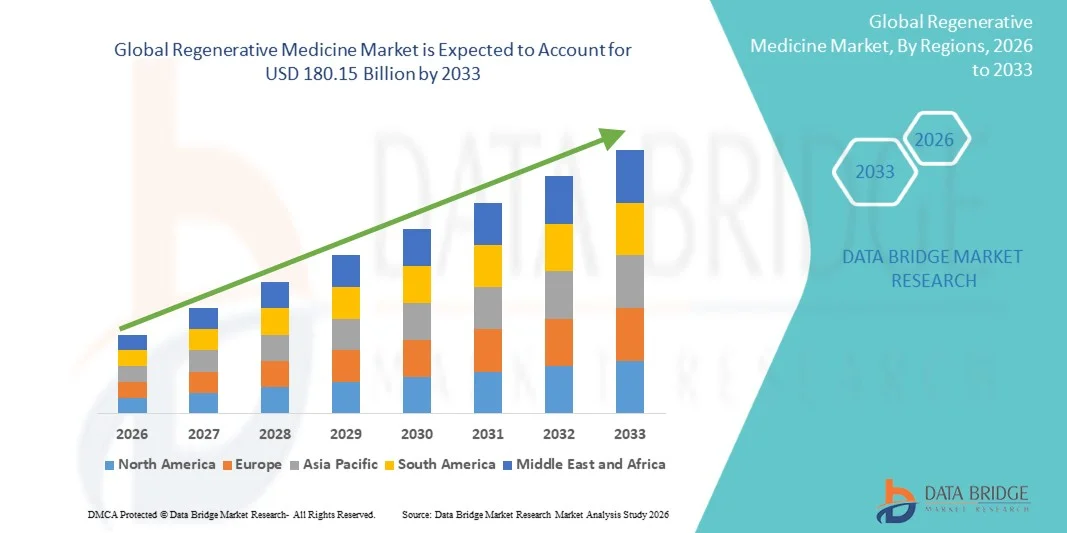
- The global regenerative medicine market size was valued at USD 42.48 billion in 2025and is expected to reach USD 180.15 billion by 2033, at a CAGR of 19.79% during the forecast period
- The growing markets and huge investment in research and development is the major factor accelerating the growth of the regenerative medicine market
- Furthermore, growing prevalence of chronic diseases, genetic disorders, and cancer are also expected to drive the growth of the regenerative medicine market
What are the Major Takeaways of Regenerative Medicine Market?
- High cost cell and gene therapies restrains the regenerative medicine market, whereas, huge financial burden coupled with stringent regulatory framework will challenge the regenerative medicine market growth
- In addition, implementation of the 21st Century Cures Act will create ample opportunities for the regenerative medicine market
- North America dominated the regenerative medicine market with a 43.12% revenue share in 2025, driven by strong growth in biotechnology research, stem cell therapy development, tissue engineering innovation, and increasing clinical adoption of advanced therapeutic solutions across the U.S. and Canada
- Asia-Pacific is projected to register the fastest CAGR of 10.84% from 2026 to 2033, driven by rapid expansion of biotechnology infrastructure, rising healthcare investments, growing medical tourism, and increasing adoption of advanced therapeutic solutions across China, Japan, India, South Korea, and Southeast Asia
- The Stem Cell Therapy segment dominated the market with a 41.6% share in 2025, as it remains the most widely adopted regenerative platform for cell repair, tissue regeneration, immune modulation, and chronic disease management
Report Scope and Regenerative Medicine Market Segmentation
|
Attributes |
Regenerative Medicine Key Market Insights |
|
Segments Covered |
|
|
Countries Covered |
North America · U.S. · Canada · Mexico Europe · Germany · France · U.K. · Netherlands · Switzerland · Belgium · Russia · Italy · Spain · Turkey · Rest of Europe Asia-Pacific · China · Japan · India · South Korea · Singapore · Malaysia · Australia · Thailand · Indonesia · Philippines · Rest of Asia-Pacific Middle East and Africa · Saudi Arabia · U.A.E. · South Africa · Egypt · Israel · Rest of Middle East and Africa South America · Brazil · Argentina · Rest of South America |
|
Key Market Players |
· Integra LifeSciences Corporation (U.S.) · MiMedx Group, Inc. (U.S.) · AstraZeneca (U.K.) · F. Hoffmann-La Roche Ltd (Switzerland) · Merck & Co., Inc. (U.S.) · Pfizer Inc. (U.S.) · Organogenesis Inc. (U.S.) · Osiris Therapeutics, Inc. (U.S.) · Vericel Corporation (U.S.) · NuVasive, Inc. (U.S.) · Acelity (KCI Concepts) (U.S.) · Cook Biotech Inc. (U.S.) · Novartis AG (Switzerland) · Vericel Corporation (U.S.) · U.S. Stem Cell (U.S.) · Athersys, Inc. (U.S.) · CryoLife, Inc. (U.S.) |
|
Market Opportunities |
· Huge Investment in Research and Development · Growing Prevalence of Chronic Diseases |
|
Value Added Data Infosets |
In addition to the insights on market scenarios such as market value, growth rate, segmentation, geographical coverage, and major players, the market reports curated by the Data Bridge Market Research also include in-depth expert analysis, pricing analysis, brand share analysis, consumer survey, demography analysis, supply chain analysis, value chain analysis, raw material/consumables overview, vendor selection criteria, PESTLE Analysis, Porter Analysis, and regulatory framework. |
What is the Key Trend in the Regenerative Medicine Market?
“Increasing Shift Toward Personalized Cell and Gene-Based Regenerative Therapies”
- The regenerative medicine market is witnessing strong momentum toward personalized and precision-based therapies, particularly in stem cell therapy, tissue engineering, gene editing, and biomaterial-based regenerative solutions designed to restore damaged tissues and organs
- Manufacturers and research institutions are increasingly introducing advanced cell therapies, scaffold technologies, 3D bioprinting solutions, and gene-modified regenerative products that improve treatment outcomes and accelerate healing processes
- Growing demand for minimally invasive, long-term curative solutions is driving adoption across orthopedics, wound care, cardiology, oncology, neurology, and dermatology applications
- For instance, companies such as Vericel, Organogenesis, MiMedx, and Integra LifeSciences are expanding their regenerative portfolios with advanced tissue repair matrices, stem-cell therapies, and bioactive wound healing products
- Increasing need for personalized therapies, faster tissue regeneration, and reduced dependence on organ transplantation is accelerating innovation in this market
- As healthcare increasingly shifts toward restorative and precision-based treatments, regenerative medicines will remain vital for long-term therapeutic advancement
What are the Key Drivers of Regenerative Medicine Market?
- Rising prevalence of chronic diseases, musculoskeletal disorders, cardiovascular conditions, and severe wounds is significantly driving demand for regenerative therapies worldwide
- For instance, in 2025, leading companies such as Pfizer, Novartis, and AstraZeneca increased investments in cell therapy research, gene editing platforms, and tissue regeneration programs
- Growing adoption of stem cell therapies, tissue-engineered products, and gene-based treatments across the U.S., Europe, and Asia-Pacific continues to support market expansion
- Advancements in CRISPR technology, biomaterials, scaffold engineering, and 3D bioprinting have significantly improved product effectiveness and commercialization potential
- Rising healthcare expenditure and supportive regulatory approvals for advanced therapy medicinal products (ATMPs) are further accelerating market growth
- Supported by strong investments in biotechnology R&D and precision medicine, the market is expected to witness strong long-term growth
Which Factor is Challenging the Growth of the Regenerative Medicine Market?
- High costs associated with cell-based therapies, gene therapies, and advanced tissue engineering products continue to restrict adoption, particularly in cost-sensitive markets
- For instance, during 2024–2025, increasing costs of clinical trials, manufacturing infrastructure, and regulatory compliance raised commercialization barriers for several global companies
- Complexity in therapy development, storage, transportation, and patient-specific customization increases operational challenges
- Limited awareness and inadequate reimbursement frameworks in emerging markets slow adoption
- Strict regulatory pathways and lengthy approval timelines create additional barriers to commercialization
- To address these issues, companies are focusing on scalable manufacturing, strategic partnerships, and cost-optimized therapy platforms to increase global adoption of regenerative medicines
How is the Regenerative Medicine Market Segmented?
The market is segmented on the basis of technology, application, end-users, and distribution channel.
- By Technology
On the basis of technology, the regenerative medicine market is segmented into Stem Cell Therapy, Biomaterial, Tissue Engineering, and Others. The Stem Cell Therapy segment dominated the market with a 41.6% share in 2025, as it remains the most widely adopted regenerative platform for cell repair, tissue regeneration, immune modulation, and chronic disease management. Stem cell-based therapies are extensively utilized in orthopedics, oncology, neurology, cardiology, and wound healing applications due to their strong regenerative potential and long-term therapeutic effectiveness. Rising clinical trials and regulatory approvals continue to support segment dominance.
The Tissue Engineering segment is expected to grow at the fastest CAGR from 2026 to 2033, driven by increasing demand for bioengineered tissues, scaffold-based repair systems, 3D bioprinting technologies, and organ regeneration solutions. Advancements in biomaterials and personalized medicine are significantly accelerating adoption.
- By Application
On the basis of application, the market is segmented into Bone Graft Substitutes, Osteoarticular Diseases, Dermatology, Cardiovascular, and Others. The Bone Graft Substitutes segment dominated the market with a 36.9% share in 2025, supported by the growing prevalence of bone fractures, spinal disorders, trauma injuries, and orthopedic surgeries. Regenerative medicine products are extensively used in bone regeneration, spinal fusion procedures, and musculoskeletal repair, owing to their ability to enhance healing and reduce recovery time.
The Cardiovascular segment is projected to grow at the fastest CAGR from 2026 to 2033, driven by increasing demand for cardiac tissue regeneration, stem cell-based heart repair, and advanced biomaterial solutions for vascular healing. Rising incidence of heart disease and ongoing research in cardiac regenerative therapies are expected to strongly support growth.
- By End-Users
On the basis of end-users, the regenerative medicine market is segmented into Hospitals, Specialty Clinics, and Others. The Hospitals segment dominated the market with a 48.3% share in 2025, driven by the high volume of advanced surgical procedures, stem cell transplant treatments, wound care therapies, and specialized regenerative treatment programs. Hospitals continue to be the primary treatment centers due to their access to multidisciplinary specialists, advanced infrastructure, and regulatory-compliant storage facilities.
The Specialty Clinics segment is expected to grow at the fastest CAGR from 2026 to 2033, propelled by rising demand for outpatient regenerative procedures, dermatology therapies, sports injury treatments, and cosmetic tissue restoration services. Increasing patient preference for minimally invasive and personalized care settings is accelerating growth.
- By Distribution Channel
On the basis of distribution channel, the market is segmented into Hospital Pharmacy, Online Pharmacy, and Retail Pharmacy. The Hospital Pharmacy segment dominated the market with a 44.7% share in 2025, owing to the high demand for specialized biologics, stem cell-based therapeutics, and hospital-administered regenerative products. Controlled dispensing, cold-chain management, and physician supervision continue to support segment leadership.
The Online Pharmacy segment is expected to grow at the fastest CAGR from 2026 to 2033, driven by increasing digital healthcare adoption, rising demand for convenience-based medicine access, and expanding e-pharmacy infrastructure across developed and emerging markets.
Which Region Holds the Largest Share of the Regenerative Medicine Market?
- North America dominated the regenerative medicine market with a 43.12% revenue share in 2025, driven by strong growth in biotechnology research, stem cell therapy development, tissue engineering innovation, and increasing clinical adoption of advanced therapeutic solutions across the U.S. and Canada. High prevalence of chronic diseases, orthopedic disorders, cardiovascular conditions, and severe wounds continues to fuel demand for regenerative medicine products across hospitals, specialty clinics, and research institutes. The presence of advanced healthcare infrastructure, strong reimbursement frameworks, and high healthcare expenditure further reinforces regional market leadership
- Leading companies in North America are actively investing in cell therapy platforms, gene-editing technologies, biomaterial innovation, and tissue repair solutions, strengthening the region’s technological advantage. Continuous investment in clinical trials, biopharmaceutical R&D, and personalized medicine drives long-term market expansion
- Strong concentration of biotechnology companies, skilled medical professionals, and robust regulatory support further reinforce regional market leadership
U.S. Regenerative Medicine Market Insight
The U.S. is the largest contributor in North America, supported by strong biotech R&D, rapid adoption of stem cell therapies, and extensive use of tissue-engineered products across orthopedics, dermatology, cardiology, and oncology sectors. Increasing development of cell-based therapies, gene therapies, and advanced wound care solutions intensifies demand for regenerative medicines. The presence of major pharmaceutical companies, academic medical centers, and strong startup ecosystems further drives market growth.
Canada Regenerative Medicine Market Insight
Canada contributes significantly to regional growth, driven by expanding biomedical research centers, rising clinical trials, and growing investments in cell therapy and biomaterials research. Hospitals and universities increasingly utilize regenerative medicine technologies for bone repair, tissue healing, and chronic disease treatment. Government-supported innovation programs and skilled workforce availability strengthen market adoption across the country.
Asia-Pacific Regenerative Medicine Market
Asia-Pacific is projected to register the fastest CAGR of 10.84% from 2026 to 2033, driven by rapid expansion of biotechnology infrastructure, rising healthcare investments, growing medical tourism, and increasing adoption of advanced therapeutic solutions across China, Japan, India, South Korea, and Southeast Asia. Rising prevalence of chronic diseases, orthopedic disorders, and aging population continues to accelerate demand for regenerative therapies.
China Regenerative Medicine Market Insight
China is the largest contributor to Asia-Pacific due to massive biotech investments, strong government support for life sciences innovation, and rapid growth in stem cell and tissue engineering research. Rising development of gene-based therapies, wound healing products, and biomaterial solutions drives strong market adoption.
Japan Regenerative Medicine Market Insight
Japan shows steady growth supported by advanced healthcare infrastructure, strong regenerative research capabilities, and increasing focus on aging population treatment and tissue restoration therapies. Strong emphasis on innovation and clinical application continues to support long-term expansion.
India Regenerative Medicine Market Insight
India is emerging as a major growth hub, driven by expanding biotech startups, hospital infrastructure, and government-backed healthcare innovation initiatives. Growing demand for stem cell therapy, wound care, and orthopedic regenerative solutions fuels adoption across treatment centers.
South Korea Regenerative Medicine Market Insight
South Korea contributes significantly due to strong demand for advanced cell therapy research, cosmetic regenerative treatments, and biotechnology innovation. Rapid development of medical research ecosystems and healthcare modernization supports sustained market growth.
Which are the Top Companies in Regenerative Medicine Market?
The regenerative medicine industry is primarily led by well-established companies, including:
- Integra LifeSciences Corporation (S.)
- MiMedx Group, Inc. (S.)
- AstraZeneca (K.)
- Hoffmann-La Roche Ltd (Switzerland)
- Merck & Co., Inc. (S.)
- Pfizer Inc. (S.)
- Organogenesis Inc. (S.)
- Osiris Therapeutics, Inc. (S.)
- Vericel Corporation (S.)
- NuVasive, Inc. (S.)
- Acelity (KCI Concepts) (S.)
- Cook Biotech Inc. (S.)
- Novartis AG (Switzerland)
- Vericel Corporation (S.)
- S. Stem Cell (U.S.)
- Athersys, Inc. (S.)
- CryoLife, Inc. (S.)
What are the Recent Developments in Global Regenerative Medicine Market?
- In December 2024, Sysmex and J-TEC entered into a basic agreement to strengthen their manufacturing capabilities in regenerative medicine and cell therapy. The collaboration is focused on enhancing production efficiency, process standardization, and scalability for advanced regenerative treatment solutions. This development is expected to accelerate commercialization and improve the supply chain for cell-based therapies globally
- In October 2023, Editas Medicine, Inc. announced that the U.S. FDA granted Regenerative Medicine Advanced Therapy (RMAT) designation to EDIT-301, its investigational gene-editing therapy for severe sickle cell disease (SCD). The designation is expected to support faster clinical development and regulatory interaction for this promising treatment candidate. This milestone is anticipated to strengthen the company’s position in advanced regenerative and gene-based therapeutics
- In October 2022, Astellas Pharma Inc. and Pantherna Therapeutics GmbH announced a technology evaluation agreement to develop mRNA-based regenerative medicine programs through direct cellular reprogramming. The partnership aims to broaden treatment possibilities for diseases with high unmet medical needs by targeting new organ regeneration pathways. This collaboration is expected to expand innovation in organ-specific regenerative therapies and support long-term market growth
- In July 2022, Mogrify Limited and Astellas Pharma Inc. entered into a collaborative research agreement to develop regenerative medicine solutions for sensorineural hearing loss. Under the agreement, Astellas Gene Therapies is providing funding and expertise in AAV-based genetic medicine, while Mogrify is utilizing its bioinformatics platform for therapeutic factor identification and validation. This partnership is expected to accelerate breakthrough treatments for hearing loss and strengthen innovation in regenerative therapeutics
- In January 2022, Novartis announced a strategic collaboration with Alnylam to leverage its established siRNA technology for regenerative medicine applications in liver cell restoration. By combining regenerative therapy principles with advanced siRNA platforms, both companies aim to develop a treatment that promotes the regrowth of functional liver cells as an alternative to transplantation. This collaboration is expected to open new pathways for regenerative solutions in organ failure treatment
SKU-
Get online access to the report on the World's First Market Intelligence Cloud

- Interactive Data Analysis Dashboard
- Company Analysis Dashboard for high growth potential opportunities
- Research Analyst Access for customization & queries
- Competitor Analysis with Interactive dashboard
- Latest News, Updates & Trend analysis
- Harness the Power of Benchmark Analysis for Comprehensive Competitor Tracking
Research Methodology
Data collection and base year analysis are done using data collection modules with large sample sizes. The stage includes obtaining market information or related data through various sources and strategies. It includes examining and planning all the data acquired from the past in advance. It likewise envelops the examination of information inconsistencies seen across different information sources. The market data is analysed and estimated using market statistical and coherent models. Also, market share analysis and key trend analysis are the major success factors in the market report. To know more, please request an analyst call or drop down your inquiry.
The key research methodology used by DBMR research team is data triangulation which involves data mining, analysis of the impact of data variables on the market and primary (industry expert) validation. Data models include Vendor Positioning Grid, Market Time Line Analysis, Market Overview and Guide, Company Positioning Grid, Patent Analysis, Pricing Analysis, Company Market Share Analysis, Standards of Measurement, Global versus Regional and Vendor Share Analysis. To know more about the research methodology, drop in an inquiry to speak to our industry experts.
Customization Available
Data Bridge Market Research is a leader in advanced formative research. We take pride in servicing our existing and new customers with data and analysis that match and suits their goal. The report can be customized to include price trend analysis of target brands understanding the market for additional countries (ask for the list of countries), clinical trial results data, literature review, refurbished market and product base analysis. Market analysis of target competitors can be analyzed from technology-based analysis to market portfolio strategies. We can add as many competitors that you require data about in the format and data style you are looking for. Our team of analysts can also provide you data in crude raw excel files pivot tables (Fact book) or can assist you in creating presentations from the data sets available in the report.