Global Relapsed Refractory Follicular Lymphoma Market
Market Size in USD Billion
CAGR :
% 
 USD
1.63 Billion
USD
2.35 Billion
2025
2033
USD
1.63 Billion
USD
2.35 Billion
2025
2033
 Forecast Period Forecast Period |
2026 –2033 |
 Market Size (Base Year) Market Size (Base Year) |
USD 1.63 Billion |
 Market Size (Forecast Year) Market Size (Forecast Year) |
USD 2.35 Billion |
 CAGR CAGR |
% |
| Major Markets Players |
|
Relapsed/Refractory Follicular Lymphoma Market Size
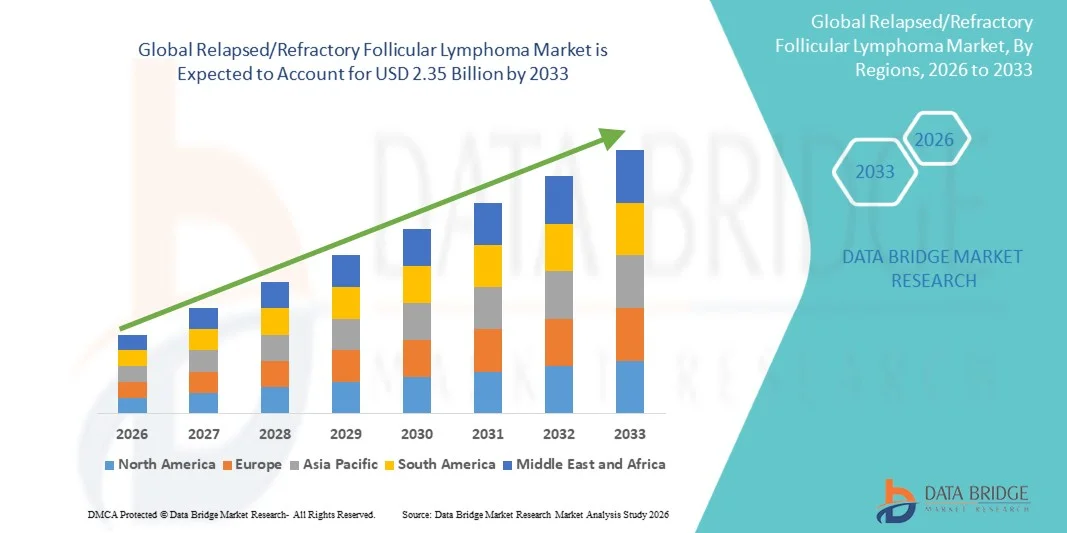
- The global relapsed/refractory follicular lymphoma market size was valued at USD 1.63 billion in 2025and is expected to reach USD 2.35 billion by 2033, at a CAGR of 4.70% during the forecast period
- The market growth is largely fueled by the increasing prevalence of follicular lymphoma and the rising number of patients experiencing relapse or refractory disease, driving demand for advanced and targeted treatment options across global healthcare systems
- Furthermore, continuous advancements in immunotherapies, including monoclonal antibodies, CAR-T cell therapies, and novel targeted agents, along with growing investments in oncology research and improved diagnostic capabilities, are establishing innovative therapies as the preferred treatment approach. These converging factors are accelerating the adoption of relapsed/refractory follicular lymphoma treatments, thereby significantly boosting the market growth
Relapsed/Refractory Follicular Lymphoma Market Analysis
- Relapsed/refractory follicular lymphoma, a subtype of non-Hodgkin lymphoma characterized by disease recurrence or resistance to standard therapies, is increasingly becoming a critical focus area in oncology due to its chronic nature and the need for long-term disease management through advanced and targeted treatment approaches
- The escalating demand for therapies in this market is primarily fueled by the rising incidence of follicular lymphoma, increasing relapse rates after first-line treatments, and a growing preference for personalized medicine, including targeted therapies and immunotherapies that improve patient outcomes
- North America dominated the relapsed/refractory follicular lymphoma market with the largest revenue share of 42.6% in 2025, characterized by advanced healthcare infrastructure, high adoption of novel biologics and cell therapies, and strong presence of leading pharmaceutical companies, with the U.S. witnessing significant growth driven by rapid regulatory approvals and increasing clinical trial activities
- Asia-Pacific is expected to be the fastest growing region in the relapsed/refractory follicular lymphoma market during the forecast period due to improving healthcare access, rising cancer awareness, and increasing investments in oncology research and treatment infrastructure
- Targeted therapy segment dominated the market in 2025 with a share of 58.4%, driven by their superior efficacy, reduced toxicity compared to conventional chemotherapy, and expanding pipeline of innovative drugs including monoclonal antibodies and CAR-T cell therapies
Report Scope and Relapsed/Refractory Follicular Lymphoma Market Segmentation
|
Attributes |
Relapsed/Refractory Follicular Lymphoma Key Market Insights |
|
Segments Covered |
|
|
Countries Covered |
North America · U.S. · Canada · Mexico Europe · Germany · France · U.K. · Netherlands · Switzerland · Belgium · Russia · Italy · Spain · Turkey · Rest of Europe Asia-Pacific · China · Japan · India · South Korea · Singapore · Malaysia · Australia · Thailand · Indonesia · Philippines · Rest of Asia-Pacific Middle East and Africa · Saudi Arabia · U.A.E. · South Africa · Egypt · Israel · Rest of Middle East and Africa South America · Brazil · Argentina · Rest of South America |
|
Key Market Players |
|
|
Market Opportunities |
· The expansion of bispecific antibody therapies in relapsed/refractory cases · The growing adoption of biomarker-driven precision medicine |
|
Value Added Data Infosets |
In addition to the insights on market scenarios such as market value, growth rate, segmentation, geographical coverage, and major players, the market reports curated by the Data Bridge Market Research also include in-depth expert analysis, patient epidemiology, pipeline analysis, pricing analysis, and regulatory framework |
Relapsed/Refractory Follicular Lymphoma Market Trends
“Expansion of Precision Immunotherapy and Next-Generation Biologics”
- A significant and accelerating trend in the global relapsed/refractory follicular lymphoma market is the increasing shift toward precision immunotherapy and next-generation biologics, including bispecific antibodies and CAR-T cell therapies, which are improving response rates in heavily pretreated patients
- For instance, therapies such as mosunetuzumab and epcoritamab are demonstrating strong clinical outcomes in relapsed/refractory cases by redirecting immune cells to target malignant B-cells with higher specificity
- The integration of biomarker-driven treatment approaches is enabling clinicians to better stratify patients and select therapies based on genetic and molecular profiles, improving treatment efficiency and reducing unnecessary toxicity
- Furthermore, combination regimens involving targeted agents and immunotherapies are increasingly being adopted to overcome resistance mechanisms and prolong remission duration in relapsed patients
- The growing role of outpatient-based targeted therapy administration is reducing hospital dependency and improving patient convenience while maintaining strong clinical efficacy in long-term disease management
- The rising expansion of clinical trial pipelines focusing on earlier use of novel immunotherapies in relapse settings is further accelerating innovation and treatment availability across key markets
Relapsed/Refractory Follicular Lymphoma Market Dynamics
Driver
“Rising Prevalence and Expansion of Advanced Oncology Treatment Access”
- The increasing prevalence of follicular lymphoma and the growing proportion of patients experiencing relapse or refractory disease is a major driver for heightened demand for advanced treatment options in this market
- For instance, expanding diagnosis rates and improved disease monitoring are leading to higher identification of relapsed cases requiring second- and third-line therapies across global oncology centers
- The growing availability and adoption of novel therapies such as CAR-T cell therapy and monoclonal antibodies are significantly improving treatment accessibility and outcomes for high-risk patients
- Furthermore, increasing investments in oncology infrastructure and clinical trials are accelerating the development and commercialization of innovative therapies for refractory cases
- The rising adoption of hospital-to-home treatment models and outpatient infusion services is improving patient convenience while expanding therapy reach in urban and semi-urban regions
- The growing integration of real-world evidence into treatment decision-making is further supporting optimized therapy selection and improved clinical outcomes
Restraint/Challenge
“High Treatment Costs and Complex Therapy Administration Barriers”
- Concerns related to the high cost of advanced therapies such as CAR-T cell therapy and bispecific antibodies pose a significant challenge to broader market accessibility and adoption
- For instance, CAR-T therapies require complex manufacturing processes and hospitalization, making them financially and logistically challenging for many healthcare systems and patients
- The requirement for specialized treatment centers and trained oncology professionals further limits the widespread availability of advanced relapsed/refractory treatment options
- Furthermore, reimbursement limitations and uneven healthcare coverage across regions restrict patient access to high-cost innovative therapies despite their clinical benefits
- The limited availability of cold-chain logistics and advanced cell therapy infrastructure in emerging markets further restricts equitable access to novel treatments
- Addressing cost barriers, improving reimbursement frameworks, and expanding treatment infrastructure will be essential for ensuring broader adoption and sustained market growth
Relapsed/Refractory Follicular Lymphoma Market Scope
The market is segmented on the basis of treatment type, route of administration, end-users, and distribution channel.
- By Treatment Type
On the basis of treatment type, the market is segmented into chemotherapy, targeted therapy, and others. The targeted therapy segment dominated the market with the largest revenue share of 58.4% in 2025, driven by its higher efficacy, improved safety profile, and ability to specifically attack malignant B-cells while minimizing damage to healthy tissues. Increasing adoption of monoclonal antibodies, BTK inhibitors, and CAR-T therapies has significantly strengthened this segment’s dominance in relapsed/refractory cases. Furthermore, growing clinical preference for precision medicine and expanding regulatory approvals for novel biologics are reinforcing targeted therapy as the standard of care in advanced disease management.
The chemotherapy segment is expected to witness the fastest growth rate of 18.9% from 2026 to 2033, fueled by its continued use in combination regimens with immunotherapy and targeted agents for patients with aggressive or multi-relapsed disease. For instance, chemo-immunotherapy combinations remain a key option in resource-limited settings where advanced biologics are less accessible. In addition, ongoing clinical research is optimizing lower-toxicity chemotherapy protocols to improve tolerability in older patient populations. The segment is also benefiting from its cost-effectiveness compared to high-priced novel therapies, supporting its sustained adoption in emerging markets.
- By Route of Administration
On the basis of route of administration, the market is segmented into oral, parenteral, and others. The parenteral segment dominated the market with the largest revenue share of 67.4% in 2025, driven by the widespread use of intravenous biologics, monoclonal antibodies, and CAR-T cell therapies that require hospital-based administration. This route ensures rapid drug delivery and controlled dosing, which is critical in managing relapsed/refractory cases with high disease burden. Furthermore, increasing hospital infrastructure for infusion therapies and rising adoption of advanced biologics are reinforcing the dominance of the parenteral segment.
The oral segment is expected to witness the fastest growth rate of 20.3% from 2026 to 2033, driven by rising demand for patient-friendly, home-based treatment options and increasing availability of oral targeted agents such as kinase inhibitors. For instance, oral therapies enable long-term disease management without frequent hospital visits, improving patient compliance and quality of life. The segment is also gaining traction due to ongoing development of next-generation oral small molecules with improved efficacy in resistant disease forms. In addition, healthcare systems are increasingly favoring oral regimens to reduce treatment costs and hospital burden.
- By End-Users
On the basis of end-users, the market is segmented into hospitals, homecare, specialty centres, and others. The hospitals segment dominated the market with the largest revenue share of 58.1% in 2025, driven by the availability of advanced oncology infrastructure, trained specialists, and access to complex therapies such as CAR-T and combination immunotherapies. Hospitals also serve as primary centers for diagnosis, treatment initiation, and management of adverse events in relapsed/refractory cases. Furthermore, strong reimbursement frameworks and high patient inflow for inpatient oncology care are reinforcing hospital dominance in this market.
The specialty centres segment is expected to witness the fastest growth rate of 19.6% from 2026 to 2033, fueled by increasing preference for focused cancer care facilities offering advanced diagnostics and personalized treatment approaches. For instance, oncology specialty centres are rapidly expanding in both developed and emerging markets to support precision medicine-based lymphoma care. These centres provide improved treatment outcomes through multidisciplinary expertise and access to clinical trials. In addition, rising patient preference for dedicated cancer treatment environments is further accelerating segment growth.
- By Distribution Channel
On the basis of distribution channel, the market is segmented into hospital pharmacy, retail pharmacy, and online pharmacy. The hospital pharmacy segment dominated the market with the largest revenue share of 61.7% in 2025, driven by the direct dispensing of high-cost oncology drugs used in inpatient and infusion-based treatments. Hospital pharmacies ensure strict monitoring, proper handling of biologics, and immediate availability of critical therapies during treatment cycles. Furthermore, integration with oncology departments and centralized procurement systems strengthens the dominance of this segment.
The online pharmacy segment is expected to witness the fastest growth rate of 22.1% from 2026 to 2033, driven by increasing digitalization of healthcare services and growing demand for convenient medication access for maintenance therapies. For instance, patients on long-term oral targeted treatments are increasingly using online platforms for prescription refills and home delivery services. The segment is also benefiting from expanding tele-oncology services and rising adoption of digital health ecosystems. In addition, improved regulatory frameworks for e-pharmacy operations are further supporting market expansion.
Relapsed/Refractory Follicular Lymphoma Market Regional Analysis
- North America dominated the relapsed/refractory follicular lymphoma market with the largest revenue share of 42.6% in 2025, characterized by advanced healthcare infrastructure, high adoption of novel biologics and cell therapies, and strong presence of leading pharmaceutical companies
- Patients and clinicians in the region highly value the availability of innovative treatment options such as CAR-T cell therapy, bispecific antibodies, and next-generation monoclonal antibodies, which offer improved response rates in refractory cases
- This widespread adoption is further supported by advanced healthcare infrastructure, strong presence of leading pharmaceutical companies, high healthcare expenditure, and rapid regulatory approvals, establishing North America as a key hub for relapsed/refractory follicular lymphoma treatment
U.S. Relapsed/Refractory Follicular Lymphoma Market Insight
The U.S. relapsed/refractory follicular lymphoma market captured the largest revenue share of 79% in 2025 within North America, fueled by high disease prevalence, rapid adoption of advanced oncology therapies, and strong presence of leading pharmaceutical and biotech companies. Patients and healthcare providers are increasingly prioritizing innovative treatment approaches such as CAR-T cell therapies, bispecific antibodies, and next-generation targeted agents for improved long-term outcomes. The growing participation in clinical trials, combined with robust reimbursement frameworks and early regulatory approvals, further propels the market. Moreover, strong integration of precision medicine and biomarker-driven treatment strategies is significantly contributing to the market’s expansion.
Europe Relapsed/Refractory Follicular Lymphoma Market Insight
The Europe relapsed/refractory follicular lymphoma market is projected to expand at a substantial CAGR throughout the forecast period, primarily driven by strong public healthcare systems and increasing adoption of immunotherapy-based treatment protocols. Rising incidence of non-Hodgkin lymphoma and improved access to novel oncology drugs are fostering market growth across major countries such as Germany, France, and the U.K. European patients are also benefiting from structured reimbursement policies and active participation in clinical trials for advanced therapies. Furthermore, increasing focus on early diagnosis and personalized treatment approaches is strengthening the adoption of targeted therapies across the region.
U.K. Relapsed/Refractory Follicular Lymphoma Market Insight
The U.K. relapsed/refractory follicular lymphoma market is anticipated to grow at a noteworthy CAGR during the forecast period, driven by expanding access to innovative oncology treatments and strong clinical research activity. Increasing cases of lymphoma and growing reliance on advanced therapies such as monoclonal antibodies and CAR-T treatments are supporting market expansion. In addition, the National Health Service (NHS) plays a crucial role in improving treatment accessibility through reimbursement and structured care pathways. The country’s strong participation in global clinical trials and focus on precision medicine further accelerate the adoption of next-generation lymphoma therapies.
Germany Relapsed/Refractory Follicular Lymphoma Market Insight
The Germany relapsed/refractory follicular lymphoma market is expected to expand at a considerable CAGR during the forecast period, fueled by advanced healthcare infrastructure and strong emphasis on innovative oncology research. Rising awareness of hematological malignancies and increasing adoption of targeted therapies are key growth drivers in the country. Germany’s strong pharmaceutical manufacturing base and high clinical trial activity further support the availability of advanced treatment options. Moreover, growing preference for personalized medicine and biomarker-guided therapies is significantly enhancing treatment outcomes in relapsed cases.
Asia-Pacific Relapsed/Refractory Follicular Lymphoma Market Insight
The Asia-Pacific relapsed/refractory follicular lymphoma market is poised to grow at the fastest CAGR of 20.8% during the forecast period of 2026 to 2033, driven by rising cancer incidence, improving healthcare infrastructure, and increasing access to advanced oncology therapies. Growing government investments in cancer care and expanding availability of targeted treatments are accelerating market growth across countries such as China, Japan, and India. Furthermore, increasing participation in global clinical trials and rising awareness of immunotherapy-based treatments are supporting adoption. The region is also benefiting from growing healthcare digitization and expanding oncology specialty centers.
Japan Relapsed/Refractory Follicular Lymphoma Market Insight
The Japan relapsed/refractory follicular lymphoma market is gaining momentum due to its advanced healthcare system, aging population, and strong focus on precision oncology. Increasing adoption of CAR-T therapies and monoclonal antibodies is driving improved outcomes in refractory cases. Japan’s high level of clinical research activity and rapid uptake of innovative treatments further support market growth. In addition, integration of biomarker testing and personalized medicine approaches is enhancing treatment selection and effectiveness in the country.
India Relapsed/Refractory Follicular Lymphoma Market Insight
The India relapsed/refractory follicular lymphoma market accounted for a growing share in Asia-Pacific in 2025, attributed to increasing cancer awareness, improving diagnostic capabilities, and rising access to oncology care in urban centers. Expanding availability of affordable targeted therapies and growing penetration of private cancer hospitals are key drivers of market growth. India’s participation in global clinical trials and rising focus on improving cancer treatment infrastructure are further strengthening the market. In addition, increasing government initiatives in oncology care and insurance coverage expansion are supporting broader patient access to advanced therapies.
Relapsed/Refractory Follicular Lymphoma Market Share
The Relapsed/Refractory Follicular Lymphoma industry is primarily led by well-established companies, including:
- F. Hoffmann-La Roche Ltd (Switzerland)
- AbbVie Inc. (U.S.)
- Genmab A/S (Denmark)
- Novartis AG (Switzerland)
- Bristol-Myers Squibb Company (U.S.)
- Gilead Sciences, Inc. (U.S.)
- Amgen Inc. (U.S.)
- Regeneron Pharmaceuticals, Inc. (U.S.)
- AstraZeneca (U.K.)
- Merck & Co., Inc. (U.S.)
- BeiGene, Ltd. (China)
- Pfizer Inc. (U.S.)
- Eli Lilly and Company (U.S.)
- Sanofi (France)
- Takeda Pharmaceutical Company Limited (Japan)
- Incyte Corporation (U.S.)
- Gilead Sciences Ireland UC (Ireland)
- TG Therapeutics, Inc. (U.S.)
- ADC Therapeutics SA (Switzerland)
What are the Recent Developments in Global Relapsed/Refractory Follicular Lymphoma Market?
- In January 2026, Genmab and AbbVie reported that the late-stage trial of epcoritamab in relapsed/refractory B-cell lymphoma did not meet its primary endpoint of overall survival improvement, although improvements were observed in response rates and disease control metrics. The study included patients with heavily pretreated relapsed or refractory lymphoma, highlighting both the promise and limitations of bispecific antibody therapy in advanced disease settings
- In December 2025, the FDA approved a subcutaneous formulation of mosunetuzumab (Lunsumio VELO) for relapsed/refractory follicular lymphoma. The innovation reduced infusion time from hours to about one minute, improving outpatient convenience and accessibility. This development supports wider adoption of bispecific T-cell engagers in community oncology settings
- In November 2025, the U.S. FDA approved epcoritamab-bysp (Epkinly) in combination with rituximab and lenalidomide for adult patients with relapsed or refractory follicular lymphoma. This marked a major expansion of bispecific antibody-based regimens into earlier treatment lines, significantly improving response rates and progression-free survival. The approval highlights the growing shift toward chemo-free immunotherapy combinations in advanced lymphoma care
- In June 2024, the FDA granted approval for epcoritamab (Epkinly) as monotherapy for relapsed/refractory follicular lymphoma after two or more prior treatments. This made it the first subcutaneous T-cell engaging bispecific antibody approved for this indication. The approval reinforced bispecific antibodies as a key treatment class in heavily pretreated patients
- In December 2022, the FDA granted accelerated approval to mosunetuzumab-axgb (Lunsumio) for relapsed/refractory follicular lymphoma after at least two prior therapies. It became one of the first CD20xCD3 bispecific antibodies approved for this patient group, offering high response rates in late-line disease. This approval marked a turning point in immunotherapy-based lymphoma treatment
SKU-
Get online access to the report on the World's First Market Intelligence Cloud

- Interactive Data Analysis Dashboard
- Company Analysis Dashboard for high growth potential opportunities
- Research Analyst Access for customization & queries
- Competitor Analysis with Interactive dashboard
- Latest News, Updates & Trend analysis
- Harness the Power of Benchmark Analysis for Comprehensive Competitor Tracking
Research Methodology
Data collection and base year analysis are done using data collection modules with large sample sizes. The stage includes obtaining market information or related data through various sources and strategies. It includes examining and planning all the data acquired from the past in advance. It likewise envelops the examination of information inconsistencies seen across different information sources. The market data is analysed and estimated using market statistical and coherent models. Also, market share analysis and key trend analysis are the major success factors in the market report. To know more, please request an analyst call or drop down your inquiry.
The key research methodology used by DBMR research team is data triangulation which involves data mining, analysis of the impact of data variables on the market and primary (industry expert) validation. Data models include Vendor Positioning Grid, Market Time Line Analysis, Market Overview and Guide, Company Positioning Grid, Patent Analysis, Pricing Analysis, Company Market Share Analysis, Standards of Measurement, Global versus Regional and Vendor Share Analysis. To know more about the research methodology, drop in an inquiry to speak to our industry experts.
Customization Available
Data Bridge Market Research is a leader in advanced formative research. We take pride in servicing our existing and new customers with data and analysis that match and suits their goal. The report can be customized to include price trend analysis of target brands understanding the market for additional countries (ask for the list of countries), clinical trial results data, literature review, refurbished market and product base analysis. Market analysis of target competitors can be analyzed from technology-based analysis to market portfolio strategies. We can add as many competitors that you require data about in the format and data style you are looking for. Our team of analysts can also provide you data in crude raw excel files pivot tables (Fact book) or can assist you in creating presentations from the data sets available in the report.