Global Renal Disease Market
Market Size in USD Billion
CAGR :
% 
 USD
119.81 Billion
USD
183.87 Billion
2025
2033
USD
119.81 Billion
USD
183.87 Billion
2025
2033
 Forecast Period Forecast Period |
2026 –2033 |
 Market Size (Base Year) Market Size (Base Year) |
USD 119.81 Billion |
 Market Size (Forecast Year) Market Size (Forecast Year) |
USD 183.87 Billion |
 CAGR CAGR |
% |
| Major Markets Players |
|
Renal Disease Market Size
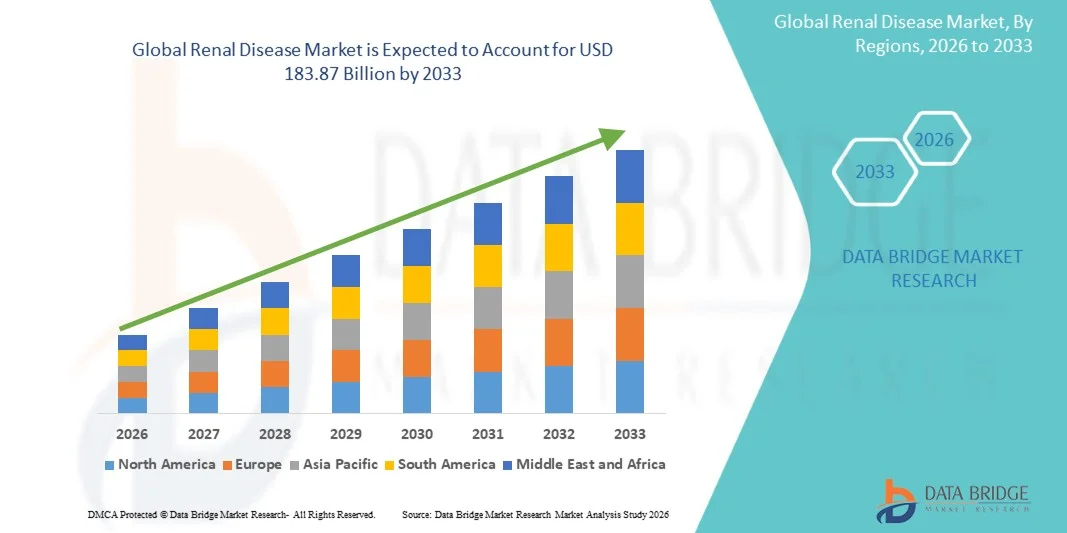
- The global renal disease market size was valued at USD 119.81 billion in 2025and is expected to reach USD 183.87 billion by 2033, at a CAGR of 5.50% during the forecast period
- The market growth is largely driven by the rising prevalence of chronic kidney disease (CKD), increasing incidence of diabetes and hypertension, and the growing aging population worldwide, all of which significantly elevate the risk of renal impairment and kidney failure
- Furthermore, expanding access to dialysis services, advancements in renal replacement therapies, and increasing demand for early diagnosis and long-term disease management solutions are strengthening the adoption of renal care products and services, thereby accelerating overall market growth
Renal Disease Market Analysis
- Chronic and acute renal diseases, including chronic kidney disease (CKD), acute kidney injury (AKI), and end-stage renal disease (ESRD), are increasingly significant global health burdens due to rising prevalence of diabetes, hypertension, and aging populations, driving strong demand for early diagnosis, dialysis, and kidney care management across hospitals and specialty clinics worldwide
- The escalating burden of renal disease is primarily driven by the growing incidence of lifestyle-related disorders, increasing obesity rates, and improved diagnostic awareness leading to higher detection rates, alongside expanding access to renal care infrastructure such as dialysis centers, transplant services, and home-based treatment solutions
- North America dominated the renal disease market with the largest revenue share of 38.7% in 2025, supported by advanced healthcare infrastructure, high treatment adoption rates, strong reimbursement systems, and a well-established dialysis network, with the U.S. witnessing significant growth in home dialysis and innovative renal therapeutics
- Asia-Pacific is expected to be the fastest growing region in the renal disease market during the forecast period due to a rapidly expanding patient pool, improving healthcare access, rising healthcare expenditure, and increasing government initiatives for early CKD screening and dialysis expansion programs
- Chronic Kidney Disease (CKD) segment dominated the renal disease market with the largest market share of 52.4% in 2025, driven by its high global prevalence, progressive nature requiring long-term management, and strong association with diabetes and hypertension, which significantly increase the demand for continuous monitoring, pharmacological therapy, and renal replacement interventions
Report Scope and Renal Disease Market Segmentation
|
Attributes |
Renal Disease Key Market Insights |
|
Segments Covered |
|
|
Countries Covered |
North America · U.S. · Canada · Mexico Europe · Germany · France · U.K. · Netherlands · Switzerland · Belgium · Russia · Italy · Spain · Turkey · Rest of Europe Asia-Pacific · China · Japan · India · South Korea · Singapore · Malaysia · Australia · Thailand · Indonesia · Philippines · Rest of Asia-Pacific Middle East and Africa · Saudi Arabia · U.A.E. · South Africa · Egypt · Israel · Rest of Middle East and Africa South America · Brazil · Argentina · Rest of South America |
|
Key Market Players |
|
|
Market Opportunities |
· Rapid expansion of home dialysis and remote patient monitoring solutions · Growing adoption of AI-driven predictive diagnostics for early-stage CKD detection |
|
Value Added Data Infosets |
In addition to the insights on market scenarios such as market value, growth rate, segmentation, geographical coverage, and major players, the market reports curated by the Data Bridge Market Research also include in-depth expert analysis, patient epidemiology, pipeline analysis, pricing analysis, and regulatory framework |
Renal Disease Market Trends
“Expansion of Home-Based Dialysis and Digital Renal Monitoring”
- A significant and accelerating trend in the global renal disease market is the growing shift toward home-based dialysis and remote patient monitoring solutions integrated with digital health platforms, improving patient convenience and long-term disease management outcomes
- For instance, Fresenius Medical Care’s home hemodialysis systems enable patients to perform dialysis at home with connected monitoring support, reducing hospital dependency and improving treatment flexibility
- Digital integration in renal care enables real-time tracking of vital parameters, fluid balance, and treatment adherence, while AI-driven analytics help clinicians predict disease progression and optimize personalized treatment plans for CKD and ESRD patients
- Furthermore, connected renal care ecosystems allow seamless coordination between hospitals, dialysis centers, and nephrologists through centralized platforms, improving care continuity and reducing emergency hospitalization risks
- This trend towards patient-centric, technology-enabled renal care is reshaping treatment expectations, with companies such as Baxter International developing advanced home dialysis machines with remote connectivity and automated treatment adjustment
- The demand for home-based and digitally integrated renal care solutions is rapidly increasing across both developed and emerging markets, as healthcare systems focus on reducing infrastructure burden and improving patient quality of life
- Moreover, tele-nephrology services are expanding rapidly, allowing remote consultations and follow-up care, particularly in underserved and rural regions where access to nephrologists is limited
Renal Disease Market Dynamics
Driver
“Rising Prevalence of Diabetes and Hypertension Driving CKD Burden”
- The increasing global prevalence of diabetes, hypertension, and obesity, coupled with aging populations, is a major driver for the growing incidence of chronic kidney disease and end-stage renal disease worldwide
- For instance, in March 2025, DaVita Inc. expanded its value-based kidney care programs in the U.S. to manage rising CKD patient loads through early intervention and integrated care models
- As lifestyle-related disorders continue to increase, renal complications are becoming more common, significantly boosting demand for dialysis services, kidney transplantation, and long-term nephrology care
- Furthermore, improved disease awareness and screening programs are enabling earlier diagnosis of renal impairment, increasing the number of patients entering treatment pathways at earlier stages
- The growing need for continuous renal replacement therapies, along with expanding healthcare infrastructure in emerging economies, is strongly supporting market expansion across both inpatient and outpatient settings
- In addition, government-led CKD screening initiatives in several countries are increasing early-stage detection rates, thereby expanding the treated patient pool
- Moreover, rising adoption of advanced biologics and targeted therapies for slowing kidney disease progression is further supporting market growth
Restraint/Challenge
“High Treatment Costs and Limited Access to Advanced Renal Care Infrastructure”
- Concerns regarding the high cost of dialysis treatments, kidney transplantation procedures, and long-term disease management remain a significant challenge limiting broader access to renal care services
- For instance, in several low- and middle-income countries, limited availability of dialysis centers and trained nephrologists restricts timely treatment access for ESRD patients, leading to higher mortality rates
- In addition, the financial burden of frequent dialysis sessions and lifelong medication requirements places strain on patients and healthcare systems, particularly in regions with limited insurance coverage
- Furthermore, disparities in healthcare infrastructure between urban and rural areas create unequal access to advanced renal therapies and early diagnostic services
- While government initiatives and public-private partnerships are expanding dialysis capacity, affordability and infrastructure gaps continue to hinder uniform market growth globally
- Overcoming these challenges through cost-effective treatment models, expanded reimbursement policies, and improved renal care infrastructure will be critical for sustained market development
- In addition, shortages of skilled nephrology professionals further limit timely treatment delivery in many developing regions
- Moreover, high dependency on imported dialysis equipment and consumables increases operational costs, creating additional pressure on healthcare systems
Renal Disease Market Scope
The market is segmented on the basis of indication, treatment, route of administration, end-users, and distribution channel.
- By Indication
On the basis of indication, the renal disease market is segmented into acute kidney injury (AKI), chronic kidney disease (CKD), end-stage renal disease (ESRD), and others. The chronic kidney disease (CKD) segment dominated the market with the largest revenue share of 52.4% in 2025, driven by its high global prevalence, strong association with diabetes and hypertension, and progressive nature requiring long-term management. CKD patients require continuous monitoring, pharmacological therapy, and dialysis preparation, which significantly increases healthcare utilization. Rising awareness, early screening programs, and improved diagnostic rates are further strengthening CKD dominance across both developed and emerging regions. In addition, the growing aging population continues to expand the CKD patient pool, making it the most economically impactful indication in the market.
The end-stage renal disease (ESRD) segment is anticipated to witness the fastest growth rate of 8.9% from 2026 to 2033, fueled by the increasing progression of untreated or late-stage CKD cases into irreversible kidney failure. ESRD patients require dialysis or kidney transplantation, significantly driving demand for advanced renal replacement therapies. Expansion of dialysis centers, especially in Asia-Pacific and Latin America, is supporting faster treatment access. Furthermore, innovations in home dialysis systems and portable machines are improving patient compliance and accelerating adoption. Rising healthcare investments and reimbursement support for ESRD management are also contributing to strong segment growth.
- By Treatment
On the basis of treatment, the renal disease market is segmented into corticosteroids, ACE inhibitors, diuretics, immunosuppressive therapy, and others. The ACE inhibitors segment dominated the market with the largest revenue share of 34.6% in 2025, driven by their widespread use as first-line therapy for managing CKD and hypertension-related kidney complications. These drugs are highly effective in slowing disease progression by reducing proteinuria and controlling blood pressure. Their strong clinical validation and inclusion in major treatment guidelines further reinforce their dominance. In addition, affordability and global availability make them a preferred choice across healthcare systems. Increasing prescriptions for diabetic nephropathy management further support segment leadership.
The immunosuppressive therapy segment is expected to witness the fastest growth rate of 9.3% from 2026 to 2033, driven by rising kidney transplant procedures and autoimmune-related renal disorders such as lupus nephritis. These therapies are critical for preventing organ rejection and managing immune-mediated kidney damage. Advancements in targeted biologics with improved safety profiles are expanding treatment adoption. Increasing transplant success rates and expanding donor programs are also boosting demand. Furthermore, growing research in precision immunotherapy is expected to further accelerate segment expansion.
- By Route of Administration
On the basis of route of administration, the renal disease market is segmented into oral and parenteral. The oral segment dominated the market with the largest revenue share of 61.8% in 2025, driven by its ease of administration, high patient compliance, and widespread use in long-term CKD management therapies such as ACE inhibitors and diuretics. Oral medications are preferred for chronic treatment due to convenience and lower healthcare facility dependence. Their cost-effectiveness and availability across retail and hospital pharmacies further strengthen dominance. In addition, oral drugs are extensively used in outpatient settings, supporting long-term disease control.
The parenteral segment is anticipated to witness the fastest growth rate of 8.5% from 2026 to 2033, driven by increasing use in dialysis care, emergency AKI management, and immunosuppressive therapy for transplant patients. Injectable formulations ensure rapid drug delivery and higher bioavailability, making them essential in critical care settings. Rising hospitalization rates for severe renal conditions are further supporting segment growth. In addition, advancements in infusion therapies and biologics are expanding parenteral treatment applications.
- By End-Users
On the basis of end-users, the renal disease market is segmented into hospitals, homecare, specialty clinics, and others. The hospitals segment dominated the market with the largest revenue share of 48.9% in 2025, driven by the high volume of dialysis procedures, emergency kidney care treatments, and transplant surgeries performed in hospital settings. Hospitals are equipped with advanced diagnostic and renal replacement therapy infrastructure, making them the primary care point for severe renal conditions. Availability of multidisciplinary nephrology teams further strengthens their dominance. In addition, reimbursement support for inpatient renal care contributes significantly to market share.
The homecare segment is expected to witness the fastest growth rate of 10.2% from 2026 to 2033, driven by the rising adoption of home dialysis systems and remote patient monitoring technologies. Patients increasingly prefer home-based care due to convenience, reduced hospital visits, and improved quality of life. Technological advancements in portable dialysis machines are enabling safer home treatment. Growing healthcare digitalization and tele-nephrology services are also supporting segment expansion. Furthermore, cost savings compared to hospital-based care are accelerating adoption in both developed and emerging economies.
- By Distribution Channel
On the basis of distribution channel, the renal disease market is segmented into hospital pharmacy, retail pharmacy, and online pharmacy. The hospital pharmacy segment dominated the market with the largest revenue share of 46.5% in 2025, driven by high inpatient treatment volumes, dialysis-related drug dispensing, and immediate availability of critical renal medications within hospital systems. Hospital pharmacies ensure controlled drug administration for severe renal patients, particularly in ICU and dialysis units. Integration with hospital treatment protocols further strengthens their dominance. In addition, reimbursement-linked procurement systems contribute to sustained demand.
The online pharmacy segment is expected to witness the fastest growth rate of 11.4% from 2026 to 2033, driven by increasing digital healthcare adoption and growing demand for convenient drug access among chronic kidney disease patients. Online platforms offer doorstep delivery of long-term medications, improving adherence and reducing hospital dependency. Expansion of telemedicine services is further supporting online prescription fulfillment. Rising internet penetration and smartphone usage in emerging markets are accelerating adoption. In addition, discounts and subscription-based medicine delivery models are enhancing segment growth.
Renal Disease Market Regional Analysis
- North America dominated the renal disease market with the largest revenue share of 38.7% in 2025, supported by advanced healthcare infrastructure, high treatment adoption rates, strong reimbursement systems, and a well-established dialysis network
- Patients and healthcare providers in the region highly prioritize early diagnosis, advanced treatment options, and comprehensive renal care services, supported by widespread availability of dialysis centers, transplant programs, and nephrology specialists across hospitals and clinics
- This strong market position is further supported by high healthcare spending, rapid adoption of innovative renal therapies and home dialysis solutions, and increasing integration of digital health technologies for remote patient monitoring and disease management, establishing renal care as a critical component of chronic disease management in the region
U.S. Renal Disease Market Insight
The U.S. renal disease market captured the largest revenue share in North America in 2025, driven by a high burden of diabetes-related kidney disorders and a well-established dialysis care infrastructure. The country shows strong adoption of advanced renal replacement therapies, including in-center and home dialysis systems, supported by favorable reimbursement policies under Medicare and private insurance. Patients increasingly prefer early-stage CKD diagnosis and long-term disease management programs, contributing to higher treatment uptake. In addition, strong presence of key market players and continuous innovation in biologics, dialysis equipment, and digital renal monitoring solutions further strengthen market growth across the U.S. healthcare system.
Europe Renal Disease Market Insight
Europe renal disease market is projected to expand at a substantial CAGR throughout the forecast period, primarily driven by rising CKD prevalence, aging population, and increasing government focus on preventive screening and early-stage diagnosis programs. The region benefits from well-established public healthcare systems, strong awareness of kidney disease management, and growing access to dialysis and transplant services across hospitals and specialty clinics. European patients increasingly prefer long-term disease management and quality-of-life improvement, supporting adoption of advanced therapies, home dialysis solutions, and integrated renal care systems across both urban and rural settings.
U.K. Renal Disease Market Insight
U.K. renal disease market is anticipated to grow at a noteworthy CAGR during the forecast period, driven by increasing CKD burden, rising diabetes cases, and strong NHS focus on early intervention and chronic disease management strategies. The market is characterized by growing adoption of outpatient dialysis and home-based renal care solutions, supported by expanding tele-nephrology services and digital health integration. In addition, increasing awareness of kidney health, structured screening programs, and improved access to specialist nephrology care are further supporting market growth across the U.K. healthcare system.
Germany Renal Disease Market Insight
Germany renal disease market is expected to expand at a considerable CAGR during the forecast period, fueled by strong healthcare infrastructure, high burden of lifestyle-related kidney disorders, and increasing adoption of advanced renal treatment technologies. The country emphasizes early diagnosis and precision treatment approaches, supporting widespread use of ACE inhibitors, immunosuppressive therapies, and dialysis-based care in clinical practice. Furthermore, Germany’s focus on innovation, hospital modernization, and comprehensive insurance coverage for renal care services is driving strong adoption of both inpatient and outpatient kidney disease management solutions.
Asia-Pacific Renal Disease Market Insight
Asia-Pacific renal disease market is poised to grow at the fastest CAGR of 10.8% during the forecast period of 2026 to 2033, driven by rapidly rising diabetes prevalence, urbanization, and improving access to healthcare infrastructure in emerging economies. The region is witnessing strong expansion of dialysis centers, increasing awareness of CKD screening, and growing adoption of affordable treatment options across hospitals and specialty clinics. In addition, government initiatives supporting healthcare modernization and universal access to renal care services are significantly improving treatment availability and accelerating market expansion across developing countries.
Japan Renal Disease Market Insight
Japan renal disease market is gaining momentum due to a rapidly aging population, high CKD prevalence, and strong focus on advanced healthcare delivery and long-term dialysis management systems. The country prioritizes high-quality renal care services, with extensive use of dialysis treatments, transplant support programs, and advanced therapeutic interventions in hospital settings. Moreover, increasing integration of digital health monitoring systems and growing adoption of home-based care solutions are enhancing patient convenience and improving chronic kidney disease management outcomes.
India Renal Disease Market Insight
India renal disease market accounted for the largest market revenue share in Asia-Pacific in 2025, attributed to a large diabetic population, rising hypertension cases, and rapid urbanization driving lifestyle-related kidney disorders. The country is witnessing strong expansion of dialysis infrastructure, increasing availability of affordable treatment options, and growing awareness regarding early-stage kidney disease diagnosis. In addition, government initiatives supporting healthcare infrastructure development and rising penetration of health insurance are significantly improving access to renal care services across both urban and rural populations.
Renal Disease Market Share
The Renal Disease industry is primarily led by well-established companies, including:
- Fresenius Medical Care AG (Germany)
- DaVita Inc. (U.S.)
- Baxter (U.S.)
- B. Braun SE (Germany)
- Nipro Corporation (Japan)
- Asahi Kasei Corporation (Japan)
- Nikkiso Co., Ltd. (Japan)
- Medtronic (Ireland)
- BD (U.S.)
- Rockwell Medical, Inc. (U.S.)
- Toray Industries, Inc. (Japan)
- JMS Co., Ltd. (Japan)
- Terumo Corporation (Japan)
- Fresenius Kabi AG (Germany)
- Diaverum AB (Sweden)
- Quanta Dialysis Technologies Ltd (U.K.)
- AWAK Technologies Pte. Ltd. (Singapore)
- Outset Medical, Inc. (U.S.)
- Vifor Pharma AG (Switzerland)
- Satellite Healthcare, Inc. (U.S.)
What are the Recent Developments in Global Renal Disease Market?
- In November 2025, Otsuka Pharmaceutical received FDA approval for Voyxact for IgA nephropathy, marking a major advancement in targeted renal disease therapy. The approval provides a new treatment option for patients with primary IgA nephropathy, a progressive autoimmune kidney disorder that can lead to kidney failure. Clinical trials demonstrated significant reduction in proteinuria, improving kidney protection outcomes. This development highlights the growing shift toward precision biologic therapies in renal care
- In March 2025, the National Kidney Foundation highlighted multiple new CKD drug approvals in the U.S., expanding treatment options for patients with kidney disorders. These include novel therapies targeting IgA nephropathy, lupus nephritis, and diabetic kidney disease. The new drugs introduce advanced mechanisms such as monoclonal antibodies and anti-inflammatory pathways to slow disease progression. This development significantly strengthens the global renal therapeutics pipeline
- In January 2025, the FDA expanded approval of semaglutide (Ozempic) for chronic kidney disease in type 2 diabetes patients, strengthening its role beyond glucose control. The therapy showed effectiveness in slowing kidney function decline and reducing risk of kidney failure and cardiovascular complications. This approval represents a key milestone in integrating metabolic and renal disease treatment pathways. It also reflects increasing use of GLP-1 receptor agonists in kidney protection strategies
- In June 2024, Fresenius Medical Care advanced its home dialysis expansion programs globally, strengthening the shift toward patient-centric renal care. The company expanded availability of home hemodialysis and digital monitoring solutions across multiple regions. These systems enable patients to undergo treatment outside hospitals with remote clinical supervision. This development supports reduced healthcare burden and improved quality of life for CKD and ESRD patients
- In April 2023, DaVita Inc. expanded its value-based kidney care model in the United States, focusing on early-stage CKD management and prevention of disease progression. The initiative integrates coordinated care, early diagnosis, and personalized treatment pathways for high-risk patients. It aims to reduce hospitalizations and improve long-term renal outcomes through proactive care management. This reflects the broader industry transition toward value-based renal healthcare deliver
SKU-
Get online access to the report on the World's First Market Intelligence Cloud

- Interactive Data Analysis Dashboard
- Company Analysis Dashboard for high growth potential opportunities
- Research Analyst Access for customization & queries
- Competitor Analysis with Interactive dashboard
- Latest News, Updates & Trend analysis
- Harness the Power of Benchmark Analysis for Comprehensive Competitor Tracking
Research Methodology
Data collection and base year analysis are done using data collection modules with large sample sizes. The stage includes obtaining market information or related data through various sources and strategies. It includes examining and planning all the data acquired from the past in advance. It likewise envelops the examination of information inconsistencies seen across different information sources. The market data is analysed and estimated using market statistical and coherent models. Also, market share analysis and key trend analysis are the major success factors in the market report. To know more, please request an analyst call or drop down your inquiry.
The key research methodology used by DBMR research team is data triangulation which involves data mining, analysis of the impact of data variables on the market and primary (industry expert) validation. Data models include Vendor Positioning Grid, Market Time Line Analysis, Market Overview and Guide, Company Positioning Grid, Patent Analysis, Pricing Analysis, Company Market Share Analysis, Standards of Measurement, Global versus Regional and Vendor Share Analysis. To know more about the research methodology, drop in an inquiry to speak to our industry experts.
Customization Available
Data Bridge Market Research is a leader in advanced formative research. We take pride in servicing our existing and new customers with data and analysis that match and suits their goal. The report can be customized to include price trend analysis of target brands understanding the market for additional countries (ask for the list of countries), clinical trial results data, literature review, refurbished market and product base analysis. Market analysis of target competitors can be analyzed from technology-based analysis to market portfolio strategies. We can add as many competitors that you require data about in the format and data style you are looking for. Our team of analysts can also provide you data in crude raw excel files pivot tables (Fact book) or can assist you in creating presentations from the data sets available in the report.