




Global Resectoscopes Devices Market
Market Size in USD Billion
CAGR :
% 
 USD
423.40 Billion
USD
659.70 Billion
2025
2033
USD
423.40 Billion
USD
659.70 Billion
2025
2033
 Forecast Period Forecast Period |
2026 - 2033 |
 Market Size (Base Year) Market Size (Base Year) |
USD 423.40 Billion |
 Market Size (Forecast Year) Market Size (Forecast Year) |
USD 659.70 Billion |
 CAGR CAGR |
% |
| Major Markets Players |
|
Resectoscopes Devices Market Overview
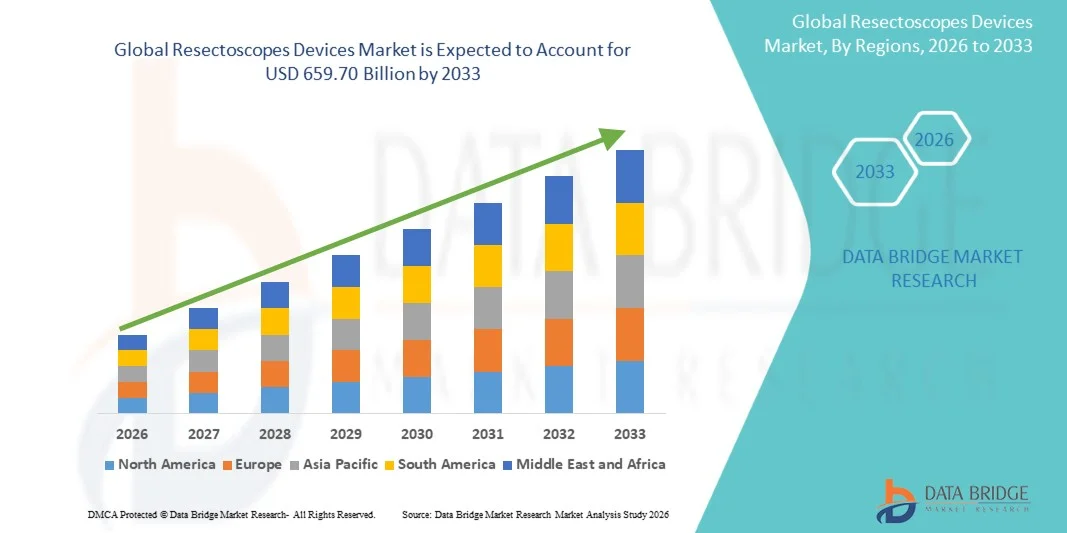
The Resectoscopes Devices Market was valued at USD 423.40 billion in 2025 and is projected to reach USD 659.70 billion by 2033, growing at a CAGR of 5.70% from 2026 to 2033. The market is experiencing steady growth driven by the rising prevalence of urological and gynecological disorders, increasing demand for minimally invasive surgical procedures, and continuous advancements in endoscopic surgical technologies. Growing adoption of resectoscope devices across hospitals, ambulatory surgical centers, and specialty clinics for procedures such as transurethral resection of the prostate (TURP), bladder tumor removal, and hysteroscopic surgeries is significantly supporting market expansion.
The increasing global burden of benign prostatic hyperplasia (BPH), bladder cancer, uterine abnormalities, and other chronic conditions, combined with rising preference for minimally invasive treatment approaches, is compelling healthcare providers to adopt advanced resectoscope systems. Bipolar and laser-assisted resectoscope technologies are increasingly replacing conventional surgical methods in many healthcare settings, offering improved precision, reduced bleeding risk, shorter hospital stays, and faster patient recovery outcomes. In addition, advancements in high-definition imaging systems, electrosurgical integration, and minimally invasive surgical infrastructure are further accelerating adoption of resectoscope devices across developed and emerging healthcare markets.
Key Market Trends & Insights
- North America dominated the Resectoscopes Devices Market with the largest revenue share of 38.46% in 2025, supported by advanced healthcare infrastructure, rising adoption of minimally invasive urological and gynecological procedures, strong reimbursement coverage, and increasing use of advanced endoscopic surgical devices across hospitals and ambulatory surgical centers in the U.S. and Canada.
- The hospitals segment dominated the market with a share of 64.18% in 2025 due to the high volume of endoscopic urology and gynecology procedures performed in hospital settings
- Asia-Pacific is expected to be the fastest-growing region at a CAGR of 7.9% from 2026 to 2033, fueled by rising prevalence of urological disorders, expanding healthcare infrastructure, increasing medical tourism, and growing adoption of advanced surgical technologies in China, India, Japan, and South Korea.
- The Unipolar Resectoscopes segment is expected to witness steady growth, supported by continued use in cost-sensitive healthcare facilities and widespread adoption in conventional transurethral resection procedures across developing markets.
- The Hospitals segment dominates the application category with a 61.37% revenue share in 2025, led by high surgical procedure volumes, availability of advanced operating room infrastructure, and increasing adoption of minimally invasive surgical techniques in tertiary care hospitals globally.
- Ambulatory Surgery Centres are projected to be the fastest-growing application segment, registering a CAGR of 7.4% from 2026 to 2033, driven by rising demand for outpatient surgical procedures, shorter recovery times, lower treatment costs, and increasing preference for same-day surgeries.
- The Others segment, including specialty clinics and research institutes, is witnessing gradual growth due to increasing adoption of compact endoscopic surgical systems and expanding access to minimally invasive treatment procedures in emerging healthcare markets.
Market Size & Forecast
- Global Market Value (2025): USD 423.40 Billion
- Expected Market Value (2033): USD 659.70 Billion
- Forecast CAGR (2026–2033): 5.70%
- Leading Region in 2025: North America
- Fastest Growing Region: Asia-Pacific
Report Scope and Resectoscopes Devices Market Segmentation
|
Attributes |
Resectoscopes Devices Key Market Insights |
|
Segments Covered |
|
|
Countries Covered |
North America · U.S. · Canada · Mexico Europe · Germany · France · U.K. · Netherlands · Switzerland · Belgium · Russia · Italy · Spain · Turkey · Rest of Europe Asia-Pacific · China · Japan · India · South Korea · Singapore · Malaysia · Australia · Thailand · Indonesia · Philippines · Rest of Asia-Pacific Middle East and Africa · Saudi Arabia · U.A.E. · South Africa · Egypt · Israel · Rest of Middle East and Africa South America · Brazil · Argentina · Rest of South America |
|
Key Market Players |
• Olympus Corporation (Japan) |
|
Market Opportunities |
· Increasing adoption of minimally invasive urological and gynecological procedures · Rising investments in high-definition imaging systems, integrated electrosurgical platforms · Growing healthcare infrastructure development and increasing medical tourism |
|
Value Added Data Infosets |
In addition to the insights on market scenarios such as market value, growth rate, segmentation, geographical coverage, and major players, the market reports curated by the Data Bridge Market Research also include in-depth expert analysis, geographically represented company-wise production and capacity, network layouts of distributors and partners, detailed and updated price trend analysis and deficit analysis of supply chain and demand. |
Resectoscopes Devices Market Trends
Trend: Rising Adoption of Minimally Invasive Urological and Gynecological Procedures
The Resectoscopes Devices Market is witnessing strong growth driven by the increasing preference for minimally invasive surgical procedures in urology and gynecology. Hospitals and specialty surgical centers are increasingly adopting advanced resectoscope systems for procedures such as transurethral resection of the prostate (TURP), bladder tumor resection, and hysteroscopic surgeries due to reduced hospital stays, lower complication risks, and faster patient recovery outcomes. According to clinical healthcare studies, benign prostatic hyperplasia (BPH) affects a significant portion of the aging male population globally, increasing demand for advanced bipolar and laser-assisted resectoscope procedures. For instance, several tertiary care hospitals across North America and Europe are increasingly replacing conventional monopolar systems with bipolar resectoscopes due to improved safety profiles and reduced risk of TUR syndrome. In addition, the integration of high-definition imaging systems, advanced electrosurgical units, and minimally invasive surgical technologies is enhancing procedural precision and improving surgical outcomes globally.
Resectoscopes Devices Market Dynamics
Key Market Driver: Rising Prevalence of Urological Disorders and Increasing Surgical Procedure Volumes
The primary driver of the Resectoscopes Devices Market is the growing prevalence of urological and gynecological disorders, particularly benign prostatic hyperplasia (BPH), bladder cancer, urinary tract abnormalities, and uterine disorders. Increasing aging population levels worldwide are significantly contributing to rising surgical intervention volumes. According to urology associations, millions of TURP and endoscopic resection procedures are performed annually across hospitals and ambulatory surgical centers globally. Healthcare providers are increasingly adopting bipolar resectoscope systems due to enhanced tissue resection efficiency, reduced bleeding complications, and shorter recovery durations. In addition, expanding healthcare infrastructure, growing awareness regarding minimally invasive surgery benefits, and increasing reimbursement support in developed healthcare systems are accelerating market growth. The increasing adoption of ambulatory surgical centers for same-day minimally invasive procedures is also strengthening demand for compact and technologically advanced resectoscope devices.
Key Restraint/Challenge: High Equipment Cost and Limited Access in Developing Healthcare Systems
A significant challenge in the Resectoscopes Devices Market is the high capital investment associated with advanced endoscopic surgical systems, imaging technologies, and electrosurgical integration platforms. Modern bipolar and high-definition resectoscope systems require substantial procurement, maintenance, sterilization, and operator training costs, limiting adoption among smaller healthcare facilities and cost-sensitive hospitals. In many low- and middle-income countries, limited access to skilled endoscopic surgeons and inadequate surgical infrastructure further restrict market penetration. In addition, regulatory compliance requirements and high costs associated with advanced visualization equipment create barriers for healthcare providers operating under budget constraints. Variability in reimbursement policies across healthcare systems also impacts adoption rates for technologically advanced minimally invasive surgical procedures.
Key Market Opportunity: Advancements in Bipolar Technology and Expansion of Ambulatory Surgical Centers
The increasing development of next-generation bipolar resectoscope technologies and expansion of outpatient surgical infrastructure presents significant growth opportunities for the Resectoscopes Devices Market. Advanced bipolar systems offer improved electrical safety, reduced thermal damage, and better procedural outcomes compared to traditional monopolar devices. Several medical device manufacturers are investing in compact endoscopic systems integrated with HD visualization, digital imaging, and laser-assisted technologies to improve surgical precision and workflow efficiency. In addition, the growing number of ambulatory surgical centers across North America, Europe, and Asia-Pacific is creating strong demand for minimally invasive surgical devices that enable faster recovery and lower hospitalization costs. Rising healthcare investments in emerging economies such as China, India, and Brazil, along with increasing medical tourism and expansion of specialized urology centers, are further accelerating growth opportunities for advanced resectoscope systems globally.
Resectoscopes Devices Market Scope
The Resectoscopes Devices market is segmented on the basis of type and application.
- By Type
On the basis of type, the Resectoscopes Devices Market is segmented into unipolar resectoscopes and bipolar resectoscopes. The bipolar resectoscopes segment dominated the market with a revenue share of 58.46% in 2025 owing to its superior safety profile, reduced risk of TUR syndrome, and increasing preference in minimally invasive urological and gynecological procedures. Bipolar systems allow the use of saline irrigation, which significantly lowers electrolyte imbalance complications during transurethral resection procedures. Hospitals and specialty surgical centers are increasingly adopting bipolar technologies due to improved patient outcomes, reduced bleeding risk, and shorter recovery periods. In addition, growing prevalence of benign prostatic hyperplasia (BPH), bladder tumors, and uterine abnormalities is increasing the volume of endoscopic surgical procedures globally. Technological advancements such as enhanced visualization systems, ergonomic instrument designs, and energy-efficient electrosurgical platforms are further supporting segment growth. Increasing adoption of minimally invasive surgical techniques across developed healthcare systems in North America and Europe is also contributing to market dominance. Moreover, favorable reimbursement policies and rising investments in advanced endoscopic equipment by hospitals are accelerating adoption. The growing geriatric population, which is highly susceptible to urological disorders, further strengthens demand for bipolar resectoscopes globally.
The bipolar resectoscopes segment is also expected to witness the fastest CAGR of 7.4% from 2026 to 2033, driven by increasing clinical preference for safer and more efficient electrosurgical procedures. Rising awareness regarding complications associated with traditional monopolar systems is encouraging healthcare providers to transition toward bipolar technologies. In addition, expanding adoption in outpatient and ambulatory surgical settings due to reduced hospitalization time and faster patient recovery is accelerating market growth. Continuous advancements in high-definition imaging integration, energy delivery precision, and minimally invasive surgical instruments are enhancing procedural efficiency. Emerging economies such as China, India, and Brazil are witnessing increasing investments in advanced surgical infrastructure, further supporting segment expansion. Furthermore, growing training initiatives for minimally invasive surgery and increasing product approvals by regulatory authorities are creating favorable growth opportunities. The rising burden of prostate cancer and gynecological disorders worldwide is expected to further strengthen long-term demand for bipolar resectoscope systems.
- By Application
On the basis of application, the Resectoscopes Devices Market is segmented into hospitals, ambulatory surgery centres, and others. The hospitals segment dominated the market with a share of 64.18% in 2025 due to the high volume of endoscopic urology and gynecology procedures performed in hospital settings. Hospitals possess advanced surgical infrastructure, highly skilled surgeons, and access to technologically advanced electrosurgical systems, enabling efficient adoption of resectoscope devices. Increasing hospitalization rates associated with benign prostatic hyperplasia, bladder cancer, and uterine fibroids are significantly driving procedural demand. In addition, hospitals are increasingly integrating minimally invasive surgical technologies to improve patient outcomes, reduce post-operative complications, and shorten recovery durations. Strong reimbursement coverage for inpatient surgical procedures in developed countries further supports segment dominance. Large tertiary care hospitals are also investing heavily in advanced visualization systems, HD endoscopy platforms, and robotic-assisted surgical technologies to improve procedural accuracy. Moreover, the growing aging population globally and rising prevalence of chronic urological disorders continue to increase hospital-based surgical interventions. Government funding for public healthcare infrastructure expansion and increasing healthcare expenditure are also contributing to sustained market growth within the hospital segment.
The ambulatory surgery centres segment is anticipated to witness the fastest CAGR of 7.1% from 2026 to 2033, driven by increasing preference for cost-effective outpatient surgical procedures and minimally invasive treatments. Ambulatory surgery centres offer reduced hospitalization costs, shorter patient stays, and faster surgical turnaround times, making them increasingly attractive for transurethral resections and gynecological interventions. Technological advancements in compact electrosurgical systems and portable endoscopic devices are enabling ASCs to perform complex minimally invasive procedures efficiently. In addition, rising healthcare cost pressures and increasing focus on reducing hospital burden are accelerating the shift toward outpatient surgical settings. Growing patient preference for same-day discharge procedures and lower infection risks is further supporting segment growth. Several developed markets, including the U.S., Germany, and Japan, are witnessing rising investments in specialized ambulatory surgical infrastructure. Furthermore, favorable reimbursement policies for outpatient minimally invasive surgeries and increasing surgeon preference for high-efficiency procedural settings are expected to strengthen adoption. Expanding access to minimally invasive healthcare services in emerging economies is also projected to create significant growth opportunities for ambulatory surgery centres globally.
Resectoscopes Devices Market Regional Analysis
North America dominated the Resectoscopes Devices market and accounted for the largest revenue share of 38.46% in 2025, supported by advanced healthcare infrastructure, rising adoption of minimally invasive urological and gynecological procedures, strong reimbursement coverage, and increasing use of advanced endoscopic surgical devices across hospitals and ambulatory surgical centers in the U.S. and Canada. The region also benefits from a high prevalence of benign prostatic hyperplasia (BPH), bladder cancer, and uterine disorders, along with growing investments in technologically advanced electrosurgical systems and minimally invasive treatment platforms. Increasing preference for outpatient surgical procedures and strong presence of leading medical device manufacturers continue to strengthen North America’s leadership position in the global market.
U.S. Resectoscopes Devices Market Insight
The U.S. Resectoscopes Devices market is witnessing strong growth due to rising demand for minimally invasive surgeries, increasing prevalence of urological disorders, and growing adoption of advanced bipolar resectoscope systems across hospitals and ambulatory surgical centers. The country’s well-established healthcare infrastructure, favorable reimbursement policies, and high healthcare expenditure are accelerating adoption of advanced endoscopic surgical technologies. In addition, increasing geriatric population and rising incidence of prostate and bladder disorders are driving procedural volumes, further supporting market expansion in the United States.
Europe Resectoscopes Devices Market Insight
The Europe Resectoscopes Devices market remains a major contributor to global revenue, driven by advanced healthcare systems, strong government support for minimally invasive surgery, and increasing adoption of technologically advanced endoscopic devices. The widespread use of resectoscopes in urology and gynecology departments across Germany, France, Italy, and the U.K. is supporting market growth throughout the region. In addition, rising focus on reducing surgical complications, shorter hospital stays, and improved patient outcomes is encouraging healthcare providers to adopt advanced bipolar and high-definition endoscopic systems.
U.K. Resectoscopes Devices Market Insight
The U.K. Resectoscopes Devices market is experiencing steady growth, supported by increasing adoption of minimally invasive surgical procedures and rising investments in modern surgical infrastructure. Growing prevalence of benign prostatic hyperplasia and gynecological disorders, along with increasing demand for outpatient procedures, is contributing to market expansion. Furthermore, technological advancements in electrosurgical systems, enhanced visualization technologies, and integration of advanced imaging platforms are improving procedural efficiency and patient safety, positioning the U.K. as a key market for resectoscope devices in Europe.
Germany Resectoscopes Devices Market Insight
The Germany Resectoscopes Devices market is expanding steadily due to the country’s strong healthcare infrastructure, advanced medical technology adoption, and high procedural volumes in urology and gynecology. Hospitals and specialty surgical centers are increasingly utilizing advanced bipolar resectoscope systems for safer and more effective minimally invasive procedures. Continuous advancements in endoscopic imaging, electrosurgical precision, and minimally invasive surgical technologies, along with increasing healthcare investments and strong medical device manufacturing capabilities, are further driving market growth in Germany.
Asia-Pacific Resectoscopes Devices Market Insight
The Asia-Pacific Resectoscopes Devices market is expected to witness rapid growth, driven by rising prevalence of urological disorders, expanding healthcare infrastructure, increasing medical tourism, and growing adoption of advanced surgical technologies across China, India, Japan, and South Korea. Growing awareness regarding minimally invasive treatment benefits, improving healthcare access, and rising healthcare expenditure are supporting regional market expansion. In addition, increasing investments in hospital modernization and growing availability of advanced endoscopic surgical systems are accelerating adoption across both public and private healthcare sectors.
Japan Resectoscopes Devices Market Insight
The Japan Resectoscopes Devices market is witnessing consistent growth due to rising demand for minimally invasive urological and gynecological procedures, increasing aging population, and strong focus on advanced healthcare technologies. Hospitals and specialty clinics are increasingly adopting high-precision bipolar resectoscope systems to improve surgical outcomes and reduce post-operative complications. Moreover, advancements in endoscopic imaging technologies and the country’s emphasis on efficient, high-quality healthcare delivery are further contributing to market growth.
China Resectoscopes Devices Market Insight
The China Resectoscopes Devices market is growing rapidly, driven by expanding healthcare infrastructure, increasing prevalence of prostate and bladder disorders, and rising government investments in advanced medical technologies. Growing adoption of minimally invasive surgical procedures across hospitals and specialty clinics is significantly boosting demand for advanced resectoscope systems. In addition, increasing healthcare awareness, rising medical tourism, and continuous technological advancements in surgical equipment are positioning China as one of the fastest-growing markets for resectoscopes devices globally.
Resectoscopes Devices Market Share
The Resectoscopes Devices industry is primarily led by well-established companies, including:
- Olympus Corporation (Japan)
- KARL STORZ SE & Co. KG (Germany)
- Richard Wolf GmbH (Germany)
- Stryker Corporation (U.S.)
- Boston Scientific Corporation (U.S.)
- Medtronic plc (Ireland)
- B. Braun SE (Germany)
- Cook Medical (U.S.)
- Smith+Nephew plc (U.K.)
- Conmed Corporation (U.S.)
- Fujifilm Holdings Corporation (Japan)
- Hologic, Inc. (U.S.)
- Teleflex Incorporated (U.S.)
- Zimmer Biomet Holdings, Inc. (U.S.)
- Ackermann Instrumente GmbH (Germany)
- EndoMed Systems GmbH (Germany)
- Maxer Endoscopy GmbH (Germany)
- SCHÖLLY Fiberoptic GmbH (Germany)
- Vimex Sp. z o.o. (Poland)
- Delmont Imaging (France)
Latest Developments in Resectoscopes Devices Market
- In September 2021, Olympus Corporation announced the launch of its POWERSEAL advanced bipolar surgical energy devices, including the POWERSEAL 5mm Curved Jaw Tissue Sealer and Divider. The device was designed to improve sealing reliability, ergonomic handling, and procedural efficiency in minimally invasive surgeries, including urology and gynecology procedures where resectoscopic interventions are widely performed. This launch strengthened Olympus’ advanced electrosurgical portfolio for endoscopic and resection-based procedures
- In September 2022, Olympus Corporation launched the THUNDERBEAT Open Fine Jaw Type X surgical energy device for open surgery applications. The system combines ultrasonic and bipolar energy technologies to support hemostatic cutting and tissue dissection in urological and gynecological surgeries. The launch reflected growing industry focus on improving precision and safety in minimally invasive and endoscopic surgical procedures
- In May 2023, Olympus Corporation announced the market availability of its ESG-410 Electrosurgical Generator for treatment of benign prostatic hyperplasia (BPH) and non-muscle-invasive bladder cancer (NMIBC). The generator supports advanced bipolar resection procedures through improved plasma stability, faster tissue resection, and enhanced procedural efficiency, strengthening the company’s position in the Resectoscopes Devices Market
- In May 2023, Olympus Europa fully launched the POWERSEAL Sealer/Divider portfolio in the Europe, Middle East, and Africa (EMEA) region. The advanced bipolar surgical energy platform was designed to support minimally invasive surgical procedures across gynecology, urology, and gastrointestinal specialties, offering enhanced vessel sealing, tissue dissection, and ergonomic usability for surgeons
- In August 2024, Olympus Corporation launched two new POWERSEAL Sealer/Divider 5mm devices, including the Straight Jaw Double-action and Curved Jaw Single-action models. The devices were developed to provide improved surgeon comfort, procedural flexibility, and enhanced bipolar energy performance in minimally invasive surgical procedures. The products received regulatory clearance across the U.S., Canada, Europe, Australia, and Thailand, expanding Olympus’ global surgical energy portfolio
SKU-
Get online access to the report on the World's First Market Intelligence Cloud

- Interactive Data Analysis Dashboard
- Company Analysis Dashboard for high growth potential opportunities
- Research Analyst Access for customization & queries
- Competitor Analysis with Interactive dashboard
- Latest News, Updates & Trend analysis
- Harness the Power of Benchmark Analysis for Comprehensive Competitor Tracking
Research Methodology
Data collection and base year analysis are done using data collection modules with large sample sizes. The stage includes obtaining market information or related data through various sources and strategies. It includes examining and planning all the data acquired from the past in advance. It likewise envelops the examination of information inconsistencies seen across different information sources. The market data is analysed and estimated using market statistical and coherent models. Also, market share analysis and key trend analysis are the major success factors in the market report. To know more, please request an analyst call or drop down your inquiry.
The key research methodology used by DBMR research team is data triangulation which involves data mining, analysis of the impact of data variables on the market and primary (industry expert) validation. Data models include Vendor Positioning Grid, Market Time Line Analysis, Market Overview and Guide, Company Positioning Grid, Patent Analysis, Pricing Analysis, Company Market Share Analysis, Standards of Measurement, Global versus Regional and Vendor Share Analysis. To know more about the research methodology, drop in an inquiry to speak to our industry experts.
Customization Available
Data Bridge Market Research is a leader in advanced formative research. We take pride in servicing our existing and new customers with data and analysis that match and suits their goal. The report can be customized to include price trend analysis of target brands understanding the market for additional countries (ask for the list of countries), clinical trial results data, literature review, refurbished market and product base analysis. Market analysis of target competitors can be analyzed from technology-based analysis to market portfolio strategies. We can add as many competitors that you require data about in the format and data style you are looking for. Our team of analysts can also provide you data in crude raw excel files pivot tables (Fact book) or can assist you in creating presentations from the data sets available in the report.












