


Residential Intellectual and Development Disability Care Market Analysis and Size
As per the American Association on Intellectual and Developmental Disabilities (AAIDD), nearly 1.5% to 2.5% of the general population has an intellectual disability, which means around 4.6 million to 7.7 million people as per the most recent U.S. Census (2011). During the last 30 years, services for people having intellectual disabilities have changed intensely, with institutional care being radically substituted by community residential care in numerous countries.
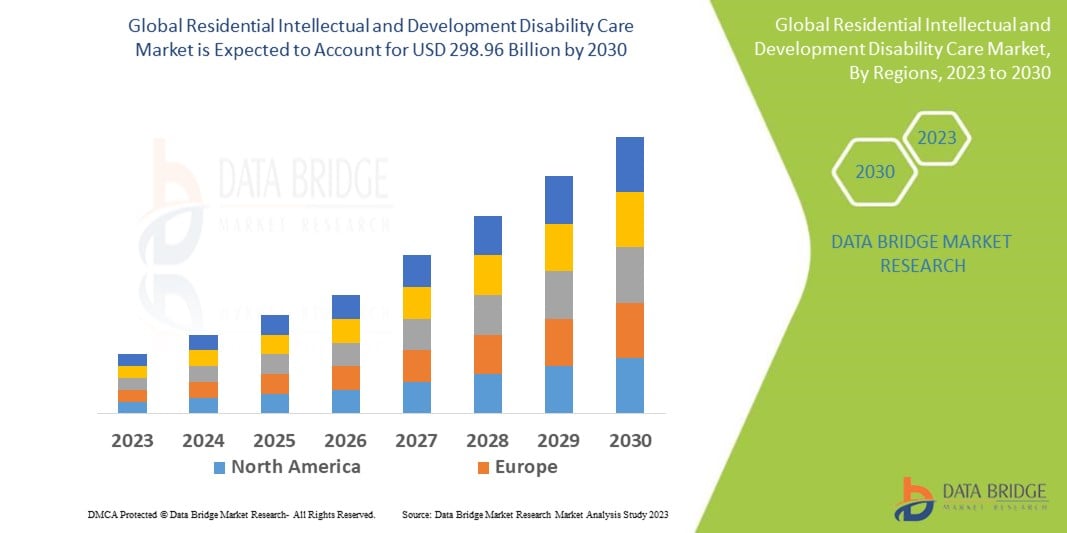
Data Bridge Market Research analyses that the residential intellectual and development disability care market, which was USD 174 billion in 2022, would rise up to USD 298.96 billion by 2030 and is expected to undergo a CAGR of 7% during the forecast period 2023 to 2030. In addition to the insights on market scenarios such as market value, growth rate, segmentation, geographical coverage, and major players, the market reports curated by the Data Bridge Market Research also include depth expert analysis, patient epidemiology, pipeline analysis, pricing analysis, and regulatory framework.
Residential Intellectual and Development Disability Care Market Scope and Segmentation
|
Report Metric |
Details |
|
Forecast Period |
2023 to 2030 |
|
Base Year |
2022 |
|
Historic Years |
2021 (Customizable to 2015 - 2020) |
|
Quantitative Units |
Revenue in USD Billion, Volumes in Units, Pricing in USD |
|
Segments Covered |
Mode of Operation (State-Run Facilities, Medicaid Funded Services, Private Large Facilities, Privately Run Small Facilities), Number of Beds (4 to 9, 10 to 19, 20 to 49, 50 to 99, 100 to 199, and 200 and more Beds), End User (Hospitals, Intermediate Care Facilities, Group Homes, Private Home, Intellectual and Developmental Disability Facilities) |
|
Countries Covered |
U.S., Canada, and Mexico in North America, Germany, France, U.K., Netherlands, Switzerland, Belgium, Russia, Italy, Spain, Turkey, Rest of Europe in Europe, China, Japan, India, South Korea, Singapore, Malaysia, Australia, Thailand, Indonesia, Philippines, Rest of Asia-Pacific (APAC) in the Asia-Pacific (APAC), Saudi Arabia, U.A.E, South Africa, Egypt, Israel, Rest of Middle East and Africa (MEA) as a part of Middle East and Africa (MEA), Brazil, Argentina and Rest of South America as part of South America |
|
Market Players Covered |
Texana Center (U.S.), SANDESH (India), St. Joseph's Center (U.S.), Metrocare Services (U.S.), PERFORMCARE (U.S.), Commonwealth of Pennsylvania (U.S.), Alliance Health (U.S.), Durham County Community Living Programs, Inc. (U.S.), Beacon Health Options (U.S.), The Home Care Spot. (U.S.), Health Standards Organization (HSO) (Canada), Texas Health & Human Services Commission (U.S.), The Commonwealth Fund (U.S.), Residential Support Services (U.S.), and Lutheran Family Services Rocky Mountains (U.S.) |
|
Market Opportunities |
|
Market Definition
Intellectual disability in people signifies that they are labeled with one or more terms such as developmental delay, developmental disability, or mental handicap. In simple terms, people with mental retardation are now referred to as having an intellectual disability. People are generally considered to have an intellectual disability if they do not have proper functionality. To diagnose intellectual disability, standardized adaptive behavior and intelligence tests are most commonly used.
Global Residential Intellectual and Development Disability Care Market Dynamics
Drivers
- Increasing Government Initiatives
Numerous people have intellectual disabilities, and as a result, the initiatives from the government are also increasing. Many Asian countries have a slight market for such facilities, and very less progress is expected from 2023 to 2030 Several local and national centers in developing nations provide similar services. In India, Muskaan, Sandesh, and Alamara Residential Centres for Persons with Developmental Disabilities are three centers that offer residential intellectual disability services. This factor leads to the growth of the market.
- Increasing Elderly Population
As per the United Nations Department of Economic and Social Affairs report published on World Population Ageing, there were around 727 million people aged 65 years and above in 2020, rise up from 703 million in 2019. This number is most likely to double to 1.5 billion people by 2050. Additionally, the number of people aged 80 years and above is expected to increase from 143 million in 2019 to 426 million by the end of 2050. The need for care for the elderly population instigates demand for services for the elderly and disabled, boosting the market. Thus, this factor boosts the market growth.
Opportunities
- Increasing Technological Advancements by Market Players
Several companies globally use robots to ease the transition of providing care facilities to disabled patients. For instance, Bright Cape, an Eindhoven-based company, has developed SARA (social and autonomous robotic health assistants). The project is part of the European EIT Digital Innovation Consortium and aims to decrease healthcare workload and enhance treatment quality. Furthermore, Japan is installing robots in workplaces, nursing homes, and schools as its population ages and the labor force decline. Thus, this factor boosts market growth.
- Increased Federal Funding for Programs
The increased federal funding for several programs and a rise in the number of people enrolled or eligible for either of the federal programs have led to a surge in the number of residential intellectual disability facilities in the U.S. There has been increasing demand for housing or residential facilities for people having intellectual disabilities in the recent years. Thus, this factor boosts market growth.
Restraints/Challenges
- Increasing Cases of Elderly Abuse
Elder abuse in care centers that offer services for the elderly and people with disabilities are anticipated to hamper the market. Elder abuse is growing in these institutions. As per World Health Organization, in 2020, around 2 in 3 staff working in institutions such as nursing homes and long-term care facilities stated that they had committed abuse in the previous year. Elder abuse can lead to severe physical injuries and long-term psychological consequences. Thus, this factor impedes market growth.
This residential intellectual and development disability care market report provides details of new recent developments, trade regulations, import-export analysis, production analysis, value chain optimization, market share, impact of domestic and localized market players, analyses opportunities in terms of emerging revenue pockets, changes in market regulations, strategic market growth analysis, market size, category market growths, application niches and dominance, product approvals, product launches, geographic expansions, technological innovations in the market. To gain more info on the residential intellectual and development disability care market contact Data Bridge Market Research for an Analyst Brief, our team will help you take an informed market decision to achieve market growth.
Global Residential Intellectual and Development Disability Care Market Scope
The residential intellectual and development disability care market is segmented on the basis of mode of operation, number of beds and end user. The growth amongst these segments will help you analyze meagre growth segments in the industries and provide the users with a valuable market overview and market insights to help them make strategic decisions for identifying core market applications.
Mode of Operation
- State-Run Facilities
- Medicaid Funded Services
- Private Large Facilities
- Privately Run Small Facilities
Number of Beds
- 4 to 9
- 10 to 19
- 20 to 49
- 50 to 99
- 100 to 199
- 200 and more Beds
End User
- Hospitals
- Intermediate Care Facilities
- Group Homes
- Private Home
- Intellectual and Developmental Disability Facilities
Residential Intellectual and Development Disability Care Market Regional Analysis/Insights
The residential intellectual and development disability care market is analyzed and market size insights and trends are provided by mode of operation, number of beds and end user as referenced above.
The countries covered in the residential intellectual and development disability care market report are U.S., Canada, and Mexico in North America, Germany, France, U.K., Netherlands, Switzerland, Belgium, Russia, Italy, Spain, Turkey, Rest of Europe in Europe, China, Japan, India, South Korea, Singapore, Malaysia, Australia, Thailand, Indonesia, Philippines, Rest of Asia-Pacific (APAC) in the Asia-Pacific (APAC), Saudi Arabia, U.A.E, South Africa, Egypt, Israel, Rest of Middle East and Africa (MEA) as a part of Middle East and Africa (MEA), Brazil, Argentina and Rest of South America as part of South America.
North America dominates the residential intellectual and development disability care market due to the region's well-developed healthcare infrastructure and favorable reimbursement policies.
Asia-Pacific is expected to grow at the highest growth rate in the forecast period because of the presence of national centers in the developing nations providing such facilities in this region. Also, the major players associated with this market are boosting the growth of the market.
The country section of the report also provides individual market impacting factors and changes in regulation in the market domestically that impacts the current and future trends of the market. Data points like down-stream and upstream value chain analysis, technical trends and porter's five forces analysis, case studies are some of the pointers used to forecast the market scenario for individual countries. Also, the presence and availability of global brands and their challenges faced due to large or scarce competition from local and domestic brands, impact of domestic tariffs and trade routes are considered while providing forecast analysis of the country data.
Healthcare Infrastructure growth Installed base and New Technology Penetration
The residential intellectual and development disability care market also provides you with detailed market analysis for every country growth in healthcare expenditure for capital equipment, installed base of different kind of products for residential intellectual and development disability care market, impact of technology using life line curves and changes in healthcare regulatory scenarios and their impact on the residential intellectual and development disability care market. The data is available for historic period 2011-2021.
Competitive Landscape and Residential Intellectual and Development Disability Care Market Share Analysis
The residential intellectual and development disability care market competitive landscape provides details by competitor. Details included are company overview, company financials, revenue generated, market potential, investment in research and development, new market initiatives, global presence, production sites and facilities, production capacities, company strengths and weaknesses, product launch, product width and breadth, application dominance. The above data points provided are only related to the companies' focus related to residential intellectual and development disability care market.
Some of the major players operating in the residential intellectual and development disability care market are:
- Texana Center (U.S.)
- SANDESH (India)
- St. Joseph's Center (U.S.)
- Metrocare Services (U.S.)
- PERFORMCARE (U.S.)
- Commonwealth of Pennsylvania (U.S.)
- Alliance Health (U.S.)
- Durham County Community Living Programs, Inc. (U.S.)
- Beacon Health Options (U.S.)
- The Home Care Spot. (U.S.)
- Health Standards Organization (HSO) (Canada)
- Texas Health & Human Services Commission (U.S.)
- The Commonwealth Fund (U.S.)
- Residential Support Services (U.S.)
- Lutheran Family Services Rocky Mountains (U.S.)

- Interactive Data Analysis Dashboard
- Company Analysis Dashboard for high growth potential opportunities
- Research Analyst Access for customization & queries
- Competitor Analysis with Interactive dashboard
- Latest News, Updates & Trend analysis
- Harness the Power of Benchmark Analysis for Comprehensive Competitor Tracking
Table of Content
1 INTRODUCTION
1.1 OBJECTIVES OF THE STUDY
1.2 MARKET DEFINITION
1.3 OVERVIEW OF GLOBAL RESIDENTIAL INTELLECTUAL AND DEVELOPMENT DISABILITY CARE MARKET
1.4 CURRENCY AND PRICING
1.5 LIMITATION
1.6 MARKETS COVERED
2 MARKET SEGMENTATION
2.1 KEY TAKEAWAYS
2.2 ARRIVING AT THE GLOBAL RESIDENTIAL INTELLECTUAL AND DEVELOPMENT DISABILITY CARE MARKET: SIZE
2.2.1 VENDOR POSITIONING GRID
2.2.2 TECHNOLOGY LIFE LINE CURVE
2.2.3 MARKET GUIDE
2.2.4 APPLICATION POSITIONING GRID`
2.2.5 COMPANY MARKET SHARE ANALYSIS
2.2.6 MULTIVARIATE MODELLING
2.2.7 TOP TO BOTTOM ANALYSIS
2.2.8 STANDARDS OF MEASUREMENT
2.2.9 VENDOR SHARE ANALYSIS
2.2.10 EPIDEMILOGY DATA
2.2.11 SALES VOLUME DATA
2.2.12 DATA POINTS FROM KEY PRIMARY INTERVIEWS
2.2.13 DATA POINTS FROM KEY SECONDARY DATABASES
2.3 GLOBAL RESIDENTIAL INTELLECTUAL AND DEVELOPMENT DISABILITY CARE MARKET: RESEARCH SNAPSHOT
2.4 ASSUMPTIONS
3 MARKET OVERVIEW
3.1 DRIVERS
3.2 RESTRAINTS
3.3 OPPORTUNITIES
3.4 CHALLENGES
4 EXECUTIVE SUMMARY
5 PREMIUM INSIGHTS
5.1 PESTEL ANALYSIS
5.2 PORTER’S FIVE FORCES MODEL
6 INDUSTRY INSIGHTS
6.1 MICRO AND MACRO ECONOMIC FACTORS
6.2 PENETRATION AND GROWTH PROSPECT MAPPING
6.3 KEY PRICING STRATEGIES
6.4 INTERVIEWS WITH SPECIALIST
6.5 ANALYIS AND RECOMMENDATION
7 COST ANALYSIS BREAKDOWN
8 TECHNONLOGY ROADMAP
9 INNOVATION TRACKER AND STRATEGIC ANALYSIS
9.1 MAJOR DEALS AND STRATEGIC ALLIANCES ANALYSIS
9.1.1 JOINT VENTURES
9.1.2 MERGERS AND ACQUISITIONS
9.1.3 LICENSING AND PARTNERSHIP
9.1.4 TECHNOLOGY COLLABORATIONS
9.1.5 STRATEGIC DIVESTMENTS
9.2 NUMBER OF PRODUCTS IN DEVELOPMENT
9.3 STAGE OF DEVELOPMENT
9.4 TIMELINES AND MILESTONES
9.5 INNOVATION STRATEGIES AND METHODOLOGIES
9.6 RISK ASSESSMENT AND MITIGATION
9.7 FUTURE OUTLOOK
10 REGULATORY COMPLIANCE
10.1 REGULATORY AUTHORITIES
10.2 REGULATORY SUBMISSIONS
10.3 INTERNATIONAL HARMONIZATION
10.4 COMPLIANCE AND QUALITY MANAGEMENT SYSTEMS
10.5 REGULATORY CHALLENGES AND STRATEGIES
11 REIMBURSEMENT FRAMEWORK
12 OPPUTUNITY MAP ANALYSIS
13 VALUE CHAIN ANALYSIS
14 HEALTHCARE ECONOMY
14.1 HEALTHCARE EXPENDITURE
14.2 CAPITAL EXPENDITURE
14.3 CAPEX TRENDS
14.4 CAPEX ALLOCATION
14.5 FUNDING SOURCES
14.6 INDUSTRY BENCHMARKS
14.7 GDP RATION IN OVERALL GDP
14.8 HEALTHCARE SYSTEM STRUCTURE
14.9 GOVERNMENT POLICIES
14.1 ECONOMIC DEVELOPMENT
15 GLOBAL RESIDENTIAL INTELLECTUAL AND DEVELOPMENT DISABILITY CARE MARKET, BY MODE OF OPERATION
15.1 OVERVIEW
15.2 STATE-RUN FACILITIES
15.3 MEDICAID FUNDED SERVICES
15.4 PRIVATE LARGE FACILITIES
15.5 PRIVATELY RUN SMALL FACILITIES
15.6 OTHERS (IF ANY)
16 GLOBAL RESIDENTIAL INTELLECTUAL AND DEVELOPMENT DISABILITY CARE MARKET, BY SERVICES TYPE
16.1 OVERVIEW
16.2 SCREENING AND DIAGNOSIS SERVICES
16.3 TREATMENT AND TRAINING SERVICES
16.4 OTHERS (IF ANY)
17 GLOBAL RESIDENTIAL INTELLECTUAL AND DEVELOPMENT DISABILITY CARE MARKET, BY GROUP HOME TYPES
17.1 OVERVIEW
17.2 DISABLED GROUP HOME TYPES
17.3 DEVELOPMENTALLY DELAYED GROUP HOME TYPES
17.4 YOUTH GROUP HOME
17.5 LOW-INCOME GROUP HOME
17.6 SUBSTANCE ABUSE GROUP HOME
17.7 OTHER GROUP HOME
18 GLOBAL RESIDENTIAL INTELLECTUAL AND DEVELOPMENT DISABILITY CARE MARKET, BY NUMBER OF BEDS
18.1 OVERVIEW
18.2 4 TO 9
18.3 10 TO 19
18.4 20 TO 49
18.5 50 TO 99
18.6 100 TO 199
18.7 200 AND MORE BEDS
18.8 OTHERS
19 GLOBAL RESIDENTIAL INTELLECTUAL AND DEVELOPMENT DISABILITY CARE MARKET, BY TYPE OF FACILITY
19.1 OVERVIEW
19.2 SHORT TERM CARE FACILITY
19.3 LONG TERM CARE FACILITY
20 GLOBAL RESIDENTIAL INTELLECTUAL AND DEVELOPMENT DISABILITY CARE MARKET, BY LEVEL OF DISABILITY
20.1 OVERVIEW
20.2 MILD LEVEL OF DISABILITY
20.3 MORDERATE LEVEL OF DISABILITY
20.4 SEVERE LEVEL OF DISABILITY
21 GLOBAL RESIDENTIAL INTELLECTUAL AND DEVELOPMENT DISABILITY CARE MARKET, BY APPLICATION
21.1 OVERVIEW
21.2 DEVELOPMENT DISABILITY
21.2.1 FRAGILE X SYNDROME
21.2.2 DOWN SYNDROME
21.2.3 AUTISM SPECTRUM DISORDERS
21.2.4 CEREBRAL PALSY
21.2.5 ATTENTION-DEFICIT/HYPERACTIVITY DISORDER (ADHD)
21.2.6 TOURETTE SYNDROME
21.2.7 OTHERS
21.3 INTELLECTUAL
21.3.1 LEARNNG DIABILITY
21.3.2 ADAPTIVE FUNCTIONING
21.3.3 OTHERS
21.4 OTHERS
22 GLOBAL RESIDENTIAL INTELLECTUAL AND DEVELOPMENT DISABILITY CARE MARKET, BY AGE GROUP
22.1 OVERVIEW
22.2 PEDIATRICS
22.3 ADULT
22.4 GERIATRICS
23 GLOBAL RESIDENTIAL INTELLECTUAL AND DEVELOPMENT DISABILITY CARE MARKET, BY END USERS
23.1 OVERVIEW
23.2 HOSPITALS
23.3 PRIVATE HOME
23.4 INTERMEDIATE CARE FACILITIES
23.5 OTHERS
24 GLOBAL RESIDENTIAL INTELLECTUAL AND DEVELOPMENT DISABILITY CARE MARKET, BY GEOGRAPHY
24.1 GLOBAL RESIDENTIAL INTELLECTUAL AND DEVELOPMENT DISABILITY CARE MARKET (ALL SEGMENTATION PROVIDED ABOVE IS REPRESENTED IN THIS CHAPTER BY COUNTRY)
24.1.1 NORTH AMERICA
24.1.1.1. U.S.
24.1.1.2. CANADA
24.1.1.3. MEXICO
24.1.2 EUROPE
24.1.2.1. GERMANY
24.1.2.2. U.K.
24.1.2.3. FRANCE
24.1.2.4. ITALY
24.1.2.5. SPAIN
24.1.2.6. THE NETHERLANDS
24.1.2.7. SWITZERLAND
24.1.2.8. TURKEY
24.1.2.9. BELGIUM
24.1.2.10. RUSSIA
24.1.2.11. REST OF EUROPE
24.1.3 ASIA-PACIFIC
24.1.3.1. CHINA
24.1.3.2. JAPAN
24.1.3.3. SOUTH KOREA
24.1.3.4. INDIA
24.1.3.5. SINGAPORE
24.1.3.6. AUSTRALIA
24.1.3.7. MALAYSIA
24.1.3.8. PHILIPPINES
24.1.3.9. THAILAND
24.1.3.10. INDONESIA
24.1.3.11. REST OF ASIA-PACIFIC
24.1.4 SOUTH AMERICA
24.1.4.1. BRAZIL
24.1.4.2. ARGENTINA
24.1.4.3. REST OF SOUTH AMERICA
24.1.5 MIDDLE EAST AND AFRICA
24.1.5.1. SOUTH AFRICA
24.1.5.2. EGYPT
24.1.5.3. SAUDI ARABIA
24.1.5.4. U.A.E
24.1.5.5. ISRAEL
24.1.5.6. REST OF MIDDLE EAST AND AFRICA
24.2 KEY PRIMARY INSIGHTS: BY MAJOR COUNTRIES
25 GLOBAL RESIDENTIAL INTELLECTUAL AND DEVELOPMENT DISABILITY CARE MARKET, COMPANY LANDSCAPE
25.1 COMPANY SHARE ANALYSIS: GLOBAL
25.2 COMPANY SHARE ANALYSIS: NORTH AMERICA
25.3 COMPANY SHARE ANALYSIS: EUROPE
25.4 COMPANY SHARE ANALYSIS: ASIA-PACIFIC
25.5 MERGERS & ACQUISITIONS
25.6 NEW PRODUCT DEVELOPMENT & APPROVALS
25.7 EXPANSIONS
25.8 REGULATORY CHANGES
25.9 PARTNERSHIP AND OTHER STRATEGIC DEVELOPMENTS
26 GLOBAL RESIDENTIAL INTELLECTUAL AND DEVELOPMENT DISABILITY CARE MARKET, SWOT AND DBMR ANALYSIS
27 GLOBAL RESIDENTIAL INTELLECTUAL AND DEVELOPMENT DISABILITY CARE MARKET, COMPANY PROFILE
27.1 TEXANA CENTER
27.1.1 COMPANY OVERVIEW
27.1.2 REVENUE ANALYSIS
27.1.3 GEOGRAPHIC PRESENCE
27.1.4 SERVICE PORTFOLIO
27.1.5 RECENT DEVELOPMENTS
27.2 SANDESH
27.2.1 COMPANY OVERVIEW
27.2.2 REVENUE ANALYSIS
27.2.3 GEOGRAPHIC PRESENCE
27.2.4 SERVICE PORTFOLIO
27.2.5 RECENT DEVELOPMENTS
27.3 ST. JOSEPH'S CENTER
27.3.1 COMPANY OVERVIEW
27.3.2 REVENUE ANALYSIS
27.3.3 GEOGRAPHIC PRESENCE
27.3.4 SERVICE PORTFOLIO
27.3.5 RECENT DEVELOPMENTS
27.4 METROCARE SERVICES
27.4.1 COMPANY OVERVIEW
27.4.2 REVENUE ANALYSIS
27.4.3 GEOGRAPHIC PRESENCE
27.4.4 SERVICE PORTFOLIO
27.4.5 RECENT DEVELOPMENTS
27.5 PERFORMCARE
27.5.1 COMPANY OVERVIEW
27.5.2 REVENUE ANALYSIS
27.5.3 GEOGRAPHIC PRESENCE
27.5.4 SERVICE PORTFOLIO
27.5.5 RECENT DEVELOPMENTS
27.6 ALLIANCE HEALTH
27.6.1 COMPANY OVERVIEW
27.6.2 REVENUE ANALYSIS
27.6.3 GEOGRAPHIC PRESENCE
27.6.4 SERVICE PORTFOLIO
27.6.5 RECENT DEVELOPMENTS
27.7 DURHAM COUNTY COMMUNITY LIVING PROGRAMS, INC.
27.7.1 COMPANY OVERVIEW
27.7.2 REVENUE ANALYSIS
27.7.3 GEOGRAPHIC PRESENCE
27.7.4 SERVICE PORTFOLIO
27.7.5 RECENT DEVELOPMENTS
27.8 COMMONWEALTH OF PENNSYLVANIA
27.8.1 COMPANY OVERVIEW
27.8.2 REVENUE ANALYSIS
27.8.3 GEOGRAPHIC PRESENCE
27.8.4 SERVICE PORTFOLIO
27.8.5 RECENT DEVELOPMENTS
27.9 TEXAS HEALTH & HUMAN SERVICES COMMISSION
27.9.1 COMPANY OVERVIEW
27.9.2 REVENUE ANALYSIS
27.9.3 GEOGRAPHIC PRESENCE
27.9.4 SERVICE PORTFOLIO
27.9.5 RECENT DEVELOPMENTS
27.1 CARELON BEHAVIORAL HEALTH
27.10.1 COMPANY OVERVIEW
27.10.2 REVENUE ANALYSIS
27.10.3 GEOGRAPHIC PRESENCE
27.10.4 SERVICE PORTFOLIO
27.10.5 RECENT DEVELOPMENTS
27.11 BEACON HEALTH SYSTEM
27.11.1 COMPANY OVERVIEW
27.11.2 REVENUE ANALYSIS
27.11.3 GEOGRAPHIC PRESENCE
27.11.4 SERVICE PORTFOLIO
27.11.5 RECENT DEVELOPMENTS
27.12 HEALTH STANDARDS ORGANIZATION (HSO) AND ITS LICENSORS
27.12.1 COMPANY OVERVIEW
27.12.2 REVENUE ANALYSIS
27.12.3 GEOGRAPHIC PRESENCE
27.12.4 SERVICE PORTFOLIO
27.12.5 RECENT DEVELOPMENTS
27.13 FIRSTPOINT HEALTHCARE.
27.13.1 COMPANY OVERVIEW
27.13.2 REVENUE ANALYSIS
27.13.3 GEOGRAPHIC PRESENCE
27.13.4 SERVICE PORTFOLIO
27.13.5 RECENT DEVELOPMENTS
27.14 LUTHERAN FAMILY SERVICES ROCKY MOUNTAINS
27.14.1 COMPANY OVERVIEW
27.14.2 REVENUE ANALYSIS
27.14.3 GEOGRAPHIC PRESENCE
27.14.4 SERVICE PORTFOLIO
27.14.5 RECENT DEVELOPMENTS
27.15 RESIDENTIAL SUPPORT SERVICES
27.15.1 COMPANY OVERVIEW
27.15.2 REVENUE ANALYSIS
27.15.3 GEOGRAPHIC PRESENCE
27.15.4 SERVICE PORTFOLIO
27.15.5 RECENT DEVELOPMENTS
NOTE: THE COMPANIES PROFILED IS NOT EXHAUSTIVE LIST AND IS AS PER OUR PREVIOUS CLIENT REQUIREMENT. WE PROFILE MORE THAN 100 COMPANIES IN OUR STUDY AND HENCE THE LIST OF COMPANIES CAN BE MODIFIED OR REPLACED ON REQUEST
28 RELATED REPORTS
29 CONCLUSION
30 QUESTIONNAIRE
31 ABOUT DATA BRIDGE MARKET RESEARCH

Data collection and base year analysis are done using data collection modules with large sample sizes. The stage includes obtaining market information or related data through various sources and strategies. It includes examining and planning all the data acquired from the past in advance. It likewise envelops the examination of information inconsistencies seen across different information sources. The market data is analysed and estimated using market statistical and coherent models. Also, market share analysis and key trend analysis are the major success factors in the market report. To know more, please request an analyst call or drop down your inquiry.
The key research methodology used by DBMR research team is data triangulation which involves data mining, analysis of the impact of data variables on the market and primary (industry expert) validation. Data models include Vendor Positioning Grid, Market Time Line Analysis, Market Overview and Guide, Company Positioning Grid, Patent Analysis, Pricing Analysis, Company Market Share Analysis, Standards of Measurement, Global versus Regional and Vendor Share Analysis. To know more about the research methodology, drop in an inquiry to speak to our industry experts.
Data Bridge Market Research is a leader in advanced formative research. We take pride in servicing our existing and new customers with data and analysis that match and suits their goal. The report can be customized to include price trend analysis of target brands understanding the market for additional countries (ask for the list of countries), clinical trial results data, literature review, refurbished market and product base analysis. Market analysis of target competitors can be analyzed from technology-based analysis to market portfolio strategies. We can add as many competitors that you require data about in the format and data style you are looking for. Our team of analysts can also provide you data in crude raw excel files pivot tables (Fact book) or can assist you in creating presentations from the data sets available in the report.













