




Global Rf Over Fiber Market
Market Size in USD Million
CAGR :
% 
 USD
700.95 Million
USD
1,513.51 Million
2025
2033
USD
700.95 Million
USD
1,513.51 Million
2025
2033
 Forecast Period Forecast Period |
2026 –2033 |
 Market Size (Base Year) Market Size (Base Year) |
USD 700.95 Million |
 Market Size (Forecast Year) Market Size (Forecast Year) |
USD 1,513.51 Million |
 CAGR CAGR |
% |
| Major Markets Players |
|
RF Over Fiber Market Size
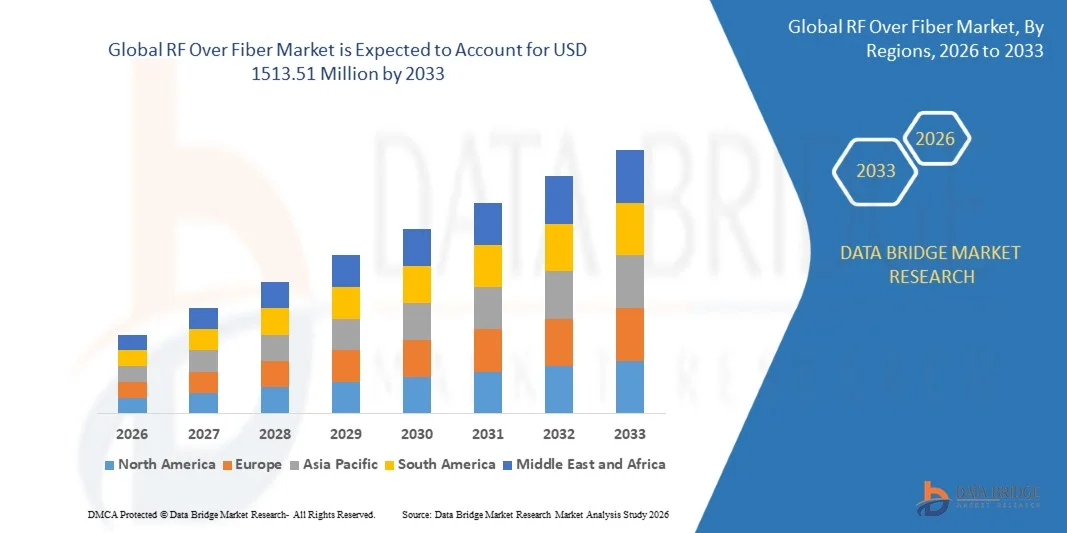
- The global RF over fiber market size was valued at USD 700.95 million in 2025 and is expected to reach USD 1513.51 million by 2033, at a CAGR of 10.1% during the forecast period
- The RF over fiber market growth is primarily driven by increasing demand for high-capacity, low-loss, and interference-free communication systems across telecommunications, defense, and satellite networks, supporting next-generation connectivity requirements such as 5G and emerging 6G infrastructure
- Furthermore, rising deployment of distributed antenna systems, data centers, and broadband expansion projects is accelerating the adoption of RF over fiber solutions due to their ability to enable long-distance signal transmission with improved bandwidth efficiency and reduced signal degradation
RF Over Fiber Market Analysis
- RF over fiber technology refers to the transmission of radio frequency signals over optical fiber links, enabling high-frequency signal transport with minimal loss and immunity to electromagnetic interference, making it suitable for advanced telecom, aerospace, and defense applications
- The increasing demand for RF over fiber systems is mainly driven by rapid expansion of wireless communication networks, growing need for high-speed data transmission, and rising adoption in satellite communication, radar systems, and centralized radio access network (C-RAN) architectures
- North America dominated the RF over fiber market with a share of 38.30% in 2025, due to strong demand for high-capacity communication infrastructure, rapid 5G deployment, and extensive adoption of advanced defense and satellite communication systems
- Asia-Pacific is expected to be the fastest growing region in the RF over fiber market during the forecast period due to rapid 5G deployment, expanding satellite communication networks, and increasing demand for high-speed broadband infrastructure
- Telecommunications segment dominated the market with a market share of around 40% in 2025, due to rapid expansion of high-speed internet infrastructure and 5G network deployment. RF over fiber enables efficient long-distance signal transmission with minimal loss, making it highly suitable for telecom operators. Rising global data consumption reinforces continuous investment in network upgrades
Report Scope and RF Over Fiber Market Segmentation
|
Attributes |
RF Over Fiber Key Market Insights |
|
Segments Covered |
|
|
Countries Covered |
North America
Europe
Asia-Pacific
Middle East and Africa
South America
|
|
Key Market Players |
|
|
Market Opportunities |
|
|
Value Added Data Infosets |
In addition to the market insights such as market value, growth rate, market segments, geographical coverage, market players, and market scenario, the market report curated by the Data Bridge Market Research team includes in-depth expert analysis, import/export analysis, pricing analysis, production consumption analysis, and pestle analysis. |
RF Over Fiber Market Trends
“Increasing Adoption of RF over Fiber in 5G and Beyond 5G Networks”
- A key trend in the RF over fiber market is the increasing deployment of RF over fiber technology in 5G and emerging beyond 5G communication networks, driven by the need for ultra-low latency, high bandwidth, and interference-free signal transmission across dense network environments. This trend is strengthening the role of optical fiber-based RF transport in supporting centralized radio access network architectures and next-generation telecom infrastructure
- For instance, Optical Zonu Corp and EMCORE Corporation provide RF over fiber transport systems and optical modules that are widely used in distributed antenna systems and 5G fronthaul networks. These solutions enhance signal coverage and enable efficient long-distance RF transmission in high-density urban communication environments
- The growing integration of RF over fiber systems in satellite communication and radar networks is expanding its application scope beyond traditional telecom infrastructure. This adoption is improving signal stability and reducing losses in high-frequency transmission environments used for aerospace and defense operations
- The increasing use of RF over fiber in data centers and broadband expansion projects is also supporting the transition toward high-capacity optical communication networks. This is improving network efficiency and enabling seamless handling of large-scale data traffic across distributed architectures
- Defense organizations are increasingly adopting RF over fiber solutions for secure, long-distance, and electromagnetic interference-resistant communication systems. This is reinforcing the importance of RFoF in mission-critical applications where reliability and signal integrity are essential
- The trend is further strengthened by continuous technological advancements in photonic integration and optical module miniaturization, which are making RF over fiber systems more scalable and efficient for next-generation communication infrastructure
RF Over Fiber Market Dynamics
Driver
“Rising Demand for High-Bandwidth and Low-Latency Communication Infrastructure”
- The rising demand for high-bandwidth and low-latency communication infrastructure is a major driver of the RF over fiber market, fueled by rapid expansion of 5G networks, increasing data traffic, and the need for efficient long-distance RF signal transmission. This demand is encouraging telecom operators and defense organizations to adopt fiber-based RF solutions for improved performance and reduced signal degradation
- For instance, HUBER+SUHNER and ViaLite Communications provide RF over fiber solutions that are widely deployed in satellite ground stations and telecom networks to ensure high-quality signal transmission with minimal latency. These systems support critical communication links where speed, stability, and reliability are essential for uninterrupted operations
- The expansion of cloud computing and hyperscale data centers is increasing the requirement for high-speed interconnects, where RF over fiber plays a crucial role in maintaining signal integrity across long distances. This supports efficient data handling and reduces network congestion in high-performance computing environments
- The growing adoption of centralized RAN (C-RAN) architecture in telecom networks is also driving demand for RF over fiber systems due to their ability to connect distributed antenna units with centralized baseband processing units. This improves network efficiency and reduces operational complexity for service providers
- The overall shift toward next-generation wireless infrastructure continues to reinforce the need for scalable and high-capacity RF over fiber systems, positioning them as a core enabler of advanced digital communication networks
Restraint/Challenge
“High Deployment and System Integration Costs”
- The high deployment and system integration costs associated with RF over fiber systems represent a significant challenge for market expansion, as these solutions require specialized optical components, precise engineering, and advanced installation processes. These cost factors can limit adoption, particularly among small and medium-scale enterprises and cost-sensitive regions
- For instance, companies such as Narda-MITEQ and ETL Systems Ltd provide advanced RF and optical signal distribution systems that require complex integration into existing telecom and defense infrastructure. The installation and calibration of these systems increase upfront investment requirements for end users
- The need for specialized photonic components, including optical transceivers, amplifiers, and RF converters, adds to the overall system cost structure. These components must meet strict performance standards, increasing manufacturing complexity and pricing pressure
- Integration of RF over fiber systems into legacy infrastructure often requires significant upgrades, including redesigning network architecture and deploying new optical pathways. This increases implementation time and raises operational expenditure for telecom operators and defense agencies
- The overall cost burden associated with large-scale deployment continues to challenge widespread adoption, particularly in developing markets where budget constraints limit investment in advanced communication infrastructure
RF Over Fiber Market Scope
The market is segmented on the basis of modules, frequency band, vertical, frequency range, organization size, and application.
• By Modules
On the basis of modules, the RF over Fiber market is segmented into transceivers, optical amplifiers, antennas, optical switches, optical cables, and others. The transceivers segment dominated the largest market revenue share in 2025, driven by its central role in converting RF signals to optical signals and ensuring efficient long-distance transmission. Their widespread deployment in telecom and satellite communication systems supports stable demand due to high reliability and signal integrity requirements. Increasing use in 5G fronthaul networks further strengthens adoption. Integration flexibility with existing fiber infrastructure enhances preference across operators. Strong demand for high-performance signal conversion continues to sustain its leadership position.
The optical switches segment is anticipated to witness the fastest growth rate from 2026 to 2033, driven by increasing network reconfigurability requirements in modern communication systems. These components enable dynamic routing of RF signals over optical networks, improving operational efficiency and scalability. Growing deployment in data centers and defense communication systems accelerates adoption. Rising need for low-latency and high-bandwidth signal management supports expansion. Advancements in photonic integration and automated network control further enhance growth potential.
• By Frequency Band
On the basis of frequency band, the RF over Fiber market is segmented into L Band, S Band, Ka Band, C Band, K Band, X Band, and Ku Band. The C Band segment dominated the largest market revenue share in 2025, driven by its extensive use in satellite communication, broadcast services, and long-distance signal transmission. Its favorable balance between bandwidth and atmospheric attenuation makes it highly reliable for continuous communication links. Established infrastructure across telecom and satellite operators reinforces sustained demand. Widespread compatibility with existing RF systems supports its dominant position. High adoption in both commercial and government communication networks further strengthens market leadership.
The Ka Band segment is anticipated to witness the fastest growth rate from 2026 to 2033, driven by increasing demand for high-throughput satellite communications and broadband connectivity. Its ability to support higher data rates enables advanced applications in 5G backhaul and aerospace communication systems. Growing deployment of next-generation satellite constellations accelerates usage. Rising need for high-capacity and low-latency communication links supports expansion. Continuous advancements in satellite technology and spectrum efficiency further enhance adoption.
• By Vertical
On the basis of vertical, the RF over Fiber market is segmented into civil and military. The civil segment dominated the largest market revenue share in 2025, driven by widespread deployment in telecommunications, broadcasting, and broadband infrastructure. Expanding urban connectivity projects and rising data traffic fuel strong adoption in civilian communication networks. Integration of RF over fiber in 5G networks enhances performance and scalability. Cost-effective long-distance signal transmission supports large-scale deployment. Growing reliance on high-speed digital communication infrastructure reinforces its dominance.
The military segment is anticipated to witness the fastest growth rate from 2026 to 2033, driven by increasing defense modernization programs and secure communication requirements. RF over fiber systems provide high immunity to electromagnetic interference, making them suitable for mission-critical operations. Rising investments in radar, surveillance, and electronic warfare systems accelerate adoption. Demand for secure, high-bandwidth, and low-latency communication channels supports expansion. Continuous upgrades in defense communication architecture further strengthen growth prospects.
• By Frequency Range
On the basis of frequency range, the RF over Fiber market is segmented into less than 30 GHz, 30 GHz to 40 GHz, 40 GHz to 50 GHz, and more than 50 GHz. The less than 30 GHz segment dominated the largest market revenue share in 2025, driven by its extensive use in conventional satellite communication and terrestrial networks. Established infrastructure and compatibility with legacy systems support strong deployment. Reliable signal transmission over long distances reinforces its preference. Cost efficiency and stable performance contribute to sustained demand. Widespread adoption across telecom and broadcast applications strengthens its leadership.
The more than 50 GHz segment is anticipated to witness the fastest growth rate from 2026 to 2033, driven by rising demand for high-capacity mmWave communication systems. Increasing deployment in 5G advanced networks and defense radar systems accelerates usage. High-frequency bands enable ultra-fast data transmission and enhanced bandwidth efficiency. Growing need for low-latency communication in data-intensive applications supports expansion. Technological advancements in high-frequency photonics further enhance adoption.
• By Organization Size
On the basis of organization size, the RF over Fiber market is segmented into large scale organizations, medium scale organizations, and small scale organizations. The large scale organization segment dominated the largest market revenue share in 2025, driven by extensive investments in telecom infrastructure, satellite networks, and defense communication systems. These organizations prioritize high-performance and scalable signal transmission solutions. Strong financial capacity enables large-scale deployment of RF over fiber systems. Integration into existing global communication networks reinforces demand. Continuous upgrades in network infrastructure sustain segment leadership.
The small scale organization segment is anticipated to witness the fastest growth rate from 2026 to 2033, driven by increasing affordability and availability of compact RF over fiber solutions. Rising adoption among regional telecom providers and private network operators supports expansion. Growing demand for cost-effective high-speed connectivity accelerates deployment. Simplified installation and maintenance enhance accessibility for smaller enterprises. Expanding digital infrastructure initiatives further boost adoption.
• By Application
On the basis of application, the RF over Fiber market is segmented into telecommunications, broadcast, navigation, radar, and broadband. The telecommunications segment dominated the largest market revenue share of around 40% in 2025, driven by rapid expansion of high-speed internet infrastructure and 5G network deployment. RF over fiber enables efficient long-distance signal transmission with minimal loss, making it highly suitable for telecom operators. Rising global data consumption reinforces continuous investment in network upgrades. Strong integration with fiber-optic backbone systems supports scalability. Growing demand for seamless connectivity ensures sustained dominance.
The broadband segment is anticipated to witness the fastest growth rate from 2026 to 2033, driven by increasing demand for high-speed internet access across residential and enterprise users. Expansion of fiber-to-the-home and fiber-to-the-premises networks accelerates adoption. RF over fiber technology enhances signal quality and network efficiency in broadband distribution. Rising digitalization and remote connectivity needs support rapid deployment. Continuous infrastructure development in emerging markets further strengthens growth momentum.
RF Over Fiber Market Regional Analysis
- North America dominated the RF over fiber market with the largest revenue share of 38.30% in 2025, driven by strong demand for high-capacity communication infrastructure, rapid 5G deployment, and extensive adoption of advanced defense and satellite communication systems
- The region benefits from early adoption of RF over fiber technology across telecommunications and military applications, supported by continuous investments in upgrading broadband and optical network infrastructure
- Growing integration of fiber-based RF transmission in data centers and aerospace communication systems further strengthens regional dominance, along with the presence of leading technology providers and high R&D spending
U.S. RF Over Fiber Market Insight
The U.S. RF over fiber market captured the largest revenue share in North America in 2025, supported by large-scale deployment of 5G networks, advanced radar systems, and satellite communication infrastructure. The country’s strong defense modernization programs and increasing demand for high-frequency, low-loss signal transmission are major growth drivers. In addition, rising investments in data center interconnects and broadband expansion are accelerating adoption across commercial and government sectors, reinforcing the U.S. position as the key contributor to regional growth.
Europe RF Over Fiber Market Insight
The Europe RF over fiber market is projected to expand at a steady CAGR throughout the forecast period, driven by increasing demand for high-speed communication networks and modernization of defense communication systems. Strong regulatory focus on improving digital infrastructure and secure communication channels is encouraging adoption across telecom and aerospace industries. The region is also witnessing rising deployment of fiber-based RF systems in smart transportation and industrial automation networks, supporting overall market expansion.
U.K. RF Over Fiber Market Insight
The U.K. RF over fiber market is expected to grow at a notable CAGR during the forecast period, driven by expanding 5G rollout, rising satellite communication requirements, and increasing investment in defense communication technologies. Demand for low-latency, high-bandwidth transmission systems is supporting adoption across telecom operators and government networks. In addition, ongoing digital transformation initiatives and upgrades in national broadband infrastructure are contributing to steady market growth.
Germany RF Over Fiber Market Insight
The Germany RF over fiber market is anticipated to expand at a considerable CAGR during the forecast period, fueled by strong industrial automation, advanced manufacturing communication needs, and growing defense electronics investments. The country’s focus on high-precision, secure, and interference-free communication systems is accelerating adoption in aerospace and industrial sectors. Integration of RF over fiber solutions in smart factories and research infrastructure is further strengthening market growth in Germany.
Asia-Pacific RF Over Fiber Market Insight
The Asia-Pacific RF over fiber market is poised to grow at the fastest CAGR during the forecast period of 2026 to 2033, driven by rapid 5G deployment, expanding satellite communication networks, and increasing demand for high-speed broadband infrastructure. Rising digitalization, urbanization, and government-led smart city projects are accelerating adoption across telecom and defense sectors. The region is also emerging as a major manufacturing hub for optical and RF components, improving affordability and scalability.
Japan RF Over Fiber Market Insight
The Japan RF over fiber market is gaining momentum due to strong demand for advanced communication systems, high-speed connectivity, and integration of RF over fiber in aerospace and defense applications. The country’s focus on ultra-reliable low-latency communication for 5G and future 6G networks is driving adoption. In addition, Japan’s emphasis on disaster-resilient communication infrastructure is further supporting deployment across critical public safety systems.
China RF Over Fiber Market Insight
The China RF over fiber market accounted for the largest market revenue share in Asia-Pacific in 2025, driven by massive 5G infrastructure expansion, rapid urbanization, and strong government support for smart city development. China’s dominance in telecommunications equipment manufacturing and increasing deployment of satellite and radar communication systems are key growth factors. In addition, large-scale investments in data centers and broadband expansion are further strengthening market leadership in the region.
RF Over Fiber Market Share
The RF over fiber industry is primarily led by well-established companies, including:
- Broadcom (U.S.)
- EMCORE Corporation (U.S.)
- APIC Corporation (U.S.)
- Optical Zonu Corp (U.S.)
- Gooch & Housego PLC (U.K.)
- ViaLite Communications (U.K.)
- Global Invacom (Singapore)
- HUBER+SUHNER (Switzerland)
- Glenair (U.S.)
- SEIKOH GIKEN CO., LTD. (Japan)
- II-VI Incorporated (U.S.)
- DEV Systemtechnik GmbH (Germany)
- Octane Wireless (U.S.)
- Syntonics LLC (U.S.)
- Intelibs, Inc. (U.S.)
- ETL Systems Ltd (U.K.)
- Narda-MITEQ (U.S.)
- RFOptic Ltd. (Israel)
- Microwave Photonic Systems, Inc. (U.S.)
Latest Developments in Global RF Over Fiber Market
- In June 2024, NEC Corporation developed a cost-effective radio-over-fiber system using a 1-bit fiber transmission method, significantly strengthening the RF over fiber market by reducing system complexity and lowering deployment costs for next-generation networks. This innovation enables stable millimeter-wave communication for beyond 5G and 6G applications, addressing key challenges related to high-frequency signal degradation and infrastructure expense. By allowing high-frequency analog signals to be transmitted through a simplified electrical-to-optical conversion process, the solution supports more efficient and scalable network architectures. It also facilitates compact distributed antenna unit deployment, improving flexibility for telecom operators in dense urban and high-capacity environments
- In March 2024, CommScope expanded its fiber-optic connectivity production capabilities to meet rising demand for Build America Buy America compliant solutions, positively impacting the RF over fiber market through improved manufacturing capacity and supply chain resilience. This expansion is focused on accelerating the availability of high-performance connectivity products used in broadband and telecom infrastructure projects. The initiative enhances deployment efficiency by supporting faster installation processes and reducing network rollout timelines, particularly in rural broadband expansion programs. It also strengthens the company’s ability to support large-scale infrastructure modernization efforts driven by government-backed digital connectivity initiatives
- In 2024, EMCORE expanded its RF over fiber module portfolio in response to increasing demand from telecom operators for higher optical transmission density and improved network performance. This development strengthens the RF over fiber market by enabling more compact and efficient centralized RAN deployments, which are critical for modern 5G infrastructure. The enhanced modules focus on improving signal integrity, reducing noise, and supporting higher data throughput over optical links. In addition, the compact design allows easier integration into existing telecom systems, helping operators optimize space utilization and improve overall network scalability
- In December 2023, RFOptic secured an order from a multinational telecommunications company based in the EU for its 4 GHz bidirectional RF over fiber subsystems, reflecting growing adoption of advanced RFoF solutions in high-performance telecom networks. This development supports the RF over fiber market by demonstrating strong commercial demand for reliable long-distance, low-loss signal transmission technologies in 5G environments. The subsystem enhances bidirectional communication efficiency, ensuring stable signal integrity across distributed network architectures. It also highlights increasing reliance on RFoF technology for improving network flexibility and reducing latency in large-scale telecom deployments
- In October 2023, Optical Zonu Corporation launched ZONUConnect 3.0, strengthening the RF over fiber market by introducing an advanced transport system designed for distributed antenna systems and multi-sector base transceiver stations. This solution improves signal transmission efficiency over extended distances ranging from 300 ft. to 16 miles, enabling better coverage in both urban and enterprise environments. The system enhances network reliability by supporting seamless integration of DAS and BTS infrastructure, reducing signal loss and improving overall communication quality. It also contributes to more flexible network design, allowing operators to expand coverage without significant infrastructure overhauls
SKU-
Get online access to the report on the World's First Market Intelligence Cloud

- Interactive Data Analysis Dashboard
- Company Analysis Dashboard for high growth potential opportunities
- Research Analyst Access for customization & queries
- Competitor Analysis with Interactive dashboard
- Latest News, Updates & Trend analysis
- Harness the Power of Benchmark Analysis for Comprehensive Competitor Tracking
Research Methodology
Data collection and base year analysis are done using data collection modules with large sample sizes. The stage includes obtaining market information or related data through various sources and strategies. It includes examining and planning all the data acquired from the past in advance. It likewise envelops the examination of information inconsistencies seen across different information sources. The market data is analysed and estimated using market statistical and coherent models. Also, market share analysis and key trend analysis are the major success factors in the market report. To know more, please request an analyst call or drop down your inquiry.
The key research methodology used by DBMR research team is data triangulation which involves data mining, analysis of the impact of data variables on the market and primary (industry expert) validation. Data models include Vendor Positioning Grid, Market Time Line Analysis, Market Overview and Guide, Company Positioning Grid, Patent Analysis, Pricing Analysis, Company Market Share Analysis, Standards of Measurement, Global versus Regional and Vendor Share Analysis. To know more about the research methodology, drop in an inquiry to speak to our industry experts.
Customization Available
Data Bridge Market Research is a leader in advanced formative research. We take pride in servicing our existing and new customers with data and analysis that match and suits their goal. The report can be customized to include price trend analysis of target brands understanding the market for additional countries (ask for the list of countries), clinical trial results data, literature review, refurbished market and product base analysis. Market analysis of target competitors can be analyzed from technology-based analysis to market portfolio strategies. We can add as many competitors that you require data about in the format and data style you are looking for. Our team of analysts can also provide you data in crude raw excel files pivot tables (Fact book) or can assist you in creating presentations from the data sets available in the report.












