




Global Rf Test Equipment Market
Market Size in USD Billion
CAGR :
% 
 USD
3.06 Billion
USD
4.66 Billion
2025
2033
USD
3.06 Billion
USD
4.66 Billion
2025
2033
 Forecast Period Forecast Period |
2026 - 2033 |
 Market Size (Base Year) Market Size (Base Year) |
USD 3.06 Billion |
 Market Size (Forecast Year) Market Size (Forecast Year) |
USD 4.66 Billion |
 CAGR CAGR |
% |
| Major Markets Players |
|
Radio Frequency (RF) Test Equipment Market Overview
The Radio Frequency (RF) Test Equipment Market was valued at USD 3.06 billion in 2025 and is projected to reach USD 4.66 billion by 2033, growing at a CAGR of 5.38% from 2026 to 2033. The market is experiencing steady growth driven by rapid deployment of 5G communication infrastructure, increasing adoption of connected devices, and rising demand for high-frequency testing solutions across telecommunications, semiconductor, aerospace, automotive, and defense industries.
The growing complexity of wireless communication technologies, combined with increasing investments in satellite communication, autonomous vehicles, and industrial IoT infrastructure, is compelling manufacturers and telecom operators to adopt advanced RF testing systems capable of ensuring signal accuracy, network reliability, and regulatory compliance. Spectrum analyzers, network analyzers, and signal generators are increasingly replacing conventional testing methods in many applications, offering highly precise, automated, and scalable solutions for validating wireless communication systems, semiconductor chipsets, radar technologies, and next-generation high-frequency communication devices.
Key Market Trends & Insights
- North America dominated the radio frequency (RF) test equipment market with the largest revenue share of approximately 36.9% in 2025, supported by strong investments in 5G network expansion, advanced aerospace and defense infrastructure, and increasing adoption of connected devices and semiconductor testing technologies across the region.
- Asia-Pacific is expected to be the fastest-growing region, recording a CAGR of approximately 7.1% from 2026 to 2033. Growth is driven by rapid expansion of telecommunications infrastructure, rising semiconductor production, increasing deployment of consumer electronics, and strong government investments in smart manufacturing and digital connectivity across China, Japan, South Korea, and India.
- The Spectrum Analyzers segment held the largest market revenue share of approximately 31.8% in 2025 driven by increasing deployment of 5G infrastructure, wireless communication systems, and advanced RF signal monitoring applications. Spectrum analyzers are extensively used across telecommunications, aerospace, semiconductor manufacturing, and defense industries for signal measurement, interference detection, and frequency validation across high-frequency communication environments. Rising investments in next-generation wireless technologies and network optimization are further strengthening segment growth globally.
- The Network Analyzers segment is projected to register the fastest growth at a CAGR of 8.9% from 2026 to 2033, driven by increasing demand for antenna testing, high-speed data transmission validation, and advanced semiconductor characterization applications. Growing deployment of millimeter-wave communication systems and expansion of automotive radar technologies are accelerating adoption of network analyzers across telecommunications and automotive electronics industries worldwide.
- The Traditional GP Instrumentation segment held the largest market revenue share of approximately 36.5% in 2025 driven by its widespread deployment across research laboratories, telecom infrastructure testing, aerospace systems, and industrial communication validation applications. Traditional RF instrumentation systems are preferred due to their high measurement accuracy, operational reliability, and compatibility with multiple wireless communication standards.
- The Semiconductor ATE segment is projected to register the fastest growth at a CAGR of 9.4% from 2026 to 2033, driven by increasing production of RF chipsets, AI processors, and high-frequency semiconductor components used in smartphones, IoT devices, and automotive electronics. Rising investments in semiconductor manufacturing facilities and advanced chip testing capabilities are significantly accelerating segment expansion globally.
- The Benchtop segment held the largest market revenue share of approximately 52.7% in 2025 driven by its extensive use across telecommunication laboratories, semiconductor facilities, aerospace testing centers, and industrial R&D environments. Benchtop RF testing systems provide superior measurement precision, higher frequency handling capabilities, and enhanced signal analysis performance for complex communication applications.
- The Modular segment is projected to witness the fastest growth at a CAGR of 9.1% from 2026 to 2033 due to rising demand for scalable, space-efficient, and software-defined RF testing platforms capable of supporting evolving wireless communication technologies. Increasing adoption of modular testing systems across 5G infrastructure development and automated semiconductor validation environments is accelerating segment growth worldwide.
- The 1 GHz to 6 GHz segment held the largest market revenue share of approximately 47.3% in 2025 driven by widespread deployment of 4G and 5G communication infrastructure, Wi-Fi technologies, IoT devices, and consumer electronics operating within mid-band frequency ranges. RF testing equipment within this range is extensively used for wireless communication validation, antenna testing, and network optimization applications across telecommunications and industrial sectors.
- The More Than 6 GHz segment is projected to register the fastest growth at a CAGR of 10.2% from 2026 to 2033, driven by increasing adoption of millimeter-wave technologies, advanced radar systems, satellite communication infrastructure, and next-generation automotive communication platforms. Expansion of 5G mmWave deployments and aerospace communication systems is significantly supporting high-frequency RF testing demand globally.
- The Telecommunications segment held the largest market revenue share of approximately 34.9% in 2025 driven by rapid deployment of 5G infrastructure, rising mobile data traffic, and increasing investments in wireless communication network optimization globally. Telecom companies and equipment manufacturers are extensively using RF testing systems for validating antennas, base stations, network reliability, and signal performance across high-frequency communication environments.
- The Automotive segment is projected to register the fastest growth at a CAGR of 9.7% from 2026 to 2033, driven by increasing integration of ADAS systems, autonomous driving technologies, vehicle-to-everything communication platforms, and automotive radar systems. Rising adoption of connected vehicles and electric mobility infrastructure is accelerating demand for high-frequency RF validation systems across automotive electronics and intelligent transportation ecosystems worldwide.
Market Size & Forecast
- Global Market Value (2025): USD 3.06 Billion
- Expected Market Value (2033): USD 4.66 Billion
- Forecast CAGR (2026–2033): 5.38%
- Leading Region in 2025: North America
- Fastest Growing Region: Asia-Pacific
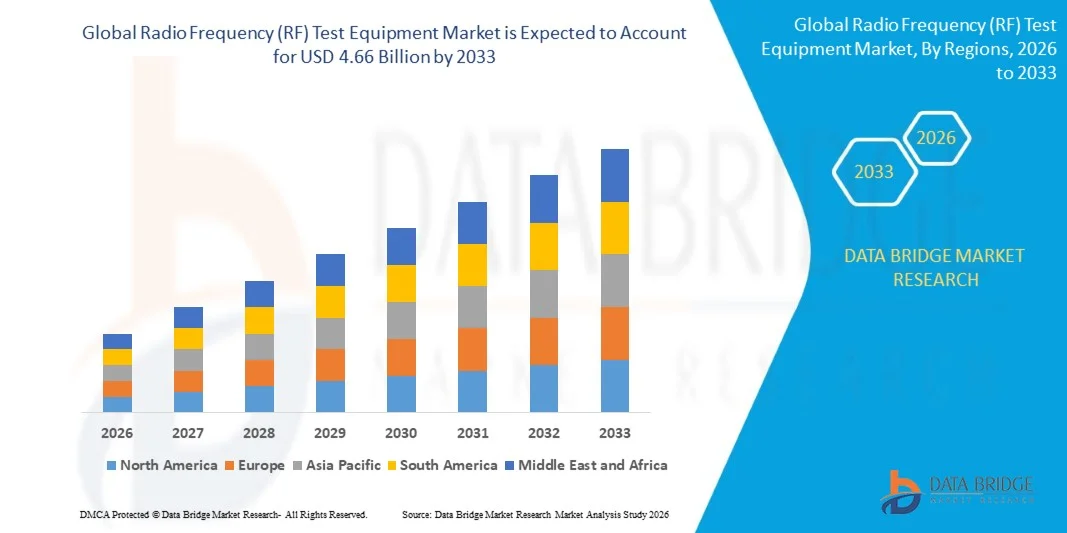
Report Scope and Radio Frequency (RF) Test Equipment Market Segmentation
|
Attributes |
Radio Frequency (RF) Test Equipment Key Market Insights |
|
Segments Covered |
· By Product: Oscilloscopes, Signal Generators, Spectrum Analyzers, Network Analyzers, and Others · By Type: Modular GP Instrumentation, Traditional GP Instrumentation, Semiconductor ATE, Rental GP, and Other Types · By Form Factor: Benchtop, Portable, and Modular · By Frequency: Less Than 1 GHz, 1 GHz to 6 GHz, and More Than 6 GHz · By Application: Telecommunications, Consumer Electronics, Automotive, Industrial, Aerospace and Defence, Medical, and Research and Education |
|
Countries Covered |
North America · U.S. · Canada · Mexico Europe · Germany · France · U.K. · Netherlands · Switzerland · Belgium · Russia · Italy · Spain · Turkey · Rest of Europe Asia-Pacific · China · Japan · India · South Korea · Singapore · Malaysia · Australia · Thailand · Indonesia · Philippines · Rest of Asia-Pacific Middle East and Africa · Saudi Arabia · U.A.E. · South Africa · Egypt · Israel · Rest of Middle East and Africa South America · Brazil · Argentina · Rest of South America |
|
Key Market Players |
• ROHDE&SCHWARZ (Germany) |
|
Market Opportunities |
|
|
Value Added Data Infosets |
In addition to the insights on market scenarios such as market value, growth rate, segmentation, geographical coverage, and major players, the market reports curated by the Data Bridge Market Research also include in-depth expert analysis, geographically represented company-wise production and capacity, network layouts of distributors and partners, detailed and updated price trend analysis and deficit analysis of supply chain and demand. |
Radio Frequency (RF) Test Equipment Market Trends
Trend: Rising Deployment Of 5G Networks And Advanced Wireless Communication Technologies
Increasing demand for high-frequency communication systems, connected devices, and advanced wireless infrastructure across telecommunications, aerospace, automotive, and semiconductor industries is accelerating adoption of RF test equipment globally. Conventional testing systems often struggle to support high-frequency millimeter-wave applications, massive MIMO architectures, and complex signal environments associated with next-generation communication standards, encouraging industries to deploy advanced RF testing solutions with higher accuracy, bandwidth, and automation capabilities.
In modern 5G infrastructure deployments, telecom operators and equipment manufacturers are increasingly integrating RF analyzers, signal generators, and network analyzers, For instance for validating antenna performance, spectrum efficiency, and network reliability, to improve communication quality and reduce latency across connected environments. In semiconductor manufacturing, RF testing systems are being used to validate high-frequency chipsets and wireless modules integrated into smartphones, IoT devices, and automotive electronics, improving production quality and reducing signal interference risks.
The rapid expansion of connected consumer electronics, AI-powered communication systems, and autonomous vehicle technologies is also increasing demand for high-precision RF measurement systems capable of operating across complex wireless frequencies. In addition, aerospace and defense sectors continue to rely on advanced RF testing technologies for radar systems, satellite communication equipment, and electronic warfare systems because of their critical role in signal validation and operational reliability. Growing industry validation through 5G infrastructure trials conducted in 2025 across the U.S. and South Korea demonstrated signal accuracy improvements of nearly 15–20% after deployment of AI-assisted RF spectrum analysis systems in dense urban communication networks.
Radio Frequency (RF) Test Equipment Market Dynamics
Key Market Driver: Increasing Expansion Of 5G Infrastructure And Connected Devices
Telecommunication providers, semiconductor manufacturers, and electronics companies worldwide are facing increasing pressure to improve network performance, signal quality, and device reliability while supporting rapidly expanding wireless communication ecosystems. The large-scale deployment of 5G infrastructure, IoT devices, autonomous systems, and advanced wireless electronics is creating strong demand for RF test equipment capable of validating high-frequency signals, minimizing interference, and ensuring regulatory compliance.
Industries such as telecommunications, automotive, aerospace, and semiconductor manufacturing are increasingly deploying RF testing solutions to evaluate antennas, wireless chipsets, radar systems, and connected communication modules to improve product performance and operational efficiency. Telecom OEMs are actively integrating advanced RF analyzers and network testing systems, For instance in 5G base stations and Open RAN infrastructure deployments, to support rising data traffic and ultra-low latency communication requirements.
Similarly, semiconductor fabrication facilities and consumer electronics manufacturers are expanding use of RF testing systems to validate next-generation wireless chipsets used in smartphones, wearables, and IoT devices while reducing product failure risks. Real-world 5G infrastructure deployments conducted in China and the U.S. during 2024 demonstrated nearly 25–30% faster network optimization capabilities after implementation of automated RF spectrum monitoring and signal analysis systems across urban communication environments.
Key Restraint/Challenge: High Equipment Costs And Technological Complexity
Advanced RF testing systems designed for millimeter-wave frequencies, high-speed wireless protocols, and complex signal environments involve substantial development and procurement costs, limiting adoption among small-scale manufacturers and cost-sensitive industries. The increasing complexity of 5G, satellite communication, and radar testing applications also requires highly skilled technical personnel capable of operating sophisticated RF analyzers and calibration systems.
In addition, frequent technology upgrades, calibration requirements, and compatibility challenges associated with evolving wireless communication standards significantly increase operational and maintenance expenses. Small and medium-sized enterprises often face difficulties in justifying investment in high-end RF testing platforms due to long return-on-investment cycles and rapidly changing testing requirements.
Commercial benchmarking studies indicate that advanced millimeter-wave RF testing platforms used for 5G and aerospace applications can cost approximately 30–45% more than conventional RF measurement systems, creating affordability and scalability challenges for emerging market manufacturers and research organizations.
Key Market Opportunity: Growing Adoption Across Automotive Electronics And Aerospace Systems
Modern autonomous vehicles, connected transportation infrastructure, satellite communication systems, and defense electronics increasingly require highly accurate RF testing technologies capable of validating complex wireless communication environments and high-frequency signal performance. Conventional testing solutions are often unable to support rapidly evolving radar, V2X communication, and satellite transmission architectures, creating demand for next-generation RF test equipment with improved automation, bandwidth, and real-time signal analysis capabilities.
Automotive manufacturers are increasingly deploying RF testing systems, For instance for advanced driver-assistance systems (ADAS), radar sensors, and vehicle-to-everything communication modules, to improve operational safety, connectivity, and autonomous driving performance without compromising signal reliability. In aerospace and defense sectors, rising investments in satellite communication, phased-array radar systems, and electronic warfare technologies are accelerating adoption of high-frequency RF validation systems across mission-critical applications.
In addition, advancements in AI-assisted spectrum analysis, cloud-connected testing platforms, and automated calibration technologies are improving operational efficiency and testing precision, opening opportunities across telecommunications, aerospace, semiconductor, and defense infrastructure markets in Asia-Pacific and North America. Automotive RF validation programs conducted in 2025 across Germany and Japan reported nearly 12–18% improvements in radar signal accuracy and wireless communication stability after integration of advanced automated RF testing platforms into autonomous vehicle development environments.
Radio Frequency (RF) Test Equipment Market Scope
The market is segmented on the basis of product, type, form factor, frequency, and application.
- By Product
On the basis of product, the radio frequency (RF) test equipment market is segmented into Oscilloscopes, Signal Generators, Spectrum Analyzers, Network Analyzers, and Others. The Spectrum Analyzers segment held the largest market revenue share of approximately 31.8% in 2025 driven by increasing deployment of 5G infrastructure, wireless communication systems, and advanced RF signal monitoring applications. Spectrum analyzers are extensively used across telecommunications, aerospace, semiconductor manufacturing, and defense industries for signal measurement, interference detection, and frequency validation across high-frequency communication environments. Rising investments in next-generation wireless technologies and network optimization are further strengthening segment growth globally.
The Network Analyzers segment is projected to register the fastest growth at a CAGR of 8.9% from 2026 to 2033, driven by increasing demand for antenna testing, high-speed data transmission validation, and advanced semiconductor characterization applications. Growing deployment of millimeter-wave communication systems and expansion of automotive radar technologies are accelerating adoption of network analyzers across telecommunications and automotive electronics industries worldwide.
- By Type
On the basis of type, the radio frequency (RF) test equipment market is segmented into Modular GP Instrumentation, Traditional GP Instrumentation, Semiconductor ATE, Rental GP, and Other Types. The Traditional GP Instrumentation segment held the largest market revenue share of approximately 36.5% in 2025 driven by its widespread deployment across research laboratories, telecom infrastructure testing, aerospace systems, and industrial communication validation applications. Traditional RF instrumentation systems are preferred due to their high measurement accuracy, operational reliability, and compatibility with multiple wireless communication standards.
The Semiconductor ATE segment is projected to register the fastest growth at a CAGR of 9.4% from 2026 to 2033, driven by increasing production of RF chipsets, AI processors, and high-frequency semiconductor components used in smartphones, IoT devices, and automotive electronics. Rising investments in semiconductor manufacturing facilities and advanced chip testing capabilities are significantly accelerating segment expansion globally.
- By Form Factor
On the basis of form factor, the radio frequency (RF) test equipment market is segmented into Benchtop, Portable, and Modular. The Benchtop segment held the largest market revenue share of approximately 52.7% in 2025 driven by its extensive use across telecommunication laboratories, semiconductor facilities, aerospace testing centers, and industrial R&D environments. Benchtop RF testing systems provide superior measurement precision, higher frequency handling capabilities, and enhanced signal analysis performance for complex communication applications.
The Modular segment is projected to witness the fastest growth at a CAGR of 9.1% from 2026 to 2033 due to rising demand for scalable, space-efficient, and software-defined RF testing platforms capable of supporting evolving wireless communication technologies. Increasing adoption of modular testing systems across 5G infrastructure development and automated semiconductor validation environments is accelerating segment growth worldwide.
- By Frequency
On the basis of frequency, the radio frequency (RF) test equipment market is segmented into Less Than 1 GHz, 1 GHz to 6 GHz, and More Than 6 GHz. The 1 GHz to 6 GHz segment held the largest market revenue share of approximately 47.3% in 2025 driven by widespread deployment of 4G and 5G communication infrastructure, Wi-Fi technologies, IoT devices, and consumer electronics operating within mid-band frequency ranges. RF testing equipment within this range is extensively used for wireless communication validation, antenna testing, and network optimization applications across telecommunications and industrial sectors.
The More Than 6 GHz segment is projected to register the fastest growth at a CAGR of 10.2% from 2026 to 2033, driven by increasing adoption of millimeter-wave technologies, advanced radar systems, satellite communication infrastructure, and next-generation automotive communication platforms. Expansion of 5G mmWave deployments and aerospace communication systems is significantly supporting high-frequency RF testing demand globally.
- By Application
On the basis of application, the radio frequency (RF) test equipment market is segmented into Telecommunications, Consumer Electronics, Automotive, Industrial, Aerospace and Defence, Medical, and Research and Education. The Telecommunications segment held the largest market revenue share of approximately 34.9% in 2025 driven by rapid deployment of 5G infrastructure, rising mobile data traffic, and increasing investments in wireless communication network optimization globally. Telecom companies and equipment manufacturers are extensively using RF testing systems for validating antennas, base stations, network reliability, and signal performance across high-frequency communication environments.
The Automotive segment is projected to register the fastest growth at a CAGR of 9.7% from 2026 to 2033, driven by increasing integration of ADAS systems, autonomous driving technologies, vehicle-to-everything communication platforms, and automotive radar systems. Rising adoption of connected vehicles and electric mobility infrastructure is accelerating demand for high-frequency RF validation systems across automotive electronics and intelligent transportation ecosystems worldwide.
Radio Frequency (RF) Test Equipment Market Regional Analysis
North America Radio Frequency (RF) Test Equipment Market Insight
North America dominated the radio frequency (RF) test equipment market with the largest revenue share of approximately 36.9% in 2025, supported by rapid deployment of 5G infrastructure, strong aerospace and defense investments, and increasing adoption of advanced wireless communication technologies. The region benefits from the presence of major semiconductor manufacturers, telecom equipment providers, and leading RF testing solution companies continuously investing in next-generation communication validation systems. Increasing adoption of connected devices, autonomous vehicle technologies, and AI-powered communication infrastructure is further accelerating demand for high-frequency RF testing equipment across commercial and industrial applications.
U.S. Radio Frequency (RF) Test Equipment Market Insight
The U.S. radio frequency (RF) test equipment market captured the largest revenue share in 2025 within North America, fueled by extensive 5G rollout activities, increasing investments in semiconductor manufacturing, and rising demand for advanced communication testing systems across aerospace, automotive, and defense sectors. Companies across the country are increasingly prioritizing high-frequency signal analysis, network optimization, and wireless device validation to support growing data traffic and connected infrastructure requirements. In addition, strong government investments in defense modernization and satellite communication systems are significantly contributing to RF testing equipment adoption across mission-critical applications.
Europe Radio Frequency (RF) Test Equipment Market Insight
The Europe radio frequency (RF) test equipment market is expected to witness strong growth from 2026 to 2033, primarily driven by increasing investments in automotive electronics, industrial automation, aerospace communication systems, and next-generation wireless infrastructure. European manufacturers are increasingly deploying RF testing solutions to support advanced radar systems, connected vehicle technologies, and industrial IoT communication platforms. The region is also witnessing rising demand for high-frequency signal validation systems integrated with 5G infrastructure, satellite communication networks, and semiconductor production facilities. Increasing focus on technological innovation and communication efficiency is further strengthening market expansion across Europe.
U.K. Radio Frequency (RF) Test Equipment Market Insight
The U.K. radio frequency (RF) test equipment market is expected to witness significant growth from 2026 to 2033, driven by increasing deployment of 5G communication infrastructure, rising aerospace and defense investments, and growing demand for wireless testing solutions across research institutions and telecom networks. The country’s strong focus on innovation in satellite communication, autonomous transportation systems, and semiconductor research is accelerating adoption of advanced RF analyzers and network testing platforms. In addition, expanding investments in Open RAN and next-generation communication infrastructure are supporting market development across the U.K.
Germany Radio Frequency (RF) Test Equipment Market Insight
The Germany radio frequency (RF) test equipment market is expected to witness steady expansion from 2026 to 2033, fueled by increasing adoption of connected automotive technologies, industrial automation systems, and advanced manufacturing infrastructure. Germany’s strong automotive and industrial ecosystem is creating substantial demand for RF testing solutions used in vehicle radar systems, V2X communication platforms, and smart factory environments. The country is also witnessing increasing integration of RF validation systems across semiconductor manufacturing and aerospace engineering applications. Rising investments in Industry 4.0 infrastructure and intelligent mobility technologies are further contributing to market growth across Germany.
Asia-Pacific Radio Frequency (RF) Test Equipment Market Insight
The Asia-Pacific radio frequency (RF) test equipment market is expected to witness the fastest growth rate from 2026 to 2033, supported by rapid expansion of telecommunications infrastructure, rising semiconductor manufacturing activities, and increasing deployment of connected consumer electronics across China, Japan, South Korea, and India. The region’s growing focus on 5G network expansion, industrial automation, and smart city development is accelerating demand for RF signal analyzers, network analyzers, and wireless communication validation systems. Furthermore, strong electronics manufacturing capabilities and rising investments in AI-powered communication infrastructure are improving adoption of advanced RF testing technologies across both industrial and commercial applications.
Japan Radio Frequency (RF) Test Equipment Market Insight
The Japan radio frequency (RF) test equipment market is expected to witness strong growth from 2026 to 2033 due to the country’s advanced semiconductor industry, technological leadership in wireless communication systems, and increasing investments in automotive electronics and robotics infrastructure. Japanese companies are increasingly deploying RF testing systems to support high-frequency communication devices, automotive radar systems, and next-generation industrial automation technologies. The integration of RF validation systems across smart factories, autonomous vehicle development, and 5G infrastructure projects is significantly accelerating market expansion. Moreover, growing investments in satellite communication and precision electronics manufacturing are strengthening demand for advanced RF testing equipment across Japan.
China Radio Frequency (RF) Test Equipment Market Insight
The China radio frequency (RF) test equipment market accounted for the largest market revenue share in Asia-Pacific in 2025, attributed to rapid expansion of 5G infrastructure, strong semiconductor manufacturing capabilities, and rising production of consumer electronics and connected devices. China represents one of the largest markets for wireless communication equipment and semiconductor testing systems, with increasing deployment of RF analyzers and network validation platforms across telecom, automotive, and industrial sectors. Government initiatives supporting domestic semiconductor production, smart city development, and advanced communication infrastructure are significantly accelerating market growth. In addition, the presence of large-scale electronics manufacturing hubs and rising investments in autonomous vehicle technologies are further strengthening RF testing equipment adoption across the country.
Radio Frequency (RF) Test Equipment Market Share
The Radio Frequency (RF) Test Equipment industry is primarily led by well-established companies, including:
• ROHDE&SCHWARZ (Germany)
• Keysight Technologies (U.S.)
• Fortive. (U.S.)
• Anritsu (Japan)
• NATIONAL INSTRUMENTS CORP. (U.S.)
• Cobham Limited (U.K.)
• EXFO Inc. (Canada)
• Teradyne Inc. (U.S.)
• VIAVI Solutions Inc. (U.S.)
• Giga-tronics Incorporated. (U.S.)
• Yokogawa Test & Measurement Corporation (Japan)
• CHROMA ATE INC. (Taiwan)
• Good Will Instrument Co., Ltd. (Taiwan)
• B&K Precision Corporation (U.S.)
• Infinite Electronics International, Inc. (U.S.)
• ERA Instruments (India)
• Freedom Communication Technologies. (U.S.)
• Saluki Technology (China)
Latest Developments in Radio Frequency (RF) Test Equipment Market
- In February 2024, Anritsu Corporation, product launch development, introduced the NR Licensed 6GHz Band Measurement MX800010A-014 software for its MT8000A Radio Communication Test Station to support RF testing for 5G FR1 devices operating between 5.925 GHz and 7.125 GHz. The solution was developed to address increasing wireless traffic and the expansion of licensed 5G frequency bands under 3GPP Release 17 standards. This advancement enhances testing capabilities for next-generation telecom infrastructure and accelerates adoption of high-frequency 5G devices globally. The launch is expected to strengthen Anritsu’s position in advanced wireless communication testing while supporting telecom operators and device manufacturers in improving network performance and compliance standards.
- In July 2023, Keysight Technologies, product portfolio expansion, launched the N9912C FieldFox Handheld Analyzer to provide field engineers with a flexible software-defined RF testing platform supporting vector network analysis, spectrum analysis, and cable testing capabilities. The new handheld solution was designed to simplify troubleshooting and maintenance of RF, microwave, and millimeter-wave communication systems used across telecom, aerospace, and defense industries. The launch improves operational efficiency for field-based wireless testing applications while supporting faster deployment and maintenance of advanced communication infrastructure. This development is expected to strengthen adoption of portable RF testing solutions across rapidly expanding 5G and satellite communication networks.
- In June 2023, Keysight Technologies, software platform enhancement, introduced the upgraded PathWave Test Executive for Manufacturing Developer Version with automated RF calibration and verification capabilities for LTE V2X and DSRC automotive communication chipsets. The system was developed to support connected vehicle applications by improving wireless communication reliability, diagnostics, and telematics performance across automotive ecosystems. This advancement enables automotive manufacturers and semiconductor developers to improve testing automation while reducing validation complexity for next-generation connected mobility technologies. The launch is expected to accelerate development of intelligent transportation infrastructure and strengthen demand for advanced automotive RF testing platforms globally.
- In June 2022, TEVET, acquisition development, acquired the Liberty GT real-time spectrum analyzer business from RADX Technologies, Inc. to expand its capabilities in real-time radio frequency analysis across multiple wireless network spectrums. The acquisition enhances TEVET’s product portfolio by strengthening advanced RF signal monitoring and spectrum analysis capabilities required across defense, telecom, and industrial communication sectors. This strategic move is expected to improve the company’s competitive positioning in high-performance RF testing applications while supporting growing demand for advanced spectrum intelligence solutions. The acquisition also contributes to broader innovation within wireless communication testing markets.
- In June 2022, Rapidtek, strategic partnership development, partnered with Amrisoft to jointly develop next-generation RF testing solutions focused on 4G and 5G communication technologies. The collaboration aims to enhance wireless testing accuracy, network optimization, and telecom infrastructure validation capabilities required for rapidly expanding mobile communication ecosystems. By combining Rapidtek’s RF testing expertise with Amrisoft’s telecom software capabilities, the partnership is expected to accelerate development of advanced wireless communication testing platforms. This initiative supports growing global investments in 5G deployment and strengthens innovation across telecom network testing environments.
- In May 2022, Atlantic Microwave, product launch development, introduced the “Modular Bench-top Instrumentation Chassis” designed to provide flexible and scalable solutions for bench-top RF testing applications across telecommunications, aerospace, and research industries. The modular platform improves testing efficiency by enabling users to customize instrumentation configurations based on evolving communication and signal analysis requirements. This launch supports increasing demand for adaptable RF testing systems capable of handling complex wireless technologies and high-frequency applications. The product introduction is expected to strengthen Atlantic Microwave’s market presence while supporting operational flexibility for advanced communication testing laboratories.
SKU-
Get online access to the report on the World's First Market Intelligence Cloud

- Interactive Data Analysis Dashboard
- Company Analysis Dashboard for high growth potential opportunities
- Research Analyst Access for customization & queries
- Competitor Analysis with Interactive dashboard
- Latest News, Updates & Trend analysis
- Harness the Power of Benchmark Analysis for Comprehensive Competitor Tracking
Global Rf Test Equipment Market, Supply Chain Analysis and Ecosystem Framework
To support market growth and help clients navigate the impact of geopolitical shifts, DBMR has integrated in-depth supply chain analysis into its Global Rf Test Equipment Market research reports. This addition empowers clients to respond effectively to global changes affecting their industries. The supply chain analysis section includes detailed insights such as Global Rf Test Equipment Market consumption and production by country, price trend analysis, the impact of tariffs and geopolitical developments, and import and export trends by country and HSN code. It also highlights major suppliers with data on production capacity and company profiles, as well as key importers and exporters. In addition to research, DBMR offers specialized supply chain consulting services backed by over a decade of experience, providing solutions like supplier discovery, supplier risk assessment, price trend analysis, impact evaluation of inflation and trade route changes, and comprehensive market trend analysis.
Research Methodology
Data collection and base year analysis are done using data collection modules with large sample sizes. The stage includes obtaining market information or related data through various sources and strategies. It includes examining and planning all the data acquired from the past in advance. It likewise envelops the examination of information inconsistencies seen across different information sources. The market data is analysed and estimated using market statistical and coherent models. Also, market share analysis and key trend analysis are the major success factors in the market report. To know more, please request an analyst call or drop down your inquiry.
The key research methodology used by DBMR research team is data triangulation which involves data mining, analysis of the impact of data variables on the market and primary (industry expert) validation. Data models include Vendor Positioning Grid, Market Time Line Analysis, Market Overview and Guide, Company Positioning Grid, Patent Analysis, Pricing Analysis, Company Market Share Analysis, Standards of Measurement, Global versus Regional and Vendor Share Analysis. To know more about the research methodology, drop in an inquiry to speak to our industry experts.
Customization Available
Data Bridge Market Research is a leader in advanced formative research. We take pride in servicing our existing and new customers with data and analysis that match and suits their goal. The report can be customized to include price trend analysis of target brands understanding the market for additional countries (ask for the list of countries), clinical trial results data, literature review, refurbished market and product base analysis. Market analysis of target competitors can be analyzed from technology-based analysis to market portfolio strategies. We can add as many competitors that you require data about in the format and data style you are looking for. Our team of analysts can also provide you data in crude raw excel files pivot tables (Fact book) or can assist you in creating presentations from the data sets available in the report.












