




Global Roaming Tariff Market
Market Size in USD Billion
CAGR :
% 
 USD
82.87 Billion
USD
115.17 Billion
2025
2033
USD
82.87 Billion
USD
115.17 Billion
2025
2033
 Forecast Period Forecast Period |
2026 –2033 |
 Market Size (Base Year) Market Size (Base Year) |
USD 82.87 Billion |
 Market Size (Forecast Year) Market Size (Forecast Year) |
USD 115.17 Billion |
 CAGR CAGR |
% |
| Major Markets Players |
|
Roaming Tariff Market Size
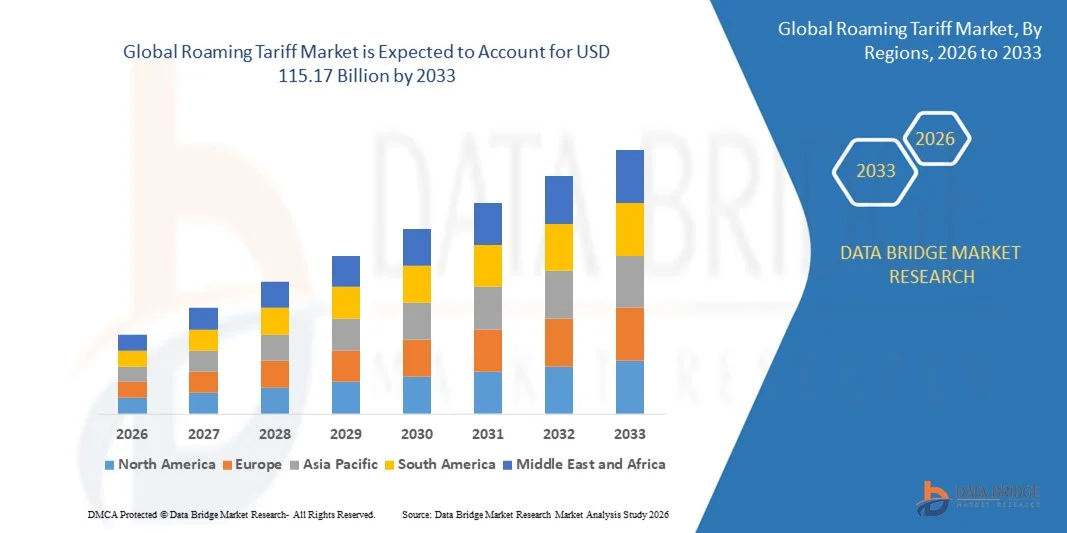
- The global roaming tariff market size was valued at USD 82.87 billion in 2025 and is expected to reach USD 115.17 billion by 2033, at a CAGR of 4.20% during the forecast period
- The market growth is largely fuelled by the rising international travel activities, increasing cross-border business operations, and growing demand for seamless mobile connectivity among global travelers
- Expansion of mobile network infrastructure, increasing smartphone penetration, and the continuous evolution of telecom services are further supporting the demand for roaming tariff services worldwide
Roaming Tariff Market Analysis
- The roaming tariff market is experiencing steady growth as telecom operators focus on offering competitive international roaming plans and value-added services to attract travelers and business users
- Continuous innovation in telecom pricing models, partnerships between global telecom operators, and improvements in mobile network technologies are encouraging wider adoption of roaming services across consumer and enterprise segments
- Europe dominated the roaming tariff market with the largest revenue share of 42.79% in 2025, primarily driven by the rising number of cross-border travelers and the strong presence of interconnected telecom networks across European countries
- Asia-Pacific region is expected to witness the highest growth rate in the global roaming tariff market, driven by increasing international tourism, rapid smartphone adoption, and expanding telecom networks across countries such as China, Japan, and India. Rising disposable incomes and growing cross-border business activities are also supporting the demand for roaming services in the region
- The International segment held the largest market revenue share in 2025 driven by the increasing number of global travelers, cross-border business activities, and the rising demand for uninterrupted mobile connectivity while abroad. International roaming services allow users to access voice, messaging, and mobile data networks outside their home country, making them essential for international communication and travel convenience
Report Scope and Roaming Tariff Market Segmentation
|
Attributes |
Roaming Tariff Key Market Insights |
|
Segments Covered |
|
|
Countries Covered |
North America
Europe
Asia-Pacific
Middle East and Africa
South America
|
|
Key Market Players |
|
|
Market Opportunities |
|
|
Value Added Data Infosets |
In addition to the market insights such as market value, growth rate, market segments, geographical coverage, market players, and market scenario, the market report curated by the Data Bridge Market Research team includes in-depth expert analysis, import/export analysis, pricing analysis, production consumption analysis, and pestle analysis. |
Roaming Tariff Market Trends
Rising Demand for Seamless International Connectivity
- The increasing number of international travelers and cross-border business activities is significantly shaping the roaming tariff market, as consumers and enterprises require uninterrupted mobile connectivity while abroad. Telecom operators are focusing on providing cost-effective roaming plans and flexible data packages that enable users to access voice, messaging, and high-speed data services across different countries. This trend is encouraging service providers to expand partnerships and roaming agreements with global telecom networks to enhance service coverage and reliability
- Growing smartphone penetration and the rising use of data-intensive applications such as video streaming, navigation services, social media, and cloud-based communication tools are accelerating the demand for roaming tariff services. Travelers increasingly rely on mobile connectivity for real-time information and communication, prompting telecom companies to introduce competitive roaming data packages and innovative pricing strategies to attract international users
- Advancements in telecom technologies and the deployment of high-speed mobile networks are influencing consumer expectations for seamless roaming experiences. Operators are investing in network upgrades, improved billing systems, and enhanced roaming infrastructure to provide faster connectivity and transparent pricing models. These improvements help telecom providers strengthen customer satisfaction while expanding their global service capabilities
- For instance, in 2024, Vodafone in the U.K. and AT&T in the U.S. introduced new international roaming plans offering expanded data allowances and simplified pricing structures for travelers. These plans were launched to address the rising demand for affordable global connectivity among frequent travelers and business professionals, with availability across multiple international destinations and supported through digital service platforms
- While demand for roaming tariff services continues to grow, long-term market expansion depends on regulatory frameworks, competitive pricing strategies, and continuous improvements in telecom infrastructure. Telecom operators are focusing on strengthening international partnerships, optimizing network management systems, and developing innovative roaming packages that balance affordability, service quality, and global connectivity
Roaming Tariff Market Dynamics
Driver
Growing International Travel And Rising Mobile Data Usage
- The increasing volume of international travel for tourism, business, and education is a major driver for the roaming tariff market. Mobile users require reliable voice and data services when traveling across borders, encouraging telecom operators to expand roaming agreements and introduce competitive pricing plans. This demand is particularly strong among frequent travelers and corporate professionals who rely on continuous connectivity
- Expanding smartphone adoption and the widespread use of mobile applications are also contributing to market growth. Consumers increasingly depend on their mobile devices for navigation, communication, banking, and entertainment while traveling internationally. This reliance on digital services is driving telecom providers to enhance roaming packages that support higher data consumption and uninterrupted connectivity
- Telecom companies are actively investing in advanced billing systems, roaming management platforms, and strategic partnerships with international network operators. These initiatives help service providers offer transparent pricing models, improved network coverage, and better service quality, strengthening their competitive position in the global roaming tariff market
- For instance, in 2023, Telefónica in Spain and T-Mobile in the U.S. expanded their international roaming offerings by introducing global data packages and simplified roaming tariffs for customers traveling across multiple regions. These initiatives were implemented to address the rising demand for affordable data services and seamless connectivity, improving customer experience and increasing service adoption
- Although the rising demand for global connectivity supports market growth, sustained expansion depends on regulatory alignment, cost optimization, and continuous network innovation. Telecom providers must focus on improving service affordability, enhancing roaming infrastructure, and strengthening global partnerships to support the increasing volume of international mobile users
Restraint/Challenge
High Roaming Charges And Increasing Availability Of Alternative Connectivity Solutions
- The relatively high cost of roaming services compared to local mobile plans remains a key challenge for the roaming tariff market. Many travelers attempt to reduce roaming expenses by purchasing local SIM cards or using alternative connectivity options such as portable Wi-Fi devices. These alternatives can limit the adoption of traditional roaming tariff services, particularly among price-sensitive consumers
- Consumer awareness of cost-saving alternatives is also influencing market dynamics. Travelers are increasingly informed about various connectivity solutions available abroad, including international eSIM services and free public Wi-Fi networks. This awareness encourages users to explore options beyond traditional roaming services, potentially reducing telecom operators’ roaming revenue
- Network compatibility and service quality variations across regions can also affect user experience. Differences in telecom infrastructure, regulatory policies, and roaming agreements between operators may result in inconsistent service availability or higher operational costs. Telecom providers must invest in advanced network integration and roaming management technologies to address these challenges
- For instance, in 2024, travelers across major tourist destinations such as Singapore and Thailand increasingly adopted international eSIM plans offered by digital connectivity providers such as Airalo and Nomad instead of traditional roaming packages. These solutions provided competitive pricing and flexible data plans, prompting telecom operators to reconsider their roaming pricing strategies
- Addressing these challenges will require telecom companies to introduce competitive roaming tariffs, improve service transparency, and expand global roaming partnerships. Developing flexible roaming packages, enhancing network interoperability, and adopting innovative connectivity solutions will be essential for sustaining long-term growth in the global roaming tariff market
Roaming Tariff Market Scope
The roaming tariff market is segmented on the basis of roaming type, distribution channel, and service.
- By Roaming Type
On the basis of roaming type, the roaming tariff market is segmented into National and International. The International segment held the largest market revenue share in 2025 driven by the increasing number of global travelers, cross-border business activities, and the rising demand for uninterrupted mobile connectivity while abroad. International roaming services allow users to access voice, messaging, and mobile data networks outside their home country, making them essential for international communication and travel convenience.
The National segment is expected to witness steady growth from 2026 to 2033, driven by the continued expansion of telecom networks and improved domestic connectivity across rural and remote regions. National roaming services enable users to access partner networks when their home network coverage is limited, ensuring uninterrupted connectivity and improved service availability within a country.
- By Distribution Channel
On the basis of distribution channel, the roaming tariff market is segmented into Retail Roaming and Wholesale Roaming. The Retail Roaming segment accounted for the largest market revenue share in 2025 due to the increasing number of mobile subscribers opting for roaming services directly through their telecom operators. Retail roaming plans are commonly offered through prepaid and postpaid packages, providing consumers with convenient access to voice, SMS, and data services while traveling.
The Wholesale Roaming segment is expected to witness significant growth from 2026 to 2033, supported by increasing partnerships and agreements between telecom operators worldwide. Wholesale roaming allows operators to provide network access to other carriers’ subscribers, enabling seamless connectivity across international networks and supporting the global expansion of telecom services.
- By Service
On the basis of service, the roaming tariff market is segmented into Voice, SMS, and Data. The Data segment held the largest market revenue share in 2025 driven by the rising usage of smartphones and increasing consumption of mobile internet services such as video streaming, navigation, and social media while traveling. Telecom operators are increasingly offering data-focused roaming packages to meet the growing demand for high-speed mobile connectivity.
The Voice segment is expected to witness steady growth from 2026 to 2033, supported by the continued need for direct communication during international travel and business activities. Voice roaming services remain essential for travelers requiring reliable voice connectivity, particularly in regions where mobile data connectivity may be limited or inconsistent.
Roaming Tariff Market Regional Analysis
- Europe dominated the roaming tariff market with the largest revenue share of 42.79% in 2025, primarily driven by the rising number of cross-border travelers and the strong presence of interconnected telecom networks across European countries
- Increasing mobile data usage among travelers and the growing adoption of digital services are encouraging telecom providers to expand roaming agreements and improve service quality
- The region is also benefiting from continuous investments in telecom infrastructure and the growing demand for seamless mobile connectivity during international travel
U.K. Roaming Tariff Market Insight
The U.K. roaming tariff market is expected to witness the fastest growth rate from 2026 to 2033, driven by the rising demand for international travel connectivity and the increasing reliance on smartphones for communication and digital services. Consumers and business travelers are actively seeking flexible roaming plans that provide cost-effective voice and data services abroad. The strong presence of telecom operators and the country’s advanced mobile network infrastructure are further supporting the expansion of roaming services.
Germany Roaming Tariff Market Insight
The Germany dominated the roaming tariff market with the largest revenue share in 2025, fueled by the country’s strong international business activities and increasing travel across European and global destinations. German consumers and enterprises require reliable roaming services for uninterrupted communication and data usage while traveling. The adoption of advanced telecom technologies and continuous improvements in mobile network infrastructure are also supporting the growth of roaming tariff services in the country.
North America Roaming Tariff Market Insight
North America is expected to witness the fastest growth rate from 2026 to 2033, driven by the high volume of international travelers, strong presence of leading telecom operators, and increasing demand for uninterrupted mobile connectivity across borders. Consumers in the region highly value seamless international communication services, including voice, SMS, and high-speed mobile data while traveling abroad for business and leisure purposes. This widespread adoption is further supported by advanced telecom infrastructure, high smartphone penetration, and growing reliance on mobile applications for navigation, communication, and digital services during international travel
U.S. Roaming Tariff Market Insight
The U.S. roaming tariff market is expected to witness the fastest growth rate from 2026 to 2033, fueled by the high number of international travelers and the strong presence of global telecom service providers. Consumers increasingly rely on international roaming plans to maintain continuous connectivity for business communication, navigation, and entertainment while traveling. The growing adoption of smartphones, combined with the increasing use of mobile data services abroad, continues to support market expansion. Furthermore, telecom operators in the country are introducing competitive international roaming packages and flexible pricing models to attract frequent travelers and corporate users.
Asia-Pacific Roaming Tariff Market Insight
The Asia-Pacific roaming tariff market is expected to witness the fastest growth rate from 2026 to 2033, driven by increasing international tourism, rising disposable incomes, and the growing adoption of smartphones across countries such as China, Japan, and India. The region is experiencing strong growth in cross-border travel and digital connectivity, encouraging telecom operators to introduce competitive roaming packages. In addition, rapid telecom infrastructure development and expanding mobile networks are supporting the accessibility of roaming services across the region.
Japan Roaming Tariff Market Insight
The Japan roaming tariff market is expected to witness the fastest growth rate from 2026 to 2033 due to the country’s advanced telecom infrastructure, high smartphone penetration, and strong international travel activity. Japanese consumers rely heavily on mobile connectivity for navigation, communication, and online services when traveling abroad. Telecom operators are continuously enhancing roaming plans and expanding global network partnerships to provide seamless connectivity and improved service quality for travelers.
China Roaming Tariff Market Insight
The China roaming tariff market accounted for the largest market revenue share in Asia Pacific in 2025, attributed to the country’s rapidly growing international travel activities and large base of smartphone users. China has one of the largest mobile subscriber populations globally, creating strong demand for international roaming services. The expansion of telecom infrastructure, increasing outbound tourism, and the presence of major telecom operators offering competitive roaming packages are key factors driving market growth in China.
Roaming Tariff Market Share
The Roaming Tariff industry is primarily led by well-established companies, including:
- América Móvil (Mexico)
- AT&T Intellectual Property. (U.S.)
- Bharti Airtel Limited (India)
- China Mobile Limited. (China)
- Deutsche Telekom AG (Germany)
- Digicel (Jamaica)
- Sprint Corporation (U.S.)
- Telefonica S.A. (Spain)
- Verizon (U.S.)
- Vodafone Group (U.K.)
- PCCW Limited (Hong Kong)
- Orange S.A. (France)
- NTT Communications Corporation (Japan)
- Claro Company (Mexico)
- Nextel (U.S.)
- Singapore Telecommunication Limited (Singapore)
- Lycamobile. (U.K.)
SKU-
Get online access to the report on the World's First Market Intelligence Cloud

- Interactive Data Analysis Dashboard
- Company Analysis Dashboard for high growth potential opportunities
- Research Analyst Access for customization & queries
- Competitor Analysis with Interactive dashboard
- Latest News, Updates & Trend analysis
- Harness the Power of Benchmark Analysis for Comprehensive Competitor Tracking
Research Methodology
Data collection and base year analysis are done using data collection modules with large sample sizes. The stage includes obtaining market information or related data through various sources and strategies. It includes examining and planning all the data acquired from the past in advance. It likewise envelops the examination of information inconsistencies seen across different information sources. The market data is analysed and estimated using market statistical and coherent models. Also, market share analysis and key trend analysis are the major success factors in the market report. To know more, please request an analyst call or drop down your inquiry.
The key research methodology used by DBMR research team is data triangulation which involves data mining, analysis of the impact of data variables on the market and primary (industry expert) validation. Data models include Vendor Positioning Grid, Market Time Line Analysis, Market Overview and Guide, Company Positioning Grid, Patent Analysis, Pricing Analysis, Company Market Share Analysis, Standards of Measurement, Global versus Regional and Vendor Share Analysis. To know more about the research methodology, drop in an inquiry to speak to our industry experts.
Customization Available
Data Bridge Market Research is a leader in advanced formative research. We take pride in servicing our existing and new customers with data and analysis that match and suits their goal. The report can be customized to include price trend analysis of target brands understanding the market for additional countries (ask for the list of countries), clinical trial results data, literature review, refurbished market and product base analysis. Market analysis of target competitors can be analyzed from technology-based analysis to market portfolio strategies. We can add as many competitors that you require data about in the format and data style you are looking for. Our team of analysts can also provide you data in crude raw excel files pivot tables (Fact book) or can assist you in creating presentations from the data sets available in the report.












