




Global Salicylic Acid Market
Market Size in USD Million
CAGR :
% 
 USD
592.80 Million
USD
1,003.41 Million
2025
2033
USD
592.80 Million
USD
1,003.41 Million
2025
2033
 Forecast Period Forecast Period |
2026 –2033 |
 Market Size (Base Year) Market Size (Base Year) |
USD 592.80 Million |
 Market Size (Forecast Year) Market Size (Forecast Year) |
USD 1,003.41 Million |
 CAGR CAGR |
% |
| Major Markets Players |
|
Salicylic Acid Market Size
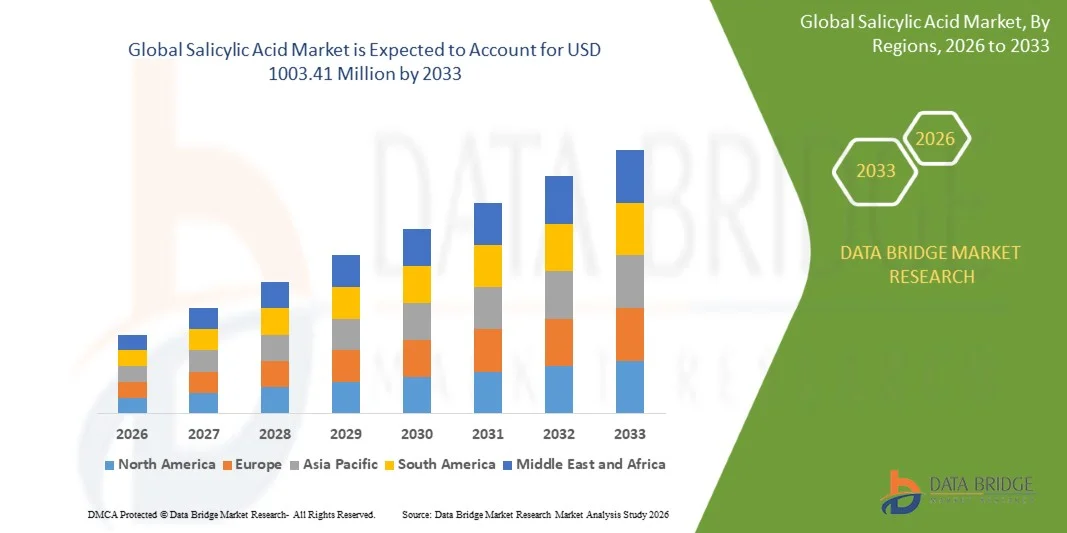
- The global salicylic acid market size was valued at USD 592.8 million in 2025 and is expected to reach USD 1003.41 million by 2033, at a CAGR of 6.8% during the forecast period
- The market growth is largely fueled by rising demand for advanced skincare solutions, increasing prevalence of acne and dermatological disorders, and growing consumer preference for active ingredient-based personal care products such as salicylic acid formulations
- Furthermore, expansion of the pharmaceutical and cosmetics industries, along with increasing awareness regarding skin health and preventive skincare routines, is establishing salicylic acid as a key functional ingredient across therapeutic and cosmetic applications. These converging factors are accelerating product adoption, thereby significantly boosting the industry's growth
Salicylic Acid Market Analysis
- Salicylic acid, a widely used beta hydroxy acid (BHA), plays a crucial role in skincare, pharmaceutical, and personal care formulations due to its exfoliating, anti-inflammatory, and keratolytic properties, making it an essential ingredient in acne treatment and skin-cleansing products
- The escalating demand for salicylic acid is primarily fueled by rising consumer inclination toward dermatology-based skincare solutions, increasing adoption in over-the-counter acne treatments, and growing usage in pharmaceutical formulations for skin disorder management
- Europe dominated the salicylic acid market with a share of 34% in 2025, due to strong demand from advanced skincare, pharmaceutical, and dermatology applications across the region
- Asia-Pacific is expected to be the fastest growing region in the salicylic acid market during the forecast period due to rising disposable incomes, expanding urban population, and increasing awareness of skincare and personal hygiene
- Skincare segment dominated the market with a market share of 48.5% in 2025, due to its extensive use in acne treatment products, exfoliating solutions, and anti-aging formulations. Rising consumer preference for chemical exfoliants in dermatology routines is strengthening demand for salicylic acid-based skincare formulations. Its keratolytic properties that help unclog pores and reduce acne breakouts further enhance its adoption across cosmetic and personal care brands
Report Scope and Salicylic Acid Market Segmentation
|
Attributes |
Salicylic Acid Key Market Insights |
|
Segments Covered |
|
|
Countries Covered |
North America · U.S. · Canada · Mexico Europe · Germany · France · U.K. · Netherlands · Switzerland · Belgium · Russia · Italy · Spain · Turkey · Rest of Europe Asia-Pacific · China · Japan · India · South Korea · Singapore · Malaysia · Australia · Thailand · Indonesia · Philippines · Rest of Asia-Pacific Middle East and Africa · Saudi Arabia · U.A.E. · South Africa · Egypt · Israel · Rest of Middle East and Africa South America · Brazil · Argentina · Rest of South America |
|
Key Market Players |
· Zhenjiang Gaopeng Pharmaceutical Co., Ltd (China) · Shandong Longxin Chemical Group Co., Ltd. (China) · Siddharth Carbochem Products Ltd (India) · J M Loveridge Ltd (U.K.) · Alta Laboratories Ltd (India) · Alfa Aesar (U.S.) · Salicylates And Chemicals Pvt. Ltd. (India) · Merck KGaA (Germany) · JQC (Huayin) Pharmaceutical Co., Ltd (China) · Vaikunth Chemicals Pvt Ltd (India) · Abhishek Chemicals (India) · Konar Organics Limited (India) |
|
Market Opportunities |
· Growth in Encapsulated and Controlled-Release Salicylic Acid Formulations · Expansion of Salicylic Acid Applications in Multifunctional Personal Care Products |
|
Value Added Data Infosets |
In addition to the insights on market scenarios such as market value, growth rate, segmentation, geographical coverage, and major players, the market reports curated by the Data Bridge Market Research also include in-depth expert analysis, pricing analysis, brand share analysis, consumer survey, demography analysis, supply chain analysis, value chain analysis, raw material/consumables overview, vendor selection criteria, PESTLE Analysis, Porter Analysis, and regulatory framework. |
Salicylic Acid Market Trends
“Rising Demand for Dermatology-Based Skincare Products”
- A significant trend in the salicylic acid market is the increasing use of dermatology-focused skincare formulations driven by growing consumer preference for acne treatment, exfoliation, and skin renewal solutions across both developed and emerging markets. This trend is strengthening the position of salicylic acid as a core active ingredient in over-the-counter and premium skincare products
- For instance, Galderma utilizes salicylic acid in its dermatology portfolio to develop acne treatment solutions widely recommended by dermatologists. Such formulations enhance product efficacy in treating acne-prone skin while improving consumer trust in clinically tested skincare solutions
- The expansion of beauty and personal care brands incorporating salicylic acid into cleansers, serums, and spot treatments is further supporting market growth as consumers increasingly adopt ingredient-focused skincare routines. This shift is reinforcing demand for scientifically backed dermatological formulations across global markets
- Rising awareness regarding skin health and preventive skincare practices is encouraging consumers to choose active ingredient-based products over traditional cosmetic solutions. This is accelerating innovation in multifunctional skincare products combining exfoliation, hydration, and acne control benefits
- The growing influence of dermatology clinics and professional skincare recommendations is also contributing to higher adoption of salicylic acid-based formulations. This is strengthening its role as a key functional ingredient in modern skincare regimens across diverse consumer groups
- The trend is further supported by continuous product innovation from global cosmetic manufacturers focusing on improved delivery systems and reduced irritation formulations. This is enhancing product performance and expanding the application scope of salicylic acid in advanced skincare solutions
Salicylic Acid Market Dynamics
Driver
“Expanding Use in Pharmaceutical Acne Treatment Formulations”
- The growing prevalence of acne and other dermatological disorders is driving the increased use of salicylic acid in pharmaceutical-grade acne treatment formulations, supported by its keratolytic and anti-inflammatory properties. This demand is strengthening its role as a key active pharmaceutical ingredient in both prescription and over-the-counter products
- For instance, Johnson & Johnson incorporates salicylic acid in its Neutrogena acne care product range, widely used for treating mild to moderate acne conditions. Such formulations enhance skin exfoliation and reduce pore blockage, improving treatment effectiveness for consumers
- The rising adoption of dermatology-based self-care routines is further increasing demand for salicylic acid in medicated skincare products across global markets. This is supporting the expansion of pharmaceutical applications beyond traditional clinical settings
- Increasing healthcare accessibility and growing awareness of skin disorder management are encouraging consumers to opt for clinically formulated acne treatments. This is accelerating the use of salicylic acid in targeted dermatological therapies
- The continuous rise in skin-related concerns among adolescents and adults is sustaining long-term demand for effective acne management solutions. This is reinforcing salicylic acid’s position as a critical component in dermatological pharmaceutical formulations
Restraint/Challenge
“Fluctuations in Raw Material Supply and Production Costs”
- The salicylic acid market faces challenges due to volatility in raw material availability and fluctuating production costs, particularly in chemical feedstocks used for synthesis. These fluctuations impact manufacturing stability and create pricing pressure across the supply chain
- For instance, companies such as Merck KGaA manage chemical production operations where variations in benzene-derived raw material costs can directly affect salicylic acid manufacturing economics. Such cost instability impacts profit margins and pricing consistency for end-use industries
- Supply chain disruptions and dependency on petrochemical-based inputs further increase vulnerability in production processes. This affects continuous manufacturing and can lead to temporary shortages in supply availability
- Strict regulatory compliance in chemical manufacturing also increases operational costs, as companies must maintain quality standards and environmental safety requirements. This adds additional financial pressure on producers
- The ongoing fluctuations in global chemical supply chains continue to challenge cost predictability and long-term planning for manufacturers. This remains a key restraint affecting stable growth in the salicylic acid market
Salicylic Acid Market Scope
The market is segmented on the basis of application, sales channel, and end-user.
- By Application
On the basis of application, the salicylic acid market is segmented into pharmaceutical, skincare, hair care, and food preservative. The skincare segment dominated the market with the largest revenue share of 48.5% in 2025, driven by its extensive use in acne treatment products, exfoliating solutions, and anti-aging formulations. Rising consumer preference for chemical exfoliants in dermatology routines is strengthening demand for salicylic acid-based skincare formulations. Its keratolytic properties that help unclog pores and reduce acne breakouts further enhance its adoption across cosmetic and personal care brands. Strong product innovation in serums, cleansers, and spot treatments is also supporting segment leadership. Increasing awareness of skin health and aesthetic appearance continues to reinforce skincare dominance in the market.
The pharmaceutical segment is expected to witness the fastest growth rate from 2026 to 2033, driven by increasing use of salicylic acid in topical therapeutic formulations and dermatological treatments. Expanding prevalence of skin disorders such as acne, psoriasis, and warts is accelerating demand for effective active pharmaceutical ingredients. For instance, companies such as Galderma are enhancing dermatology portfolios with salicylic acid-based prescription and over-the-counter formulations. Growing healthcare accessibility and rising self-medication trends are further contributing to segment expansion. Continuous research into advanced drug delivery systems is improving efficacy and patient compliance. The segment is gaining traction due to its expanding role in clinical dermatology applications.
- By Sales Channel
On the basis of sales channel, the salicylic acid market is segmented into online retail and offline retail. The offline retail segment dominated the market with the largest revenue share in 2025, supported by strong distribution through pharmacies, dermatology clinics, and specialty stores. Consumers continue to rely on in-store consultations for skincare and pharmaceutical purchases involving active ingredients. Immediate product availability and trust in pharmacist recommendations are reinforcing offline channel strength. Established retail infrastructure and wide brand presence further support sustained dominance. The segment remains central to product accessibility across both urban and semi-urban regions.
The online retail segment is expected to witness the fastest growth rate from 2026 to 2033, driven by increasing digital adoption and rising preference for doorstep delivery of skincare and healthcare products. Expanding e-commerce platforms are enabling easier access to niche dermatology brands and formulation-specific salicylic acid products. For instance, platforms such as Nykaa are strengthening skincare category penetration through curated dermatology product listings. Growing smartphone usage and digital payment integration are further enhancing consumer convenience. Discounted pricing and subscription-based skincare purchases are accelerating online channel adoption. The segment is gaining momentum due to shifting consumer purchasing behavior toward digital platforms.
- By End User
On the basis of end user, the salicylic acid market is segmented into antifungal, dentifrices, antiseptic, anti-irritant, moisturizer, sunscreen, acne solution, conditioner, shampoo, and others. The acne solution segment dominated the market with the largest revenue share in 2025, driven by widespread use of salicylic acid in treating acne-prone skin conditions. Its ability to exfoliate dead skin cells and reduce sebum buildup makes it a key active ingredient in acne management products. Strong demand from teenage and adult populations suffering from acne is supporting sustained dominance. Dermatology-focused skincare brands are increasingly formulating targeted acne treatments using salicylic acid. The segment continues to benefit from rising awareness of skin health and treatment-driven skincare routines.
The moisturizer segment is expected to witness the fastest growth rate from 2026 to 2033, driven by increasing demand for multifunctional skincare products combining hydration with exfoliation benefits. Consumers are increasingly preferring moisturizers enriched with active ingredients that support skin barrier repair and acne prevention simultaneously. For instance, companies such as La Roche-Posay are integrating salicylic acid into hydrating formulations for sensitive skin types. Growing focus on preventive skincare routines is strengthening adoption across diverse age groups. Expanding premium skincare offerings and dermatologist-recommended products are further boosting segment growth. The segment is expanding due to rising demand for combination skincare solutions with therapeutic benefits.
Salicylic Acid Market Regional Analysis
- Europe dominated the salicylic acid market with the largest revenue share of 34% in 2025, driven by strong demand from advanced skincare, pharmaceutical, and dermatology applications across the region
- The region benefits from high consumer awareness regarding skin health, widespread adoption of dermatology-based treatments, and strong presence of leading personal care and pharmaceutical manufacturers
- Strict regulatory frameworks supporting safe cosmetic formulations and increasing preference for clinically tested active ingredients are further strengthening salicylic acid adoption across skincare and healthcare products, establishing Europe as the leading regional market
Germany Salicylic Acid Market Insight
Germany accounted for the largest share in the Europe salicylic acid market in 2025, driven by strong pharmaceutical manufacturing capabilities and high demand for dermatology-based skincare products. The country’s advanced healthcare infrastructure and strong emphasis on clinical-grade cosmetic formulations are supporting widespread adoption of salicylic acid. Rising consumer preference for scientifically validated skincare solutions and increasing presence of leading pharmaceutical and cosmetic companies further strengthen Germany’s dominance in the regional market.
North America Salicylic Acid Market Insight
The North America salicylic acid market captured a significant revenue share in 2025, fueled by high consumption of over-the-counter acne treatment products and advanced skincare solutions. Rising prevalence of skin-related disorders and strong consumer spending on personal care products are supporting market growth. The region also benefits from a well-established pharmaceutical industry and strong presence of major skincare brands incorporating salicylic acid in therapeutic formulations. Increasing adoption of dermatologist-recommended skincare routines continues to drive consistent demand across the region.
U.S. Salicylic Acid Market Insight
The U.S. salicylic acid market accounted for the largest share within North America in 2025, driven by strong demand for acne treatment products, exfoliating cleansers, and medicated skincare formulations. High awareness regarding dermatological care and widespread availability of OTC skincare products are supporting market expansion. The presence of leading cosmetic and pharmaceutical companies is further accelerating product innovation and distribution. Growing focus on self-care routines and preventive skincare practices is significantly contributing to sustained market growth in the country.
Asia-Pacific Salicylic Acid Market Insight
The Asia-Pacific salicylic acid market is projected to grow at the fastest CAGR from 2026 to 2033, driven by rising disposable incomes, expanding urban population, and increasing awareness of skincare and personal hygiene. Rapid growth of the cosmetics and pharmaceutical industries in countries such as China, India, and South Korea is strengthening regional demand. Expanding e-commerce penetration and availability of affordable skincare products are further boosting adoption. Growing influence of global beauty trends and increasing dermatology consultations are accelerating market expansion across the region.
China Salicylic Acid Market Insight
The China salicylic acid market held the largest revenue share in Asia-Pacific in 2025, supported by strong domestic production, rising skincare consumption, and rapid urbanization. Increasing demand for acne treatment and whitening skincare products is significantly driving usage of salicylic acid-based formulations. Strong manufacturing capabilities and expansion of local cosmetic brands are further supporting market growth. Rising middle-class population and increasing focus on personal grooming are reinforcing China’s dominant position in the regional market.
Japan Salicylic Acid Market Insight
The Japan salicylic acid market is gaining steady momentum, driven by high demand for advanced skincare solutions and dermatologist-recommended formulations. The country’s strong focus on skin health and anti-aging products is supporting adoption across both pharmaceutical and cosmetic applications. Increasing preference for gentle yet effective exfoliating agents is further strengthening market growth. Integration of salicylic acid in premium skincare formulations and expanding aging population are key factors contributing to rising demand in Japan.
Salicylic Acid Market Share
The salicylic acid industry is primarily led by well-established companies, including:
- Zhenjiang Gaopeng Pharmaceutical Co., Ltd (China)
- Shandong Longxin Chemical Group Co., Ltd. (China)
- Siddharth Carbochem Products Ltd (India)
- J M Loveridge Ltd (U.K.)
- Alta Laboratories Ltd (India)
- Alfa Aesar (U.S.)
- Salicylates And Chemicals Pvt. Ltd. (India)
- Merck KGaA (Germany)
- JQC (Huayin) Pharmaceutical Co., Ltd (China)
- Vaikunth Chemicals Pvt Ltd (India)
- Abhishek Chemicals (India)
- Konar Organics Limited (India)
Latest Developments in Global Salicylic Acid Market
- In April 2025, Thermo Fisher Scientific announced a USD 2 billion investment plan in the U.S. over four years, aimed at expanding and upgrading manufacturing facilities along with strengthening research and development in life sciences. This development is expected to significantly enhance production capacity for pharmaceutical and chemical intermediates, indirectly supporting the salicylic acid market by improving supply chain efficiency, scaling active ingredient manufacturing, and accelerating innovation in dermatology and skincare-related formulations
- In June 2024, MilliporeSigma, the life science division of Merck KGaA, invested EUR 62 million in a new quality control facility at its Darmstadt headquarters, scheduled to open by mid-2025. This expansion is expected to improve product quality assurance and regulatory compliance in chemical and pharmaceutical manufacturing, thereby strengthening the reliability and consistency of salicylic acid supply for skincare and pharmaceutical applications across global markets
- In June 2024, Flychem introduced KOSAVA, a high-purity encapsulated salicylic acid designed for personal care and pharmaceutical formulations, using ProbiCap™ encapsulation technology. This innovation is expected to enhance market adoption of salicylic acid by improving stability, enabling controlled release, and reducing skin irritation, thereby supporting the development of advanced acne treatment and dermatology products with improved consumer safety and efficacy
- In July 2024, Re’equil launched its Skin Clarifying Serum featuring encapsulated salicylic acid and Granactive ACNE, targeting acne-prone skin with enhanced formulation efficiency. This product introduction is expected to strengthen demand for advanced salicylic acid-based skincare solutions, as encapsulation technology improves ingredient delivery, reduces irritation, and enhances product performance in acne treatment and skin clarity applications
- In December 2023, Dove introduced its serum body wash range, including Acne Clear with 1% salicylic acid acne treatment, designed to help clear and prevent body acne. This launch is expected to expand salicylic acid usage beyond facial skincare into body care applications, increasing consumer accessibility to acne treatment solutions and driving broader adoption of salicylic acid in mass-market personal care products
SKU-
Get online access to the report on the World's First Market Intelligence Cloud

- Interactive Data Analysis Dashboard
- Company Analysis Dashboard for high growth potential opportunities
- Research Analyst Access for customization & queries
- Competitor Analysis with Interactive dashboard
- Latest News, Updates & Trend analysis
- Harness the Power of Benchmark Analysis for Comprehensive Competitor Tracking
Global Salicylic Acid Market, Supply Chain Analysis and Ecosystem Framework
To support market growth and help clients navigate the impact of geopolitical shifts, DBMR has integrated in-depth supply chain analysis into its Global Salicylic Acid Market research reports. This addition empowers clients to respond effectively to global changes affecting their industries. The supply chain analysis section includes detailed insights such as Global Salicylic Acid Market consumption and production by country, price trend analysis, the impact of tariffs and geopolitical developments, and import and export trends by country and HSN code. It also highlights major suppliers with data on production capacity and company profiles, as well as key importers and exporters. In addition to research, DBMR offers specialized supply chain consulting services backed by over a decade of experience, providing solutions like supplier discovery, supplier risk assessment, price trend analysis, impact evaluation of inflation and trade route changes, and comprehensive market trend analysis.
Research Methodology
Data collection and base year analysis are done using data collection modules with large sample sizes. The stage includes obtaining market information or related data through various sources and strategies. It includes examining and planning all the data acquired from the past in advance. It likewise envelops the examination of information inconsistencies seen across different information sources. The market data is analysed and estimated using market statistical and coherent models. Also, market share analysis and key trend analysis are the major success factors in the market report. To know more, please request an analyst call or drop down your inquiry.
The key research methodology used by DBMR research team is data triangulation which involves data mining, analysis of the impact of data variables on the market and primary (industry expert) validation. Data models include Vendor Positioning Grid, Market Time Line Analysis, Market Overview and Guide, Company Positioning Grid, Patent Analysis, Pricing Analysis, Company Market Share Analysis, Standards of Measurement, Global versus Regional and Vendor Share Analysis. To know more about the research methodology, drop in an inquiry to speak to our industry experts.
Customization Available
Data Bridge Market Research is a leader in advanced formative research. We take pride in servicing our existing and new customers with data and analysis that match and suits their goal. The report can be customized to include price trend analysis of target brands understanding the market for additional countries (ask for the list of countries), clinical trial results data, literature review, refurbished market and product base analysis. Market analysis of target competitors can be analyzed from technology-based analysis to market portfolio strategies. We can add as many competitors that you require data about in the format and data style you are looking for. Our team of analysts can also provide you data in crude raw excel files pivot tables (Fact book) or can assist you in creating presentations from the data sets available in the report.












