

Global Scientific And Laboratory Equipment Market
Market Size in USD Billion
CAGR :
% 
 USD
51.68 Billion
USD
93.27 Billion
2025
2033
USD
51.68 Billion
USD
93.27 Billion
2025
2033
 Forecast Period Forecast Period |
2026 –2033 |
 Market Size (Base Year) Market Size (Base Year) |
USD 51.68 Billion |
 Market Size (Forecast Year) Market Size (Forecast Year) |
USD 93.27 Billion |
 CAGR CAGR |
% |
| Major Markets Players |
|
Scientific and Laboratory Equipment Market Size
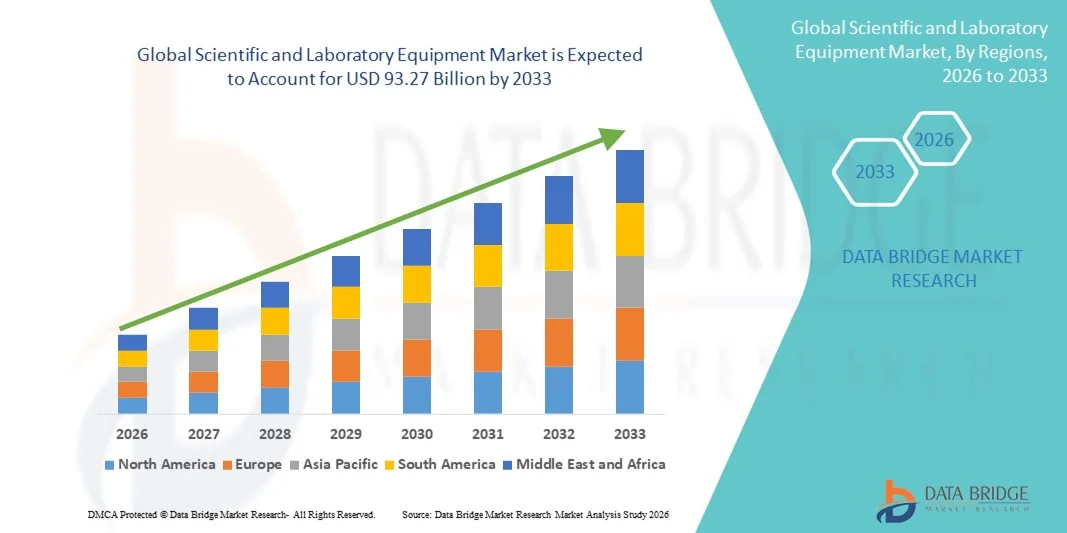
- The global scientific and laboratory equipment market size was valued at USD 51.68 billion in 2025 and is expected to reach USD 93.27 billion by 2033, at a CAGR of 7.66% during the forecast period
- The market growth is largely fueled by the expanding demand for advanced laboratory instruments across healthcare, pharmaceutical, biotechnology, and academic research sectors, alongside ongoing technological advancements that enhance precision, automation, and diagnostic capabilities
- Furthermore, increasing global investments in research and development (R&D), rising regulatory requirements for quality and safety, and the integration of digital and IoT‑enabled laboratory solutions are driving adoption of sophisticated scientific equipment worldwide. These converging factors are accelerating uptake of scientific and laboratory equipment, thereby significantly boosting the industry’s growth
Scientific and Laboratory Equipment Market Analysis
- Scientific and laboratory equipment, encompassing instruments and apparatus for research, testing, and analysis, are increasingly essential across healthcare, pharmaceutical, biotechnology, and academic sectors due to their role in enhancing accuracy, automation, and operational efficiency
- The growing demand for laboratory equipment is primarily driven by rising investments in R&D, increasing regulatory requirements for quality and safety, and the adoption of advanced digital and IoT-enabled laboratory solutions that improve productivity and data management
- North America dominated the scientific and laboratory equipment market with the largest revenue share of 38.5% in 2025, fueled by significant R&D investments, high adoption of advanced laboratory technologies, and the presence of leading global equipment manufacturers, with the U.S. witnessing strong growth in analytical instruments and automated laboratory systems across healthcare and academic research facilities
- Asia-Pacific is expected to be the fastest-growing region in the scientific and laboratory equipment market during the forecast period due to expanding pharmaceutical and biotechnology industries, increasing research activities, and rising government initiatives supporting scientific innovation
- Analytical Equipment segment dominated the scientific and laboratory equipment market with a market share of 41.7% in 2025, driven by widespread usage in chemical, pharmaceutical, and clinical laboratories for precise measurement, testing, and quality control
Report Scope and Scientific and Laboratory Equipment Market Segmentation
|
Attributes |
Scientific and Laboratory Equipment Key Market Insights |
|
Segments Covered |
|
|
Countries Covered |
North America
Europe
Asia-Pacific
Middle East and Africa
South America
|
|
Key Market Players |
|
|
Market Opportunities |
|
|
Value Added Data Infosets |
In addition to the insights on market scenarios such as market value, growth rate, segmentation, geographical coverage, and major players, the market reports curated by the Data Bridge Market Research also include in-depth expert analysis, patient epidemiology, pipeline analysis, pricing analysis, and regulatory framework |
Scientific and Laboratory Equipment Market Trends
Advancements in Automation and Digital Integration
- A significant and accelerating trend in the global scientific and laboratory equipment market is the growing integration of automation, robotics, and digital solutions such as IoT-enabled instruments and cloud-based laboratory management systems, enhancing workflow efficiency and data accuracy
- For instance, automated liquid handling systems from Tecan streamline sample processing and integration with laboratory information management systems (LIMS) to reduce manual errors and save time in high-throughput laboratories
- Digital integration allows real-time monitoring, predictive maintenance, and data analytics to improve instrument utilization and laboratory productivity, while IoT-enabled devices provide centralized control over multiple laboratory instrument
- The seamless adoption of automated and connected laboratory systems facilitates enhanced reproducibility, standardization of protocols, and faster reporting of results, supporting both research and clinical applications
- This trend towards more intelligent, connected, and automated laboratory equipment is reshaping expectations in research, diagnostics, and quality control, prompting companies such as Agilent Technologies to develop instruments with remote monitoring, AI-assisted analysis, and cloud-enabled data management
- The demand for laboratory equipment with advanced automation and digital integration is increasing rapidly across pharmaceutical, biotechnology, and academic research sectors, as organizations prioritize efficiency, accuracy, and regulatory compliance
- Growing adoption of modular and portable laboratory equipment is allowing smaller labs and field research units to access advanced testing capabilities previously limited to centralized facilities
Scientific and Laboratory Equipment Market Dynamics
Driver
Increasing R&D Investments and Demand for High-Precision Instruments
- The rising global investments in research and development, along with growing demand for precise analytical, diagnostic, and testing capabilities, are significant drivers for scientific and laboratory equipment adoption
- For instance, in March 2025, Thermo Fisher Scientific launched a next-generation mass spectrometer system to support high-precision analytical research in pharmaceutical and clinical laboratories
- As industries expand research efforts in biotechnology, pharmaceuticals, and materials science, advanced instruments such as spectrometers, chromatographs, and automated analyzers are increasingly required for accurate data and reproducibility
- Furthermore, stringent regulatory requirements for laboratory testing and quality assurance in healthcare, food, and chemical industries are driving adoption of modern laboratory equipment that meets compliance standards
- The increasing need for faster, more reliable, and automated laboratory processes is encouraging laboratories to invest in integrated, high-throughput solutions capable of handling complex workflows efficiently
- Expanding collaborations between academic institutions, biotech startups, and pharmaceutical companies are boosting demand for flexible and multifunctional laboratory instruments that can support varied research needs
- Increasing government funding for scientific research and innovation programs worldwide is further accelerating the deployment of state-of-the-art laboratory equipment across public and private research facilities
Restraint/Challenge
High Costs and Technical Complexity
- The relatively high initial cost of advanced laboratory equipment, along with ongoing maintenance and calibration expenses, poses a significant challenge to broader market penetration
- For instance, high-end automated chromatography or spectroscopy systems often require specialized training and skilled personnel, limiting adoption among smaller laboratories or developing regions
- Technical complexity and the need for regular software updates, maintenance, and calibration can make operation and upkeep challenging, deterring organizations with limited technical resources
- In addition, integration of multiple instruments and systems into a single workflow may involve compatibility issues and additional costs, further complicating adoption
- While investments in automation and digital solutions are increasing, cost barriers and technical challenges remain key obstacles, necessitating more user-friendly designs, training programs, and scalable solutions to broaden adoption across diverse laboratory environments
- Limited standardization across laboratory equipment interfaces can create operational inefficiencies and slow the implementation of interconnected laboratory systems
- Dependence on specialized consumables and reagents for advanced instruments adds recurring costs, creating additional financial hurdles for research organizations, especially in emerging markets
Scientific and Laboratory Equipment Market Scope
The market is segmented on the basis of type, product, application, and end user
- By Type
On the basis of type, the scientific and laboratory equipment market is segmented into analytical equipment, general equipment, support equipment, specialty equipment, and others. The analytical equipment segment dominated the market with the largest market revenue share of 41.7% in 2025, driven by its essential role in providing precise measurement, testing, and data analysis across pharmaceutical, biotechnology, chemical, and clinical laboratories. Analytical instruments such as spectrometers, chromatographs, and mass spectrometers are widely used for quality control, research, and regulatory compliance, making them indispensable for laboratories. The demand is further strengthened by continuous technological advancements, including automation, AI integration, and enhanced sensitivity, which improve experiment accuracy and reduce human error. Laboratories prioritize analytical equipment due to its reliability, reproducibility, and capability to handle high-throughput workflows efficiently. Companies are increasingly offering multifunctional analytical instruments that can perform multiple tests within a single platform, enhancing operational efficiency and space utilization. The adoption of analytical equipment is further encouraged by the growing trend toward digitization and connected laboratory systems, allowing remote monitoring, real-time data analysis, and cloud-enabled storage of results.
The specialty equipment segment is anticipated to witness the fastest growth rate of 7.8% from 2026 to 2033, fueled by increasing demand for instruments designed for niche applications such as genetic testing, molecular biology, and advanced material research. Specialty equipment such as biosafety cabinets, PCR machines, and automated DNA sequencers offer highly specific functionalities that meet stringent experimental requirements. The rising prevalence of personalized medicine, gene therapy, and cutting-edge biotechnology research is driving adoption of these instruments in both academic and commercial research settings. Furthermore, government and private funding for advanced scientific research is encouraging laboratories to invest in specialty equipment that provides high precision and specialized analytical capabilities. The compact design, modularity, and integration with laboratory automation systems enhance the appeal of specialty equipment to modern laboratories with space and efficiency constraints.
- By Product
On the basis of product, the market is segmented into autoclaves, incubators, centrifuges, spectrometers, sonicators, scopes, and others. The spectrometer segment dominated the market with the largest market revenue share of 35.6% in 2025, due to its widespread application in chemical, pharmaceutical, clinical, and environmental laboratories for qualitative and quantitative analysis. Spectrometers provide highly accurate measurements of molecular composition and structure, making them critical for research, quality control, and compliance purposes. The growing focus on high-precision research and regulatory compliance in multiple industries further reinforces their adoption. In addition, advancements such as multi-mode spectrometers, miniaturized designs, and cloud-enabled data analysis have expanded their use in small and medium-sized laboratories. Companies are also integrating spectrometers with automated workflows and digital monitoring, enhancing productivity and reducing human error. Their versatility across various laboratory applications makes spectrometers a preferred choice for laboratories seeking reliable and reproducible results.
The incubator segment is expected to witness the fastest growth rate of 8.2% from 2026 to 2033, driven by expanding biotechnology and pharmaceutical research, particularly in cell culture, microbial testing, and regenerative medicine. Incubators provide controlled environments for temperature, humidity, and CO₂ levels, ensuring reproducibility and consistency in biological experiments. The rise of personalized medicine and increasing demand for rapid drug discovery and development are further accelerating their adoption. Modern incubators incorporate automation, real-time monitoring, and remote access features, enhancing laboratory efficiency and safety. Their integration with laboratory management software and automation systems allows seamless data tracking and compliance with regulatory standards. Compact and modular incubators also support laboratories with limited space while maintaining advanced functionality, making them attractive for emerging research facilities.
- By Application
On the basis of application, the market is segmented into genetic testing, endocrinology, pharmaceutical and biotechnology, hematology, microbiology, biochemistry, academic institutes, and others. The pharmaceutical and biotechnology segment dominated the market with the largest revenue share of 39.4% in 2025, driven by continuous investment in drug discovery, clinical trials, and biopharmaceutical production. Laboratories in this sector require high-precision instruments for quality control, compound analysis, and compliance with stringent regulatory standards. Increasing adoption of laboratory automation and digitalization in pharmaceutical and biotech R&D enhances data accuracy, throughput, and operational efficiency. Companies are developing instruments tailored for large-scale pharmaceutical applications, integrating multiple testing functionalities within a single platform to optimize space and workflow. The segment benefits from ongoing technological innovations, such as AI-assisted analytical instruments and IoT-enabled monitoring, which reduce experimental error and improve reproducibility. In addition, the expansion of biotechnology startups and contract research organizations (CROs) globally is driving increased demand for modern laboratory equipment.
The genetic testing segment is anticipated to witness the fastest growth rate of 9.1% from 2026 to 2033, fueled by rising demand for personalized medicine, early disease detection, and genomic research. Genetic testing laboratories require specialized instruments such as PCR machines, DNA sequencers, and automated analyzers to perform high-precision tests efficiently. The growing prevalence of inherited disorders and demand for advanced diagnostics are driving adoption in both clinical and research settings. Integration of AI and digital platforms enables faster data analysis and improved interpretation of complex genetic information. Government initiatives and private funding supporting genomics research further accelerate market growth. The compact design, automation compatibility, and cloud-based monitoring of modern genetic testing instruments make them increasingly accessible to a broader range of laboratories.
- By End User
On the basis of end user, the market is segmented into diagnostic laboratories, hospitals and clinics, and others. The diagnostic laboratories segment dominated the market with the largest revenue share of 42.8% in 2025, due to increasing demand for clinical testing, disease diagnosis, and health screening services. Diagnostic labs utilize a wide range of laboratory equipment, including analytical instruments, incubators, and centrifuges, to perform high-throughput testing with accuracy and efficiency. The growing prevalence of chronic diseases, government health initiatives, and rising awareness of preventive care are driving the adoption of modern laboratory instruments in this segment. Companies are increasingly offering integrated diagnostic solutions that combine multiple functionalities and digital monitoring to improve workflow and reduce turnaround time. In addition, partnerships between diagnostic laboratories and equipment manufacturers facilitate access to state-of-the-art instruments and maintenance support. The segment also benefits from the expansion of private diagnostic chains and outpatient testing centers globally.
The hospitals and clinics segment is expected to witness the fastest growth rate of 7.9% from 2026 to 2033, fueled by rising healthcare expenditures, expansion of medical facilities, and increasing need for in-house testing capabilities. Hospitals and clinics are increasingly investing in analytical and diagnostic equipment to provide rapid, accurate, and on-site test results for patients. Adoption is further driven by integration of laboratory instruments with hospital information systems (HIS) and electronic medical records (EMR), allowing real-time data sharing and improved patient care. The segment is witnessing growing interest in point-of-care testing, automated sample processing, and compact lab instruments suitable for clinical environments. Technological advancements in hospital-grade instruments, such as automated hematology analyzers and molecular diagnostic equipment, enhance accuracy and efficiency. Moreover, emerging economies are seeing an expansion of healthcare infrastructure, creating additional demand for modern laboratory equipment in hospitals and clinics.
Scientific and Laboratory Equipment Market Regional Analysis
- North America dominated the scientific and laboratory equipment market with the largest revenue share of 38.5% in 2025, fueled by significant R&D investments, high adoption of advanced laboratory technologies, and the presence of leading global equipment manufacturers
- Laboratories in the region prioritize high-precision instruments, automation, and digital integration to enhance accuracy, efficiency, and compliance with stringent regulatory standards across pharmaceutical, biotechnology, and clinical research sectors
- This widespread adoption is further supported by high R&D spending, early adoption of innovative laboratory technologies, and a strong network of academic and commercial research institutions, establishing North America as a key market for advanced scientific and laboratory equipment
The U.S. Scientific and Laboratory Equipment Market Insight
The U.S. scientific and laboratory equipment market captured the largest revenue share of 42% in 2025 within North America, fueled by significant investments in research and development, advanced healthcare infrastructure, and adoption of cutting-edge laboratory technologies. Laboratories are increasingly prioritizing automation, high-precision instruments, and digital integration to improve workflow efficiency and data accuracy. The growing demand for clinical diagnostics, biotechnology research, and pharmaceutical testing further drives market expansion. In addition, the strong presence of leading global equipment manufacturers and extensive collaborations with academic institutions reinforce the U.S. as a key market. Integration of instruments with laboratory information management systems (LIMS) and cloud-based data analytics is further enhancing operational productivity.
Europe Scientific and Laboratory Equipment Market Insight
The Europe scientific and laboratory equipment market is projected to expand at a substantial CAGR during the forecast period, primarily driven by stringent regulatory standards for laboratory testing and quality assurance. Increasing urbanization, investments in research, and adoption of automated and digital laboratory systems are fostering market growth. European laboratories are also adopting energy-efficient and eco-conscious instruments, reflecting regional sustainability trends. The market is witnessing strong demand across pharmaceutical, biotechnology, academic, and diagnostic applications. Integration with smart laboratory platforms and automation is supporting improved reproducibility and efficiency in both new laboratory setups and renovation projects.
U.K. Scientific and Laboratory Equipment Market Insight
The U.K. scientific and laboratory equipment market is anticipated to grow at a noteworthy CAGR during the forecast period, driven by the expanding research and clinical diagnostics sectors and demand for advanced, reliable instruments. Concerns regarding regulatory compliance, accuracy, and workflow efficiency are encouraging laboratories to adopt automated and high-precision equipment. The U.K.’s well-developed healthcare and academic research infrastructure, combined with growing funding for life sciences and biotechnology, is expected to continue to stimulate market growth. Integration with data analytics, IoT-enabled devices, and cloud-based monitoring systems is becoming increasingly prevalent in laboratories across the country.
Germany Scientific and Laboratory Equipment Market Insight
The Germany scientific and laboratory equipment market is expected to expand at a considerable CAGR during the forecast period, fueled by high awareness of research quality, technological innovation, and the adoption of automated laboratory systems. Germany’s strong infrastructure, emphasis on sustainability, and robust pharmaceutical and biotech industries promote the adoption of analytical, specialty, and automated instruments. Integration with laboratory automation and data management platforms is becoming more common, enabling reproducibility, efficiency, and regulatory compliance. The focus on precision, reliability, and eco-conscious solutions is driving investments in modern laboratory equipment across academic, commercial, and clinical research laboratories.
Asia-Pacific Scientific and Laboratory Equipment Market Insight
The Asia-Pacific scientific and laboratory equipment market is poised to grow at the fastest CAGR of 8.7% during the forecast period of 2026 to 2033, driven by rising R&D investments, rapid expansion of pharmaceutical and biotechnology sectors, and technological advancements in countries such as China, Japan, and India. The region’s increasing adoption of automation, digital laboratory systems, and connected instruments is supporting operational efficiency and high-throughput research. Government initiatives promoting research innovation and the establishment of smart laboratories further propel growth. In addition, as APAC becomes a manufacturing hub for laboratory instruments and components, affordability and accessibility are improving, expanding adoption across clinical, academic, and industrial laboratories.
Japan Scientific and Laboratory Equipment Market Insight
The Japan scientific and laboratory equipment market is gaining momentum due to strong technological capabilities, a high focus on R&D, and widespread adoption of automation and connected laboratory systems. The market places significant emphasis on precision, reliability, and workflow efficiency, which supports growth in pharmaceutical, biotechnology, and academic research sectors. Integration with IoT-enabled platforms, AI-assisted instruments, and laboratory management software is enhancing data analytics and operational productivity. In addition, Japan’s aging population and demand for efficient, user-friendly laboratory instruments are further driving adoption in healthcare, clinical diagnostics, and research applications.
India Scientific and Laboratory Equipment Market Insight
The India scientific and laboratory equipment market accounted for the largest market revenue share in Asia-Pacific in 2025, attributed to rising investments in research, expanding pharmaceutical and biotechnology industries, and increasing adoption of automated and digital laboratory systems. India’s growing focus on smart laboratories, life sciences research, and quality diagnostics is fueling demand across academic, clinical, and industrial applications. Affordable laboratory instruments, local manufacturing capabilities, and government initiatives supporting scientific research are key factors propelling the market. Rapid urbanization, expansion of private laboratories, and increasing R&D funding are further accelerating adoption across the country.
Scientific and Laboratory Equipment Market Share
The Scientific and Laboratory Equipment industry is primarily led by well-established companies, including:
- Thermo Fisher Scientific Inc. (U.S.)
- Agilent Technologies (U.S.)
- Bio Rad Laboratories, Inc. (U.S.)
- PerkinElmer, Inc. (U.S.)
- Waters Corporation (U.S.)
- Bruker Corporation (U.S.)
- Sartorius AG (Germany)
- Shimadzu Corporation (Japan)
- Mettler Toledo International Inc. (Switzerland)
- Eppendorf SE (Germany)
- Metrohm AG (Switzerland)
- Danaher (U.S.)
- Abbott (U.S.)
- Siemens Healthineers AG (Germany)
- Sysmex Corporation (Japan)
- Illumina, Inc. (U.S.)
- GE Healthcare (U.S.)
- QIAGEN (Netherlands)
- Tecan Group (Switzerland)
What are the Recent Developments in Global Scientific and Laboratory Equipment Market?
- In September 2025, Beckman Coulter Diagnostics launched the industry’s first fully automated BD‑Tau RUO immunoassay test for advanced neurodegenerative research, expanding precision testing capabilities on high‑throughput platforms
- In April 2025, Brookfield agreed to acquire Antylia Scientific, one of the world’s largest laboratory equipment suppliers, for approximately USD 1.4 billion, marking a significant consolidation move in the laboratory equipment and supplies sector with implications for global distribution and product portfolios
- In March 2025, Beckman Coulter announced FDA 510(k) clearance for the DxC 500i Clinical Analyzer, an integrated clinical chemistry and immunoassay system offering high throughput and scalable testing for clinical laboratories worldwide
- In January 2025, Beckman Coulter Diagnostics announced new fully automated, high‑throughput Research Use Only (RUO) immunoassays for neurodegenerative disease biomarkers (including p‑Tau217, GFAP, NfL, and APOE ε4) on automated immunoassay platforms to support advanced research workflows
- In June 2024, Thermo Fisher Scientific introduced the Stellar mass spectrometer, a next‑generation high‑throughput, high‑sensitivity analytical instrument that enhances quantitative analysis for translational omics research, designed to improve efficiency and accuracy across disciplines such as proteomics and biomarker verification at the ASMS conference
SKU-
Get online access to the report on the World's First Market Intelligence Cloud

- Interactive Data Analysis Dashboard
- Company Analysis Dashboard for high growth potential opportunities
- Research Analyst Access for customization & queries
- Competitor Analysis with Interactive dashboard
- Latest News, Updates & Trend analysis
- Harness the Power of Benchmark Analysis for Comprehensive Competitor Tracking
Research Methodology
Data collection and base year analysis are done using data collection modules with large sample sizes. The stage includes obtaining market information or related data through various sources and strategies. It includes examining and planning all the data acquired from the past in advance. It likewise envelops the examination of information inconsistencies seen across different information sources. The market data is analysed and estimated using market statistical and coherent models. Also, market share analysis and key trend analysis are the major success factors in the market report. To know more, please request an analyst call or drop down your inquiry.
The key research methodology used by DBMR research team is data triangulation which involves data mining, analysis of the impact of data variables on the market and primary (industry expert) validation. Data models include Vendor Positioning Grid, Market Time Line Analysis, Market Overview and Guide, Company Positioning Grid, Patent Analysis, Pricing Analysis, Company Market Share Analysis, Standards of Measurement, Global versus Regional and Vendor Share Analysis. To know more about the research methodology, drop in an inquiry to speak to our industry experts.
Customization Available
Data Bridge Market Research is a leader in advanced formative research. We take pride in servicing our existing and new customers with data and analysis that match and suits their goal. The report can be customized to include price trend analysis of target brands understanding the market for additional countries (ask for the list of countries), clinical trial results data, literature review, refurbished market and product base analysis. Market analysis of target competitors can be analyzed from technology-based analysis to market portfolio strategies. We can add as many competitors that you require data about in the format and data style you are looking for. Our team of analysts can also provide you data in crude raw excel files pivot tables (Fact book) or can assist you in creating presentations from the data sets available in the report.