




Global Screenless Display Market
Market Size in USD Million
CAGR :
% 
 USD
317.42 Million
USD
2,872.90 Million
2025
2033
USD
317.42 Million
USD
2,872.90 Million
2025
2033
 Forecast Period Forecast Period |
2026 - 2033 |
 Market Size (Base Year) Market Size (Base Year) |
USD 317.42 Million |
 Market Size (Forecast Year) Market Size (Forecast Year) |
USD 2,872.90 Million |
 CAGR CAGR |
% |
| Major Markets Players |
|
Screenless Display Market Overview
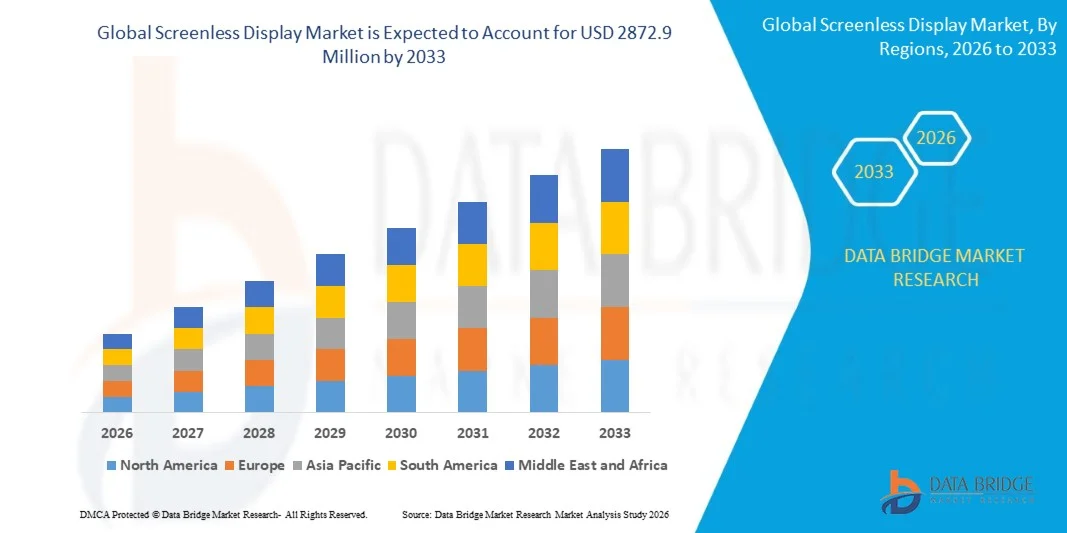
The Screenless Display Market was valued at USD 317.42 Million in 2025 and is projected to reach USD 2872.9 Million by 2033, growing at a CAGR of 31.70% from 2026 to 2033. The market is experiencing consistent growth driven by rising adoption of augmented reality and virtual reality technologies, increasing demand for immersive and wearable computing devices, and rapid advancements in holographic and retinal projection systems. Expanding integration of screenless display solutions across consumer electronics, healthcare visualization, automotive head-up systems, and enterprise training applications is further supporting market expansion globally.
The increasing global shift toward immersive digital experiences and hands-free computing, combined with rapid advancements in optical engineering, microdisplay technologies, and spatial computing platforms, is significantly accelerating adoption of screenless display systems. Growing investments by leading technology companies in AR headsets, neural interface solutions, and holographic visualization devices are further enhancing market development. In addition, rising demand for high-performance, lightweight, and energy-efficient display solutions across multiple industries is reinforcing long-term growth prospects for the screenless display market.
Key Market Trends & Insights
- North America dominated the Screenless Display Market with the largest revenue share of 41% in 2025, supported by high adoption of augmented reality and virtual reality technologies, strong presence of leading technology developers, and early integration of advanced wearable display systems
- The visual image segment led the market with a 46% share in 2025, driven by widespread deployment of projection-based and laser-based display systems across AR and VR ecosystems
- Asia-Pacific is expected to be the fastest-growing region at a CAGR of 25% from 2026 to 2033, fueled by rapid digitalization, expanding consumer electronics manufacturing, and increasing adoption of AR, VR, and wearable technologies across industries
- Synaptic Interface is the fastest-growing type, projected to register a CAGR of 16% from 2026 to 2033, supported by rapid progress in brain-computer interface technologies and neural signal processing systems
- The head mounted display segment dominated the application category with a 44% revenue share in 2025, led by strong penetration across AR and VR devices used in gaming, training, and industrial simulation
- Consumer segment accounted for 40% of the market in 2025, preferred by strong adoption of AR glasses, smart wearable devices, and immersive entertainment systems
- The holographic display segment is the fastest-growing application category, with a CAGR of 15% from 2026 to 2033, driven by rising demand for advanced 3D visualization across medical imaging, retail visualization, and automotive design
Market Size & Forecast
- Global Market Value (2025): USD 42 Million
- Expected Market Value (2033): USD 2872.9 Million
- Forecast CAGR (2026–2033): 31.70%
- Leading Region in 2025: North America
- Fastest Growing Region: Asia-Pacific
Report Scope and Screenless Display Market Segmentation
|
Attributes |
Screenless Display Key Market Insights |
|
Segments Covered |
|
|
Countries Covered |
North America · U.S. · Canada · Mexico Europe · Germany · France · U.K. · Netherlands · Switzerland · Belgium · Russia · Italy · Spain · Turkey · Rest of Europe Asia-Pacific · China · Japan · India · South Korea · Singapore · Malaysia · Australia · Thailand · Indonesia · Philippines · Rest of Asia-Pacific Middle East and Africa · Saudi Arabia · U.A.E. · South Africa · Egypt · Israel · Rest of Middle East and Africa South America · Brazil · Argentina · Rest of South America |
|
Key Market Players |
· LG Display Co., Ltd. (South Korea) · AU Optronics Corp. (Taiwan) · Samsung Electronics Co., Ltd. (South Korea) · Japan Display Inc. (Japan) · Innolux Corporation (Taiwan) · HannStar Display Corporation (Taiwan) · BOE Technology Group Co., Ltd. (China) · Sharp Corp. Limited (Japan) · VARITRONIX (Hong Kong) · E Ink Holdings, Inc. (Taiwan) · TCL Display Technology Holdings Limited (China) · UNIVERSAL DISPLAY (U.S.) · Corning Incorporated (U.S.) · Kent Displays Inc. (U.S.) · NEC Display Solutions (Japan) · Atmel Corporation (U.S.) · Cambridge Display Technology Limited (U.K.) · HP Development Company, L.P. (U.S.) · Epson (Japan) · Sony Corporation (Japan) · DuPont (U.S.) |
|
Market Opportunities |
· Healthcare and Surgical Visualization Expansion · Automotive Head Up Display Growth · Industrial Training and Remote Assistance Use Cases |
|
Value Added Data Infosets |
In addition to the insights on market scenarios such as market value, growth rate, segmentation, geographical coverage, and major players, the market reports curated by the Data Bridge Market Research also include in-depth expert analysis, geographically represented company-wise production and capacity, network layouts of distributors and partners, detailed and updated price trend analysis and deficit analysis of supply chain and demand. |
Screenless Display Market Trends
Trend: Rising AR and VR Adoption in Immersive Computing
The Screenless Display market is witnessing strong growth driven by increasing adoption of AR and VR technologies that enable immersive, hands-free digital interaction. Demand is rising across gaming, enterprise collaboration, healthcare visualization, and industrial training as users shift toward spatial computing environments. Advancements in head mounted displays, holographic projection systems, and retinal projection technologies are further enhancing user experience and accelerating commercialization.
Companies such as Apple Inc. are advancing this trend through its Vision Pro headset, which integrates spatial computing and screenless visualization to deliver highly immersive mixed reality experiences for enterprise and consumer applications.
Screenless Display Market Dynamics
Key Market Driver: Growing Demand for Hands Free Wearable Displays
The increasing demand for hands free wearable display systems is significantly driving the Screenless Display market as enterprises and consumers seek more intuitive and mobile computing experiences. Industries such as healthcare, logistics, and defense are adopting AR glasses and head mounted displays to enable real time data visualization without physical screens. Improvements in microdisplay efficiency, optical waveguides, and lightweight wearable designs are further supporting adoption.
Companies such as Microsoft are expanding this trend through HoloLens deployments in enterprise training and industrial applications, enabling workers to access real time digital overlays while performing complex tasks.
Key Restraint/Challenge: High Cost and Technical Complexity of Development
A major challenge in the Screenless Display market is the high cost and technical complexity associated with developing advanced display systems such as retinal projection, holographic displays, and neural interface technologies. These systems require highly precise optical engineering, advanced semiconductor integration, and significant R&D investment, which limits large-scale commercialization. In addition, power efficiency constraints and miniaturization challenges further slow adoption across price-sensitive markets.
Companies such as Magic Leap have faced commercialization challenges in scaling spatial computing devices due to high production costs and complex hardware-software integration requirements.
Key Market Opportunity: Industrial Training and Remote Assistance Use Cases
Industrial training and remote assistance applications present a significant growth opportunity for the Screenless Display market as enterprises increasingly adopt AR-based solutions to improve workforce efficiency and reduce operational downtime. Screenless displays enable real-time guidance, maintenance support, and simulation-based training without reliance on physical screens. Growing demand in manufacturing, aerospace, and field service operations is accelerating adoption of wearable visualization systems.
Companies such as Boeing are utilizing AR-based smart glasses for aircraft assembly and maintenance training, enabling technicians to access step-by-step digital instructions and reduce error rates in complex engineering processes.
Screenless Display Market Scope
The screenless display market is segmented on the basis of type, application, and vertical.
- By Type
On the basis of type, the Screenless Display Market is segmented into visual image, retinal direct, and synaptic interface. The Visual Image segment dominated the market with the largest share of 46% in 2025, driven by widespread deployment of projection-based and laser-based display systems across AR and VR ecosystems. Strong adoption in consumer electronics and enterprise visualization tools supports its leading position. Advancements in micro-projectors and optical waveguide technologies further enhance image clarity and usability. Growing integration in wearable devices and portable display solutions strengthens commercial scalability. Continuous demand for immersive visualization in gaming and training applications reinforces segment dominance.
The Synaptic Interface segment is projected to register the fastest growth at a CAGR of 16% from 2026 to 2033, driven by rapid progress in brain-computer interface technologies and neural signal processing systems. Increasing investment in neurotechnology research is enabling more precise and responsive display interactions. Expanding applications in healthcare rehabilitation and assistive communication systems are accelerating adoption. Improvements in non-invasive neural sensing and AI-based interpretation models further support commercialization. Rising demand for highly immersive and hands-free interaction environments continues to propel segment expansion.
- By Application
On the basis of application, the Screenless Display Market is segmented into holographic display, head mounted display, and head-up display. The Head Mounted Display segment dominated the market with a share of 44% in 2025, supported by strong penetration across AR and VR devices used in gaming, training, and industrial simulation. Increasing enterprise adoption for remote assistance and design visualization enhances demand stability. Continuous improvements in lightweight optics and high-resolution micro-displays strengthen user experience. Integration with spatial computing platforms further drives large-scale deployment. Expanding ecosystem of wearable smart devices reinforces segment leadership.
The Holographic Display segment is projected to register the fastest growth at a CAGR of 15% from 2026 to 2033, driven by rising demand for advanced 3D visualization across medical imaging, retail visualization, and automotive design. Technological advancements in light field rendering and volumetric display systems are improving real-time image reconstruction. Increasing adoption in high-end advertising and immersive communication platforms is accelerating market penetration. Growing investments in next-generation display research are supporting commercial readiness. Expanding demand for highly realistic visualization solutions continues to drive rapid segment growth.
- By Vertical
On the basis of vertical, the Screenless Display Market is segmented into medical, aerospace and defense, automotive, consumer, and commercial. The Consumer segment dominated the market with a share of 40% in 2025, driven by strong adoption of AR glasses, smart wearable devices, and immersive entertainment systems. Rising demand for enhanced gaming and personal visualization tools supports sustained growth. Continuous innovation in compact and energy-efficient display modules strengthens product accessibility. Expanding integration of smart ecosystems in daily consumer devices reinforces market leadership. High replacement cycles in consumer electronics further contribute to dominance.
The Aerospace and Defense segment is projected to register the fastest growth at a CAGR of 14.5% from 2026 to 2033, driven by increasing use of head-up displays and AR-based situational awareness systems in aircraft and defense operations. Growing emphasis on pilot safety and mission-critical data visualization is accelerating adoption. Advancements in lightweight wearable display technologies improve operational efficiency in extreme environments. Rising defense modernization programs across major economies are boosting procurement of advanced visualization systems. Continuous focus on real-time tactical data integration supports strong segment expansion.
Screenless Display Market Regional Analysis
North America dominated the screenless display market and accounted for the largest revenue share of 41% in 2025, supported by high adoption of augmented reality and virtual reality technologies, strong presence of leading technology developers, and early integration of advanced wearable display systems. The region benefits from a highly mature consumer electronics ecosystem, strong R&D investments in optical engineering, and rapid commercialization of head mounted and projection based display solutions. Enterprises across healthcare, defense, automotive, and entertainment sectors are increasingly deploying screenless visualization systems to enhance operational efficiency and user experience. In addition, strong cloud infrastructure and AI enabled computing capabilities continue to support real time rendering and immersive display applications. Continuous innovation in micro optics and spatial computing further reinforces North America’s leading position in the global market.
U.S. Screenless Display Market Insight
The U.S. Screenless Display market is witnessing strong growth driven by rapid adoption of AR and VR devices, increasing demand for immersive enterprise visualization, and expanding use of wearable computing technologies across multiple industries. Companies are heavily investing in neural interface research, holographic imaging, and head mounted display systems to improve human machine interaction. Strong presence of major technology firms and startups focused on spatial computing is accelerating innovation cycles. Rising application of screenless displays in defense simulation, surgical navigation, and industrial training is further strengthening market expansion across the country.
Canada Screenless Display Market Insight
The Canada Screenless Display market is experiencing steady growth supported by increasing adoption of advanced visualization tools in healthcare, education, and industrial training applications. Organizations are progressively integrating AR based systems to improve remote collaboration and workforce training efficiency. Growing investments in digital infrastructure and immersive technology development are further encouraging market penetration. In addition, rising focus on innovation in clean technology and smart visualization systems is contributing to the gradual expansion of screenless display adoption in Canada.
Europe Screenless Display Market Insight
The Europe Screenless Display market is expanding steadily due to strong emphasis on industrial digitization, increasing deployment of AR and holographic systems, and growing adoption of advanced visualization technologies across automotive, aerospace, and healthcare sectors. The region benefits from a strong regulatory framework supporting safe deployment of wearable technologies and high investment in research and innovation programs. Enterprises are increasingly using head up displays and immersive projection systems to enhance productivity and operational accuracy. Rising demand for energy efficient and compact display solutions continues to support regional market growth across Europe.
U.K. Screenless Display Market Insight
The U.K. Screenless Display market is growing steadily, driven by high adoption of AR based enterprise solutions, strong digital transformation across industries, and increasing use of immersive technologies in education and healthcare. Financial services and retail sectors are also integrating advanced visualization tools to improve customer engagement and operational efficiency. The presence of a strong innovation ecosystem and growing investments in spatial computing technologies are further strengthening market expansion. In addition, rising demand for wearable and hands free computing devices continues to support adoption across multiple applications in the U.K.
Germany Screenless Display Market Insight
The Germany Screenless Display market is expanding due to strong industrial automation, advanced automotive manufacturing capabilities, and increasing integration of head up display systems in vehicles and industrial operations. Enterprises are adopting AR based visualization tools to improve design accuracy, maintenance processes, and workforce training efficiency. Strong focus on engineering excellence and technological innovation is supporting continuous development of high precision display systems. In addition, rising investments in Industry 4.0 initiatives are accelerating the adoption of screenless display technologies across the country.
Asia-Pacific Screenless Display Market Insight
The Asia-Pacific Screenless Display market is projected to register the fastest growth with a CAGR of 25% from 2026 to 2033, driven by rapid digitalization, expanding consumer electronics manufacturing, and increasing adoption of AR, VR, and wearable technologies across industries. Strong growth in e learning, gaming, and mobile computing ecosystems is significantly boosting demand for immersive display solutions. Countries such as China, Japan, South Korea, and India are witnessing rising investments in advanced optical technologies and spatial computing platforms. In addition, growing penetration of smart devices and expanding 5G infrastructure are further accelerating regional market expansion.
Japan Screenless Display Market Insight
The Japan Screenless Display market is witnessing steady growth supported by high technology adoption, strong robotics integration, and increasing use of AR based visualization in industrial and healthcare applications. Enterprises are focusing on enhancing precision and efficiency through head mounted display systems and advanced optical solutions. Strong research capabilities in electronics and photonics are enabling continuous innovation in compact display technologies. In addition, growing demand for immersive consumer electronics and smart wearable devices is further strengthening market adoption in Japan.
China Screenless Display Market Insight
The China Screenless Display market is growing rapidly due to large scale smartphone penetration, strong expansion of AR and VR ecosystems, and increasing investment in advanced display manufacturing technologies. Technology companies are actively developing holographic and projection based systems for applications in gaming, retail, and industrial visualization. Government support for high tech innovation and smart manufacturing is further accelerating market development. In addition, rising demand for immersive digital experiences and rapid growth of consumer electronics production continue to drive strong market expansion in China.
Screenless Display Market Share
The screenless display industry is primarily led by well-established companies, including:
- LG Display Co., Ltd. (South Korea)
- AU Optronics Corp. (Taiwan)
- Samsung Electronics Co., Ltd. (South Korea)
- Japan Display Inc. (Japan)
- Innolux Corporation (Taiwan)
- HannStar Display Corporation (Taiwan)
- BOE Technology Group Co., Ltd. (China)
- Sharp Corp. Limited (Japan)
- VARITRONIX (Hong Kong)
- E Ink Holdings, Inc. (Taiwan)
- TCL Display Technology Holdings Limited (China)
- UNIVERSAL DISPLAY (U.S.)
- Corning Incorporated (U.S.)
- Kent Displays Inc. (U.S.)
- NEC Display Solutions (Japan)
- Atmel Corporation (U.S.)
- Cambridge Display Technology Limited (U.K.)
- HP Development Company, L.P. (U.S.)
- Epson (Japan)
- Sony Corporation (Japan)
- DuPont (U.S.)
Latest Developments in Screenless Display Market
- In May 2024, Sightful introduced the Spacetop G1, an advanced screenless laptop that replaces conventional physical displays with floating virtual screens viewed through integrated AR glasses. This innovation strengthens the screenless computing ecosystem by enhancing portability and redefining personal computing experiences. The upgraded G1 model builds on the earlier Early Access version, improving usability and scalability for mainstream adoption. By transitioning early adopters to the consumer-ready version, Sightful is accelerating commercialization of AR-driven productivity devices and expanding the addressable market for immersive computing solutions
- In January 2024, Avegant announced its Spotlight display technology, featuring the world’s first adaptive LED illumination architecture for Liquid Crystal on Silicon (LCoS) systems. This advancement significantly improves screenless display performance by reducing illumination power consumption by up to 90% while enhancing local contrast by more than ten times. The innovation strengthens the efficiency and visual quality of microdisplay-based systems, supporting broader adoption in AR and VR applications. By improving energy efficiency and image clarity, Avegant is addressing key technical barriers that have limited large-scale deployment of high-performance screenless displays
- In August 2024, Apple (U.S.) launched its latest augmented reality headset integrated with advanced screenless display technology, marking a strategic expansion of its presence in immersive computing. This development reinforces Apple’s focus on AR ecosystems and strengthens its positioning in the premium mixed reality segment. By leveraging its established hardware and software ecosystem, Apple enhances user experience continuity across devices, accelerating adoption of screenless visualization technologies. The move intensifies competition in the AR headset market and contributes to broader mainstream acceptance of immersive display systems
- In September 2024, NVIDIA (U.S.) unveiled a dedicated software platform designed to optimize screenless display performance for gaming applications, enhancing real-time rendering and visual fidelity. This innovation plays a critical role in improving computational efficiency and latency reduction in immersive gaming environments. By focusing on software-level optimization, NVIDIA strengthens its position in the rapidly expanding AR and VR gaming ecosystem. The development supports higher-quality immersive experiences, driving increased demand for advanced display hardware and reinforcing ecosystem integration between software and screenless display technologies
- In July 2024, Google (U.S.) entered into strategic partnerships with educational institutions to develop screenless display solutions tailored for remote learning environments. This initiative enhances accessibility to immersive learning tools by integrating AR-based visualization into digital education systems. The collaboration supports the expansion of screenless display applications beyond entertainment and enterprise use cases into the education sector. By aligning technology development with evolving learning needs, Google strengthens its influence in the immersive technology ecosystem and accelerates adoption of interactive, screenless visualization platforms
SKU-
Get online access to the report on the World's First Market Intelligence Cloud

- Interactive Data Analysis Dashboard
- Company Analysis Dashboard for high growth potential opportunities
- Research Analyst Access for customization & queries
- Competitor Analysis with Interactive dashboard
- Latest News, Updates & Trend analysis
- Harness the Power of Benchmark Analysis for Comprehensive Competitor Tracking
Global Screenless Display Market, Supply Chain Analysis and Ecosystem Framework
To support market growth and help clients navigate the impact of geopolitical shifts, DBMR has integrated in-depth supply chain analysis into its Global Screenless Display Market research reports. This addition empowers clients to respond effectively to global changes affecting their industries. The supply chain analysis section includes detailed insights such as Global Screenless Display Market consumption and production by country, price trend analysis, the impact of tariffs and geopolitical developments, and import and export trends by country and HSN code. It also highlights major suppliers with data on production capacity and company profiles, as well as key importers and exporters. In addition to research, DBMR offers specialized supply chain consulting services backed by over a decade of experience, providing solutions like supplier discovery, supplier risk assessment, price trend analysis, impact evaluation of inflation and trade route changes, and comprehensive market trend analysis.
Research Methodology
Data collection and base year analysis are done using data collection modules with large sample sizes. The stage includes obtaining market information or related data through various sources and strategies. It includes examining and planning all the data acquired from the past in advance. It likewise envelops the examination of information inconsistencies seen across different information sources. The market data is analysed and estimated using market statistical and coherent models. Also, market share analysis and key trend analysis are the major success factors in the market report. To know more, please request an analyst call or drop down your inquiry.
The key research methodology used by DBMR research team is data triangulation which involves data mining, analysis of the impact of data variables on the market and primary (industry expert) validation. Data models include Vendor Positioning Grid, Market Time Line Analysis, Market Overview and Guide, Company Positioning Grid, Patent Analysis, Pricing Analysis, Company Market Share Analysis, Standards of Measurement, Global versus Regional and Vendor Share Analysis. To know more about the research methodology, drop in an inquiry to speak to our industry experts.
Customization Available
Data Bridge Market Research is a leader in advanced formative research. We take pride in servicing our existing and new customers with data and analysis that match and suits their goal. The report can be customized to include price trend analysis of target brands understanding the market for additional countries (ask for the list of countries), clinical trial results data, literature review, refurbished market and product base analysis. Market analysis of target competitors can be analyzed from technology-based analysis to market portfolio strategies. We can add as many competitors that you require data about in the format and data style you are looking for. Our team of analysts can also provide you data in crude raw excel files pivot tables (Fact book) or can assist you in creating presentations from the data sets available in the report.












