




Global Scuba Diving Equipment Market
Market Size in USD Billion

 USD
1.10 Billion
USD
1.84 Billion
2025
2033
USD
1.10 Billion
USD
1.84 Billion
2025
2033
Forecast Period |
2026 - 2033 |
Market Size (Base Year) |
USD 1.10 Billion |
Market Size (Forecast Year) |
USD 1.84 Billion |
CAGR |
% |
Major Markets Players |
|
 Forecast Period
 Market Size (Base Year)
 Market Size (Forecast Year)
 CAGR
CAGRWhat is the Scuba Diving Equipment Market Size and Growth Rate?
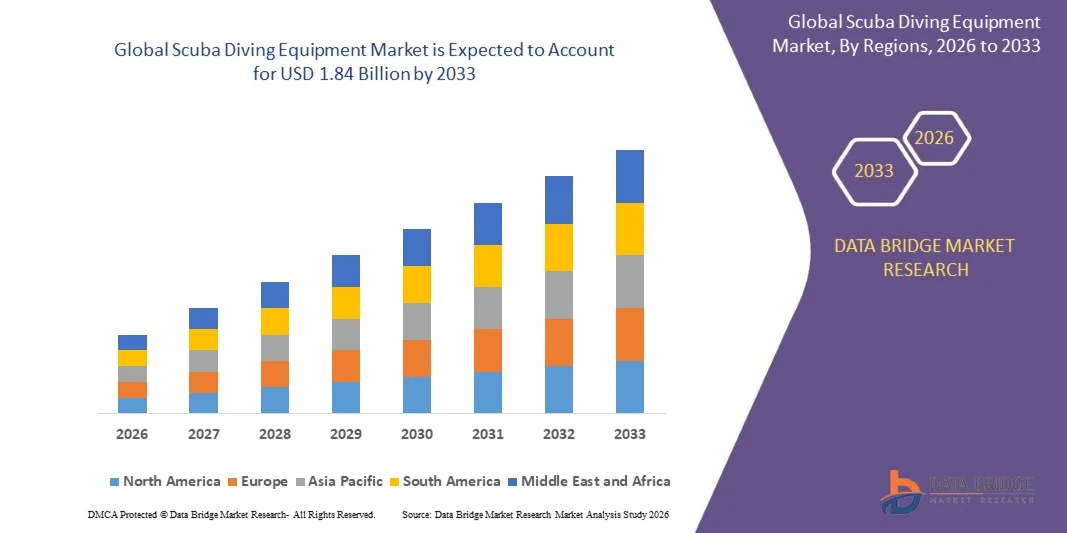
- As per Data Bridge Market Research analysis, the scuba diving equipment market was valued at USD 1.10 billion in 2025 and is projected to reach USD 1.84 billion by 2033, growing at a CAGR of 6.7% from 2026 to 2033.
- The market is experiencing consistent growth driven by increasing interest in adventure sports, rising disposable incomes, and a growing tourism industry, while recreational, professional, and underwater research activities continue to support demand for scuba diving equipment.
- The increasing popularity of scuba diving and adventure sports, combined with growing tourism, improving infrastructure and safety, and health benefits associated with scuba diving, is supporting the adoption of diving equipment. The market is also witnessing emphasis on innovative and eco-friendly gear, including equipment designed to minimize environmental impact and sustainable materials for wetsuits and other diving products.
Market Size & Forecast
- Global Market Value (2025): USD 1.10 Billion
- Expected Market Value (2033): USD 1.84 Billion
- Forecast CAGR (2026–2033): 6.7%
- Leading Region in 2025: North America
- Fastest Growing Region: Asia Pacific
What are the Major Takeaways of the Scuba Diving Equipment Market?
- North America dominated the scuba diving equipment market with the largest revenue share of 31.6% in 2025, supported by large base of certified divers, a strong culture of underwater exploration, and robust demand for advanced diving equipment
- Asia-Pacific is expected to be the fastest-growing region at a CAGR of 6.05% from 2026 to 2033, fueled by rising disposable incomes, growing dive tourism, and increasing participation in recreational diving across the region.
- The BCD and regulator segment led the market with a 37% share in 2025, driven by its essential role in buoyancy control and underwater breathing across recreational, professional, and technical diving activities.
- Accessories are the fastest-growing type, projected to register a CAGR of 6.0%, reflecting the surge in demand for complementary diving equipment, underwater photography accessories, safety products, and equipment designed to improve diver comfort and convenience.
- The rebreathers and regulators segment dominated the product type category with a 36.78% revenue share in 2025, led by the essential role of breathing systems in underwater activities.
- Recreational diving accounted for 63.62% of the market share in 2025, preferred by tourists, adventure enthusiasts, recreational divers, and underwater-exploration participants seeking accessible and enjoyable diving experiences
- The saturation diving segment is the fastest-growing application category, with a CAGR of 5.0%, driven by increasing offshore oil and gas exploration, subsea construction, inspection, maintenance, and repair activities that require specialized deep-water diving capabilities.
Report Scope and Scuba Diving Equipment Market Segmentation
|
Attributes |
Scuba Diving Equipment Key Market Insights |
|
Segments Covered |
|
|
Countries Covered |
North America
Europe
Asia-Pacific
Middle East and Africa
South America
|
|
Key Market Players |
|
|
Market Opportunities |
|
|
Value Added Data Infosets |
In addition to the insights on market scenarios such as market value, growth rate, segmentation, geographical coverage, and major players, the market reports curated by the Data Bridge Market Research also include in-depth expert analysis, pricing analysis, brand share analysis, consumer survey, demography analysis, supply chain analysis, value chain analysis, raw material/consumables overview, vendor selection criteria, PESTLE Analysis, Porter Analysis, and regulatory framework. |
What is the Key Trend in the Scuba Diving Equipment Market?
- Manufacturers are increasingly integrating smart connectivity, biometric monitoring, advanced displays, and environmentally responsible materials into scuba diving equipment, reflecting rising demand for safer, more convenient, and sustainable diving experiences.
- For instance, in February 2025, Garmin launched the Descent G2, integrating a 1.2-inch AMOLED display, dive-readiness scoring, health and fitness monitoring, multiple dive modes, smartphone connectivity, and recycled ocean-bound plastics, demonstrating the shift toward connected, multifunctional, and sustainable dive equipment.
- Connected dive computers are evolving beyond basic depth and decompression monitoring by incorporating health metrics, dive-readiness assessments, mobile connectivity, navigation, and real-time diving information.
- Sustainability is also becoming a stronger product-development priority as divers and tourism operators increasingly consider the environmental impact of diving equipment and marine activities.
- Lightweight and compact equipment is gaining attention as international dive tourism expands, particularly among recreational divers who require equipment that is easier to transport without compromising underwater performance.
- For instance, in May 2024, Suunto introduced the Suunto Ocean, combining a 1.43-inch AMOLED display, dive computer functionality, air integration, 3D dive mapping, GPS, and more than 95 sports modes, demonstrating the growing integration of smartwatch, navigation, health, and diving technologies in a single device.
- Manufacturers are also combining diving functionality with everyday wearable technologies, allowing consumers to use advanced dive computers for fitness, health monitoring, navigation, and communication outside the water.
What are the Key Drivers of the Scuba Diving Equipment Market?
- The growing popularity of recreational diving and marine tourism is increasing demand for essential equipment such as regulators, masks, fins, buoyancy control devices, wetsuits, and dive computers across established and emerging diving destinations.
- For instance, in June 2025, Maharashtra government approved a USD 5.39 million project to develop India’s first underwater museum and artificial coral reef around the decommissioned INS Guldar, with scuba diving planned as a major tourism activity, supporting expansion of marine adventure tourism and related diving-equipment demand.
- Expansion of global dive tourism is encouraging investment in diving infrastructure, certification programs, dive operators, and equipment rental services, thereby supporting recurring demand for both entry-level and professional-grade equipment.
- Rising participation in underwater tourism is also increasing demand for advanced safety and monitoring equipment, as divers increasingly seek technologies that provide real-time information on depth, decompression status, air supply, navigation, and physiological conditions.
- For instance, in May 2025, the Odisha government announced USD 0.575 million investment to establish a national scuba diving training centre in Puri, combining professional underwater-rescue training with the development of adventure tourism and providing modern diving equipment and safety infrastructure
- The economic contribution generated by scuba diving is strengthening the tourism ecosystem surrounding equipment manufacturers, retailers, training centers, dive operators, and marine conservation organizations.
Which Factors are Challenging the Growth of the Scuba Diving Equipment Market?
- Advanced scuba diving equipment can involve high acquisition and maintenance costs, particularly for sophisticated dive computers, technical regulators, rebreathers, buoyancy systems, and specialized exposure equipment, limiting affordability for price-sensitive recreational divers.
- For instance, in March 2026, PADI highlighted that purchasing a complete scuba gear setup can represent a substantial upfront expense, with rental equipment offering a more affordable alternative for new or infrequent divers, demonstrating the cost barrier to personal equipment ownership.
- The requirement for multiple equipment components also increases the overall cost of assembling a complete personal diving system, encouraging some recreational users to rely on rental equipment rather than purchasing complete sets.
- Environmental pressures on coral reefs and marine ecosystems can also constrain diving activity at heavily visited destinations, potentially reducing equipment demand when authorities introduce visitor restrictions, carrying-capacity limits, or site-management measures.
- Stringent safety regulations and certification requirements increase compliance costs and can delay the introduction of new scuba diving equipment, particularly for manufacturers developing advanced life-support and technical diving systems.
- For instance, in June 2026, the International Marine Contractors Association (IMCA) revised its code of practice for diving plant and equipment, requiring initial and periodic examination, testing, certification, competent-person oversight, and planned maintenance, illustrating the regulatory and compliance burden associated with professional diving equipment.
- Limited access to certified diving training and continuing participation restricts the pool of new equipment buyers, particularly in emerging markets where training resources and qualified instructors remain unevenly available.
How is the Scuba Diving Equipment Market Segmented?
The scuba diving equipment market is segmented on the basis of type, product, application, and distribution channel.
- By Type
On the basis of type, the scuba diving equipment market is segmented into BCD and regulator, cylinder and diving propulsion vehicle, decompression chamber, exposure suit, and accessories. The BCD and regulator segment dominated the type category with 37% share in 2025, owing to the essential role of buoyancy-control and breathing systems in scuba diving. BCDs enable divers to control buoyancy and maintain stability during underwater activities. Regulators deliver breathable gas from cylinders and are fundamental to diver safety. These products are required across recreational, professional, and technical diving activities. Growing participation in scuba diving and increasing emphasis on equipment safety are supporting demand for these systems. Product development focused on lightweight construction, comfort, durability, and improved breathing performance is further supporting the segment.
The accessories segment is expected to witness strong growth expected to witness strong growth at 6.0% CAGR during the forecast period, as divers increasingly require complementary equipment to improve comfort, mobility, safety, and convenience during underwater activities. Accessories include products that complement core diving systems and support different diving conditions and user requirements. Growth in recreational diving and underwater tourism is increasing demand for additional equipment beyond basic breathing and buoyancy systems. Technical and professional divers also require specialized accessories for more demanding underwater environments. Manufacturers are increasingly developing lightweight, ergonomic, and durable accessories to improve the overall diving experience. Growing interest in underwater photography and longer recreational diving activities is creating additional requirements for supporting equipment.
- By Product
On the basis of product, the scuba diving equipment market is segmented into bags and apparel, rebreathers and regulators, diving computers and gauges, and others. The rebreathers and regulators segment dominated the product category with a 36.78% share in 2025, owing to the essential role of breathing equipment in underwater activities. Regulators provide breathable gas from compressed cylinders, making them indispensable for scuba diving. Rebreathers recycle exhaled gas and are particularly valuable for technical and specialized diving applications. The category benefits from consistent replacement and servicing requirements associated with safety-critical equipment. Recreational, professional, and technical divers all require reliable breathing systems, creating a broad customer base. Manufacturers are also introducing improvements in airflow, cold-water performance, ergonomics, and materials.
The diving computers and gauges segment is projected to register the fastest growth at a CAGR of 6.53% through 2033, driven by increasing adoption of digital monitoring and connected diving technologies. Modern dive computers provide information on depth, dive time, decompression status, and other critical parameters. Increasing integration of artificial intelligence and smartwatch interoperability is expanding their functionality. Wireless connectivity is also enabling more convenient monitoring and integration with other diving equipment. Shorter technology upgrade cycles are encouraging divers to replace conventional gauges with multifunctional digital devices. Manufacturers are increasingly incorporating navigation, health monitoring, and enhanced displays into dive computers.
- By Application
On the basis of application, the scuba diving equipment market is segmented into recreational diving, clearance diving, and saturation diving. The recreational diving segment dominated the application category, with recreational divers accounting for 63.62% of market revenue in 2025, supported by the broad participation base associated with tourism and underwater recreation. Recreational diving creates demand for regulators, BCDs, masks, fins, exposure suits, and dive computers. The recovery of coastal tourism and increasing participation in adventure activities are supporting equipment purchases. Certification programs are also expanding the pool of recreational divers entering the market. Underwater photography, marine exploration, and social-media-driven diving experiences are encouraging consumers to invest in additional equipment.
The saturation diving segment is expected to witness strong growth at a 5.0% CAGR through the forecast period, as specialized underwater operations require advanced diving equipment and life-support systems. Saturation diving enables professional divers to conduct extended underwater operations at significant depths. The application is associated with offshore energy, subsea construction, inspection, maintenance, and repair activities. Such operations require specialized equipment, including decompression chambers, advanced breathing systems, and high-performance diving equipment. Increasing offshore infrastructure development can create additional demand for professional diving services. The technically demanding nature of saturation diving also increases the need for reliable and specialized equipment.
- By Distribution Channel
On the basis of distribution channel, the scuba diving equipment market is segmented into specialty store, online, and others. The specialty store segment dominated the distribution channel with a 39.85% share in 2025, owing to the importance of professional advice, equipment fitting, product demonstrations, and servicing. Specialty stores enable consumers to physically assess equipment before purchasing safety-critical products. Specialized staff can recommend equipment according to diving experience, water conditions, and intended application. Dive shops can also provide equipment rental, maintenance, certification, and training services alongside product sales. These additional services strengthen customer relationships and encourage repeat purchases. Specialty stores remain particularly important for complex equipment requiring fitting and technical guidance.
The online segment is projected to register the fastest growth at a CAGR of 8.12% through 2033, driven by increasing e-commerce adoption and the convenience of digital purchasing. Online platforms allow divers to compare product specifications, prices, reviews, and features before making purchasing decisions. Younger consumers are increasingly using comparison websites, product reviews, and online videos during equipment selection. Manufacturers are also expanding direct-to-consumer portals to reach customers while reducing reliance on traditional intermediaries. Broader online product availability allows consumers to access specialized equipment that may not be available through local retailers. Omnichannel strategies combining online ordering with physical-store services are further strengthening digital distribution.
Which Region Holds the Largest Share of the Scuba Diving Equipment Market?
- North America dominated the scuba diving equipment market with the largest revenue share of 31.6% in 2025, supported by large base of certified divers, a strong culture of underwater exploration, and robust demand for advanced diving equipment
- The region also benefits from established specialty dive stores, strong demand for technologically advanced diving equipment, and the presence of major diving-equipment manufacturers and distributors. Growing participation in recreational diving, increasing interest in marine tourism, and continued demand for advanced diving computers, regulators, and buoyancy-control equipment are further strengthening North America’s leadership in the global market.
U.S. Scuba Diving Equipment Market Insight
The U.S. scuba diving equipment market is witnessing steady growth due to a well-established recreational diving culture, extensive coastal access, and strong participation in underwater adventure activities. The country benefits from a mature network of dive centers, training organizations, equipment retailers, and marine tourism destinations, supporting demand for regulators, BCDs, exposure suits, and diving computers. The established diving ecosystem also encourages recurring equipment purchases, servicing, and replacement. In addition, the U.S. has a strong technical-diving community and established infrastructure for diver safety and training. PADI reports that its global certification network has issued more than 29 million certifications since its establishment, highlighting the scale of the organized diving community that supports equipment demand.
Asia-Pacific Scuba Diving Equipment Market Insight
The Asia-Pacific scuba diving equipment market is expected to witness rapid growth, driven by expanding marine tourism, increasing recreational diving participation, and the development of diving infrastructure across Southeast Asia and other coastal markets. Countries including Indonesia, the Philippines, Thailand, Malaysia, China, and Australia offer extensive marine and coral-reef diving destinations that support equipment demand. Rising interest in underwater tourism and marine experiences is encouraging participation among both domestic and international tourists. Growth in diving training and professional certification is also strengthening the regional diving ecosystem. A study published in ScienceDirect found that muck-diving tourism in Indonesia and the Philippines attracts more than 100,000 divers annually and generates more than USD 150 million in tourist income, demonstrating the economic importance of diving tourism in Southeast Asia.
Japan Scuba Diving Equipment Market Insight
The Japan scuba diving equipment market is witnessing consistent growth due to its extensive coastline, established marine tourism industry, and strong interest in recreational water activities. Diving destinations across Okinawa and other coastal areas support demand for regulators, BCDs, exposure suits, diving computers, and related accessories. The country's mature tourism infrastructure and organized diving operators provide consumers with access to training, equipment rental, and specialty retail services. Japan's emphasis on safety and structured recreational activities also supports demand for reliable diving equipment. In addition, the country's marine biodiversity and island destinations continue to attract domestic and international divers. Japan's official tourism promotion highlights scuba diving among the marine activities available across Okinawa, supporting the region's role as a major diving destination
China Scuba Diving Equipment Market Insight
The China scuba diving equipment market is growing rapidly, driven by increasing interest in recreational diving, expansion of diving facilities, and greater government and industry efforts to promote water sports. Rising participation in marine and underwater activities is creating demand for diving equipment, training, and specialized facilities. The development of dedicated diving centers is also making structured training and certification more accessible to consumers. Growing interest in professional diving skills is further supporting development of the domestic diving ecosystem. In November 2025, Shanghai's Qingpu District announced the opening of the city's first 16-meter-deep diving pool, incorporating a diving academy offering professional training and internationally recognized diving certifications
U.K. Scuba Diving Equipment Market Insight
The U.K. scuba diving equipment market is experiencing steady growth, supported by a large organized diving community, established training infrastructure, and extensive participation in recreational diving. The country's diving ecosystem includes clubs, training organizations, specialty retailers, and operators serving both recreational and technical divers. Demand for regulators, BCDs, exposure suits, diving computers, and other equipment is supported by regular training and diving activities. The U.K.'s established safety and certification framework also encourages the use of reliable and properly maintained equipment. The British Sub-Aqua Club reported that its 2025 Kernow Dive Festival attracted more than 200 divers from at least 15 BSAC clubs and generated nearly 300 boat dives during the event, demonstrating continued participation in organized recreational diving.
Germany Scuba Diving Equipment Market Insight
The Germany scuba diving equipment market is expanding steadily due to established diving clubs, structured training programs, and continued participation in recreational and technical diving. Germany's organized diving community supports demand for safety equipment, exposure suits, regulators, BCDs, and digital diving instruments. The country's diving sector also benefits from established certification and training systems that encourage equipment standardization and safety awareness. Increasing interest in recreational water activities and international diving travel provides additional opportunities for equipment purchases. Professional and technical diving activities further support demand for specialized equipment. The German diving association VDST represents more than 900 diving clubs and approximately 65,000 members, demonstrating the country's substantial organized diving community and established equipment-user base.
Which are the Top Companies in Scuba Diving Equipment Market?
The scuba diving equipment industry is primarily led by well-established companies, including:
- Johnson Outdoors Inc., (U.S.)
- Garmin Ltd. (Switzerland)
- Shearwater Research Inc. (Canada)
- Beuchat (France)
- DIVE RITE (U.S.)
- Tabata USA, Inc. (U.S.)
- Halcyon Manufacturing, Inc. (U.S.)
- Poseidon Diving Systems (Sweden)
- MARES (Italy)
- AQUATEC - DUTON INDUSTRY CO., LTD. (Taiwan)
- SEACSUB SPA (Italy)
- IST Sports Corp. (Taiwan)
- Atomic Aquatics, Inc. (U.S.)
- Zeagle Systems, Inc. (U.S.)
- Ocean Reef Group (Italy)
- Underwater Kinetics (U.S.)
- Suunto Oy (Finland)
- Avelo Labs, Inc. (U.S.)
What are Latest Developments in Scuba Diving Equipment Market?
- In June 2025, Shearwater and Avelo unveiled the Shearwater Jetpack, a new buoyancy-control system developed for the Avelo diving system. The Jetpack incorporates an onboard gas-pressure monitoring system and integrates with compatible Shearwater dive computers, enabling gas tracking, buoyancy prediction, and real-time performance information. The product represents a shift toward lighter and more digitally integrated buoyancy-control equipment for recreational diving.
- In June 2025, SCUBAPRO launched the Galileo 3 Titanium dive computer, a titanium-cased version of its Galileo G3 wrist-style computer. The new model weighs approximately 40% less than the original G3 while retaining six dive modes and advanced decompression algorithms. The launch demonstrates continued development of lightweight, wearable digital dive computers for recreational and freediving applications.
- In March 2025, SCUBAPRO introduced the Navigator Lite travel BCD, a lightweight, foldable back-inflation buoyancy compensator designed for traveling recreational divers. The BCD weighs approximately 2.5 kg in the smaller size and uses a durable 420D nylon air cell with a compact design for easier transportation. The launch reflects manufacturers' focus on reducing equipment weight and improving portability for recreational divers.
- In February 2025, Garmin announced the launch of the Descent G2, a watch-style dive computer featuring a 1.2-inch AMOLED display, multiple diving modes, dive-readiness scoring, and health and fitness monitoring. The device supports technical diving, freediving, single- and multi-gas diving, and closed-circuit rebreather modes. Garmin also incorporated recycled ocean-bound plastics into the housing, bezel, and buttons. The launch highlights the industry's shift toward connected, multifunctional, and environmentally conscious diving equipment.
- In November 2023, Garmin announced the Descent Mk3 series of watch-style dive computers and the Descent T2 transceiver, incorporating 200-meter dive ratings, AMOLED displays, air integration, and enhanced SubWave sonar technology. The system was developed to provide tank-pressure monitoring, dive-group tracking, and planned diver-to-diver communication and assistance features. The Descent Mk3i also incorporated a built-in LED flashlight for improved visibility in low-light environments. The launch reflects increasing integration of communication, navigation, monitoring, and safety technologies into scuba diving equipment.
SKU-

- Interactive Data Analysis Dashboard
- Company Analysis Dashboard for high growth potential opportunities
- Research Analyst Access for customization & queries
- Competitor Analysis with Interactive dashboard
- Latest News, Updates & Trend analysis
- Harness the Power of Benchmark Analysis for Comprehensive Competitor Tracking
Data collection and base year analysis are done using data collection modules with large sample sizes. The stage includes obtaining market information or related data through various sources and strategies. It includes examining and planning all the data acquired from the past in advance. It likewise envelops the examination of information inconsistencies seen across different information sources. The market data is analysed and estimated using market statistical and coherent models. Also, market share analysis and key trend analysis are the major success factors in the market report. To know more, please request an analyst call or drop down your inquiry.
The key research methodology used by DBMR research team is data triangulation which involves data mining, analysis of the impact of data variables on the market and primary (industry expert) validation. Data models include Vendor Positioning Grid, Market Time Line Analysis, Market Overview and Guide, Company Positioning Grid, Patent Analysis, Pricing Analysis, Company Market Share Analysis, Standards of Measurement, Global versus Regional and Vendor Share Analysis. To know more about the research methodology, drop in an inquiry to speak to our industry experts.
Data Bridge Market Research is a leader in advanced formative research. We take pride in servicing our existing and new customers with data and analysis that match and suits their goal. The report can be customized to include price trend analysis of target brands understanding the market for additional countries (ask for the list of countries), clinical trial results data, literature review, refurbished market and product base analysis. Market analysis of target competitors can be analyzed from technology-based analysis to market portfolio strategies. We can add as many competitors that you require data about in the format and data style you are looking for. Our team of analysts can also provide you data in crude raw excel files pivot tables (Fact book) or can assist you in creating presentations from the data sets available in the report.















