




Global Security Testing Market
Market Size in USD Billion
CAGR :
% 
 USD
13.62 Billion
USD
122.53 Billion
2025
2033
USD
13.62 Billion
USD
122.53 Billion
2025
2033
 Forecast Period Forecast Period |
2026 –2033 |
 Market Size (Base Year) Market Size (Base Year) |
USD 13.62 Billion |
 Market Size (Forecast Year) Market Size (Forecast Year) |
USD 122.53 Billion |
 CAGR CAGR |
% |
| Major Markets Players |
|
Security Testing Market Size
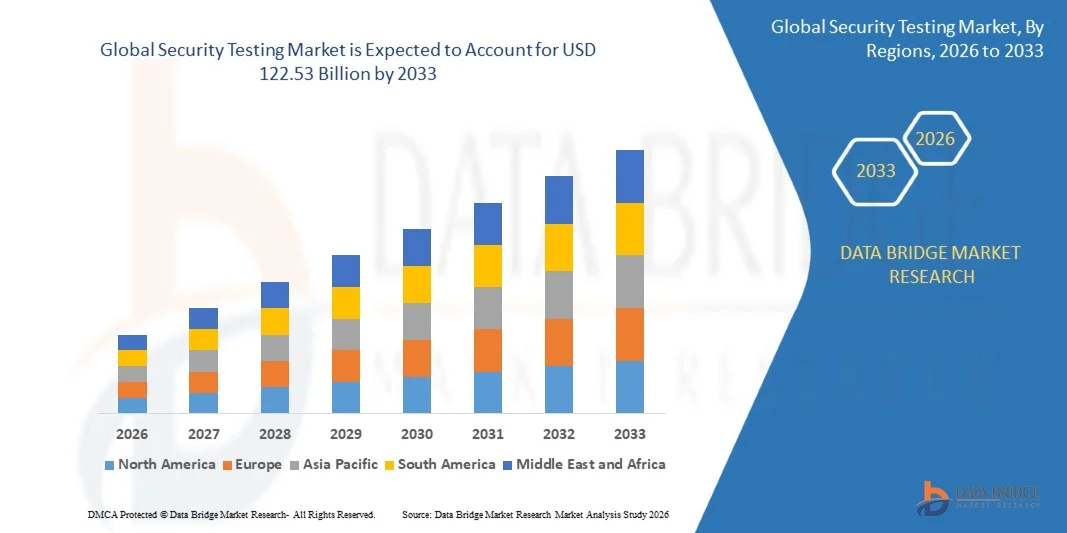
- The global security testing market size was valued at USD 13.62 billion in 2025 and is expected to reach USD 122.53 billion by 2033, at a CAGR of 31.6% during the forecast period
- The market growth is largely fueled by the rising frequency of cyberattacks and increasing dependence of enterprises on digital platforms, cloud infrastructure, and connected applications, which is intensifying the need for comprehensive security testing solutions
- Furthermore, organizations are increasingly prioritizing proactive vulnerability detection, regulatory compliance, and secure software development practices, establishing security testing as a critical component of modern cybersecurity strategies. These converging factors are accelerating the adoption of advanced testing tools and services, thereby significantly boosting the industry's growth
Security Testing Market Analysis
- Security testing solutions, designed to identify vulnerabilities and assess the resilience of applications, networks, and digital infrastructure, are becoming essential elements of enterprise cybersecurity frameworks across industries due to their ability to detect threats, prevent data breaches, and ensure secure digital operations
- The escalating demand for security testing is primarily fueled by the rapid adoption of cloud computing, expansion of digital services, and increasing integration of connected devices, along with stricter data protection regulations and growing enterprise investments in cybersecurity risk management
- North America dominated the security testing market with a share of 36.8% in 2025, due to the strong presence of cybersecurity solution providers and the increasing frequency of sophisticated cyberattacks across enterprises
- Asia-Pacific is expected to be the fastest growing region in the security testing market during the forecast period due to rapid digitalization, increasing internet penetration, and the expansion of cloud computing across emerging economies
- Cloud segment dominated the market with a market share of 61.70% in 2025, due to the increasing adoption of cloud-based infrastructure and the growing need for scalable and remotely accessible security testing solutions. Organizations are rapidly shifting applications and data to cloud environments, which has increased the demand for continuous vulnerability assessment and automated security monitoring through cloud-based testing platforms
Report Scope and Security Testing Market Segmentation
|
Attributes |
Security Testing Key Market Insights |
|
Segments Covered |
|
|
Countries Covered |
North America
Europe
Asia-Pacific
Middle East and Africa
South America
|
|
Key Market Players |
|
|
Market Opportunities |
|
|
Value Added Data Infosets |
In addition to the market insights such as market value, growth rate, market segments, geographical coverage, market players, and market scenario, the market report curated by the Data Bridge Market Research team includes in-depth expert analysis, import/export analysis, pricing analysis, production consumption analysis, and pestle analysis. |
Security Testing Market Trends
“Increasing Adoption of AI-Driven and Automated Security Testing Solutions”
- A significant trend in the security testing market is the growing integration of artificial intelligence and automation into vulnerability detection and threat analysis processes, driven by the increasing complexity of enterprise digital environments. These technologies are enabling organizations to detect security flaws faster and manage large volumes of security assessments with improved efficiency across cloud platforms, applications, and enterprise networks
- For instance, IBM introduced Watson Code Assistant for Security Testing, which enables developers to generate security test cases using natural-language prompts. This solution accelerates vulnerability detection during the software development lifecycle and reduces the time required to implement complex security testing scripts
- Enterprises are increasingly adopting automated security testing tools within DevSecOps pipelines to ensure continuous monitoring and rapid identification of vulnerabilities across applications and infrastructure. Automation helps development teams integrate security testing directly into development workflows, enabling faster remediation and improving overall software resilience
- Cloud-based development environments are further encouraging the adoption of AI-driven testing solutions that can analyze massive datasets and identify abnormal behavior patterns within applications and networks. This capability allows organizations to strengthen threat detection while reducing manual intervention and operational complexity
- Security teams are also leveraging machine learning models to prioritize vulnerabilities based on risk severity and potential business impact. This approach improves decision-making efficiency and ensures that critical security issues are addressed before they can be exploited by attackers
- The increasing reliance on automated and intelligent testing technologies is reinforcing the transformation of security testing from a periodic assessment process into a continuous and integrated cybersecurity practice. This trend is strengthening the overall effectiveness of vulnerability management and supporting the growth of the security testing market
Security Testing Market Dynamics
Driver
“Rising Frequency of Cyberattacks and Data Breaches Across Digital Platforms”
- The rising number of cyberattacks targeting enterprise applications, cloud infrastructure, and digital platforms is a major factor driving the adoption of security testing solutions across industries. Organizations are increasingly investing in vulnerability assessment, penetration testing, and application security tools to identify weaknesses and protect sensitive information from unauthorized access
- For instance, Synopsys strengthened its security testing portfolio by acquiring a specialized API security testing firm in 2025. This development enabled the company to integrate automated endpoint scanning capabilities within its application security platform, helping enterprises identify vulnerabilities in application programming interfaces before they can be exploited
- The rapid growth of digital services, online financial transactions, and cloud-based applications has significantly expanded the attack surface for cybercriminals. As a result, organizations are deploying advanced security testing frameworks to evaluate system resilience and reduce the risk of data breaches
- Regulatory requirements related to data protection and cybersecurity compliance are also encouraging enterprises to implement comprehensive testing strategies. Industries such as BFSI, healthcare, and IT are required to regularly assess application and network security to maintain regulatory adherence and ensure consumer data protection
- The persistent rise in sophisticated cyber threats continues to reinforce the importance of security testing solutions across enterprise ecosystems. This growing emphasis on proactive cybersecurity practices is significantly contributing to the expansion of the security testing market
Restraint/Challenge
“Shortage of Skilled Cybersecurity and Security Testing Professionals”
- The security testing market faces challenges due to the limited availability of skilled cybersecurity professionals capable of performing complex vulnerability assessments and penetration testing activities. Advanced testing procedures require expertise in ethical hacking, secure coding practices, and threat analysis, making talent acquisition a major concern for many organizations
- For instance, ISC2 reported a global cybersecurity workforce gap exceeding four million professionals, highlighting the shortage of skilled experts required to manage modern security operations. This workforce deficit directly affects organizations’ ability to implement comprehensive security testing programs
- The growing complexity of digital infrastructures and emerging technologies such as cloud computing, artificial intelligence, and Internet of Things is increasing the demand for specialized security expertise. However, the supply of qualified professionals capable of performing advanced security testing remains limited
- Organizations often face difficulties in maintaining continuous security assessments due to the lack of experienced penetration testers and vulnerability analysts. This shortage can delay testing cycles and reduce the effectiveness of proactive threat detection strategies
- The shortage of qualified professionals continues to constrain the scalability of security testing programs across enterprises. This challenge is encouraging organizations to adopt automated testing platforms and managed security services to compensate for the lack of specialized expertise while maintaining strong cybersecurity defenses
Security Testing Market Scope
The market is segmented on the basis of testing type, testing tool, deployment mode, organization size, and vertical.
• By Testing Type
On the basis of testing type, the security testing market is segmented into application security, network security, device security, and social engineering. The application security segment dominated the market with the largest market revenue share in 2025, driven by the increasing adoption of web and mobile applications across enterprises. Organizations prioritize application security testing to identify vulnerabilities and protect sensitive customer and business data, ensuring compliance with standards such as OWASP and PCI DSS. The rise in cyberattacks targeting applications has further strengthened demand, making application security testing a critical component of enterprise cybersecurity strategies. Integration with automated DevSecOps pipelines also enhances its utility, providing continuous monitoring and remediation.
The network security segment is anticipated to witness the fastest growth rate from 2026 to 2033, fueled by rising cyber threats targeting enterprise networks and the proliferation of cloud-based infrastructures. Network security testing enables organizations to detect configuration weaknesses, unauthorized access points, and potential threats before they can be exploited. For instance, companies such as Qualys provide network vulnerability assessment tools that allow real-time monitoring and scanning of enterprise networks, increasing adoption across both SMEs and large enterprises. Growing reliance on remote work and hybrid IT environments further drives demand for advanced network security testing solutions.
• By Testing Tool
On the basis of testing tool, the security testing market is segmented into web application testing tools, code review tools, and penetration testing tools. Web application testing tools dominated the market in 2025, driven by the high frequency of attacks targeting web applications and APIs. Enterprises leverage these tools to detect vulnerabilities such as SQL injection, cross-site scripting, and authentication flaws, ensuring secure digital experiences for customers. Adoption is further enhanced by integration with CI/CD pipelines, allowing developers to identify issues early in the development lifecycle. Tools providing detailed reporting and automated remediation guidance are increasingly preferred, strengthening their market position.
The penetration testing tool segment is expected to witness the fastest CAGR from 2026 to 2033, fueled by the growing emphasis on proactive security assessment and ethical hacking practices. Penetration testing simulates real-world cyberattacks to evaluate the resilience of enterprise systems, networks, and applications. For instance, Rapid7’s penetration testing solutions enable organizations to conduct automated and manual assessments, helping prioritize vulnerabilities and strengthen defenses. The increasing regulatory requirements for penetration testing in sectors such as BFSI and healthcare further support its adoption.
• By Deployment Mode
On the basis of deployment mode, the security testing market is segmented into on-premises and cloud. The cloud segment held the largest market revenue share of 61.70% in 2025, driven by the increasing adoption of cloud-based infrastructure and the growing need for scalable and remotely accessible security testing solutions. Organizations are rapidly shifting applications and data to cloud environments, which has increased the demand for continuous vulnerability assessment and automated security monitoring through cloud-based testing platforms. In addition, cloud deployment enables faster implementation, centralized management, and integration with DevSecOps pipelines, making it a preferred option for enterprises seeking flexible and cost-efficient security testing capabilities.
The on-premises deployment segment is anticipated to witness the fastest growth rate from 2026 to 2033, fueled by rising concerns regarding data privacy, regulatory compliance, and the need for complete control over sensitive enterprise information. Organizations operating in highly regulated industries such as BFSI and healthcare often prefer on-premises security testing solutions to maintain strict data governance and internal security policies. The ability to customize security frameworks, integrate with legacy infrastructure, and ensure internal control over vulnerability assessments further supports the growing adoption of on-premises deployment.
• By Organization Size
On the basis of organization size, the security testing market is segmented into SMEs and large enterprises. Large enterprises dominated the market in 2025, driven by their complex IT infrastructure, higher cybersecurity budgets, and stringent regulatory compliance requirements. These organizations often operate across multiple geographies and need advanced security testing solutions to protect sensitive corporate and customer data from sophisticated cyber threats. Adoption of comprehensive security testing platforms ensures continuous risk monitoring, vulnerability management, and incident response. Integration with enterprise-wide cybersecurity frameworks enhances operational efficiency and strengthens resilience against attacks.
The SMEs segment is expected to witness the fastest CAGR from 2026 to 2033, fueled by increasing cyberattacks targeting small businesses and the growing awareness of affordable security testing solutions. SMEs are increasingly adopting cloud-based, automated, and managed security testing services to protect against potential breaches without heavy upfront investments. For instance, ImmuniWeb provides AI-powered security testing tailored for SMEs, allowing efficient vulnerability assessment and remediation. Rising regulatory pressures and the need to build customer trust further boost adoption in this segment.
• By Vertical
On the basis of vertical, the security testing market is segmented into BFSI, healthcare, IT, and telecom. The BFSI segment dominated the market in 2025, driven by the critical need to protect sensitive financial data, comply with stringent regulations, and mitigate the risk of cyber fraud. Financial institutions invest heavily in security testing to ensure the robustness of online banking, payment systems, and mobile applications. The adoption of digital banking services, mobile wallets, and real-time transaction processing further elevates the demand for comprehensive security testing frameworks.
The healthcare segment is anticipated to witness the fastest growth rate from 2026 to 2033, fueled by the rising digitization of medical records, telemedicine platforms, and connected medical devices. For instance, IBM Security provides healthcare-focused security testing solutions that help hospitals and clinics identify vulnerabilities in patient data systems and network infrastructure. Increasing regulatory requirements such as HIPAA compliance and the criticality of safeguarding patient privacy drive the adoption of advanced security testing solutions across the healthcare sector.
Security Testing Market Regional Analysis
- North America dominated the security testing market with the largest revenue share of 36.8% in 2025, driven by the strong presence of cybersecurity solution providers and the increasing frequency of sophisticated cyberattacks across enterprises
- Organizations in the region emphasize proactive security testing to safeguard digital assets, enterprise networks, and customer data as digital transformation and cloud adoption accelerate
- This widespread adoption is further supported by advanced IT infrastructure, strict regulatory compliance requirements, and high cybersecurity spending, establishing security testing as an essential component of enterprise risk management strategies
U.S. Security Testing Market Insight
The U.S. security testing market captured the largest revenue share within North America in 2025, fueled by the rapid adoption of digital platforms, cloud computing, and connected enterprise systems. Organizations across sectors are increasingly investing in vulnerability assessment, penetration testing, and application security to prevent data breaches and financial losses. The presence of major cybersecurity companies, continuous innovation in security technologies, and strict regulatory frameworks such as data protection and financial security standards further support the expansion of the security testing market in the U.S.
Europe Security Testing Market Insight
The Europe security testing market is projected to expand at a substantial CAGR throughout the forecast period, primarily driven by stringent data protection regulations and the growing emphasis on cybersecurity risk management. Organizations across industries are increasingly adopting advanced testing solutions to secure enterprise applications, networks, and digital platforms. The region’s strong regulatory framework, rising cyber threats, and expanding adoption of cloud and digital services are encouraging enterprises to implement comprehensive security testing strategies across IT environments.
U.K. Security Testing Market Insight
The U.K. security testing market is anticipated to grow at a noteworthy CAGR during the forecast period, driven by increasing cyber threats and the expanding digital economy. Businesses are focusing on strengthening application and network security as remote work environments and cloud adoption continue to grow. The presence of a well-established financial services sector, strong cybersecurity policies, and increasing investments in digital infrastructure are expected to continue driving demand for advanced security testing solutions in the country.
Germany Security Testing Market Insight
The Germany security testing market is expected to expand at a considerable CAGR during the forecast period, fueled by the country’s strong industrial base and growing focus on digital security. Enterprises across manufacturing, automotive, and financial sectors are investing in security testing to protect connected systems, industrial networks, and enterprise applications. Germany’s emphasis on technological innovation, data privacy, and secure digital infrastructure supports the growing adoption of comprehensive cybersecurity and testing frameworks.
Asia-Pacific Security Testing Market Insight
The Asia-Pacific security testing market is poised to grow at the fastest CAGR during the forecast period of 2026 to 2033, driven by rapid digitalization, increasing internet penetration, and the expansion of cloud computing across emerging economies. Organizations across the region are strengthening cybersecurity strategies to protect digital assets and customer data as online services and mobile applications grow rapidly. Government initiatives supporting digital transformation and the rising number of cyber incidents are accelerating the adoption of security testing solutions across industries.
Japan Security Testing Market Insight
The Japan security testing market is gaining momentum due to the country’s advanced technological ecosystem and increasing demand for secure digital infrastructure. Enterprises are increasingly adopting security testing solutions to protect enterprise systems, financial platforms, and connected devices from evolving cyber threats. The growing adoption of IoT devices, digital services, and cloud platforms across industries is encouraging organizations to implement continuous security testing to ensure operational resilience and data protection.
China Security Testing Market Insight
The China security testing market accounted for the largest market revenue share in Asia Pacific in 2025, attributed to the country’s rapid expansion of digital services and growing cybersecurity awareness among enterprises. Organizations are increasingly implementing security testing frameworks to safeguard cloud platforms, e-commerce systems, and enterprise networks from cyber threats. The strong growth of the technology sector, increasing regulatory focus on data protection, and large-scale digital transformation initiatives are key factors supporting the expansion of the security testing market in China.
Security Testing Market Share
The security testing industry is primarily led by well-established companies, including:
- Qualys, Inc. (U.S.)
- Cisco Systems, Inc. (U.S.)
- Intertek Group plc (U.K.)
- Hewlett Packard Enterprise Development LP (U.S.)
- Applause App Quality, Inc. (U.S.)
- IBM Corporation (U.S.)
- UL LLC (U.S.)
- Checkmarx Ltd. (U.S.)
- NTT Security AppSec Solutions Inc. (U.S.)
- Veracode, Inc. (U.S.)
- Accenture plc (Ireland)
- Synopsys, Inc. (U.S.)
- Rapid7, Inc. (U.S.)
- Micro Focus International plc (U.K.)
- Tenable, Inc. (U.S.)
- PortSwigger Ltd. (U.K.)
Latest Developments in Global Security Testing Market
- In December 2025, Synopsys acquired a dedicated API-security testing firm for approximately USD 450 million, strengthening its position in the rapidly evolving security testing market. The acquisition enabled Synopsys to integrate automated endpoint scanning capabilities directly into its application security platform, allowing organizations to detect API vulnerabilities earlier in the development cycle. This move reflects the growing importance of API security as enterprises increasingly rely on interconnected applications and microservices. The integration also enhances automated vulnerability detection and supports DevSecOps workflows, contributing to broader adoption of advanced security testing solutions across enterprise environments
- In November 2025, IBM introduced Watson Code Assistant for Security Testing, an AI-driven solution designed to simplify and accelerate security testing processes. The tool enables developers and security teams to generate test cases using natural-language prompts, significantly reducing the time and expertise required for scripting complex security tests. By shrinking scripting time by nearly 60%, the platform improves testing efficiency and allows organizations to integrate security validation earlier within software development cycles. This development strengthens IBM’s presence in the AI-driven cybersecurity ecosystem and supports the market’s transition toward automated and intelligent security testing frameworks
- In July 2025, Okta, Inc. expanded its collaboration with Palo Alto Networks to develop a unified security architecture aimed at strengthening enterprise identity protection and automated threat response. The partnership integrates Okta Workforce Identity with Palo Alto Networks’ Prisma Access Browser, enabling conditional access that restricts single sign-on application usage to secure browser environments. In addition, Okta’s AI-powered Identity Threat Protection capabilities were integrated with Palo Alto Networks’ Cortex SecOps, improving visibility into identity-based cyber threats. Expanded compatibility with Cortex XSIAM and Cortex XDR further enhances coordinated defense mechanisms, supporting organizations in strengthening identity security and improving threat detection efficiency across complex digital infrastructures
- In June 2025, Cobalt introduced significant upgrades to its Offensive Security Platform, aimed at helping enterprises scale their security testing programs with greater automation, transparency, and operational control. The enhancements deliver improved data insights, faster vulnerability reporting, and optimized workflows for penetration testing processes. These updates also reinforce Cobalt’s focus on expert-led and rapid-deployment security testing services, enabling organizations to identify and remediate vulnerabilities more efficiently. As cyber threats continue to evolve, such innovations strengthen the role of managed penetration testing platforms in the broader security testing market
- In October 2024, CyCognito introduced new enhancements to its CyCognito Automated Security Testing (AST) platform to improve automated exposure validation and security assessments. The updates accelerate the deployment of automated testing within Amazon Web Services environments, allowing organizations to rapidly assess cloud-based assets and detect potential vulnerabilities. Additional improvements enable better identification of exposed data and provide penetration testers with automated reconnaissance capabilities that prioritize critical vulnerabilities. These advancements strengthen automated security testing capabilities and support enterprises in improving cloud security posture and risk management strategies
SKU-
Get online access to the report on the World's First Market Intelligence Cloud

- Interactive Data Analysis Dashboard
- Company Analysis Dashboard for high growth potential opportunities
- Research Analyst Access for customization & queries
- Competitor Analysis with Interactive dashboard
- Latest News, Updates & Trend analysis
- Harness the Power of Benchmark Analysis for Comprehensive Competitor Tracking
Research Methodology
Data collection and base year analysis are done using data collection modules with large sample sizes. The stage includes obtaining market information or related data through various sources and strategies. It includes examining and planning all the data acquired from the past in advance. It likewise envelops the examination of information inconsistencies seen across different information sources. The market data is analysed and estimated using market statistical and coherent models. Also, market share analysis and key trend analysis are the major success factors in the market report. To know more, please request an analyst call or drop down your inquiry.
The key research methodology used by DBMR research team is data triangulation which involves data mining, analysis of the impact of data variables on the market and primary (industry expert) validation. Data models include Vendor Positioning Grid, Market Time Line Analysis, Market Overview and Guide, Company Positioning Grid, Patent Analysis, Pricing Analysis, Company Market Share Analysis, Standards of Measurement, Global versus Regional and Vendor Share Analysis. To know more about the research methodology, drop in an inquiry to speak to our industry experts.
Customization Available
Data Bridge Market Research is a leader in advanced formative research. We take pride in servicing our existing and new customers with data and analysis that match and suits their goal. The report can be customized to include price trend analysis of target brands understanding the market for additional countries (ask for the list of countries), clinical trial results data, literature review, refurbished market and product base analysis. Market analysis of target competitors can be analyzed from technology-based analysis to market portfolio strategies. We can add as many competitors that you require data about in the format and data style you are looking for. Our team of analysts can also provide you data in crude raw excel files pivot tables (Fact book) or can assist you in creating presentations from the data sets available in the report.












