


Self-Sealing Ziplock Bag Market Overview
The Self-Sealing Ziplock Bag Market was valued at USD 5.20 billion in 2025 and is projected to reach USD 8.35 billion by 2033, growing at a CAGR of 6.1% from 2026 to 2033. The market is experiencing steady growth driven by increasing demand for convenient food storage solutions, rising adoption of flexible packaging formats, and growing consumer preference for reusable and resealable packaging across household, commercial, and industrial applications.
The expanding food and beverage sector, coupled with heightened awareness regarding food preservation, hygiene, and waste reduction, is accelerating the use of self-sealing ziplock bags worldwide. Manufacturers are increasingly introducing recyclable, BPA-free, and sustainable packaging alternatives to meet evolving environmental regulations and consumer expectations. In addition, growing applications in healthcare, retail, e-commerce, and logistics are supporting market expansion, as ziplock bags provide cost-effective, lightweight, and secure packaging solutions for storage, transportation, and product protection.
Key Market Trends & Insights
- North America dominated the Self-Sealing Ziplock Bag Market with the largest revenue share of 35.42% in 2025, supported by high consumption of packaged foods, strong retail penetration, and widespread adoption of convenient food storage solutions.
- The Stand Up Bag segment led the market with a 36.84% share in 2025, driven by its superior shelf visibility, convenient storage capabilities, and extensive use in food packaging applications.
- Asia-Pacific is expected to be the fastest-growing region at a CAGR of 7.1% from 2026 to 2033, fueled by expanding food processing industries, rising disposable incomes, and increasing demand for flexible packaging in China, India, and Southeast Asia.
- Gusseted Bag are the fastest-growing product type, projected to register a CAGR of 7.2%, reflecting the surge in demand for high-capacity flexible packaging solutions.
- The Plastic segment dominated the material category with a 68.57% revenue share in 2025, led by its affordability, flexibility, durability, and excellent moisture resistance properties.
- 8 Oz to 15 Oz accounted for 31.62% of the market, preferred by its widespread use in household food storage, snacks, frozen foods, and retail packaging applications
- The Paper segment is the fastest-growing material category, with a CAGR of 7.5%, driven by the increasing consumer preference for environmentally friendly packaging solutions.
Market Size & Forecast
- Global Market Value (2025): USD 5.20 Billion
- Expected Market Value (2033): USD 8.35 Billion
- Forecast CAGR (2026–2033): 6.1%
- Leading Region in 2025: North America
- Fastest Growing Region: Asia Pacific
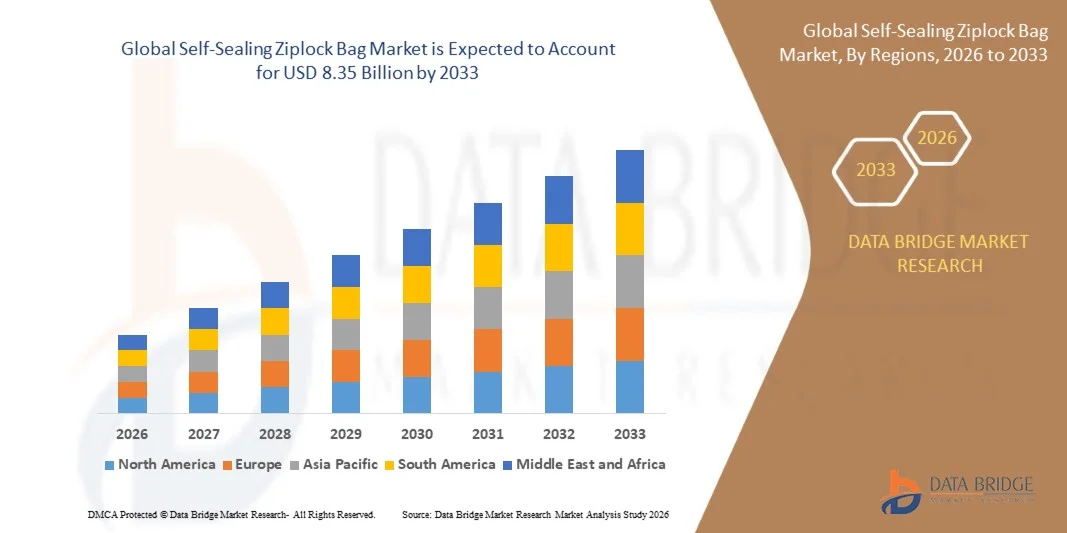
Report Scope and Self-Sealing Ziplock Bag Market Segmentation
|
Attributes |
Self-Sealing Ziplock Bag Key Market Insights |
|
Segments Covered |
|
|
Countries Covered |
North America · U.S. · Canada · Mexico Europe · Germany · France · U.K. · Netherlands · Switzerland · Belgium · Russia · Italy · Spain · Turkey · Rest of Europe Asia-Pacific · China · Japan · India · South Korea · Singapore · Malaysia · Australia · Thailand · Indonesia · Philippines · Rest of Asia-Pacific Middle East and Africa · Saudi Arabia · U.A.E. · South Africa · Egypt · Israel · Rest of Middle East and Africa South America · Brazil · Argentina · Rest of South America |
|
Key Market Players |
· Amcor plc (Switzerland) · Berry Global, Inc. (U.S.) · Sealed Air Corporation (U.S.) · Mondi plc (U.K.) · Huhtamäki Oyj (Finland) · Sonoco Products Company (U.S.) · Constantia Flexibles GmbH (Austria) · Coveris Holdings S.A. (U.K.) · ProAmpac LLC (U.S.) · Winpak Ltd. (Canada) · Printpack Inc. (U.S.) · Uflex Ltd. (India) · Novolex Holdings Inc. (U.S.) · Pactiv Evergreen Inc. (U.S.) · Glenroy, Inc. (U.S.) · Transcontinental Inc. (Canada) · Sigma Plastics Group (U.S.) · Clondalkin Group Holdings B.V. (Netherlands) · Smurfit Kappa Group (Ireland) · ALPLA Werke Alwin Lehner GmbH & Co KG (Austria) |
|
Market Opportunities |
· Expansion of recyclable and bio-based ziplock bag solutions · Growing penetration of e-commerce and direct-to-consumer food delivery services · Rising adoption in healthcare, pharmaceutical, and laboratory sample storage applications |
|
Value Added Data Infosets |
In addition to the insights on market scenarios such as market value, growth rate, segmentation, geographical coverage, and major players, the market reports curated by the Data Bridge Market Research also include import export analysis, production capacity overview, production consumption analysis, price trend analysis, climate change scenario, supply chain analysis, value chain analysis, raw material/consumables overview, vendor selection criteria, PESTLE Analysis, Porter Analysis, and regulatory framework. |
Self-Sealing Ziplock Bag Market Trends
Trend: Rising Demand for Sustainable and Reusable Packaging Solutions
Consumers and businesses are increasingly adopting reusable and environmentally friendly self-sealing ziplock bags to reduce plastic waste and comply with evolving sustainability goals. Manufacturers are introducing recyclable materials, bio-based polymers, and durable multi-use designs that extend product lifespan while maintaining convenience and functionality. Retailers and food service providers are similarly promoting eco-conscious packaging alternatives through sustainability initiatives, while advancements in material science improve barrier properties and product performance without compromising environmental objectives.
For instance, in March 2025, several global packaging manufacturers expanded their portfolios of recyclable and reusable ziplock bags made from mono-material polyethylene structures, supporting circular economy initiatives and growing consumer demand for sustainable flexible packaging solutions.
Self-Sealing Ziplock Bag Market Dynamics
Key Market Driver: Expanding Demand for Convenient Food Storage and Preservation
The growing demand for convenient food storage and preservation solutions has created substantial demand for self-sealing ziplock bags across residential, commercial, and industrial applications. Food manufacturers, retailers, and consumers increasingly rely on resealable packaging to maintain freshness, extend shelf life, and reduce food waste. The ease of use, portability, and cost-effectiveness of ziplock bags continue to support widespread adoption, while innovations in barrier protection and leak-resistant sealing technologies further enhance product utility.
For instance, in January 2025, multiple food packaging companies introduced enhanced ziplock bag designs with improved moisture and oxygen barriers to support longer food preservation and reduce spoilage throughout storage and transportation processes.
Key Restraint/Challenge: Environmental Concerns Regarding Plastic Waste Generation
A significant restraint in the Self-Sealing Ziplock Bag Market is the growing concern regarding plastic waste generation and environmental pollution. Conventional ziplock bags are predominantly manufactured using petroleum-based plastics, creating challenges related to disposal, recycling efficiency, and landfill accumulation. The total environmental impact extends to resource consumption, carbon emissions, and waste management costs, making regulatory compliance increasingly difficult for manufacturers operating in environmentally conscious markets.
For instance, in 2024, several countries strengthened regulations on single-use plastics and packaging waste management, increasing compliance requirements for flexible packaging manufacturers and highlighting challenges associated with conventional plastic-based ziplock bag production.
Key Market Opportunity: Expansion of Recyclable and Bio-Based Ziplock Bag Technologies
The expansion of recyclable and bio-based ziplock bag technologies presents a significant market opportunity. Sustainable material innovations can improve recyclability, reduce dependence on fossil-fuel-derived plastics, and support corporate environmental commitments. The development of compostable materials, advanced recycling systems, and mono-material packaging structures is further accelerating adoption across food, healthcare, and retail sectors, creating growth opportunities throughout North America, Europe, Asia-Pacific, Latin America, and the Middle East.
For instance, in February 2025, leading flexible packaging producers increased investments in bio-based and recyclable resealable packaging technologies to address sustainability targets and meet evolving consumer preferences for environmentally responsible packaging solutions.
Self-Sealing Ziplock Bag Market Scope
The self-sealing ziplock bag market is segmented on the basis of product type, material, capacity, and end-user industry.
- By Product Type
On the basis of product type, the Self-Sealing Ziplock Bag Market is segmented into stand up bag, 3-side seal bag, pillow pack bag, gusseted bag, and pinch bottom bag. The Stand Up Bag segment dominated the market with an estimated 36.84% share in 2025, owing to its superior shelf visibility, convenient storage capabilities, and extensive use in food packaging applications. These bags provide excellent stability and allow products to remain upright on retail shelves, enhancing product presentation and consumer appeal. Their resealable design helps preserve freshness and extend product shelf life, making them highly preferred for snacks, dry foods, and pet food packaging. Manufacturers increasingly favor stand up bags due to their lightweight structure and lower material consumption compared to rigid packaging formats. Advancements in barrier technologies and printing capabilities are further supporting adoption across multiple industries. The combination of functionality, convenience, and cost efficiency continues to strengthen the segment’s market leadership.
The Gusseted Bag segment is projected to register the fastest growth at a CAGR of 7.2% from 2026 to 2033, driven by rising demand for high-capacity flexible packaging solutions. These bags offer enhanced storage volume and structural strength, making them suitable for bulk food products, industrial materials, and specialty consumer goods. Their ability to expand while maintaining package integrity improves transportation and storage efficiency. Growing demand for e-commerce-friendly packaging formats is accelerating adoption among manufacturers and retailers. Continuous innovations in recyclable materials and resealable closures are further improving product appeal. Increasing utilization across foodservice, chemicals, and agricultural applications is expected to support strong future growth.
- By Material
On the basis of material, the Self-Sealing Ziplock Bag Market is segmented into plastic, paper, and foil. The Plastic segment dominated the market with an estimated 68.57% share in 2025, driven by its affordability, flexibility, durability, and excellent moisture resistance properties. Plastic ziplock bags are widely used across food storage, retail packaging, healthcare, and industrial applications due to their versatility and ease of manufacturing. They provide reliable sealing performance while maintaining product freshness and protection during storage and transportation. The availability of various plastic grades allows manufacturers to tailor products according to end-user requirements. Strong global production infrastructure and established supply chains further support market dominance. Despite sustainability concerns, ongoing developments in recyclable and reusable plastic packaging continue to sustain demand.
The Paper segment is anticipated to witness the fastest growth at a CAGR of 7.5% from 2026 to 2033, supported by increasing consumer preference for environmentally friendly packaging solutions. Paper-based ziplock bags are gaining popularity among brands seeking to reduce plastic usage and improve sustainability credentials. Regulatory initiatives aimed at minimizing plastic waste are encouraging manufacturers to invest in paper packaging innovations. Improvements in coating technologies and barrier performance are expanding the range of applications for paper-based solutions. Growing adoption in premium food, bakery, and organic product packaging is further contributing to market expansion. Rising environmental awareness among consumers is expected to drive sustained growth throughout the forecast period.
- By Capacity
On the basis of capacity, the Self-Sealing Ziplock Bag Market is segmented into up to 3 oz, 3 oz to 7 oz, 8 oz to 15 oz, 16 oz to 30 oz, and above 30 oz. The 8 Oz to 15 Oz segment accounted for the largest market share of 31.62% in 2025, owing to its widespread use in household food storage, snacks, frozen foods, and retail packaging applications. This capacity range offers an ideal balance between portability and storage efficiency, making it highly versatile across consumer markets. It is extensively utilized for portion control, meal preparation, and convenience packaging. The segment benefits from strong demand in both developed and emerging economies where packaged food consumption continues to rise. Manufacturers favor this size category due to its broad consumer appeal and production efficiency. Consistent usage across residential and commercial sectors reinforces its leading market position.
The Above 30 Oz segment is expected to record the fastest growth at a CAGR of 7.0% from 2026 to 2033, driven by increasing demand for bulk storage and commercial packaging solutions. Large-capacity ziplock bags are gaining traction in foodservice establishments, industrial facilities, and e-commerce logistics operations. Their ability to securely store larger product volumes improves operational efficiency and reduces packaging waste. Growing adoption in pet food, agricultural products, and industrial materials is supporting segment expansion. Advances in material strength and sealing technology are enhancing performance for heavy-duty applications. Rising preference for bulk purchasing and storage solutions is expected to further accelerate growth.
- By End User Industry
On the basis of end user industry, the Self-Sealing Ziplock Bag Market is segmented into food, automotive, personal care & cosmetics, pharmaceuticals, automotive, electronics and electricals, chemicals, and others. The Food segment dominated the market with an estimated 48.36% share in 2025, driven by extensive usage in food storage, preservation, transportation, and retail packaging applications. Self-sealing ziplock bags help maintain freshness, prevent contamination, and extend product shelf life, making them highly valuable throughout the food supply chain. Growing consumer demand for convenience foods and meal preparation products is further increasing adoption. Food manufacturers rely on these bags for efficient packaging of snacks, frozen products, dry goods, and fresh produce. Their lightweight nature reduces transportation costs while ensuring product protection. Continuous innovation in food-grade materials and sustainable packaging solutions supports the segment’s dominant position.
The Pharmaceuticals segment is projected to grow at the fastest CAGR of 7.4% from 2026 to 2033, fueled by rising demand for secure, contamination-resistant storage and transportation solutions. Pharmaceutical companies increasingly utilize self-sealing ziplock bags for packaging medical components, diagnostic kits, samples, and healthcare supplies. These bags provide reliable protection against moisture, dust, and external contaminants, ensuring product integrity. Growing healthcare expenditure and expanding pharmaceutical manufacturing activities are contributing significantly to demand growth. Stringent quality and safety standards are encouraging the use of advanced packaging materials with enhanced barrier properties. Increasing focus on healthcare accessibility and pharmaceutical distribution networks is expected to support long-term market expansion.
Self-Sealing Ziplock Bag Market Regional Analysis
North America dominated the Self-Sealing Ziplock Bag Market with the largest revenue share of 35.42% in 2025, supported by high consumption of packaged foods, strong retail penetration, and widespread adoption of convenient food storage solutions. The region also benefits from advanced flexible packaging technologies, strong presence of leading packaging manufacturers, and increasing demand for reusable and sustainable packaging products. Growing consumer awareness regarding food preservation, expanding e-commerce activities, and rising utilization of resealable packaging across household, healthcare, and industrial applications continue to support market growth. Increasing focus on environmentally responsible packaging innovations and product convenience further strengthens North America’s leadership position in the global market.
U.S. Self-Sealing Ziplock Bag Market Insight
The U.S. self-sealing ziplock bag market is witnessing steady growth due to rising demand from food packaging, healthcare storage, and household organization applications. Increasing focus on convenience packaging, food preservation, and sustainable storage solutions is driving adoption across retail and industrial sectors. In addition, growing e-commerce penetration and expanding ready-to-eat food consumption are further supporting demand for advanced resealable packaging formats, including recyclable and biodegradable ziplock bags.
Europe Self-Sealing Ziplock Bag Market Insight
The Europe self-sealing ziplock bag market remains a significant contributor to global demand, driven by strict packaging regulations, strong sustainability initiatives, and high consumer preference for eco-friendly materials. The region’s emphasis on reducing plastic waste is accelerating the shift toward recyclable and reusable ziplock solutions. In addition, widespread use in food retail, pharmaceuticals, and industrial packaging applications continues to support steady market expansion across major European economies.
U.K. Self-Sealing Ziplock Bag Market Insight
The U.K. self-sealing ziplock bag market is experiencing stable growth, supported by increasing demand from food service providers, retail packaging, and household storage applications. Rising consumer preference for convenient, portion-controlled, and reusable packaging solutions is contributing to market expansion. Furthermore, growing adoption of sustainable packaging alternatives and government initiatives to reduce single-use plastics are encouraging manufacturers to innovate with biodegradable and recyclable ziplock bag formats.
Germany Self-Sealing Ziplock Bag Market Insight
The Germany self-sealing ziplock bag market is expanding steadily due to strong industrial packaging demand, advanced manufacturing capabilities, and increasing environmental awareness. The country’s strict recycling regulations and focus on circular economy practices are driving the adoption of eco-friendly resealable packaging solutions. In addition, growing usage across food processing, pharmaceuticals, and logistics sectors is further accelerating market growth in Germany.
Asia-Pacific Self-Sealing Ziplock Bag Market Insight
The Asia-Pacific self-sealing ziplock bag market is expected to witness rapid growth, driven by expanding urbanization, rising disposable incomes, and increasing demand for packaged food and consumer goods. Rapid growth in e-commerce, retail distribution, and food delivery services is significantly boosting product adoption. In addition, growing manufacturing activities and cost-effective production capabilities across China, India, and Southeast Asia are supporting regional market expansion.
Japan Self-Sealing Ziplock Bag Market Insight
The Japan self-sealing ziplock bag market is witnessing steady growth due to high demand for compact, hygienic, and efficient packaging solutions. Increasing focus on food safety, portion control, and storage efficiency is driving adoption across households, retail, and food service sectors. Moreover, advancements in high-quality plastic alternatives and rising interest in sustainable packaging innovations are further contributing to market growth in Japan.
China Self-Sealing Ziplock Bag Market Insight
The China self-sealing ziplock bag market is growing rapidly, driven by expanding e-commerce activities, rising packaged food consumption, and strong manufacturing capabilities. Increasing urbanization and changing consumer lifestyles are boosting demand for convenient and cost-effective packaging solutions. In addition, growing emphasis on recyclable materials and government initiatives promoting sustainable packaging are further accelerating market adoption across commercial and industrial applications.
Self-Sealing Ziplock Bag Market Share
The self-sealing ziplock bag industry is primarily led by well-established companies, including:
- Amcor plc (Switzerland)
- Berry Global, Inc. (U.S.)
- Sealed Air Corporation (U.S.)
- Mondi plc (U.K.)
- Huhtamäki Oyj (Finland)
- Sonoco Products Company (U.S.)
- Constantia Flexibles GmbH (Austria)
- Coveris Holdings S.A. (U.K.)
- ProAmpac LLC (U.S.)
- Winpak Ltd. (Canada)
- Printpack Inc. (U.S.)
- Uflex Ltd. (India)
- Novolex Holdings Inc. (U.S.)
- Pactiv Evergreen Inc. (U.S.)
- Glenroy, Inc. (U.S.)
- Transcontinental Inc. (Canada)
- Sigma Plastics Group (U.S.)
- Clondalkin Group Holdings B.V. (Netherlands)
- Smurfit Kappa Group (Ireland)
- ALPLA Werke Alwin Lehner GmbH & Co KG (Austria)
Latest Developments in Self-Sealing Ziplock Bag Market
- In March 2024, Mondi Group expanded its recyclable flexible packaging portfolio with mono-material resealable pouch structures designed for food and e-commerce applications. The development enhances recyclability while maintaining sealing strength and product protection, making it suitable for ziplock-style packaging formats. This innovation supports the growing shift toward sustainable and recyclable packaging across retail and logistics sectors
- In February 2023, SC Johnson introduced Ziploc® Endurables reusable silicone storage bags as a durable alternative to traditional disposable ziplock bags. The product is designed for food storage, freezing, and reheating applications, helping reduce single-use plastic consumption in household packaging. This launch reflects increasing consumer demand for reusable and long-lasting storage solutions
- In June 2022, Sealed Air expanded its CRYOVAC® packaging portfolio with recyclable-ready flexible food packaging solutions designed to improve shelf life and reduce environmental impact. The development includes advanced resealable and vacuum packaging structures used in food preservation and storage applications. This innovation supports the broader transition toward recyclable flexible packaging systems in global markets
- In April 2022, Amcor launched its AmFiber™ Performance Paper packaging solution aimed at replacing conventional plastic-based flexible packaging formats used in food and consumer goods applications. The innovation supports recyclable packaging structures with strong barrier properties suitable for storage and resealable formats similar to ziplock bags. This launch reflects Amcor’s focus on advancing sustainable alternatives in flexible packaging
- In May 2021, Berry Global expanded its use of post-consumer recycled (PCR) resin in flexible packaging solutions used across food, household, and industrial storage applications. The development includes enhanced recyclable film structures widely applied in resealable and ziplock-style bags, supporting improved sustainability and reduced reliance on virgin plastics. This move strengthens circular economy adoption in flexible packaging manufacturing and aligns with growing global demand for eco-friendly storage solutions

- Interactive Data Analysis Dashboard
- Company Analysis Dashboard for high growth potential opportunities
- Research Analyst Access for customization & queries
- Competitor Analysis with Interactive dashboard
- Latest News, Updates & Trend analysis
- Harness the Power of Benchmark Analysis for Comprehensive Competitor Tracking
Global Self Sealing Ziplock Bag Market, Supply Chain Analysis and Ecosystem Framework
To support market growth and help clients navigate the impact of geopolitical shifts, DBMR has integrated in-depth supply chain analysis into its Global Self Sealing Ziplock Bag Market research reports. This addition empowers clients to respond effectively to global changes affecting their industries. The supply chain analysis section includes detailed insights such as Global Self Sealing Ziplock Bag Market consumption and production by country, price trend analysis, the impact of tariffs and geopolitical developments, and import and export trends by country and HSN code. It also highlights major suppliers with data on production capacity and company profiles, as well as key importers and exporters. In addition to research, DBMR offers specialized supply chain consulting services backed by over a decade of experience, providing solutions like supplier discovery, supplier risk assessment, price trend analysis, impact evaluation of inflation and trade route changes, and comprehensive market trend analysis.
Data collection and base year analysis are done using data collection modules with large sample sizes. The stage includes obtaining market information or related data through various sources and strategies. It includes examining and planning all the data acquired from the past in advance. It likewise envelops the examination of information inconsistencies seen across different information sources. The market data is analysed and estimated using market statistical and coherent models. Also, market share analysis and key trend analysis are the major success factors in the market report. To know more, please request an analyst call or drop down your inquiry.
The key research methodology used by DBMR research team is data triangulation which involves data mining, analysis of the impact of data variables on the market and primary (industry expert) validation. Data models include Vendor Positioning Grid, Market Time Line Analysis, Market Overview and Guide, Company Positioning Grid, Patent Analysis, Pricing Analysis, Company Market Share Analysis, Standards of Measurement, Global versus Regional and Vendor Share Analysis. To know more about the research methodology, drop in an inquiry to speak to our industry experts.
Data Bridge Market Research is a leader in advanced formative research. We take pride in servicing our existing and new customers with data and analysis that match and suits their goal. The report can be customized to include price trend analysis of target brands understanding the market for additional countries (ask for the list of countries), clinical trial results data, literature review, refurbished market and product base analysis. Market analysis of target competitors can be analyzed from technology-based analysis to market portfolio strategies. We can add as many competitors that you require data about in the format and data style you are looking for. Our team of analysts can also provide you data in crude raw excel files pivot tables (Fact book) or can assist you in creating presentations from the data sets available in the report.













