




Global Sesame Seeds Market
Market Size in USD Billion
CAGR :
% 
 USD
7.40 Billion
USD
8.95 Billion
2025
2033
USD
7.40 Billion
USD
8.95 Billion
2025
2033
 Forecast Period Forecast Period |
2026 - 2033 |
 Market Size (Base Year) Market Size (Base Year) |
USD 7.40 Billion |
 Market Size (Forecast Year) Market Size (Forecast Year) |
USD 8.95 Billion |
 CAGR CAGR |
% |
| Major Markets Players |
|
Sesame Seeds Market Overview
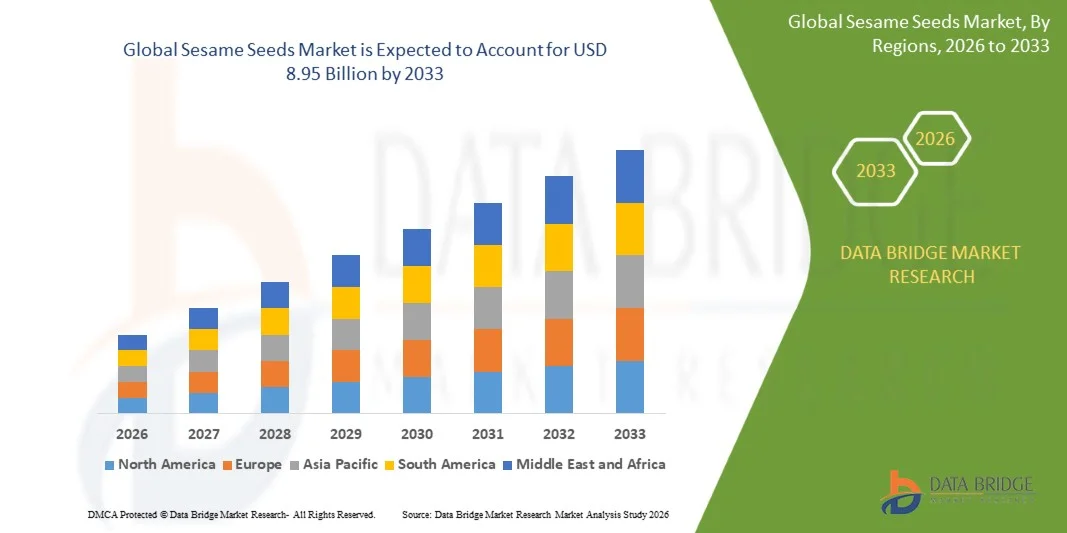
The Sesame Seeds Market was valued at USD 7.40 billion in 2025 and is projected to reach USD 8.95 billion by 2033, growing at a CAGR of 2.40% from 2026 to 2033. The market is witnessing steady growth driven by rising demand for natural and nutrient-rich ingredients in food applications, increasing consumption of sesame-based products in bakery, confectionery, and traditional cuisines, and expanding use of sesame seeds in oil extraction and health-oriented diets.
Growing consumer preference for plant-based, clean-label, and functional food ingredients is further supporting market expansion. Sesame seeds are widely recognized for their high protein, healthy fats, and antioxidant content, making them increasingly popular in nutraceuticals and dietary supplements. In addition, rising demand from food processing industries and the expansion of global trade in oilseeds are contributing to stable market growth across both developed and emerging economies.
Key Market Trends & Insights
- North America dominated the sesame seeds market with the largest revenue share in 2025, supported by strong demand for health-focused food products, rising adoption of plant-based diets, and high consumption of sesame-based ingredients in bakery, snack foods, and ethnic cuisines such as hummus and tahini.
- Asia-Pacific is expected to be the fastest-growing region, recording a CAGR of 3.1% from 2026 to 2033. Growth is driven by strong production capacity, increasing domestic consumption, expanding food processing industries, and rising export demand from countries such as India, China, and Myanmar.
- The Conventional segment held the largest market revenue share of approximately 78.5% in 2025, driven by large-scale agricultural production, lower cultivation costs, and widespread availability across major producing countries such as India, Sudan, and Myanmar. Conventional sesame seeds are extensively used in food processing industries, bakery applications, and edible oil extraction due to their cost efficiency and high yield output.
- The Organic segment is projected to register the fastest growth at a CAGR of 6.9% from 2026 to 2033, driven by rising consumer preference for clean-label, non-GMO, and chemical-free food products. Increasing demand from health-conscious consumers in North America and Europe, along with expanding certified organic farming initiatives in Asia-Pacific and Africa, is accelerating segment expansion.
- The Raw Seed segment held the largest market revenue share of approximately 52.3% in 2025, driven by its extensive use in direct consumption, bakery toppings, and traditional food preparations across Asia-Pacific and Middle Eastern cuisines. Raw sesame seeds are widely preferred due to minimal processing requirements and strong nutritional retention.
- The Processed Seed segment is projected to register the fastest growth at a CAGR of 7.4% from 2026 to 2033, driven by increasing demand for value-added products such as hulled, roasted, and paste-based sesame formulations such as tahini. Rising adoption in packaged food, snack manufacturing, and ready-to-eat applications is supporting segment expansion.
- The White sesame segment held the largest market revenue share of approximately 61.2% in 2025, driven by its dominant usage in bakery products, edible oil extraction, and global food processing industries due to its mild flavor and high versatility. White sesame seeds are widely traded in international markets and are a preferred variety in industrial applications.
- The Black sesame segment is projected to register the fastest growth at a CAGR of 8.1% from 2026 to 2033, driven by increasing demand in nutraceuticals, functional foods, and premium culinary applications. Rising consumer awareness regarding antioxidant properties and traditional medicinal usage in Asia-Pacific countries such as China, Japan, and India is accelerating demand growth.
- The Bakery and Confectionery Products segment held the largest market revenue share of approximately 44.6% in 2025, driven by extensive use in bread toppings, cookies, snacks, and traditional sweets across global food industries. Sesame seeds are widely preferred in bakery formulations due to their texture enhancement and nutritional enrichment.
- The Cosmetics segment is projected to register the fastest growth at a CAGR of 7.8% from 2026 to 2033, driven by increasing use of sesame oil and extracts in skincare, haircare, and personal care formulations. Growing demand for natural and plant-based cosmetic ingredients, along with rising adoption in anti-aging and moisturizing products, is supporting segment expansion.
Market Size & Forecast
- Global Market Value (2025): USD 7.40 Billion
- Expected Market Value (2033): USD 8.95 Billion
- Forecast CAGR (2026–2033): 2.40%
- Leading Region in 2025: North America
- Fastest Growing Region: Asia-Pacific
Report Scope and Sesame Seeds Market Segmentation
|
Attributes |
Sesame Seeds Key Market Insights |
|
Segments Covered |
· By Category: Organic and Conventional · By Type: Raw Seed, Processed Seed, and Others · By Color: White, Black, Brown, and Others · By Application: Bakery and Confectionery Products, Pet Food, Cosmetics, Medicines, and Other |
|
Countries Covered |
North America · U.S. · Canada · Mexico Europe · Germany · France · U.K. · Netherlands · Switzerland · Belgium · Russia · Italy · Spain · Turkey · Rest of Europe Asia-Pacific · China · Japan · India · South Korea · Singapore · Malaysia · Australia · Thailand · Indonesia · Philippines · Rest of Asia-Pacific Middle East and Africa · Saudi Arabia · U.A.E. · South Africa · Egypt · Israel · Rest of Middle East and Africa South America · Brazil · Argentina · Rest of South America |
|
Key Market Players |
• SHYAM INDUSTRIES (India) |
|
Market Opportunities |
|
|
Value Added Data Infosets |
In addition to the insights on market scenarios such as market value, growth rate, segmentation, geographical coverage, and major players, the market reports curated by the Data Bridge Market Research also include in-depth expert analysis, pricing analysis, brand share analysis, consumer survey, demography analysis, supply chain analysis, value chain analysis, raw material/consumables overview, vendor selection criteria, PESTLE Analysis, Porter Analysis, and regulatory framework. |
Sesame Seeds Market Trends
Trend: Growth In Health-Conscious Consumption And Expanding Functional Food Applications
Increasing demand for nutrient-rich, plant-based, and minimally processed food ingredients across global food and nutraceutical industries. Rising consumer awareness regarding protein intake, healthy fats, and antioxidant-rich diets is driving the incorporation of sesame seeds in bakery products, confectionery items, and traditional food preparations. Growing preference for clean-label and natural ingredients is also encouraging food manufacturers to replace synthetic additives with sesame-based components.
In modern food processing industries, sesame seeds are being widely used in bakery toppings, tahini production, and snack formulations such as protein bars and multigrain breads, enhancing both nutritional value and sensory appeal. For instance, tahini consumption has been expanding steadily in Europe and North America due to rising vegan and Mediterranean diet adoption, supporting higher demand for sesame seed processing. In edible oil applications, sesame oil is increasingly utilized in gourmet cooking, cosmetics, and pharmaceuticals due to its antioxidant-rich composition and stability under heat processing conditions.
The rapid expansion of functional foods, dietary supplements, and plant-based protein products is also increasing demand for sesame seeds, supported by their high calcium, magnesium, and lignan content. In addition, traditional consumption remains strong in Asia-Pacific and Middle Eastern regions such as India, China, Turkey, and Sudan, where sesame is widely used in sweets, sauces, and bakery products. According to FAO agricultural estimates, global sesame seed production has consistently remained above 6 million metric tons annually in recent years, with Africa and Asia collectively accounting for more than 85% of total output, reinforcing stable supply and trade flows in 2025.
Sesame Seeds Market Dynamics
Key Market Driver: Rising Demand For Plant-Based Nutrition And Functional Food Ingredients
Increasing shift toward healthier diets and plant-based nutrition is driving strong demand for sesame seeds as a natural source of protein, healthy fats, and micronutrients. Consumers are increasingly adopting functional foods that support heart health, digestion, and immunity, contributing to sesame’s growing use in both processed and traditional food categories. Food manufacturers are integrating sesame seeds into bakery products, snack foods, and health supplements to enhance nutritional positioning and product differentiation.
In food service and packaged food industries, sesame-based ingredients are widely used in burger buns, sauces, protein blends, and ethnic cuisines such as hummus and tahini-based spreads. For instance, large-scale bakery chains in North America and Europe have increased use of sesame toppings in premium bread lines to align with clean-label and organic product demand. In addition, rising awareness of plant-based diets in countries such as India, Germany, and the U.S. is accelerating adoption across retail and institutional food channels.
Global sesame seed consumption continues to expand steadily, with Asia-Pacific accounting for a major share of demand due to strong culinary usage and population-driven consumption growth. According to trade estimates, countries such as India, China, and Japan collectively represent a significant portion of global sesame imports, supporting sustained market expansion in 2025.
Key Restraint/Challenge: Price Volatility And Supply Chain Dependency On Climate Conditions
The Sesame Seeds Market is highly dependent on agricultural output, making it vulnerable to weather fluctuations, drought conditions, and inconsistent rainfall patterns in key producing regions. Countries such as Sudan, Myanmar, and India experience periodic production instability, which directly impacts global supply availability and price volatility.
In addition, sesame cultivation is largely dependent on smallholder farmers with limited mechanization, leading to inconsistent yield quality and post-harvest losses. Supply chain inefficiencies, such as inadequate storage and processing infrastructure, further contribute to quality degradation and export constraints in developing economies.
Market data indicates that sesame seed prices can fluctuate significantly within a single harvest cycle, with international trade prices varying by more than 20–30% depending on seasonal output and export restrictions in major producing countries. These factors create procurement uncertainty for food manufacturers and limit long-term contract stability in global trade markets.
Key Market Opportunity: Expansion In Organic, Premium, And Export-Oriented Sesame Products
Rising demand for organic and premium food products is creating strong opportunities for certified sesame seed production and value-added processing. Consumers in developed markets are increasingly willing to pay higher prices for organic, non-GMO, and sustainably sourced sesame products, driving export growth from producing countries.
In international trade, sesame seeds are increasingly being used in premium food applications such as artisanal bakery products, health snacks, and specialty oils. For instance, organic sesame seed exports from India and Ethiopia have grown steadily due to strong demand from Europe and North America’s health food sectors.
In addition, advancements in food processing and cleaning technologies are improving product quality standards, enabling better compliance with international food safety regulations. Growing investment in contract farming, export processing zones, and agricultural modernization in Africa and Asia is expected to strengthen global supply chains and open new high-value market segments in 2025.
Sesame Seeds Market Scope
The market is segmented on the basis of category, type, color, and application.
- By Category
On the basis of category, the sesame seeds market is segmented into Organic and Conventional. The Conventional segment held the largest market revenue share of approximately 78.5% in 2025, driven by large-scale agricultural production, lower cultivation costs, and widespread availability across major producing countries such as India, Sudan, and Myanmar. Conventional sesame seeds are extensively used in food processing industries, bakery applications, and edible oil extraction due to their cost efficiency and high yield output.
The Organic segment is projected to register the fastest growth at a CAGR of 6.9% from 2026 to 2033, driven by rising consumer preference for clean-label, non-GMO, and chemical-free food products. Increasing demand from health-conscious consumers in North America and Europe, along with expanding certified organic farming initiatives in Asia-Pacific and Africa, is accelerating segment expansion.
- By Type
On the basis of type, the sesame seeds market is segmented into Raw Seed, Processed Seed, and Others. The Raw Seed segment held the largest market revenue share of approximately 52.3% in 2025, driven by its extensive use in direct consumption, bakery toppings, and traditional food preparations across Asia-Pacific and Middle Eastern cuisines. Raw sesame seeds are widely preferred due to minimal processing requirements and strong nutritional retention.
The Processed Seed segment is projected to register the fastest growth at a CAGR of 7.4% from 2026 to 2033, driven by increasing demand for value-added products such as hulled, roasted, and paste-based sesame formulations such as tahini. Rising adoption in packaged food, snack manufacturing, and ready-to-eat applications is supporting segment expansion.
- By Color
On the basis of color, the sesame seeds market is segmented into White, Black, Brown, and Others. The White sesame segment held the largest market revenue share of approximately 61.2% in 2025, driven by its dominant usage in bakery products, edible oil extraction, and global food processing industries due to its mild flavor and high versatility. White sesame seeds are widely traded in international markets and are a preferred variety in industrial applications.
The Black sesame segment is projected to register the fastest growth at a CAGR of 8.1% from 2026 to 2033, driven by increasing demand in nutraceuticals, functional foods, and premium culinary applications. Rising consumer awareness regarding antioxidant properties and traditional medicinal usage in Asia-Pacific countries such as China, Japan, and India is accelerating demand growth.
- By Application
On the basis of application, the sesame seeds market is segmented into Bakery and Confectionery Products, Pet Food, Cosmetics, Medicines, and Other. The Bakery and Confectionery Products segment held the largest market revenue share of approximately 44.6% in 2025, driven by extensive use in bread toppings, cookies, snacks, and traditional sweets across global food industries. Sesame seeds are widely preferred in bakery formulations due to their texture enhancement and nutritional enrichment.
The Cosmetics segment is projected to register the fastest growth at a CAGR of 7.8% from 2026 to 2033, driven by increasing use of sesame oil and extracts in skincare, haircare, and personal care formulations. Growing demand for natural and plant-based cosmetic ingredients, along with rising adoption in anti-aging and moisturizing products, is supporting segment expansion.
Sesame Seeds Market Regional Analysis
North America Sesame Seeds Market Insight
North America dominated the sesame seeds market with the largest revenue share of approximately 34.6% in 2025, supported by strong demand for plant-based foods, rising health-conscious consumption, and expanding use of sesame-based ingredients in bakery, confectionery, and functional food applications. Consumers in the region increasingly prefer nutrient-rich and clean-label ingredients, such as sesame seeds, due to their high protein, healthy fat content, and antioxidant properties. This demand is further supported by the growing vegan and vegetarian population, high disposable incomes, and increasing adoption of global cuisines including Middle Eastern and Asian food products.
U.S. Sesame Seeds Market Insight
The U.S. sesame seeds market captured the largest revenue share of approximately 29.8% in 2025 within North America, driven by strong demand from bakery, snack food, and health food industries. Increasing consumption of products such as hummus, tahini, protein bars, and seeded bread is significantly supporting market growth. The rising popularity of plant-based diets, combined with expanding retail availability of organic and non-GMO sesame products, is further propelling demand. In addition, the presence of large food processing companies and growing imports from major producing countries such as India and Sudan continue to strengthen supply chains.
Europe Sesame Seeds Market Insight
The Europe sesame seeds market is expected to witness the fastest growth rate from 2026 to 2033, primarily driven by rising demand for organic food products, plant-based diets, and functional nutrition ingredients. Increasing consumption of sesame-based products such as tahini, bakery toppings, and health snacks is supporting regional growth. Europe’s strong preference for clean-label and sustainable sourcing, along with strict food safety standards, is encouraging imports of high-quality sesame seeds from Africa and Asia.
U.K. Sesame Seeds Market Insight
The U.K. sesame seeds market is expected to witness steady growth from 2026 to 2033, driven by increasing demand for ethnic foods, bakery products, and vegan diets. Rising consumption of Mediterranean and Middle Eastern cuisines, such as hummus and sesame-based spreads, is boosting market penetration. In addition, growing retail expansion of organic and premium food products is supporting wider adoption of sesame seeds in household and food service applications.
Germany Sesame Seeds Market Insight
The Germany sesame seeds market is expected to witness strong growth from 2026 to 2033, fueled by rising demand for organic food ingredients and functional nutrition products. Germany’s well-established health food sector and strong preference for plant-based diets are driving the use of sesame seeds in bakery, confectionery, and dietary supplement applications. Increasing imports of certified organic sesame seeds from developing countries are further supporting market expansion.
Asia-Pacific Sesame Seeds Market Insight
The Asia-Pacific sesame seeds market is expected to witness the fastest growth rate from 2026 to 2033, supported by large-scale production, strong domestic consumption, and expanding food processing industries in countries such as India, China, and Myanmar. The region remains both a major producer and consumer of sesame seeds, driven by traditional dietary usage and rising demand for packaged and processed foods. Government support for oilseed cultivation and increasing export-oriented production are further strengthening regional growth.
Japan Sesame Seeds Market Insight
The Japan sesame seeds market is expected to witness steady growth from 2026 to 2033 due to strong cultural consumption of sesame-based products and rising demand for functional foods. Sesame seeds are widely used in traditional Japanese cuisine, such as sauces, seasonings, and rice toppings. Increasing consumer focus on health and longevity is also driving demand for black sesame products in nutraceutical and dietary applications.
China Sesame Seeds Market Insight
The China sesame seeds market accounted for the largest revenue share in Asia-Pacific in 2025, attributed to high domestic consumption, strong food processing industries, and expanding demand for edible oils and sesame-based food products. Sesame seeds are widely used in traditional foods, snacks, and sesame oil production across the country. In addition, China’s growing middle class, rapid urbanization, and increasing demand for premium and imported food ingredients are further supporting market expansion.
Sesame Seeds Market Share
The Sesame Seeds industry is primarily led by well-established companies, including:
• SHYAM INDUSTRIES (India)
• Organic Spices Inc. (U.S.)
• NOW Foods (U.S.)
• Frontier Co-op (U.S.)
• Raab Vitalfood GmbH (Germany)
• TRADIN ORGANIC AGRICULTURE B.V. (Netherlands)
• Dipasa (Mexico)
• Etico Lifesciences Private Limited (India)
• Dhaval Agri Exports (India)
• SunOpta (Canada)
• Ethics ORGANIC (India)
• Samruddhi Organic (India)
• 24 MANTRA ORGANIC (India)
• HL Agro Products Pvt. Ltd. (India)
• Just Organik (India)
• McCormick & Company, Inc. (U.S.)
• Orienco (India)
• SHILOH FARMS (U.S.)
• Wholefood Earth (U.K.)
• KTC Edibles (U.K.)
• Saitaku (Japan)
Latest Developments in Sesame Seeds Market
- In November 2025, the International Fund for Agricultural Development (IFAD), Japan’s Ministry of Agriculture, Forestry and Fisheries (MAFF), Euglena, and Grameen Euglena launched a sesame-focused initiative in Bangladesh to support small-scale farmers. The project aims to improve sesame seed quality and strengthen supply chains for export-grade sesame to Japanese companies through a social procurement model. This initiative is expected to enhance farmer income, improve traceability, and ensure a stable supply of high-quality sesame, positively impacting international trade flows.
- In September 2025, Olam Agri entered a Memorandum of Understanding (MoU) with Kadoya Sesame Mills, IFAD, and MC Agri Alliance during TICAD 9 to support Nigerian smallholder sesame farmers. The collaboration focuses on improving productivity, sustainability, and seed quality through technical support and structured market access. The initiative is expected to strengthen West Africa’s position in global sesame exports and improve supply chain efficiency for premium sesame markets.
- In October 2024, Tanzania initiated the development of a cashew processing industrial park in Mtwara, which also includes dedicated facilities for sesame processing. This development aims to enhance value addition, reduce post-harvest losses, and promote agro-industrial growth in the region. The project is expected to strengthen domestic processing capacity and improve export competitiveness of Tanzanian sesame in international markets.
SKU-
Get online access to the report on the World's First Market Intelligence Cloud

- Interactive Data Analysis Dashboard
- Company Analysis Dashboard for high growth potential opportunities
- Research Analyst Access for customization & queries
- Competitor Analysis with Interactive dashboard
- Latest News, Updates & Trend analysis
- Harness the Power of Benchmark Analysis for Comprehensive Competitor Tracking
Global Sesame Seeds Market, Supply Chain Analysis and Ecosystem Framework
To support market growth and help clients navigate the impact of geopolitical shifts, DBMR has integrated in-depth supply chain analysis into its Global Sesame Seeds Market research reports. This addition empowers clients to respond effectively to global changes affecting their industries. The supply chain analysis section includes detailed insights such as Global Sesame Seeds Market consumption and production by country, price trend analysis, the impact of tariffs and geopolitical developments, and import and export trends by country and HSN code. It also highlights major suppliers with data on production capacity and company profiles, as well as key importers and exporters. In addition to research, DBMR offers specialized supply chain consulting services backed by over a decade of experience, providing solutions like supplier discovery, supplier risk assessment, price trend analysis, impact evaluation of inflation and trade route changes, and comprehensive market trend analysis.
Research Methodology
Data collection and base year analysis are done using data collection modules with large sample sizes. The stage includes obtaining market information or related data through various sources and strategies. It includes examining and planning all the data acquired from the past in advance. It likewise envelops the examination of information inconsistencies seen across different information sources. The market data is analysed and estimated using market statistical and coherent models. Also, market share analysis and key trend analysis are the major success factors in the market report. To know more, please request an analyst call or drop down your inquiry.
The key research methodology used by DBMR research team is data triangulation which involves data mining, analysis of the impact of data variables on the market and primary (industry expert) validation. Data models include Vendor Positioning Grid, Market Time Line Analysis, Market Overview and Guide, Company Positioning Grid, Patent Analysis, Pricing Analysis, Company Market Share Analysis, Standards of Measurement, Global versus Regional and Vendor Share Analysis. To know more about the research methodology, drop in an inquiry to speak to our industry experts.
Customization Available
Data Bridge Market Research is a leader in advanced formative research. We take pride in servicing our existing and new customers with data and analysis that match and suits their goal. The report can be customized to include price trend analysis of target brands understanding the market for additional countries (ask for the list of countries), clinical trial results data, literature review, refurbished market and product base analysis. Market analysis of target competitors can be analyzed from technology-based analysis to market portfolio strategies. We can add as many competitors that you require data about in the format and data style you are looking for. Our team of analysts can also provide you data in crude raw excel files pivot tables (Fact book) or can assist you in creating presentations from the data sets available in the report.












