




Global Shape Memory Alloy Market
Market Size in USD Billion
CAGR :
% 
 USD
26.85 Billion
USD
68.21 Billion
2025
2033
USD
26.85 Billion
USD
68.21 Billion
2025
2033
 Forecast Period Forecast Period |
2026 –2033 |
 Market Size (Base Year) Market Size (Base Year) |
USD 26.85 Billion |
 Market Size (Forecast Year) Market Size (Forecast Year) |
USD 68.21 Billion |
 CAGR CAGR |
% |
| Major Markets Players |
|
What is the Global Shape Memory Alloy Market Size and Growth Rate?
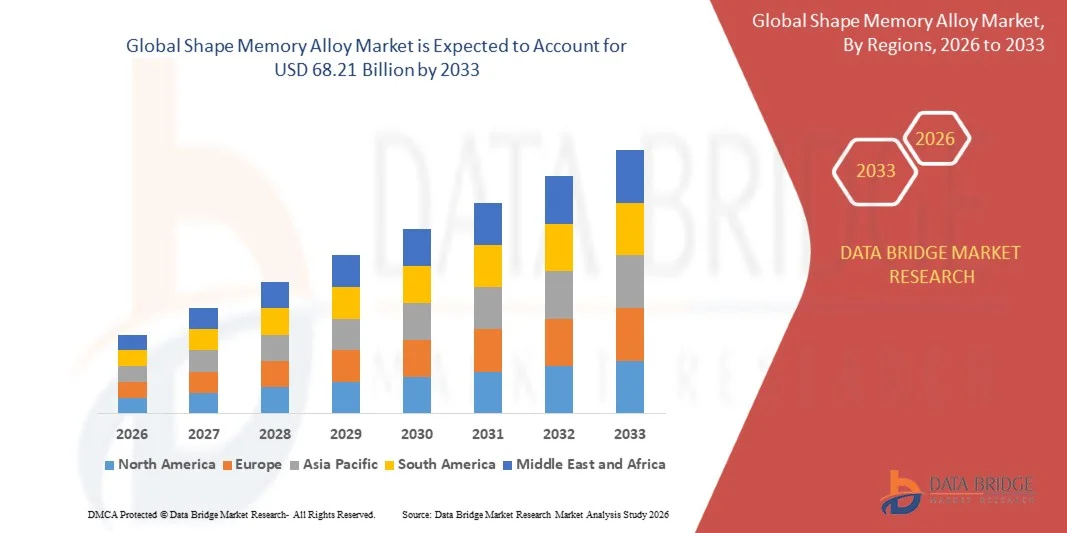
- The global shape memory alloy market size was valued at USD 26.85 billion in 2025 and is expected to reach USD 68.21 billion by 2033, at a CAGR of 12.36% during the forecast period
- The factors such as rising product demand in aerospace, electronics and defense industry and rapidly increasing medical implants are the root cause fueling up the market growth rate
- The factors expected to cushion the growth of the shape memory alloy market in the forecast period are the increasing preference for nitinol alloys and increasing defense expenditures by the governments
What are the Major Takeaways of Shape Memory Alloy Market?
- The rising usage in bioengineering fields such as reinforcements for arteries and veins, dental wires and bones reinforcement are further expected to cushion the overall markets growth. The availability of substitutes is expected to impede the growth of the shape memory alloy market. Moreover, High cost of raw materials which results in high cost of implantable devices also hampers the overall growth of the market
- The high growth of the consumer electronics and home appliances industry along with various attempts by manufacturers for innovative solutions at an affordable price are estimated to generate numerous opportunities for the market
- North America dominated the shape memory alloy market with a 41.32% revenue share in 2025, driven by strong demand across biomedical, aerospace, and automotive sectors, along with increasing adoption of advanced smart materials in high-performance applications across the U.S. and Canada
- Asia-Pacific is projected to register the fastest CAGR of 8.14% from 2026 to 2033, driven by rapid industrialization, expanding healthcare infrastructure, and strong growth in automotive and electronics manufacturing across China, Japan, India, South Korea, and Southeast Asia
- The Nickel-Titanium (Nitinol) segment dominated the market with a 52.6% share in 2025, owing to its superior biocompatibility, excellent corrosion resistance, and high fatigue strength. Nitinol is widely used in medical devices such as stents, guidewires, and orthodontic wires, as well as in actuators and aerospace components
Report Scope and Shape Memory Alloy Market Segmentation
|
Attributes |
Shape Memory Alloy Key Market Insights |
|
Segments Covered |
|
|
Countries Covered |
North America
Europe
Asia-Pacific
Middle East and Africa
South America
|
|
Key Market Players |
|
|
Market Opportunities |
|
|
Value Added Data Infosets |
In addition to the insights on market scenarios such as market value, growth rate, segmentation, geographical coverage, and major players, the market reports curated by the Data Bridge Market Research also include in-depth expert analysis, pricing analysis, brand share analysis, consumer survey, demography analysis, supply chain analysis, value chain analysis, raw material/consumables overview, vendor selection criteria, PESTLE Analysis, Porter Analysis, and regulatory framework. |
What is the Key Trend in the Shape Memory Alloy Market?
“Increasing Shift Toward Advanced Smart Materials for Medical, Automotive, and Aerospace Applications”
- The shape memory alloy market is witnessing strong adoption of advanced nickel-titanium and copper-based alloys owing to their superior superelasticity, corrosion resistance, and temperature-responsive properties across critical engineering applications
- Manufacturers are increasingly developing high-performance shape memory materials with enhanced fatigue life, precision actuation, and miniaturization capabilities to support next-generation medical devices, sensors, and actuators
- Growing demand for lightweight and intelligent materials in aerospace structures, automotive safety systems, and robotics is significantly accelerating product innovation across global markets
- For instance, leading companies such as Johnson Matthey, Dynalloy, and Fort Wayne Metals are expanding their SMA product portfolios for stents, orthodontic wires, valves, and thermal actuators
- Rising use of smart materials in wearable devices, minimally invasive surgical instruments, and adaptive industrial components is further strengthening market momentum
- As industries increasingly move toward automation and material intelligence, Shape Memory Alloys are expected to remain vital for high-precision, responsive, and compact component design
What are the Key Drivers of Shape Memory Alloy Market?
- Rising demand from the healthcare sector for minimally invasive surgical devices, stents, guidewires, and orthodontic applications is a major factor driving the Shape Memory Alloy market
- For instance, in 2025, several global medical device manufacturers expanded the use of nitinol-based alloys in cardiovascular implants and surgical tools due to their flexibility and biocompatibility
- Growing adoption in automotive applications such as actuators, sensors, fuel efficiency systems, and safety components is boosting market expansion across the U.S., Europe, and Asia-Pacific
- Advancements in metallurgy, precision manufacturing, and thermal response engineering have significantly improved durability, recovery performance, and lifecycle efficiency
- Increasing use in aerospace, defence, robotics, and industrial automation for vibration control and adaptive mechanisms is creating substantial long-term demand
- Supported by continuous investments in advanced materials research and smart manufacturing technologies, the Shape Memory Alloy market is expected to witness strong long-term growth
Which Factor is Challenging the Growth of the Shape Memory Alloy Market?
- High production costs associated with premium nickel-titanium alloys and complex manufacturing processes continue to restrict wider market adoption, especially among cost-sensitive industries
- For instance, during 2024–2025, fluctuations in nickel and titanium prices, coupled with supply chain disruptions, increased raw material costs for several global manufacturers
- Complexity in alloy processing, shape-setting, and thermal calibration increases production time and requires specialized engineering expertise
- Limited awareness and lower adoption in emerging industrial markets continue to slow penetration beyond established medical and aerospace sectors
- Competition from alternative smart materials and advanced polymers creates pricing pressure and impacts product differentiation
- To address these challenges, companies are focusing on cost-efficient alloy processing, enhanced recycling technologies, and broader application development to accelerate global adoption of shape memory alloys
How is the Shape Memory Alloy Market Segmented?
The market is segmented on the basis of type, functionality, application, and end-user.
• By Type
On the basis of type, the shape memory alloy market is segmented into Nickel-Titanium (Nitinol), Copper-Based Alloys, Iron-Manganese-Silicon (Fe-Mn-Si), and Others. The Nickel-Titanium (Nitinol) segment dominated the market with a 52.6% share in 2025, owing to its superior biocompatibility, excellent corrosion resistance, and high fatigue strength. Nitinol is widely used in medical devices such as stents, guidewires, and orthodontic wires, as well as in actuators and aerospace components. Its ability to exhibit both shape memory effect and superelasticity makes it the most preferred material across high-performance applications.
The Copper-Based Alloys segment is expected to grow at the fastest CAGR from 2026 to 2033, driven by their lower cost, ease of processing, and increasing adoption in industrial and consumer applications. These alloys are gaining traction in temperature control systems and actuators where cost-efficiency is critical.
• By Functionality
On the basis of functionality, the shape memory alloy market is segmented into Super-elasticity/Pseudoelasticity, Constrained Recovery, Free Recovery, and Others. The Super-elasticity/Pseudoelasticity segment dominated the market with a 44.3% share in 2025, as it enables materials to undergo large deformation and return to their original shape without permanent damage. This functionality is highly valuable in biomedical applications such as stents and surgical instruments, as well as in flexible mechanical systems.
The Constrained Recovery segment is expected to grow at the fastest CAGR from 2026 to 2033, driven by its increasing use in actuators, fastening systems, and structural reinforcement applications. It provides controlled force generation during phase transformation, making it suitable for aerospace, automotive, and industrial uses. Rising demand for smart actuation systems is further accelerating segment growth.
• By Application
On the basis of application, the market is segmented into Laser, Motors and Actuators, Transducers, Structural Material, Sensors, and Others. The Motors and Actuators segment dominated the market with a 38.7% share in 2025, driven by extensive use of shape memory alloys in compact, energy-efficient actuation systems. These materials are widely utilized in robotics, automotive systems, aerospace components, and consumer devices for precise motion control and automation.
The Sensors segment is expected to grow at the fastest CAGR from 2026 to 2033, owing to increasing demand for smart sensing technologies in IoT devices, healthcare monitoring systems, and industrial automation. Shape memory alloys enhance sensor responsiveness and enable miniaturization, making them ideal for advanced electronic and wearable applications.
• By End-User
On the basis of end-user, the shape memory alloy market is segmented into Biomedical, Aerospace and Defense, Automotive, Consumer Electronics and Home Appliances, and Others. The Biomedical segment dominated the market with a 41.9% share in 2025, supported by widespread use of shape memory alloys in minimally invasive surgical devices, implants, orthodontics, and cardiovascular applications. Their biocompatibility, flexibility, and shape recovery capabilities make them essential in modern medical technologies.
The Automotive segment is expected to grow at the fastest CAGR from 2026 to 2033, driven by rising adoption of smart materials in actuators, sensors, fuel efficiency systems, and safety mechanisms. Increasing electrification of vehicles and advancements in automotive design are further boosting demand for shape memory alloy-based components across global markets.
Which Region Holds the Largest Share of the Shape Memory Alloy Market?
- North America dominated the shape memory alloy market with a 41.32% revenue share in 2025, driven by strong demand across biomedical, aerospace, and automotive sectors, along with increasing adoption of advanced smart materials in high-performance applications across the U.S. and Canada. High utilization of nickel-titanium alloys in medical implants, surgical tools, and aerospace components continues to fuel demand across hospitals, research institutions, and advanced manufacturing facilities
- Leading companies in North America are focusing on innovation in high-performance alloys with enhanced fatigue resistance, precision control, and miniaturization capabilities, strengthening the region’s technological advantage. Continuous investments in healthcare infrastructure, defence technologies, and smart material research drive long-term market expansion
- Strong presence of skilled professionals, advanced R&D ecosystems, and sustained investment in material science and manufacturing technologies further reinforce regional market leadership
U.S. Shape Memory Alloy Market Insight
The U.S. is the largest contributor in North America, supported by strong demand from the healthcare sector, aerospace industry, and advanced manufacturing applications. Increasing use of shape memory alloys in minimally invasive surgical devices, cardiovascular implants, and orthodontic solutions is significantly driving market growth. In addition, rising adoption in aerospace components, defence systems, and automotive actuators is further expanding application scope. Presence of leading medical device manufacturers, strong innovation ecosystems, and high investment in advanced materials research continue to strengthen the U.S. market.
Canada Shape Memory Alloy Market Insight
Canada contributes significantly to regional growth, driven by increasing research in advanced materials, rising adoption of smart alloys in medical and industrial applications, and growing investments in aerospace and defence sectors. Universities and research institutions are actively utilizing shape memory alloys for material innovation, prototyping, and product development. Government-supported R&D programs, availability of skilled workforce, and increasing focus on next-generation technologies such as robotics and automation further support market expansion across the country.
Asia-Pacific Shape Memory Alloy Market
Asia-Pacific is projected to register the fastest CAGR of 8.14% from 2026 to 2033, driven by rapid industrialization, expanding healthcare infrastructure, and strong growth in automotive and electronics manufacturing across China, Japan, India, South Korea, and Southeast Asia. Increasing demand for cost-effective smart materials in consumer electronics, automotive systems, and medical devices is accelerating market growth. Rising investments in manufacturing capabilities, coupled with growing adoption of advanced materials in emerging economies, continue to boost demand for shape memory alloys across diverse applications.
China Shape Memory Alloy Market Insight
China is the largest contributor to Asia-Pacific due to strong manufacturing capabilities, increasing investments in medical devices, and expanding automotive and electronics industries. Growing production of smart devices, EV components, and healthcare equipment is driving demand for shape memory alloys. Government support for advanced materials and domestic production further strengthens both local and export market growth.
Japan Shape Memory Alloy Market Insight
Japan shows steady growth supported by advanced material science expertise, strong presence of precision manufacturing industries, and continuous innovation in medical and automotive technologies. High demand for reliable and high-performance alloys in robotics, electronics, and healthcare applications drives adoption. Increasing focus on miniaturization and high-precision components further supports long-term market expansion.
India Shape Memory Alloy Market Insight
India is emerging as a major growth hub, driven by expanding healthcare infrastructure, rising demand for medical devices, and growing automotive manufacturing sector. Increasing adoption of smart materials in industrial automation, consumer electronics, and defence applications is fueling market growth. Government initiatives supporting domestic manufacturing and rising R&D investments further accelerate market penetration.
South Korea Shape Memory Alloy Market Insight
South Korea contributes significantly due to strong demand from electronics, automotive, and semiconductor industries. Rapid development of smart devices, robotics, and advanced automotive systems is driving adoption of shape memory alloys for precision applications. Technological innovation, strong industrial base, and increasing focus on advanced materials continue to support sustained market growth.
Which are the Top Companies in Shape Memory Alloy Market?
The shape memory alloy industry is primarily led by well-established companies, including:
- ATI (U.S.)
- SAES Getters S.p.A. (Italy)
- Johnson Matthey (U.K.)
- Fort Wayne Metals Research Products Corp. (U.S.)
- Nippon Seisen Co. Ltd. (Japan)
- Xi’an Saite Metal Materials Development Co. Ltd. (China)
- Baoji Seabird Metal Material Co., Ltd. (China)
- samaterials (U.S.)
- Sunrise Titanium Technology Co. Ltd. (China)
- Dynalloy Inc (U.S.)
- Metalwerks (U.S.)
- Ultimate R&D (U.S.)
- GRINM GROUP CORPORATION LIMITED (China)
- Euroflex GmbH (Germany)
- Confluent Medical Technologies (U.S.)
- Nippon Steel Corporation (Japan)
- Furukawa Electric Co., Ltd. (Japan)
- Precision Castparts Corp. (U.S.)
- Nanoshel LLC (U.S.)
- Boston Centerless (U.S.)
- MicroGroup (U.S.)
- Sma Wires India (India)
- ALB Materials Inc. (U.S.)
- Hangzhou Ualloy Material Co., Ltd (China)
What are the Recent Developments in Global Shape Memory Alloy Market?
- In March 2025, Johnson & Johnson launched an advanced Nitinol-based stent system designed for minimally invasive cardiac procedures, aimed at improving patient outcomes through enhanced flexibility, durability, and long-term vascular performance. The upgraded shape memory alloy technology strengthens its use in next-generation medical implants and reinforces the company’s position in advanced healthcare solutions. This development is expected to significantly support the growth of the Shape Memory Alloy market in biomedical applications
- In February 2025, SAES Getters S.p.A. introduced a breakthrough range of high-performance shape memory alloys for industrial applications, offering superior resistance to environmental stress and improved reliability under extreme operating conditions. The innovation is specifically targeted toward high-stress industries such as aerospace and automotive, where durability and lifecycle performance are critical. This advancement is expected to strengthen demand for SMAs across industrial and transportation sectors globally
- In January 2025, Mitsubishi Materials Corporation announced a new portfolio of copper-based shape memory alloys for use in actuators and sensors, focused on reducing production costs while maintaining high functional efficiency. These cost-effective alloys are anticipated to witness strong adoption across automotive systems, robotics, and smart industrial applications worldwide. This launch is expected to accelerate market penetration of affordable SMA solutions across emerging applications
- In March 2024, investment firm Montagu agreed to acquire Johnson Matthey’s recently separated Medical Device Components (MDC) business, strengthening its presence in precision medical materials and advanced component manufacturing. The acquisition highlights increasing strategic interest in specialized SMA-based healthcare technologies. This transaction is expected to enhance innovation and competitive intensity within the medical shape memory alloy segment
- In December 2023, Fluid-o-Tech expanded its technology focus beyond magnetic systems to include shape memory alloys and piezo technologies, enhancing its product development capabilities in precision fluidics and advanced motion-control applications. The move also opens new growth opportunities across industrial and medical end-use sectors. This expansion is expected to support broader commercial adoption of shape memory alloy technologies in precision engineering applications
SKU-
Get online access to the report on the World's First Market Intelligence Cloud

- Interactive Data Analysis Dashboard
- Company Analysis Dashboard for high growth potential opportunities
- Research Analyst Access for customization & queries
- Competitor Analysis with Interactive dashboard
- Latest News, Updates & Trend analysis
- Harness the Power of Benchmark Analysis for Comprehensive Competitor Tracking
Global Shape Memory Alloy Market, Supply Chain Analysis and Ecosystem Framework
To support market growth and help clients navigate the impact of geopolitical shifts, DBMR has integrated in-depth supply chain analysis into its Global Shape Memory Alloy Market research reports. This addition empowers clients to respond effectively to global changes affecting their industries. The supply chain analysis section includes detailed insights such as Global Shape Memory Alloy Market consumption and production by country, price trend analysis, the impact of tariffs and geopolitical developments, and import and export trends by country and HSN code. It also highlights major suppliers with data on production capacity and company profiles, as well as key importers and exporters. In addition to research, DBMR offers specialized supply chain consulting services backed by over a decade of experience, providing solutions like supplier discovery, supplier risk assessment, price trend analysis, impact evaluation of inflation and trade route changes, and comprehensive market trend analysis.
Research Methodology
Data collection and base year analysis are done using data collection modules with large sample sizes. The stage includes obtaining market information or related data through various sources and strategies. It includes examining and planning all the data acquired from the past in advance. It likewise envelops the examination of information inconsistencies seen across different information sources. The market data is analysed and estimated using market statistical and coherent models. Also, market share analysis and key trend analysis are the major success factors in the market report. To know more, please request an analyst call or drop down your inquiry.
The key research methodology used by DBMR research team is data triangulation which involves data mining, analysis of the impact of data variables on the market and primary (industry expert) validation. Data models include Vendor Positioning Grid, Market Time Line Analysis, Market Overview and Guide, Company Positioning Grid, Patent Analysis, Pricing Analysis, Company Market Share Analysis, Standards of Measurement, Global versus Regional and Vendor Share Analysis. To know more about the research methodology, drop in an inquiry to speak to our industry experts.
Customization Available
Data Bridge Market Research is a leader in advanced formative research. We take pride in servicing our existing and new customers with data and analysis that match and suits their goal. The report can be customized to include price trend analysis of target brands understanding the market for additional countries (ask for the list of countries), clinical trial results data, literature review, refurbished market and product base analysis. Market analysis of target competitors can be analyzed from technology-based analysis to market portfolio strategies. We can add as many competitors that you require data about in the format and data style you are looking for. Our team of analysts can also provide you data in crude raw excel files pivot tables (Fact book) or can assist you in creating presentations from the data sets available in the report.












