




Global Silicon Carbide Fibers Market
Market Size in USD Billion
CAGR :
% 
 USD
1.34 Billion
USD
17.42 Billion
2025
2033
USD
1.34 Billion
USD
17.42 Billion
2025
2033
 Forecast Period Forecast Period |
2026 –2033 |
 Market Size (Base Year) Market Size (Base Year) |
USD 1.34 Billion |
 Market Size (Forecast Year) Market Size (Forecast Year) |
USD 17.42 Billion |
 CAGR CAGR |
% |
| Major Markets Players |
|
Silicon Carbide Fibers Market Size
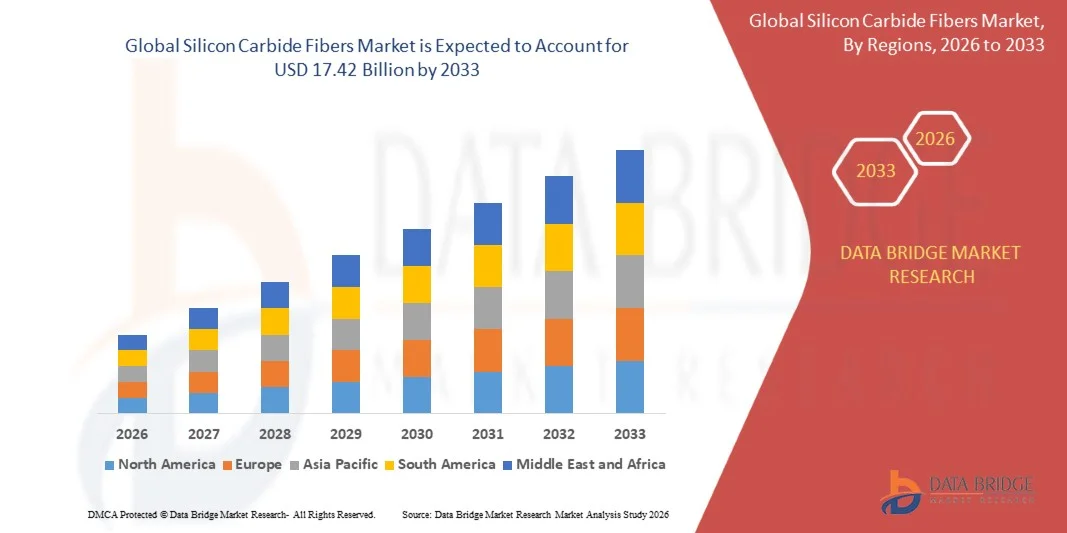
- The global silicon carbide fibers market size was valued at USD 1.34 billion in 2025 and is expected to reach USD 17.42 billion by 2033, at a CAGR of 37.8% during the forecast period
- The market growth is largely driven by increasing demand for high-performance materials capable of withstanding extreme temperatures, corrosion, and mechanical stress in aerospace, defense, and energy applications
- Furthermore, rising adoption of ceramic matrix composites in next-generation jet engines, gas turbines, and hypersonic systems is significantly accelerating the need for silicon carbide fibers as a key reinforcement material
Silicon Carbide Fibers Market Analysis
- Silicon carbide fibers are advanced ceramic reinforcement materials known for their exceptional thermal stability, high strength-to-weight ratio, and resistance to oxidation under extreme operating conditions
- The escalating demand for silicon carbide fibers is primarily fueled by rapid advancements in aerospace propulsion systems, expanding defense modernization programs, and growing investments in clean energy and high-temperature industrial applications
- North America dominated the silicon carbide fibers market with a share of 53.86% in 2025, due to strong demand from aerospace, defense, and advanced energy applications
- Asia-Pacific is expected to be the fastest growing region in the silicon carbide fibers market during the forecast period due to rapid industrialization, expanding aerospace manufacturing, and increasing energy infrastructure development
- First generation segment dominated the market with a market share of 47.3% in 2025, due to its early commercialization, cost effectiveness, and established use in high-temperature structural applications. These fibers are widely preferred in conventional aerospace and industrial thermal systems because they offer stable mechanical performance and proven reliability under oxidizing environments
Report Scope and Silicon Carbide Fibers Market Segmentation
|
Attributes |
Silicon Carbide Fibers Key Market Insights |
|
Segments Covered |
|
|
Countries Covered |
North America
Europe
Asia-Pacific
Middle East and Africa
South America
|
|
Key Market Players |
|
|
Market Opportunities |
|
|
Value Added Data Infosets |
In addition to the insights on market scenarios such as market value, growth rate, segmentation, geographical coverage, and major players, the market reports curated by the Data Bridge Market Research also include import export analysis, production capacity overview, production consumption analysis, price trend analysis, climate change scenario, supply chain analysis, value chain analysis, raw material/consumables overview, vendor selection criteria, PESTLE Analysis, Porter Analysis, and regulatory framework. |
Silicon Carbide Fibers Market Trends
“Rising Use of Ceramic Matrix Composites in Aerospace and Defense”
- A significant trend in the silicon carbide fibers market is the increasing integration of ceramic matrix composites (CMCs) reinforced with silicon carbide fibers in aerospace and defense applications to achieve higher thermal resistance and lightweight structural performance. This shift is driven by the need for materials that can withstand extreme operating environments in jet engines, hypersonic systems, and space exploration platforms
- For instance, GE Aviation utilizes silicon carbide fiber-reinforced ceramic matrix composites in advanced turbine engine components such as combustor liners and shrouds to improve fuel efficiency and reduce overall engine weight. These applications demonstrate how silicon carbide fibers are enabling next-generation propulsion systems with enhanced thermal stability and durability
- The adoption of silicon carbide fibers in hypersonic vehicle development is increasing as defense programs require materials capable of maintaining structural integrity under ultra-high temperatures and aerodynamic stress. Organizations such as NASA and the U.S. Department of Defense are actively investing in advanced CMC technologies to support next-generation aerospace platforms
- The aerospace sector is also expanding the use of silicon carbide fiber composites in spacecraft thermal protection systems where resistance to oxidation and heat flux is critical for mission success. This is strengthening the role of these fibers in long-duration space missions and re-entry systems
- Industrial gas turbine manufacturers are integrating silicon carbide fiber-based components to improve operational efficiency and reduce emissions through higher combustion temperatures. This trend is reinforcing the importance of advanced ceramics in energy-efficient propulsion and power generation systems
- The market is witnessing growing emphasis on lightweight structural materials that combine mechanical strength with thermal endurance, positioning silicon carbide fibers as essential enablers of high-performance engineering across aerospace and defense ecosystems
Silicon Carbide Fibers Market Dynamics
Driver
“Growing Demand for High-Temperature Materials in Energy and Industry”
- The increasing requirement for materials capable of withstanding extreme temperatures in energy generation, aerospace propulsion, and industrial processing is driving demand for silicon carbide fibers. These fibers provide exceptional thermal stability, oxidation resistance, and mechanical strength, making them highly suitable for harsh operating environments
- For instance, General Electric applies silicon carbide fiber-reinforced ceramic matrix composites in next-generation aircraft engines to enhance thermal efficiency and reduce fuel consumption under high-temperature conditions. These applications highlight the role of advanced materials in improving engine performance and durability
- The expansion of gas turbine power plants is increasing the need for heat-resistant components that can operate efficiently at elevated combustion temperatures without degradation. Silicon carbide fibers enable improved efficiency and longer service life in such energy systems
- The growth of nuclear energy infrastructure is also contributing to demand for advanced materials capable of maintaining structural integrity under radiation and high heat exposure. This is encouraging the adoption of ceramic fiber composites in critical reactor components
- The continuous push toward higher energy efficiency and reduced emissions across global industries is reinforcing the demand for advanced thermal materials, positioning silicon carbide fibers as a key enabler of next-generation high-performance systems
Restraint/Challenge
“High Production Cost and Complex Manufacturing Process”
- The silicon carbide fibers market faces significant constraints due to the highly complex and costly manufacturing processes required to produce high-purity, defect-free fibers. These processes involve multiple stages of chemical vapor deposition, polymer precursor conversion, and controlled heat treatment, which increase production time and cost intensity
- For instance, Nippon Carbon Co., Ltd. utilizes advanced chemical vapor infiltration and specialized precursor technologies to manufacture high-performance silicon carbide fibers, requiring highly controlled environments and expensive equipment. These sophisticated production methods significantly elevate operational costs
- The requirement for ultra-precise control over fiber composition and microstructure increases manufacturing difficulty and limits large-scale production scalability. This restricts widespread commercialization despite growing demand across aerospace and industrial sectors
- The dependency on specialized raw materials and energy-intensive processing further adds to cost pressures and supply chain sensitivity. Manufacturers must balance performance characteristics with economic feasibility, limiting price competitiveness
- The combination of technical complexity, capital-intensive infrastructure, and stringent performance standards continues to challenge manufacturers, restricting broader adoption and slowing cost optimization across the silicon carbide fibers market
Silicon Carbide Fibers Market Scope
The market is segmented on the basis of type, form, phase, usage, and end user.
• By Type
On the basis of type, the silicon carbide fibers market is segmented into first generation, second generation, and third generation, where the first generation segment dominated the largest market revenue share of 47.3% in 2025 due to its early commercialization, cost effectiveness, and established use in high-temperature structural applications. These fibers are widely preferred in conventional aerospace and industrial thermal systems because they offer stable mechanical performance and proven reliability under oxidizing environments. The demand is further reinforced by their extensive integration in legacy composite systems where replacement compatibility remains critical. Strong adoption in defense-grade thermal shielding and turbine components continues to sustain the leadership position of this segment in the market.
The third generation segment is anticipated to witness the fastest growth rate from 2026 to 2033 due to its enhanced tensile strength, improved creep resistance, and superior thermal stability under extreme operating conditions. These advanced fibers are increasingly utilized in next-generation aerospace engines and hypersonic vehicle structures where performance efficiency is critical. For instance, companies engaged in advanced propulsion systems are integrating third generation fibers into ceramic matrix composites to improve durability and weight reduction. Growing investments in next-generation defense technologies and space exploration programs further accelerate the adoption of this segment.
• By Form
On the basis of form, the silicon carbide fibers market is segmented into continuous, woven cloth, and others, where the continuous form segment held the largest market revenue share in 2025 due to its superior load-bearing capacity and ability to provide uniform reinforcement in composite structures. Continuous fibers are extensively used in aerospace and energy applications where structural integrity under high stress and temperature is essential. Their compatibility with advanced composite manufacturing processes makes them the preferred choice for turbine blades, heat shields, and engine components. The consistent performance and high strength-to-weight ratio further reinforce their dominant position across industrial applications.
The woven cloth segment is expected to witness the fastest growth from 2026 to 2033 due to its increasing use in complex-shaped components and multilayer composite systems. These fabrics offer enhanced flexibility and easier handling during fabrication, making them suitable for aerospace panels and thermal protection systems. For instance, aerospace manufacturers are adopting woven silicon carbide fabrics in lightweight airframe structures to improve thermal resistance and mechanical stability. Rising demand for customizable composite architectures in defense and industrial applications is driving strong expansion of this segment.
• By Phase
On the basis of phase, the silicon carbide fibers market is segmented into amorphous and crystalline, where the amorphous segment dominated the largest market revenue share in 2025 due to its easier manufacturing process and cost efficiency in large-scale production. Amorphous silicon carbide fibers are widely used in intermediate-temperature applications where moderate mechanical performance is sufficient. Their relatively simpler processing requirements make them suitable for cost-sensitive industrial applications and conventional composite systems. Strong usage in energy systems and general industrial components continues to support the dominance of this segment.
The crystalline segment is anticipated to witness the fastest growth rate from 2026 to 2033 due to its superior thermal conductivity, higher tensile strength, and exceptional resistance to extreme environments. These properties make crystalline fibers highly suitable for advanced aerospace engines, nuclear systems, and high-performance defense applications. For instance, aerospace propulsion manufacturers are increasingly integrating crystalline fibers into hot-section engine components to enhance operational efficiency. Rising demand for high-temperature-resistant materials in next-generation energy and defense systems is accelerating the adoption of this segment.
• By Usage
On the basis of usage, the silicon carbide fibers market is segmented into composites and non-composites, where the composites segment dominated the largest market revenue share in 2025 due to its extensive utilization in reinforcing high-performance materials across aerospace and industrial sectors. Silicon carbide fibers embedded in ceramic matrix composites deliver exceptional thermal stability, mechanical strength, and oxidation resistance. These characteristics make them ideal for turbine engines, spacecraft components, and advanced structural systems. Increasing reliance on lightweight and durable materials further strengthens the dominance of composite applications.
The non-composites segment is expected to witness the fastest growth from 2026 to 2033 due to rising adoption in specialized coatings, standalone thermal insulation systems, and niche industrial applications. These fibers are being increasingly used where direct exposure to extreme heat and corrosive environments requires standalone material performance. For instance, energy sector companies are utilizing non-composite silicon carbide fibers in high-temperature furnace linings to improve operational durability. Expanding applications in emerging industrial processing technologies are driving rapid growth in this segment.
• By End User
On the basis of end user, the silicon carbide fibers market is segmented into aerospace and defense, energy and power, industrial, and others, where the aerospace and defense segment dominated the largest market revenue share in 2025 due to extensive use in high-temperature engine components, structural reinforcement, and thermal protection systems. These fibers are critical for improving fuel efficiency, reducing structural weight, and enhancing durability in extreme operational environments. Strong government investments in advanced defense aircraft and space programs continue to reinforce this dominance. The segment benefits from continuous innovation in propulsion systems and hypersonic technologies.
The energy and power segment is anticipated to witness the fastest growth rate from 2026 to 2033 due to rising demand for high-performance materials in gas turbines, nuclear reactors, and next-generation renewable energy systems. Silicon carbide fibers improve efficiency and operational lifespan under extreme thermal and mechanical stress conditions. For instance, energy companies are integrating these fibers into advanced turbine systems to enhance heat resistance and reduce maintenance downtime. Expanding global focus on efficient and low-emission power generation technologies is accelerating the adoption of this segment.
Silicon Carbide Fibers Market Regional Analysis
- North America dominated the silicon carbide fibers market with the largest revenue share of 53.86% in 2025, driven by strong demand from aerospace, defense, and advanced energy applications
- The region benefits from well-established R&D infrastructure and high investment in next-generation aircraft engines and hypersonic technologies
- Increasing focus on high-temperature-resistant materials for gas turbines and nuclear systems further supports market expansion. Strong presence of leading aerospace manufacturers and material science companies continues to reinforce regional dominance in the market
U.S. Silicon Carbide Fibers Market Insight
The U.S. silicon carbide fibers market captured the largest revenue share in North America in 2025, driven by robust investments in defense modernization and aerospace propulsion systems. Demand is rising for high-performance composite materials used in hypersonic vehicles, jet engines, and space exploration programs. The presence of leading manufacturers and research institutions focused on advanced ceramics further strengthens market expansion. In addition, increasing adoption in nuclear energy systems and industrial gas turbines is accelerating material innovation and commercialization.
Europe Silicon Carbide Fibers Market Insight
The Europe silicon carbide fibers market is projected to expand at a substantial CAGR throughout the forecast period, driven by rising adoption in aerospace, automotive, and industrial manufacturing sectors. The region’s emphasis on energy efficiency and lightweight composite materials supports strong demand for advanced fiber technologies. Increasing investments in sustainable aviation programs and defense modernization initiatives further accelerate market growth. Strong regulatory focus on reducing emissions is also encouraging the use of high-performance ceramic matrix composites.
U.K. Silicon Carbide Fibers Market Insight
The U.K. silicon carbide fibers market is anticipated to grow at a notable CAGR during the forecast period, supported by expanding aerospace engineering and defense manufacturing activities. Demand is increasing for advanced thermal protection systems and lightweight structural components in aircraft and spacecraft applications. Government-backed innovation programs in advanced materials are further strengthening adoption across industrial sectors. The country’s strong research ecosystem continues to support development of next-generation fiber technologies.
Germany Silicon Carbide Fibers Market Insight
The Germany silicon carbide fibers market is expected to expand at a considerable CAGR during the forecast period, driven by strong industrial base and increasing use in high-temperature engineering applications. Automotive and aerospace industries are key contributors, with growing demand for efficient and durable composite materials. Germany’s focus on advanced manufacturing and material innovation supports integration of silicon carbide fibers in energy and industrial systems. Rising emphasis on precision engineering further accelerates market penetration.
Asia-Pacific Silicon Carbide Fibers Market Insight
The Asia-Pacific silicon carbide fibers market is poised to grow at the fastest CAGR during the forecast period of 2026 to 2033, driven by rapid industrialization, expanding aerospace manufacturing, and increasing energy infrastructure development. Rising investments in defense modernization programs in countries such as China, Japan, and India are accelerating demand for high-performance materials. Growing adoption of advanced composites in industrial and automotive sectors further strengthens market expansion. Expanding manufacturing capabilities and cost advantages are also supporting widespread regional adoption.
Japan Silicon Carbide Fibers Market Insight
The Japan silicon carbide fibers market is gaining momentum due to strong demand from aerospace, defense, and high-precision industrial applications. The country’s advanced manufacturing ecosystem supports integration of high-temperature resistant materials in turbine engines and structural components. Increasing focus on lightweight and durable composites aligns with Japan’s emphasis on efficiency and technological advancement. Strong R&D investment in advanced ceramics further supports market development.
China Silicon Carbide Fibers Market Insight
The China silicon carbide fibers market accounted for the largest market revenue share in Asia-Pacific in 2025, driven by rapid industrial expansion, strong aerospace development programs, and growing defense modernization initiatives. The country’s large-scale manufacturing capabilities and strong domestic supply chain support widespread adoption of advanced fiber materials. Increasing investment in next-generation energy systems and high-temperature industrial applications further fuels demand. Government focus on advanced materials and self-reliant manufacturing continues to strengthen market growth.
Silicon Carbide Fibers Market Share
The silicon carbide fibers industry is primarily led by well-established companies, including:
- Suzhou Saifei Group Ltd. (China)
- BJS Ceramics GmbH (Germany)
- Toshiba Corporation (Japan)
- NGS Advanced Fibers Co., Ltd (Japan)
- Saint-Gobain (France)
- Washington Mills (U.S.)
- Calix Limited (Australia)
- Triveni Interchem Private Limited (India)
- CeramTec GmbH (Germany)
- Aremco Products Inc. (U.S.)
- Ultramet Inc. (U.S.)
Latest Developments in Global Silicon Carbide Fibers Market
- In August 2025, Wolfspeed announced an expansion of its advanced silicon carbide materials ecosystem, strengthening upstream capacity for next-generation SiC-based components used in high-temperature and power-intensive applications. This development enhances supply stability for silicon carbide fibers by improving integrated production capabilities and supporting rising demand from aerospace, energy, and electric mobility sectors
- In June 2025, a European aerospace research consortium advanced the testing of silicon carbide fiber-reinforced ceramic matrix composites for next-generation turbine engines and hypersonic propulsion systems. This initiative is accelerating commercialization pathways for SiC fibers by validating their performance in extreme thermal and structural conditions, thereby expanding their adoption in advanced aviation and defense applications
- In May 2024, Tokai Carbon and Soitec entered a strategic collaboration to co-develop polycrystalline silicon carbide substrates for SmartSiC wafers, strengthening upstream material integration across the value chain. This partnership is enhancing regional SiC production capacity and improving supply chain resilience for high-performance silicon carbide materials, indirectly supporting fiber-grade SiC ecosystem development in Europe and Asia
- In January 2024, General Atomics Electromagnetic Systems secured a Department of Energy contract to develop silicon carbide materials for fusion energy systems. This initiative is driving innovation in high-temperature structural materials, reinforcing future demand for silicon carbide fibers due to their critical role in extreme energy and defense environments requiring superior thermal stability and mechanical strength
- In March 2023, SGL Carbon collaborated with Wolfspeed to supply essential graphite components for silicon carbide production facilities, aimed at improving manufacturing efficiency and scaling output capacity. This collaboration is strengthening the upstream supply chain for silicon carbide materials, indirectly supporting increased availability and cost efficiency of advanced SiC fibers for industrial applications
SKU-
Get online access to the report on the World's First Market Intelligence Cloud

- Interactive Data Analysis Dashboard
- Company Analysis Dashboard for high growth potential opportunities
- Research Analyst Access for customization & queries
- Competitor Analysis with Interactive dashboard
- Latest News, Updates & Trend analysis
- Harness the Power of Benchmark Analysis for Comprehensive Competitor Tracking
Global Silicon Carbide Fibers Market, Supply Chain Analysis and Ecosystem Framework
To support market growth and help clients navigate the impact of geopolitical shifts, DBMR has integrated in-depth supply chain analysis into its Global Silicon Carbide Fibers Market research reports. This addition empowers clients to respond effectively to global changes affecting their industries. The supply chain analysis section includes detailed insights such as Global Silicon Carbide Fibers Market consumption and production by country, price trend analysis, the impact of tariffs and geopolitical developments, and import and export trends by country and HSN code. It also highlights major suppliers with data on production capacity and company profiles, as well as key importers and exporters. In addition to research, DBMR offers specialized supply chain consulting services backed by over a decade of experience, providing solutions like supplier discovery, supplier risk assessment, price trend analysis, impact evaluation of inflation and trade route changes, and comprehensive market trend analysis.
Research Methodology
Data collection and base year analysis are done using data collection modules with large sample sizes. The stage includes obtaining market information or related data through various sources and strategies. It includes examining and planning all the data acquired from the past in advance. It likewise envelops the examination of information inconsistencies seen across different information sources. The market data is analysed and estimated using market statistical and coherent models. Also, market share analysis and key trend analysis are the major success factors in the market report. To know more, please request an analyst call or drop down your inquiry.
The key research methodology used by DBMR research team is data triangulation which involves data mining, analysis of the impact of data variables on the market and primary (industry expert) validation. Data models include Vendor Positioning Grid, Market Time Line Analysis, Market Overview and Guide, Company Positioning Grid, Patent Analysis, Pricing Analysis, Company Market Share Analysis, Standards of Measurement, Global versus Regional and Vendor Share Analysis. To know more about the research methodology, drop in an inquiry to speak to our industry experts.
Customization Available
Data Bridge Market Research is a leader in advanced formative research. We take pride in servicing our existing and new customers with data and analysis that match and suits their goal. The report can be customized to include price trend analysis of target brands understanding the market for additional countries (ask for the list of countries), clinical trial results data, literature review, refurbished market and product base analysis. Market analysis of target competitors can be analyzed from technology-based analysis to market portfolio strategies. We can add as many competitors that you require data about in the format and data style you are looking for. Our team of analysts can also provide you data in crude raw excel files pivot tables (Fact book) or can assist you in creating presentations from the data sets available in the report.












