




Global Situation Awareness System Market
Market Size in USD Billion
CAGR :
% 
 USD
34.66 Billion
USD
67.46 Billion
2025
2033
USD
34.66 Billion
USD
67.46 Billion
2025
2033
 Forecast Period Forecast Period |
2026 –2033 |
 Market Size (Base Year) Market Size (Base Year) |
USD 34.66 Billion |
 Market Size (Forecast Year) Market Size (Forecast Year) |
USD 67.46 Billion |
 CAGR CAGR |
% |
| Major Markets Players |
|
Situation Awareness System Market Size
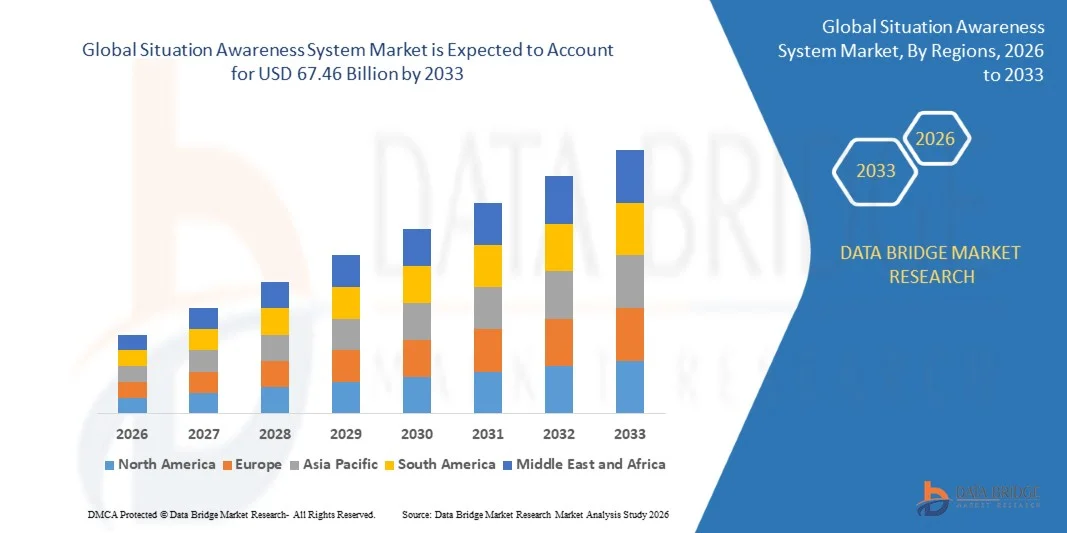
- The global situation awareness system market size was valued at USD 34.66 billion in 2025and is expected to reach USD 67.46 billion by 2033, at a CAGR of 8.68% during the forecast period
- The market growth is largely fuelled by the increasing demand for real-time monitoring, threat detection, and advanced surveillance systems across defense, transportation, industrial, and public safety sectors
- Rising adoption of artificial intelligence, IoT-enabled sensors, and advanced communication technologies is further accelerating the deployment of situation awareness systems globally
Situation Awareness System Market Analysis
- The market is witnessing strong growth due to increasing investments in defense modernization, smart transportation infrastructure, and advanced command and control systems
- Expanding integration of data analytics, cloud computing, and sensor fusion technologies is enhancing operational visibility and decision-making capabilities across multiple industries
- North America dominated the situation awareness system market with the largest revenue share in 2025, driven by rising investments in defense modernization, critical infrastructure protection, and advanced surveillance technologies across military and commercial sectors
- Asia-Pacific region is expected to witness the highest growth rate in the global situation awareness system market, driven by rapid urbanization, increasing defense spending, expanding smart transportation networks, and rising adoption of AI-enabled surveillance and disaster management systems across emerging economies
- The sensors segment held the largest market revenue share in 2025 driven by its critical role in real-time monitoring, threat detection, and data collection across defense, transportation, industrial, and security applications. Sensors are widely utilized for surveillance, motion tracking, environmental monitoring, and operational intelligence, making them essential for advanced situation awareness systems
Report Scope and Situation Awareness System Market Segmentation
|
Attributes |
Situation Awareness System Key Market Insights |
|
Segments Covered |
· By Component: Sensors, Global Positioning Systems (GPS), Mems/Gyroscopes, Network Video Recorders, and Others · By Product: Fire and Flood Alarm Systems, Human Machine Interfaces (HMI), Radio Frequency Identification (RFID), Access Control, Radars, Chemical Biological Radiological Nuclear (CBRN) Systems, Command and Control Systems, Sonar, and Physical Security Information Management (PSIM) · By Application: Robots, Driving/Connected Cars, Business Intelligence, Disaster Response, Security and Surveillance, Environmental Impact Tracking, Logistics, Natural and Cultural Resources, Smart Infrastructure Management, and Crisis Management · By End User: Military and Defense, Aviation, Maritime Security, Cybersecurity, Automotive, Healthcare, Construction, Industrial, and Homeland Security |
|
Countries Covered |
North America · U.S. · Canada · Mexico Europe · Germany · France · U.K. · Netherlands · Switzerland · Belgium · Russia · Italy · Spain · Turkey · Rest of Europe Asia-Pacific · China · Japan · India · South Korea · Singapore · Malaysia · Australia · Thailand · Indonesia · Philippines · Rest of Asia-Pacific Middle East and Africa · Saudi Arabia · U.A.E. · South Africa · Egypt · Israel · Rest of Middle East and Africa South America · Brazil · Argentina · Rest of South America |
|
Key Market Players |
• Collins Aerospace (U.S.) |
|
Market Opportunities |
• Expansion Of Smart City And Intelligent Transportation Projects |
|
Value Added Data Infosets |
In addition to the market insights such as market value, growth rate, market segments, geographical coverage, market players, and market scenario, the market report curated by the Data Bridge Market Research team includes in-depth expert analysis, import/export analysis, pricing analysis, production consumption analysis, and pestle analysis. |
Situation Awareness System Market Trends
“Increasing Adoption Of AI-Driven Real-Time Monitoring And Threat Detection Systems”
- The growing emphasis on real-time operational intelligence and security management is significantly shaping the situation awareness system market, as organizations increasingly prioritize advanced monitoring, threat detection, and rapid decision-making capabilities. Situation awareness systems are gaining traction due to their ability to integrate sensor data, communication networks, and analytics platforms to provide comprehensive visibility across defense, transportation, industrial, and public safety environments. This trend is encouraging technology providers to develop more intelligent and automated monitoring solutions
- Rising concerns regarding border security, cyber threats, terrorism, and critical infrastructure protection have accelerated the demand for advanced situation awareness systems across military and civilian sectors. Governments and enterprises are actively investing in AI-powered surveillance, command and control platforms, and sensor fusion technologies to strengthen operational efficiency and emergency response capabilities
- Smart city initiatives and increasing deployment of connected infrastructure are influencing purchasing decisions, with authorities emphasizing integrated surveillance, traffic management, and public safety systems. These factors are helping technology providers expand their market presence while encouraging the adoption of cloud-based analytics, IoT-enabled devices, and advanced communication platforms
- For instance, in 2024, Honeywell in the U.S. and Thales Group in France expanded their intelligent surveillance and real-time monitoring solutions for smart transportation and critical infrastructure projects. These deployments were introduced to improve operational visibility, emergency coordination, and predictive threat analysis across urban and industrial environments
- While demand for situation awareness systems is growing, sustained market expansion depends on advancements in AI analytics, cybersecurity protection, and seamless interoperability across complex communication and monitoring networks
Situation Awareness System Market Dynamics
Driver
“Growing Demand For Real-Time Security And Operational Intelligence”
- Increasing need for enhanced security, operational efficiency, and rapid decision-making is a major driver for the situation awareness system market. Governments, defense organizations, and enterprises are increasingly deploying advanced monitoring and surveillance systems to improve situational visibility and strengthen threat response capabilities across critical operations
- Expanding applications in defense, transportation, industrial automation, and emergency management are influencing market growth. Situation awareness systems help improve coordination, reduce operational risks, and provide actionable intelligence through real-time data integration and analytics. The growing adoption of smart infrastructure and connected systems globally further reinforces this trend
- Technology providers are actively investing in AI, machine learning, cloud computing, and sensor fusion technologies to enhance the performance and scalability of situation awareness platforms. These efforts are supported by rising investments in smart cities, border surveillance, and cybersecurity infrastructure, while also encouraging collaborations between defense agencies and technology companies
- For instance, in 2023, Lockheed Martin in the U.S. and Saab AB in Sweden reported increased deployment of advanced command and control systems integrated with AI-powered analytics for defense and public safety applications. These developments were introduced to strengthen real-time threat assessment, improve mission coordination, and enhance operational efficiency in critical environments
- Although rising investments in security and digital infrastructure support growth, wider adoption depends on system integration capabilities, data management efficiency, and continuous innovation in real-time analytics and communication technologies
Restraint/Challenge
“High Deployment Costs And Cybersecurity Concerns”
- The relatively high cost of deploying advanced situation awareness systems compared to conventional monitoring solutions remains a key challenge, limiting adoption among small and medium-sized organizations. Complex infrastructure requirements, integration of multiple hardware and software components, and ongoing maintenance expenses contribute to elevated operational costs
- Cybersecurity and data privacy concerns remain significant challenges, particularly as situation awareness systems rely heavily on interconnected networks, cloud platforms, and real-time data transmission. Vulnerabilities in communication systems and potential cyberattacks can impact operational reliability and compromise sensitive information
- Integration challenges and interoperability issues also affect market growth, as organizations often operate with legacy systems that may not seamlessly connect with modern AI-enabled monitoring platforms. Companies must invest in advanced software compatibility, secure communication protocols, and workforce training to ensure efficient deployment and operation
- For instance, in 2024, transportation authorities and industrial operators in Germany and Singapore reported delays in deployment of advanced surveillance and command systems due to rising cybersecurity compliance requirements and high implementation costs associated with integrating AI-driven monitoring technologies into existing infrastructure
- Overcoming these challenges will require cost-efficient deployment strategies, stronger cybersecurity frameworks, and continuous investment in interoperable technologies. Collaboration between governments, technology providers, and cybersecurity firms will be essential for ensuring secure, scalable, and reliable adoption of situation awareness systems across global markets
Situation Awareness System Market Scope
The situation awareness system market is segmented into notable segments based on component, product, application, and end user.
- By Component
On the basis of component, the situation awareness system market is segmented into sensors, global positioning systems (GPS), MEMS/gyroscopes, network video recorders, and others. The sensors segment held the largest market revenue share in 2025 driven by its critical role in real-time monitoring, threat detection, and data collection across defense, transportation, industrial, and security applications. Sensors are widely utilized for surveillance, motion tracking, environmental monitoring, and operational intelligence, making them essential for advanced situation awareness systems.
The MEMS/gyroscopes segment is expected to witness the fastest growth rate from 2026 to 2033, driven by increasing demand for precision navigation, unmanned systems, and autonomous technologies. MEMS and gyroscope technologies offer enhanced motion sensing, stability control, and orientation tracking, making them highly suitable for drones, connected vehicles, and advanced defense applications.
- By Product
On the basis of product, the situation awareness system market is segmented into fire and flood alarm systems, human machine interfaces (HMI), radio frequency identification (RFID), access control, radars, chemical biological radiological nuclear (CBRN) systems, command and control systems, sonar, and physical security information management (PSIM). The command and control systems segment held the largest market revenue share in 2025 driven by increasing adoption across military, emergency response, and industrial operations for centralized monitoring and decision-making. These systems provide integrated situational visibility, communication coordination, and rapid threat assessment capabilities across critical environments.
The physical security information management (PSIM) segment is expected to witness the fastest growth rate from 2026 to 2033, driven by rising demand for integrated security platforms capable of consolidating surveillance, analytics, and access control systems. PSIM solutions help improve operational efficiency, incident response, and security management through centralized real-time monitoring capabilities.
- By Application
On the basis of application, the situation awareness system market is segmented into robots, driving/connected cars, business intelligence, disaster response, security and surveillance, environmental impact tracking, logistics, natural and cultural resources, smart infrastructure management, and crisis management. The security and surveillance segment held the largest market revenue share in 2025 driven by rising concerns regarding public safety, border security, and critical infrastructure protection. Organizations and governments are increasingly deploying advanced surveillance systems integrated with AI analytics and real-time monitoring technologies to improve threat detection and operational awareness.
The driving/connected cars segment is expected to witness the fastest growth rate from 2026 to 2033, driven by increasing adoption of autonomous driving technologies, advanced driver assistance systems, and connected mobility infrastructure. Situation awareness systems play a critical role in improving vehicle safety, navigation, collision avoidance, and real-time traffic analysis in connected transportation ecosystems.
- By End User
On the basis of end user, the situation awareness system market is segmented into military and defense, aviation, maritime security, cybersecurity, automotive, healthcare, construction, industrial, and homeland security. The military and defense segment held the largest market revenue share in 2025 driven by rising investments in defense modernization, battlefield surveillance, intelligence gathering, and command and control infrastructure. Situation awareness systems are extensively used to improve mission coordination, operational visibility, and threat response capabilities across military operations.
The cybersecurity segment is expected to witness the fastest growth rate from 2026 to 2033, driven by increasing cyber threats, data breaches, and growing reliance on interconnected digital infrastructure. Organizations are increasingly adopting advanced cybersecurity awareness systems integrated with AI and analytics platforms to strengthen network monitoring, detect vulnerabilities, and enhance incident response capabilities.
Situation Awareness System Market Regional Analysis
- North America dominated the situation awareness system market with the largest revenue share in 2025, driven by rising investments in defense modernization, critical infrastructure protection, and advanced surveillance technologies across military and commercial sectors
- Organizations in the region highly value the real-time monitoring, threat detection, and operational intelligence capabilities offered by situation awareness systems for improving security and decision-making efficiency
- This widespread adoption is further supported by strong technological infrastructure, high defense expenditure, and increasing integration of AI, IoT, and cloud-based analytics, establishing situation awareness systems as essential solutions across transportation, industrial, and homeland security applications
U.S. Situation Awareness System Market Insight
The U.S. situation awareness system market captured the largest revenue share in 2025 within North America, fueled by significant investments in defense technologies, smart infrastructure, and cybersecurity systems. Government agencies and enterprises are increasingly prioritizing advanced surveillance, command and control, and threat intelligence platforms to strengthen national security and operational efficiency. The growing deployment of AI-powered analytics, unmanned systems, and connected monitoring technologies is further propelling market growth. Moreover, increasing integration of cloud computing and real-time data fusion technologies is significantly contributing to the expansion of the market.
Europe Situation Awareness System Market Insight
The Europe situation awareness system market is expected to witness the fastest growth rate from 2026 to 2033, primarily driven by stringent security regulations, increasing cybersecurity concerns, and rising investments in smart transportation and border surveillance systems. The expansion of connected infrastructure and industrial automation is fostering the adoption of advanced monitoring and operational intelligence platforms. European organizations are also focusing on improving emergency response capabilities and public safety systems through integrated surveillance technologies.
U.K. Situation Awareness System Market Insight
The U.K. situation awareness system market is expected to witness the fastest growth rate from 2026 to 2033, driven by increasing investments in homeland security, public safety monitoring, and cybersecurity infrastructure. Growing concerns regarding terrorism, cyber threats, and critical infrastructure protection are encouraging government agencies and enterprises to deploy advanced command and control systems. The country’s strong digital infrastructure and growing adoption of AI-enabled surveillance solutions are further supporting market expansion.
Germany Situation Awareness System Market Insight
The Germany situation awareness system market is expected to witness the fastest growth rate from 2026 to 2033, fueled by increasing focus on industrial automation, smart manufacturing, and advanced transportation management systems. Germany’s strong technological base and emphasis on innovation are promoting the deployment of AI-driven monitoring and operational intelligence platforms across industrial and public sectors. Increasing integration of connected devices and real-time analytics is also strengthening market growth in the country.
Asia-Pacific Situation Awareness System Market Insight
The Asia-Pacific situation awareness system market is expected to witness the fastest growth rate from 2026 to 2033, driven by rapid urbanization, increasing defense expenditure, and rising adoption of smart city technologies in countries such as China, Japan, and India. Governments across the region are increasingly investing in advanced surveillance, disaster management, and public safety infrastructure to strengthen operational awareness and emergency response capabilities. The region’s expanding industrial and transportation sectors are further contributing to market growth.
Japan Situation Awareness System Market Insight
The Japan situation awareness system market is expected to witness the fastest growth rate from 2026 to 2033 due to the country’s advanced technological infrastructure, increasing investments in disaster response systems, and rising focus on smart transportation networks. The Japanese market places significant emphasis on real-time monitoring and emergency preparedness, driving the adoption of AI-powered operational intelligence platforms. Integration of situation awareness systems with connected infrastructure and IoT-enabled devices is further fueling growth across public safety and industrial applications.
China Situation Awareness System Market Insight
The China situation awareness system market accounted for the largest market revenue share in Asia Pacific in 2025, attributed to the country’s rapid industrialization, increasing defense modernization programs, and expanding smart city initiatives. China is one of the largest adopters of advanced surveillance and monitoring technologies across transportation, industrial, and public safety sectors. The growing deployment of AI-enabled command and control systems, along with strong domestic technology manufacturing capabilities, is significantly propelling the market in China.
Situation Awareness System Market Share
The Situation Awareness System industry is primarily led by well-established companies, including:
• Collins Aerospace (U.S.)
• Xilinx (U.S.)
• L3Harris Technologies, Inc. (U.S.)
• Qualcomm Technologies, Inc. (U.S.)
• Lockheed Martin Corporation (U.S.)
• DENSO-Holding GmbH & Co. KG (Germany)
• BAE Systems (U.K.)
• General Electric (U.S.)
• Honeywell International, Inc. (U.S.)
• Microsoft (U.S.)
• Barco (Belgium)
• Advanced Micro Devices, Inc. (U.S.)
• Airbus (Netherlands)
• Johnson Controls (Ireland)
• Axis Communications AB (Sweden)
• Robert Bosch GmbH (Germany)
• Raytheon Technologies Corporation (U.S.)
• Rheinmetall AG (Germany)
Latest Developments in Global Situation Awareness System Market
- In February 2026, Bayanat Engineering (Qatar), received a contract from the Qatar Civil Aviation Authority to deploy Frequentis’ next-generation display system, aimed at integrating weather, runway, aerodrome, and operational support data into a unified real-time interface for air traffic controllers. The development is expected to improve operational efficiency, strengthen aviation safety, and enhance situational awareness capabilities across air traffic management systems, thereby supporting market growth in intelligent monitoring and command platforms
- In October 2025, Thales (France), launched Aurore under France’s ARES program, introducing Europe’s largest ground-based radar system designed to monitor satellites and space debris in low-Earth orbit. The system is intended to strengthen space situational awareness, improve orbital threat detection, and support strategic defense operations, contributing to rising demand for advanced surveillance and aerospace monitoring technologies globally
- In September 2025, V2X (U.S.), secured a USD 72 million contract to modernize the U.S. Army’s Gateway Mission Router system, focusing on cyber-hardened connectivity and integrated air-to-ground data fusion capabilities. The upgraded platform is expected to enhance unified situational awareness, accelerate C4ISR decision-making, and support multi-domain military operations, positively impacting the market through increased adoption of secure communication and battlefield intelligence systems
- In April 2025, Thales (France), secured a contract from NATO for Phase 3 of the NATO Common Operational Picture (NCOP-BMD) program, aimed at delivering a unified real-time operational and ballistic missile defense awareness platform for joint military forces. The project is expected to improve mission coordination, strengthen command visibility, and enhance threat response capabilities, thereby driving market demand for integrated defense surveillance systems
- In June 2025, Lockheed Martin (U.S.), received a USD 1 billion contract to advance hypersonic weapon systems for the U.S. defense sector, incorporating enhanced situational awareness technologies for improved threat detection and mission coordination. The initiative is expected to strengthen next-generation defense capabilities, support advanced battlefield intelligence, and accelerate innovation in military surveillance and monitoring systems within the global market
- In January 2025, Northrop Grumman (U.S.), secured a contract to equip the Royal Australian Air Force C-130J fleet with the AN/ALQ-251 advanced radio frequency countermeasures system, aimed at enhancing aircraft protection against sophisticated threats. The system is expected to deliver improved radar warning, precise RF threat detection, and enhanced operational situational awareness, supporting the growing adoption of advanced electronic warfare and defense intelligence solutions globally
SKU-
Get online access to the report on the World's First Market Intelligence Cloud

- Interactive Data Analysis Dashboard
- Company Analysis Dashboard for high growth potential opportunities
- Research Analyst Access for customization & queries
- Competitor Analysis with Interactive dashboard
- Latest News, Updates & Trend analysis
- Harness the Power of Benchmark Analysis for Comprehensive Competitor Tracking
Research Methodology
Data collection and base year analysis are done using data collection modules with large sample sizes. The stage includes obtaining market information or related data through various sources and strategies. It includes examining and planning all the data acquired from the past in advance. It likewise envelops the examination of information inconsistencies seen across different information sources. The market data is analysed and estimated using market statistical and coherent models. Also, market share analysis and key trend analysis are the major success factors in the market report. To know more, please request an analyst call or drop down your inquiry.
The key research methodology used by DBMR research team is data triangulation which involves data mining, analysis of the impact of data variables on the market and primary (industry expert) validation. Data models include Vendor Positioning Grid, Market Time Line Analysis, Market Overview and Guide, Company Positioning Grid, Patent Analysis, Pricing Analysis, Company Market Share Analysis, Standards of Measurement, Global versus Regional and Vendor Share Analysis. To know more about the research methodology, drop in an inquiry to speak to our industry experts.
Customization Available
Data Bridge Market Research is a leader in advanced formative research. We take pride in servicing our existing and new customers with data and analysis that match and suits their goal. The report can be customized to include price trend analysis of target brands understanding the market for additional countries (ask for the list of countries), clinical trial results data, literature review, refurbished market and product base analysis. Market analysis of target competitors can be analyzed from technology-based analysis to market portfolio strategies. We can add as many competitors that you require data about in the format and data style you are looking for. Our team of analysts can also provide you data in crude raw excel files pivot tables (Fact book) or can assist you in creating presentations from the data sets available in the report.












