




Global Smart Cities Market
Market Size in USD Billion
CAGR :
% 
 USD
702.86 Billion
USD
3,377.71 Billion
2024
2032
USD
702.86 Billion
USD
3,377.71 Billion
2024
2032
 Forecast Period Forecast Period |
2025 –2032 |
 Market Size (Base Year) Market Size (Base Year) |
USD 702.86 Billion |
 Market Size (Forecast Year) Market Size (Forecast Year) |
USD 3,377.71 Billion |
 CAGR CAGR |
% |
| Major Markets Players |
|
Smart Cities Market Size
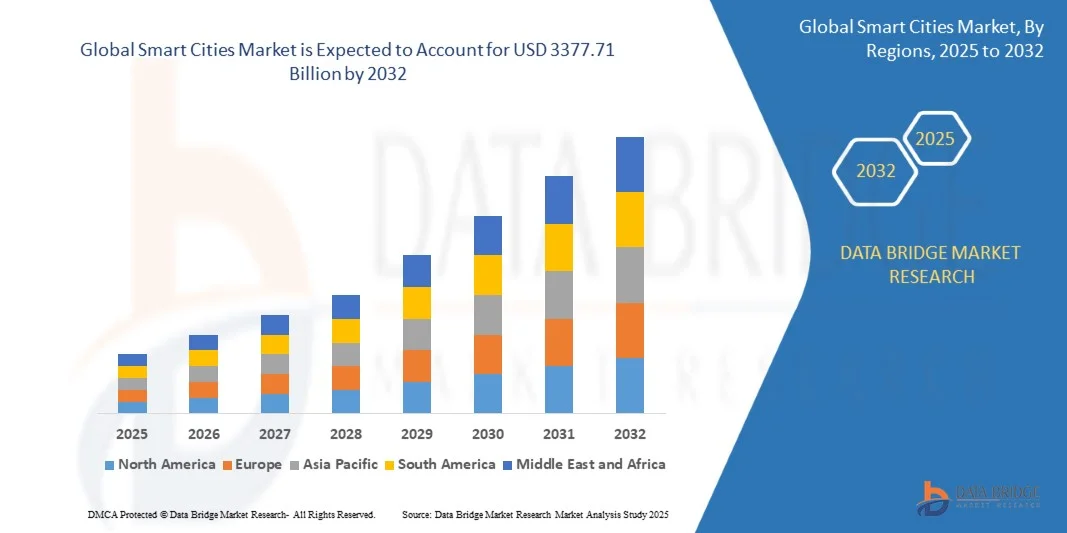
- The Smart Cities Market size was valued at USD 702.86 billion in 2024 and is projected to reach USD 3377.71 billion by 2032, growing at a CAGR of 21.68% during the forecast period
- Market expansion is primarily driven by rising adoption of connected home ecosystems and advancements in smart home technologies, fueling broader digital transformation across residential and commercial environments
- Additionally, increasing demand for secure, seamless, and integrated access solutions is positioning smart locks as the preferred choice for modern access control, further accelerating market growth and innovation
Smart Cities Market Analysis
- Smart cities, integrating digital technology and IoT across urban infrastructure, are becoming essential to address growing urbanization challenges by enhancing efficiency, sustainability, and the quality of life in both developed and developing regions through intelligent transportation, energy management, and public safety systems
- The rapid growth of the smart cities market is largely propelled by increasing government initiatives, rising demand for energy-efficient solutions, and technological advancements in connectivity, AI, and data analytics for real-time urban management
- North America dominated the Smart Cities Market with the largest revenue share of 21.5% in 2024, driven by early adoption of advanced technologies, strong public-private partnerships, and significant investments in smart infrastructure, particularly in cities across the U.S. and Canada focusing on mobility, surveillance, and energy systems
- Asia-Pacific is expected to be the fastest-growing region in the Smart Cities Market during the forecast period due to rapid urban development, expanding middle-class population, and increased investments in digital infrastructure across countries like China, India, and Southeast Asia
- Smart utilities segment dominated the Smart Cities Market with a market share of 27.5% in 2024, driven primarily by large-scale infrastructure investments in smart energy and water systems (smart grids, advanced metering), regulatory and decarbonization mandates, and the wide adoption of IoT/AI-enabled asset management and demand-response solutions that require substantial hardware, deployment and maintenance spend
Report Scope and Smart Cities Market Segmentation
|
Attributes |
Smart Cities Key Market Insights |
|
Segments Covered |
|
|
Countries Covered |
North America
Europe
Asia-Pacific
Middle East and Africa
South America
|
|
Key Market Players |
|
|
Market Opportunities |
|
|
Value Added Data Infosets |
In addition to the insights on market scenarios such as market value, growth rate, segmentation, geographical coverage, and major players, the market reports curated by the Data Bridge Market Research also include in-depth expert analysis, pricing analysis, brand share analysis, consumer survey, demography analysis, supply chain analysis, value chain analysis, raw material/consumables overview, vendor selection criteria, PESTLE Analysis, Porter Analysis, and regulatory framework. |
Smart Cities Market Trends
“Enhanced Convenience Through AI and Voice Integration”
- A significant and rapidly evolving trend in the Smart Cities Market is the growing integration of artificial intelligence (AI) and voice-controlled technologies such as Amazon Alexa, Google Assistant, and Apple Siri into urban infrastructure, greatly enhancing citizen engagement, operational efficiency, and service delivery across municipalities.
- For example, smart public kiosks in cities like New York and London integrate AI-powered voice assistants to provide directions, local information, and emergency services access, making city services more accessible and user-friendly for residents and tourists alike.
- AI-driven systems are being increasingly embedded in smart traffic management, surveillance, waste collection, and energy systems. Voice-enabled applications allow city operators and even citizens to interact with services through natural language, reducing complexity and improving responsiveness. For instance, AI-enabled transport apps can provide real-time updates or rerouting suggestions through voice prompts based on current traffic conditions.
- The integration of smart city services into centralized platforms, often accessible through voice-activated hubs, allows residents to report issues like streetlight outages or public maintenance needs with simple verbal commands. AI then categorizes and prioritizes these inputs, streamlining municipal response times and reducing manual workloads.
- This trend is redefining how citizens interact with urban environments—transforming passive infrastructure into interactive, intuitive ecosystems. Companies like IBM and SAP SE are leading in deploying AI-powered platforms for smart city governance, enabling features such as predictive analytics for utilities and voice-assisted service management tools.
- With the demand for connected, voice-activated, and AI-optimized city systems rising globally, municipalities are increasingly adopting these technologies to boost convenience, inclusivity, and efficiency—marking a transformative shift in how modern cities operate and serve their populations.
Smart Cities Market Dynamics
Driver
“Growing Need Due to Rising Urbanization and Infrastructure Modernization”
- The rapid pace of urbanization, particularly in developing economies, along with the increasing demand for efficient, sustainable, and technologically advanced urban infrastructure, is a key driver of growth in the Smart Cities Market
- For example, in February 2024, the Government of India announced a renewed investment phase for its Smart Cities Mission, allocating substantial funding toward AI-enabled traffic management, smart utilities, and integrated public safety systems in Tier-2 and Tier-3 cities. Similar initiatives in regions like Southeast Asia and the Middle East are accelerating the deployment of smart infrastructure
- As cities become more populated and complex, traditional infrastructure systems struggle to keep up with demands. Smart city technologies address these challenges by enabling real-time data collection and analytics, improving energy efficiency, transportation flow, public safety, and waste management
- Additionally, the rise in consumer expectations for high-quality urban living, combined with the widespread adoption of smart technologies in everyday life, is encouraging governments and private players to invest in smart city solutions that offer better service delivery, convenience, and sustainability
- Features such as smart lighting, AI-powered surveillance, real-time traffic optimization, and IoT-based waste management are becoming standard components of modern urban planning. These solutions not only enhance operational efficiency but also promote greener, safer, and more livable cities—driving demand across both emerging and developed regions
Restraint/Challenge
“Data Privacy Concerns and High Implementation Costs”
- One of the major challenges limiting the broader adoption of smart city technologies is the growing concern around data privacy, surveillance, and the high upfront costs associated with large-scale implementation of smart infrastructure
- Smart cities rely heavily on data collected from sensors, connected devices, and citizen interactions. This raises concerns about data misuse, lack of transparency, and potential breaches of privacy—especially when sensitive information is collected without proper consent or oversight
- For instance, public backlash over surveillance camera deployments and facial recognition systems in cities such as London and San Francisco highlights growing citizen unease with how urban data is collected and utilized
- Addressing these concerns requires robust regulatory frameworks, transparent data governance policies, and secure digital infrastructure to build public trust. Companies like IBM and SAP SE are increasingly focusing on ethical AI use and data protection standards in their smart city solutions
- Moreover, the high initial investment needed for deploying IoT sensors, upgrading infrastructure, and integrating AI systems can be a barrier for municipalities with limited budgets—particularly in low-income or developing regions. While long-term benefits include cost savings and efficiency, the short-term financial burden can delay implementation
- To overcome these barriers, governments are increasingly adopting public-private partnership (PPP) models, leveraging funding from tech firms and international organizations. Additionally, scalable and modular smart city solutions that allow gradual adoption are gaining traction, especially in smaller cities and towns aiming to become more digitally inclusive
Smart Cities Market Scope
The smart cities market is segmented on the basis of application.
• By Application
On the basis of application, the Smart Cities Market is segmented into smart transportation, smart utilities, smart education, smart healthcare, smart public safety, smart governance, smart lighting solutions, and smart buildings. The smart utilities segment dominated the Smart Cities Market with a market share of 27.5% in 2024, driven primarily by large-scale infrastructure investments in smart energy and water systems (smart grids, advanced metering), regulatory and decarbonization mandates, and the wide adoption of IoT/AI-enabled asset management and demand-response solutions that require substantial hardware, deployment and maintenance spend.
The smart healthcare segment is projected to grow at the fastest CAGR from 2025 to 2032, fueled by increased focus on telemedicine, AI-driven diagnostics, and real-time health monitoring systems in urban environments. The COVID-19 pandemic accelerated digital transformation in healthcare, and smart cities are increasingly incorporating tech-driven health infrastructure to improve public wellness, emergency response times, and remote care capabilities. Demand is especially high in densely populated urban centers and aging populations requiring accessible care.
Smart Cities Market Regional Analysis
- North America dominated the Smart Cities Market with the largest revenue share of 21.5% in 2024, driven by strong government initiatives, advanced digital infrastructure, and the early adoption of smart city technologies across major urban areas
- Cities in the region are leveraging integrated platforms for traffic management, energy efficiency, public safety, and digital governance. The presence of major technology companies, including IBM and Cisco Systems, further accelerates innovation and deployment of scalable smart city solutions
- The region benefits from high R&D spending, public-private partnerships, and widespread availability of 5G and IoT infrastructure, enabling real-time data collection and analysis. Citizens also show high receptiveness to digital services and mobile-based urban management tools, making North America a leading market for smart city implementation across residential, commercial, and institutional segments
U.S. Smart Cities Market Insight
The U.S. Smart Cities Market captured the largest revenue share of 80% in 2024 within North America, driven by strong federal and local government initiatives, advanced digital infrastructure, and widespread adoption of IoT technologies. The country leads in smart transportation, public safety, and smart energy projects, with major cities such as New York, San Francisco, and Chicago deploying AI-powered traffic systems, surveillance networks, and connected utilities. Increasing consumer reliance on real-time services and mobile apps for urban navigation and resource management further accelerates market growth. In addition, the presence of leading tech firms such as IBM and Ciscoenhances innovation, making the U.S. a global leader in smart city implementation.
Europe Smart Cities Market Insight
The Europe Smart Cities Market is projected to expand at a substantial CAGR throughout the forecast period, fueled by strong regulatory frameworks, sustainability goals, and significant investment in digital urban infrastructure. The European Union’s Smart Cities Marketplace and Green Deal initiatives are accelerating the adoption of intelligent energy systems, mobility solutions, and e-governance. Countries across the region are integrating smart solutions into both new developments and retrofitting older infrastructure, aiming for energy efficiency and reduced emissions. The demand for secure, efficient, and citizen-centric smart city services is steadily rising, with growing interest in smart lighting, mobility-as-a-service (MaaS), and green building solutions.
U.K. Smart Cities Market Insight
The U.K. Smart Cities Market is anticipated to grow at a noteworthy CAGR during the forecast period, supported by rising digital transformation initiatives and urban sustainability efforts. The U.K. government continues to fund smart city testbeds and public-private partnerships focused on AI-based traffic systems, connected healthcare, and carbon-neutral city planning. Rising concerns over environmental sustainability and public safety are pushing cities like London, Manchester, and Bristol to invest in integrated smart infrastructure. Additionally, the U.K.’s strong telecom network, data protection policies, and citizen engagement programs support broader smart city adoption.
Germany Smart Cities Market Insight
The Germany Smart Cities Market is expected to expand at a considerable CAGR during the forecast period, driven by its focus on Industry 4.0, sustainable urban development, and strong federal support for smart infrastructure. German cities are prioritizing energy-efficient buildings, electric mobility, and AI-powered governance platforms. The market benefits from Germany’s advanced technological capabilities and public trust in regulated data use. The integration of smart energy grids, intelligent traffic management, and smart waste systems are at the forefront, while digital twin technology and green architecture are emerging trends in smart city planning.
Asia-Pacific Smart Cities Market Insight
The Asia-Pacific Smart Cities Market is poised to grow at the fastest CAGR of 24% during the forecast period (2025–2032), led by rapid urbanization, increasing government support, and technology adoption in countries like China, India, and Japan. National programs such as India’s Smart Cities Mission and China’s New Urbanization Plan are injecting massive investments into smart infrastructure. The region benefits from a growing middle class, rising demand for energy-efficient solutions, and the expanding manufacturing base for IoT and smart city components. Smart transportation, smart utilities, and public safety solutions are key areas of growth, with increased focus on affordability and scalability.
Japan Smart Cities Market Insight
The Japan Smart Cities Market is gaining momentum due to the nation’s advanced technological ecosystem, high urban density, and strong government emphasis on digital infrastructure. Japanese cities are leveraging smart mobility, AI-based healthcare systems, and real-time disaster response networks to improve urban living. Aging demographics are also driving the adoption of user-friendly, automated services, particularly in residential and healthcare infrastructure. The integration of robotics, IoT, and voice assistants in public and private spaces contributes to the country’s reputation as a global innovator in smart city applications.
China Smart Cities Market Insight
The China Smart Cities Market accounted for the largest revenue share in Asia-Pacific in 2024, supported by large-scale government investments, digital transformation initiatives, and rapid urban expansion. China leads in smart surveillance, connected infrastructure, and AI-driven governance, with cities like Shenzhen, Hangzhou, and Beijing setting global benchmarks. Local governments are increasingly adopting 5G, edge computing, and big data analytics to manage urban services, while domestic tech giants are rapidly innovating in smart city technologies. The affordability of locally manufactured solutions ensures widespread adoption across both tier-1 and emerging cities.
Smart Cities Market Share
Some of the major players operating in the market are:
- IBM (U.S.)
- SAP SE (Germany)
- Sensoneo (Finland)
- Big belly solar, LLC (U.S.)
- Inogen Environmental Alliance, Inc. (U.S.)
- Ecube Labs (South Korea)
- Covanta Holding Corporation (U.S.)
- Pepperl+Fuchs (Germany)
- OnePlus Systems Inc. (U.S.)
- Urbiotica (Spain)
What are the Recent Developments in Global Smart Cities Market?
- In April 2023, Cisco Systems Inc., a global leader in networking and smart infrastructure, launched its Smart City Blueprint Initiative in partnership with several municipal governments across Latin America. This initiative aims to transform urban infrastructure through the deployment of integrated IoT systems, intelligent traffic control, and connected public services. By leveraging its global expertise, Cisco is addressing region-specific challenges such as traffic congestion, inefficient energy use, and public safety, thereby reinforcing its leadership in the Smart Cities Market.
- In March 2023, Siemens AG, a pioneer in digital infrastructure, announced a strategic collaboration with the City of Vienna to implement AI-based smart energy and mobility systems. This project includes the deployment of predictive energy grids and autonomous traffic systems designed to reduce emissions and improve energy efficiency. Siemens’ involvement reflects its long-term commitment to sustainable urban development and its integral role in shaping Europe’s smart city landscape.
- In March 2023, Honeywell International Inc. successfully expanded its smart city portfolio by initiating the Naya Raipur Smart City Project in India. The project integrates advanced environmental sensors, AI-powered surveillance systems, and smart utility monitoring across the city. As part of its broader focus on smart urban infrastructure, Honeywell’s contribution exemplifies how intelligent systems are becoming foundational to urban planning and citizen safety in emerging economies.
- In February 2023, Huawei Technologies Co., Ltd. launched its Urban Intelligent Twins solution in collaboration with Chinese city planners. This advanced digital twin system enables real-time simulation and optimization of city functions—ranging from water management to emergency services—using AI and big data. Huawei’s initiative is aimed at improving operational efficiency and supporting evidence-based governance, showcasing the evolving role of real-time analytics in smart city management.
- In January 2023, IBM Corporation announced its role in developing a cloud-based platform for Toronto’s Smart Urban Data Ecosystem, designed to support seamless integration of smart mobility, waste management, and digital public services. The system utilizes AI and blockchain technologies to enhance transparency, reduce urban inefficiencies, and promote sustainable growth. IBM’s involvement demonstrates the increasing demand for intelligent, data-driven platforms that can scale across large urban environments.
SKU-
Get online access to the report on the World's First Market Intelligence Cloud

- Interactive Data Analysis Dashboard
- Company Analysis Dashboard for high growth potential opportunities
- Research Analyst Access for customization & queries
- Competitor Analysis with Interactive dashboard
- Latest News, Updates & Trend analysis
- Harness the Power of Benchmark Analysis for Comprehensive Competitor Tracking
Research Methodology
Data collection and base year analysis are done using data collection modules with large sample sizes. The stage includes obtaining market information or related data through various sources and strategies. It includes examining and planning all the data acquired from the past in advance. It likewise envelops the examination of information inconsistencies seen across different information sources. The market data is analysed and estimated using market statistical and coherent models. Also, market share analysis and key trend analysis are the major success factors in the market report. To know more, please request an analyst call or drop down your inquiry.
The key research methodology used by DBMR research team is data triangulation which involves data mining, analysis of the impact of data variables on the market and primary (industry expert) validation. Data models include Vendor Positioning Grid, Market Time Line Analysis, Market Overview and Guide, Company Positioning Grid, Patent Analysis, Pricing Analysis, Company Market Share Analysis, Standards of Measurement, Global versus Regional and Vendor Share Analysis. To know more about the research methodology, drop in an inquiry to speak to our industry experts.
Customization Available
Data Bridge Market Research is a leader in advanced formative research. We take pride in servicing our existing and new customers with data and analysis that match and suits their goal. The report can be customized to include price trend analysis of target brands understanding the market for additional countries (ask for the list of countries), clinical trial results data, literature review, refurbished market and product base analysis. Market analysis of target competitors can be analyzed from technology-based analysis to market portfolio strategies. We can add as many competitors that you require data about in the format and data style you are looking for. Our team of analysts can also provide you data in crude raw excel files pivot tables (Fact book) or can assist you in creating presentations from the data sets available in the report.












