

Global Smart Coatings Market
Market Size in USD Billion
CAGR :
% 
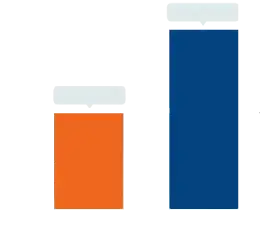 USD
7.80 Billion
USD
34.42 Billion
2025
2033
USD
7.80 Billion
USD
34.42 Billion
2025
2033
 Forecast Period Forecast Period |
2026 –2033 |
 Market Size (Base Year) Market Size (Base Year) |
USD 7.80 Billion |
 Market Size (Forecast Year) Market Size (Forecast Year) |
USD 34.42 Billion |
 CAGR CAGR |
% |
| Major Markets Players |
|
Smart Coatings Market Size
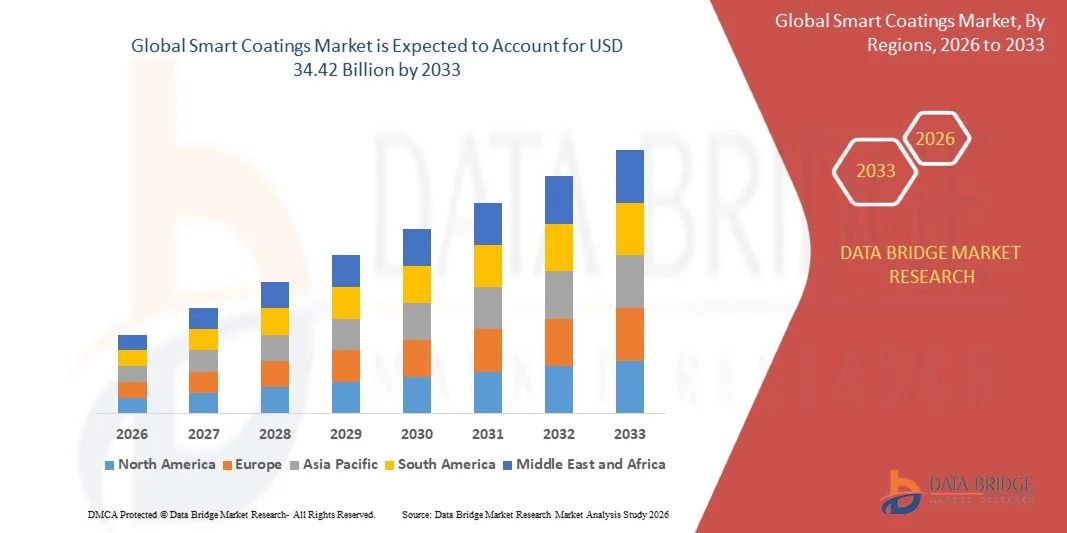
- The global smart coatings market size was valued at USD 7.80 billion in 2025 and is expected to reach USD 34.42 billion by 2033, at a CAGR of 20.39% during the forecast period
- The market growth is largely fueled by the increasing demand for advanced protective and functional coatings across industries such as automotive, aerospace, and marine, driving the adoption of smart coatings that enhance durability, corrosion resistance, and surface performance
- Furthermore, rising focus on sustainability, energy efficiency, and multifunctional solutions is establishing smart coatings as the preferred choice for industrial and commercial applications. These converging factors are accelerating the uptake of smart coatings, thereby significantly boosting the industry's growth
Smart Coatings Market Analysis
- Smart coatings are advanced surface treatments that provide targeted functionalities such as anti-corrosion, anti-fouling, anti-microbial, self-healing, and anti-icing properties, improving the longevity and performance of coated substrates. These coatings can be applied across metals, plastics, textiles, and composites in industrial, automotive, and marine applications
- The escalating demand for smart coatings is primarily fueled by increasing industrial automation, stringent environmental regulations, and the need to reduce maintenance costs, combined with growing awareness of sustainable and high-performance coating technologies
- North America dominated the smart coatings market with a share of 33.5% in 2025, due to growing adoption of advanced protective coatings across automotive, aerospace, and defense sectors
- Asia-Pacific is expected to be the fastest growing region in the smart coatings market during the forecast period due to increasing industrialization, rapid urbanization, and technological advancements in countries such as China, Japan, and India
- Single-layer segment dominated the market with a market share of 61.9% in 2025, due to its simplified application process, cost-effectiveness, and ability to provide essential protective functionalities across various surfaces. Single-layer coatings are widely adopted in industries such as automotive and marine due to their ease of deployment, reduced material consumption, and compatibility with diverse substrates, making them a preferred choice for large-scale applications
Report Scope and Smart Coatings Market Segmentation
|
Attributes |
Smart Coatings Key Market Insights |
|
Segments Covered |
|
|
Countries Covered |
North America
Europe
Asia-Pacific
Middle East and Africa
South America
|
|
Key Market Players |
|
|
Market Opportunities |
|
|
Value Added Data Infosets |
In addition to the insights on market scenarios such as market value, growth rate, segmentation, geographical coverage, and major players, the market reports curated by the Data Bridge Market Research also include import export analysis, production capacity overview, production consumption analysis, price trend analysis, climate change scenario, supply chain analysis, value chain analysis, raw material/consumables overview, vendor selection criteria, PESTLE Analysis, Porter Analysis, and regulatory framework. |
Smart Coatings Market Trends
“Rising Adoption of Eco-Friendly and Functional Smart Coatings”
- A prominent trend in the smart coatings market is the increasing preference for environmentally friendly and multifunctional coatings that provide durability, corrosion resistance, and self-cleaning or anti-microbial properties. This trend is driven by regulatory pressures, sustainability initiatives, and rising industrial and consumer demand for high-performance surfaces across sectors such as automotive, construction, and electronics
- For instance, PPG Industries supplies eco-friendly powder and waterborne smart coatings that offer corrosion protection and enhanced surface performance for automotive and aerospace applications. These solutions help manufacturers reduce environmental impact while maintaining high functional standards
- The adoption of self-healing and anti-fouling coatings is gaining traction as industries aim to extend equipment lifecycle, reduce maintenance costs, and enhance operational efficiency. Functional coatings with properties such as scratch resistance and chemical protection are positioning smart coatings as critical components in advanced manufacturing and infrastructure projects
- The construction and building sector is increasingly integrating smart coatings for energy-efficient and protective applications, including solar reflective and fire-resistant surfaces. This integration is strengthening the role of smart coatings in sustainability-focused architecture and infrastructure resilience
- The electronics industry is utilizing thin-film and conductive smart coatings to improve device performance, heat dissipation, and electromagnetic interference shielding. Such applications are driving innovation in high-value coatings capable of meeting stringent technical requirements
- The market is witnessing strong growth in automotive and industrial applications where anti-corrosion and functional smart coatings enhance vehicle durability and industrial equipment performance. This rising incorporation of advanced coatings is reinforcing their strategic importance across global industrial and consumer markets
Smart Coatings Market Dynamics
Driver
“Increasing Demand for Corrosion-Resistant and High-Performance Surfaces”
- The growing requirement for durable and protective surfaces across automotive, aerospace, and marine sectors is driving demand for smart coatings that offer corrosion resistance, chemical stability, and long-term performance. These coatings help reduce maintenance costs, extend asset lifetimes, and improve operational reliability
- For instance, AkzoNobel supplies high-performance anti-corrosion and specialty coatings for industrial and automotive applications that meet stringent durability and environmental standards. Their products enhance resistance to environmental degradation while supporting sustainability goals
- Rising awareness of asset protection and equipment longevity in industries such as oil & gas and infrastructure is fueling investments in functional coatings with advanced barrier properties. These coatings improve safety, reduce downtime, and minimize operational risks
- The automotive sector’s shift toward lightweight materials such as aluminum and composites increases reliance on protective coatings that prevent corrosion and maintain aesthetic quality. Smart coatings provide tailored solutions for these evolving material requirements
- The expanding emphasis on sustainability and regulatory compliance continues to support demand for eco-friendly high-performance coatings. Companies are adopting solutions that balance protection, functionality, and environmental responsibility
Restraint/Challenge
“High Production Costs and Complex Formulation Requirements”
- The smart coatings market faces challenges due to the intricate formulations required to achieve multifunctional and high-performance properties, which involve advanced polymers, nanoparticles, and specialty additives. These complex processes increase production difficulty, capital requirements, and overall cost structures for manufacturers
- For instance, Axalta Coating Systems develops high-performance automotive and industrial coatings using advanced nanotechnology and eco-friendly formulations. These processes demand specialized equipment, precise quality control, and skilled personnel, driving up operational costs
- Producing environmentally compliant coatings requires adherence to strict VOC limits and regulatory standards, which further complicates formulation and manufacturing. Compliance measures add additional time and cost pressures across the production chain
- The reliance on high-quality raw materials such as titanium dioxide, graphene, and other nanomaterials increases supply-side vulnerability and impacts cost stability. Manufacturers must carefully balance material performance with economic feasibility
- Scaling production while maintaining coating performance, consistency, and competitive pricing remains a significant challenge. These constraints collectively compel manufacturers to invest in R&D and process optimization to meet growing global demand without compromising quality or functionality
Smart Coatings Market Scope
The market is segmented on the basis of layer, function, product, and end-use industry.
• By Layer
On the basis of layer, the smart coatings market is segmented into multi-layer and single-layer. The single-layer segment dominated the largest market revenue share of 61.9% in 2025, driven by its simplified application process, cost-effectiveness, and ability to provide essential protective functionalities across various surfaces. Single-layer coatings are widely adopted in industries such as automotive and marine due to their ease of deployment, reduced material consumption, and compatibility with diverse substrates, making them a preferred choice for large-scale applications. Their versatility in offering targeted protection while maintaining efficient production timelines further reinforces their market dominance.
The multi-layer segment is anticipated to witness the fastest growth rate from 2026 to 2033, fueled by increasing demand for advanced performance coatings that combine multiple functionalities such as anti-corrosion, anti-fouling, and self-healing properties. Multi-layer smart coatings are gaining traction in high-performance industries, including aerospace and defense, where durability, surface longevity, and environmental resistance are critical. For instance, companies are developing multi-layer systems that integrate tailored protective features to extend asset life and reduce maintenance costs. Technological advancements in layer engineering and the ability to customize coatings for specific industrial applications further accelerate the adoption of multi-layer smart coatings.
• By Function
On the basis of function, the smart coatings market is segmented into anti-microbial, anti-corrosion, anti-fouling, anti-icing, and others. The anti-corrosion segment dominated the largest market revenue share in 2025, driven by the critical need to prevent metal degradation and extend equipment life in harsh environments. Anti-corrosion smart coatings are highly valued in automotive, marine, and aerospace sectors for protecting structural components against moisture, chemicals, and saltwater exposure. Their ability to integrate with self-healing and environmentally friendly chemistries enhances market appeal. Manufacturers increasingly deploy anti-corrosion coatings to reduce maintenance costs and ensure operational reliability, supporting long-term investment strategies. Anti-corrosion coatings also provide compatibility with various substrates, which strengthens their demand across multiple industrial applications.
The anti-microbial segment is expected to witness the fastest CAGR from 2026 to 2033, fueled by rising health and hygiene concerns across healthcare, food processing, and public facilities. For instance, companies such as PPG Industries are developing anti-microbial smart coatings to inhibit bacterial growth on high-contact surfaces, enhancing safety and compliance. Anti-microbial coatings combine surface protection with sanitation benefits, which is increasingly critical in post-pandemic facility management. Their ease of integration with existing coating systems and durability under repeated cleaning further accelerates adoption. In addition, growing awareness of infection control and stricter regulatory standards are driving rapid market penetration for anti-microbial coatings.
• By Product
On the basis of product, the smart coatings market is segmented into pH, ionic strength, and others. The pH-based segment dominated the largest market revenue share in 2025, driven by its widespread application in self-healing coatings and responsive protective layers. pH-sensitive smart coatings can adapt to environmental changes, providing corrosion inhibition or protective action when the pH shifts, making them highly effective in industrial and marine environments. Their precision in targeted functionality allows manufacturers to extend substrate life and reduce maintenance frequency, which is critical for cost-sensitive applications. pH-based coatings are also compatible with advanced multi-layer formulations, increasing their applicability across different sectors. The ease of integrating pH-responsive systems into automated processes further strengthens their market demand.
The ionic strength segment is anticipated to witness the fastest growth rate from 2026 to 2033, fueled by emerging applications in responsive and self-regulating coatings for aerospace and marine sectors. Ionic strength-based coatings enable controlled release of protective ions, enhancing anti-corrosion and anti-fouling performance. For instance, AkzoNobel has developed ionic-responsive coatings that adjust to changing environmental conditions, improving operational efficiency and substrate protection. Their increasing use in precision engineering and high-performance industries contributes to rapid adoption. In addition, advancements in formulation chemistry and deposition techniques are expanding the functional versatility of ionic strength smart coatings.
• By End-Use Industry
On the basis of end-use industry, the smart coatings market is segmented into automotive and transportation, aerospace and defense, and marine. The automotive and transportation segment dominated the largest market revenue share in 2025, driven by the growing need for protective and functional coatings in vehicles to improve performance and durability. Smart coatings in this sector offer anti-corrosion, anti-fouling, and self-healing properties, which enhance vehicle longevity and reduce long-term maintenance costs. Automotive manufacturers increasingly integrate smart coatings into high-contact and structural components to maintain aesthetic and functional quality. The rise of electric vehicles also drives demand for lightweight and multifunctional coatings to optimize energy efficiency and component protection. Multi-layer and advanced product formulations further reinforce their adoption across automotive applications.
The aerospace and defense segment is expected to witness the fastest CAGR from 2026 to 2033, fueled by the growing demand for high-performance protective coatings in aircraft and defense equipment. For instance, Hexcel Corporation is leveraging smart coatings in aerospace applications to provide anti-icing and anti-corrosion functionality for critical components, enhancing safety and operational efficiency. Smart coatings in aerospace reduce maintenance cycles and weight while increasing surface longevity under extreme conditions. In addition, increasing government investments and stringent performance standards in the defense sector are accelerating the adoption of smart coatings. The ability to combine multiple functionalities in a single coating layer strengthens their market growth in aerospace applications.
Smart Coatings Market Regional Analysis
- North America dominated the smart coatings market with the largest revenue share of 33.5% in 2025, driven by growing adoption of advanced protective coatings across automotive, aerospace, and defense sectors
- Consumers and industries in the region highly value coatings that enhance durability, corrosion resistance, and surface performance while reducing maintenance costs
- This widespread adoption is further supported by high industrial investment, advanced research infrastructure, and strong regulatory standards for safety and material longevity, establishing smart coatings as a preferred solution for critical applications
U.S. Smart Coatings Market Insight
The U.S. smart coatings market captured the largest revenue share in 2025 within North America, fueled by increasing industrial automation and the demand for high-performance coatings in automotive, aerospace, and defense applications. Manufacturers are prioritizing coatings that provide anti-corrosion, anti-fouling, and self-healing properties to extend product life and reduce maintenance cycles. The growing trend of lightweight materials in vehicles and aircraft drives the adoption of multi-functional smart coatings. Moreover, strong R&D investment and collaboration with coating technology providers are significantly contributing to market expansion.
Europe Smart Coatings Market Insight
The Europe smart coatings market is projected to expand at a substantial CAGR throughout the forecast period, primarily driven by stringent environmental regulations and the increasing need for corrosion- and wear-resistant coatings. The rise in automotive production, aerospace modernization, and maritime activities is fostering the adoption of smart coatings across industries. European consumers and manufacturers are drawn to energy-efficient and environmentally friendly coating solutions. The market is experiencing growth in both new industrial constructions and refurbishment projects, emphasizing high-performance, long-lasting coatings.
U.K. Smart Coatings Market Insight
The U.K. smart coatings market is anticipated to grow at a noteworthy CAGR during the forecast period, driven by industrial modernization and increasing awareness of protective surface technologies. The growing focus on sustainability, coupled with the need for corrosion and fouling prevention in automotive and marine applications, is encouraging manufacturers to adopt advanced smart coatings. In addition, the U.K.’s emphasis on research and innovation, along with strong industrial standards, continues to stimulate market growth across commercial and defense sectors.
Germany Smart Coatings Market Insight
The Germany smart coatings market is expected to expand at a considerable CAGR during the forecast period, fueled by rising demand for high-performance coatings in automotive, aerospace, and marine industries. Germany’s emphasis on technological innovation and industrial efficiency promotes adoption of advanced smart coatings, particularly multi-layer and functional systems. Integration with environmentally friendly and self-healing technologies is increasingly prevalent, aligning with local sustainability regulations and consumer expectations for durable, low-maintenance coatings.
Asia-Pacific Smart Coatings Market Insight
The Asia-Pacific smart coatings market is poised to grow at the fastest CAGR during the forecast period of 2026 to 2033, driven by increasing industrialization, rapid urbanization, and technological advancements in countries such as China, Japan, and India. The region’s growing automotive, aerospace, and marine manufacturing sectors are boosting demand for protective and functional coatings. Government initiatives promoting advanced manufacturing and smart industrial practices are accelerating the adoption of smart coatings. Moreover, as APAC becomes a production hub for coating materials and technologies, affordability and accessibility are expanding the market to a wider industrial base.
Japan Smart Coatings Market Insight
The Japan smart coatings market is gaining momentum due to the country’s high-tech industrial base, rapid adoption of advanced manufacturing processes, and stringent safety and durability standards. Japanese industries prioritize coatings that enhance corrosion resistance, anti-fouling, and self-healing properties, particularly in automotive and aerospace applications. Integration of smart coatings with automated production and quality control systems is fueling growth. Furthermore, Japan’s focus on long-term maintenance reduction and surface longevity continues to drive demand across commercial and industrial sectors.
China Smart Coatings Market Insight
The China smart coatings market accounted for the largest market revenue share in Asia-Pacific in 2025, attributed to rapid industrial growth, expanding automotive and marine sectors, and high rates of technological adoption. China’s industrial modernization and push towards high-performance, protective, and multifunctional coatings are key market drivers. Domestic manufacturers and cost-effective solutions are enhancing accessibility for both large-scale industrial applications and specialized high-performance needs. The development of smart coatings for anti-corrosion, anti-fouling, and self-healing purposes supports the country’s growing manufacturing and infrastructure projects.
Smart Coatings Market Share
The smart coatings industry is primarily led by well-established companies, including:
- Bayer AG (Germany)
- 3M Company (U.S.)
- DOW Inc. (U.S.)
- DSM (Netherlands)
- DuPont de Nemours, Inc. (U.S.)
- Eastern Chemical Company (U.S.)
- NIPPON STEEL CORPORATION (Japan)
- Debiotech S.A (Switzerland)
- Balcony Systems Solutions Ltd (U.K.)
- AnCatt, Inc (U.S.)
- RPM International Inc (U.S.)
- Sherwin-Williams Company (U.S.)
- NEI Corporation (U.S.)
- HygraTek (U.S.)
- Tesla NanoCoatings Inc (U.S.)
- Greenkote (U.S.)
- Helicity Technologies, Inc (U.S.)
- The Lubrizol Corporation (U.S.)
- A&K Painting Company, Inc (U.S.)
Latest Developments in Global Smart Coatings Market
- In December 2025, JSW Paints Limited acquired a majority stake in Akzo Nobel India Limited from Akzo Nobel N.V., strengthening its position in both decorative and industrial coatings. This strategic consolidation enhances JSW Paints’ access to advanced coating technologies and manufacturing capabilities, enabling the development and distribution of high-performance and multifunctional smart coatings. The acquisition supports market growth by promoting innovation in protective and energy-efficient coatings and expanding the availability of technologically advanced solutions across India’s rapidly growing industrial and infrastructure sectors
- In July 2025, Nippon Paint launched its next-generation smart coating system, Walltron Advance Thermal Comfort Solutions (WATCS), in India to address rising urban temperatures and increasing energy demands. The coating provides cooler indoor conditions, reduces dependency on air-conditioning, and promotes energy-efficient, sustainable building practices in residential and commercial projects. Such innovations drive market adoption by emphasizing multifunctional, environmentally friendly solutions, enhancing the role of smart coatings in energy conservation, and expanding their application in sustainable construction initiatives
- In July 2024, AkzoNobel expanded its portfolio with Resicoat EV powder coatings specifically designed for electric vehicle components. These coatings enhance electrical insulation, corrosion resistance, and thermal management, meeting the stringent requirements of EV manufacturing. This development strengthens the smart coatings market by supporting the rapidly growing EV sector, encouraging the adoption of high-performance coatings, and promoting safer, more durable, and energy-efficient vehicle components
- In November 2023, Covestro AG launched Impranil CQ DLU, a bio-based polyurethane dispersion with 34% plant-derived carbon, targeting sports, automotive, and technical textiles. By replacing petroleum-based alternatives while maintaining durability, this innovation positions bio-based smart coatings as a sustainable solution for environmentally conscious industries. The development drives market growth by accelerating demand for eco-friendly, high-performance coatings and encouraging the adoption of greener manufacturing practices across multiple industrial segments
- In October 2022, Apex Auto Care unveiled its self-healing ceramic coatings, Self Heal Plus and Heal Light, capable of repairing scratches at 60°C. These coatings offer a long-lasting, durable alternative to traditional protective films and paint coatings in automotive and specialty applications. Such technological advancement impacts the market by increasing the adoption of functional, high-performance coatings that extend product life, reduce maintenance costs, and provide enhanced aesthetic and protective benefits, reinforcing the value proposition of smart coatings in automotive care
SKU-
Get online access to the report on the World's First Market Intelligence Cloud

- Interactive Data Analysis Dashboard
- Company Analysis Dashboard for high growth potential opportunities
- Research Analyst Access for customization & queries
- Competitor Analysis with Interactive dashboard
- Latest News, Updates & Trend analysis
- Harness the Power of Benchmark Analysis for Comprehensive Competitor Tracking
Global Smart Coatings Market, Supply Chain Analysis and Ecosystem Framework
To support market growth and help clients navigate the impact of geopolitical shifts, DBMR has integrated in-depth supply chain analysis into its Global Smart Coatings Market research reports. This addition empowers clients to respond effectively to global changes affecting their industries. The supply chain analysis section includes detailed insights such as Global Smart Coatings Market consumption and production by country, price trend analysis, the impact of tariffs and geopolitical developments, and import and export trends by country and HSN code. It also highlights major suppliers with data on production capacity and company profiles, as well as key importers and exporters. In addition to research, DBMR offers specialized supply chain consulting services backed by over a decade of experience, providing solutions like supplier discovery, supplier risk assessment, price trend analysis, impact evaluation of inflation and trade route changes, and comprehensive market trend analysis.
Research Methodology
Data collection and base year analysis are done using data collection modules with large sample sizes. The stage includes obtaining market information or related data through various sources and strategies. It includes examining and planning all the data acquired from the past in advance. It likewise envelops the examination of information inconsistencies seen across different information sources. The market data is analysed and estimated using market statistical and coherent models. Also, market share analysis and key trend analysis are the major success factors in the market report. To know more, please request an analyst call or drop down your inquiry.
The key research methodology used by DBMR research team is data triangulation which involves data mining, analysis of the impact of data variables on the market and primary (industry expert) validation. Data models include Vendor Positioning Grid, Market Time Line Analysis, Market Overview and Guide, Company Positioning Grid, Patent Analysis, Pricing Analysis, Company Market Share Analysis, Standards of Measurement, Global versus Regional and Vendor Share Analysis. To know more about the research methodology, drop in an inquiry to speak to our industry experts.
Customization Available
Data Bridge Market Research is a leader in advanced formative research. We take pride in servicing our existing and new customers with data and analysis that match and suits their goal. The report can be customized to include price trend analysis of target brands understanding the market for additional countries (ask for the list of countries), clinical trial results data, literature review, refurbished market and product base analysis. Market analysis of target competitors can be analyzed from technology-based analysis to market portfolio strategies. We can add as many competitors that you require data about in the format and data style you are looking for. Our team of analysts can also provide you data in crude raw excel files pivot tables (Fact book) or can assist you in creating presentations from the data sets available in the report.