


Global Smart Fertilizers Market
Market Size in USD Billion
CAGR :
% 
 USD
3.71 Billion
USD
5.69 Billion
2025
2033
USD
3.71 Billion
USD
5.69 Billion
2025
2033
 Forecast Period Forecast Period |
2026 –2033 |
 Market Size (Base Year) Market Size (Base Year) |
USD 3.71 Billion |
 Market Size (Forecast Year) Market Size (Forecast Year) |
USD 5.69 Billion |
 CAGR CAGR |
% |
| Major Markets Players |
|
Smart Fertilizers Market Size
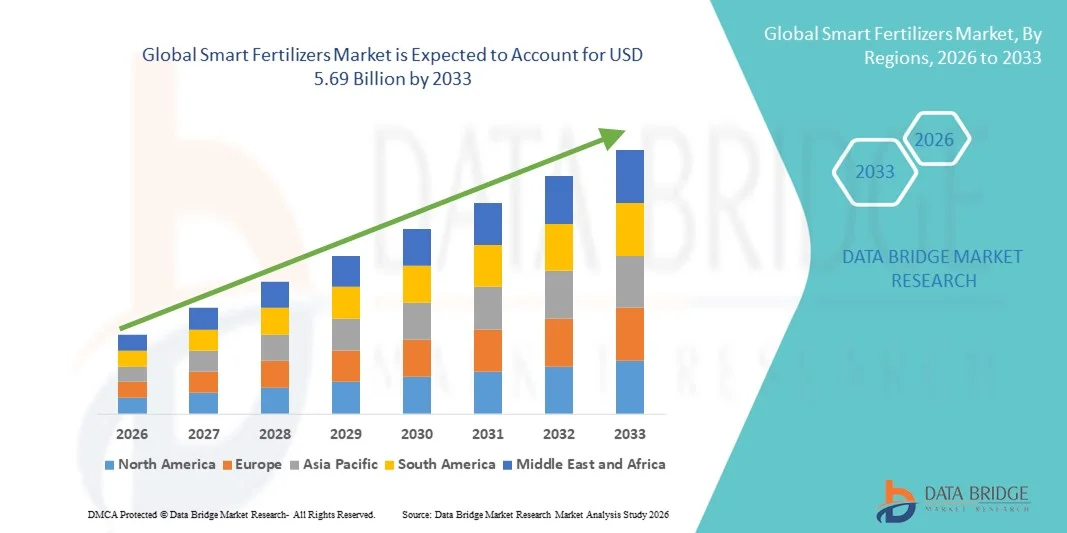
- The global smart fertilizers market size was valued at USD 3.71 billion in 2025 and is expected to reach USD 5.69 billion by 2033, at a CAGR of 5.5% during the forecast period
- The market growth is largely fueled by the increasing adoption of precision agriculture practices and advanced nutrient management technologies, which are driving the digitalization and optimization of fertilizer application across both large-scale and smallholder farming operations
- Furthermore, rising pressure to improve crop productivity while reducing environmental impact is strengthening demand for nutrient-efficient and controlled-release fertilizer solutions. These combined factors are accelerating the adoption of smart fertilizers, thereby significantly supporting overall market expansion
Smart Fertilizers Market Analysis
- Smart fertilizers, designed to enhance nutrient use efficiency through controlled release, targeted delivery, and improved soil interaction, are becoming essential inputs in modern agriculture due to their ability to increase yields while minimizing nutrient losses
- The growing demand for smart fertilizers is primarily driven by the need to address soil degradation, rising global food demand, and increasing adoption of sustainable and precision farming practices aimed at maximizing output with optimized fertilizer usage
- Asia-Pacific dominated the smart fertilizers market with a share of 37.7% in 2025, due to the extensive agricultural base, rising adoption of precision farming practices, and increasing pressure to improve crop yields across food security–focused economies in Asia-Pacific
- North America is expected to be the fastest growing region in the smart fertilizers market during the forecast period due to widespread adoption of precision agriculture, strong mechanization levels, and high awareness of nutrient efficiency among farmers
- SmartPhosphates segment dominated the market with a market share of 62.5% in 2025, due to its critical role in enhancing root development, energy transfer, and overall crop productivity. Farmers increasingly adopt SmartPhosphates due to their controlled nutrient release and higher phosphorus use efficiency, which reduces fixation losses in soil
Report Scope and Smart Fertilizers Market Segmentation
|
Attributes |
Smart Fertilizers Key Market Insights |
|
Segments Covered |
|
|
Countries Covered |
North America
Europe
Asia-Pacific
Middle East and Africa
South America
|
|
Key Market Players |
|
|
Market Opportunities |
|
|
Value Added Data Infosets |
In addition to the insights on market scenarios such as market value, growth rate, segmentation, geographical coverage, and major players, the market reports curated by the Data Bridge Market Research also include import export analysis, production capacity overview, production consumption analysis, price trend analysis, climate change scenario, supply chain analysis, value chain analysis, raw material/consumables overview, vendor selection criteria, PESTLE Analysis, Porter Analysis, and regulatory framework. |
Smart Fertilizers Market Trends
Increasing Adoption of Precision Agriculture Practices
- A major trend in the smart fertilizers market is the increasing adoption of precision agriculture practices, driven by the need to optimize nutrient application, improve crop productivity, and reduce environmental impact across modern farming systems. Smart fertilizers are gaining importance as they enable controlled nutrient release, site-specific application, and improved synchronization with crop growth cycles
- For instance, Yara International has expanded its portfolio of enhanced-efficiency fertilizers and digital crop nutrition tools that support precision farming by aligning nutrient delivery with real-time field conditions. These solutions help farmers improve yield consistency while reducing nutrient losses and input wastage
- The integration of smart fertilizers with data-driven farm management platforms is increasing as growers adopt soil sensors, satellite imaging, and variable-rate application technologies. This integration allows nutrients to be delivered more accurately, strengthening the role of smart fertilizers in precision-based crop management strategies
- Rising pressure to enhance land productivity amid shrinking arable land is further encouraging farmers to adopt fertilizers that improve nutrient use efficiency. Smart fertilizers help maintain soil health and ensure consistent nutrient availability, supporting sustainable intensification of agriculture
- The trend is also supported by government-backed digital agriculture initiatives that promote precision nutrient management to reduce runoff and emissions. These programs are accelerating the transition from conventional fertilizers to smarter, technology-enabled alternatives
- Overall, the growing alignment between smart fertilizers and precision agriculture systems is reinforcing their adoption as essential inputs for efficient, data-driven, and environmentally responsible farming practices worldwide
Smart Fertilizers Market Dynamics
Driver
Rising Demand for Sustainable and Nutrient-Efficient Fertilizers
- The rising demand for sustainable and nutrient-efficient fertilizers is a key driver of the smart fertilizers market, as farmers and agribusinesses seek solutions that enhance crop output while minimizing environmental harm. Smart fertilizers support this shift by reducing nutrient leaching, volatilization, and over-application
- For instance, BASF offers fertilizer stabilizers and controlled-release technologies that improve nitrogen efficiency and lower greenhouse gas emissions from agricultural operations. These products help growers comply with sustainability standards while maintaining strong crop performance
- Increasing regulatory scrutiny on fertilizer runoff and soil degradation is pushing adoption of advanced nutrient solutions that deliver measurable efficiency gains. Smart fertilizers align well with these regulations by enabling precise nutrient management and improved environmental outcomes
- Food producers and retailers are increasingly prioritizing sustainably sourced crops, which is influencing farmers to adopt nutrient-efficient fertilizers that support responsible agricultural practices. This shift is strengthening long-term demand for smart fertilizer solutions across value chains
- As sustainability becomes central to global food systems, the demand for fertilizers that balance yield improvement with environmental protection continues to propel smart fertilizer market growth
Restraint/Challenge
High Cost of Smart Fertilizer Products and Technologies
- High cost remains a significant challenge for the smart fertilizers market, as advanced formulations, coating technologies, and integration with digital tools increase overall product prices compared to conventional fertilizers. These higher costs can limit adoption, particularly among small and price-sensitive farmers
- For instance, Nutrien produces controlled-release and enhanced-efficiency fertilizers that require sophisticated manufacturing processes and specialized materials. These factors contribute to premium pricing, which can slow uptake in cost-constrained agricultural markets
- The need for specialized application equipment and precision farming infrastructure further adds to the total cost of adopting smart fertilizers. Farmers may face additional investment requirements to fully realize the benefits of these advanced nutrient solutions
- Fluctuations in raw material prices and coating inputs also affect production costs, making it challenging for manufacturers to offer competitively priced smart fertilizers at scale. This cost volatility can impact market penetration in developing agricultural regions
- Limited awareness of long-term economic benefits among some farming communities further restricts adoption, as upfront costs often outweigh perceived short-term gains. Addressing cost barriers remains essential for expanding smart fertilizer use across diverse farming systems and achieving broader market growth
Smart Fertilizers Market Scope
The market is segmented on the basis of category and application.
- By Category
On the basis of category, the smart fertilizers market is segmented into SmartPhosphates and SmartMicronutrients. The SmartPhosphates segment dominated the market with the largest revenue share of 62.5% in 2025, supported by its critical role in enhancing root development, energy transfer, and overall crop productivity. Farmers increasingly adopt SmartPhosphates due to their controlled nutrient release and higher phosphorus use efficiency, which reduces fixation losses in soil. Strong demand from large-scale grain and cereal cultivation further strengthens the dominance of this segment. The ability of SmartPhosphates to improve yield consistency across diverse soil conditions continues to support widespread adoption.
The SmartMicronutrients segment is anticipated to witness the fastest growth during the forecast period, driven by rising awareness of micronutrient deficiencies impacting crop quality and yield. These fertilizers enable precise delivery of nutrients such as zinc, iron, and boron, directly addressing soil imbalance issues. Increasing adoption of precision farming practices accelerates demand for SmartMicronutrients across high-value crops. Their role in improving crop resilience, nutrient uptake efficiency, and produce quality supports rapid market expansion.
- By Application
On the basis of application, the smart fertilizers market is segmented into Grains and Cereals, Pulses and Oilseeds, Commercial Crops, Fruits and Vegetables, and Others. The Grains and Cereals segment dominated the market revenue share in 2025, driven by extensive global cultivation area and the need for yield optimization to meet rising food demand. Smart fertilizers help improve nutrient absorption efficiency in staple crops, supporting higher productivity with optimized input usage. Large-scale farming operations increasingly rely on smart nutrient solutions to enhance profitability and soil health. Consistent demand from wheat, rice, and maize cultivation underpins segment leadership.
The Fruits and Vegetables segment is expected to register the fastest growth rate over the forecast period, fueled by increasing focus on crop quality, shelf life, and nutrient density. Smart fertilizers enable precise nutrient management, which is essential for high-value horticultural crops sensitive to nutrient imbalance. Growing adoption of protected cultivation and drip fertigation systems further supports segment growth. Rising consumer demand for premium-quality produce continues to accelerate the use of smart fertilizers in this application segment.
Smart Fertilizers Market Regional Analysis
- Asia-Pacific dominated the smart fertilizers market with the largest revenue share of 37.7% in 2025, driven by the extensive agricultural base, rising adoption of precision farming practices, and increasing pressure to improve crop yields across food security–focused economies in Asia-Pacific
- The region’s growing population, declining arable land per capita, and strong dependence on fertilizers for staple crop production are accelerating the adoption of nutrient-efficient smart fertilizer solutions
- Supportive government initiatives promoting sustainable agriculture, increasing penetration of digital farming technologies, and rapid modernization of farming practices are contributing to sustained market growth
China Smart Fertilizers Market Insight
China held the largest share in the Asia-Pacific smart fertilizers market in 2025, supported by its vast agricultural output and strong focus on improving fertilizer use efficiency. Government-led soil health programs, strict regulations on excessive fertilizer usage, and large-scale adoption of precision agriculture are key growth drivers. Continuous investments in agri-tech innovation and smart nutrient management solutions further reinforce market expansion.
India Smart Fertilizers Market Insight
India is witnessing the fastest growth in the Asia-Pacific region, driven by rising awareness of soil nutrient imbalance, increasing adoption of micronutrient-based fertilizers, and government support for sustainable farming. Programs promoting balanced fertilization, along with growing use of drip irrigation and fertigation systems, are strengthening demand. Expansion of commercial crop cultivation and horticulture is further accelerating market growth.
Europe Smart Fertilizers Market Insight
The Europe smart fertilizers market is expanding steadily, supported by stringent environmental regulations, strong emphasis on sustainable agriculture, and increasing adoption of precision nutrient management practices. Farmers across the region are shifting toward controlled-release and efficiency-enhancing fertilizers to reduce environmental impact. Growing focus on soil health restoration and compliance with EU agricultural sustainability goals is supporting market development.
Germany Smart Fertilizers Market Insight
Germany plays a key role in the European smart fertilizers market, driven by advanced agricultural practices, high adoption of precision farming technologies, and strong R&D capabilities. The country’s focus on optimizing input efficiency and reducing nutrient runoff is encouraging the use of smart fertilizer formulations. Collaboration between agri-tech firms and research institutions further supports innovation and adoption.
U.K. Smart Fertilizers Market Insight
The U.K. market is supported by growing adoption of sustainable farming methods and increasing emphasis on improving crop productivity with reduced environmental impact. Policies encouraging responsible fertilizer use and soil conservation are driving demand for smart nutrient solutions. Rising use of data-driven farm management systems is also contributing to market growth.
North America Smart Fertilizers Market Insight
North America is projected to grow at the fastest CAGR from 2026 to 2033, driven by widespread adoption of precision agriculture, strong mechanization levels, and high awareness of nutrient efficiency among farmers. Increasing focus on maximizing yield while minimizing fertilizer losses is accelerating demand for smart fertilizers. Technological advancements and integration of digital agriculture platforms further support market expansion.
U.S. Smart Fertilizers Market Insight
The U.S. accounted for the largest share in the North America smart fertilizers market in 2025, underpinned by large-scale commercial farming and advanced agri-tech infrastructure. Strong emphasis on yield optimization, soil health management, and sustainable nutrient application is driving adoption. Presence of leading agricultural technology providers and widespread use of precision farming tools continue to strengthen the U.S.'s market leadership.
Smart Fertilizers Market Share
The smart fertilizers industry is primarily led by well-established companies, including:
- BASF SE (Germany)
- Nutrien Ltd. (Canada)
- ICL Group (Israel)
- Yara International (Norway)
- Dakota (U.S.)
- The Mosaic Company (U.S.)
- Haifa Group (Israel)
- K+S Aktiengesellschaft (Germany)
- Trimble Inc. (U.S.)
- EuroChem Group AG (Switzerland)
- CF Industries Holdings, Inc. (U.S.)
- Coromandel International Limited (India)
- Bayer CropScience AG (Germany)
- Kingenta Ecological Engineering Co., Ltd. (China)
Latest Developments in Global Smart Fertilizers Market
- In April 2024, Nitricity Inc. initiated its first tonnage-scale field trial of locally produced liquid calcium nitrate in California, in collaboration with Olam Food Ingredients, Elemental Excelerator, and the Madera/Chowchilla RCD. This development highlights the commercial viability of decentralized, climate-smart nitrogen fertilizer production, strengthening market momentum toward low-carbon and locally manufactured smart fertilizer solutions
- In March 2024, Lucent Bio announced plans to expand its production facilities across the U.S., Brazil, and Europe following the launch of its climate-smart fertilizer. The expansion reflects rising global demand for nutrient-efficient fertilizers and supports wider adoption of smart fertilizers across both developed and emerging agricultural markets
- In February 2024, Yara International advanced its smart fertilizer portfolio by expanding trials of precision-applied nutrient solutions integrated with digital farm management platforms. This initiative reinforces the role of data-driven nutrient optimization in improving crop yields while reducing environmental impact, accelerating smart fertilizer adoption among large commercial farms
- In November 2023, Universitas Gadjah Mada introduced its Super Smart Fertilizer (SSF), which demonstrated up to a threefold increase in tea shoot production during trials at PT Pagilaran plantations. The significant yield improvement validates the effectiveness of smart fertilizers in high-value crops and strengthens confidence in their scalability across plantation agriculture
- In September 2023, Nutrien expanded its controlled-release and enhanced-efficiency fertilizer offerings targeting sustainable crop nutrition. This move supports broader market growth by aligning smart fertilizer adoption with environmental compliance requirements and increasing farmer focus on nutrient efficiency and long-term soil health
SKU-
Get online access to the report on the World's First Market Intelligence Cloud

- Interactive Data Analysis Dashboard
- Company Analysis Dashboard for high growth potential opportunities
- Research Analyst Access for customization & queries
- Competitor Analysis with Interactive dashboard
- Latest News, Updates & Trend analysis
- Harness the Power of Benchmark Analysis for Comprehensive Competitor Tracking
Research Methodology
Data collection and base year analysis are done using data collection modules with large sample sizes. The stage includes obtaining market information or related data through various sources and strategies. It includes examining and planning all the data acquired from the past in advance. It likewise envelops the examination of information inconsistencies seen across different information sources. The market data is analysed and estimated using market statistical and coherent models. Also, market share analysis and key trend analysis are the major success factors in the market report. To know more, please request an analyst call or drop down your inquiry.
The key research methodology used by DBMR research team is data triangulation which involves data mining, analysis of the impact of data variables on the market and primary (industry expert) validation. Data models include Vendor Positioning Grid, Market Time Line Analysis, Market Overview and Guide, Company Positioning Grid, Patent Analysis, Pricing Analysis, Company Market Share Analysis, Standards of Measurement, Global versus Regional and Vendor Share Analysis. To know more about the research methodology, drop in an inquiry to speak to our industry experts.
Customization Available
Data Bridge Market Research is a leader in advanced formative research. We take pride in servicing our existing and new customers with data and analysis that match and suits their goal. The report can be customized to include price trend analysis of target brands understanding the market for additional countries (ask for the list of countries), clinical trial results data, literature review, refurbished market and product base analysis. Market analysis of target competitors can be analyzed from technology-based analysis to market portfolio strategies. We can add as many competitors that you require data about in the format and data style you are looking for. Our team of analysts can also provide you data in crude raw excel files pivot tables (Fact book) or can assist you in creating presentations from the data sets available in the report.












