


What is the Smart Socks Market Size and Overview ?
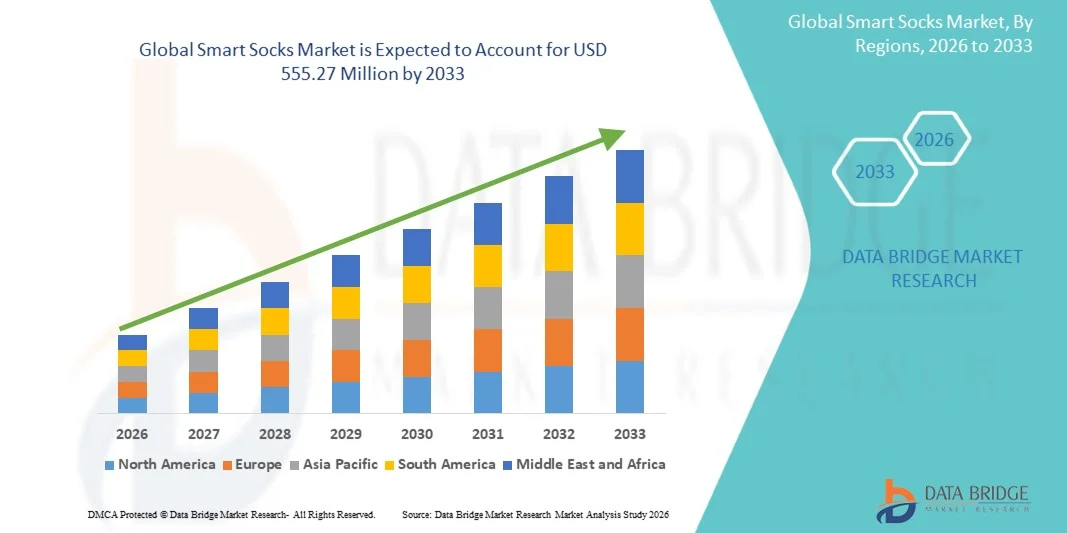
As per Data Bridge Market Research Analysis the Smart Socks Market was valued at USD 300.00 million in 2025 and is projected to reach USD 555.27 million by 2033, growing at a CAGR of 8.00% from 2026 to 2033. The market is experiencing steady growth driven by rising demand for wearable health monitoring devices, increasing prevalence of diabetes and diabetic foot complications, and rapid advancements in sensor-based textile technologies and IoT-enabled wearables.
The growing focus on preventive healthcare, combined with increasing adoption of remote patient monitoring solutions and sports performance analytics, is accelerating the use of smart socks across healthcare, fitness, and rehabilitation sectors. Integration of pressure sensors, temperature monitoring, and real-time gait analysis is enabling early detection of foot-related disorders and improving athletic performance, while expanding applications in elderly care and post-surgery recovery are further supporting market expansion.
Key Market Trends & Insights
- North America dominated the Smart Socks Market in 2025 with a 38.6% revenue share, supported by strong adoption of wearable healthcare devices, advanced digital health infrastructure, and high prevalence of diabetes and sports-related injuries driving demand for continuous foot monitoring solutions.
- The Step Counting Socks segment led the market with a 42.6% share in 2025, driven by widespread adoption in fitness tracking, basic activity monitoring, and healthcare applications for elderly and diabetic patients.
- Asia-Pacific is expected to be the fastest-growing region from 2026 to 2033, with a CAGR of 9.1%, fueled by expanding healthcare digitization, increasing diabetic population, growing fitness awareness, and rapid adoption of IoT-enabled wearable technologies in China, India, and Japan.
- Speed Tracking Socks are the fastest-growing product type, projected to register a CAGR of 9.4%, reflecting the surge in demand for professional sports training and performance optimization.
- The Men segment dominated the category with a 46.3% revenue share in 2025, led by higher participation in sports, fitness activities, and greater adoption of wearable health monitoring devices.
- Medical Monitoring accounted for 39.8% of the market, preferred by the increasing adoption in diabetic foot care, neuropathy management, and chronic disease monitoring.
- The Fall Detection & Elderly Car segment is the fastest-growing application category, with a CAGR of 10.6%, driven by rising aging population and increasing demand for independent living solutions.
Market Size & Forecast
- Global Market Value (2025): USD 300.00 Million
- Expected Market Value (2033): USD 555.27 Million
- Forecast CAGR (2026–2033): 8.00%
- Leading Region in 2025: North America
- Fastest Growing Region: Asia Pacific
Report Scope and Smart Socks Market Segmentation
|
Attributes |
Smart Socks Key Market Insights |
|
Segments Covered |
|
|
Countries Covered |
North America · U.S. · Canada · Mexico Europe · Germany · France · U.K. · Netherlands · Switzerland · Belgium · Russia · Italy · Spain · Turkey · Rest of Europe Asia-Pacific · China · Japan · India · South Korea · Singapore · Malaysia · Australia · Thailand · Indonesia · Philippines · Rest of Asia-Pacific Middle East and Africa · Saudi Arabia · U.A.E. · South Africa · Egypt · Israel · Rest of Middle East and Africa South America · Brazil · Argentina · Rest of South America |
|
Key Market Players |
· Owlet, Inc. (U.S.) · Siren Care, Inc. (U.S.) · Sensoria Inc. (U.S.) · FeetMe SAS (France) · Orpyx Medical Technologies Inc. (Canada) · Palarum, Inc. (U.S.) · Digitsole (France) · Lumos Health, Inc. (U.S.) · Ambiotex GmbH (Germany) · Myant Corp. (Canada) · Innorog Medical (China) · Heapsylon, Inc. (U.S.) · Textronics Design Systems, LLC (U.S.) · Wearable X, Inc. (U.S.) · Hexoskin (Carré Technologies Inc.) (Canada) · Xsensio SA (Switzerland) · Lumos Labs Wearables Division (U.S.) · E-Tactica Ltd. (U.K.) · SmartSox Technologies (U.S.) · BodiTrak Sports (Canada) |
|
Market Opportunities |
· Rising integration of smart socks with remote patient monitoring platforms · Growing adoption of sports performance analytics in professional athletics and wearable biomechanics tracking · Expanding use of AI-powered predictive foot health diagnostics in homecare setting |
|
Value Added Data Infosets |
In addition to the insights on market scenarios such as market value, growth rate, segmentation, geographical coverage, and major players, the market reports curated by the Data Bridge Market Research also include in-depth expert analysis, patient epidemiology, pipeline analysis, pricing analysis, and regulatory framework. |
What is the Key Trend in the Smart Socks Market?
Trend: Growth in Sports Performance & Digital Health Wearables
Smart socks are increasingly being adopted in sports performance tracking and digital health monitoring, enabling real-time analysis of gait, pressure distribution, and foot biomechanics for athletes and patients. The integration of embedded pressure and temperature sensors with mobile applications allows continuous tracking of movement efficiency and injury risk. Fitness brands and healthcare providers are leveraging these solutions to support preventive care and personalized training programs, while AI-driven analytics enhances data interpretation and long-term health insights. For instance, companies such as Siren and Sensoria are deploying sensor-based smart socks for diabetic foot monitoring and athletic performance tracking in connected health ecosystems.
Smart Socks Market Dynamics
Key Market Driver: Rising Prevalence of Chronic Diseases & Remote Monitoring Demand
The increasing incidence of diabetes, neuropathy, and age-related mobility disorders is significantly driving demand for smart socks as a preventive healthcare solution. These devices enable continuous monitoring of foot temperature, pressure points, and circulation, helping reduce the risk of ulcers and complications. Healthcare systems and homecare providers are increasingly adopting wearable monitoring technologies to reduce hospital visits and improve patient outcomes. For instance, diabetic care programs in North America and Europe are integrating smart textile-based wearables for early detection of foot-related complications.
Key Restraint/Challenge: Limited Affordability and Product Adoption Barriers
A major challenge in the smart socks market is the relatively high cost of advanced sensor-integrated products, which limits adoption among price-sensitive consumers and emerging economies. In addition, concerns related to durability, washability, battery life, and long-term sensor accuracy restrict widespread commercial acceptance. Limited consumer awareness outside healthcare and professional sports segments further slows market penetration. For instance, small-scale wearable startups in Asia-Pacific often face difficulty scaling due to high component costs and limited reimbursement support for smart textile devices.
Key Market Opportunity: Expansion of AI-Driven Predictive Health Analytics Platforms
The integration of artificial intelligence and cloud-based analytics presents a major growth opportunity by transforming smart socks into predictive health monitoring systems. AI algorithms can detect early signs of gait abnormalities, pressure imbalance, and potential injury risks, enabling proactive intervention. The expansion of connected healthcare ecosystems and telemedicine platforms is further enhancing the scalability of these solutions across global markets. For instance, AI-enabled wearable health platforms are being integrated into remote patient monitoring programs to support elderly care and post-surgical rehabilitation in real-time digital health ecosystems.
How is the Smart Socks Market Segmented ?
The smart socks market is segmented on the basis of product type, category, application, and distribution channel.
- By Product Type
On the basis of product type, the Smart Socks Market is segmented into step counting socks, speed tracking socks, and distance tracking socks. The Step Counting Socks segment dominated the market with a 42.6% share in 2025, owing to widespread adoption in fitness tracking, basic activity monitoring, and healthcare applications for elderly and diabetic patients. These socks are widely preferred due to their simple functionality, low power consumption, and compatibility with mobile health applications. They are extensively used in preventive healthcare programs and rehabilitation centers for monitoring daily mobility levels. Increasing consumer awareness about physical activity tracking is further supporting segment growth. Integration with smartphone apps and wearable ecosystems is enhancing usability and adoption. Their affordability makes them the most accessible smart sock category globally.
The Speed Tracking Socks segment is expected to witness the fastest growth at a CAGR of 9.4% from 2026 to 2033, driven by rising demand in professional sports training and performance optimization. These socks provide real-time insights into movement efficiency, stride dynamics, and running speed, making them highly valuable for athletes and coaches. Advancements in sensor accuracy and AI-based analytics are improving performance evaluation capabilities. Growing adoption in competitive sports and fitness clubs is further accelerating demand. Increasing use in injury prevention and biomechanics analysis is also contributing to growth. Expanding integration with wearable sports ecosystems is strengthening this segment’s expansion globally.
- By Category
On the basis of category, the Smart Socks Market is segmented into men, women, and kids. The Men segment dominated the market with a 46.3% share in 2025, driven by higher participation in sports, fitness activities, and greater adoption of wearable health monitoring devices. Men are more likely to use performance tracking wearables in athletics and professional training environments. Increasing prevalence of lifestyle-related diseases such as diabetes among male populations is also boosting adoption. Smart socks are widely used for gait correction and foot pressure monitoring in this segment. Strong penetration in sports and fitness applications further supports dominance. Continuous product innovation tailored for male consumers is enhancing market penetration.
The Kids segment is expected to witness the fastest growth at a CAGR of 10.1% from 2026 to 2033, driven by rising parental focus on health tracking and physical activity monitoring. Smart socks are increasingly being used to monitor children’s mobility, posture, and early developmental issues. Growing awareness of preventive healthcare and obesity management in children is further supporting adoption. Schools and pediatric care programs are gradually integrating wearable monitoring solutions. Technological advancements in lightweight and comfortable sensor design are improving usability for children. Expanding use in early diagnosis of movement disorders is also accelerating growth.
- By Application
On the basis of application, the Smart Socks Market is segmented into medical monitoring, sports performance tracking, gait analysis & biomechanics, fall detection & elderly care, and post-surgery rehabilitation. The Medical Monitoring segment dominated the market with a 39.8% share in 2025, due to increasing adoption in diabetic foot care, neuropathy management, and chronic disease monitoring. Smart socks enable continuous tracking of foot temperature, pressure, and circulation to prevent complications. Hospitals and homecare providers are increasingly integrating these devices into remote patient monitoring systems. Rising elderly population and chronic disease burden are further supporting demand. Integration with digital health platforms enhances real-time clinical decision-making. Strong reimbursement support in developed regions is reinforcing segment dominance.
The Fall Detection & Elderly Care segment is expected to witness the fastest growth at a CAGR of 10.6% from 2026 to 2033, driven by rising aging population and increasing demand for independent living solutions. Smart socks provide real-time alerts for imbalance, fall risk, and abnormal movement patterns. These devices are increasingly used in assisted living facilities and homecare environments. Advancements in AI-based motion analysis are improving predictive accuracy. Growing focus on reducing elderly hospitalization costs is further boosting adoption. Integration with emergency response systems is strengthening the segment’s expansion.
- By Distribution Channel
On the basis of distribution channel, the Smart Socks Market is segmented into online stores and offline stores. The Online Stores segment dominated the market with a 57.4% share in 2025, driven by increasing e-commerce penetration and direct-to-consumer wearable sales models. Consumers prefer online platforms due to wider product availability, competitive pricing, and access to global brands. Digital marketing and subscription-based wearable services are further boosting online adoption. Integration with mobile apps and health platforms encourages online purchases. Convenience and doorstep delivery are key growth drivers. Strong presence of startups in online retail is further reinforcing dominance.
The Offline Stores segment is expected to witness the fastest growth at a CAGR of 8.8% from 2026 to 2033, driven by increasing demand for product trials, personalized fitting, and clinical recommendations. Hospitals, specialty medical stores, and sports retail outlets are playing a key role in adoption. Consumers often prefer offline channels for first-time wearable purchases requiring technical guidance. Expansion of retail healthcare infrastructure in emerging markets is supporting growth. Partnerships between medical institutions and wearable manufacturers are strengthening offline sales. Growing trust in in-person consultations is further accelerating segment expansion.
Which Region Holds the Largest Share of the Smart Socks Market ?
North America dominated the Smart Socks Market in 2025 with a 38.6% revenue share, supported by strong adoption of wearable healthcare devices, advanced digital health infrastructure, and high prevalence of diabetes and sports-related injuries driving demand for continuous foot monitoring solutions. The region also benefits from early integration of remote patient monitoring systems, strong presence of leading wearable technology companies, and high consumer awareness regarding preventive healthcare. Increasing use of smart socks in sports performance tracking, elderly care, and rehabilitation programs continues to strengthen North America’s leadership position in the global market.
U.S. Smart Socks Market Insight
The U.S. smart socks market is witnessing strong growth due to rising adoption of wearable healthcare devices, increasing prevalence of diabetes, and growing focus on remote patient monitoring solutions. The country’s advanced digital health ecosystem, strong presence of wearable technology companies, and high consumer awareness regarding preventive healthcare are driving demand across medical, sports, and elderly care applications. In addition, increasing use of AI-enabled gait analysis and Bluetooth-connected health wearables is accelerating adoption across hospitals, rehabilitation centers, and fitness platforms.
Europe Smart Socks Market Insight
The Europe smart socks market remains a major contributor to global revenue, driven by strong healthcare infrastructure, supportive regulatory frameworks, and rising demand for elderly care monitoring solutions. The widespread use of digital health technologies in chronic disease management and rehabilitation programs is supporting market expansion across the region. Increasing investments in wearable medical devices, coupled with strong adoption of preventive healthcare practices and sports science applications, continue to enhance smart socks penetration throughout Europe.
U.K. Smart Socks Market Insight
The U.K. smart socks market is experiencing steady growth, supported by rising adoption of wearable health monitoring solutions in elderly care, sports performance tracking, and clinical rehabilitation. Increasing investments in digital health infrastructure and growing demand for remote patient monitoring systems are contributing to market expansion. Furthermore, integration of AI-driven analytics, IoT connectivity, and sensor-based textile innovations is improving product efficiency and strengthening the U.K.’s position as a key innovation hub in wearable healthcare technologies.
Germany Smart Socks Market Insight
The Germany smart socks market is expanding steadily due to strong healthcare systems, increasing focus on preventive care, and rising adoption of advanced medical wearable technologies. Hospitals, rehabilitation centers, and sports institutions are increasingly utilizing smart socks for gait analysis, diabetic foot monitoring, and mobility assessment. Continuous advancements in sensor technology, coupled with strong research and development capabilities in wearable textiles and digital health, are further driving market growth in Germany.
Asia-Pacific Smart Socks Market Insight
The Asia-Pacific smart socks market is expected to witness rapid growth, driven by increasing healthcare digitization, rising diabetic population, and growing awareness of wearable health monitoring solutions across countries such as China, India, and Japan. Expanding fitness culture, rising elderly population, and increasing adoption of IoT-enabled healthcare devices are supporting regional market expansion. In addition, growing investments in smart textile innovation and digital healthcare infrastructure are accelerating smart socks adoption across commercial and clinical sectors.
Japan Smart Socks Market Insight
The Japan smart socks market is witnessing consistent growth due to rising demand for elderly care monitoring, advanced healthcare technologies, and sports performance optimization solutions. Healthcare providers and research institutions are increasingly adopting sensor-based wearable devices for gait analysis, fall detection, and rehabilitation support. Moreover, integration of AI-powered analytics and Japan’s strong focus on robotics and precision healthcare technologies are further contributing to market growth.
China Smart Socks Market Insight
The China smart socks market is growing rapidly, driven by expanding healthcare infrastructure, rising prevalence of lifestyle diseases, and increasing adoption of smart wearable technologies. Strong government focus on digital health transformation and growing investments in AI-enabled medical devices are significantly boosting market demand. In addition, rising awareness of preventive healthcare, expanding fitness industry, and rapid technological advancements in smart textiles are positioning China as one of the fastest-growing markets for smart socks globally.
Which are the Top Companies in Smart Socks Market ?
The smart socks industry is primarily led by well-established companies, including:
- Owlet, Inc. (U.S.)
- Siren Care, Inc. (U.S.)
- Sensoria Inc. (U.S.)
- FeetMe SAS (France)
- Orpyx Medical Technologies Inc. (Canada)
- Palarum, Inc. (U.S.)
- Digitsole (France)
- Lumos Health, Inc. (U.S.)
- Ambiotex GmbH (Germany)
- Myant Corp. (Canada)
- Innorog Medical (China)
- Heapsylon, Inc. (U.S.)
- Textronics Design Systems, LLC (U.S.)
- Wearable X, Inc. (U.S.)
- Hexoskin (Carré Technologies Inc.) (Canada)
- Xsensio SA (Switzerland)
- Lumos Labs Wearables Division (U.S.)
- E-Tactica Ltd. (U.K.)
- SmartSox Technologies (U.S.)
- BodiTrak Sports (Canada)
What are Latest Developments in Smart Socks Market ?
- In October 2025, Owlet reported strong financial growth driven by increased adoption of its Dream Sock product line, with revenues rising significantly due to higher demand for infant health monitoring devices. The company highlighted expansion across digital health ecosystems and subscription-based monitoring services as key growth drivers. This development reflects rising mainstream adoption of smart socks within connected healthcare and remote monitoring platforms
- In November 2024, Owlet expanded its Dream Sock launch across the U.K. and Europe with medically certified approval, strengthening its global footprint in regulated markets. The device offers real-time health readings and notifications for infants, supporting growing demand for digital pediatric monitoring solutions. This expansion demonstrated increasing international acceptance of smart sock-based medical wearables
- In November 2023, Owlet achieved a major milestone when the FDA granted De Novo clearance for its Dream Sock with Health Notifications, making it the first over-the-counter medically cleared smart infant monitoring sock in the U.S. This approval validated the clinical accuracy of smart sock technology for tracking pulse rate and oxygen levels in real time. It also enabled broader commercialization across pediatric care and home monitoring segments
- In June 2023, Owlet received FDA 510(k) clearance for its BabySat prescription-based smart sock system, enabling clinical use of its pulse oximetry monitoring technology for infants under physician supervision. This approval marked a key transition of smart socks from consumer wellness devices to regulated medical wearables. The device provides continuous monitoring of oxygen saturation and heart rate, strengthening adoption in hospitals and home healthcare settings
- In December 2021, Owlet faced a major regulatory setback when the U.S. FDA issued a warning letter requiring the company to stop marketing its Smart Sock product as a medical device without proper clearance. This enforcement action led to the temporary withdrawal of the product from sale in the U.S., significantly impacting the smart sock wearable market and forcing a shift toward regulatory-compliant product redesigns

- Interactive Data Analysis Dashboard
- Company Analysis Dashboard for high growth potential opportunities
- Research Analyst Access for customization & queries
- Competitor Analysis with Interactive dashboard
- Latest News, Updates & Trend analysis
- Harness the Power of Benchmark Analysis for Comprehensive Competitor Tracking
Data collection and base year analysis are done using data collection modules with large sample sizes. The stage includes obtaining market information or related data through various sources and strategies. It includes examining and planning all the data acquired from the past in advance. It likewise envelops the examination of information inconsistencies seen across different information sources. The market data is analysed and estimated using market statistical and coherent models. Also, market share analysis and key trend analysis are the major success factors in the market report. To know more, please request an analyst call or drop down your inquiry.
The key research methodology used by DBMR research team is data triangulation which involves data mining, analysis of the impact of data variables on the market and primary (industry expert) validation. Data models include Vendor Positioning Grid, Market Time Line Analysis, Market Overview and Guide, Company Positioning Grid, Patent Analysis, Pricing Analysis, Company Market Share Analysis, Standards of Measurement, Global versus Regional and Vendor Share Analysis. To know more about the research methodology, drop in an inquiry to speak to our industry experts.
Data Bridge Market Research is a leader in advanced formative research. We take pride in servicing our existing and new customers with data and analysis that match and suits their goal. The report can be customized to include price trend analysis of target brands understanding the market for additional countries (ask for the list of countries), clinical trial results data, literature review, refurbished market and product base analysis. Market analysis of target competitors can be analyzed from technology-based analysis to market portfolio strategies. We can add as many competitors that you require data about in the format and data style you are looking for. Our team of analysts can also provide you data in crude raw excel files pivot tables (Fact book) or can assist you in creating presentations from the data sets available in the report.













